Civilization · Myth · Shared Meaning
Why Do Civilizations Create Myths?
Myths are not primitive mistakes left behind by rational societies. They are systems of shared meaning that turn memory into identity, identity into cooperation, and cooperation into civilization.
Every civilization tells stories that are not ordinary reports of events. They speak of beginnings, heroes, betrayals, sacrifices, lost ages, sacred duties, promised futures, and forces larger than any individual life. The characters change. The symbols change. The historical details change. Yet the function remains remarkably persistent.
People use myths to answer questions that facts alone cannot settle: Who are we? Where did we come from? What deserves loyalty? What makes a life honorable? Why must suffering be endured? What should be preserved when everything else is lost?
This is why civilizations create myths. A civilization is not only a population living under the same administration. It is a large group of people who recognize enough of the same world to cooperate across distance, difference, and time. Myths help create that recognizable world.
In brief
Civilizations create myths because large societies need shared meaning. Myths compress experience into memorable stories, connect individuals to a collective identity, communicate moral expectations, legitimate institutions, preserve cultural memory, and give generations a common future. They do not replace material systems such as law, agriculture, trade, or defense. They make those systems intelligible, emotionally binding, and worth sustaining.
Key Takeaways
- Myths are not merely false claims; they are culturally important narratives that organize shared meaning.
- Civilizations use myths to connect identity, morality, memory, institutions, and a vision of the future.
- Myths can preserve wisdom and cooperation, but they can also legitimize exclusion, hierarchy, and violence.
- Modern societies remain myth-making societies, even when their dominant stories are secular, technological, or political.
- A healthy civilization does not eliminate myth. It makes its myths more truthful, inclusive, self-correcting, and worthy of inheritance.
How This Article Approaches Myth
This article treats myth as a multidisciplinary problem. Anthropology examines how myths operate inside living cultures. Religious studies explores their relationship to ritual and the sacred. Philosophy asks what kinds of truth myths can express. Psychology studies recurring symbolic patterns and narrative cognition. History distinguishes inherited memory from evidence-based reconstruction. Sociology and political theory examine how collective stories create legitimacy, solidarity, and power. Cultural evolution studies how narratives are transmitted, selected, transformed, and retained.
No single discipline fully explains why civilizations create myths. A purely psychological account can overlook institutions. A purely political account can overlook grief, awe, mortality, and the search for meaning. A purely literary account can miss ritual and authority. A purely historical account can describe how a narrative changed without explaining why people needed it.
The explanatory models in this article therefore synthesize several levels:
- individual cognition — how people transform experience into narrative;
- collective meaning — how stories become shared identities and values;
- institutional embodiment — how myths enter ritual, law, education, and authority;
- civilizational continuity — how narratives coordinate cooperation across generations;
- critical evaluation — how societies distinguish life-giving myths from destructive ones.
This approach also follows a principle developed across Eternity Management: civilization should be evaluated not only by whether it survives, but by whether it creates the conditions for human flourishing. A myth that preserves continuity by destroying dignity is not vindicated by its effectiveness.
What Is a Myth?
In everyday speech, the word myth often means a false belief: something that should be corrected or debunked. In the study of religion, folklore, literature, philosophy, and anthropology, the word has a different use. A myth is a culturally important narrative that helps a group interpret origins, values, powers, boundaries, obligations, and possibilities.
A myth does not become a myth simply because it is ancient, supernatural, or factually doubtful. Its defining feature is social importance. It carries meaning that a community considers foundational. That meaning may be expressed through gods and ancestors, but it may also appear through national founders, heroic revolutions, civilizing missions, golden ages, promised progress, sacred constitutions, or stories about what a people has survived.
A practical definition
A myth is a story through which a community converts experience into shared meaning and shared meaning into a model of reality.
This definition avoids two mistakes. The first is treating every inaccurate claim as a myth. Many errors are merely errors. The second is treating myths as inferior attempts at science. Myths may contain observations about the world, but their principal task is usually not measurement. Their task is orientation.
A scientific explanation may tell us how an eclipse occurs. A mythic narrative may tell a community what darkness, interruption, cosmic order, or restoration means. The two forms can conflict when myth makes testable claims about nature. But they do not always answer the same kind of question.
Facts describe what happened. Myths tell people where they stand inside what happened.
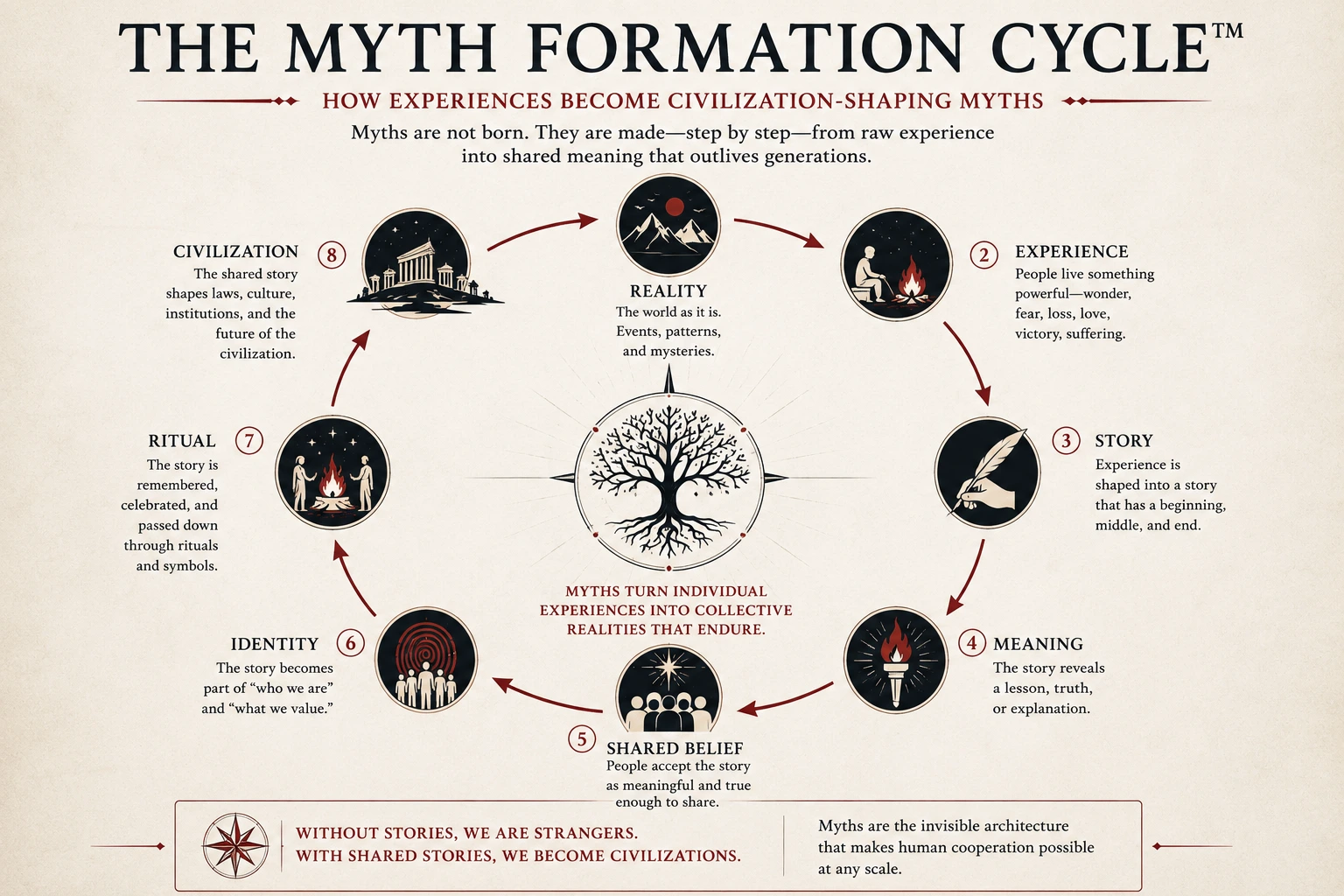
Myth as cognitive compression
No person can remember the entire history of a society. No child can inherit every argument, disaster, law, discovery, betrayal, or sacrifice that shaped the world into which they were born. Civilizations therefore compress complexity.
A myth is one of the most powerful forms of cultural compression. It reduces a vast field of events into a pattern that can be remembered and retold. A flood becomes a story about destruction and renewal. A migration becomes a story about exile and belonging. A war becomes a story about courage, treachery, liberation, or tragic pride. A founder becomes the image of an entire political order.
Compression always removes detail. That makes myth dangerous when it replaces careful history. But without compression, cultural memory would be too large and disorganized to transmit. The challenge is not to choose between perfect memory and myth. No civilization possesses perfect memory. The challenge is to build myths that preserve essential truth without turning complexity into propaganda.
Myth, Legend, Folklore, and Ideology: What Is the Difference?
These terms overlap, and scholars do not use them in perfectly uniform ways. Still, distinguishing them helps clarify the role of myths in civilization.
| Form | Typical focus | Relationship to truth | Civilizational function |
|---|---|---|---|
| Myth | Origins, sacred order, identity, destiny, cosmic or moral structure | May combine symbolic, sacred, remembered, and historical claims | Creates a shared model of reality |
| Legend | Memorable people, places, battles, founders, or extraordinary events | Often linked to a historical core transformed by retelling | Personifies virtues, failures, and collective memory |
| Folklore | Customs, tales, sayings, songs, jokes, beliefs, and everyday traditions | Preserved through cultural transmission rather than formal verification | Carries local knowledge and social norms |
| Ideology | Political, economic, or social explanations and programs | Makes claims about how society works and how it should be ordered | Organizes collective action and legitimacy |
A single narrative can belong to more than one category. A historical founder can become legendary. The legend can acquire mythic status when it explains the identity and destiny of a people. Political ideology can absorb that myth and use it to justify institutions or mobilize sacrifice.
Are myths the same as fairy tales?
Not usually. Fairy tales often occur in an indefinite time and place and focus on transformation, danger, family, fortune, cleverness, or moral testing. They may preserve archetypal material, but they do not necessarily explain a civilization’s sacred origins or legitimate its institutions.
Are myths the same as propaganda?
No. Propaganda is strategic communication designed to shape perception or behavior, often in the interests of a state, movement, or institution. Propaganda frequently uses existing myths because they already carry emotional authority. A myth can emerge without a central propagandist, while propaganda is normally produced for a deliberate persuasive purpose.
The distinction matters because calling every shared story “propaganda” reduces culture to manipulation. Yet calling every inherited narrative “sacred” protects it from scrutiny. Civilizational maturity requires both interpretive respect and critical distance.
How Major Thinkers Have Explained Myth
Theories of myth differ because they emphasize different parts of the same phenomenon. Rather than forcing them into one answer, it is more useful to see what each illuminates—and what each leaves incomplete.
Émile Durkheim: myth and social solidarity
Durkheim’s sociology of religion emphasized that sacred symbols are also social symbols. When a community gathers around ritual and shared representations, it experiences its own collective power. From this perspective, myths do not merely describe society; they help society become conscious of itself.
Bronisław Malinowski: myth as a charter for institutions
Malinowski argued that myths function within social life. They can authorize customs, explain privileges, confirm obligations, and provide precedents for institutions. This helps explain why myths often become most visible when an order must justify itself.
Claude Lévi-Strauss: myth as a structure of thought
Lévi-Strauss examined how myths organize oppositions—life and death, nature and culture, raw and cooked, kin and stranger—and transform them through narrative. His work suggests that myth is not random fantasy but a way of thinking through contradictions that cannot be solved directly.
Carl Jung: myth and recurring psychic patterns
Jung interpreted myths through archetypal patterns of the psyche. His approach influenced the modern language of the hero, shadow, mother, trickster, and wise elder. It is valuable for identifying recurring symbolic forms, though it can become reductive when it treats local cultures as illustrations of a universal psychological system.
Joseph Campbell: comparative patterns and the hero’s journey
Campbell popularized comparative mythology and the idea of a recurring heroic journey. His work remains influential in literature and film. Its strength is explanatory accessibility; its limitation is that it can flatten differences among traditions and overemphasize one narrative pattern.
Mircea Eliade: sacred time and return to origins
Eliade emphasized that myth can return participants to sacred beginnings. Through ritual repetition, communities do not merely remember an origin; they symbolically re-enter it. This helps explain why festivals, rites, and sacred calendars renew identity rather than simply commemorate the past.
Ernst Cassirer: humanity as a symbolic species
Cassirer treated myth, language, art, and science as symbolic forms through which humans construct intelligible worlds. Myth, in this view, is one mode of world-making—not simply an error waiting to be replaced, but a fundamental expression of symbolic life.
The integrative conclusion
Myth is simultaneously psychological, social, institutional, symbolic, historical, and political. It survives because it can connect all these levels at once. A powerful myth is remembered by individuals, enacted by communities, embodied in institutions, and transmitted as a model of reality.
Why Do Humans Create Myths?
Human beings do not encounter reality as a neutral stream of data. We notice patterns, assign causes, remember emotionally charged events, and connect separate experiences into narratives. This is not an optional cultural habit. It is part of how human cognition makes a changing world understandable.
Yet individual storytelling alone does not create civilizational myth. A private interpretation becomes mythic only when it is repeated, recognized, contested, ritualized, and inherited. Myth therefore arises at the meeting point of cognition and culture.
Pattern
Humans search for connections between events. A story turns coincidence and sequence into an intelligible structure.
Agency
People naturally ask who acted, intended, protected, betrayed, punished, or restored. Myths personify forces that would otherwise feel impersonal.
Memory
Narrative makes information easier to retain and transmit than disconnected instructions or lists of facts.
Emotion
Fear, grief, awe, gratitude, and hope make events memorable. Myth gives those emotions a social form.
Identity
Stories locate the individual inside a larger “we,” connecting personal life to ancestors, community, and descendants.
Orientation
Myths distinguish the admirable from the shameful, the sacred from the ordinary, and the possible from the forbidden.
These tendencies explain why myths are widespread, but not why particular myths survive. Survival requires selection. Communities remember stories that can be retold, emotionally felt, socially used, and adapted to new conditions. A story that cannot be connected to ritual, identity, conflict, education, or authority may disappear even if it is beautiful. A story that organizes many parts of collective life can endure for centuries.
This is also why myths change. Every retelling occurs in a new present. People preserve what still carries meaning, reinterpret what has become difficult, and sometimes erase what threatens the current order. Myth is therefore both inheritance and reconstruction.
Why Every Civilization Creates Myths: Five Essential Functions
Civilizations differ enormously, and no single framework can capture every tradition. Still, most durable mythic systems perform several recurring civilizational functions.
Myths create shared identity
A civilization contains people who will never meet. They may speak different dialects, belong to different regions, practice different trades, and disagree about almost everything. Shared stories allow them to imagine themselves as members of a larger continuity.
This identity may be built around ancestry, covenant, territory, language, law, struggle, migration, faith, revolution, or a vision of the future. The details matter, but the structural function is similar: myth turns a population into a people.
Myths create moral order
Laws can state what is permitted. Myths explain why certain actions are honorable, shameful, sacred, corrupting, loyal, or treacherous. They supply memorable models of conduct.
A moral code expressed only as abstraction may remain distant. A hero who keeps faith under pressure, a ruler destroyed by arrogance, or a community punished for betrayal gives the code a human shape. The narrative allows people to rehearse moral conflict before encountering it themselves.
Myths preserve cultural memory
Myths carry traces of migrations, ecological disasters, wars, dynastic transitions, encounters with strangers, and changes in social order. They should not be read as transparent historical records, because memory transforms events. But neither should they be dismissed as empty fantasy.
Myth preserves what a community decided an event meant. That is not the same as preserving exactly what happened, yet it is a crucial part of understanding how the past continued to act on the present.
Myths legitimize institutions
Institutions require more than rules. They require recognized authority. Myths can explain why a crown, council, priesthood, constitution, territory, lineage, or legal order deserves obedience.
This power is morally ambiguous. A founding story can inspire responsibility and self-restraint. It can also conceal domination. Myth does not guarantee justice; it gives institutions meaning. Whether that meaning protects human dignity or excuses abuse depends on the values and power relations embedded in the story.
Myths create a shared future
No civilization survives through memory alone. People must believe that their actions participate in a future worth building. Myths connect sacrifice in the present to a horizon beyond the individual lifespan.
The future may be imagined as restoration, salvation, progress, return, liberation, flourishing, or the completion of an unfinished promise. In each case, myth turns endurance into direction.
How Different Civilizations Used Myth
Comparative examples show that myths do not perform one universal task in one universal way. The same structural need—identity, legitimacy, memory, moral order, continuity—can be answered through very different narratives.
Mesopotamia: order against chaos
Mesopotamian myths often situated human life within a precarious cosmic and political order. Cities depended on irrigation, administration, temples, and rulers in an environment where drought, flood, war, and crop failure were constant threats. Stories of divine conflict, kingship, creation, and catastrophe gave symbolic form to the fragility of order.
The Epic of Gilgamesh also confronted a problem no civilization can solve technologically: mortality. Its enduring power comes from placing kingship, friendship, grief, fame, and the limits of human life inside one narrative. That question connects to Eternity Management’s explorations of why humans want to live forever and whether humanity needs death.
Ancient Egypt: continuity, kingship, and cosmic balance
Egyptian religious narratives connected political order to a wider principle of balance, justice, and right arrangement. Kingship was not merely administrative. It participated in the maintenance of cosmic order. Funerary traditions connected individual death to a larger drama of judgment, transformation, and continuity.
The resulting mythic system helped bind landscape, kingship, ritual, ancestry, and the afterlife into one civilizational structure. It also shows how myths can make political hierarchy appear cosmically necessary—a source of stability and a protection against criticism.
Ancient Greece: conflict among powers and limits
Greek myths did not present a single morally flawless divine order. Gods, heroes, cities, families, fate, pride, and necessity collided. Tragedy exposed conflicts in which every available choice carried loss. Such myths trained audiences to recognize limits: power could not eliminate consequence, knowledge could intensify suffering, and heroic greatness could coexist with catastrophic blindness.
This is one reason myth remains relevant to philosophical questions about the hidden cost of knowing the future and whether humanity could survive absolute truth.
Rome: ancestry, duty, and imperial destiny
Roman narratives linked civic identity to founders, ancestors, sacrifice, military virtue, law, and destiny. The story of Rome could justify extraordinary discipline and public service. It could also transform expansion into a civilizing mission and conceal the violence of empire.
Rome illustrates the double character of civilizational myth: the same narrative can create responsibility within the group while legitimizing domination beyond it.
Norse traditions: courage within an impermanent world
Norse myths often portray gods and humans acting under conditions of foreknown loss. The future may be constrained, yet courage remains meaningful. This produces a moral imagination in which dignity lies not in guaranteed victory but in how one acts when victory cannot be guaranteed.
Such stories answer a universal civilizational problem: how can people remain responsible when permanence is impossible? The question becomes especially powerful beside the article Can Humanity Survive the End of Time?.
China: dynastic legitimacy and moral order
Chinese political traditions developed narratives in which rulership depended on moral and cosmic legitimacy. The Mandate of Heaven could authorize a dynasty while also explaining its loss of power when disorder, corruption, or disaster revealed failure. The narrative therefore stabilized authority but also contained a principle of conditional legitimacy.
This demonstrates an important feature of resilient myths: they can justify an institution while preserving a language for judging it.
Indigenous traditions: land, ancestry, and reciprocal obligation
Many Indigenous traditions connect identity to particular landscapes, ancestral beings, animals, seasons, and practices of reciprocity. These narratives cannot be reduced to primitive explanations of nature. They encode relationships—between people and place, living and dead, human and nonhuman, gift and obligation.
Modern readers should resist collapsing distinct peoples into a single category. The broader insight is that myth can make a landscape morally legible. A river is not merely a resource; a mountain is not merely an object; ancestry is not merely a genetic fact. The story defines how one must live in relation to them.
Modern constitutional societies: founding promises
Modern democracies also organize themselves through founding narratives. Revolutions, declarations, constitutions, resistance to tyranny, abolition, civil rights, sacrifice, and national renewal become reference points through which later generations judge the present.
The strongest civic myths do not claim that the nation has always fulfilled its ideals. They preserve a promise that can be used against hypocrisy. The weakest civic myths confuse national innocence with national loyalty and treat historical correction as betrayal.
The healthiest civilizational myths do not say, “We have always been good.” They say, “This is the good to which we remain accountable.”
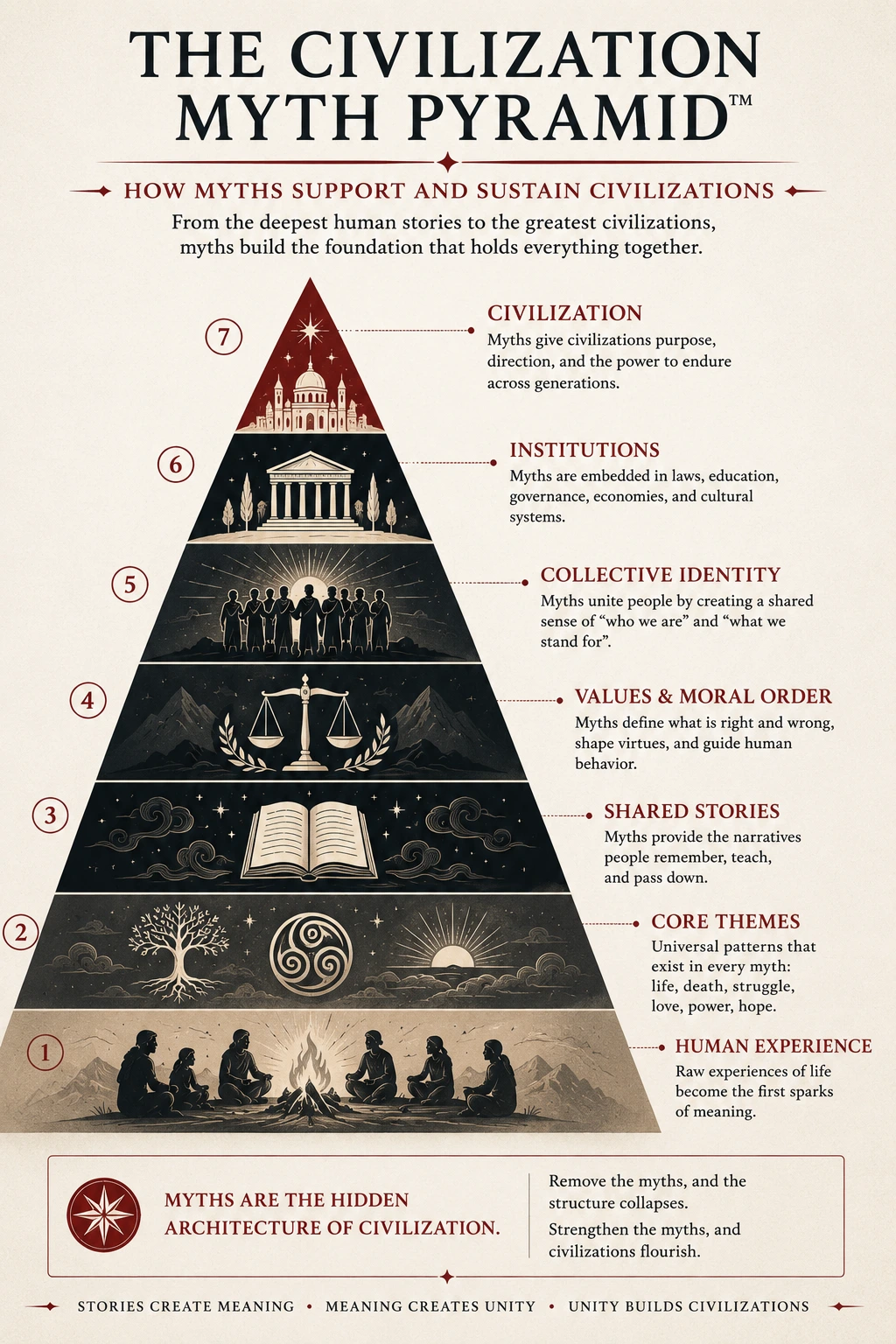
Myths Are the Operating System of Civilization
It is tempting to imagine that civilization comes first and myth comes later, as decoration. A city is built, laws are written, armies are organized, and only then do poets invent stories about what the civilization means.
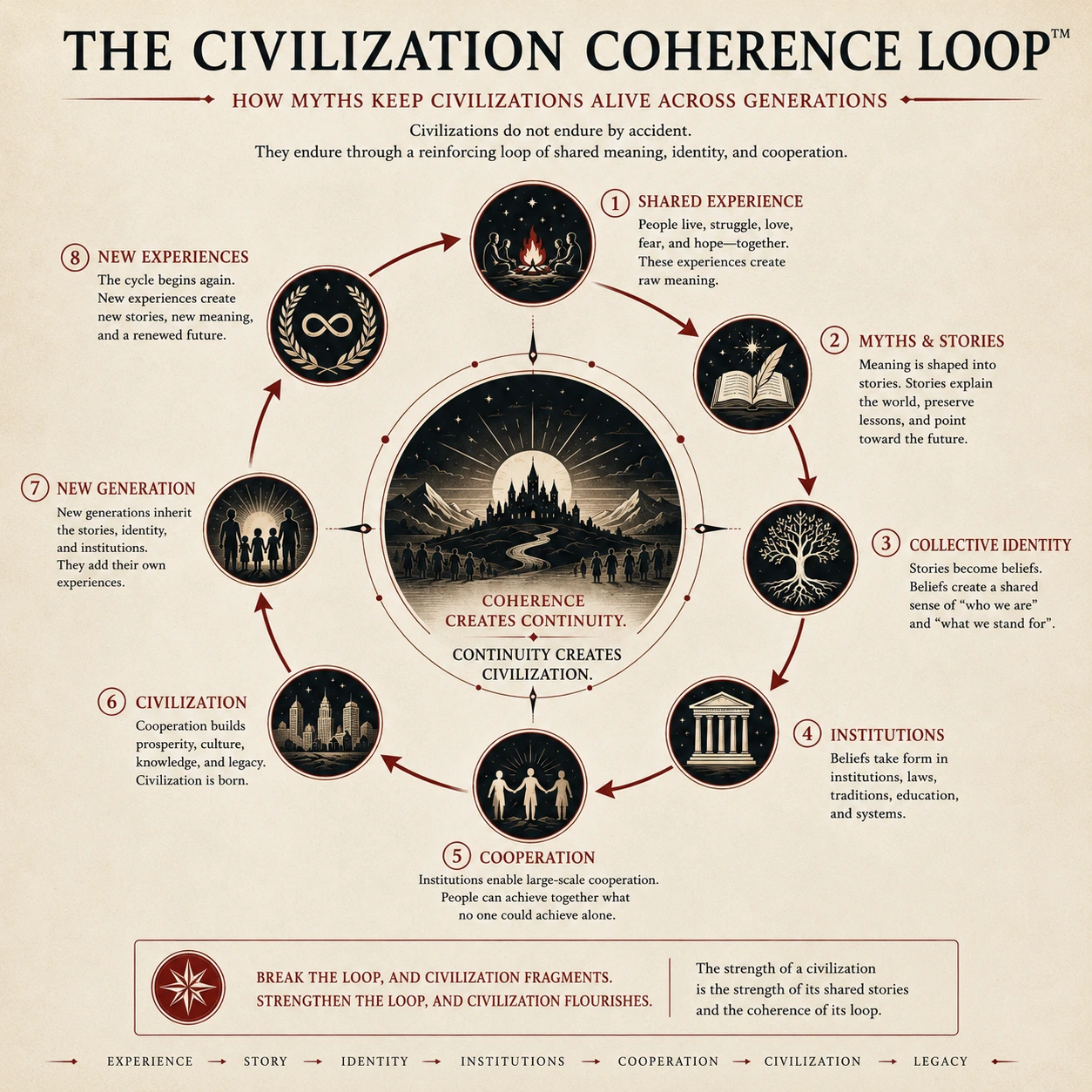
History is rarely so clean. Shared narratives often precede large institutions, guide their formation, and continue to determine how people interpret them. The relationship is recursive:
Experience creates stories. Stories create shared meaning. Shared meaning shapes institutions. Institutions generate new experience. New experience changes the stories.
Calling myth an operating system is a metaphor, but a useful one. An operating system does not perform every task itself. It creates the environment in which many tasks can be coordinated. Likewise, myth does not plant crops, build bridges, calculate taxes, or defend borders. It provides assumptions about why these activities belong to a common world.
Consider law. A legal code consists of rules, procedures, offices, and enforcement. But citizens also need an account of why law is legitimate. Is law inherited from divine order? Is it an agreement among free people? Is it the achievement of ancestors who resisted tyranny? Is it an instrument of national destiny? Each answer frames obedience, dissent, reform, and sacrifice differently.
The same is true of education. A school does not merely transfer skills. It tells students what knowledge is worth preserving, which people belong in the historical narrative, what adulthood requires, and what future the society expects them to build.
Myths therefore operate below explicit policy. They supply the background assumptions through which policy becomes meaningful.
Civilizations are not held together by stone, armies, or technology alone. They endure because people recognize enough of the same story to act together.
This does not mean that consensus must be total. Healthy civilizations contain disagreement. In fact, a mythic tradition may remain alive precisely because people argue over its meaning. The decisive question is whether disagreement occurs within a shared world or whether groups no longer recognize any common memory, obligation, or future.
Myth and History: Facts, Memory, and Meaning
Myth and history overlap, but they are not interchangeable.
History, at its best, investigates evidence, chronology, causation, uncertainty, and competing interpretations. It asks what can responsibly be claimed about the past. Myth asks what the past means for a community now.
A historical account may reveal that a founding event was more complex than the national story suggests. Multiple groups may have contributed. Motives may have been mixed. Later institutions may have projected their values backward. The myth simplifies this complexity into a usable narrative.
That simplification can serve different purposes:
- It can preserve courage that would otherwise be forgotten.
- It can turn suffering into a claim for justice.
- It can connect generations through gratitude.
- It can excuse conquest or erase victims.
- It can make reform appear faithful to a founding promise.
- It can make reform appear like betrayal.
The responsible response is not to abolish every shared narrative. That is impossible. Even the decision to “leave myth behind” can become a myth of pure rational emancipation. The better response is to place myth and history in productive tension.
History disciplines myth
Evidence prevents collective memory from becoming unlimited invention. It restores complexity, excluded voices, and moral accountability.
Myth gives history public meaning
Narrative helps a society understand why the past matters and what obligations follow from remembering it.
A mature civilization does not require its myths to be immune from criticism. It needs myths strong enough to survive truth.
Myth and Religion Are Related, but They Are Not the Same
Many myths are religious. They describe gods, creation, sacred ancestors, cosmic conflict, death, judgment, renewal, or the relationship between visible and invisible reality. They may be performed through ritual and treated as sacred truth.
Yet religion is broader than myth. It can include worship, prayer, ethics, institutions, contemplation, law, communal practice, and personal transformation. Myth is one narrative dimension within that larger field.
Myth is also broader than religion. Secular societies create powerful narratives about nation, progress, revolution, markets, technology, civilization, freedom, equality, and history. These narratives may not invoke supernatural beings, yet they can still organize identity, sacrifice, legitimacy, and hope.
It is therefore more useful to ask what a story does than whether it belongs to a religious or secular category.
Modern myths do not disappear when gods disappear
A modern society may define itself as rational and post-mythic while remaining structured by stories such as:
- history inevitably moves toward progress;
- the nation possesses a unique moral mission;
- technology will solve every fundamental problem;
- markets automatically convert self-interest into public good;
- revolution can create an entirely new human being;
- the individual can become fully independent of community;
- data can eliminate the need for judgment.
Some of these claims may contain truth under specific conditions. They become mythic when they are elevated into total narratives that explain identity, destiny, and moral order while resisting counterevidence.
The lesson is not that every ideal is false. It is that no civilization escapes narrative. The task is to examine which narratives deserve trust.
Why Modern Societies Still Create Myths
Modernity did not end myth. It changed myth’s preferred vocabulary. Gods and sacred ancestors may recede while progress, nation, race, class, markets, technology, data, authenticity, and disruption become narrative forces.
A modern myth often presents itself as a neutral description of reality. That makes it harder to recognize. Several recurring examples illustrate the pattern.
The myth of inevitable progress
This story treats history as a one-way movement from ignorance to knowledge, oppression to freedom, poverty to abundance, or nature to technological mastery. It can motivate reform and confidence. It becomes dangerous when it assumes that every increase in power is an increase in wisdom.
The tension is explored directly in Can Humanity Survive Unlimited Knowledge?. Knowledge enlarges possibility, but it does not automatically determine which possibilities should be chosen.
The myth of national innocence
Every nation needs some account of belonging. But when the national story excludes wrongdoing, minority experience, or the suffering of outsiders, loyalty becomes dependent on denial. A mature civilization can remember achievement without requiring innocence.
The myth of the self-made individual
Stories of personal agency are valuable because they resist fatalism. Yet the self-made myth can erase inheritance, education, infrastructure, law, care, luck, and social cooperation. It turns dependence into shame even though every human life begins in dependence.
The myth of perfect transparency
Modern societies often assume that more visibility necessarily produces more trust and justice. Transparency can expose abuse, but a world without privacy, ambiguity, or protected interiority may become coercive. This problem is developed in Can Humanity Survive Total Transparency?.
The myth that data eliminates judgment
Data can correct intuition and reveal patterns that individuals miss. Yet data requires selection, measurement, interpretation, and value judgments. A metric can show movement without deciding whether the movement is good. Treating data as judgment hides human responsibility behind technical procedure.
The myth of technological salvation
Technology can reduce suffering, extend capacity, and transform civilization. The mythic version promises that technical innovation can resolve moral conflict, mortality, meaning, inequality, and political legitimacy without changing human responsibility.
This is a modern form of the ancient dream that enough power can escape the human condition. Eternity Management explores its limit through questions such as whether humanity can survive unlimited power, perfect memory, or infinite meaning.
The myth of complete demythologization
Perhaps the most persistent modern myth is that rational societies have no myths. This story divides humanity into a primitive past ruled by narrative and a modern present ruled by facts. It ignores the narratives embedded in institutions, markets, political identities, technological visions, and concepts of history.
Reason is essential because it tests claims, identifies contradiction, and disciplines imagination. But reason operates within questions of value and purpose that cannot be answered by measurement alone. A rational civilization therefore needs better myths, not unconscious myths.
Why the Same Archetypes Appear Across Civilizations
Myths from distant societies often contain recognizable patterns: the hero who leaves home, the wise guide, the dangerous stranger, the nurturing mother, the sacrificed figure, the descent into darkness, the sacred tree, the serpent, the flood, the mountain, the return, the restoration of light.
Similarity does not prove that every tradition shares one source. Some motifs travel through migration, trade, conquest, translation, and intermarriage. Others may arise independently because human beings face recurring conditions: birth, dependence, maturation, conflict, hierarchy, sexuality, loss, death, uncertainty, nature, and the need to cooperate.
Archetypes are useful when treated as recurring patterns, not rigid formulas. They become misleading when scholars or creators force every culture into one universal script and ignore local meaning.
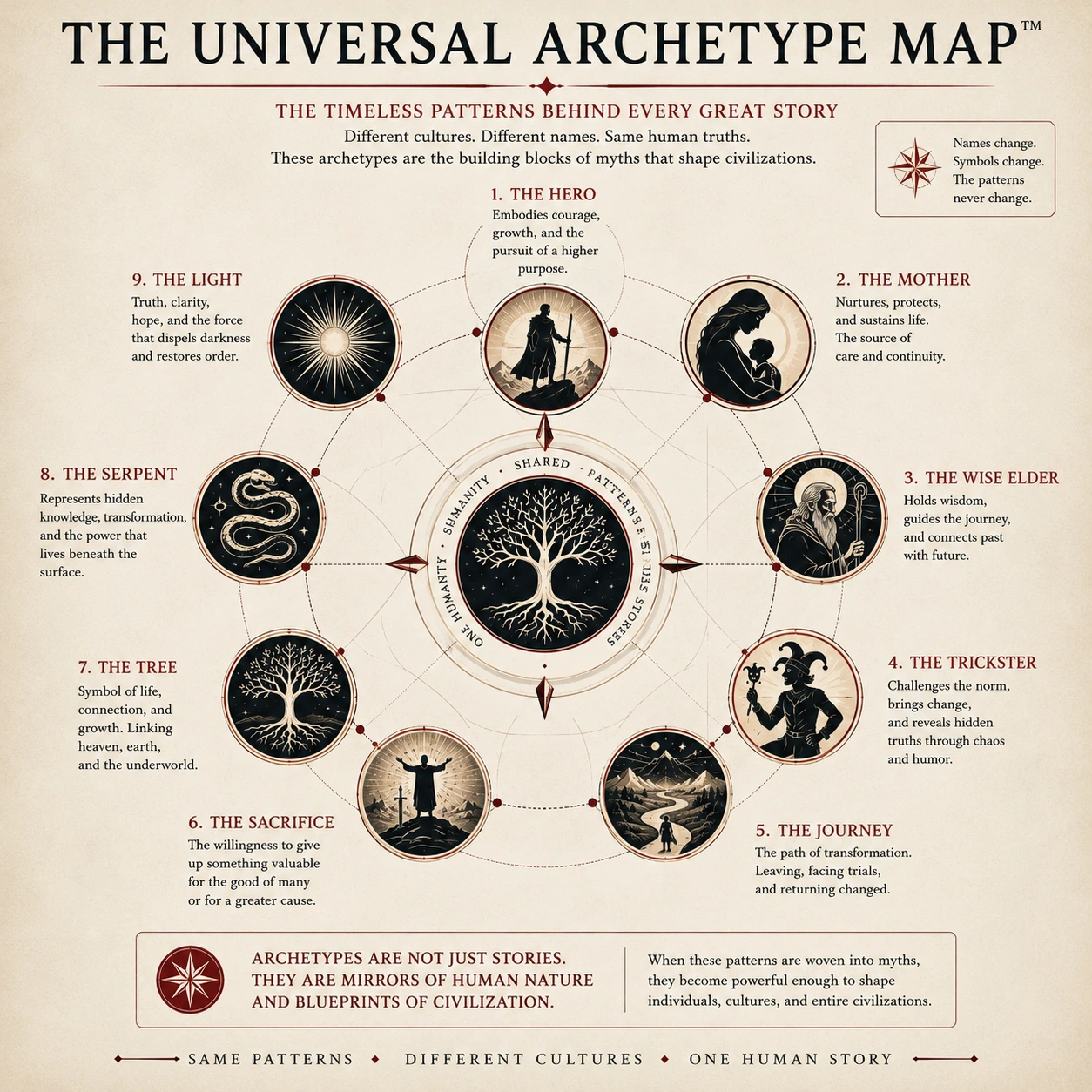
The hero
The hero concentrates a community’s image of worthy action. The hero may conquer, endure, sacrifice, discover, rebel, reconcile, or return with knowledge. Hero stories teach not only how to win but what a civilization considers victory.
The mother
The mother archetype represents origin, care, fertility, protection, continuity, and sometimes engulfing power. It can appear as a person, land, city, language, river, or cosmic source.
The wise elder
The elder connects memory to action. This figure represents inherited knowledge, restraint, initiation, and the ability to see beyond immediate desire. Civilizations use the elder to personify continuity across generations.
The trickster
The trickster crosses boundaries and exposes the limits of order. Through humor, deception, appetite, accident, or violation, the trickster reveals that systems can become brittle. This figure may be destructive, creative, or both.
The journey
The journey transforms space into meaning. Leaving home, crossing a threshold, entering danger, losing certainty, and returning changed create a narrative model for maturation, exile, pilgrimage, discovery, and collective renewal.
Sacrifice
Sacrifice asks what must be surrendered so something larger can survive. It can express generosity and courage, but it can also be used by authorities to romanticize avoidable suffering. A mature reading distinguishes chosen responsibility from imposed victimhood.
The tree, serpent, and light
These symbols recur because they gather many meanings. The tree connects roots, growth, generations, earth, and sky. The serpent can signify danger, renewal, hidden knowledge, life, or chaos. Light can signify truth, order, hope, revelation, and return.
Archetypes are not a secret code behind all stories. They are flexible vessels through which civilizations interpret recurring human realities.
How Myths Create Collective Reality
A shared story is not material in the same way as a wall or a river. Yet shared stories can produce material consequences. They influence where walls are built, who controls rivers, which promises are enforceable, who may rule, what counts as property, and what people are willing to defend.
Many large-scale institutions depend on collectively recognized meanings:
- Money works because people trust systems of value, accounting, authority, and future exchange.
- Law works because rules are connected to legitimate procedures, offices, and public expectations.
- Nations exist through territory and administration, but also through shared history, symbols, and belonging.
- Corporations depend on legal recognition, roles, obligations, brands, and confidence in continuing cooperation.
- Human rights have institutional force because societies treat human dignity as a claim that should constrain power.
Calling these realities socially constructed does not mean they are imaginary or arbitrary. A bridge is constructed and still real. A constitution is constructed and still capable of shaping millions of lives. Construction describes origin, not insignificance.
Myths help stabilize collective constructions by embedding them in narratives. A legal institution becomes the guardian of freedom. A currency becomes a symbol of sovereignty. A school becomes the carrier of civilization. A public ceremony becomes the reenactment of national continuity.
The same mechanism can stabilize injustice. If hierarchy is presented as cosmic necessity, domination can appear natural. If expansion is narrated as destiny, conquest can appear virtuous. If one group is excluded from the founding story, its suffering can become invisible.
Myths do not merely unite. They define the boundaries of the “we.” Every civilizational myth should therefore be judged partly by whom it asks society to forget.
Myth, Power, and the Boundaries of Belonging
Myths create a “we,” but every “we” has a boundary. Civilizational narratives determine who counts as an ancestor, citizen, hero, victim, stranger, convert, traitor, or enemy. This boundary-making power is one of myth’s greatest strengths and greatest dangers.
Myth can humanize obligation
A shared story can persuade people to care for strangers, preserve institutions they did not create, protect future generations, and accept limits on personal advantage. It can extend moral concern beyond family and immediate reciprocity.
Myth can also manufacture outsiders
When social problems are narrated as the work of an impure group, internal complexity becomes an enemy story. Economic anxiety, political failure, humiliation, or rapid change can be compressed into a myth of betrayal. The outsider becomes responsible for restoring coherence simply by being blamed.
This mechanism is powerful because it offers three things at once: an explanation, an identity, and a target. It should therefore be treated as a major warning sign of civilizational decline.
Founding myths and erased memory
Founding stories select beginnings. Selection is unavoidable, but it is never neutral. A nation may begin its story with settlement rather than dispossession, liberation rather than civil conflict, independence rather than the institutions inherited from earlier peoples, or constitutional promise rather than exclusion from that promise.
Historical correction expands the field of memory. It does not have to destroy belonging. A civilization becomes more credible when it can include the perspectives of those once placed outside its official story.
The moral test of a myth
A myth should be judged not only by the solidarity it produces but by the kind of solidarity it produces. Unity achieved through permanent enemies is unstable. Order achieved through dehumanization destroys the value it claims to defend. Sacrifice demanded only from the powerless is not sacred responsibility; it is domination with ceremonial language.
The Civilizational Myth Audit™
- Evidence: Can the narrative survive contact with historical truth?
- Inclusion: Who is recognized as part of the shared world?
- Dignity: Does the story treat any group as less than fully human?
- Accountability: Can leaders be judged by the ideals they invoke?
- Reciprocity: Are duties distributed fairly, or only demanded downward?
- Future: Does the narrative create a livable future rather than endless revenge?
This audit connects myth to the larger question of whether humanity can survive absolute justice. Justice without mercy can become inhuman, but mercy without truth can preserve injustice. A worthy myth must hold memory, responsibility, and the possibility of renewal together.
Can Civilization Exist Without Myths?
Imagine a society that eliminates every inherited story. It preserves factual databases but rejects founding narratives, sacred symbols, public rituals, heroes, collective memory, and visions of a shared future. Citizens receive accurate information but no common interpretation of what deserves loyalty or sacrifice.
Such a society might continue administratively for a time. Roads would still exist. Contracts might still be enforced. Technical systems could remain operational. But the society would struggle to answer why its institutions should be preserved when they become costly, why strangers owe one another solidarity, or why the future deserves sacrifice from the present.
In practice, the empty space would not remain empty. New narratives would emerge. Political movements, media communities, corporations, subcultures, and charismatic figures would offer identities and moral dramas. The choice is rarely between myth and no myth. It is between myths that are visible and accountable, and myths that operate while pretending to be nothing more than reality itself.
This is why mythlessness can become dangerous. A society that believes it has escaped myth may lose the ability to examine its own sacred assumptions.
Pluralism does not require mythlessness
Modern civilizations contain many religions, philosophies, ethnic memories, lifestyles, and political traditions. They cannot depend on one total story that erases all difference. Yet pluralism still needs a shared civic narrative: why disagreement is permitted, why minorities are protected, why power must be limited, why truth matters, and why opponents remain members of the same political community.
The goal is not one compulsory myth. It is a layered narrative order in which diverse communities can inhabit different stories while sharing enough commitments to sustain common institutions.
Why Modern Civilizations Lose Their Myths
Modern societies do not necessarily lose stories. They may produce more stories than any previous civilization. What they lose is narrative coherence.
Several forces contribute to this fragmentation.
Information abundance
When every event is immediately surrounded by competing explanations, shared interpretation becomes difficult. More information can improve knowledge, but volume alone does not produce wisdom. Without trusted methods of evaluation, abundance becomes noise.
Fragmented media
People increasingly encounter different versions of reality. Algorithms optimize attention, not civilizational coherence. Outrage, certainty, fear, and identity conflict travel quickly because they are emotionally efficient.
Declining trust
Institutions cannot transmit a common story when citizens suspect that every narrative conceals manipulation. Some distrust is earned and necessary. But total distrust destroys the possibility of shared correction: no source, procedure, or mediator can resolve disagreement.
Hyper-individualism
A society that treats autonomy as the only good can struggle to explain obligation. Individuals may be encouraged to create personal identities without inheriting durable roles, duties, or communities. Freedom expands, but belonging becomes fragile.
Historical disillusionment
Critical history reveals violence, exclusion, hypocrisy, and contradiction within inherited myths. This correction is essential. The danger appears when exposure is not followed by reconstruction. A civilization may become skilled at explaining why its stories are false while losing the ability to articulate what should replace them.
Accelerating technological change
Institutions and moral narratives adapt more slowly than technology. Societies gain new powers before they have shared stories capable of locating those powers within responsibility, dignity, limits, and purpose.
These forces do not prove that civilization is ending. They show that inherited myths no longer organize reality automatically. Civilizations must decide which parts of their narratives remain true, which require repentance, which must be expanded, and which should be abandoned.
This question connects directly to the deeper issue explored in What Makes a Civilization Worth Saving?. A civilization is not worth preserving merely because it exists. Its continuity becomes defensible when it protects human dignity, enables truth, limits cruelty, preserves memory, and creates conditions for human flourishing.
How Civilizations Renew Their Myths Without Losing Themselves
Civilizations face a recurring dilemma. If they freeze their myths, inherited stories become unable to interpret new realities. If they abandon them entirely, institutions lose continuity and people lose a shared language for obligation. Renewal requires neither literal repetition nor total rupture.
1. Recover the deepest principle
Every long-lived myth accumulates historical layers. Some are essential; others are adaptations to conditions that no longer exist. Renewal begins by asking what indispensable moral or existential problem the narrative was trying to solve.
A founding story may be less about the perfection of founders than about resistance to arbitrary power. A religious narrative may be less about preserving one social hierarchy than about the dignity of the vulnerable. A heroic tradition may be less about conquest than about courage under responsibility.
2. Separate identity from innocence
People often resist historical truth because they believe belonging requires moral purity. But no civilization is innocent. A durable identity must be capable of holding gratitude and grief, achievement and wrongdoing, inheritance and correction.
The fear of being forgotten, examined in Why Do Humans Fear Being Forgotten?, also operates collectively. Civilizations defend simplified memories because correction feels like erasure. Renewal reframes truth as a deeper form of remembrance.
3. Expand the circle of memory
A renewed myth includes people who were once absent from the official narrative. This is not achieved by adding token figures to an unchanged story. It requires asking how the civilization looks from different locations within it.
Plural memory does not eliminate coherence. It replaces coherence based on silence with coherence capable of complexity.
4. Reconnect symbols to institutions
Public language loses authority when institutions repeatedly violate the values they celebrate. No amount of ritual can permanently conceal that gap. Renewal therefore requires institutional change: laws, incentives, education, accountability, and distribution of power must become more consistent with the narrative.
5. Give the future a credible form
A civilization cannot survive on guilt alone. Nor can it survive on nostalgia. People need to know what constructive future their memory makes possible.
Hope is credible when it identifies agency, limits, and responsibility. It does not promise perfect happiness, total knowledge, or the end of conflict. The fragility of those fantasies is examined in Can Humanity Survive Perfect Happiness? and Can Humanity Survive the End of Mystery?.
6. Preserve the right to reinterpret
A living myth belongs not only to guardians of the past but also to descendants who must inhabit its consequences. Education should therefore teach both inheritance and interpretation. Students should encounter the narrative, the evidence around it, the disputes it produced, and the ethical questions it leaves unfinished.
A civilization renews its myths when it can say: “This story is ours, but it is not beyond truth; it binds us, but it does not imprison us; it comes from the past, but it asks something new of the future.”
Can Artificial Intelligence Create Myths?
Artificial intelligence can generate stories, imitate mythic styles, recombine archetypes, create images of gods and heroes, and produce narratives tailored to different audiences. But generating a story is not the same as creating a myth.
A story becomes mythic through collective adoption. People must repeat it, interpret it, attach identity to it, build rituals around it, use it to justify action, and transmit it across time. AI can participate in this process, but it cannot complete it alone.
AI as a myth-making instrument
AI may lower the cost of producing persuasive symbolic material. Political movements, brands, communities, and individuals can generate coherent worlds of text, image, and video at enormous speed. This makes myth-making more accessible—and manipulation more scalable.
The danger is not that machines will suddenly invent a perfect religion. The more immediate danger is that automated systems will flood societies with emotionally optimized narratives faster than communities can test them against evidence, ethics, and shared reality.
AI as a mythic object
AI is also becoming the subject of myth. It is described as savior, oracle, child, rival, monster, judge, inevitable destiny, or next stage of evolution. These images reveal as much about human hopes and fears as they do about technology.
Such myths can influence policy. If AI is imagined as an unstoppable autonomous force, human responsibility may disappear from the story. If it is imagined as a neutral tool, power relations may be ignored. If it is imagined as salvation, societies may delegate moral and political choices that cannot be reduced to prediction.
What AI cannot supply by itself
AI can model patterns in existing culture, but it does not independently possess membership in a human community, embodied vulnerability, mortality, ancestry, or responsibility to descendants. It can describe sacrifice without being able to owe one. It can simulate belonging without having inherited a world.
This does not make AI irrelevant to myth. It means humans remain accountable for the myths built with it.
AI can generate narratives. Only communities can turn narratives into shared worlds—and only communities can be held responsible for the worlds they choose.
The Myth Continuity Model™
The article’s four diagrams can now be combined into one explanatory model.
Experience creates narrative pressure
Communities encounter birth, danger, abundance, loss, injustice, victory, mystery, and death. These events demand interpretation.
Stories compress experience
Events are selected and arranged into memorable patterns with characters, causes, conflicts, and consequences.
Shared meaning creates identity
Repeated stories tell people who “we” are, what “we” survived, what “we” owe, and what “we” hope to become.
Identity creates ritual and institutions
Meaning is embodied in ceremonies, calendars, education, monuments, law, leadership, and public memory.
Institutions enable cooperation
People coordinate with strangers because roles, rules, authority, and obligations become recognizable.
Cooperation creates civilizational capacity
Large-scale cooperation produces knowledge, infrastructure, security, art, archives, welfare, trade, and collective power.
Civilization generates new experience
The created order changes how people live. Its successes, failures, conflicts, and discoveries become the raw material of new myths.
Every generation reinterprets the inheritance
Myths remain alive only when descendants can connect inherited meaning to present reality. A civilization that repeats its stories without reinterpretation becomes rigid. One that abandons every story becomes incoherent.
This model explains both endurance and decline. Civilizations weaken when the loop breaks:
- experience no longer fits the inherited story;
- stories lose credibility;
- identity fragments into mutually exclusive worlds;
- institutions retain power but lose legitimacy;
- cooperation becomes coercive or transactional;
- future generations inherit systems without reasons to preserve them.
Renewal begins when a civilization can tell a more truthful story about itself—one that remembers achievement without hiding harm, preserves continuity without worshipping the past, and creates belonging without requiring an enemy.
What Makes a Civilizational Myth Worth Keeping?
Not every myth deserves preservation. Longevity is not proof of goodness. A narrative can endure because it benefits those with power, sanctifies hierarchy, or makes violence emotionally acceptable.
A worthy civilizational myth should pass at least six tests.
Truthfulness
Does the story remain open to evidence, correction, and the voices of those it once excluded?
Human dignity
Does it recognize people as ends in themselves, or reduce some lives to instruments for others?
Responsibility
Does it help people understand what they owe one another, including strangers and future generations?
Pluralism
Can people participate without surrendering every difference, memory, or conviction?
Self-correction
Does the myth contain resources for confronting hypocrisy and reforming institutions?
A livable future
Does it direct sacrifice toward genuine flourishing rather than endless domination, expansion, or revenge?
A strong myth does not make criticism impossible. It makes criticism meaningful. It gives reformers a language in which they can say: We are failing to become what our best story asks us to be.
That is why hope matters. As explored in Why Do Humans Need Hope?, hope is not passive optimism. It is a structure that connects present action to a future that remains worth serving. Myths often carry that structure across generations.
Stories matter for the same reason. Why Do Humans Need Stories? examines how narrative organizes experience at the human level. Civilizational myth is what happens when that narrative capacity becomes collective, institutional, and historical.
The Final Principle
Civilizations create myths because human beings cannot cooperate through information alone.
They need facts, but facts must be interpreted. They need laws, but laws must be legitimate. They need institutions, but institutions must belong to a recognizable moral world. They need memory, but memory must be carried in forms that descendants can inherit. They need a future, but the future must feel connected to present responsibility.
Myths perform this work by turning experience into story, story into identity, identity into institutions, and institutions into continuity.
This power should never be romanticized. Myths can unite people around justice or organize them around exclusion. They can preserve wisdom or protect lies. They can teach courage or demand obedience. Their power makes criticism necessary.
But criticism does not eliminate the need for shared meaning. It clarifies the responsibility of creating it.
Myths are not the opposite of civilization. They are part of the invisible architecture that makes civilization possible.
Myths are not relics of the ancient world. They remain one of humanity’s primary technologies for creating civilizations. Understanding them is therefore not merely about interpreting the past. It is about recognizing the future we are building together.
The deepest question is not whether a civilization has myths.
Every civilization does.
The deepest question is whether its myths help people see reality more honestly, remember suffering without becoming imprisoned by it, live together more justly, and build a future worth inheriting.
That question also determines whether civilization can preserve its humanity. As explored in Can Humanity Lose Its Humanity?, survival without dignity is not success. A civilization becomes worthy of continuity when its stories enlarge responsibility rather than power alone.
Frequently Asked Questions
Why did ancient civilizations create myths?
Ancient civilizations used myths to interpret origins, natural events, death, moral obligations, political authority, social boundaries, and collective memory. Myths also made complex knowledge easier to preserve through oral transmission, ritual, art, and education.
Are myths simply false stories?
No. In everyday language, “myth” can mean a false belief. In scholarly contexts, a myth is usually a culturally important traditional narrative. Its classification does not depend only on whether every event can be historically verified. The more important question is what social, religious, moral, or explanatory role the narrative performs.
What is the main purpose of myths?
Myths organize shared meaning. They help communities explain origins, preserve memory, model values, define identity, legitimate institutions, and connect present action to a larger past and future.
Why are myths important to civilization?
Large societies require cooperation among strangers and across generations. Myths support this cooperation by creating shared identities, moral expectations, symbols, and narratives that make institutions recognizable and legitimate.
What is the difference between myth and history?
History investigates evidence and reconstructs what happened with attention to uncertainty and complexity. Myth expresses what a community believes events mean. They can overlap, but myth should not be used as a substitute for historical evidence.
What is the difference between myth and religion?
Religion may include myth, but also ritual, worship, ethics, institutions, contemplation, and communal practice. Myths can also be secular, appearing in national, political, technological, and cultural narratives.
Do modern societies still create myths?
Yes. Modern myths may concern progress, nationhood, revolution, technology, markets, freedom, equality, or historical destiny. They may be expressed without supernatural characters while still organizing identity, legitimacy, and hope.
Can science replace myth?
Science can replace mythic explanations when both make testable claims about the natural world and evidence supports the scientific account. But science alone does not determine collective purpose, moral obligation, identity, or what a society should preserve. These require philosophical, ethical, political, and narrative interpretation.
Why do similar myths appear in different cultures?
Some stories spread through migration, trade, conquest, and translation. Other similarities may arise independently because all societies confront recurring human conditions such as birth, death, conflict, dependence, loss, nature, hierarchy, and the need for cooperation.
What are universal archetypes?
Universal archetypes are recurring symbolic roles or patterns, such as the hero, guide, mother, trickster, journey, sacrifice, tree, serpent, and return of light. They are flexible interpretive patterns, not proof that every culture tells exactly the same story.
Can a civilization survive without shared stories?
A complex society may function temporarily through administration and incentives, but long-term cooperation requires some shared account of legitimacy, obligation, belonging, and the future. Where one common narrative disappears, multiple competing narratives usually take its place.
Can myths be harmful?
Yes. Myths can justify conquest, hierarchy, exclusion, persecution, or unquestioned authority. Their social power is precisely why they should be tested against evidence, human dignity, justice, and their treatment of excluded groups.
How do myths become institutions?
Stories become institutional when they are encoded in rituals, education, law, leadership roles, monuments, calendars, public ceremonies, and shared expectations. Institutions then reproduce the narratives that legitimize them.
Can artificial intelligence create myths?
AI can generate myth-like stories and symbols, but a narrative becomes a social myth only when communities adopt, repeat, ritualize, and use it to organize identity and action. Humans remain responsible for that adoption.
Why do myths survive for thousands of years?
Myths survive when they remain memorable, emotionally powerful, adaptable, connected to ritual and identity, and useful for interpreting recurring human problems. They endure by changing as well as by preserving continuity.
What happens when a civilization loses faith in its myths?
Institutions can lose legitimacy, identity can fragment, and cooperation can become more transactional or coercive. Decline is not inevitable, but renewal requires a more credible shared narrative that can acknowledge past failures while defining a common future.
Continue Exploring
Selected Sources and Further Reading
The proprietary diagrams and integrative models in this article are original to Eternity Management. The interpretation synthesizes anthropology, philosophy, religious studies, sociology, psychology, political theory, and cultural evolution. The following sources provide scholarly background on myth, ritual, symbolic thought, transmission, and cooperation.
- Stanford Encyclopedia of Philosophy — “Plato’s Myths”
- Clyde Kluckhohn — “Myths and Rituals: A General Theory”
- “Ritual and Religion as Social Technologies of Cooperation”
- Jack Goody — Myth, Ritual and the Oral
- Annual Review of Developmental Psychology — “The Development of Cumulative Cultural Learning”
- Émile Durkheim, The Elementary Forms of Religious Life.
- Ernst Cassirer, An Essay on Man and The Philosophy of Symbolic Forms.
- Claude Lévi-Strauss, Structural Anthropology.
- Bronisław Malinowski, Myth in Primitive Psychology.
- Mircea Eliade, Myth and Reality.