For thousands of years, humanity has feared one thing above almost everything else.
That one day, our time will run out.
Every civilization has measured it.
Every culture has tried to understand it.
Every human life has been shaped by it.
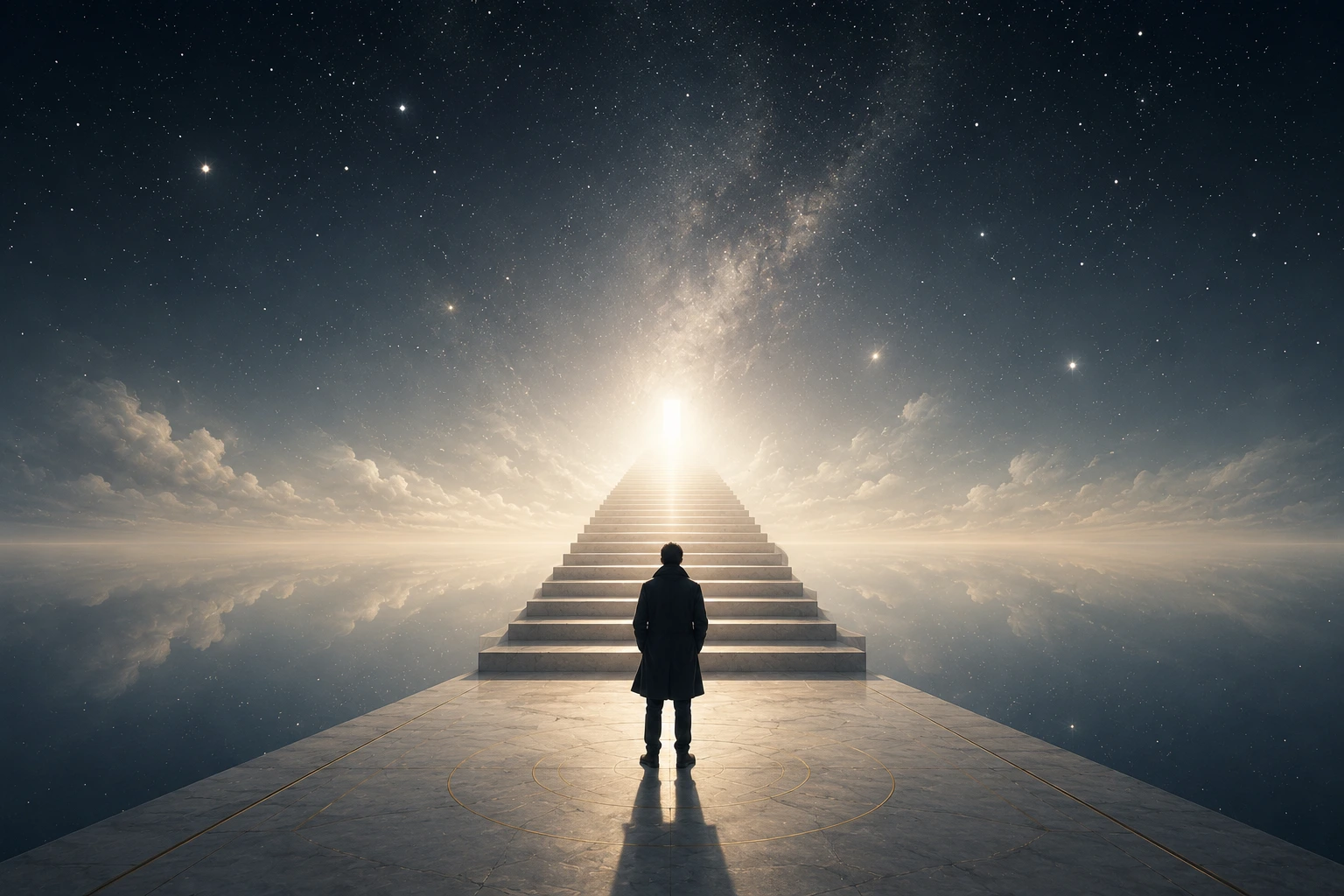
Time appears so fundamental that we rarely stop to question it.
We organize our lives around calendars.
We measure success in years.
We remember the past.
We plan for the future.
Everything we call progress assumes that tomorrow exists.
Without time, there would be no history.
No growth.
No learning.
No waiting.
No hope.
Yet modern science has transformed the way we think about time.
Einstein showed that time is not an absolute universal clock.
Physics suggests that time can slow down.
It can bend.
It may even have had a beginning.
Some cosmological models even explore whether time itself could eventually come to an end.
These ideas are fascinating.
But perhaps they are not the deepest questions we should ask.
Because even if physics eventually explains the beginning or the end of time, another mystery remains.
What would happen to humanity if time itself ceased to matter?
Not because the universe disappeared.
But because the experience of time—the very thing that gives structure to every human life—was fundamentally transformed.
Can Humanity Survive the End of Time? A Short Answer
No one knows. Humanity depends on time for memory, identity, responsibility, learning, civilization, and meaning itself. If time were no longer experienced as a finite resource, human psychology and society might change more profoundly than any technological revolution in history. The greatest challenge would not be surviving the end of time—it would be preserving humanity without one of the conditions that has always defined it.
This question continues the philosophical journey explored throughout Eternity Management.
We have already asked whether humanity could survive unlimited knowledge, perfect memory, absolute truth, immortality without purpose, unlimited freedom, and even death itself.
Each article removed one of humanity’s oldest limitations.
This article removes perhaps the oldest limitation of all.
Time.
Because if mortality gives urgency to life, time gives mortality its meaning.
Every choice matters because another choice becomes impossible.
Every relationship matters because it cannot last forever.
Every civilization matters because history moves forward.
Without time, would humanity still understand progress?
Would purpose survive?
Would hope still exist?
Or would eternity become something entirely different from everything we have ever imagined?
Perhaps the greatest question is not whether time will someday end. Perhaps it is whether humanity could remain human if time no longer shaped every decision we make.
Time Is More Than a Clock
When most people think about time, they imagine clocks.
Calendars.
Deadlines.
Birthdays.
Years passing.
But none of these things are time.
They are only ways of measuring something far more mysterious.
Time is the invisible framework that allows events to unfold instead of existing all at once.
It allows causes to produce consequences.
Children to become adults.
Ideas to become civilizations.
Dreams to become reality.
Without time, there is no sequence.
Without sequence, there is no story.
Without story, human life loses one of its deepest structures.
This is why the philosophy of time has fascinated thinkers for thousands of years.
Is time something that exists independently of us?
Or is it inseparable from consciousness itself?
Physics studies time as a dimension.
Psychology studies how we experience it.
Philosophy asks why it matters at all.
These perspectives are not competitors.
Together, they reveal that time is both an objective feature of the universe and one of the most personal aspects of human existence.
A single hour can feel endless while waiting for difficult news.
The same hour can disappear almost instantly when shared with someone we love.
The clock measures sixty minutes.
The mind experiences something entirely different.
This distinction becomes even more important when we imagine a civilization that no longer experiences time in the way we do today.
Would human identity remain recognizable if yesterday and tomorrow gradually lost their emotional meaning?
Would memory still shape who we are?
Would anticipation still inspire hope?
Or would existence slowly become a single endless present?
These questions connect naturally with another cornerstone article, Can Humanity Survive Perfect Memory?. Memory depends on time. Without a meaningful distinction between past, present, and future, memory itself might cease to function in the way human beings have always understood it.
Time is not merely what moves the universe forward. It is what allows human beings to experience life as a journey rather than a collection of disconnected moments.
Why Time Gives Meaning to Every Choice
Every meaningful decision depends on something we rarely notice.
It depends on the impossibility of making every choice.
When we choose one career, countless others disappear.
When we decide where to live, we leave behind different futures.
When we tell one person “yes,” we often say “no” to another possibility.
Time quietly enforces these decisions.
Every passing moment closes doors that can never again be opened in exactly the same way.
Because of this, time transforms ordinary decisions into meaningful commitments.
If every possibility remained permanently available, commitment itself would gradually lose its significance.
Promises could always wait.
Dreams could always begin tomorrow.
Responsibilities could always be postponed.
Perhaps this is why human beings so often struggle with procrastination.
Even within a finite lifetime, we sometimes behave as though tomorrow were guaranteed.
Imagine how much stronger that temptation might become if tomorrow literally never ended.
This insight connects directly to Why Do Humans Need Meaning?. Meaning is inseparable from limitation. Every purpose requires sacrifice. Every achievement requires time invested instead of endlessly postponed.
Perhaps time does not merely measure our lives.
Perhaps it silently creates the conditions that allow purpose to exist at all.
Without the possibility of running out of time, humanity might also lose the urgency that transforms intentions into actions.
And that leads to an even deeper question.
If time gives meaning to every choice we make, what would happen to civilization itself if time gradually stopped shaping the way human beings think?
What Happens to Civilization When Time No Longer Matters?
Imagine a civilization where nobody feels pressed for time.
Not because life is easy.
Not because problems have disappeared.
But because time itself has lost its ability to create urgency.
Every project could wait.
Every discovery could be made later.
Every conversation could happen tomorrow.
Every dream could always be postponed.
At first, such a world sounds peaceful.
But civilizations are not built merely by having opportunities.
They are built by acting before opportunities disappear.
History has always moved because generations knew their time was limited.
Scientists raced to complete discoveries.
Artists hurried to finish masterpieces.
Leaders made difficult decisions knowing they would not govern forever.
Parents invested in children who would one day inherit the future.
Time silently coordinated civilization.
Remove that invisible pressure, and progress itself might begin to change.
This does not necessarily mean civilization would collapse.
It may simply evolve into something almost impossible for us to recognize.
Innovation could slow.
Institutions could become increasingly permanent.
Cultures might preserve rather than reinvent themselves.
Even democracy, education, economics, and scientific research might begin operating according to entirely different principles.
Throughout history, the future has always belonged to people who knew they had limited time to shape it.
If time stopped exerting pressure, would humanity still feel compelled to improve the world?
Or would civilization slowly drift toward endless maintenance instead of continual creation?
This possibility connects closely with Can Humanity Survive Immortality Without Purpose?. Immortality already raises questions about motivation. Removing the significance of time would amplify those questions even further.
Progress depends not only on intelligence, knowledge, or technology. It also depends on believing that tomorrow cannot always wait.
Would Hope Exist Without a Future?
Hope always points forward.
It imagines something that does not yet exist.
A better tomorrow.
A healed relationship.
A scientific breakthrough.
A more just civilization.
Every form of hope assumes one simple reality.
The future has not yet arrived.
But what if the distinction between present and future gradually disappeared?
If existence became an endless present, hope itself might become almost impossible to define.
Without tomorrow, there can be no anticipation.
Without anticipation, many human emotions would change beyond recognition.
Excitement before a journey.
The joy of waiting to meet someone.
The satisfaction of working toward a distant goal.
These experiences all depend on time moving forward.
Even love is deeply connected to time.
Relationships grow.
Trust develops.
Memories accumulate.
People change together.
Without the passage of time, many of the experiences we associate with being human might lose the very process that gives them depth.
This idea echoes another question explored in Can Humanity Lose Its Humanity?. Humanity is not defined only by intelligence or biology. It is also defined by the way we experience change, growth, memory, expectation, and hope.
If time disappeared as a meaningful experience, humanity might not vanish.
But it might become something profoundly different.
Perhaps the end of time would not destroy civilization. Perhaps it would quietly transform every emotion that has ever connected us to the future.
Perhaps Time Is the Invisible Foundation of Humanity
When people speak about the foundations of civilization, they usually mention language.
Culture.
Science.
Law.
Technology.
All of these are essential.
Yet each of them depends on something even more fundamental.
Time.
Language develops through generations.
Knowledge accumulates over centuries.
Culture evolves because each generation inherits, questions, and reshapes what came before.
Even identity depends on continuity between yesterday, today, and tomorrow.
Without that continuity, personal history would dissolve.
The person you were yesterday would have little connection to the person reading these words now.
This is why time is not simply one more feature of reality.
It is the invisible structure that allows every other human experience to exist.
Even morality depends on time.
Responsibility assumes that today’s actions will influence tomorrow.
Justice assumes consequences unfold over time.
Forgiveness assumes people can change.
Growth assumes the future can become different from the past.
If time ceased to function as the framework connecting actions and consequences, many of our deepest moral concepts would become difficult to define.
Perhaps this is why time quietly underlies almost every philosophical question explored throughout Eternity Management.
Perfect memory depends on time.
Absolute truth unfolds through time.
Meaning develops over time.
Even immortality only becomes meaningful because time continues moving forward.
Without time, every one of these ideas begins to lose its familiar shape.
Perhaps time is not one element of human existence. Perhaps it is the invisible thread that quietly holds every other element together.
The Eternity Management Perspective
Most stories about the end of time imagine the destruction of the universe.
Stars disappear.
Galaxies collapse.
Reality itself comes to an end.
But perhaps the most important question is not whether the universe survives.
Perhaps it is whether humanity survives the loss of one of the ideas that has always defined human existence.
The universe might continue.
Consciousness might continue.
Civilization might continue.
Yet if time no longer gave structure to experience, would those words still describe anything we would recognize?
This question unites nearly every philosophical exploration within the Eternity Management universe. Articles such as Can Humanity Survive Unlimited Knowledge?, Can Humanity Survive Unlimited Power?, Can Humanity Survive Infinite Freedom?, Does Humanity Need Death?, and Can Humanity Survive Immortality Without Purpose? all remove one fundamental limitation and ask the same underlying question:
What remains of humanity after the conditions that shaped humanity disappear?
The end of time may therefore represent the deepest question of all.
Because time is not merely one limitation among many.
It is the condition that quietly makes every other limitation possible.
If you would like to explore these ideas further, continue with our collections of Books About Time, Books About Consciousness, Books About the Meaning of Life, Books About Human Nature, and Books About the Future of Humanity. Together, these articles and book collections form a connected philosophical map exploring humanity’s future beyond its oldest boundaries.
Conclusion: Time May Be Humanity’s Greatest Inheritance
We began this article with a question that sounds almost impossible to answer.
Can humanity survive the end of time?
At first glance, the question appears to belong entirely to cosmology.
We imagine the death of stars.
The collapse of galaxies.
The final chapter of the universe itself.
But as we explored throughout this article, the deeper question is not about physics.
It is about humanity.
Time is far more than a measurement.
It is the invisible architecture of human existence.
It allows memories to become identity.
Choices to become responsibility.
Dreams to become achievements.
Relationships to become love.
Generations to become civilization.
Without time, none of these ideas would disappear immediately.
But they would gradually lose the structure that has always given them meaning.
This is why the end of time is not merely a scientific thought experiment.
It is one of the deepest philosophical questions humanity can ask.
Because every great human achievement has quietly depended on one assumption:
There will always be another tomorrow.
Yet if tomorrow itself lost its meaning, humanity would face a challenge unlike anything it has ever encountered.
The greatest question would no longer be how to survive time. It would become how to remain human without it.
This idea completes another chapter in the philosophical journey of Eternity Management.
Together, these articles explore what happens when humanity gradually removes the limits that have shaped civilization for thousands of years. We have examined unlimited knowledge, perfect memory, absolute truth, the end of mystery, total transparency, infinite freedom, unlimited power, immortality without purpose, and whether humanity needs death. Each removes one fundamental condition of human existence. Together, they ask a single question: what remains when humanity begins to transcend itself?
Time may be the deepest of those conditions.
Not because clocks govern our lives.
But because time quietly gives meaning to everything clocks can never measure.
Every promise.
Every sacrifice.
Every goodbye.
Every beginning.
Perhaps one day humanity will discover technologies capable of reshaping time itself.
Perhaps we will live far beyond anything previous generations imagined.
Perhaps eternity will become more than a philosophical idea.
But even then, one question will remain.
Not whether we have more time.
But whether we still understand why time ever mattered.
Perhaps humanity’s greatest achievement will never be mastering time. Perhaps it will be remembering why time once made every moment worth living.
Frequently Asked Questions
No one knows. Scientifically, the ultimate fate of time remains uncertain. Philosophically, the disappearance of meaningful time would transform memory, identity, civilization, responsibility, and purpose more profoundly than almost any other change humanity could experience.
Time provides the structure that allows learning, relationships, responsibility, growth, and civilization to develop. Without time, many of the concepts that define human existence would lose their meaning.
Purpose depends on change, progress, and the ability to move toward future goals. If time ceased to function as humanity experiences it today, purpose itself could be fundamentally transformed.
It is both. Physics explores the structure and future of time, while philosophy examines how time shapes consciousness, identity, morality, and civilization.
This article continues the Eternity Management exploration of what happens when humanity transcends its oldest limitations, including mortality, memory, truth, freedom, knowledge, and time itself.
Continue with Does Humanity Need Death?, Can Humanity Survive Immortality Without Purpose?, Can Humanity Survive Perfect Memory?, and our collections of Books About Time and Books About the Future of Humanity.