
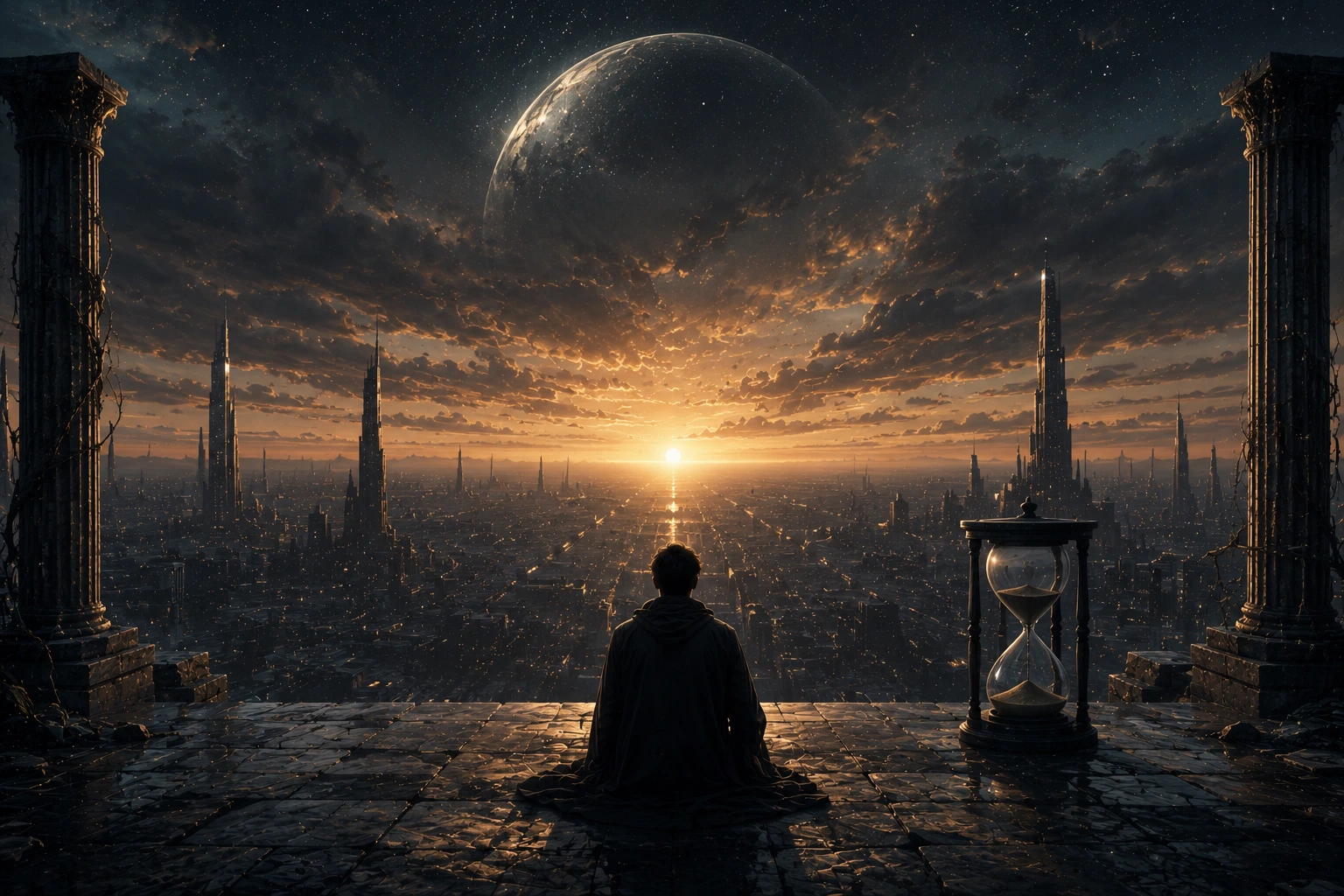
Can humanity survive immortality without purpose? What happens when humanity finally defeats death?
For thousands of years, immortality has been one of humanity’s oldest dreams. Ancient myths searched for it. Religions promised it. Science pursues it. Technology increasingly imagines it as possible.
At first, immortality sounds like the ultimate victory: no endings, no final goodbyes, no fear of disappearing, no race against time.
But immortality may create a question more dangerous than death itself:
What happens when life no longer ends, but purpose does?
Death Gives Shape to Human Life
Most people see death as humanity’s greatest enemy. Yet death quietly shapes almost every human decision.
We choose because time is limited. We love because moments disappear. We act because opportunities eventually close.
Mortality creates urgency. Urgency creates priority. Priority often creates meaning.
This is why books about immortality rarely explore endless life as a simple reward. The deeper question is not only whether humans can live forever, but whether forever can still feel meaningful.
A world without endings may become a world without urgency.
If tomorrow always exists, why choose today?
Could Meaning Survive Infinite Time?
Meaning often emerges from limitation.
A single day matters because it ends. A human life matters because it cannot be repeated forever. Achievements matter because time is scarce.
Relationships matter because they are temporary. Choices matter because they exclude other choices.
Imagine a civilization with unlimited time.
A book can always be written later. A journey can always happen tomorrow. An apology can always wait another century.
Without scarcity, purpose itself may begin to dissolve. This is why immortality without purpose connects directly to the larger question behind books about meaning of life: human beings do not only need existence. They need direction.
Immortality and the Problem of Motivation
Human ambition depends heavily on finiteness.
Students study because deadlines exist. Scientists race against time. Artists create because they know they cannot create forever.
Remove mortality and motivation may slowly change.
The question may no longer be:
What should I do with my life?
It may become:
Why should I do anything now?
Infinite time may create infinite procrastination.
Would Relationships Survive Eternity?
Human relationships are built around change.
Friendships evolve. Families grow. Generations replace one another. Love itself often gains meaning because people know they cannot remain together forever.
What happens when relationships last thousands of years?
Would love deepen, or would emotional exhaustion eventually replace attachment?
Could loyalty survive eternity?
Could forgiveness?
Could novelty?
An immortal civilization may not suffer from too little time. It may suffer from too much repetition.
Memory Was Never Designed for Eternity
Human memory evolved for mortal lives.
Even now memories fade. Names disappear. Experiences blur together. Pain loses intensity. The past becomes lighter because the mind cannot carry everything forever.
Forgetting is often treated as a flaw, but it may also be a survival mechanism.
An immortal mind might eventually carry millions of memories. Every friendship. Every betrayal. Every loss. Every identity it once inhabited.
This connects directly to the question explored in Can Humanity Survive Perfect Memory?: would a mind that remembers too much become wiser, or trapped?
Would the Immortal Person Still Be the Same Person?
Immortality creates a deeper identity problem.
If a person lives for one thousand years, changes their values, forgets early memories, replaces every old desire and becomes emotionally unrecognizable, are they still the same person?
Is identity based on memory? On the body? On consciousness? On continuity? On the story a person tells about themselves?
This is why immortality belongs beside books about identity and books about consciousness. Eternal life is not only a biological problem. It is a problem of selfhood.
An immortal person may not fear death.
They may fear becoming someone who no longer remembers why they wanted to live forever.
Consciousness Continuity May Matter More Than Survival
When people imagine immortality, they often imagine the survival of the self.
But what exactly must survive?
The body? The memories? The personality? The consciousness observing experience from within?
If consciousness continues but purpose disappears, immortality may become a prison of awareness.
If memories continue but identity changes beyond recognition, immortality may become a chain of strangers sharing one life.
This is why the question is not only whether humanity can defeat death. It is whether humanity can preserve a meaningful continuity of consciousness across endless time.
Would Civilization Stop Changing?
Civilizations evolve partly because generations disappear.
New generations challenge old assumptions. Old systems eventually give way to new ones. Cultural memory changes because people change.
Immortality could freeze this process.
A civilization ruled by immortal institutions may become extremely stable, but also nearly impossible to transform.
The future may become owned by the past.
This makes immortality without purpose not only a personal crisis, but a civilizational crisis.
Could Immortality Become Worse Than Death?
Many stories assume immortality automatically creates happiness.
But philosophy and speculative fiction often suggest something more complicated.
Pleasure adapts. Achievements normalize. Experiences become familiar. Novelty fades.
An infinite life may eventually face an infinite version of boredom — not because life lacks possibilities, but because the mind itself changes.
This is why the question Why Immortality Might Be Worse Than Death is not pessimistic. It is necessary.
Purpose May Matter More Than Survival
Human beings do not simply want to continue existing.
They want existence to matter.
Survival and meaning are not the same thing.
A meaningful life can feel complete even when it is short. An endless life can feel empty even when it lasts forever.
This is why Why Do Humans Need Meaning? may be one of the most important questions behind immortality itself.
Perhaps humanity’s deepest need was never immortality.
Perhaps it was purpose.
Why This Question Belongs to Philosophical Science Fiction
The best philosophical science fiction rarely asks what humanity can build.
It asks what humanity can survive.
Could humanity survive unlimited knowledge?
Could humanity survive perfect happiness?
Could humanity survive infinite freedom?
Could humanity survive unlimited power?
Could humanity survive perfect memory?
Could humanity survive absolute truth?
Could humanity survive the end of mystery?
And now another question emerges:
Could humanity survive immortality without purpose?
The Eternity Management Question
In the world of Eternity Management, the greatest danger is often not destruction.
Sometimes the greatest danger is success.
Unlimited knowledge may destroy humility. Perfect happiness may destroy longing. Infinite freedom may destroy responsibility. Unlimited power may destroy restraint. Perfect memory may destroy the ability to begin again. Absolute truth may destroy trust. The end of mystery may destroy wonder.
And immortality without purpose may destroy meaning itself.
The real question is not whether humanity can live forever.
The real question is whether humanity can remain human if forever loses its direction.
Frequently Asked Questions About Immortality Without Purpose
What is immortality without purpose?
Immortality without purpose describes a future in which humans achieve indefinite life extension but struggle to find meaning, motivation or direction across endless time.
Would immortality make people happier?
Not necessarily. Happiness and meaning are related but not identical. Endless life does not automatically guarantee fulfillment.
Could purpose survive eternal life?
Possibly. But purpose might need to evolve continuously for an immortal civilization to remain psychologically healthy.
Would an immortal person still be the same person?
That depends on whether identity is based on memory, consciousness, body, personality or psychological continuity. Over centuries, the same immortal life might contain many different versions of the self.
Why might immortality become a problem?
Infinite time may affect motivation, relationships, memory, identity, consciousness continuity and social change in unexpected ways.
Could humanity survive immortality without purpose?
Perhaps. But humanity might become fundamentally different if meaning disappears while existence continues forever.
Read More
- Books About Immortality
- Books About Meaning of Life
- Books About Purpose
- Books About Consciousness
- Books About Identity
- Books About Existence
- Books About the Future of Humanity
- Why Immortality Might Be Worse Than Death?
- Why Do Humans Need Meaning?
- Can Humanity Survive Perfect Memory?
- Can Humanity Survive Absolute Truth?
- Can Humanity Survive the End of Mystery?