Books About Identity: Philosophical Fantasy About Memory, Choice, and Consciousness
Books about identity explore what makes a person who they are: memory, consciousness, values, experience, choice, destiny, and the future they decide to become.
For readers of philosophical fantasy, identity is never fixed. It is shaped by what is remembered, what is chosen, what is lost, and what remains when reality itself begins to change.
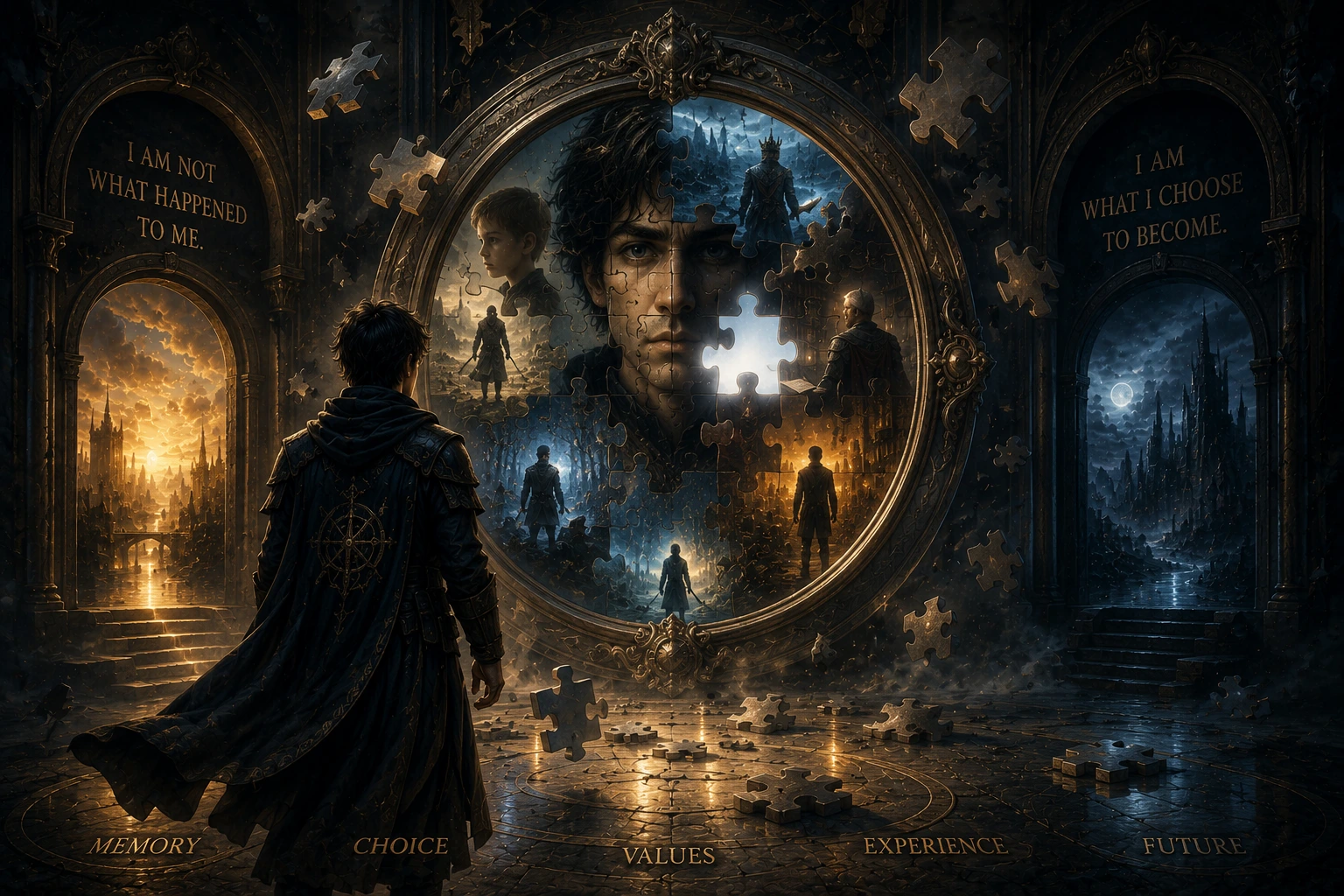
Books about identity: philosophical fantasy about memory, consciousness, choice, values, experience, destiny, and eternity.
What You Will Find on This Page
- why readers search for books about identity;
- how identity connects to memory, consciousness, choice, and values;
- why experience and future decisions reshape who a person becomes;
- how philosophical fantasy explores identity through time, reality, and transformation;
- how the Eternity Saga examines identity across memory, destiny, and eternity.
Why Readers Search for Books About Identity
Readers search for books about identity because identity is one of the deepest questions in human life. Who are we beneath our memories, roles, choices, wounds, values, and hopes?
Stories about identity allow readers to explore that question through characters who change, remember, forget, awaken, inherit hidden truths, face impossible choices, or discover that the person they were is not the person they must become.
The best books about identity do not treat identity as a simple label. They show it as a living structure shaped by memory, consciousness, responsibility, relationships, experience, and the future.
What Are Books About Identity?
Books about identity are stories that explore what makes a person who they are. They ask whether identity comes from memory, choice, body, name, values, culture, destiny, consciousness, or the stories people tell about themselves.
These books may be philosophical novels, fantasy, science fiction, literary fiction, speculative fiction, or mythological stories. The genre matters less than the central question: what creates the self?
In philosophical fantasy, identity can become even deeper. A character may face lost memories, altered realities, immortal lives, parallel futures, inherited destinies, or a world where consciousness changes what is real.
Books About Identity: Key Themes
| Theme | Question Explored |
|---|---|
| Identity | What makes a person who they are? |
| Memory | Are we still ourselves if memory changes? |
| Consciousness | How does awareness shape the self? |
| Choice | Do decisions reveal identity or create it? |
| Values | What remains when roles and memories are tested? |
| Destiny | Can a person become someone other than who they were meant to be? |
| Eternity | What happens to identity across time, loss, immortality, and consequence? |
Books About Identity and Memory
Memory is one of the strongest foundations of identity. A person understands themselves through what they remember: childhood, promises, wounds, love, failure, loyalty, and loss.
Books about identity and memory ask whether a person remains the same if memory is changed, broken, hidden, or restored.
In philosophical fantasy, memory can become more than personal history. It can become a force that preserves civilizations, burdens immortals, or reveals truths that reshape the self.
Books About Identity and Consciousness
Consciousness gives identity depth. A person is not only a collection of memories. They are also the awareness that interprets those memories and gives them meaning.
Books about identity and consciousness explore how self-awareness changes the way characters understand their past, their choices, their body, their future, and their place in reality.
When consciousness expands, identity can change. What once seemed fixed may become open. What once seemed impossible may become part of a new self.
Books About Identity and Choice
Choice reveals identity because decisions show what a person values under pressure. A character may claim many beliefs, but a difficult choice reveals what those beliefs mean.
Books about identity and choice ask whether people discover who they are by choosing, or whether they create who they are through repeated decisions.
In philosophical fantasy, choice can reshape more than a character’s life. It can reshape reality, destiny, memory, and eternity itself.
Books About Identity and Values
Values are the inner structure of identity. When memory is confused, destiny is uncertain, and reality changes, values may be the only thing that remains stable.
Books about identity and values explore what characters refuse to betray. They ask what matters most when power, fear, love, duty, or survival pulls a person in different directions.
A character’s identity is often defined not only by what they want, but by what they will not abandon.
Books About Identity and Experience
Experience shapes identity because every event leaves a mark. Loss, failure, discovery, love, responsibility, and survival all become part of the person who continues forward.
Books about identity and experience ask whether people are shaped by what happens to them or by how they respond to what happens.
Philosophical fantasy often turns experience into visible symbols: scars, mirrors, doors, altered worlds, forgotten names, or fragments of memory returning at the right moment.
Books About Identity and Free Will
Free will matters because identity is not only inherited. It is also chosen.
Books about identity and free will explore whether a person can become someone different from what history, memory, prophecy, culture, trauma, or destiny expects them to be.
A character may not choose everything that shaped them, but they may still choose what those forces mean.
Books About Identity and Responsibility
Responsibility shapes identity because what a person is willing to carry reveals who they are.
Books about identity and responsibility ask whether identity is created by comfort or by burden. A character may become themselves only when they accept what must be protected, remembered, repaired, or carried forward.
In philosophical fantasy, responsibility can extend beyond a single life, making identity part of time, memory, and eternity.
Books About Identity and Destiny
Destiny challenges identity by suggesting that a character may already have a role, a path, or a future prepared for them.
Books about identity and destiny ask whether a person must become who they were meant to become, or whether they can reshape the meaning of that destiny.
The strongest stories do not simply reject destiny. They show characters transforming destiny through choice, consciousness, and responsibility.
Books About Identity and Reality
Reality shapes identity, but identity also shapes how reality is experienced.
Books about identity and reality explore what happens when the world a character trusts begins to change. If reality is unstable, what part of the self remains true?
In philosophical fantasy, reality may respond to memory, consciousness, and choice. This makes identity part of worldbuilding, not only character development.
Books About Identity and Time
Time changes identity. A person is not the same at the beginning of a life, after loss, after love, after power, after betrayal, or after responsibility.
Books about identity and time ask whether the self is continuous or constantly becoming. Is identity something preserved, or something remade through every moment?
When a story treats time as a living system, identity becomes even more complex. The past does not disappear. The future reaches back. The present becomes the place where the self is chosen.
Books About Identity and Immortality
Immortality makes identity difficult. If a person lives for centuries, changes names, loses people, carries too many memories, and watches worlds transform, who are they still?
Books about identity and immortality ask whether the self can survive endless time, or whether identity must evolve to remain alive.
In philosophical fantasy, immortality is rarely only power. It is also a test of memory, meaning, responsibility, and the ability to remain human across time.
Books About Identity and Eternity
Eternity expands the question of identity beyond one lifetime. If choices echo across generations and consequences survive the person who made them, identity becomes part of something larger.
Books about identity and eternity ask what remains when time stretches beyond ordinary human scale. Memory, values, responsibility, love, and choice may become the parts of identity that endure.
In philosophical fantasy, eternity makes identity both fragile and powerful.
Why Philosophical Fantasy Explores Identity So Well
Philosophical fantasy is one of the best genres for exploring identity because it can make inner transformation visible.
A fractured self can become a broken mirror. Lost memory can become a hidden kingdom. A chosen identity can reshape a world. A forgotten name can carry ancient responsibility.
Fantasy gives identity scale. Philosophy gives it depth. Together, they create stories where the question “Who am I?” becomes personal, cosmic, and transformative.
The Eternity Saga: Philosophical Fantasy About Identity Across Time and Eternity
Readers interested in books about identity may enjoy the Eternity Saga by Denys Kostin.
The series explores a universe where time behaves like a living system and where identity is shaped by memory, consciousness, choice, responsibility, reality, destiny, immortality, and eternity.
The Eternity Saga does not treat identity as a fixed answer. It asks what identity becomes when memory is heavy, choice is dangerous, reality is unstable, and the future itself can be guarded, destroyed, or shaped.
Those Who Guard Eternity
The first book introduces a world where identity begins with memory, choice, and responsibility before eternity.
Those Who Destroy Eternity
The second book explores what happens when identity, power, and responsibility begin to fracture.
Those Who Shape Eternity
The third book asks who a person becomes when they have the power to shape the future.
Recommended Reading Order
- Those Who Guard Eternity — begin with the first question of identity, memory, and responsibility.
- Those Who Destroy Eternity — continue into the consequences of fractured identity and dangerous choice.
- Those Who Shape Eternity — follow the final question of who can shape the future.
Who Should Read Books About Identity?
- readers of philosophical fantasy books;
- fans of books about memory and consciousness;
- readers interested in choice, values, and selfhood;
- people drawn to stories about destiny, reality, and transformation;
- readers looking for fantasy with deeper meaning;
- anyone who enjoys stories about becoming who you truly are.
Books about identity are ideal for readers who want stories about memory, selfhood, transformation, difficult choices, and the future a person decides to become.
The Eternity Saga connects identity to time, choice, memory, consciousness, reality, destiny, immortality, responsibility, and eternity.
About the Author of the Eternity Saga
Denys Kostin is the creator of the Eternity Management universe and author of the Eternity Saga.
His work combines philosophical fantasy, symbolic storytelling, systems thinking, mythology, psychology, and questions about how memory, identity, choice, and human responsibility shape reality over time.
Explore Related Themes
Books About Memory
Memory preserves the experiences that shape identity and continuity.
Books About Consciousness
Consciousness gives identity depth, awareness, and moral weight.
Books About Choice
Choice reveals identity and can create the person a character becomes.
Readers Searching for Books About Identity Also Explore
- books about memory and identity;
- books about self identity;
- books about consciousness;
- books about choice and values;
- books about destiny and transformation;
- books about reality, time, immortality, and eternity;
- philosophical fantasy books with deeper meaning.
Read Philosophical Fantasy About Identity Online or on Amazon
If you are looking for books about identity, memory, consciousness, choice, destiny, values, reality, and eternity, the Eternity Saga offers a mythological and philosophical approach to those themes.
Begin with Those Who Guard Eternity and enter a universe where identity is not fixed, memory has power, and every choice can shape who a person becomes.
Frequently Asked Questions
What are books about identity usually about?
Books about identity usually explore memory, consciousness, selfhood, values, choice, destiny, transformation, and what makes a person who they are.
What are the best books about identity?
The best books about identity do not treat identity as a simple label. They explore memory, consciousness, experience, responsibility, reality, and the choices that shape who a character becomes.
Are there fantasy books about identity?
Yes. Philosophical fantasy is especially strong for exploring identity because it can show lost memory, altered reality, immortal life, hidden destiny, symbolic mirrors, and transformation across time.
What books explore memory and identity?
Books that explore memory and identity ask whether a person remains the same if memories change, disappear, return, or reveal a hidden truth about the self.
What is the connection between identity and choice?
Choice reveals identity because decisions show what a person values under pressure. In many stories, identity is not only discovered through choice but created through it.
Is the Eternity Saga a book series about identity?
Yes. The Eternity Saga explores identity through memory, consciousness, choice, reality, destiny, responsibility, immortality, time, and eternity.
Where can I read the Eternity Saga?
The Eternity Saga can be read online through the official Cokos.org library, starting with Those Who Guard Eternity. Readers who prefer Kindle can also use the Amazon link on this page.
Begin a Fantasy Saga About Identity, Memory, and Eternity
Enter a philosophical fantasy universe where identity is shaped by memory, choice, consciousness, responsibility, and the future that must be guarded, destroyed, or shaped.
Explore the full hub of philosophical fantasy books if you want stories about meaning, consciousness, choice, time, destiny, reality, and eternity.