
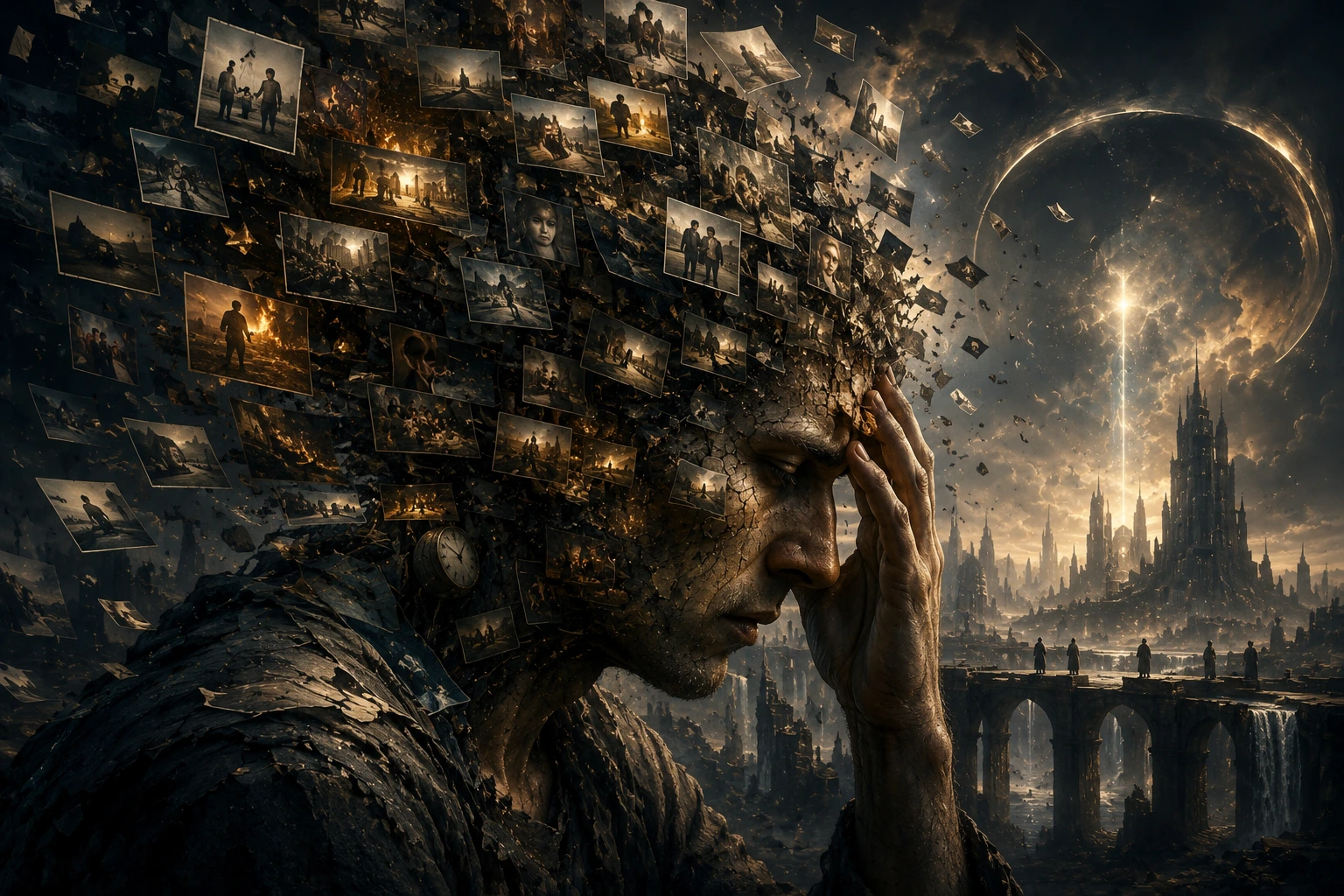
Can humanity survive perfect memory? What if every human being could remember everything forever?
Every mistake. Every loss. Every betrayal. Every moment of beauty. Every failure. Every version of ourselves we once were and can no longer become again.
Would perfect memory make humanity wiser, or would it slowly destroy the fragile ability to keep living?
Perfect Memory Sounds Like a Gift
At first, perfect memory sounds like one of humanity’s oldest dreams. No forgotten lessons. No repeated mistakes. No lost histories. No vanished faces. No wisdom buried under time.
A civilization with perfect memory might seem stronger, wiser and more responsible. It would remember every war, every collapse, every injustice and every warning sign that previous generations ignored.
But perfect memory hides a darker question: can human beings survive a past that never fades?
Forgetting Is Not Just a Flaw
Most people think of forgetting as a weakness. We forget names, dates, promises, conversations and entire periods of our lives. So we build tools against forgetting: books, monuments, archives, photographs, databases and digital memory.
But forgetting may not be only a failure of the mind. It may be one of the conditions that allows human life to continue.
Memory gives identity. Forgetting gives mercy.
Without forgetting memories, every wound would remain emotionally close. Every humiliation would stay sharp. Every grief would return with full force. Every mistake would remain permanently present.
The past would no longer be behind us. It would live beside us forever.
Memory Is Not a Perfect Archive
Human memory is not simple storage. It is not a hard drive. It edits, reorganizes, weakens, strengthens and reshapes experience around meaning.
Autobiographical memory gives us a personal story. Memory consolidation helps experience become part of that story. Neuroplasticity allows the brain to adapt as life changes. Even painful memories can change their emotional weight over time.
This matters because human memory limits are not only defects. They help protect the mind from carrying every detail with equal force forever.
A human being is not only a record of what happened. A human being is also a living system that must continue after what happened.
If nothing faded, memory and identity might become too heavy to carry.
Perfect Memory Could Become Memory Overload
Imagine remembering every conversation with perfect clarity. Every insult. Every awkward silence. Every failure to act. Every wrong decision. Every lost opportunity.
Now imagine carrying that not for seventy years, but for centuries.
An immortal person with perfect memory would not simply become wiser. They might experience memory overload: the endless presence of their own life pressing against every new decision.
Every new choice would be compared against thousands of previous choices. Every new relationship would carry the weight of every relationship that ended. Every new hope would stand beside every hope that failed.
Perfect memory could make action harder, not easier.
Would Eidetic Memory or Photographic Memory Be Enough?
People often imagine eidetic memory or photographic memory as superpowers. The ability to remember everything seems useful, especially in a world built around information, records and proof.
But a perfect human memory would not only preserve facts. It would preserve emotional experience. It would not only remember what happened. It would remember how it felt.
That is why perfect memory is more dangerous than simple intelligence. A mind that can remember everything may also lose the freedom to move lightly through time.
Could Forgiveness Exist Without Forgetting?
Forgetting does not mean denying truth. It does not mean pretending pain never happened.
But some form of emotional distance is necessary for forgiveness, renewal and change. A wound may remain part of the story, but it cannot remain equally alive forever.
If humanity could not forget, every society might become trapped in permanent accusation. Every historical wound would remain immediate. Every betrayal would feel recent. Every generation would inherit not only memory, but the full emotional force of memory.
Justice requires memory. But survival may require that memory changes weight.
Immortal Memory Would Need Forgetting
The dream of immortality usually focuses on survival. What if death could be defeated? What if consciousness could continue forever? What if identity could be preserved across time?
But immortality without forgetting may not be freedom. It may be endless accumulation.
Immortal memory would eventually become a second world inside the mind: crowded, vivid, unresolved and impossible to leave.
A being that remembers everything forever may not become divine. It may become buried under itself.
This is why perfect memory belongs beside the great philosophical dangers of eternity: unlimited knowledge, unlimited power, infinite freedom and perfect happiness.
Each removes a human limit. Each looks like liberation. Each may reveal that some limits protect humanity from collapse.
Why Perfect Memory Matters in Philosophical Science Fiction
Philosophical science fiction is not only about advanced technology, distant planets or future civilizations. At its best, it asks what humanity can survive.
A world with perfect memory would transform everything: law, love, guilt, history, identity, politics, education and responsibility.
Would anyone be forgiven if nothing faded? Would societies heal if every wound stayed vivid? Would immortality remain desirable if consciousness carried every moment forever?
These are not abstract questions. They are questions about the hidden architecture of being human.
The Eternity Management Question
In Eternity Management, the greatest danger is not always destruction. Sometimes the greatest danger is preservation without mercy.
What should be saved? What should be released? What must remain human, even in the face of eternity?
Perfect memory would not only preserve the past. It might prevent humanity from beginning again.
So the real question is not only whether humanity can remember everything.
The real question is whether humanity could survive if it lost the ability to forget.
Frequently Asked Questions About Perfect Memory
Is forgetting necessary for humans?
Yes. Forgetting helps humans reduce emotional overload, adapt to change and prevent the past from controlling every future decision. Memory creates continuity, but forgetting creates psychological space.
Would perfect memory be a blessing or a curse?
Perfect memory could help humans learn from experience, but it could also become a curse if every painful, embarrassing or traumatic moment remained permanently vivid.
Can humans survive remembering everything?
Humans may not be psychologically built to remember everything with equal force forever. Perfect memory could create emotional paralysis, memory overload and difficulty moving beyond past experiences.
Why does the brain forget memories?
The brain forgets because memory is selective. It prioritizes, reorganizes and weakens information over time. This helps humans focus, adapt and avoid being overwhelmed by every detail of life.
Is perfect memory the same as photographic memory?
No. Photographic memory usually refers to the imagined ability to recall visual details with extreme accuracy. Perfect memory would be much broader: remembering facts, emotions, experiences, relationships and identity across time.
Would immortality require forgetting?
Immortality may require some form of forgetting or emotional distance. Without it, an immortal being could become trapped under the endless weight of accumulated memories.
Read More
- Books About Memory
- Books About Consciousness
- Books About Identity
- Books About Existence
- Books About Immortality
- Why Immortality Might Be Worse Than Death
- Can Humanity Survive Unlimited Knowledge?
- Can Humanity Survive Perfect Happiness?
- Can Humanity Survive Infinite Freedom?
- Can Humanity Survive Unlimited Power?