
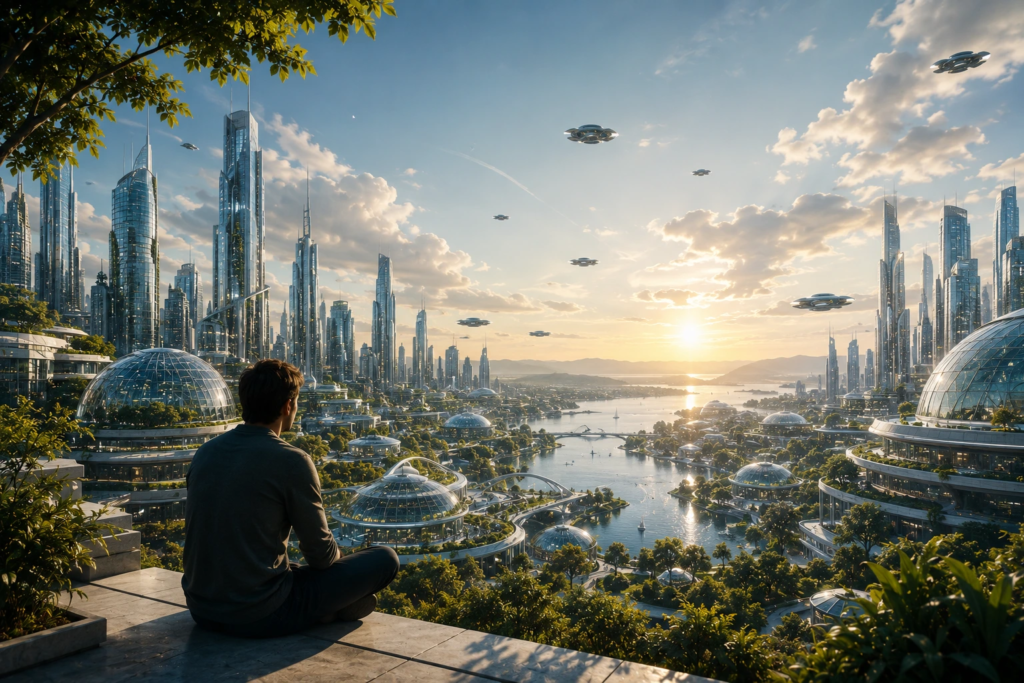
Short answer:
Humanity may eventually overcome disease, scarcity, aging, and perhaps even death itself. But surviving material abundance may prove easier than surviving the loss of meaning, responsibility, and purpose.
The greatest challenge of the future may not be survival.
It may be discovering why we should continue moving forward once survival is no longer difficult.
In this article:
- can humanity survive perfect happiness;
- what is a post-scarcity society;
- whether humans need challenge and difficulty;
- why meaning matters more than comfort;
- how artificial intelligence may change purpose;
- whether transhumanism could create happiness;
- why abundance may become civilization’s greatest test.
What is perfect happiness?
Perfect happiness does not necessarily mean endless pleasure.
Rather, it describes a hypothetical future in which most traditional sources of suffering have been dramatically reduced or eliminated.
Disease becomes manageable.
Scarcity disappears.
Automation performs most labor.
Violence becomes rare.
Material insecurity fades into history.
For thousands of years, humanity has worked toward exactly this future.
Medicine extended life.
Agriculture reduced hunger.
Technology increased comfort.
Science expanded control over nature.
The direction appears obvious.
Less suffering.
More freedom.
More happiness.
But philosophy asks an uncomfortable question.
What happens if humanity actually succeeds?
What happens when there is little left to struggle against?
Perhaps humanity’s greatest challenge will begin not when happiness is scarce.
But when happiness becomes effortless.
What is a post-scarcity society?
Many futurists describe this possible future as a post-scarcity society.
A post-scarcity civilization is one in which most material needs can be satisfied with minimal human labor.
Food becomes abundant.
Energy becomes inexpensive.
Automation replaces repetitive work.
Artificial intelligence performs complex cognitive tasks.
Medical technology dramatically extends healthy lifespan.
For much of human history, survival determined priorities.
People worked because they had to.
Produced because they had to.
Competed because resources were limited.
But what happens when necessity itself begins to disappear?
The central question of civilization may shift.
From:
“How do we survive?”
To:
“Why do we continue?”
Can humanity survive perfect happiness?
Throughout history, humanity has fought against suffering.
Against hunger.
Against disease.
Against violence.
Against mortality.
Against uncertainty.
Every generation inherited problems and attempted to solve them.
But every solved problem created new questions.
When societies became wealthier, they did not stop searching.
They began searching for different things.
Meaning.
Identity.
Purpose.
Belonging.
Future generations may discover something unexpected.
Human beings may be remarkably good at surviving scarcity.
But they may be less prepared to survive abundance.
Civilizations may collapse not only from lack.
They may also lose themselves through excess.
Why humans may need challenge
This is an uncomfortable idea.
Human beings do not need suffering for suffering’s sake.
War, disease, poverty, and violence are not valuable simply because they are difficult.
But there is an important distinction between suffering and challenge.
Challenge creates resistance.
Resistance creates adaptation.
Adaptation creates growth.
Muscles weaken without load.
Immune systems weaken without exposure.
Perhaps consciousness also requires friction.
Human beings often grow when confronting something larger than their current capabilities.
Remove every obstacle and growth itself may begin to disappear.
The problem may not be that humans need pain.
The problem may be that humans need challenge.
Can happiness exist without meaning?
Happiness and meaning are often treated as if they were the same thing.
But they behave very differently.
Happiness is often an emotional state.
Meaning behaves more like a direction.
Happiness comes and goes.
Meaning can remain even during hardship.
Parents are not always happy during sleepless nights with children.
Scientists are not always happy during decades of research.
Explorers are not always happy during dangerous expeditions.
Yet they continue.
Not because they feel pleasure every day.
But because they believe what they are doing matters.
This distinction has appeared repeatedly throughout philosophy.
Aristotle described human flourishing as something deeper than pleasure alone.
Friedrich Nietzsche argued that people can endure enormous suffering if they possess a reason to endure it.
Later, Viktor Frankl built an entire psychological framework around the idea that meaning allows human beings to survive circumstances that would otherwise feel unbearable.
Happiness answers the question:
“How do I feel right now?”
Meaning answers the question:
“Why do I continue moving forward?”
What happens if artificial intelligence removes most work?
Artificial intelligence is already changing the nature of work.
It writes.
Designs.
Analyzes.
Optimizes.
Assists decision making.
Future systems may perform a significant portion of today’s economic activity.
For many people this sounds liberating.
Less routine.
More free time.
More freedom.
But a deeper question emerges.
What happens to identity when necessity disappears?
For thousands of years work provided more than income.
It provided structure.
Status.
Responsibility.
Belonging.
A sense of usefulness.
If artificial intelligence removes much of that necessity, humanity may face an unexpected crisis.
Not unemployment.
Purpose.
Perhaps the greatest challenge of automation will not be job loss.
Perhaps it will be losing the feeling of being needed.
Could transhumanism create perfect happiness?
Some future thinkers believe technology may eventually engineer happiness directly.
Brain-computer interfaces.
Emotional regulation technologies.
Cognitive enhancement.
Designer emotions.
Neurological optimization.
These ideas often appear within discussions of transhumanism.
Transhumanism argues that humanity should use technology to improve intelligence, health, longevity, and perhaps even emotional experience itself.
But this creates another philosophical question.
If happiness can be manufactured on demand, does it still mean the same thing?
If every unpleasant feeling can be removed instantly, what happens to courage?
What happens to sacrifice?
Responsibility?
Growth?
Would a perfectly optimized emotional life still feel human?
The question may not be whether we can engineer happiness.
The question may be whether engineered happiness remains happiness at all.
The paradox of utopia
Utopia promises a world without conflict.
Without scarcity.
Without fear.
Without uncertainty.
Without suffering.
Yet conflict, uncertainty, and risk have shaped civilization from the beginning.
They forced innovation.
Created cooperation.
Inspired exploration.
Generated culture.
Built institutions.
If every source of friction disappears, what remains to move civilization forward?
Perhaps utopia is dangerous not because it is too good.
Perhaps it is dangerous because it risks making growth unnecessary.
Civilizations may die not only from scarcity.
They may also disappear into comfort.
Survival society versus post-scarcity society
| Survival Society | Post-Scarcity Society |
|---|---|
| Scarcity | Abundance |
| Necessity | Choice |
| Labor | Purpose |
| Competition for resources | Competition for meaning |
| Survival | Significance |
| Security | Identity |
The challenges change.
They do not disappear.
The central struggle of civilization may shift from survival toward meaning.
The future may ask humanity a question no previous civilization had to answer:
What are you for when survival is no longer difficult?
Maslow’s prediction may have been incomplete
Psychologist Abraham Maslow proposed that human needs develop in layers.
Physiological needs come first.
Safety follows.
Then belonging.
Esteem.
Self-actualization.
But perhaps the future adds another layer beyond self-actualization.
Contribution.
Meaning.
Responsibility toward future generations.
Purpose larger than the self.
The higher humanity climbs, the more important these questions may become.
Perhaps abundance does not eliminate meaning.
Perhaps abundance makes meaning unavoidable.
Could abundance become an existential risk?
Most discussions about existential risk focus on artificial intelligence, nuclear war, pandemics, or climate change.
But there may be another kind of existential risk.
Not extinction.
Loss of direction.
A civilization can survive physically while losing the reasons that once motivated it to create, explore, sacrifice, and build.
History suggests that societies rarely collapse from a single event.
More often, they gradually lose confidence in their future.
They stop believing that tomorrow should be larger than today.
Perhaps abundance creates a new version of that danger.
Not despair.
But indifference.
The greatest threat to civilization may not be suffering.
It may be the disappearance of reasons to overcome it.
Does humanity need struggle?
This question remains deeply controversial.
Human beings should reduce unnecessary suffering wherever possible.
Disease should be cured.
Poverty should be reduced.
Violence should be prevented.
But challenge may be different from suffering.
Challenge creates mastery.
Responsibility creates identity.
Difficulty creates adaptation.
Exploration creates growth.
Perhaps human beings do not require pain.
But they may require something larger than themselves.
A mountain to climb.
A mystery to solve.
A future worth building.
Humanity may not need suffering.
But it may need horizons.
What happens after the end of scarcity?
Most of human history has been defined by limits.
Limited food.
Limited energy.
Limited security.
Limited lifespan.
Future technologies may change all of that.
Artificial intelligence.
Automation.
Biotechnology.
Nanotechnology.
Longevity research.
The next age of civilization may become the first in which survival is no longer humanity’s primary concern.
If that happens, civilization may face an entirely new question.
Not:
“How do we live longer?”
But:
“What should longer lives be for?”
The future may not be defined by resources.
It may be defined by reasons.
What does Eternity Management say about perfect happiness?
The universe of Eternity Management repeatedly returns to a single observation.
Human beings do not search only for survival.
They search for significance.
The series explores civilizations that possess extraordinary knowledge, technological power, and lifespan extension.
Yet they continue asking ancient questions.
Why continue?
What deserves preservation?
What is worth sacrifice?
What should survive even the most radical transformation?
Technology changes possibilities.
Knowledge changes decisions.
Time changes civilizations.
Meaning determines direction.
This article naturally connects with other Eternity Management explorations:
- Why Do People Need Meaning?
- Why Do People Want to Live Forever?
- Can Humanity Survive Unlimited Knowledge?
- Can Humanity Lose Its Humanity?
- The Hidden Cost of Knowing the Future
- Why Do We Fear the Future More Than Death?
The future may test humanity not through suffering.
But through the absence of suffering.
Conclusion: Can humanity survive perfect happiness?
Humanity has crossed oceans.
Reached space.
Decoded the genome.
Built civilizations.
Created artificial intelligence.
It may eventually conquer scarcity itself.
But one ancient question will remain.
Why continue?
Perfect happiness may become a blessing if it creates space for meaning.
It may become a trap if it replaces meaning with comfort alone.
Perhaps civilization survives abundance only when it remembers that happiness is not the final destination.
It is the beginning of a deeper question.
What should we do with life once survival is no longer the challenge?
Humanity may survive perfect happiness only if it learns to seek not only satisfaction —
but significance.
Frequently Asked Questions
Can humanity survive perfect happiness?
Possibly, but only if abundance does not eliminate meaning, responsibility, growth, and long-term purpose.
What is a post-scarcity society?
A post-scarcity society is a civilization in which technology allows most material needs to be met with minimal human labor.
Do humans need struggle?
Humans may not need suffering, but many philosophers argue that challenge, effort, and responsibility are important for growth and meaning.
Can happiness exist without meaning?
Yes, but it may be temporary. Meaning often provides long-term direction that emotional happiness alone cannot sustain.
Could artificial intelligence create a crisis of purpose?
If AI removes much of the work humans perform today, societies may need to redefine identity, usefulness, and contribution.
Could transhumanism create perfect happiness?
Future technologies may allow emotional optimization, but philosophers continue debating whether engineered happiness would still feel authentically human.
Can comfort destroy civilization?
Comfort itself is not dangerous, but a civilization that loses purpose, curiosity, and responsibility may struggle to sustain long-term progress.
What is the biggest challenge of a post-scarcity future?
The greatest challenge may shift from survival toward meaning, identity, and purpose.