
Imagine that one day every trace of your existence disappears.
Your photographs are gone.
Your messages have been erased.
Your name no longer appears in any book, archive, or database.
The last person who remembered you has died.
Nothing remains to prove you ever existed.
Would your life still matter?
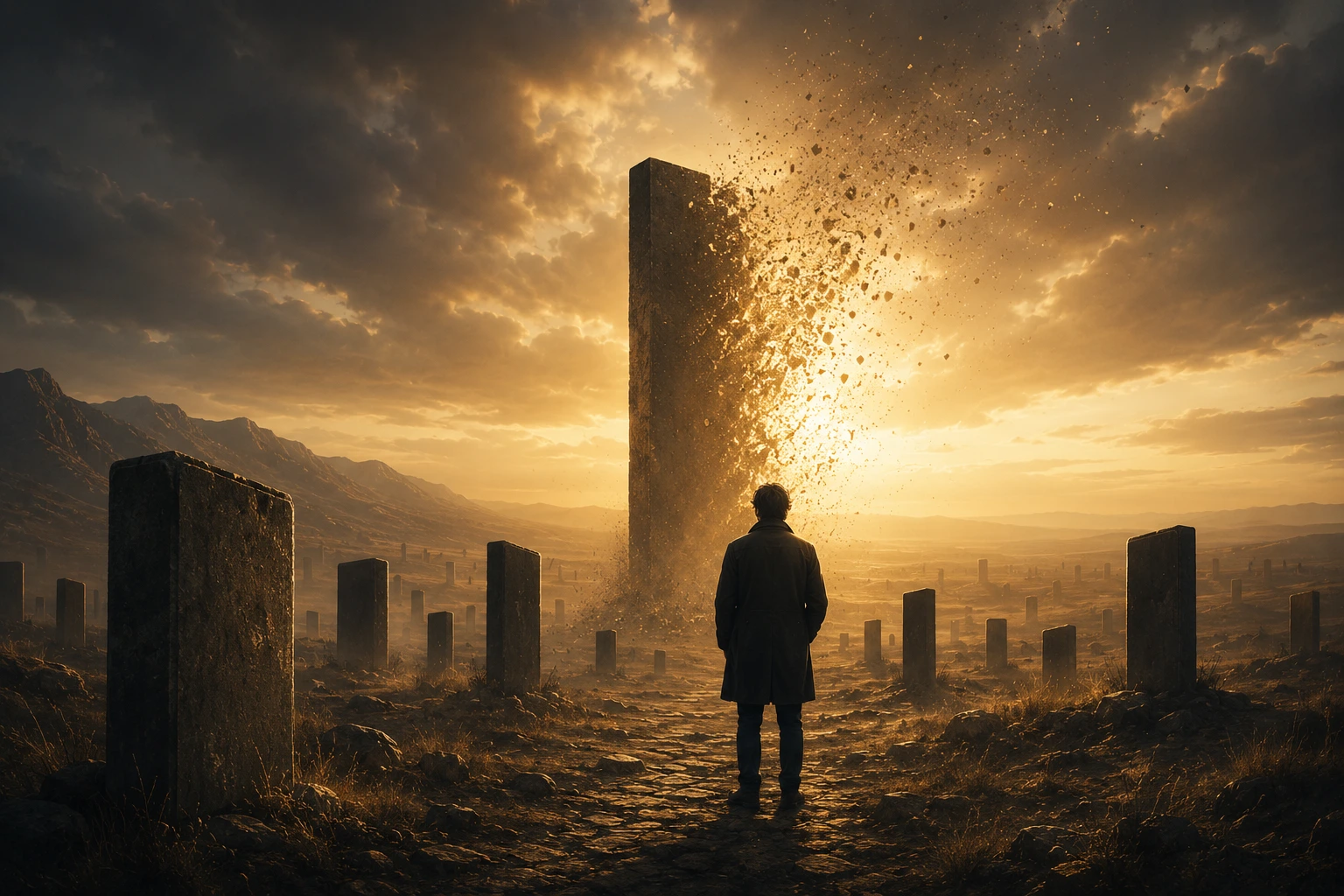
This thought experiment is unsettling because it touches one of humanity’s oldest and deepest fears. While people often say they fear death, careful reflection suggests that death itself is only part of the story. What truly disturbs many of us is something that extends beyond biological mortality—the possibility that everything we experienced, loved, created, believed, and sacrificed for could eventually vanish without leaving a meaningful trace.
The fear of being forgotten has shaped civilizations for thousands of years. It explains why ancient rulers carved their names into mountains, why families preserve old photographs, why writers hope their books will outlive them, why scientists dedicate decades to discoveries they may never personally benefit from, and why parents devote their lives to generations they will never fully see.
Although these pursuits appear very different, they are often driven by the same question:
Can something about us continue after we are gone?
This question reaches far beyond psychology. It lies at the intersection of philosophy, neuroscience, anthropology, history, evolutionary biology, religion, literature, and speculative fiction. Understanding why humans fear being forgotten means understanding why people seek meaning, why civilizations preserve history, why identity depends upon memory, and why the idea of legacy appears in every culture that has ever existed.
It also reveals one of the central paradoxes explored throughout Eternity Management.
Humanity has always imagined overcoming death, ignorance, and limitation. But what happens after those victories are achieved? If memory could become permanent, if technology could preserve every human experience indefinitely, and if forgetting itself disappeared, would humanity finally feel secure—or would it discover entirely new existential problems?
Questions like these connect naturally with broader philosophical explorations of memory, identity, consciousness, meaning, and immortality. Each topic examines a different aspect of what it means to remain human while confronting possibilities that previous generations could scarcely imagine.
The Fear Beneath the Fear
Most fears have obvious causes.
- We fear pain because it causes suffering.
- We fear illness because it threatens health.
- We fear uncertainty because it limits our ability to predict the future.
- We fear death because it ends biological life.
The fear of being forgotten is different.
It is not primarily about physical survival.
Instead, it concerns significance.
If every memory eventually disappears, people naturally begin asking whether their lives truly mattered. If every achievement fades, every relationship is forgotten, and every story eventually ends, where does meaning come from?
This question has fascinated philosophers for centuries because it challenges one of humanity’s deepest assumptions—that permanence and meaning are inseparable.
Yet experience suggests something more complicated.
A beautiful sunset lasts only minutes.
A conversation can change someone’s life in an hour.
A single act of compassion may influence generations despite never being recorded anywhere.
These experiences remind us that significance does not always depend upon permanence. Temporary moments can transform lives forever.
This distinction between permanence and significance will appear repeatedly throughout this article because it ultimately reshapes the entire discussion about memory, legacy, and human existence.
Why Humans Became the Species That Remembers
Memory is often treated as a simple biological function—a way for the brain to store information.
In reality, memory may be one of humanity’s greatest evolutionary achievements.
Long before written language existed, human beings were already preserving knowledge across generations. Stories about hunting, weather, medicine, family, cooperation, danger, and survival allowed children to begin life with knowledge accumulated over thousands of years rather than learning everything through trial and error.
This transformed the trajectory of our species.
Unlike most animals, humans inherit not only genes but also culture. Every generation receives discoveries, beliefs, technologies, languages, values, myths, scientific observations, and philosophical questions developed by countless people who lived before them.
Civilization itself is therefore built upon memory.
Libraries are organized memory.
Education is transferred memory.
History is collective memory.
Culture is shared memory.
Identity is personal memory.
Without memory, there would be no science, no philosophy, no literature, no civilization, and ultimately no coherent understanding of ourselves.
Recognizing this also reveals why the fear of being forgotten feels so deeply personal. Forgetting is not simply losing information. It threatens the continuity that allows both individuals and civilizations to exist across time.
Key Insight: Humans do not simply remember the past. We build our identities, cultures, and civilizations from remembered experience. The fear of being forgotten is ultimately a fear that our contribution to that ongoing story may disappear forever.
Memory Is More Than Information—It Is the Foundation of Identity
Most people think of memory as a storage system.
We remember birthdays, names, faces, historical events, passwords, and directions. Modern neuroscience often describes memory in terms of encoding, storage, and retrieval, making it appear almost like a biological hard drive.
Yet human memory performs a far more profound function than simply preserving information.
Memory creates continuity.
Without it, every morning would be the beginning of an entirely new existence. There would be no lasting friendships, no personal growth, no accumulated wisdom, and no coherent understanding of who we are. Every experience would exist in isolation, disconnected from everything that came before.
This is why philosophers have long argued that identity is inseparable from memory. Although every cell in the human body gradually changes throughout life, most people still experience themselves as the same person they were years—or even decades—earlier.
What creates that continuity is not the body itself.
It is the ongoing story that memory allows us to construct.
Psychologists refer to this as narrative identity—the internal narrative through which people organize experiences into a meaningful life story. Rather than remembering isolated events, we connect them into patterns that explain who we are, how we changed, what we value, and where we hope to go next.
Every major decision becomes another chapter.
Every failure becomes a lesson.
Every success becomes part of our self-understanding.
Without memory, identity fragments into disconnected moments with no overarching meaning.
This explains why conditions affecting memory are among the most devastating illnesses humans experience. They do more than erase facts. They gradually dissolve the thread connecting one version of a person to the next, leaving families with the painful feeling that someone they love is simultaneously present and disappearing.
The fear of being forgotten reflects this same intuition on a larger scale. If memory creates identity during life, what happens when every memory of that life eventually disappears?
Key Insight: Humans fear being forgotten because memory is not simply something we possess—it is one of the mechanisms through which we become ourselves.
Why Every Civilization Fights Against Oblivion
The desire to preserve memory is not limited to individuals.
Entire civilizations organize themselves around the act of remembering.
Consider how much of human society exists primarily to prevent knowledge from disappearing.
- Libraries preserve ideas.
- Museums preserve culture.
- Archives preserve history.
- Universities preserve accumulated knowledge.
- Religious traditions preserve beliefs.
- Families preserve ancestry.
- Languages preserve ways of thinking.
- Books preserve imagination.
None of these institutions exist by accident.
They represent humanity’s collective resistance to oblivion.
Anthropologists often describe humans as a species capable of cumulative culture. Unlike other animals, we do not merely adapt individually—we inherit the discoveries of previous generations and add new knowledge before passing it forward again.
This cumulative process transformed small hunter-gatherer communities into civilizations capable of mathematics, medicine, philosophy, astronomy, engineering, and space exploration.
Every scientific discovery depends upon someone remembering previous discoveries.
Every work of philosophy builds upon earlier questions.
Every civilization is, in many ways, an enormous system designed to preserve memory across generations.
This understanding also explains why the destruction of libraries, cultural monuments, historical records, and works of art has always been viewed as something more than physical vandalism. Such acts attack the continuity of civilization itself. They attempt to erase not only information but also identity.
Perhaps this is why societies instinctively rebuild archives after wars, restore damaged monuments, digitize historical collections, and preserve endangered languages. Deep down, humanity recognizes that losing memory means losing part of itself.
This broader perspective naturally connects with questions explored in Books About Human Nature and Books About Existence. Human civilization is not held together by technology alone. It is held together by shared memory, shared stories, and shared meaning, transmitted across generations. XML Sitemap posts eternity .pdf
The Psychology of Legacy: Why Humans Want to Leave Something Behind
If memory preserves identity, legacy extends identity beyond individual life.
This helps explain one of the most universal characteristics of human behavior: the desire to leave something behind.
Parents hope their children will carry forward their values.
Teachers hope their lessons will shape future generations.
Scientists hope their discoveries will continue improving human life.
Writers hope their books will still be read long after they are gone.
Artists create works intended to outlive their creators.
Entrepreneurs build organizations designed to continue beyond their own careers.
Although these ambitions differ, they are united by a common motivation:
To ensure that existence continues influencing the future.
Psychologists sometimes describe this as symbolic immortality. Even if biological life eventually ends, people seek reassurance that their values, ideas, relationships, or contributions will continue shaping the world after they are gone.
Importantly, symbolic immortality is not reserved for famous individuals.
Some of history’s greatest influences belong to people whose names have already disappeared. A teacher may inspire a future scientist. A parent may raise a child who changes the course of history. A compassionate stranger may alter someone’s life through a single conversation.
The original source may be forgotten.
The influence remains.
Recognizing this distinction transforms the discussion about legacy. It shifts attention away from fame and toward contribution. History remembers remarkably few names, but civilization has always depended upon countless people whose influence extended far beyond anything history ever recorded.
Why Fame Cannot Eliminate the Fear of Being Forgotten
At first glance, fame appears to solve humanity’s oldest existential problem.
If millions of people know your name, surely you will never be forgotten.
History suggests otherwise.
Every generation celebrates individuals who seem impossible to forget. Political leaders dominate headlines. Athletes become global icons. Actors, musicians, entrepreneurs, scientists, and influencers accumulate extraordinary public attention.
Yet only a few decades later, many of those names become unfamiliar to younger generations.
Attention moves on.
Culture changes.
New heroes replace old ones.
Public memory constantly reorganizes itself.
This reveals an uncomfortable truth.
Fame delays oblivion. It does not defeat it.
More importantly, fame often fails to address the deeper human need beneath the desire for recognition.
Recognition answers the question:
“Do people know who I am?”
The fear of being forgotten asks something entirely different:
“Did my existence genuinely matter?”
These are not the same question.
A person may become world-famous while contributing very little to humanity’s long-term development. Another individual may never become publicly known while profoundly influencing thousands of lives through education, compassion, scientific discovery, or leadership.
The first receives attention.
The second creates significance.
Understanding this distinction fundamentally changes how we think about legacy. Instead of asking how many people will remember us, we begin asking how deeply our actions improve the lives of others.
Key Insight: Recognition satisfies the ego. Significance satisfies something much deeper—the human desire to know that one’s existence genuinely improved the future.
The Invisible Legacy That Shapes Humanity
History often creates the illusion that civilization is built by extraordinary individuals.
History books celebrate inventors, philosophers, political leaders, military commanders, artists, and scientists whose names became inseparable from major historical events.
Yet civilization has always depended upon millions of people whose names disappeared long ago.
Consider a simple example.
A teacher encourages a struggling student.
That student later becomes a physician.
The physician saves thousands of lives.
Those lives influence countless other families, discoveries, careers, and communities.
Eventually, no one remembers the teacher.
Yet the consequences of that single act continue unfolding across generations.
This phenomenon appears everywhere.
- Parents shape future generations.
- Mentors influence future leaders.
- Researchers build upon forgotten discoveries.
- Engineers improve technologies created by previous engineers.
- Artists inspire artists they will never meet.
- Acts of kindness ripple through communities in ways nobody can fully measure.
Most human influence is invisible.
This observation offers a profoundly hopeful perspective.
Meaning does not depend upon becoming historically famous. Instead, meaning often emerges through countless small actions whose effects continue expanding long after the original source disappears.
Perhaps legacy functions less like a monument and more like a river.
No one can identify every drop of water that shaped its course.
Yet every drop contributed.
Terror Management Theory and Humanity’s Search for Symbolic Immortality
Modern psychology provides another fascinating perspective on why humans fear being forgotten.
One of the most influential explanations is Terror Management Theory (TMT), developed from the work of cultural anthropologist Ernest Becker and later expanded through decades of psychological research.
The theory begins with a remarkably simple observation.
Unlike most other animals, humans understand that death is inevitable.
This awareness creates a unique psychological challenge.
If people constantly focused on their inevitable mortality, anxiety could become overwhelming. According to Terror Management Theory, cultures help manage this existential awareness by providing systems of meaning that allow individuals to participate in something larger and more enduring than themselves.
These systems take many different forms.
- Religious traditions.
- Cultural values.
- National identity.
- Scientific progress.
- Family continuity.
- Creative achievement.
- Moral purpose.
- Community service.
Each offers a form of symbolic immortality by connecting individual lives to stories that continue beyond personal death.
Whether one fully accepts Terror Management Theory or not, it highlights something important.
Humans rarely seek survival alone.
They seek meaningful participation in something that transcends individual existence.
This idea resonates strongly with questions explored elsewhere on Eternity Management. Articles such as Why Do Humans Need Meaning? and Why Do Humans Want to Live Forever? examine how the pursuit of meaning often becomes more important than extending biological life itself. In many cases, people willingly sacrifice years of their own lives for causes they believe will outlast them. XML Sitemap posts eternity .pdf
Collective Memory: Why Civilizations Refuse to Forget
Memory exists on more than one level.
Each of us carries personal memories—our childhood, our relationships, our successes and failures. But humanity also possesses something much larger: collective memory.
Collective memory is the shared understanding that binds generations together. It includes historical events, cultural traditions, scientific discoveries, literature, philosophy, myths, religious beliefs, and stories that define who a society believes itself to be.
Unlike individual memory, collective memory does not exist inside a single brain. It is distributed across books, monuments, museums, archives, schools, families, languages, and increasingly, digital technology.
This explains why civilizations devote enormous resources to preserving the past. Libraries are built not simply to store books but to protect accumulated knowledge. Museums safeguard artifacts because they connect present generations with people who lived centuries earlier. Historical monuments remind societies that today’s freedoms, institutions, and values did not appear spontaneously—they were created through countless human lives.
When viewed from this perspective, remembering becomes an act of civilization itself.
Every generation inherits a world it did not create.
Every generation adds something new.
Every generation decides what deserves to be remembered.
Key Insight: Civilization survives because memory survives. Without collective memory, humanity would repeatedly lose its knowledge, values, and identity, forcing every generation to begin again.
What Happens When Memory Is Lost?
History offers many examples of civilizations that lost significant portions of their collective memory.
Libraries have burned.
Languages have disappeared.
Cities have been abandoned.
Entire cultures have vanished, leaving behind only fragments that archaeologists struggle to interpret.
These losses represent more than missing information.
Every destroyed archive removes countless personal stories. Every forgotten language erases unique ways of understanding reality. Every lost manuscript may contain ideas that humanity will never recover.
This is why attacks on cultural heritage often feel profoundly disturbing. Destroying memory means breaking the conversation between generations. It weakens the continuity that allows civilizations to understand themselves.
Modern technology appears to offer a solution by allowing humanity to preserve more information than ever before. Massive digital archives, cloud storage, and artificial intelligence make it increasingly difficult for information to disappear completely.
Yet preserving information introduces another challenge.
Can humanity preserve understanding at the same pace that it preserves data?
An archive containing billions of documents is valuable only if future generations can still interpret them, distinguish the meaningful from the trivial, and integrate that knowledge into their understanding of the world.
This question naturally extends ideas explored in Can Humanity Survive Unlimited Knowledge?. Accumulating information is relatively easy. Transforming information into wisdom remains one of humanity’s greatest challenges. XML Sitemap posts eternity .pdf
The Digital Age Has Changed Humanity’s Relationship with Memory
For most of human history, forgetting happened naturally.
Letters deteriorated.
Paintings faded.
Stories gradually changed as they passed from one generation to another.
Today, humanity is experiencing an unprecedented shift.
Every day, billions of photographs, videos, voice recordings, messages, location histories, and personal documents are preserved indefinitely. Never before have ordinary human lives left such extensive records behind.
This transformation raises philosophical questions that previous generations never had to consider.
- What happens if every mistake is preserved forever?
- Can people truly reinvent themselves if previous versions of their lives remain permanently accessible?
- Does permanent memory strengthen identity—or trap people inside outdated identities?
- Can forgiveness fully exist when forgetting becomes impossible?
These questions demonstrate that remembering is not automatically beneficial. Human memory has always been selective. It naturally filters experience, allowing some events to fade while preserving others that become central to our identity.
Perfect memory would fundamentally change this balance.
Instead of choosing what deserves to remain, humanity would attempt to preserve everything.
Whether civilization could psychologically survive such a transformation remains an open question—one explored more deeply in Can Humanity Survive Perfect Memory?. XML Sitemap posts eternity .pdf
Key Insight: Humanity’s future challenge may no longer be preventing memories from disappearing. It may be learning how to live in a world where almost nothing is ever forgotten.
Would Perfect Memory Actually Make Humanity Happier?
It is tempting to believe that forgetting is one of the human mind’s greatest flaws.
We forget names, birthdays, important conversations, valuable lessons, and moments we desperately wish we could relive. Entire industries have emerged around improving memory, preserving photographs, digitizing archives, and ensuring that information is never lost.
From this perspective, perfect memory appears to be an obvious improvement.
But is it?
Imagine remembering every embarrassing moment with perfect clarity.
Every painful argument.
Every personal failure.
Every regret.
Every grief.
Not as vague recollections softened by time, but with complete emotional intensity—as vivid decades later as on the day they occurred.
Would such a mind truly be freer?
Modern neuroscience suggests that forgetting is not simply a malfunction. It is an essential cognitive process. The brain constantly filters enormous amounts of information, preserving patterns that appear meaningful while allowing countless insignificant details to fade.
This selective process makes learning possible.
It also makes healing possible.
Without forgetting, painful experiences could remain psychologically overwhelming forever. Every emotional wound might continue demanding equal attention, leaving little room for growth, adaptation, or hope.
Paradoxically, forgetting is one of the reasons human beings remain capable of resilience.
Key Insight: Forgetting is not always the opposite of wisdom. Sometimes it is one of the conditions that makes wisdom possible.
This paradox lies at the heart of Can Humanity Survive Perfect Memory?, where preserving every experience may ultimately become more dangerous than losing some of them. XML Sitemap posts eternity .pdf
Artificial Intelligence and the Dream of Digital Immortality
Advances in artificial intelligence have transformed philosophical speculation into practical questions.
For the first time in history, it has become conceivable that enormous portions of a person’s life could remain accessible indefinitely. Emails, voice recordings, videos, photographs, journals, creative work, and online conversations can collectively form a remarkably detailed portrait of an individual.
Some researchers and technology companies have suggested that future AI systems may reconstruct convincing digital representations of deceased people using these records.
The idea is both fascinating and unsettling.
If an AI speaks with your vocabulary, recalls your memories, answers questions in your style, and appears indistinguishable from you during conversation, what exactly has survived?
Your knowledge?
Your personality?
Your consciousness?
Or merely a highly sophisticated reflection of someone who no longer exists?
This distinction matters because information and consciousness are not the same phenomenon.
A library preserves Shakespeare’s words.
It does not preserve Shakespeare’s awareness.
Likewise, an AI trained on every document a person ever produced may recreate recognizable patterns of thought without recreating the subjective experience of being that individual.
This philosophical distinction becomes increasingly important as humanity approaches technologies capable of preserving unprecedented amounts of personal information. Digital permanence should not automatically be confused with personal immortality.
The Difference Between Information and Meaning
One of the defining characteristics of the modern world is its extraordinary ability to collect information.
Every day humanity generates unimaginable amounts of data.
Yet data alone has never been enough.
A library may contain millions of books, but only a handful fundamentally change a person’s life.
A family may preserve thousands of photographs, yet one image often becomes the defining memory passed through generations.
An archive may contain every historical record available, but only careful interpretation transforms those records into understanding.
This reveals an essential distinction.
- Information describes.
- Memory preserves.
- Meaning interprets.
The human mind does not merely accumulate experiences. It continuously assigns significance to them. Some moments become turning points. Others quietly disappear because they no longer contribute to our understanding of ourselves.
This process explains why stories remain more powerful than databases.
Stories organize countless experiences into coherent narratives that answer fundamental human questions:
- Who am I?
- Where did I come from?
- What matters?
- Why did this happen?
- What should I do next?
Perhaps this is why people fear being forgotten.
They are not simply afraid that information about them will disappear.
They are afraid that the meaning of their existence will disappear with it.
Key Insight: Humans do not seek endless information about themselves. They seek reassurance that their lives formed part of a meaningful story that continues beyond them.
What If Nobody Could Ever Be Forgotten?
For thousands of years, humanity has treated forgetting as an enemy.
We preserve ancient manuscripts behind protective glass. We restore damaged paintings. We digitize historical records. We back up family photographs to multiple devices. Increasingly, we assume that preserving everything is always better than losing anything.
But philosophy often begins where common assumptions end.
What if humanity finally succeeded?
Imagine a civilization where nothing is ever forgotten.
Every conversation remains accessible.
Every decision is permanently recorded.
Every mistake survives forever.
Every relationship leaves a complete digital history.
Every human life becomes an eternal archive.
At first, this sounds like humanity’s greatest triumph over oblivion.
No loved one would ever truly disappear.
No discovery would ever be lost.
No civilization would ever forget its past.
Yet the longer we consider this possibility, the more unsettling it becomes.
If nothing can ever be forgotten, can anything still be forgiven?
If every version of ourselves survives forever, can we ever truly become someone new?
If every moment receives equal permanence, what distinguishes the extraordinary from the ordinary?
The opposite of forgetting may not be freedom. It may be permanence without perspective.
Perhaps Forgetting Is One of Humanity’s Greatest Gifts
Human memory was never designed to preserve everything.
It was designed to preserve what matters.
Every day the brain silently filters extraordinary amounts of information. Sounds disappear. Faces blur. Conversations fade. Countless details simply vanish because they no longer contribute to understanding the world.
This filtering process is not a design flaw.
It is one of the reasons intelligence is possible.
Imagine remembering every leaf you have ever seen.
Every cloud.
Every passing stranger.
Every word ever spoken around you.
The sheer volume of information would become overwhelming.
Meaning emerges because the mind continuously distinguishes signal from noise. It preserves patterns rather than isolated facts.
The same principle applies emotionally.
Many painful experiences gradually lose their intensity. Memories become less vivid. Emotional wounds slowly integrate into a broader understanding of life. This natural softening allows people to heal, forgive, adapt, and continue moving forward.
Without forgetting, every grief might remain as overwhelming decades later as on the day it occurred.
Every embarrassment could remain permanently present.
Every regret would compete equally with every joy.
In that world, psychological growth itself might become far more difficult.
Key Insight: Forgetting does not simply erase the past. It creates space for healing, learning, forgiveness, and personal transformation.
The Difference Between Living Forever and Remaining Human
Throughout history, countless myths have imagined humanity overcoming death.
Far fewer have asked what happens afterward.
If people lived forever while remembering everything, would they remain psychologically human?
Or would unlimited memory gradually transform consciousness into something entirely different?
This question sits at the heart of many philosophical thought experiments explored throughout Eternity Management.
The challenge is rarely technological.
The challenge is existential.
Technology may eventually allow humanity to extend life, preserve memories, and store virtually unlimited information. Yet none of these achievements automatically answer deeper questions.
- What gives life meaning?
- Why do relationships matter?
- How does identity continue changing?
- What role does mystery play in human curiosity?
- Can wisdom continue growing if nothing is ever allowed to disappear?
These questions become increasingly important because solving practical problems often reveals deeper philosophical ones.
This is why articles such as Can Humanity Survive the End of Mystery?, Can Humanity Survive Total Transparency?, Can Humanity Survive Absolute Truth?, and Can Humanity Survive Immortality Without Purpose? ask not whether humanity can achieve extraordinary breakthroughs, but whether civilization can psychologically survive living with them. XML Sitemap posts eternity .pdf
The Eternity Management Perspective
Most philosophical discussions ask how humanity might escape its limitations.
Eternity Management asks a different question.
What if humanity succeeds?
What happens after death becomes optional?
What happens after memory becomes permanent?
What happens after knowledge becomes unlimited?
What happens after mystery disappears?
The fear of being forgotten becomes one chapter in a much larger philosophical exploration.
It reveals that humanity has never searched only for survival.
Humanity has always searched for significance.
And perhaps significance has never depended upon living forever.
Perhaps it depends upon becoming part of a story that continues shaping the future long after our own chapter has ended.
Why Humans Tell Stories to Defeat Oblivion
Long before humanity built libraries, invented writing, or preserved knowledge in digital archives, people gathered around fires and told stories.
Those stories explained where people came from, why the stars filled the night sky, how ancestors survived famine, why courage mattered, and what future generations should never forget. Every culture developed myths, legends, songs, poems, and oral traditions that carried knowledge across centuries.
At first glance, storytelling appears to exist primarily for entertainment.
Anthropology suggests something much deeper.
Stories were humanity’s first technology for preserving memory.
Unlike isolated facts, stories organize information into meaningful patterns. They connect people, places, decisions, consequences, and emotions into narratives that can be remembered, repeated, and shared across generations.
A list of historical dates is easily forgotten.
A meaningful story may survive for thousands of years.
This explains why nearly every civilization preserved itself through storytelling before preserving itself through writing. Families told stories about grandparents. Communities remembered heroes through legends. Religions transmitted values through parables. Nations constructed shared identities through historical narratives.
Stories compressed enormous amounts of cultural knowledge into forms that human memory could easily retain.
Even today, we naturally introduce ourselves through stories rather than statistics. When someone asks who we are, we rarely recite dates and facts. We describe turning points, relationships, failures, discoveries, and defining experiences. We explain our lives through narrative.
This reveals something profound about human consciousness.
We do not simply remember information.
We remember meaning.
Perhaps this explains why books continue changing lives centuries after their authors die. A story preserves more than information. It preserves perspective. It allows future generations to experience another human mind across enormous distances in time.
Every novel, biography, philosophical dialogue, and myth becomes part of humanity’s ongoing conversation with oblivion. They remind us that although individual lives are temporary, ideas can continue evolving long after their creators disappear.
Key Insight: Stories are humanity’s oldest form of symbolic immortality. They preserve not only events, but meaning itself.
Why Every Culture Honors the Dead
Few human behaviors are as universal as honoring those who have died.
Across continents, religions, and thousands of years of history, people have developed remarkably similar practices.
- Funeral ceremonies.
- Memorials.
- Graves.
- Monuments.
- Days of remembrance.
- Ancestor traditions.
- Family genealogies.
- Historical commemorations.
Although these rituals differ greatly in appearance, they often serve the same psychological purpose.
They affirm that a human life continues to matter after biological death.
Remembering someone is not simply an act of preserving information. It is an act of acknowledging significance. Memorials remind communities that sacrifices should not disappear into anonymity. Family traditions ensure that children know the generations who shaped their existence. National ceremonies preserve shared identity by connecting living citizens with those who came before them.
These rituals also strengthen social continuity. They reassure people that they belong to a story larger than their own individual lives. Every generation inherits memories, values, and responsibilities from previous generations before passing them forward once again.
Perhaps this explains why humanity invests so much effort in remembrance. We instinctively understand that civilizations survive not merely through technology or economic systems, but through the memories they choose to preserve.
Forgetting every individual would ultimately mean forgetting ourselves.
Yet honoring the dead also teaches another lesson.
Being remembered is not solely about preserving names.
It is about preserving the values, courage, compassion, curiosity, and wisdom that continue shaping future generations.
Key Insight: Memorials preserve more than people. They preserve the values that civilizations choose to carry into the future.
Frequently Asked Questions
Why do humans fear being forgotten?
Humans fear being forgotten because memory is closely connected to identity, meaning, belonging, and legacy. Being remembered represents more than historical recognition—it symbolizes the hope that our lives continue to matter even after we are gone.
Is the fear of being forgotten stronger than the fear of death?
For many people, these fears overlap but are not identical. Death ends biological life, while being forgotten represents the possibility that every experience, relationship, achievement, and contribution might eventually disappear from human memory.
Why do people want to leave a legacy?
Legacy provides a sense of symbolic continuity. Through children, ideas, discoveries, art, education, kindness, or service, people hope that something they create will continue influencing future generations.
What is symbolic immortality?
Symbolic immortality describes the human desire to continue existing through influence rather than biology. Instead of living forever physically, people seek to leave values, knowledge, relationships, or creations that outlive them.
Can someone live a meaningful life without becoming famous?
Absolutely. Fame and significance are not the same. Many of history’s greatest influences came from parents, teachers, mentors, researchers, healthcare professionals, and ordinary individuals whose names disappeared while their contributions continued shaping countless lives.
How does memory shape personal identity?
Memory connects experiences into a continuous life story. It allows people to understand who they are, how they have changed, and what gives their lives meaning. Without memory, identity becomes fragmented.
Why do civilizations preserve history?
History allows societies to transmit knowledge, culture, values, and experience across generations. Collective memory enables civilizations to learn from previous successes and failures rather than beginning from the same starting point repeatedly.
Can artificial intelligence preserve a person’s identity?
Artificial intelligence may eventually preserve large amounts of information about individuals, including writing styles, memories, and patterns of communication. However, preserving information is not necessarily the same as preserving consciousness or subjective experience.
Would perfect memory eliminate humanity’s fear of oblivion?
Probably not. Perfect memory could create entirely new challenges, including information overload, difficulty forgiving mistakes, reduced privacy, and the inability to allow painful experiences to fade naturally.
Why does forgetting matter?
Forgetting helps people heal, prioritize, learn, and adapt. Rather than being a flaw, selective forgetting often enables emotional resilience and allows meaningful memories to stand out from ordinary experiences.
Can humanity survive if nothing is ever forgotten?
This remains one of the central philosophical questions explored throughout Eternity Management. A world where every experience is permanently preserved could transform identity, relationships, forgiveness, justice, and even the meaning of being human.
How does this topic relate to the Eternity Management series?
The Eternity Management novels examine humanity after seemingly impossible achievements become reality. Rather than asking whether humans can overcome death, perfect memory, or unlimited knowledge, the series explores whether civilization can survive the consequences of succeeding.
Why do humans want to be remembered after death?
The desire to be remembered reflects a universal human need for significance. Most people hope their lives will continue influencing the future through relationships, ideas, achievements, or values. Being remembered provides symbolic continuity even after biological life ends.
Is legacy more important than fame?
Legacy and fame are not the same. Fame attracts attention, often temporarily. Legacy refers to the lasting impact a person’s actions have on others. Many people who changed history were never widely known during their own lifetimes, while many famous individuals left little lasting influence.
What is collective memory?
Collective memory is the shared remembrance held by a society. It includes historical events, cultural traditions, literature, monuments, scientific discoveries, and stories that help communities understand their identity and preserve knowledge across generations.
Why do societies build monuments and memorials?
Monuments preserve more than historical facts. They honor people, values, sacrifices, and achievements that societies believe should continue influencing future generations. They strengthen cultural identity by connecting the present with the past.
Can someone be forgotten and still change history?
Yes. Many of history’s most important influences came from individuals whose names have disappeared. Teachers, parents, mentors, craftspeople, caregivers, and researchers often create ripple effects that continue shaping humanity even after their identities are forgotten.
Does meaning require permanence?
Not necessarily. Many philosophers argue that temporary experiences can possess profound meaning precisely because they are finite. Love, friendship, creativity, compassion, and discovery often matter because they transform lives, not because they last forever.
Final Thoughts
The fear of being forgotten has accompanied humanity since the beginning of civilization because it reflects one of our deepest existential questions.
Did my life truly matter?
For thousands of years, people have answered that question in remarkably similar ways.
They built cities.
They wrote books.
They created art.
They discovered scientific principles.
They raised children.
They taught students.
They protected cultures.
They preserved history.
All of these actions represent humanity’s enduring conversation with time.
Yet perhaps the greatest lesson history offers is this:
The purpose of life is not to ensure that everyone remembers our name.
It is to leave the future better because we were here.
Long after individual names disappear, compassion continues through the people it inspired. Knowledge continues through those who build upon it. Courage continues through those who choose to act despite fear. Every generation inherits invisible gifts from countless individuals whose names have already been lost to history.
Perhaps this is the deepest answer to the fear of being forgotten.
Legacy is not measured by how many people remember us.
Legacy is measured by how deeply our existence becomes woven into the future.
This is also the central philosophical question explored throughout Eternity Management. The series asks what happens when humanity begins overcoming its greatest limitations—death, ignorance, uncertainty, and even time itself. It explores not only what becomes possible, but what remains meaningful once the impossible has been achieved.
If this article sparked new questions, continue exploring related philosophical essays including Why Do Humans Need Meaning?, Why Do Humans Want to Live Forever?, Can Humanity Survive Perfect Memory?, Can Humanity Survive Unlimited Knowledge?, Can Humanity Survive the End of Mystery?, and discover how these ideas converge throughout the Eternity Management universe.