
Stories as Humanity’s Oldest Technology of Understanding
Imagine that humanity suddenly lost every story.
Not only novels, films, myths, and legends, but every family memory, every historical account, every scientific explanation, every moral tradition, every religious narrative, every national identity, and every vision of the future.
Cities would still stand. Libraries would remain full. Computers would continue storing immense quantities of information. Yet civilization itself would begin to weaken, because people would no longer understand why their institutions existed, what previous generations had learned, what their communities valued, or what future they were trying to build together.
Civilizations are not held together by stone. They are held together by stories.
Short answer: Humans need stories because stories transform fragmented experience into understanding. They preserve knowledge, shape identity, enable cooperation, create meaning, and help civilization imagine and build better futures.
Key Takeaways
- Stories turn disconnected events into causal and meaningful patterns.
- Narrative helps people remember, explain, and transmit experience.
- Personal stories contribute to identity and future choices.
- Shared stories support trust, cooperation, institutions, and culture.
- Stories can clarify reality or distort it, making narrative integrity essential.
- In the age of artificial intelligence, evaluating stories becomes more important than generating them.
Table of Contents
- The human problem: reality is too complex
- Information is not understanding
- Narrative Understanding Theory™
- Stories as knowledge compression
- The Understanding Engine
- The birth of narrative intelligence
- Stories build identity
- Stories are civilization’s long-term memory
- Stories make cooperation possible
- Narrative Integrity™
- Stories and artificial intelligence
- Stories and human flourishing
- Frequently asked questions
The Human Problem: Reality Is Too Complex
Reality contains more information than any finite mind can perceive. Every moment includes countless relationships, causes, intentions, risks, consequences, and possibilities. No person can observe all of them. No memory can preserve all of them. No society can record all of them.
Intelligence therefore faces a permanent constraint: it must act in a world it can never fully observe.
To survive that limitation, intelligence builds models. Maps model geography. Equations model quantitative relationships. Scientific theories model recurring patterns. Institutions model cooperation. Stories model lived experience.
Understanding begins when finite minds create models of a reality they can never fully contain.
A story selects from the overwhelming flow of experience and places events in relation to one another. It identifies beginnings, consequences, intentions, conflicts, transformations, and endings. It does not preserve reality in full. Nothing can. Instead, it compresses experience into a form another mind can remember, interpret, test, and share.
Information Is Not Understanding
Modern society often assumes that more information automatically produces greater understanding. It does not.
A person can possess thousands of facts and still fail to understand the system those facts describe. A society can preserve perfect records and still forget why an institution was created. A civilization can generate more data than any previous civilization and remain confused about what its knowledge is for.
Information becomes understanding only when relationships become visible.
- What caused this?
- What followed from it?
- What changed?
- What remained hidden?
- Which pattern is repeating?
- What is likely to happen next?
These are narrative questions. Stories answer them by organizing events across time. They transform isolated observations into sequences and sequences into models.
Information accumulates. Understanding must be constructed.
Data, Information, Story, and Understanding
| Form | Primary function | What it adds | Main risk |
|---|---|---|---|
| Data | Records observations | Raw evidence | Fragmentation |
| Information | Organizes data | Context and categories | Overload |
| Story | Connects events | Sequence, causality, motive, consequence | Distortion |
| Model | Explains relationships | Prediction and interpretation | Oversimplification |
| Understanding | Reduces uncertainty | More coherent judgment | False confidence |
| Wisdom | Guides responsible action | Context-sensitive decisions | Failure to act |
This distinction matters for search, education, science, and everyday life. A person can know many facts without understanding the system those facts describe. Stories become useful when they preserve the relationships required to move from information toward explanation.
Narrative Understanding Theory™
Narrative Understanding Theory™ proposes that stories are explanatory compression systems. They preserve the causal relationships necessary for finite intelligence to construct increasingly accurate, coherent, and useful models of reality.
Formal definition: A narrative is a selective model that connects agents, events, causes, intentions, consequences, and possible futures across time. Narrative understanding occurs when that model reduces uncertainty without concealing relationships essential to sound judgment.
This is an original theoretical proposal developed in this article. It should not be confused with an established scientific consensus. Existing research supports several components of the argument—such as narrative advantages in comprehension and recall, narrative identity, social bonding, and cooperation—while the complete theory offered here remains open to testing and revision.
The theory rests on five core principles:
- Reality exceeds every finite observer. No individual mind can perceive or retain reality in its entirety.
- Intelligence requires models. Meaningful action depends on simplified representations rather than exhaustive knowledge.
- Every model compresses reality. Compression is unavoidable because attention, memory, and reasoning are limited.
- Useful compression preserves relationships. A model succeeds when it retains the structure needed for explanation and prediction.
- Narrative is one of humanity’s oldest explanatory models. Stories organize experience into transferable patterns that improve learning, communication, and collective adaptation.
This does not mean every form of understanding is narrative. Mathematics, direct perception, visual reasoning, experimentation, and embodied skill each contribute forms of knowledge that stories alone cannot replace. The narrower claim is that narrative is one of humanity’s foundational technologies for transforming experience into understanding that can travel between minds and generations.
Stories as Knowledge Compression
Compression is not a weakness of intelligence. It is one of its defining achievements.
- A biography compresses decades of life into a few hundred pages.
- A myth compresses generations of observation into a memorable narrative.
- A constitution compresses political experience into governing principles.
- A scientific theory compresses thousands of observations into one explanatory framework.
- A story compresses lived experience into transferable understanding.
The challenge is not simply to remove detail. It is to preserve what matters. A subway map is geographically inaccurate, yet useful because it preserves the relationships passengers need. In the same way, a good story does not reproduce life in full. It preserves the causal and emotional structure required for understanding.
A true story is not one that contains every detail. It is one that preserves the structure of reality well enough to improve understanding.
The Understanding Engine
The complete process can be understood as a cycle:
- Reality exists beyond the limits of any single perspective.
- Observation selects fragments of reality.
- Experience gives those fragments personal and temporal context.
- Story connects experience into an intelligible pattern.
- Understanding reduces uncertainty through a more coherent model.
- Meaning reveals why the model matters.
- Identity turns meaning into a model of the self.
- Cooperation aligns many selves around shared expectations.
- Civilization accumulates coordinated understanding across generations.
- New reality is created, beginning the cycle again.
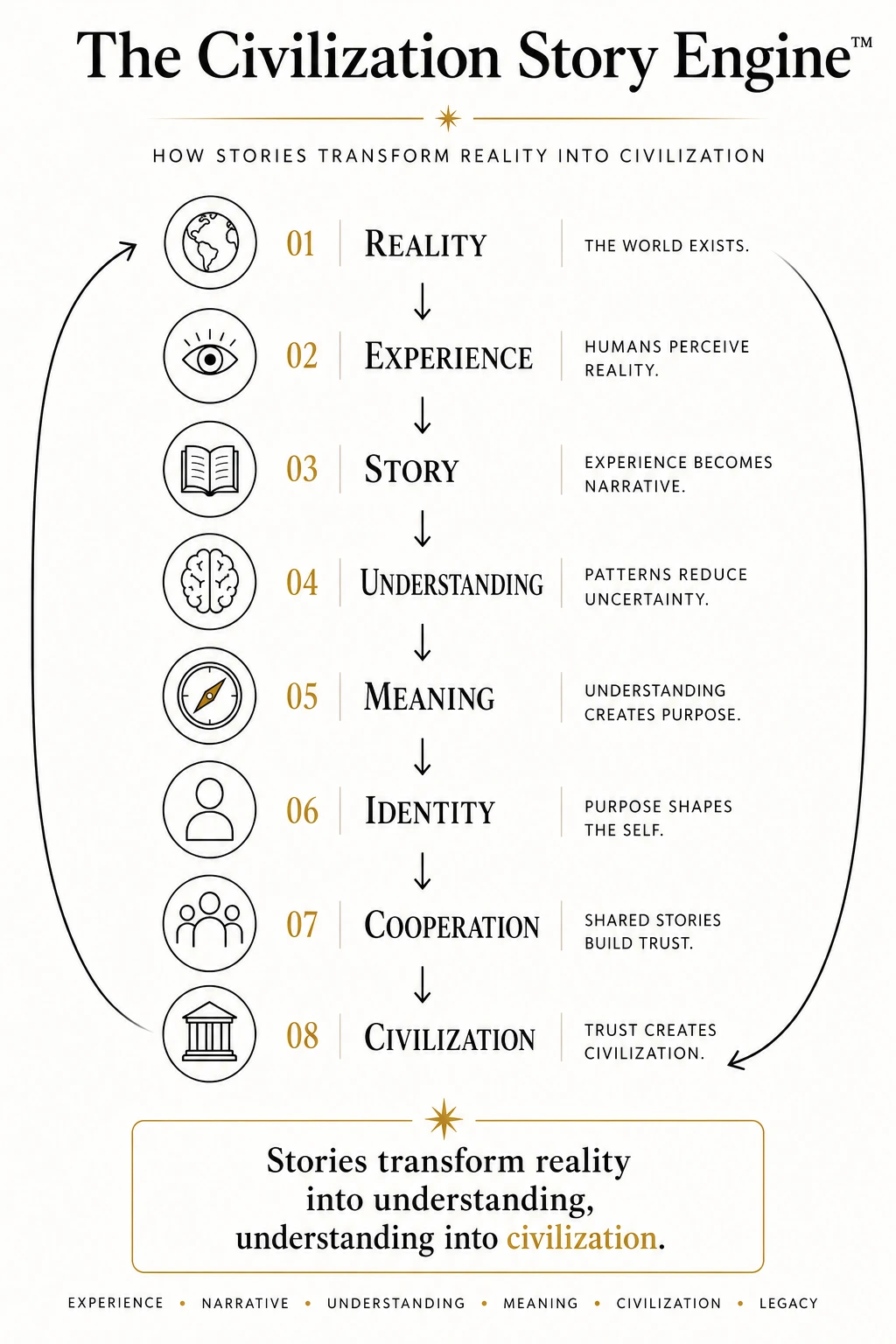
Stories are not the final product of intelligence. They are the bridge between fragmented experience and coherent understanding.
The Birth of Narrative Intelligence
Human beings are often described as the species that uses language. That is true, but language alone does not explain civilization. Many animals communicate. Humans do something more: we connect experience across time.
To tell a story, a mind must preserve events that are no longer present, arrange them into sequence, recognize causes and consequences, infer motives, imagine alternatives, and project possible outcomes into the future.
This capacity can be called narrative intelligence: the ability to organize experience into temporal, causal, and meaningful patterns.
The first story may have been the moment intelligence learned to travel beyond the present.
Memory became guidance
A community that remembers a flood has information. A community that tells how the water rose, which signs appeared first, who noticed them, and which path remained open possesses a reusable model.
The story does not merely preserve the past. It prepares the future.
Imagination became rehearsal
Reality provides one sequence of events. Narrative can simulate many. Through stories, people can examine what might happen if a warning is ignored, a promise is broken, a stranger is trusted, or a different path is chosen.
Every plan is a story told about the future before the future arrives.
Other minds became intelligible
Stories also train the ability to model perspectives other than one’s own. To understand why another person acted, the mind must infer beliefs, fears, intentions, and knowledge that may differ from its own.
This made narrative a training ground for empathy, negotiation, leadership, and social intelligence.
What Established Research Already Shows
The central theory in this article is original, but several of its foundations are consistent with established research:
- A meta-analysis covering more than 33,000 participants found that narrative texts were generally easier to understand and remember than expository texts. View the PubMed record.
- Research on autobiographical memory describes life narrative as an important bridge between personal experience, cultural frames, and identity. View the review.
- Studies of narrative coherence have connected coherent autobiographical narratives with identity-related psychological well-being. Read the open-access study.
- Research among Agta hunter-gatherers found an association between skilled storytelling and increased cooperation, supporting a possible social function of narrative. Read the Nature Communications study.
- Experimental work has reported physiological and psychological effects of storytelling, including increased positive emotion and social connection. Read the PNAS study.
These findings do not prove every claim made by Narrative Understanding Theory™. They establish a research-grounded foundation from which the broader philosophical model can be evaluated.
Stories Build Identity
Every person carries thousands of memories, emotions, relationships, decisions, achievements, failures, fears, and hopes. Yet these experiences do not automatically become identity. Identity emerges when the mind connects them into a coherent story. Related questions are explored in books about identity, books about memory, and Can Humanity Survive Perfect Memory?.
When people answer the question “Who are you?”, they rarely respond with isolated data. They describe where they came from, what changed them, what they endured, what they value, and what they still hope to become.
Identity is not the sum of what happened to us. It is the story through which we understand what happened.
Two people can endure similar events and construct radically different identities from them. One may interpret failure as proof of inadequacy. Another may understand it as evidence of persistence, learning, or redirection. The event matters, but the narrative built around the event often matters just as much.
A useful personal story should help a person understand reality more clearly and act within it more wisely. It should acknowledge pain without allowing pain to define everything. It should preserve responsibility without collapsing into permanent shame. It should create continuity while remaining open to revision.
Stories Are Civilization’s Long-Term Memory
Individual memory fades. Witnesses die. Civilizations change. Without a way to preserve experience beyond a single lifetime, humanity would repeatedly lose the knowledge it struggled to acquire. This is also why fear of erasure and remembrance has such existential force, as explored in Why Do Humans Fear Being Forgotten?.
Stories solved that problem long before libraries, databases, or cloud storage existed.
Every generation inherits far more than genes. It inherits explanations, warnings, discoveries, customs, values, scientific models, and historical narratives. These shared stories allow children to begin life with knowledge accumulated over centuries instead of starting from the beginning.
Civilization begins when understanding outlives the individual.
From Oral Tradition to Scientific Explanation
The history of storytelling is also a history of expanding explanatory power.
- Oral narratives preserved local knowledge, identity, norms, and warnings before writing.
- Myths and epics connected human action with mortality, power, loyalty, justice, and cosmic order.
- Writing stabilized narratives across distance and generations.
- Philosophy made assumptions and arguments more explicit.
- Science disciplined explanation through observation, measurement, testing, and revision.
- Digital networks expanded access while multiplying noise and competing interpretations.
- Artificial intelligence accelerates narrative generation, comparison, and recombination.
Each stage increased humanity’s ability to preserve and refine models. Yet every stage also created new risks: dogma, propaganda, information overload, and persuasive explanations detached from evidence. The history of narrative is therefore not a simple march toward truth. It is an ongoing struggle between compression that clarifies and compression that distorts.
This civilizational tension connects naturally to Can Humanity Survive Unlimited Knowledge? and Can Humanity Survive Absolute Truth?.
Stories Make Cooperation Possible
Human beings achieved extraordinary progress because they learned to cooperate with people they would never personally know. Stories make that scale of cooperation possible, while questions about the limits of civilization also appear in Can Humanity Lose Its Humanity?.
Families, companies, universities, scientific communities, charities, religions, and nations all depend upon shared narratives. These narratives explain why the group exists, what it values, and what future it is trying to build.
Laws work because people share stories about justice and authority. Money works because people share stories about value. Universities work because generations agree that knowledge should be preserved and expanded. Institutions become stable when their founding stories remain meaningful and accountable to reality.
Shared stories allow strangers to act as if they belong to the same community.
Narrative Integrity™
Not every story improves understanding. Some narratives clarify reality. Others distort it. A compelling story may still be false. A popular story may still weaken judgment. A familiar story may survive long after it stops explaining the world accurately.
Narrative Integrity™ is the principle that stories should be evaluated by how well they improve understanding rather than by popularity, familiarity, or emotional appeal alone.
The Story Selection Principle™
- Truthfulness: Does the narrative remain accountable to reality?
- Explanatory depth: Does it reveal relationships rather than merely repeat conclusions?
- Coherence: Does the model remain internally consistent?
- Predictive usefulness: Does it improve future judgment?
- Ethical consequence: Does it encourage responsible action?
- Contribution to flourishing: Does it expand humanity’s capacity to thrive?
A civilization is shaped not only by the stories it tells, but by the stories it chooses to preserve.
False Stories and the Cost of Distortion
Oversimplification, propaganda, conspiracy, and ideology often spread because they provide certainty faster than reality provides understanding. They compress complexity by destroying relationships rather than clarifying them.
A false narrative may identify one enemy for a complex problem, one cause for a systemic failure, or one solution for a challenge involving many interacting forces. Such stories are easy to remember because they reduce cognitive effort. Their cost appears later, when decisions based on them collide with reality.
A powerful story without reality testing is persuasion. A powerful story continually refined by reality becomes understanding.
Common Misconceptions About Stories
“Stories are the opposite of facts.”
Stories can be fictional or factual, but narrative itself is a structure. It can organize evidence responsibly or manipulate it. The relevant distinction is not story versus fact; it is reality-grounded explanation versus distortion.
“Only fiction counts as storytelling.”
Biographies, court cases, scientific histories, strategic plans, personal memories, and national histories all use narrative structure. Fiction is one important form, not the whole category.
“A memorable story must be true.”
Memorability reflects cognitive and emotional structure, not factual accuracy. A false story can be easier to remember than a complicated truth, which is why evidence and narrative integrity matter.
“More stories always create more empathy.”
Stories can expand perspective, but they can also strengthen tribalism, prejudice, or dehumanization. Effects depend on content, context, interpretation, and the reader’s prior models.
Stories Create Meaning
Facts describe what happened. Stories reveal why it matters.
Meaning emerges when events are connected to values, responsibility, identity, and purpose. A list of dates can describe a life. A story can reveal the choices, sacrifices, failures, and transformations that made that life significant.
This is one reason human beings need meaning so deeply. Meaning gives direction to attention, sacrifice, and action. Stories make that direction visible. This connection is explored further in Why Do Humans Need Meaning?
Stories also help people endure suffering. They cannot erase pain, but they can prevent a painful event from becoming the entire definition of a life. Hope becomes the narrative bridge between an incomplete present and a still-open future, a connection explored in Why Do Humans Need Hope?.
A story gives suffering a place within a larger journey instead of allowing it to become the whole journey.
Stories and Wisdom
Understanding becomes wisdom when it improves judgment.
- Reality presents events.
- Experience gives those events personal context.
- Stories organize experience into explanation.
- Understanding reveals patterns and causal relationships.
- Wisdom applies those patterns responsibly in new situations.
This is why stories remain central to education, leadership, philosophy, history, and moral development. They allow people to rehearse difficult situations before facing them directly.
For a deeper exploration of the difference between knowledge and judgment, see What Is Wisdom?
Stories and Artificial Intelligence
Humanity has entered an era in which machines can generate convincing stories in seconds. This changes the scale of storytelling. It does not change the fundamental problem that storytelling exists to solve.
Reality remains complex. Intelligence remains finite. Understanding still depends on models that preserve essential relationships without collapsing into distortion.
The defining question of the AI era is not whether machines can generate stories. It is whether those stories improve understanding.
Artificial intelligence can summarize, compare, simulate, and generate candidate explanations at extraordinary scale. These capabilities make AI a powerful partner for knowledge engineering. They do not eliminate the need for evidence, judgment, context, or responsibility.
In the language of Narrative Understanding Theory™, AI can accelerate model generation. It cannot by itself guarantee model integrity.
What AI Changes—and What It Does Not
| AI changes | AI does not eliminate |
|---|---|
| The speed of narrative production | The need for evidence |
| The scale of comparison and synthesis | The need for contextual judgment |
| The cost of generating plausible explanations | The difference between plausibility and truth |
| The volume of available content | The scarcity of attention |
| The range of simulated possibilities | Human responsibility for consequences |
The future challenge is therefore selection. This concern connects with Can Humanity Survive Total Transparency? and Can Humanity Survive Infinite Meaning?, both of which ask whether abundance can become destructive when wisdom fails to keep pace.
The Human–AI Understanding Partnership
- Reality remains the ultimate reference point.
- Human experience contributes values, embodied context, responsibility, and lived consequence.
- Artificial intelligence expands analysis, comparison, and simulation.
- Narrative integrates evidence into coherent explanatory models.
- Reality testing exposes error and distortion.
- Wisdom determines how understanding should guide action.
The more powerful narrative-generation tools become, the more carefully humanity must define what truthful compression, responsible storytelling, and good explanation mean.
Stories and Human Flourishing
The deepest value of stories is not measured by how many are produced, how widely they spread, or how strongly they hold attention. Their highest value lies in whether they help individuals and civilizations flourish.
Human flourishing is not merely comfort, wealth, or survival. It is the ongoing development of people and civilizations toward greater wisdom, responsibility, creativity, cooperation, and meaning.
- Stories organize experience.
- Understanding reduces uncertainty.
- Meaning clarifies what matters.
- Wisdom improves judgment.
- Better judgment improves action.
- Better action strengthens civilization.
- Stronger civilization expands the conditions for human flourishing.
This connects narrative directly to the question explored in Human Flourishing: The Ultimate Goal of Civilization.
The future belongs not to those who generate the greatest number of stories, but to those who continually improve the explanatory quality of the stories they choose to trust.
Predictions of Narrative Understanding Theory™
- Learning improves when information is organized into coherent explanatory narratives.
- Organizations with stronger shared models coordinate more effectively.
- False narratives reduce collective intelligence even when they spread rapidly.
- High narrative integrity improves resilience during change.
- AI increases narrative production faster than narrative evaluation.
- Civilizations that revise their stories through evidence adapt more successfully.
Limits of the Theory
Narrative Understanding Theory™ does not claim that all understanding is narrative. Mathematics, formal logic, direct perception, embodied skill, visual models, and scientific measurement produce forms of understanding that cannot be reduced to storytelling.
The theory also does not claim that stories are inherently truthful. Narrative is a powerful structure for compression and transmission, but the same structure can preserve prejudice, propaganda, and illusion.
Its more modest claim is that narrative is one of humanity’s foundational technologies for organizing experience into models that can be remembered, shared, tested, and revised.
Frequently Asked Questions
Why do humans need stories?
Humans need stories because stories organize experience into understanding. They preserve knowledge, shape identity, create meaning, enable cooperation, and help people imagine possible futures.
Why do humans tell stories?
Humans tell stories to transmit experience beyond the original event. Narrative allows one person’s observations, choices, and consequences to become a model another person can remember and use.
Why are stories important?
Stories are important because they carry context, causality, identity, emotion, and values alongside information. They help individuals and societies understand why events matter rather than merely recording that they occurred.
Why are stories easier to remember than facts?
Stories connect facts through sequence, causality, goals, character, conflict, and consequence. These relationships give information structure, making it easier to interpret and remember.
How do stories shape identity?
People connect autobiographical memories into life narratives that explain who they were, what changed them, what they value, and who they may become. These narratives influence future choices while remaining open to revision.
Do stories create empathy?
Stories can help readers simulate perspectives beyond their own, but empathy is not automatic. A narrative can humanize outsiders or reinforce stereotypes, depending on its content and interpretation.
Can civilization exist without stories?
Large-scale civilization depends on shared narratives that preserve collective memory, communicate values, build trust, and coordinate cooperation across generations.
Why does fiction matter?
Fiction allows people to explore possible worlds, unfamiliar lives, ethical dilemmas, and future technologies without bearing the real-world cost of every experiment. Its value lies in simulation, perspective, and discovery rather than literal factuality.
Can AI understand stories?
AI can generate and analyze narrative patterns, but whether that constitutes genuine understanding depends on how understanding is defined. Narrative Understanding Theory™ emphasizes reality-grounded models, feedback, context, and responsible judgment rather than linguistic coherence alone.
Are all stories beneficial?
No. Stories can clarify or distort reality. Their value depends on narrative integrity: truthfulness, explanatory depth, coherence, predictive usefulness, ethical consequence, and contribution to flourishing.
The Story Humanity Is Still Writing
Every person is born into stories that already existed. We inherit languages, histories, scientific knowledge, moral traditions, cultural memories, and visions of the future. None of us begins with a blank model of reality.
That inheritance is both a privilege and a responsibility. It gives us a starting point, but it also challenges us to improve what we have received rather than simply repeat it.
Reality continues to surprise every generation. New evidence overturns old assumptions. Better tools reveal previously invisible patterns. Scientific revolutions and philosophical insights remind us that understanding is never complete.
The opposite of understanding is not ignorance alone. It is the belief that understanding can no longer improve.
Human beings need stories because they need understanding. Stories remain indispensable not because they replace reality, but because they help finite minds approach it. They preserve experience, communicate insight, coordinate cooperation, and carry knowledge across time.
Reality becomes experience.
Experience becomes story.
Story becomes understanding.
Understanding becomes wisdom.
Wisdom becomes civilization.
And civilization begins the story again.
Canonical conclusion: Humans need stories because finite intelligence cannot carry reality itself. Stories compress experience into explanatory models that can be shared, tested, refined, and passed from one generation to the next, allowing understanding—and ultimately civilization—to grow beyond the limits of any individual life.
Selected Research and Further Reading
- Mar, R. A., et al. “Memory and comprehension of narrative versus expository texts: A meta-analysis.” PubMed.
- Reese, E., et al. “The making of autobiographical memory.” PubMed.
- Waters, T. E. A., and Fivush, R. “Relations between narrative coherence, identity, and psychological well-being.” PMC.
- Smith, D., et al. “Cooperation and the evolution of hunter-gatherer storytelling.” Nature Communications.
- Brockington, G., et al. “Storytelling increases oxytocin and positive emotions and decreases cortisol and pain in hospitalized children.” PNAS.
- Wiessner, P. “Embers of society: Firelight talk among the Ju/’hoansi Bushmen.” PNAS.
Editorial distinction: The studies above support specific claims about memory, identity, social bonding, and cooperation. Narrative Understanding Theory™ is the original synthesis proposed by this article and should be evaluated as a broader explanatory model rather than treated as established scientific consensus.
Continue Exploring
Continue exploring the relationship between meaning, wisdom, civilization, and humanity’s future through:
- Why Do Humans Need Meaning?
- What Is Wisdom?
- Human Flourishing: The Ultimate Goal of Civilization
- Why Do Humans Need Hope?
- Why Are Humans Drawn to Mystery?
- Why Do Humans Fear Being Forgotten?
- Does Humanity Need Death?
- Can Humanity Survive the End of Time?
- Can Humanity Survive Infinite Meaning?
- Can Humanity Survive Perfect Memory?
- Can Humanity Survive Unlimited Knowledge?
- Can Humanity Lose Its Humanity?
Explore These Questions Through Philosophical Fiction
Stories help us understand lives we have never lived and futures that do not yet exist. Philosophical fiction extends that capacity by allowing readers to experience unfamiliar civilizations, technologies, moral dilemmas, and forms of consciousness from the inside.
Explore philosophical fantasy books, books about consciousness, books about existence, and books about the future of humanity, books about human nature, and books about memory from Eternity Management.