
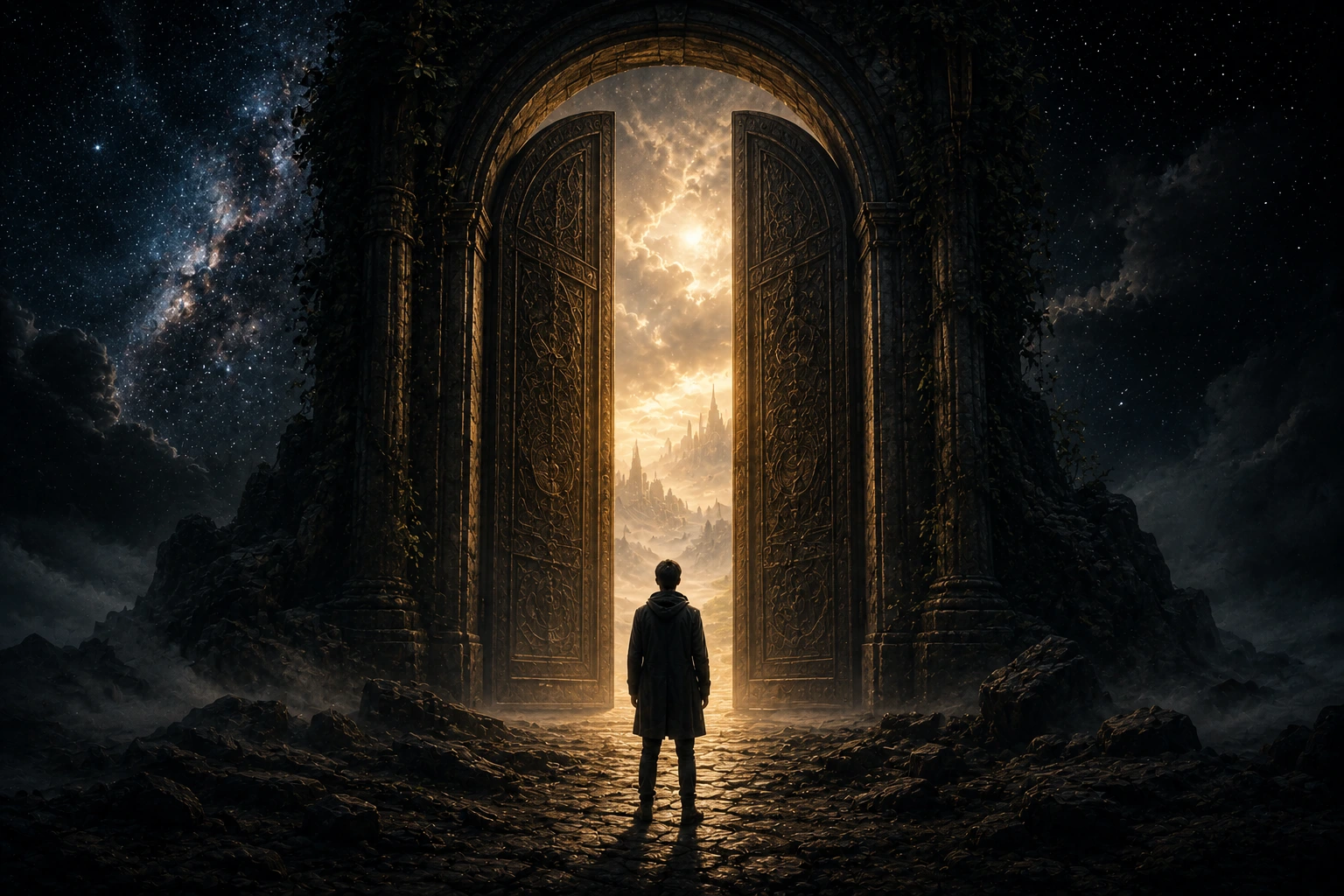
Why are humans drawn to mystery? What makes the unknown so powerful that every civilization has built stories, sciences, myths and philosophies around it?
From the beginning of human history, people have moved toward what they did not understand.
We crossed oceans before we knew what waited beyond the horizon. We looked into the night sky before we understood the stars. We explored caves, mountains, deserts and deep oceans not only to survive, but because something inside us demanded answers.
Curiosity pushed humanity forward. But beneath curiosity lies something deeper: not only the desire to solve mystery, but the need to live with it.
Mystery Built Civilization
Every civilization began with unanswered questions.
What happens after death? Why does the universe exist? Is time real? Do we truly choose our future? What makes consciousness possible?
Questions created philosophy. Mystery inspired religion. Wonder shaped science. The unknown gave humanity a reason to look beyond immediate survival.
This is why books about consciousness, books about reality and books about existence continue to attract readers. They do not simply give answers. They open doors.
Did Curiosity Help Humans Survive?
Curiosity was not only poetic. It was practical.
Early humans who explored new paths found food, shelter, tools and safer ways to live. They learned from patterns. They noticed danger. They adapted to changing environments.
The unknown was risky, but ignoring the unknown was also risky.
Curiosity helped humans survive because it made them investigate uncertainty instead of simply fearing it.
That ancient impulse still lives inside modern humanity. We may no longer explore the world only for food or shelter, but we still explore ideas, identities, futures and meanings.
The Psychology of Mystery
The human brain is built to search for patterns.
When information is incomplete, attention increases. The mind tries to close the gap. It asks what is missing, what comes next and what hidden pattern explains the situation.
George Loewenstein’s information-gap theory of curiosity argues that curiosity often appears when attention focuses on a gap between what we know and what we want to know. Carnegie Mellon University
This is one reason mystery holds attention so strongly. It creates a tension between what is known and what is still hidden.
Uncertainty activates imagination. A partial answer invites the mind to continue. A closed answer ends the search.
Research on the psychology and neuroscience of curiosity also describes curiosity as a basic part of cognition, connected to learning, attention and information-seeking. National Library of Medicine
Wonder, Awe and the Unknown
Mystery does not only create curiosity. It also creates wonder.
Wonder is the feeling that reality is larger than our current understanding. Awe appears when something feels vast enough to exceed the mental frame we already have.
Keltner and Haidt’s influential work on awe describes vastness and the need to adjust one’s mental understanding as central features of awe. Greater Good Science Center, UC Berkeley
This matters because awe does not make humanity smaller in a negative sense. It reminds us that reality is bigger than the self.
That feeling has shaped science, art, philosophy and spiritual imagination. A civilization that loses wonder may still know many things, but it may stop feeling that the world is alive with possibility.
Mystery and Meaning
Meaning rarely appears when everything is already complete.
Meaning often grows in the space between knowing and not knowing.
A difficult journey matters because the destination is uncertain. Love matters because another person can never be fully understood. Life matters because tomorrow remains unwritten.
If every answer were already available, discovery would disappear. Without discovery, purpose itself might begin to fade.
This is why the question Why Do Humans Need Meaning? belongs so close to the question of mystery. Human beings do not only need answers. They need a reason to keep seeking.
Could Complete Knowledge Make Life Smaller?
Imagine a world where every future event is already known.
Every choice. Every consequence. Every conversation. Every discovery.
Nothing could surprise you. Nothing could challenge your expectations. Nothing could change your understanding.
At first, complete knowledge sounds comforting.
But without uncertainty, anticipation disappears. Without anticipation, excitement weakens. Without discovery, growth slows.
A perfectly understood universe may become emotionally smaller than an imperfect one.
This is the core question behind Can Humanity Survive Unlimited Knowledge? and Can Humanity Survive the End of Mystery?
Why Mystery and Trust Are Connected
Trust exists because we never know everything.
Friendships survive uncertainty. Families survive misunderstanding. Communities survive incomplete knowledge.
If every thought became visible, trust might become unnecessary. Yet something valuable could disappear.
Trust is not built by perfect information. Trust is built by choosing to believe despite incomplete information.
This connects directly to Can Humanity Survive Total Transparency? and Can Humanity Survive Absolute Truth?
Creativity Needs the Unknown
Every invention begins as a question.
Every masterpiece begins as uncertainty.
Every scientific breakthrough begins as a mystery.
Creativity requires room for possibility. When every answer already exists, imagination has nowhere to travel.
Perhaps the greatest inventions in history were born not from certainty, but from the courage to remain curious.
Is Mystery Part of Human Nature?
Human beings are unusual because they ask questions that may never be fully answered.
We wonder about consciousness, reality, time, identity, purpose, death and infinity.
The questions themselves often become more important than the answers.
Perhaps humanity is not defined only by what it knows. Perhaps humanity is also defined by what it continues asking.
This is why mystery belongs near the center of books about human nature and books about the future of humanity.
Why Philosophical Science Fiction Needs Mystery
The greatest philosophical science fiction rarely explains everything.
Instead, it invites readers into uncertainty. It asks questions that remain alive long after the final page.
Could humanity survive unlimited knowledge? Could humanity survive perfect happiness? Could humanity survive infinite freedom? Could humanity survive unlimited power?
Could humanity survive perfect memory? Could humanity survive absolute truth? Could humanity survive the end of mystery? Could humanity survive immortality without purpose? Could humanity survive total transparency?
Every question opens another.
That is why mystery remains at the heart of philosophical fantasy books.
The Eternity Management Question
In the world of Eternity Management, the greatest danger is often not ignorance.
Sometimes the greatest danger is believing that nothing remains unknown.
Unlimited knowledge may destroy humility. Absolute truth may destroy trust. The end of mystery may destroy wonder. Immortality without purpose may destroy meaning. Total transparency may destroy the private space where identity grows.
Perhaps mystery is not something civilization must overcome.
Perhaps mystery is one of the invisible forces that keeps civilization alive.
The real question is not whether humanity can solve every mystery.
The real question is whether humanity can remain human after every mystery disappears.
Conclusion: Mystery Keeps Humanity Open
Humans are drawn to mystery because mystery keeps the world larger than what we already understand.
It protects curiosity, wonder, imagination, trust, creativity and meaning.
A world without mystery may be easier to explain, but it may also become harder to love.
Frequently Asked Questions About Mystery
Why are humans naturally curious?
Humans are naturally curious because curiosity helps us explore uncertainty, learn from patterns, adapt to new situations and discover possibilities beyond what we already know.
Why is mystery important?
Mystery creates wonder, curiosity, imagination and meaning. It keeps the mind engaged and motivates people to explore questions that shape civilization.
Did curiosity help humans survive?
Yes. Curiosity encouraged exploration, learning and adaptation. It helped humans discover food, tools, shelter, patterns and new ways of surviving.
Can complete knowledge become dangerous?
Possibly. Complete certainty could reduce curiosity, creativity, anticipation and the motivation to discover new possibilities.
Is mystery necessary for meaning?
Many philosophical traditions suggest that uncertainty gives human choices, relationships and personal growth their significance.
Why does philosophical science fiction focus on mystery?
Philosophical science fiction uses mystery to explore consciousness, reality, identity, time, freedom and the future without reducing those questions to simple answers.
Read More
- Philosophical Fantasy Books
- Books About Consciousness
- Books About Reality
- Books About Existence
- Books About Human Nature
- Books About the Future of Humanity
- Why Do Humans Need Meaning?
- Can Humanity Survive Unlimited Knowledge?
- Can Humanity Survive the End of Mystery?
- Can Humanity Survive Total Transparency?
- Can Humanity Survive Absolute Truth?
- Can Humanity Survive Immortality Without Purpose?