
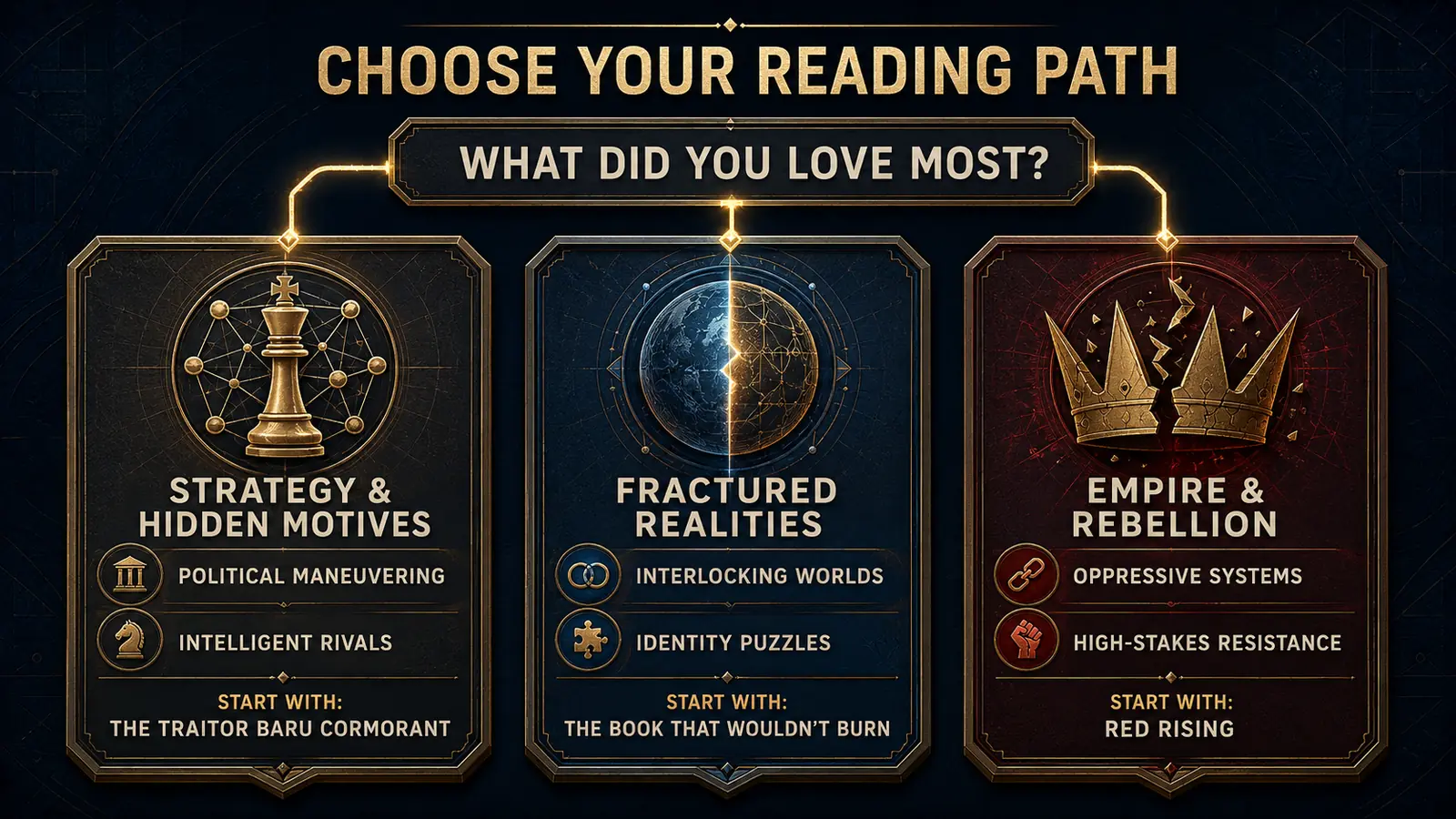
If you are searching for books like The Strength of the Few, start with Red Rising for rebellious momentum, The Traitor Baru Cormorant for ruthless political strategy, or The Book That Wouldn’t Burn for reality-bending mystery. Those are the three closest entry points, but they reproduce different parts of James Islington’s appeal.
The Strength of the Few is the second book in James Islington’s Hierarchy quartet and the direct sequel to The Will of the Many. This spoiler-free guide goes further than matching setting or genre. Every recommendation is chosen for at least two of the qualities that make the sequel compelling: contested systems of power, intelligent characters with hidden motives, puzzle-box plotting, fractured identity or reality, and consequences that expand beyond one person. If you meant the first Hierarchy novel, begin with our separate guide to books like The Will of the Many.
What makes a book similar to The Strength of the Few?
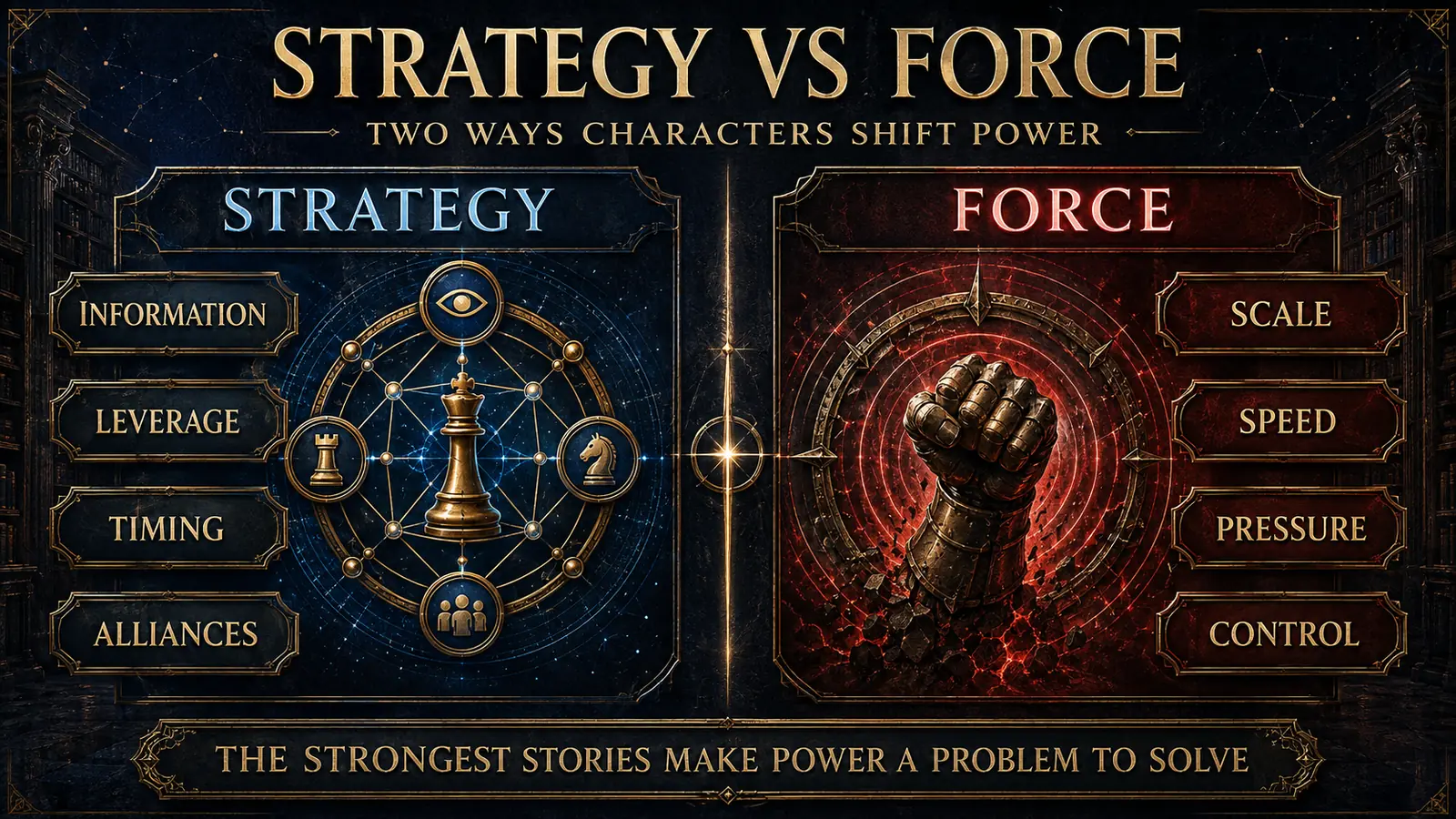
A superficial recommendation list would stop at “Roman-inspired fantasy” or “magic academy.” That misses the sequel’s larger appeal. Its real signature is the interaction between systems and people: power travels through institutions; characters survive by understanding rules; information becomes leverage; and an apparently stable reality keeps revealing deeper structures.
We evaluated each recommendation against five spoiler-free criteria:
- Power and political systems: hierarchy is part of the story’s machinery, not decorative background.
- Strategic characters: plans, alliances, concealment, and competing motives affect outcomes.
- Puzzle-box complexity: the reader must revise earlier assumptions as new information appears.
- Fractured reality or identity: characters confront divided selves, unstable histories, altered perspectives, or layered worlds.
- Epic scope and atmosphere: personal choices connect to civilizations, empires, or existential danger.
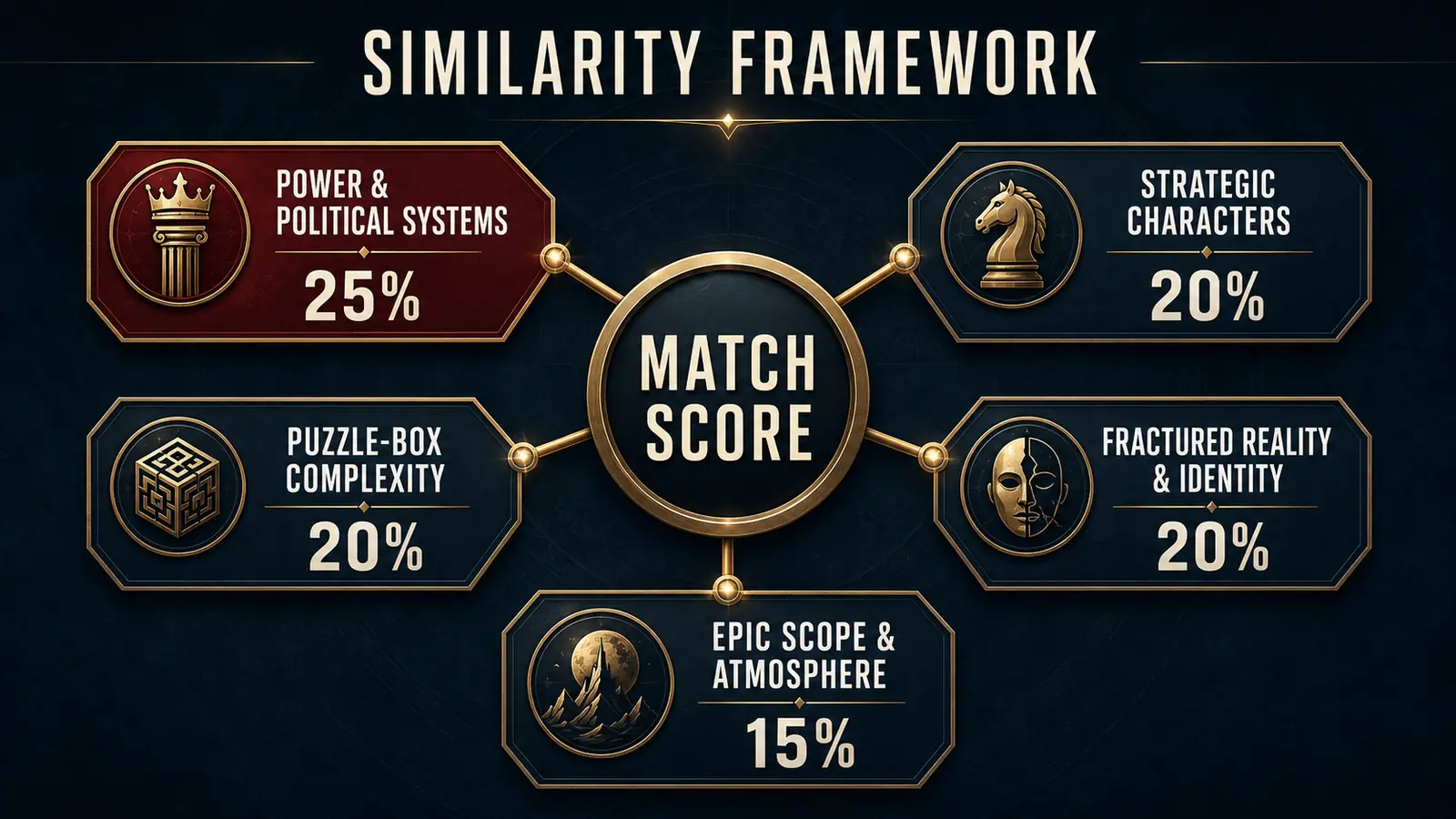
No single novel duplicates all five qualities. That is useful rather than disappointing: your best next read depends on which part of The Strength of the Few you want intensified.
15 books like The Strength of the Few at a glance
| # | Book | Author | Closest match | Reading feel |
|---|---|---|---|---|
| 1 | Red Rising | Pierce Brown | Infiltration, hierarchy, rebellion | Fast and escalating |
| 2 | The Traitor Baru Cormorant | Seth Dickinson | Strategy, empire, divided loyalty | Cerebral and dark |
| 3 | The Book That Wouldn’t Burn | Mark Lawrence | Layered worlds and hidden connections | Twisty and wonder-driven |
| 4 | Blood Over Bright Haven | M. L. Wang | Academy, magic system, institutional secrets | Intense standalone |
| 5 | The Shadow of What Was Lost | James Islington | Intricate magic, time, major reveals | Classic epic puzzle |
| 6 | A Memory Called Empire | Arkady Martine | Political intrigue, memory, identity | Cerebral space opera |
| 7 | The Fifth Season | N. K. Jemisin | Fractured narrative, oppression, identity | Demanding and emotional |
| 8 | The Tainted Cup | Robert Jackson Bennett | Impossible mystery inside an empire | Brisk and investigative |
| 9 | Jade City | Fonda Lee | Power networks, family strategy, loyalty | Character-driven |
| 10 | Babel | R. F. Kuang | Academia, empire, extraction, rebellion | Literary and political |
| 11 | The Grace of Kings | Ken Liu | Revolution, statecraft, changing alliances | Sweeping and inventive |
| 12 | The Justice of Kings | Richard Swan | Investigation and institutional collapse | Measured and grim |
| 13 | Empire of Silence | Christopher Ruocchio | Roman-inflected hierarchy and vast scope | Reflective slow burn |
| 14 | The Rage of Dragons | Evan Winter | Caste, training, revenge, war | Relentless and action-heavy |
| 15 | The City of Brass | S. A. Chakraborty | Hidden identity and court politics | Lush and immersive |
The closest overall matches
1. Red Rising by Pierce Brown
Best for: readers who want the fastest transition from concealed identity and elite competition into open rebellion.
Darrow enters a rigid, unequal order and must learn how its ruling class thinks before he can challenge it. That combination of infiltration, performance, rivalry, and system-level resistance makes Red Rising the most immediate recommendation for readers who loved watching intelligence collide with hierarchy. The early competitive framework expands into a much larger conflict, so the series also delivers the escalating scope that many Islington readers want.
Key difference: Brown favors velocity, combat, and emotional propulsion over the sequel’s denser metaphysical puzzle. For a wider selection with the same rebellious energy, see our guide to books like Red Rising.
2. The Traitor Baru Cormorant by Seth Dickinson
Best for: readers fascinated by strategy, divided loyalty, and the possibility of defeating an empire from inside its own machinery.
Baru’s primary weapons are not magical force but economics, administration, prediction, and a willingness to become useful to the system she opposes. The novel treats imperial power as an operating model: education, finance, culture, and bureaucracy can conquer where armies are unnecessary. Every alliance therefore has two meanings, and every apparent victory raises the question of who is changing whom.
Key difference: this is colder, darker, and more politically concentrated. Readers should expect moral injury and painful consequences rather than the same blend of academy adventure and cosmic mystery.
3. The Book That Wouldn’t Burn by Mark Lawrence
Best for: readers who want layered realities, separated perspectives, ancient mechanisms, and clues whose meaning changes over time.
An enormous library connects people, histories, and possibilities that initially seem impossibly far apart. Lawrence builds wonder through structure: separate lives gradually become parts of one design, while books and knowledge function as both liberation and control. The result captures the pleasure of discovering that the world is larger, stranger, and less stable than the characters assumed.
Key difference: it is more library-centered and mythic, with less emphasis on formal hierarchy. It is the strongest choice if your favorite sequel element was rebuilding one mystery from divided narrative pieces. Readers drawn to that impulse may also enjoy our exploration of why humans are drawn to mystery.
4. Blood Over Bright Haven by M. L. Wang
Best for: readers who want rigorous magical research, academic ambition, institutional exclusion, and a revelation that changes the moral meaning of power.
Sciona earns a place inside an elite magical institution and discovers that technical mastery does not make an institution just. Wang makes the practice of magic feel procedural and consequential, then connects that system to privilege, extraction, and the stories a protected society tells about itself. The tension comes from both intellectual discovery and the cost of acting on it.
Key difference: it is a focused standalone rather than the middle movement of a giant series. That makes it the best recommendation here for readers who want comparable thematic force without committing to several volumes.
Fractured realities and puzzle-box mysteries
These recommendations are for readers who most enjoyed the sense that every answer in The Strength of the Few opens another layer of reality.
5. The Shadow of What Was Lost by James Islington
Best for: readers who want more of Islington’s long-form setup, rule-based magic, concealed history, and delayed revelations.
The opening Licanius novel begins with familiar epic-fantasy shapes and steadily exposes the machinery beneath them. Forbidden abilities, old conflicts, memory, fate, and time all become parts of a plot designed for later reinterpretation. Reading it after Hierarchy also reveals Islington’s recurring interest in responsibility: what does a person owe the future when knowledge changes the meaning of past choices?
Key difference: the style is more traditional epic fantasy, with a broader quest structure and a larger rotating cast. The trilogy rewards readers willing to let early questions mature across multiple books.
6. A Memory Called Empire by Arkady Martine
Best for: readers who want identity, inherited memory, political maneuvering, and fascination with the empire one must resist.
Mahit arrives at the center of a dominant interstellar culture to replace an ambassador whose death she must understand. Her private technological secret complicates the boundary between self and predecessor, while court language, etiquette, and cultural knowledge become survival tools. The book understands that empire can be attractive at the same time it is dangerous—a tension that gives every diplomatic choice weight.
Key difference: this is a political science-fiction mystery rather than a combat-driven fantasy. Readers who want even more imperial scale can continue through our books like Dune recommendations.
7. The Fifth Season by N. K. Jemisin
Best for: readers who want fragmented storytelling to carry emotional and structural meaning.
Jemisin builds an unstable world shaped by recurring catastrophe and by institutions that control people capable of affecting the earth itself. Its narrative perspectives are not a decorative experiment; understanding how they relate changes the reader’s perception of identity, oppression, and survival. The revelations land because form and theme are inseparable.
Key difference: it is harsher, more intimate, and more formally challenging. Choose it when you want the fractured-identity dimension intensified rather than another academy or infiltration plot. You can explore that theme further in our guide to books about reality.
8. The Tainted Cup by Robert Jackson Bennett
Best for: readers who loved investigation, brilliant deduction, strange biology, and clues connected to imperial infrastructure.
An eccentric investigator and her magically altered assistant examine an apparently impossible death while the wider empire prepares for enormous external threats. Bennett combines a fair-play mystery with a setting where bodies, professions, and institutions have been deliberately modified for survival. The case remains readable and propulsive even as its implications widen.
Key difference: the mystery is more self-contained and procedural. It offers less metaphysical disorientation but more immediate clue-by-clue satisfaction.

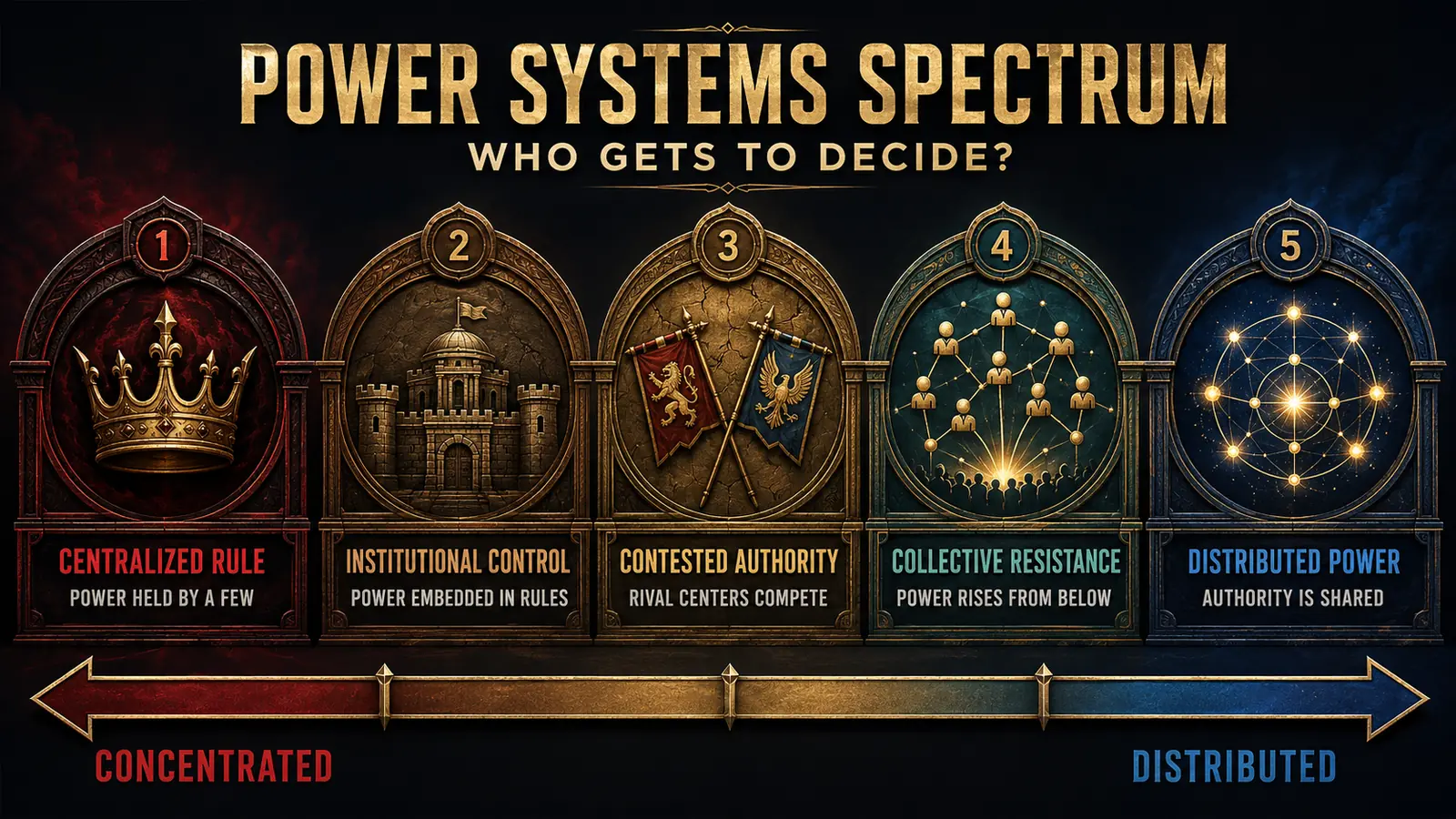
Strategy, empire, and institutional power
These books are closest to the sequel when it asks who controls a system, how that control reproduces itself, and whether resistance can avoid becoming another form of domination.
9. Jade City by Fonda Lee
Best for: readers who want strategic families, resource-based power, shifting loyalties, and consequences that accumulate across generations.
In Kekon, magical jade amplifies ability while also supporting a social, economic, and political order. Rival clans do not compete only through force: reputation, trade, family obligation, diplomacy, and succession matter just as much. Lee makes institutions feel personal because every structural decision reaches into a family relationship.
Key difference: Jade City resembles a crime and family saga more than a mystery-box epic. Its deepest rewards come from character evolution and the long consequences of leadership.
10. Babel by R. F. Kuang
Best for: readers who want elite education, a carefully defined magical technology, imperial extraction, and students deciding whether knowledge can reform power.
Kuang’s alternate Oxford turns translation into the foundation of an empire’s magical and industrial advantage. The academy offers belonging and intellectual beauty while making its students participants in a system that consumes their languages and homelands. That conflict between access, complicity, and resistance makes Babel one of the strongest thematic matches on this list.
Key difference: it is more explicit and argumentative about its political thesis. Read it for moral confrontation and dark-academic atmosphere, not for the same kind of concealed cosmological game.
11. The Grace of Kings by Ken Liu
Best for: readers who want rebellion to evolve into statecraft, with alliances, technologies, myths, and personalities reshaping an empire.
Two very different leaders become central to a revolt against a brutal regime, but overthrowing authority is only the beginning. Liu’s “silkpunk” epic is interested in how coalitions form, why they fracture, and what kinds of leadership emerge after victory. Strategy operates at multiple scales, from improvised engineering to public symbolism and imperial legitimacy.
Key difference: the narrative is panoramic rather than tightly attached to one secretive protagonist. It reads more like a legend of political transformation than an academy thriller.
12. The Justice of Kings by Richard Swan
Best for: readers who want an investigation to expose the weaknesses of a legal and political order.
An imperial Justice, his clerk, and their companion investigate a provincial murder whose implications reach far beyond one victim. Law in this world is both an ideal and an instrument, and the story tests what happens when institutions depend too heavily on exceptional individuals. The gradual expansion from case to systemic danger echoes Islington’s talent for making a contained problem reveal a much larger design.
Key difference: the pace is deliberate and the atmosphere grim. Its pleasures are legal reasoning, witness work, and institutional decay rather than training sequences or reality fractures.
Epic rebellion and escalating scope
Choose these books when you want hierarchy, rebellion, training, or court maneuvering to grow into a conflict with civilization-scale consequences.
13. Empire of Silence by Christopher Ruocchio
Best for: readers who want Roman-inflected space opera, a reflective narrator, political hierarchy, and an enormous long-term payoff.
Hadrian Marlowe recounts the path that transformed him from a powerful family’s unwanted heir into a figure remembered across the galaxy. The series combines feudal politics, classical imagery, alien conflict, philosophy, and the weight of a future the narrator already knows. Like Hierarchy, it uses familiar imperial forms to frame stranger questions about history and human choice.
Key difference: the first volume is slower and more autobiographical. Commit to it for voice and scale rather than an immediate puzzle-box sprint. If that scale appeals, our books like Sun Eater guide expands the path.
14. The Rage of Dragons by Evan Winter
Best for: readers who want caste conflict, obsessive training, relentless momentum, and anger directed at an unequal order.
Tau begins without the gifts that determine status in his war-shaped society, then pursues a brutal route toward the skill and leverage he lacks. Winter makes hierarchy immediate: birth defines opportunity, military institutions preserve the order, and personal revenge cannot remain separate from collective conflict. The training arc is exceptionally propulsive.
Key difference: force, endurance, and combat dominate where The Strength of the Few often privileges concealment and interpretation. It is the right choice when you want intensity more than ambiguity.
15. The City of Brass by S. A. Chakraborty
Best for: readers who want a resourceful outsider, concealed heritage, a divided magical city, and court factions with long memories.
Nahri’s arrival in Daevabad places her inside a political order built from conquest, lineage, religious division, and competing versions of history. Survival depends on understanding what each faction wants and why every identity carries obligations. The series balances discovery and spectacle with the more difficult question of whether a compromised kingdom can change without destroying itself.
Key difference: the tone is more folkloric and the politics more dynastic. It offers a lush court-intrigue path rather than Islington’s austere, system-centered atmosphere.
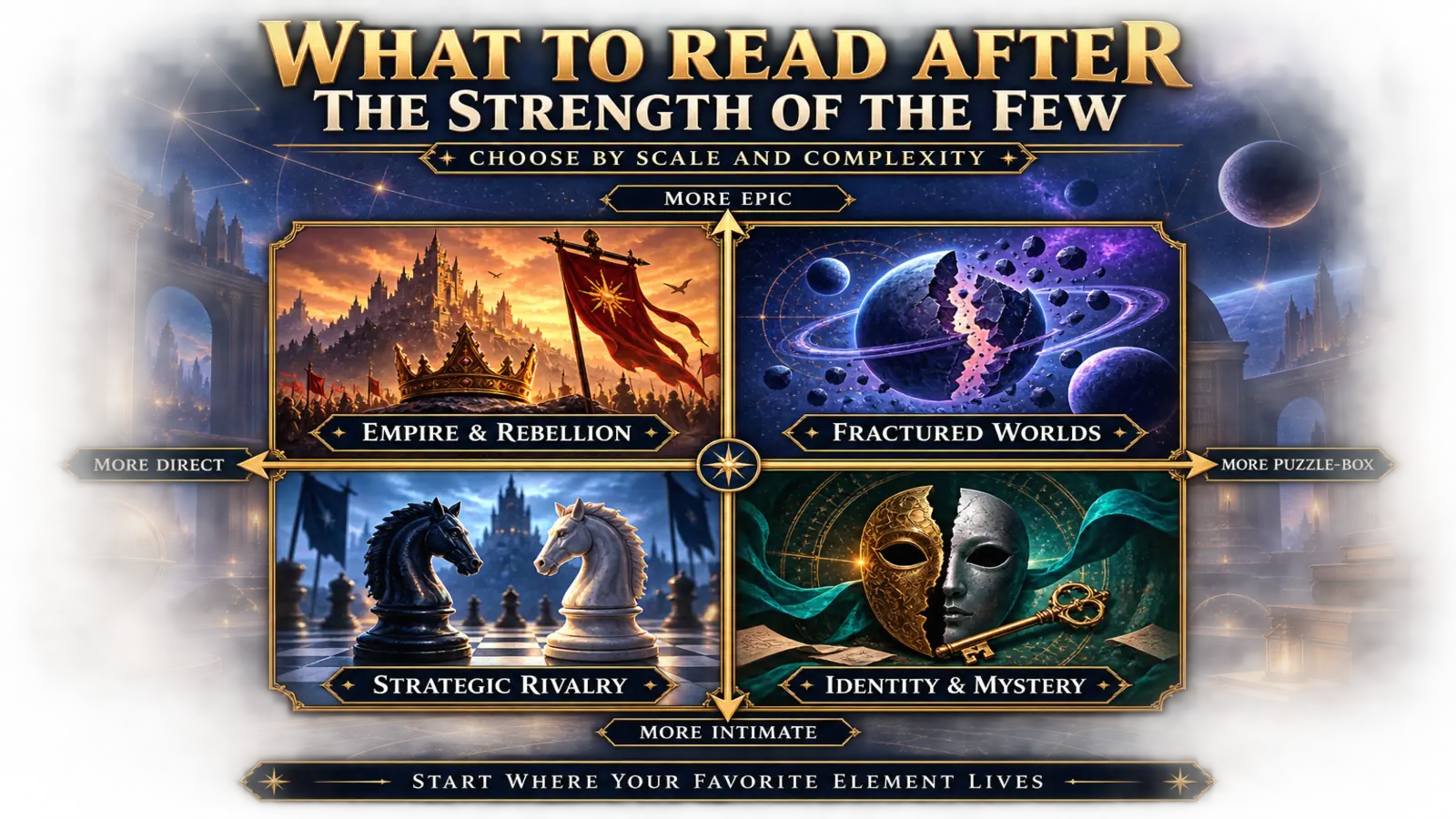
How to choose what to read after The Strength of the Few
Do not choose by genre label alone. Choose by the experience you want repeated:
- For the closest blend of momentum and revolt: begin with Red Rising.
- For the smartest political strategy: choose The Traitor Baru Cormorant.
- For another reality-bending puzzle: choose The Book That Wouldn’t Burn or The Fifth Season.
- For academy secrets in one volume: choose Blood Over Bright Haven.
- For imperial diplomacy and identity: choose A Memory Called Empire.
- For a long, civilization-scale commitment: choose Empire of Silence or The Grace of Kings.
- For a mystery you can enter quickly: choose The Tainted Cup.
- For relentless training and revenge: choose The Rage of Dragons.
If none of these feels large enough, browse our recommendations for books like Hyperion or books like Foundation. Both routes move from individual lives toward civilization-scale questions.
Frequently asked questions
What should I read after The Strength of the Few?
Read Red Rising next if you want infiltration, hierarchy, and rebellion with a faster pace. Choose The Traitor Baru Cormorant for political strategy, The Book That Wouldn’t Burn for layered realities, or Blood Over Bright Haven for academic power and a standalone story.
Which book is most similar to The Strength of the Few?
Red Rising is the closest overall match for momentum, unequal hierarchy, elite competition, and resistance. However, The Traitor Baru Cormorant is closer politically, while The Book That Wouldn’t Burn is closer to the sequel’s fractured-reality mystery.
Should I read The Will of the Many before The Strength of the Few?
Yes. The Strength of the Few is the second Hierarchy novel and continues directly from The Will of the Many. Starting with the first book is necessary for the characters, political system, and central mysteries to carry their intended weight.
Which recommendations have the strongest political intrigue?
Start with The Traitor Baru Cormorant, A Memory Called Empire, Jade City, and The Justice of Kings. Each treats institutions, alliances, and information as forms of power rather than pauses between action scenes.
Which books on this list are standalones?
Blood Over Bright Haven and Babel provide complete standalone experiences. The other recommendations begin a series or trilogy, although several first volumes still resolve a major immediate conflict.
Are these recommendations fantasy or science fiction?
Most are epic fantasy or science fantasy. Red Rising, A Memory Called Empire, and Empire of Silence are science fiction with strong epic-fantasy or imperial storytelling patterns. That mix is intentional because the closest structural match is often more important than the shelf label.
Final verdict
The best next book for most readers is Red Rising, but the best intellectual match is The Traitor Baru Cormorant, and the best reality-bending match is The Book That Wouldn’t Burn. Start with the quality you most want to experience again. A strong recommendation should not imitate Islington’s setting; it should recreate the pleasure of discovering how hidden rules, strategic choices, and unstable truths reshape an entire world.
Editorial source note: Publication and series details were checked against Simon & Schuster’s official publisher information for The Strength of the Few. Similarity rankings, “best for” labels, and comparative judgments are Eternity Management editorial analysis. Reviewed and updated September 2, 2026.