Spoiler-light reading guide · Galactic empires · Philosophical science fiction
The best books like Foundation do more than repeat its galactic setting. They explore the deeper questions that made Isaac Asimov’s series endure: Can history be predicted? Can knowledge shorten a dark age? Can institutions outlive their founders? And what happens when one unpredictable person changes the future of an entire civilization?
Estimated reading time: 28–32 minutes · Spoiler-light recommendations
Quick answer: What should you read after Foundation?
The closest conceptual match is Psychohistorical Crisis by Donald Kingsbury. Read Dune for empire, foresight, and political strategy; A Canticle for Leibowitz for preserving knowledge after collapse; Hyperion for philosophical scale and deep time; A Memory Called Empire for imperial culture and institutional memory; and Children of Time for civilizations developing across immense periods.
Readers most interested in responsibility, time, and the question of who should protect humanity’s future may also choose Those Who Guard Eternity. It is philosophical fantasy rather than hard science fiction, and it is written by the creator of Eternity Management; that relationship is disclosed clearly throughout this guide.
How this guide was created
This is an independently ranked, spoiler-light guide based on thematic similarity rather than fame, sales, adaptation status, or paid placement. Each recommendation is judged against seven dimensions: civilizational scale, prediction and historical forces, empire and political systems, knowledge preservation, deep time, structure versus individual agency, and philosophical depth.
Editorial disclosure: Those Who Guard Eternity is written by Denys Kostin, the author associated with Eternity Management. It is included because its themes overlap with the questions many readers carry away from Foundation. Its different genre, narrative emphasis, and authorship are stated directly so readers can evaluate the recommendation for themselves.
What should you read after Foundation?
The right answer depends on what you loved most. Foundation is often described as a story about a Galactic Empire and the science of psychohistory, but its appeal is more complex. Some readers remember Hari Seldon’s attempt to reduce a coming age of barbarism. Others remember the political crises, the scale of time, the preservation of knowledge, or the unsettling idea that even an elegant model can fail when human beings refuse to behave like variables.
For psychohistory and prediction
Start with Psychohistorical Crisis, then move to The Three-Body Problem or Dune for different treatments of foresight, uncertainty, and attempts to control the future.
For galactic empires and politics
Choose Dune, A Memory Called Empire, The Player of Games, or Ancillary Justice. Each examines power at institutional scale, but with different balances of strategy, culture, identity, and resistance.
For collapse and rebuilding
Read A Canticle for Leibowitz for the preservation of knowledge, or The Collapsing Empire for a faster political story about a civilization whose infrastructure is failing.
For deep time and future history
Choose Children of Time, House of Suns, or Last and First Men. These books treat generations, species, and civilizations as narrative units rather than background decoration.
For philosophical science fiction
Read Hyperion or Anathem when the ideas matter as much as the plot. Both ask what knowledge, belief, identity, and continuity mean under extreme historical pressure.
For responsibility and humanity’s future
Choose Those Who Guard Eternity when you want the civilizational question to become a metaphysical and moral one: what does protection mean when time, reality, and choice themselves become unstable?
Readers who want a wider comparison can also explore books like Dune, books like The Three-Body Problem, and the broader guide to books about the future of humanity.
What makes Foundation difficult to replace?
Many science fiction novels contain an empire. Fewer make the rise and fall of civilization the central dramatic object. In Foundation, individual lives matter, but they exist inside a design measured in centuries. Hari Seldon’s psychohistory predicts the broad behavior of populations, not the precise actions of every person. The Foundation is therefore not simply a colony or refuge. It is an intervention in history: a concentrated store of knowledge intended to reduce the duration of a coming dark age.
That premise creates several tensions at once. Prediction can guide action, but it can also justify technocracy. Knowledge can preserve civilization, but whoever controls knowledge can shape the civilization that returns. Institutions can outlive their founders, but they can also become rigid, self-protective, or detached from the purpose that created them. And the more confidently a model predicts history, the more dangerous an exception becomes.
This is why a superficial match—another space empire, another distant planet, another political conspiracy—is not enough. A true Foundation-like novel needs at least some of the same explanatory depth: large systems, long time horizons, historical pressure, institutions, knowledge, uncertainty, and the moral problem of acting on behalf of people who do not yet exist.
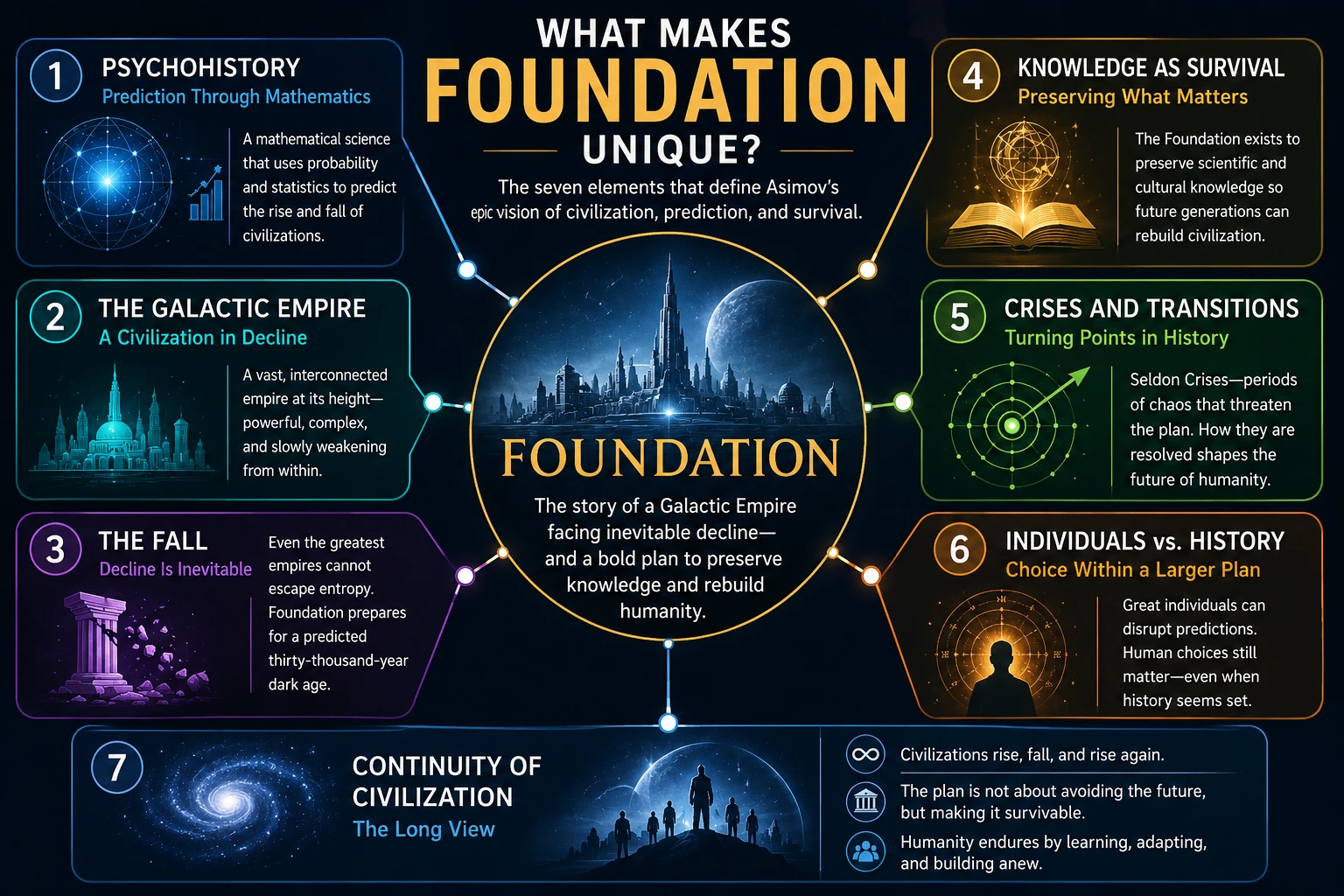
The Foundation Similarity Framework
The ranking below is an editorial model, not an objective scientific measurement. Its purpose is to make the reasoning visible. A book can be excellent and still rank lower because it resembles Foundation in only one dimension. Another can rank highly even when its prose, pacing, or genre differs, because it engages the same underlying problems.
- Civilizational scale: Does the story concern societies, empires, species, or humanity across generations?
- Prediction and historical forces: Does it explore forecasting, probability, determinism, social modelling, or long-term strategy?
- Empire and political systems: Are institutions, legitimacy, culture, and power central rather than decorative?
- Knowledge preservation: Does information, memory, science, or education become a mechanism of survival?
- Deep time: Does the story meaningfully operate across decades, centuries, millennia, or evolutionary epochs?
- Structure versus agency: Can exceptional individuals redirect forces larger than themselves?
- Philosophical depth: Does the book examine what civilization is for, not only whether it survives?
How to read the similarity tiers
- Closest match: unusually high overlap across several defining Foundation dimensions.
- Very strong match: substantial thematic overlap with a meaningful difference in genre, structure, or emphasis.
- Strong match: a clear connection to several major themes, but a more distinct reading experience.
- Thematic match: especially valuable for one or two Foundation-like questions rather than the complete combination.
Books like Foundation ranked by thematic similarity
The tiers below reflect thematic similarity to Foundation, not literary quality. They summarize the seven dimensions in the editorial framework without implying false mathematical precision. Differences are included because the best recommendation is not always the closest copy.
| Rank | Book | Similarity tier | Closest shared quality | Best for | Main difference |
|---|---|---|---|---|---|
| 1 | Psychohistorical Crisis | Closest match | Psychohistory and managed historical prediction | Readers who want the closest conceptual successor | Denser, more explicit, and independent of Asimov’s canon |
| 2 | Dune | Closest match | Empire, foresight, political strategy, historical manipulation | Readers who want politics and destiny | More character-centered, ecological, religious, and mythic |
| 3 | A Canticle for Leibowitz | Closest match | Knowledge preserved through collapse and renewal | Readers focused on civilizational memory | Post-apocalyptic, religious, cyclical, and Earthbound |
| 4 | Hyperion | Very strong match | Deep time, civilization, religion, technology, destiny | Readers wanting emotion and philosophical scale | More literary, fragmented, personal, and mysterious |
| 5 | A Memory Called Empire | Very strong match | Imperial culture, institutional memory, political legitimacy | Readers wanting diplomacy and identity | Shorter time horizon and closer character focus |
| 6 | Those Who Guard Eternity | Very strong match | Guardianship, time, responsibility, and humanity’s future | Readers seeking metaphysical and moral depth | Philosophical fantasy, not hard or social science fiction |
| 7 | The Collapsing Empire | Strong match | An interstellar order confronting systemic breakdown | Readers wanting pace, politics, and accessibility | More humorous and immediate; less historical depth |
| 8 | Children of Time | Strong match | Civilizations evolving across vast spans | Readers wanting species-level history | Evolution and contact replace psychohistory and empire |
| 9 | The Three-Body Problem | Strong match | Civilizational survival under long-term cosmic pressure | Readers wanting hard science and existential stakes | More scientific, contemporary, and first-contact focused |
| 10 | The Player of Games | Strong match | Political systems examined through strategic conflict | Readers drawn to civilization and ideology | More concentrated, satirical, and character-driven |
| 11 | A Fire Upon the Deep | Thematic match | Galactic scale, competing intelligences, civilizational danger | Readers wanting idea-rich space opera | Faster, stranger, and more adventure-oriented |
| 12 | Ancillary Justice | Thematic match | Empire, identity, institutional violence, divided agency | Readers wanting power examined from inside | Personal revenge and consciousness are more central |
| 13 | House of Suns | Thematic match | Humanity and memory across millions of years | Readers wanting deep-time wonder | Less political and more posthuman, cosmic, and personal |
| 14 | Last and First Men | Thematic match | Future history across successive human civilizations | Readers prioritizing the largest possible scale | Closer to speculative history than a conventional novel |
| 15 | Anathem | Thematic match | Scholarly continuity, protected knowledge, philosophy | Readers wanting intellectual immersion | Less imperial and more epistemological and monastic |
15 best books like Foundation
1. Psychohistorical Crisis by Donald Kingsbury
Psychohistorical Crisis is the most direct answer for readers who finished Foundation and wanted someone to take psychohistory even further. Kingsbury builds an independent future in which mathematical models of society are not merely a plan left by one visionary. They have become part of the operating architecture of civilization. That shift allows the novel to ask what happens after predictive governance succeeds—and what kinds of freedom, dissent, and intellectual access may be lost in the process.
The resemblance is conceptual rather than canonical. This is not an official continuation of Asimov’s series. It is better understood as a sustained argument with the idea behind it. The book examines whether social prediction can remain a neutral science once institutions depend on it, whether experts who understand history can legitimately control those who do not, and whether a civilization managed for stability can still correct its own deepest assumptions.
The main difference is density. Kingsbury expects patience and rewards readers who enjoy theory, institutional conflict, and intellectual puzzles more than continuous action. Yet for the reader whose favorite word in Foundation was “psychohistory,” no other recommendation is as precisely targeted.
Verdict: Read this first when you want the closest conceptual successor to Asimov’s central invention.
Bibliographic reference: Publishers Weekly: Psychohistorical Crisis.
2. Dune by Frank Herbert
Dune and Foundation are different kinds of epics, but they share a fascination with people who believe history can be anticipated and directed. Frank Herbert replaces psychohistory with prescience, ecology, religion, breeding programs, propaganda, and political strategy. The future is not calculated through population mathematics; it is perceived, cultivated, narrated, and weaponized by competing institutions.
Both novels distrust simple heroism. Hari Seldon’s plan depends on historical pressure larger than any individual, while Dune repeatedly asks what happens when entire populations organize their hopes around one exceptional figure. In both worlds, prediction creates power. It also creates blindness. People who believe they know the future may become less capable of seeing the consequences of the methods they use to secure it.
Choose Dune when you want a more sensory, ecological, character-centered story without losing civilizational scale. It offers richer interiority and a more mythic narrative, while Foundation remains more procedural and institutional. The two books meet in their deepest concern: the danger of treating human history as something a sufficiently intelligent elite can safely control.
Verdict: The strongest match for readers who want empire, foresight, strategy, and the moral danger of engineering history.
Publisher information: Macmillan.
3. A Canticle for Leibowitz by Walter M. Miller Jr.
If the most moving part of Foundation was the idea that knowledge must survive the people who currently possess it, A Canticle for Leibowitz is essential. After catastrophic destruction, a religious order preserves fragments of scientific and cultural memory through centuries of darkness. What begins as safeguarding becomes interpretation, rediscovery, political leverage, and eventually a confrontation with humanity’s capacity to repeat its own disasters.
The similarity lies not in setting but in function. Both books ask how civilization can transmit enough understanding across a rupture to make renewal possible. Yet Miller is more skeptical about progress. Preserved knowledge does not automatically produce wisdom. A society can recover its technologies faster than it recovers the moral capacity to use them. The archive may survive while the cycle that destroyed the old world quietly reconstructs itself around the archive.
The novel also gives preservation a spiritual and human texture that Foundation often keeps at institutional distance. Its custodians do not know whether the future will honor their work. They preserve because continuity itself is an obligation. That makes this one of the deepest fictional companions to the idea of a Foundation.
Verdict: The best book for readers who see knowledge preservation—not empire—as the true heart of Foundation.
Publisher information: Penguin Random House.
4. Hyperion by Dan Simmons
Hyperion is the right recommendation when you want Foundation-scale ideas with more emotional intensity, mystery, and literary structure. Its pilgrims carry personal stories into a conflict shaped by artificial intelligence, religion, empire, time, memory, and the fate of humanity. The result is simultaneously intimate and civilizational: private grief and love exist inside forces capable of reshaping the future of the species.
Where Asimov often moves through history by replacing one political problem with the next, Simmons lets multiple voices reveal different layers of the same world. This makes Hyperion less like a historical model and more like a mosaic. The reader does not stand above civilization with a plan. The reader enters civilization through people who each understand only part of what is happening.
The shared appeal comes from scale and consequence. Institutions, technologies, and beliefs have accumulated across time until no single actor fully controls them. Yet individual choices still matter. That tension—between systems too large to comprehend and persons who must nevertheless act—is one of the strongest bridges between the two series.
Verdict: Choose Hyperion for philosophical science fiction with epic scope, deep feeling, and a more mysterious universe.
Publisher information: Penguin Random House.
5. A Memory Called Empire by Arkady Martine
A Memory Called Empire narrows the time horizon but deepens the experience of living next to an empire whose power is cultural as well as military. Mahit Dzmare arrives at the center of the Teixcalaanli Empire carrying the interests of a smaller station that risks absorption. Politics, language, poetry, memory technology, and personal identity become parts of the same struggle.
The connection to Foundation is strongest in its treatment of institutions. Civilizations persist not only through armies or resources but through stories, rituals, administrative memory, and the ability to make their worldview feel universal. An empire can dominate people who admire it. A small society can survive materially and still lose the language in which it understands itself.
This novel is more character-driven than Foundation, and its crisis unfolds within a compressed political moment rather than centuries. That difference is precisely why it works as a next read. It brings the civilizational question down to the level of a person deciding which memories are hers, which loyalties are inherited, and whether survival without cultural continuity is survival at all.
Verdict: Read this for imperial politics, cultural seduction, diplomacy, identity, and the machinery of institutional memory.
Publisher information: Macmillan.
6. Those Who Guard Eternity by Denys Kostin
Those Who Guard Eternity is included for readers whose deepest question after Foundation is not simply how civilization can be predicted, but who has the right to protect its future. The novel begins from a different genre and narrative tradition. It is philosophical fantasy and speculative fiction rather than hard science fiction. Its world treats time and reality not merely as backgrounds for action but as structures that can be perceived, guarded, damaged, and reshaped through human choice.
The thematic bridge is guardianship. Seldon’s project assumes that a small group with superior understanding can intervene on behalf of generations that cannot consent. Those Who Guard Eternity carries that problem into a metaphysical register: when protection becomes powerful enough to shape what is possible, how can guardians avoid turning preservation into control? What must remain free? What is worth carrying forward? And does seeing more create authority—or responsibility?
Disclosure: Denys Kostin is the creator of Eternity Management and the author of this book. It is ranked here because of its relevance to time, civilizational responsibility, hidden structures, choice, and the protection of humanity’s future. Readers who want strict scientific realism, psychohistory, or galactic politics should choose another title above. Readers who want the underlying ethical question expanded may find this the most personally relevant recommendation.
Verdict: Choose this when you want Foundation’s guardianship problem transformed into a story about time, freedom, responsibility, and what humanity chooses to preserve.
Official reading page: Read Those Who Guard Eternity online free.
7. The Collapsing Empire by John Scalzi
The Collapsing Empire begins with a problem that is structurally close to Foundation’s premise: the system making an interstellar civilization possible is changing, and most institutions are not prepared to believe the evidence. Humanity’s worlds depend on the Flow, a network that enables travel and trade. When that network begins to shift, the Interdependency faces fragmentation on a scale that can destroy entire populations.
Scalzi is faster, funnier, and more immediately political than Asimov. The novel spends less time building a theory of history and more time showing how evidence moves through elites who have incentives to deny, manipulate, or monopolize it. That makes the book especially relevant to readers who enjoyed the Seldon Crises as moments when long-term structural change becomes an urgent political choice.
The central similarity is that collapse is not caused by one villain. It emerges from dependence, institutional delay, concentrated power, and a system designed for conditions that no longer exist. Individuals matter because they can accelerate denial or adaptation, not because they can personally repair the whole civilization.
Verdict: The best Foundation-like choice when you want a clear, fast, contemporary story about systemic breakdown and political response.
Publisher information: Tor Publishing Group.
8. Children of Time by Adrian Tchaikovsky
Children of Time replaces psychohistory with evolution. Instead of modelling the behavior of a vast human population, it watches societies emerge under biological, technological, environmental, and cultural pressures across generations. This creates one of the strongest modern examples of civilization itself becoming a protagonist.
The resemblance to Foundation appears in scale and compression. Centuries pass. Institutions develop. Knowledge is lost, transformed, mythologized, and rediscovered. Individuals appear within patterns they cannot fully see, yet their decisions can redirect those patterns. The novel asks how intelligence becomes social, how cooperation is learned, and whether one civilization can recognize another without measuring it against inherited assumptions.
The difference is equally important. Foundation begins with a mature civilization entering decline. Children of Time gives readers the experience of civilizations becoming possible. Its engine is not empire but adaptation. Readers who want the sweep of history without the colder distance sometimes associated with Asimov may find Tchaikovsky more emotionally immediate and biologically imaginative.
Verdict: Choose this for one of science fiction’s most compelling depictions of civilization evolving across deep time.
Publisher information: Pan Macmillan.
9. The Three-Body Problem by Liu Cixin
The Three-Body Problem is an excellent next step when Foundation’s long horizon interested you more than its empire. Humanity encounters a threat that cannot be solved within one election, one career, or one generation. Knowledge becomes dangerous, scientific confidence fractures, and decisions made in the present become commitments imposed on descendants.
Like Foundation, the novel forces characters to think beyond ordinary human time. Yet the source of uncertainty is different. Psychohistory assumes that sufficiently large populations become statistically predictable. Liu’s trilogy emphasizes cosmic uncertainty, strategic deception, scientific limits, and the possibility that civilization is vulnerable precisely because it cannot know enough about the intentions of others.
The result is harder, darker, and more explicitly scientific. The political scale expands across the series, while the first novel remains closer to contemporary history and scientific investigation. Readers who want equations, existential risk, and long-term planning will find a powerful continuation of Foundation’s most unsettling idea: the future may be visible enough to demand action but never visible enough to make action safe.
Verdict: Read this when you want humanity’s long future treated as a strategic and scientific problem under radical uncertainty.
Publisher information: Macmillan.
10. The Player of Games by Iain M. Banks
The Player of Games uses competition to reveal civilization. Gurgeh, a celebrated game player from the post-scarcity Culture, enters an empire whose hierarchy is expressed through an extraordinarily complex game. Strategy, status, violence, gender, ideology, and legitimacy converge until playing well becomes inseparable from understanding how the society reproduces itself.
This is Foundation-like not because it spans centuries but because it treats political order as a system with discoverable rules. The Culture’s intervention also raises a Seldon-like question: when a more capable civilization understands another society’s weaknesses, does it have the right to manipulate the outcome? Is indirect intervention more ethical because it is subtle, or less ethical because those affected cannot see who is shaping them?
Banks is sharper, more satirical, and more character-focused than Asimov. The book works as a compact entry into the Culture series and offers a different model of advanced civilization—one defined by abundance and artificial intelligence rather than scarcity and decline. It is especially valuable for readers who want to compare not only empires but the assumptions that make empires appear natural.
Verdict: Choose this for a strategic, accessible examination of ideology, intervention, and the hidden rules of political systems.
Publisher information: Orbit.
11. A Fire Upon the Deep by Vernor Vinge
A Fire Upon the Deep expands the galactic canvas through the Zones of Thought, regions in which the possibilities of intelligence and technology vary. The premise allows Vinge to place civilizations, networks, artificial superintelligences, group minds, and vulnerable societies inside one fast-moving conflict. The galaxy is not a uniform stage. Its structure determines what kinds of minds and powers can exist.
The connection to Foundation lies in systemic scale. Individual actors confront forces that exceed any personal understanding, while communication networks transmit rumor, fear, strategy, and misinformation across vast distances. The future depends on how civilizations interpret threats before those threats become irreversible.
Vinge offers more adventure, more aliens, and more conceptual surprise. Readers who loved Foundation’s restrained political problem-solving may find this chaotic; readers who wanted its galaxy to feel stranger and more alive may find it liberating. Beneath the speed is a serious question about civilizational asymmetry: what happens when one form of intelligence can operate at a level another cannot meaningfully comprehend?
Verdict: Read this for visionary galactic scale, competing intelligences, and a universe whose structure changes the limits of civilization.
Publisher information: Tor Publishing Group.
12. Ancillary Justice by Ann Leckie
Ancillary Justice approaches empire from inside one of its instruments. Breq was once the artificial intelligence of a vast warship operating through many bodies. Reduced to a single human form, she carries memory of conquest, obedience, betrayal, and institutional violence into a personal quest that exposes fractures within the Radch.
The novel shares Foundation’s concern with systems that outgrow the people who created them. An empire can present itself as order while distributing harm through ordinary procedures. A ruler can be one person and many bodies, producing a political conflict that is also a conflict of identity. Memory becomes both evidence and burden: the past survives inside a consciousness that the institution would prefer to control or erase.
This recommendation is less about long historical modelling and more about what large systems feel like to those used by them. It asks whether an individual shaped by an empire can act outside its logic, and whether identity can remain coherent when agency has been divided across bodies, ranks, and commands.
Verdict: Choose this when you want imperial scale examined through consciousness, identity, revenge, and the moral cost of institutional power.
Publisher information: Orbit.
13. House of Suns by Alastair Reynolds
House of Suns operates on a timescale that makes empires look temporary. Members of the Gentian Line travel the galaxy in separate bodies, reunite after enormous circuits through space, and exchange memories collected across ages. Civilizations rise, transform, and disappear between their encounters. Continuity depends less on territory than on memory, identity, and the persistence of relationships across time.
The Foundation connection comes from perspective. Both works invite readers to view political orders as episodes within a longer historical process. Yet Reynolds goes far beyond the duration of Seldon’s Plan. The question is no longer how one empire can be replaced by another, but what remains meaningful when human and posthuman history extends across millions of years.
The story is more personal than its scale suggests. Its emotional center prevents deep time from becoming an abstract timeline. That balance makes it especially effective for readers who want enormous temporal horizons without sacrificing mystery, attachment, and narrative momentum.
Verdict: Read this when the greatest attraction of Foundation was the experience of looking at humanity from far beyond one lifetime.
Publisher information: Gollancz.
14. Last and First Men by Olaf Stapledon
Last and First Men is less a conventional novel than a future history of humanity across an almost unimaginable span. Civilizations emerge, fail, recover, mutate, and give way to new forms of human life. Individuals recede so that species, cultures, and epochs can become the primary units of narrative.
That makes Stapledon one of the purest recommendations for readers who loved Foundation’s historical distance. Asimov compresses centuries into crises and political transitions. Stapledon expands the same impulse until history itself becomes the subject. Progress is never linear. Intelligence does not guarantee continuity. Great achievements can coexist with catastrophic limitations inherited from biology, culture, or collective imagination.
The cost of this scale is emotional immediacy. Readers seeking character arcs may struggle. Readers willing to experience fiction as a philosophical telescope may find that the book changes the size of the questions they ask. It is particularly powerful as a reminder that “humanity” is not a fixed object carried unchanged into the future.
Verdict: Choose this for the widest civilizational horizon and one of science fiction’s foundational experiments in future history.
Publisher information: Gollancz.
15. Anathem by Neal Stephenson
Anathem imagines scholarly communities separated from ordinary society and organized around long cycles of intellectual continuity. Their rituals, vocabulary, and institutional boundaries protect forms of thought from the speed and volatility of the outside world. When a crisis challenges those boundaries, preservation can no longer mean isolation.
The connection to Foundation is the belief that civilization depends on institutions capable of carrying knowledge across disruptions. Yet Stephenson is more interested in epistemology: How do we know what is real? Which communities preserve reliable methods? What happens when a protected intellectual tradition becomes too insulated to act—or when the surrounding society values its knowledge only during emergency?
This is the densest recommendation in the list and deliberately creates distance through invented terminology. Readers who want immediate action may prefer The Collapsing Empire. Readers who enjoy the idea of a Foundation as an institution of long memory may find Anathem uniquely satisfying because it explores preservation as a lived discipline rather than a plot device.
Verdict: Read this for philosophy, scholarly continuity, protected knowledge, and institutions built to think beyond the present.
Publisher information: HarperCollins.
Which book like Foundation should you read next?
Rankings are useful, but reader intent matters more. Use the pathway below to choose the book that preserves the part of Foundation you most want to continue.
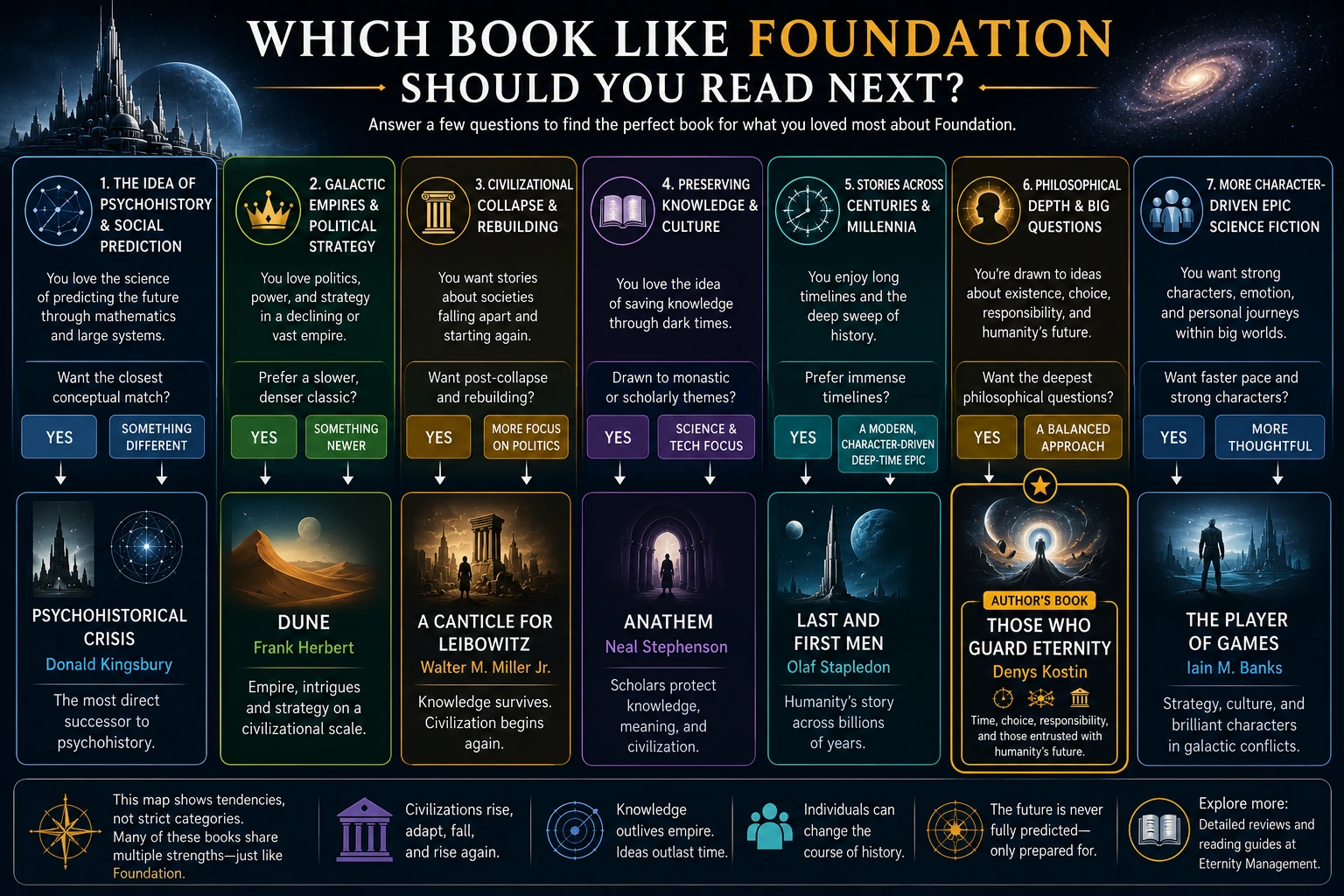
Choose Psychohistorical Crisis
when psychohistory itself was the attraction and you want a denser examination of predictive governance.
Choose Dune
when you want empire, strategy, foresight, religion, ecology, and the danger of manufactured destiny.
Choose A Canticle for Leibowitz
when the preservation of knowledge through collapse mattered more than galactic politics.
Choose Hyperion
when you want greater emotional intensity, literary structure, mystery, religion, and deep-time philosophy.
Choose Children of Time
when you want to watch civilizations evolve across generations and encounter radically different intelligence.
Choose Those Who Guard Eternity
when the question you cannot leave behind is who should protect the future—and how protection avoids becoming control.
Can history be predicted without destroying freedom?
This is the deepest question connecting the strongest books like Foundation. Prediction seems to offer responsibility. If leaders can foresee collapse, famine, war, or civilizational breakdown, refusing to act appears negligent. Yet prediction also changes the moral position of the predictor. Once a model claims to know what populations will do, individuals can be treated as noise, resistance can be interpreted as ignorance, and control can be justified as prevention.
Psychohistory tries to preserve freedom at the individual level by predicting only large populations. The distinction is elegant but unstable. Large-scale intervention still changes the choices available to particular people. A plan designed to reduce suffering may hide information, manipulate crises, concentrate expertise, or decide which institutions deserve to survive. The future is protected, but not necessarily allowed to remain open.
Dune approaches the same danger through prescience. The Player of Games approaches it through strategic intervention. The Three-Body Problem approaches it through long-term survival planning under uncertainty. Those Who Guard Eternity turns it into a guardianship paradox: power sufficient to protect the future may also be power sufficient to author it.
The answer is not to abandon foresight. Civilizations need models, memory, institutions, and long-term planning. The answer is to separate prediction from ownership. A forecast should improve the capacity to choose, not eliminate choice. A guardian should preserve options for future generations, not complete their future before they arrive.
This problem is explored more directly in Who Should Guard the Future of Humanity? and in the question of whether humanity can survive unlimited knowledge.
What allows civilization to continue after a crisis?
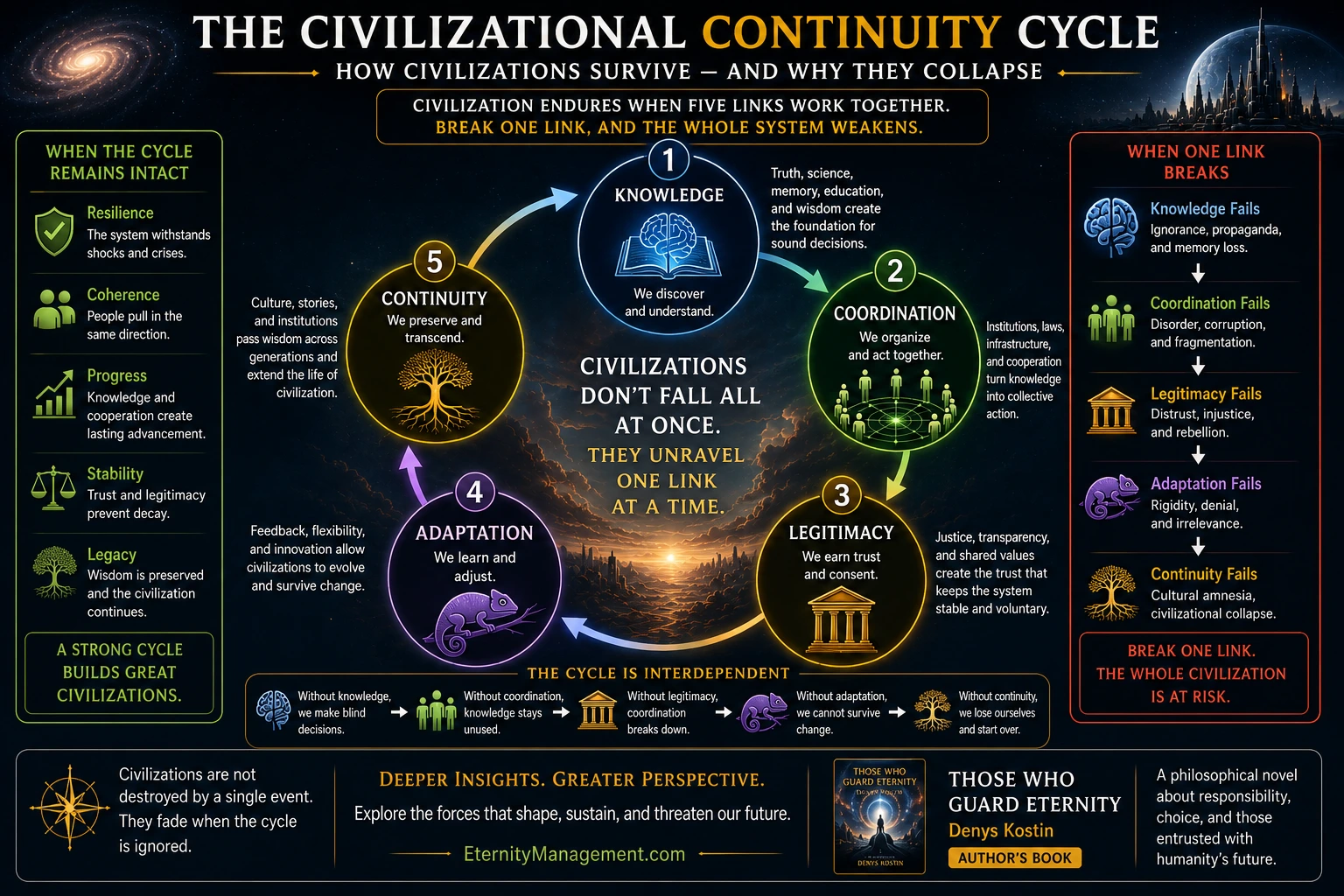
Foundation proposes concentrated knowledge and a long plan. Other novels in this guide emphasize different links: institutions, culture, legitimacy, adaptation, memory, cooperation, or moral restraint. Taken together, they suggest that continuity is not one thing preserved in a vault. It is a cycle.
Knowledge makes sound decisions possible. Coordination turns understanding into collective action. Legitimacy makes coordination durable without relying entirely on force. Adaptation allows institutions to change when inherited solutions stop working. Continuity carries learning, identity, and responsibility across generations. If any one link weakens long enough, the others become harder to sustain.
This model also explains why wealthy civilizations can collapse. Resources cannot compensate indefinitely for corrupted knowledge, fragmented coordination, lost legitimacy, institutional rigidity, or civilizational amnesia. Collapse rarely arrives as one event. It becomes visible after the cycle has already been breaking for years.
For a deeper explanation of these dynamics, continue with why civilizations collapse even when they are rich and how civilizations survive collapse.
Foundation asks how civilization can survive. The Eternity Saga asks what must be preserved beyond civilization.
Those Who Guard Eternity begins a philosophical fantasy saga about time, consciousness, truth, responsibility, and those entrusted with humanity’s future. It is for readers who want speculative fiction to move from predicting history toward the moral burden of guarding what history makes possible.
Transparent note: this is Denys Kostin’s book and the central fiction project connected to Eternity Management. The complete first book is available to read online free on Cokos.org.
Read Those Who Guard Eternity Free Explore the Eternity SagaFrequently asked questions about books like Foundation
What should I read after Foundation?
Read Psychohistorical Crisis for the closest conceptual match, Dune for empire and foresight, A Canticle for Leibowitz for knowledge preservation, Hyperion for philosophical space opera, or Children of Time for civilizations evolving across deep time.
What book is most similar to Foundation?
Psychohistorical Crisis is the closest match to the idea of psychohistory and a civilization shaped by predictive social science. It is not part of Asimov’s canon, but it engages more directly with psychohistorical governance than any other novel in this guide.
Are Dune and Foundation similar?
Yes, at the level of themes. Both examine empire, long-term strategy, historical forces, elite attempts to shape the future, and the danger of trusting prediction too completely. Dune is more character-centered, ecological, religious, and mythic; Foundation is more institutional and procedural.
What books explore ideas like psychohistory?
Psychohistorical Crisis is the most direct choice. Dune explores prescience and managed history, while The Three-Body Problem explores long-term strategic planning under scientific and cosmic uncertainty. None reproduces Asimov’s concept exactly.
What science fiction books are about galactic empires?
Strong recommendations include Dune, A Memory Called Empire, The Player of Games, A Fire Upon the Deep, and Ancillary Justice. Each examines empire differently: through dynasty, culture, strategic intervention, galactic asymmetry, or institutional violence.
Is Hyperion similar to Foundation?
Hyperion shares Foundation’s civilizational scale, deep time, technology, religion, and concern with humanity’s future. It is more literary, emotional, fragmented, and mysterious, with stronger emphasis on individual stories.
What books are about preserving knowledge after collapse?
A Canticle for Leibowitz is the strongest recommendation, followed by Anathem. The first examines knowledge preserved through a post-apocalyptic cycle; the second examines scholarly institutions built to maintain intellectual continuity across long periods.
Should I read the Foundation books in publication or chronological order?
New readers are usually better served by publication order because the ideas, revelations, and scope develop in the sequence experienced by the original readership. Begin with Foundation, Foundation and Empire, and Second Foundation before deciding whether to continue into later sequels and prequels.
What modern science fiction feels like Foundation?
A Memory Called Empire, Children of Time, The Collapsing Empire, and The Three-Body Problem are strong modern choices. They preserve different elements of Foundation: empire, deep-time civilization, systemic collapse, and long-term survival strategy.
Is Those Who Guard Eternity science fiction?
No. It is philosophical fantasy and speculative fiction. Its connection to Foundation lies in time, responsibility, hidden structures, guardianship, human choice, and the future of civilization—not in psychohistory, scientific realism, or a galactic empire.
Is the Foundation television series the same as the books?
No. The television adaptation expands characters, relationships, action, and chronology while reworking major elements for serialized drama. Readers coming from the series should expect the books to feel more idea-centered, episodic, and focused on political and historical problem-solving.
Related reading
Final thoughts
Finding books like Foundation is not simply a search for another Galactic Empire. It is a search for stories large enough to treat civilization as something that can be understood, preserved, mismanaged, transformed, or lost.
The closest recommendations continue different parts of Asimov’s question. Psychohistorical Crisis asks what happens when prediction becomes government. Dune asks what happens when foresight becomes myth and power. A Canticle for Leibowitz asks whether preserved knowledge can prevent repeated destruction. Children of Time asks how civilization emerges. Hyperion asks what meaning survives inside a future shaped by forces no one fully controls. Those Who Guard Eternity asks whether the authority to protect the future can remain distinct from the power to imprison it.
The future is never only predicted. It is prepared for, interpreted, contested, and inherited. The most important question is not whether civilization can avoid every fall. It is whether enough knowledge, legitimacy, adaptability, freedom, and responsibility will remain for those who come next to build again.
About the author and editorial transparency
Denys Kostin is the creator of Eternity Management and author of the Eternity Saga, a philosophical fantasy series about time, consciousness, reality, immortality, responsibility, and human choice. This guide distinguishes editorial comparison from promotion, identifies the author’s own book openly, and explains where its genre and emphasis differ from the external recommendations.
Learn more about Eternity Management and Denys Kostin.
Publisher and bibliographic sources
Premises, publication details, and series descriptions were checked against publisher, author, or established bibliographic sources where available. The ranking, similarity tiers, reader pathways, and Civilizational Continuity Cycle are original editorial analysis.
- Publishers Weekly: Psychohistorical Crisis by Donald Kingsbury
- Penguin Random House: Foundation by Isaac Asimov
- Macmillan: Dune by Frank Herbert
- Penguin Random House: A Canticle for Leibowitz
- Penguin Random House: Hyperion
- Macmillan: A Memory Called Empire
- Tor Publishing Group: The Collapsing Empire
- Pan Macmillan: Children of Time
- Macmillan: The Three-Body Problem
- Orbit: The Player of Games
- Tor Publishing Group: A Fire Upon the Deep
- Orbit: Ancillary Justice
- Gollancz: House of Suns
- Gollancz: Last and First Men
- HarperCollins: Anathem
- Cokos.org: Those Who Guard Eternity official reading page