Civilizations do not survive because every institution remains intact. They survive when enough essential capacities remain available to perceive reality, cooperate, preserve knowledge, renew institutions, and protect possibilities for generations yet to come.
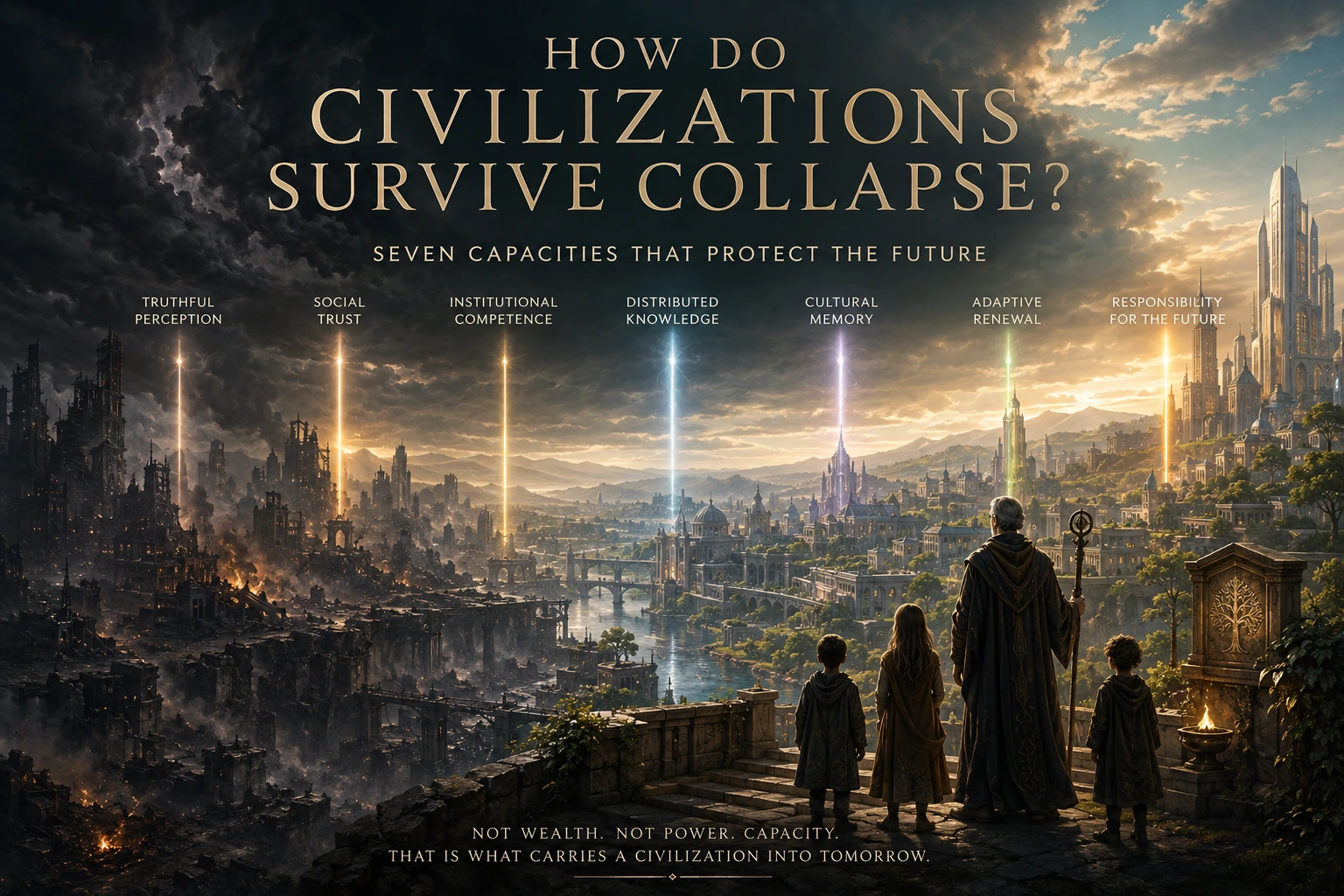
A city can fall while a people continue. A political regime can disappear while its language, law, memory, craft, and moral vocabulary survive in altered forms. A population can remain alive while the civilization that once connected it loses the ability to coordinate, teach, repair, and imagine a shared future. These are not the same outcome, and confusing them makes the study of collapse less useful.
The essential question is not whether every structure can be preserved. No civilization can prevent every war, disease, drought, technological rupture, political failure, or institutional mistake. The deeper question is whether a society retains the capacities from which viable order can be rebuilt. Collapse becomes terminal only when destruction reaches not merely buildings and governments, but the ability to learn, cooperate, transmit, adapt, and begin again.
This article develops an interpretive framework called The Seven Capacities of Civilizational Survival™. It is not a predictive equation and does not claim that complex historical outcomes can be reduced to seven variables. It is a practical explanatory model: a way to ask what must remain functional when the visible surface of civilization is under pressure.
What Does It Mean for a Civilization to Survive Collapse?
Survival can refer to at least five different things: the survival of people, a state, a culture, a body of knowledge, or a set of civilizational capabilities. These forms can separate. A state may vanish while cultural identity continues. A regime may retain its symbols while losing operational competence. Archives may physically survive while the communities able to interpret them disappear. A society may rebuild production while becoming unable to preserve freedom, dignity, or truthful inquiry.
A useful definition must therefore focus on capability rather than appearance:
This definition avoids two errors. The first is romantic preservation: assuming that survival means restoring every institution exactly as it existed before crisis. Some institutions caused the crisis, concealed it, or distributed its costs unjustly. Rebuilding them unchanged may reproduce the same collapse in a new cycle.
The second error is survival without continuity: treating biological persistence as sufficient. People can remain alive under conditions that destroy agency, trust, learning, memory, and choice. A system may become durable precisely because it suppresses correction. That is persistence, but not necessarily civilizational success. The prior question—what makes a civilization worth saving—must remain active throughout recovery.
Collapse Is Not Always Extinction
Popular images of collapse tend to compress a long process into a single scene: a ruined skyline, an abandoned road, a final battle, a government falling in one night. Real transformations are often less cinematic. Political authority fragments. Long-distance trade shrinks. Infrastructure becomes unreliable. Administrative reach contracts. People reorganize at smaller scales. New authorities inherit old practices. Languages, beliefs, crafts, and social identities continue unevenly.
Collapse can produce several different outcomes:
| Outcome | What changes | What may continue |
|---|---|---|
| Disintegration | Large systems lose coordination and split into smaller units. | Local communities, customs, skills, and fragments of authority. |
| Simplification | Society operates with less complexity, reach, and specialization. | Population, subsistence systems, language, ritual, and practical knowledge. |
| Absorption | Another political or cultural order incorporates people and institutions. | Selected laws, elites, beliefs, techniques, and identities in transformed form. |
| Transformation | Former structures disappear, but essential functions re-emerge differently. | Learning capacity, identity, knowledge, and new forms of coordination. |
This is why the language of “death” can mislead. It may describe the disappearance of a political order while obscuring the survival of communities who continue to speak, remember, farm, teach, worship, build, and adapt. Research on the Classic Maya emphasizes that collapse was not a single uniform event affecting every polity in the same way; it unfolded across generations through decline, migration, transformation, and regional variation.1 Modern Maya communities and languages also demonstrate that the end of ancient political centers was not the end of Maya peoples or culture.2
Survival should therefore be judged by what can still be done together after systems contract—not only by whether old monuments remain standing.
Civilizational Survival Begins Before Collapse
A civilization cannot manufacture deep trust, institutional competence, distributed knowledge, or cultural memory at the exact moment those capacities are needed most. Crisis reveals reserves that were accumulated earlier. It exposes whether truth could travel before the emergency, whether institutions practiced correction before their legitimacy was threatened, whether knowledge was shared before repositories failed, and whether responsibility for the future existed before sacrifice became unavoidable.
The previous article, Why Do Civilizations Collapse Even When They Are Rich?, argued that material prosperity can conceal declining coordination, feedback, trust, maintenance, and long-term responsibility. The same logic works in reverse: survival capacity is often built during ordinary periods when no one feels an urgent need for it.
- Redundant archives appear inefficient until one archive is destroyed.
- Independent institutions appear slow until concentrated authority begins suppressing evidence.
- Local expertise appears duplicative until distant supply chains fail.
- Public trust appears intangible until emergency coordination depends on it.
- Cultural memory appears ceremonial until people must decide what deserves rebuilding.
- Long-term planning appears abstract until every short-term choice begins closing future options.
Efficiency removes slack. Resilience preserves alternatives. A civilization that optimizes every system for normal conditions may become highly productive and dangerously brittle at the same time. The goal is not waste for its own sake. It is to recognize that redundancy, diversity, local capacity, repair knowledge, and independent feedback are forms of insurance that become visible only when ordinary systems stop working.
The Seven Capacities of Civilizational Survival™
The seven capacities below are not isolated virtues. They form a sequence of mutual dependence. Truth without trust may produce accurate warnings that no one can act on. Trust without competence may produce solidarity without reliable systems. Institutions without distributed knowledge may become single points of failure. Memory without renewal may protect identity while blocking adaptation. Renewal without responsibility may merely transfer costs to those who come later.
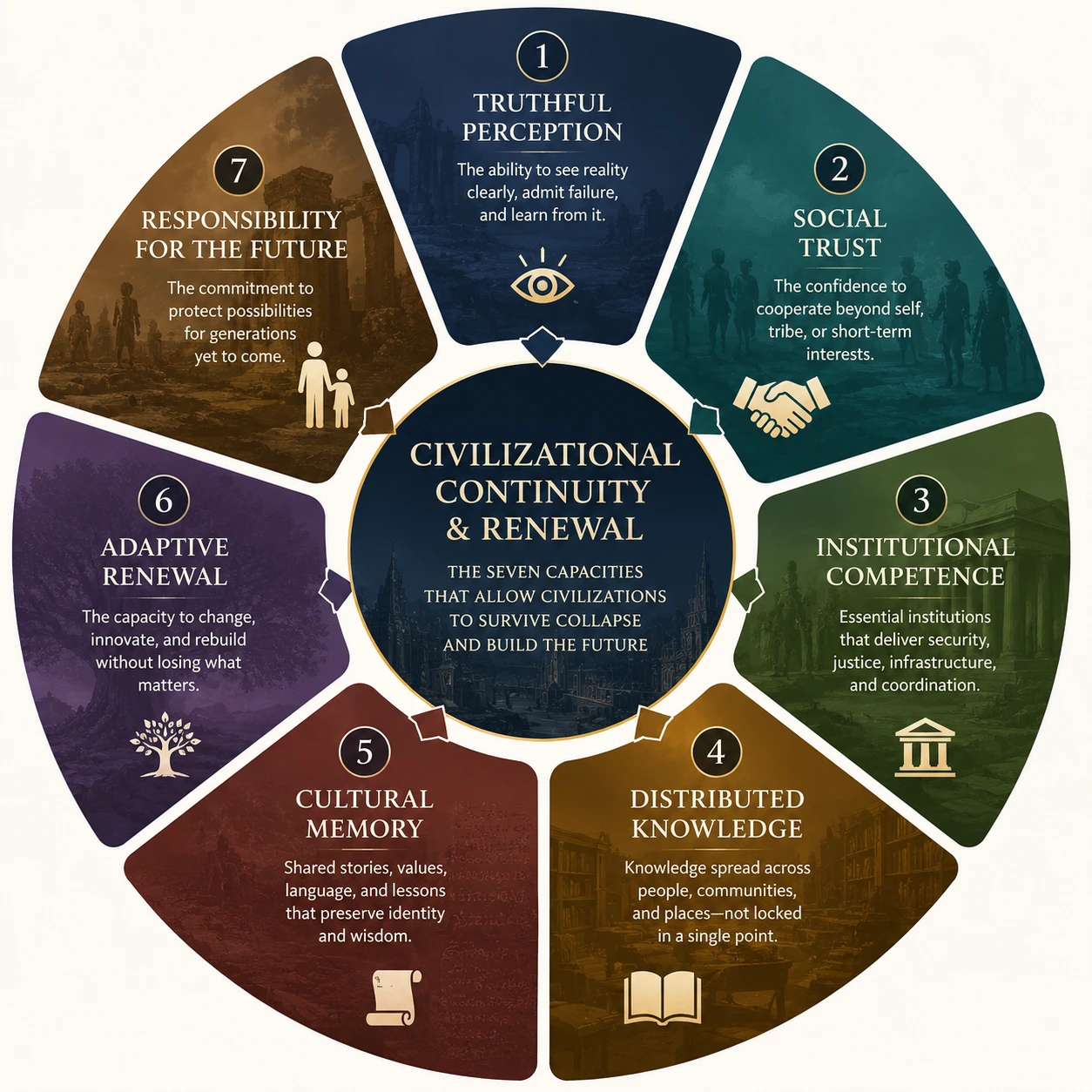
1. Truthful Perception
Truthful perception is the capacity to see conditions as they are, test claims, admit failure, and revise understanding when evidence changes. It does not require perfect knowledge. It requires a system in which error can be discovered without making discovery itself impossible.
During collapse, distorted perception multiplies damage. Leaders may conceal losses to preserve legitimacy. Institutions may defend obsolete metrics. Citizens may choose stories that reduce fear but prevent adaptation. Experts may become isolated inside technical systems that cannot communicate uncertainty. The civilization then responds not to reality, but to a filtered image of reality created by incentives, fear, status, and institutional self-protection.
Truthful perception survives when multiple channels of observation remain open: independent inquiry, local reporting, scientific institutions, protected dissent, practical knowledge, public records, and communities able to compare official claims with lived experience. The purpose is not endless disagreement. It is corrigibility—the ability to detect when a shared model no longer matches the world.
2. Social Trust
Social trust is confidence that cooperation will not be exploited immediately and that shared rules apply with enough fairness to justify participation. It does not mean naïveté or unquestioning faith in authority. It means that strangers, groups, professions, and institutions can coordinate beyond kinship, faction, or short-term exchange.
When trust collapses, every collective action becomes more expensive. Information is interpreted as manipulation. Sacrifice is viewed as someone else’s advantage. Communities hoard resources because they expect others to defect. Institutions rely increasingly on coercion because voluntary compliance weakens. The civilization may still possess wealth and technology, but it loses the social infrastructure required to use them together.
OECD research on public institutions identifies reliability, responsiveness, integrity, openness, and fairness as important drivers of institutional trust.3 Those qualities matter in ordinary governance, but they become even more decisive under pressure. People do not need to agree on everything. They need credible reasons to believe that cooperation is possible, burdens are not arbitrarily distributed, and institutions can be corrected.
3. Institutional Competence
Institutions convert shared intention into repeatable action. They provide security, justice, infrastructure, public health, education, records, coordination, and predictable rules. Their names and buildings are not the capacity itself. Competence exists only when institutions can still perform their functions, learn from failure, retain skilled people, and maintain legitimacy.
Institutional collapse often begins long before formal dissolution. Procedures become ends in themselves. Decision-makers lose contact with operating reality. Skilled staff leave. Maintenance is deferred. Responsibility becomes fragmented across offices that can each explain why another office must act. The institution survives as a symbol while its capacity to deliver quietly disappears.
Post-conflict reconstruction experience repeatedly shows that recovery requires more than physical rebuilding. Institutional capacity, social services, governance, reintegration, education, and coordination must be restored together.4 Reconstructing roads without rebuilding trustworthy rules may restore movement while preserving predation. Restoring administration without feedback may recreate the same brittleness that failed before.
4. Distributed Knowledge
Distributed knowledge exists across people, communities, professions, places, languages, formats, and repositories. It reduces the risk that one destroyed library, disabled network, discredited institution, or lost generation will erase a civilization’s ability to understand and rebuild.
Information storage alone is not enough. A manual may survive while no one retains the tacit knowledge needed to use it. A database may remain intact while electricity, passwords, software, context, or institutional memory disappear. A language may be recorded while no community remains able to interpret its nuances. Knowledge survives only when it can still be accessed, understood, taught, adapted, and applied.
UNESCO’s work on documentary heritage emphasizes preservation together with accessibility and reuse, because inaccessible memory cannot reliably support understanding, governance, or development.5 Redundancy therefore means more than making copies. It means maintaining people who know, institutions that teach, communities that practice, and formats that can outlive one technological dependency.
5. Cultural Memory
Cultural memory carries identity, language, values, stories, rituals, warnings, and accumulated interpretation across generations. It helps people understand not only what happened, but what previous generations believed was worth protecting. Without memory, recovery becomes improvisation without orientation.
Yet memory can fail in two opposite ways. It can disappear, leaving communities severed from lessons and identity. Or it can become frozen and weaponized, forcing the present to repeat inherited conflicts and protecting institutions merely because they are old. Living memory is not obedience to the past. It is an ongoing relationship with the past that allows reinterpretation, accountability, and renewed purpose.
This is why human beings need stories, why civilizations create myths, and why societies repeatedly construct heroes. Narrative compresses values into memorable form. It can preserve wisdom—but it can also hide responsibility. Cultural memory supports survival only when it remembers failure as honestly as achievement.
6. Adaptive Renewal
Adaptive renewal is the capacity to change what must change without destroying what still deserves preservation. It lies between two forms of failure: rigid continuity and indiscriminate rupture.
Rigid systems treat adaptation as disloyalty. They preserve procedures, hierarchies, and identities after their original conditions have disappeared. Indiscriminate renewal treats inheritance as contamination. It destroys institutions, norms, and knowledge faster than viable replacements can emerge. One produces stagnation; the other produces amnesia and repeated failure.
Renewal requires selective continuity. A society must distinguish principles from procedures, functions from forms, and essential values from historical arrangements. Justice may remain essential while a court structure changes. Education may remain essential while curricula and institutions are redesigned. Cultural identity may remain essential while exclusionary narratives are rejected.
The strongest systems do not merely recover their previous condition. They use disruption to create better feedback, broader participation, safer redundancy, and more legitimate institutions. Recovery that restores the old vulnerability is only an interval before the next collapse.
7. Responsibility for the Future
Responsibility for the future is the willingness to protect conditions that present generations may never personally enjoy. It appears in maintenance, education, ecological stewardship, public knowledge, debt restraint, institutional design, long-term safety, and the preservation of choice.
Crisis creates intense pressure to consume the future. Forests are cut because food is needed now. Archives are abandoned because storage appears nonessential. Education narrows because immediate labor is urgent. Safeguards are removed because action must be faster. Each decision may be understandable in isolation. Together they can make recovery impossible.
The United Nations’ Declaration on Future Generations formalizes the idea that people who do not yet exist will inherit the consequences of present decisions.6 The philosophical challenge goes deeper than policy: future generations cannot vote, bargain, protest, or withdraw consent. Their interests must be represented by people who receive no immediate reward for doing so.
This is the heart of guardianship. The question is not merely who should guard the future of humanity, but how to prevent guardianship from becoming ownership. Responsibility must protect future freedom, not impose one final vision of what future people are allowed to become.
The Civilizational Continuity System™
The seven capacities are best understood as a living system. Each one produces conditions required by the others:
- Truthful perception reveals what must be repaired.
- Social trust makes shared repair possible.
- Institutional competence turns cooperation into reliable action.
- Distributed knowledge prevents critical understanding from disappearing with one center.
- Cultural memory preserves identity, lessons, and orientation.
- Adaptive renewal changes obsolete forms while retaining essential functions.
- Responsibility for the future prevents recovery from consuming the conditions of later survival.
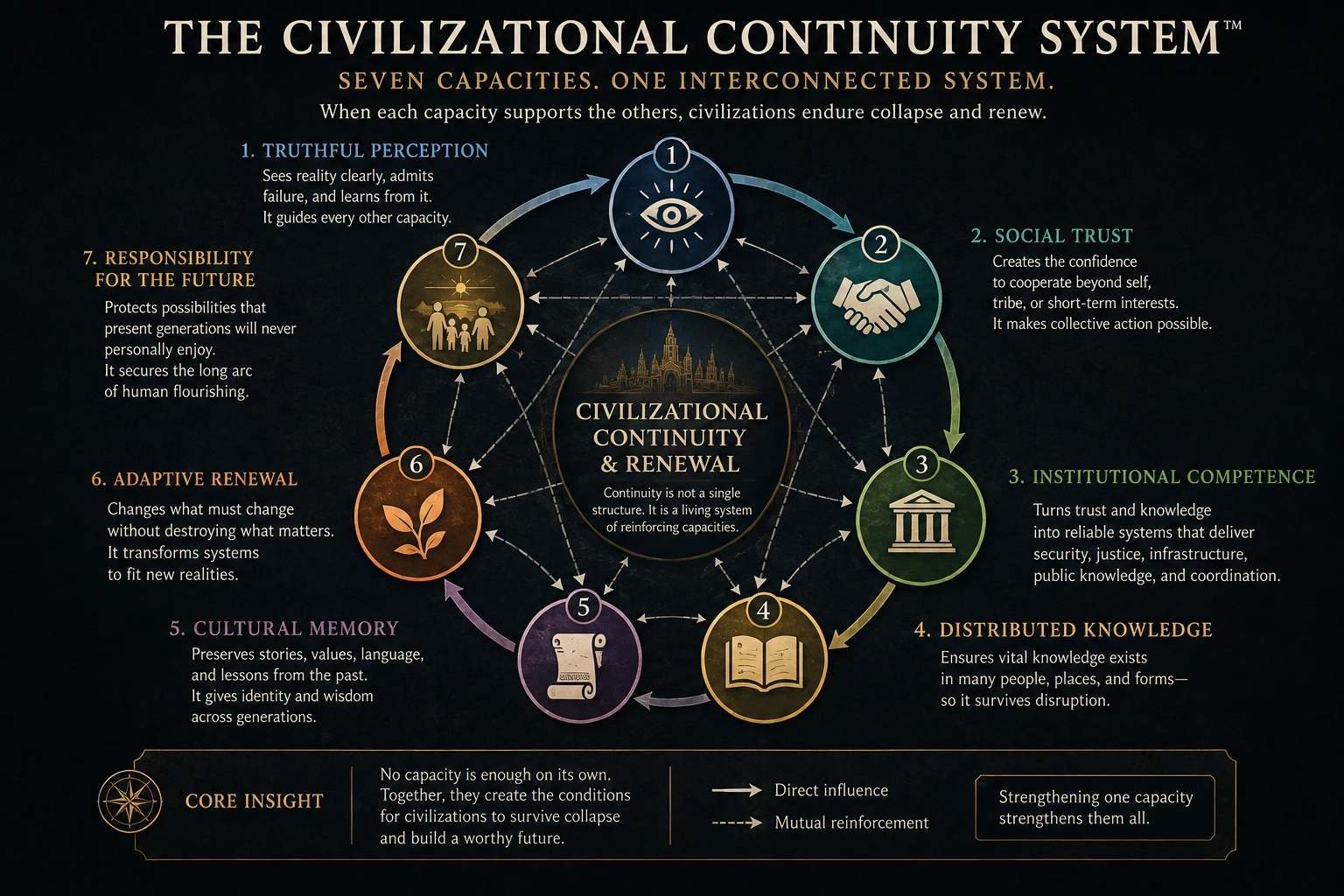
The system also contains negative feedback loops. When truthful perception weakens, institutional failure is hidden. Hidden failure damages trust. Falling trust makes knowledge sharing more difficult. Siloed knowledge weakens institutional competence. Weak institutions become defensive and suppress further truth. The civilization may appear stable because each institution protects its surface, while the relationships that make correction possible are disappearing.
Conversely, one well-designed intervention can strengthen several capacities at once. Open public records can support truthful perception, trust, institutional accountability, and distributed knowledge. Education can preserve memory, spread expertise, expand cooperation, and represent future generations. Local emergency planning can build institutional competence while revealing gaps in knowledge and trust before a crisis.
The Civilizational Continuity Threshold™
Collapse is rarely a clean transition from “functioning” to “failed.” Capacity erodes through stages. The categories below are qualitative, not numerical. They help identify the changing relationship between visible stability and hidden fragility.
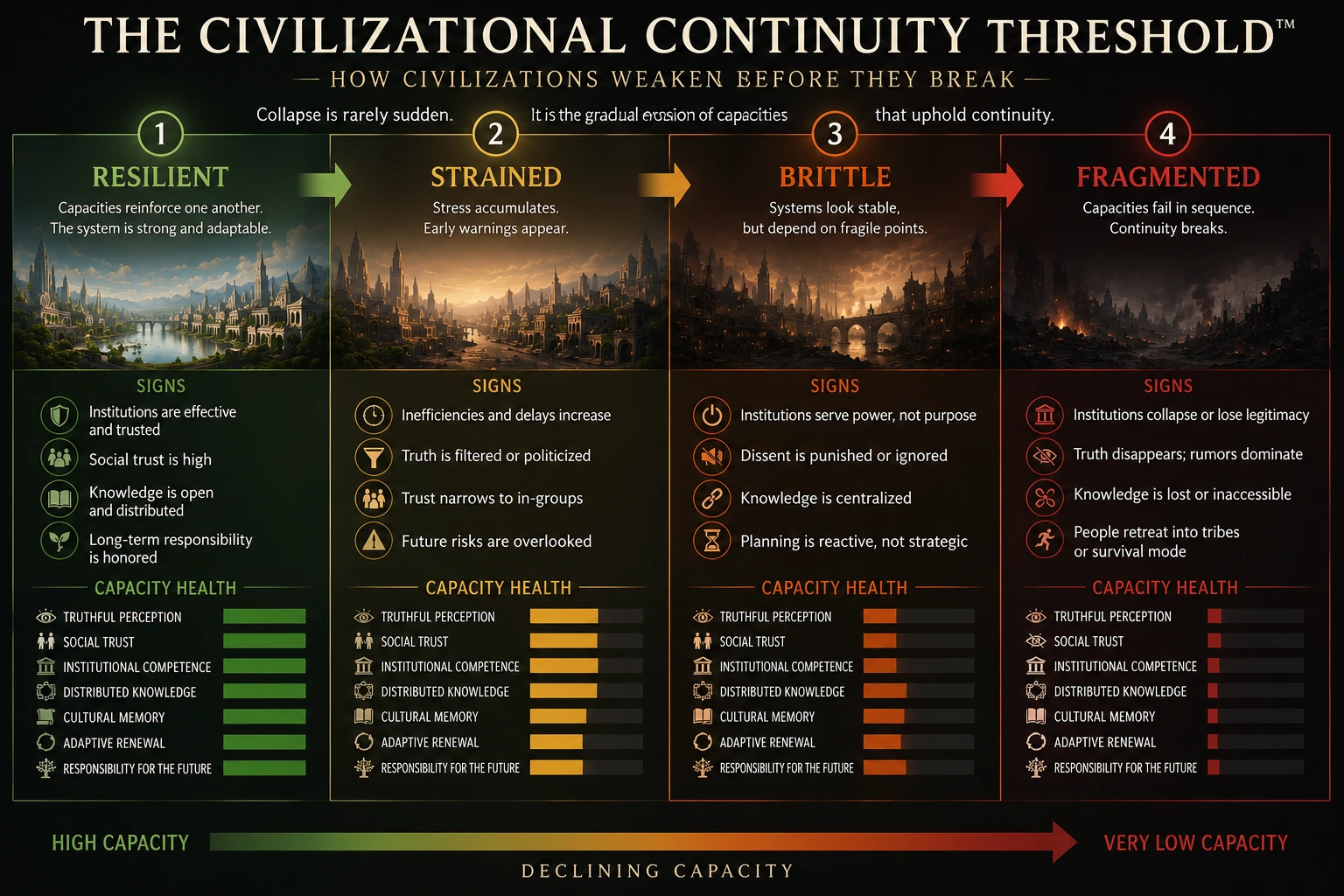
Resilient
Capacities reinforce one another. Institutions can admit failure without losing all legitimacy. Knowledge is distributed. Trust supports cooperation. Long-term thinking shapes decisions. Resilience does not mean the absence of conflict; it means conflict can be processed without destroying the system’s capacity to learn.
Strained
Stress accumulates and early warnings appear. Delays increase. Truth becomes selective. Trust narrows toward insiders. Memory becomes politicized. Long-term risks are acknowledged but repeatedly postponed. Correction remains possible, but it requires action against incentives that benefit from delay.
Brittle
Systems still look stable, but depend on fragile points. Institutions serve self-protection more than purpose. Dissent is punished or ignored. Knowledge is concentrated. Planning becomes reactive. The civilization can continue under normal pressure while losing the ability to absorb unusual shocks.
Fragmented
Capacities fail in sequence and continuity retreats to smaller units. Institutions lose legitimacy. Rumor replaces trusted information. Knowledge becomes inaccessible. People retreat toward tribes, families, local networks, or survival strategies. Civilizational continuity may still exist—but only in fragments waiting to be connected again.
What Actually Survives Historical Collapse?
Historical comparison should be used carefully. Civilizations differ in scale, ecology, technology, institutions, and historical context. No single case proves a universal law. Yet several patterns clarify the difference between political collapse and civilizational disappearance.
The Maya: political centers declined, Maya peoples endured
The Classic Maya collapse affected cities and regions unevenly. Research emphasizes complexity rather than a single synchronized end: drought, conflict, political fragmentation, demographic change, and shifting settlement patterns interacted over time. 1 The decline of major centers did not erase Maya identity. UNESCO documents that roughly 30 Mayan languages remain spoken across southern Mexico, Guatemala, and Belize, while its work on Indigenous languages emphasizes their role in transmitting worldviews, history, science, culture, and knowledge across generations. 2
The lesson is not that collapse was harmless. Population loss, displacement, violence, and institutional breakdown were profound. The lesson is that a civilization cannot be reduced to the political centers archaeologists can see most easily. Cultural memory, language, local knowledge, kinship, and adaptive practice can outlive monumental authority.
The Roman world: fragmentation and continuity coexisted
The end of Western imperial rule was a major transformation, not a symbolic date without consequences. Political integration, taxation, military organization, trade, urban systems, and living standards changed substantially in many regions. Yet 476 did not erase every Roman capacity. The Eastern Roman Empire continued for centuries and developed the Roman legal tradition in Byzantium. In Western successor kingdoms, scholarship also identifies a continuing role for Roman law in practice and administration. 7
Rome demonstrates that continuity is selective. Legal, administrative, religious, educational, and local institutions can carry functions into new political forms, while systems whose financing and coordination depend on imperial scale may contract or disappear. Survival therefore depends not only on preserving artifacts, but on whether successor institutions can understand, adapt, and operate what they inherit.
Post-conflict reconstruction: rebuilding capacity, not only structures
Modern post-conflict reconstruction offers a different kind of evidence. Roads, schools, utilities, courts, and administrative offices matter, but the World Bank’s Building for Peace framework argues that reconstruction must move beyond physical rebuilding alone. Sustainable recovery also requires social cohesion, legitimate and inclusive institutions, human capital, trust, coordination, and a long-term vision connecting past, present, and future. 4 Culture can support peacebuilding and recovery by carrying identity, meaning, connection, and shared resources into reconstruction. 8
These cases point toward a common principle: physical reconstruction cannot substitute for civilizational capacity. A rebuilt bridge is valuable. A society able to maintain bridges, train engineers, allocate resources fairly, correct corruption, and teach the next generation is resilient.
Why Distributed Knowledge Matters More Than Perfect Preservation
Centralized knowledge systems can be extraordinarily efficient. A single repository, expert institution, database, or technological platform makes coordination easier during stable conditions. Yet concentration creates a hidden dependency: one failure can erase access to everything that depends on the center.
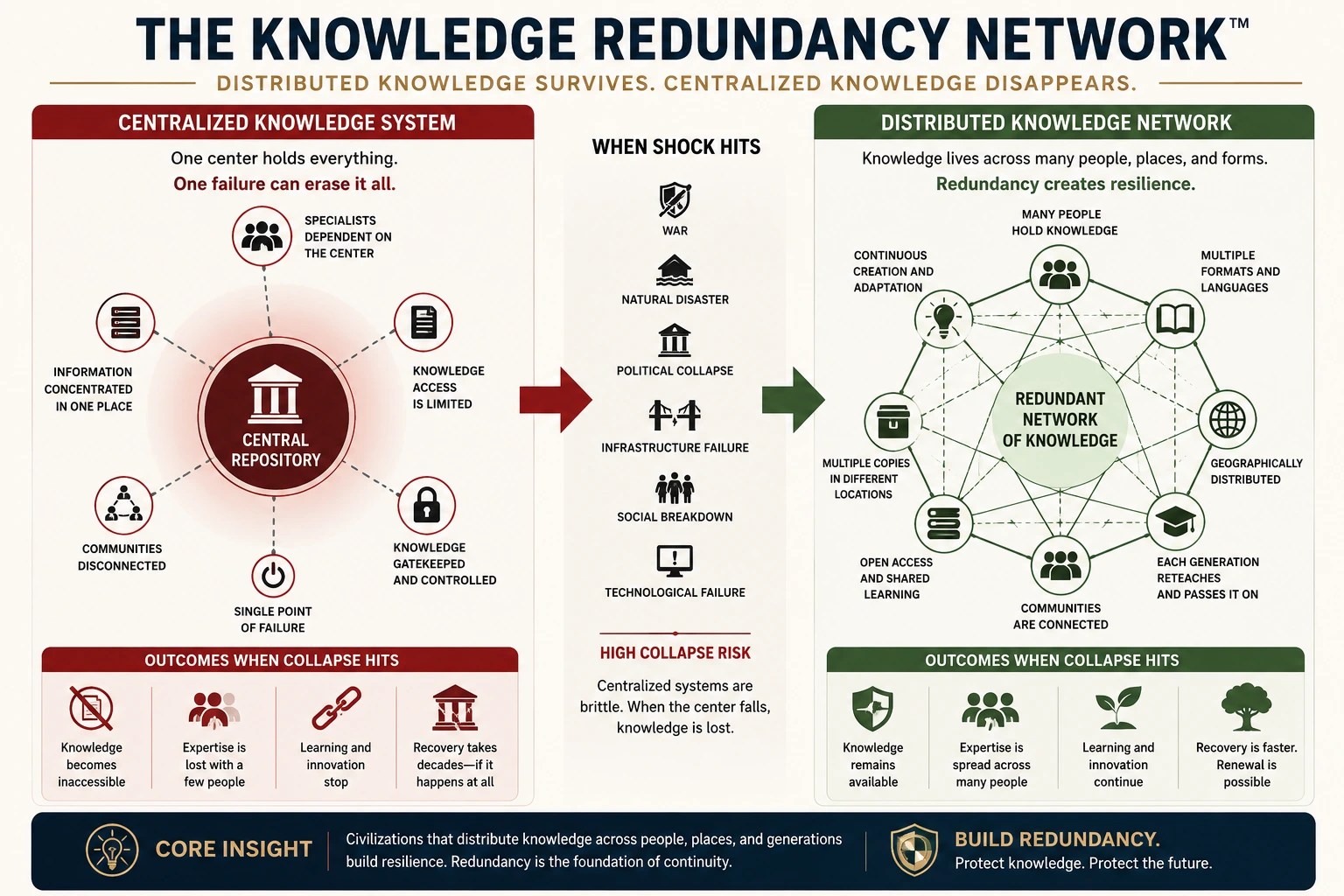
A resilient knowledge system has several layers:
- Physical redundancy: multiple copies in different locations and media.
- Human redundancy: more than one person or profession understands the knowledge.
- Interpretive continuity: language, context, standards, and explanatory traditions survive with the data.
- Educational continuity: institutions and communities can teach the knowledge to newcomers.
- Practical continuity: people still know how to apply, repair, test, and adapt what was preserved.
- Access continuity: knowledge is not locked behind systems that fail when authority, electricity, money, or credentials disappear.
This distinction matters in a digital civilization. Digital storage can multiply copies at low cost, but it can also create dependence on software, hardware, networks, encryption keys, proprietary formats, energy, and institutions. A file that exists but cannot be opened is not fully preserved. A procedure that can be read but not practiced is not fully transmitted.
Fiction can explore the human meaning of this problem in a way systems analysis cannot. What happens when one person discovers that reality itself depends on structures most people cannot see—and that knowledge creates a responsibility they cannot return? Readers drawn to that question can read Those Who Guard Eternity online free on Cokos.org, without registration or locked chapters.
The Memory–Renewal Balance™
Every civilization inherits two obligations that can appear to conflict. It must remember enough to preserve identity, accumulated knowledge, and hard-won lessons. It must also renew enough to remain viable under conditions the past never encountered.
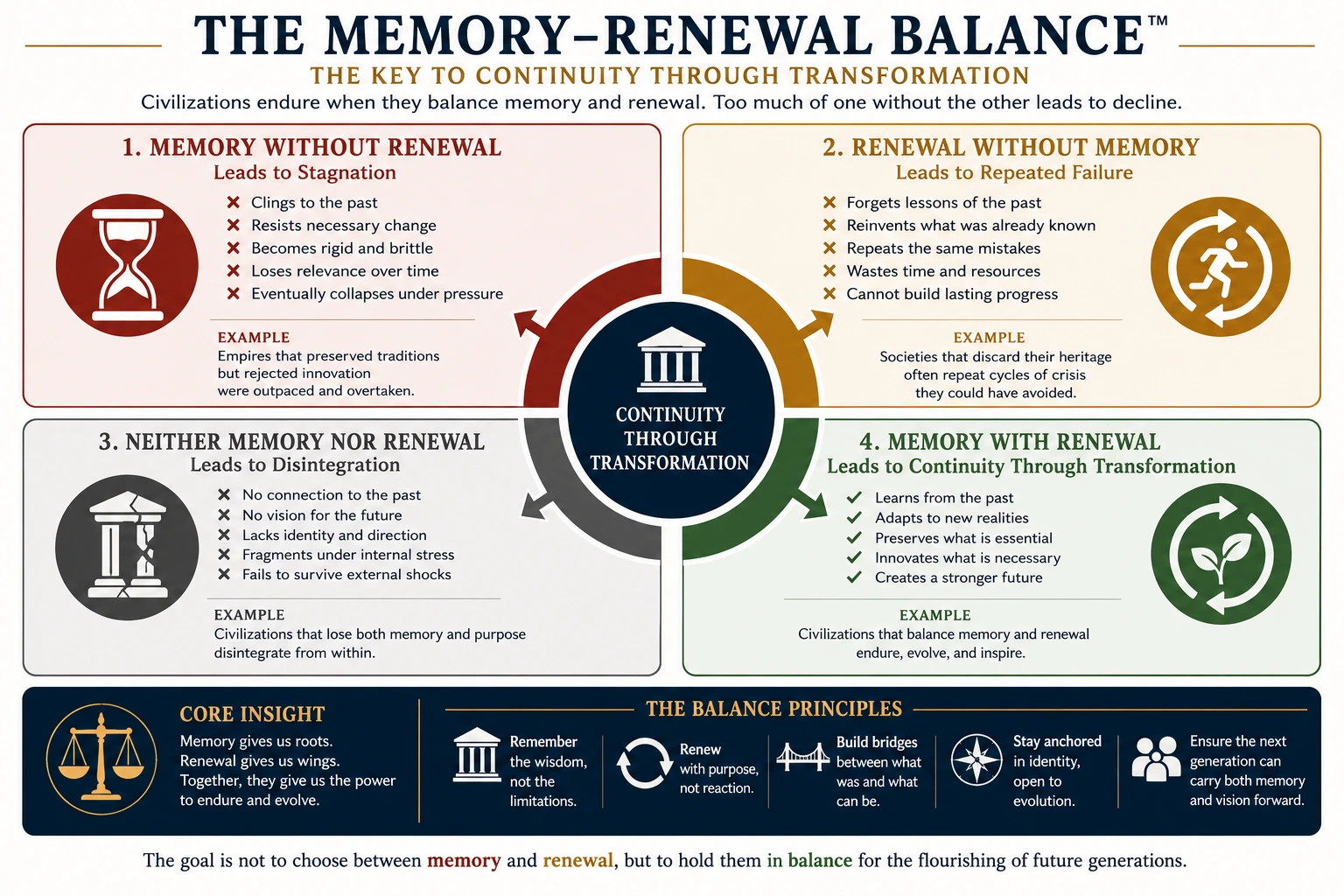
Memory without renewal
Tradition becomes a defense against reality. Institutions preserve inherited forms after those forms lose their function. Identity remains strong, but relevance and adaptability decline. The outcome is stagnation and eventual brittleness.
Renewal without memory
Every generation treats itself as the beginning. Old errors are rediscovered at great cost. Knowledge, identity, and legitimacy must be rebuilt repeatedly. The outcome is motion without cumulative learning.
Neither memory nor renewal
The civilization loses both orientation and adaptive capacity. It cannot explain what it is preserving, where it is going, or how to respond. The outcome is fragmentation and disintegration.
Memory with renewal
The past supplies identity and lessons; renewal adapts them to new realities. Principles remain available while forms change. The outcome is continuity through transformation.
The goal is not balance as a static midpoint. Different moments require different emphases. After propaganda, memory may need restoration. After institutional paralysis, renewal may need acceleration. After revolutionary destruction, continuity may need protection. The governing principle is that neither memory nor renewal should destroy the conditions required by the other.
Can Modern Global Civilization Survive Systemic Collapse?
Modern civilization possesses extraordinary resilience resources: scientific knowledge, global communication, medical capacity, distributed expertise, international institutions, rapid transportation, diverse energy systems, and the ability to copy information at unprecedented scale. It also possesses unprecedented dependencies.
Food systems depend on energy, logistics, finance, fertilizer, data, and stable trade. Hospitals depend on complex supply chains, specialist training, digital records, water, power, and pharmaceuticals. Cities depend on continuous flows that residents rarely see. Digital knowledge depends on networks, servers, standards, institutions, and energy. Global efficiency has expanded capability while reducing the visibility of local dependencies.
This does not mean collapse is inevitable. It means resilience cannot be measured only by inventory, wealth, or technological sophistication. The World Bank’s resilience work emphasizes anticipation, risk reduction, preparedness, financial protection, and inclusive recovery rather than purely reactive response.9 A modern civilization that wants to survive systemic shocks must deliberately preserve alternatives:
- local capacity alongside global exchange;
- open standards alongside proprietary systems;
- human competence alongside automation;
- distributed energy and communication alongside large networks;
- public knowledge alongside institutional specialization;
- trusted coordination alongside legitimate decentralization;
- efficiency alongside repairability, reserves, and redundancy.
The greatest modern danger may not be lack of information. It may be the inability to convert abundant information into shared understanding and coordinated action. A civilization can know more than any civilization before it and still fail if truth cannot cross institutional boundaries, incentives punish long-term thinking, and public trust collapses faster than knowledge can be used.
The Civilizational Renewal Path™
Renewal is not a single event, a heroic rescue, or a return to the exact condition that existed before collapse. It is a continuous process in which capacities are rebuilt together and repeatedly reinforce one another.
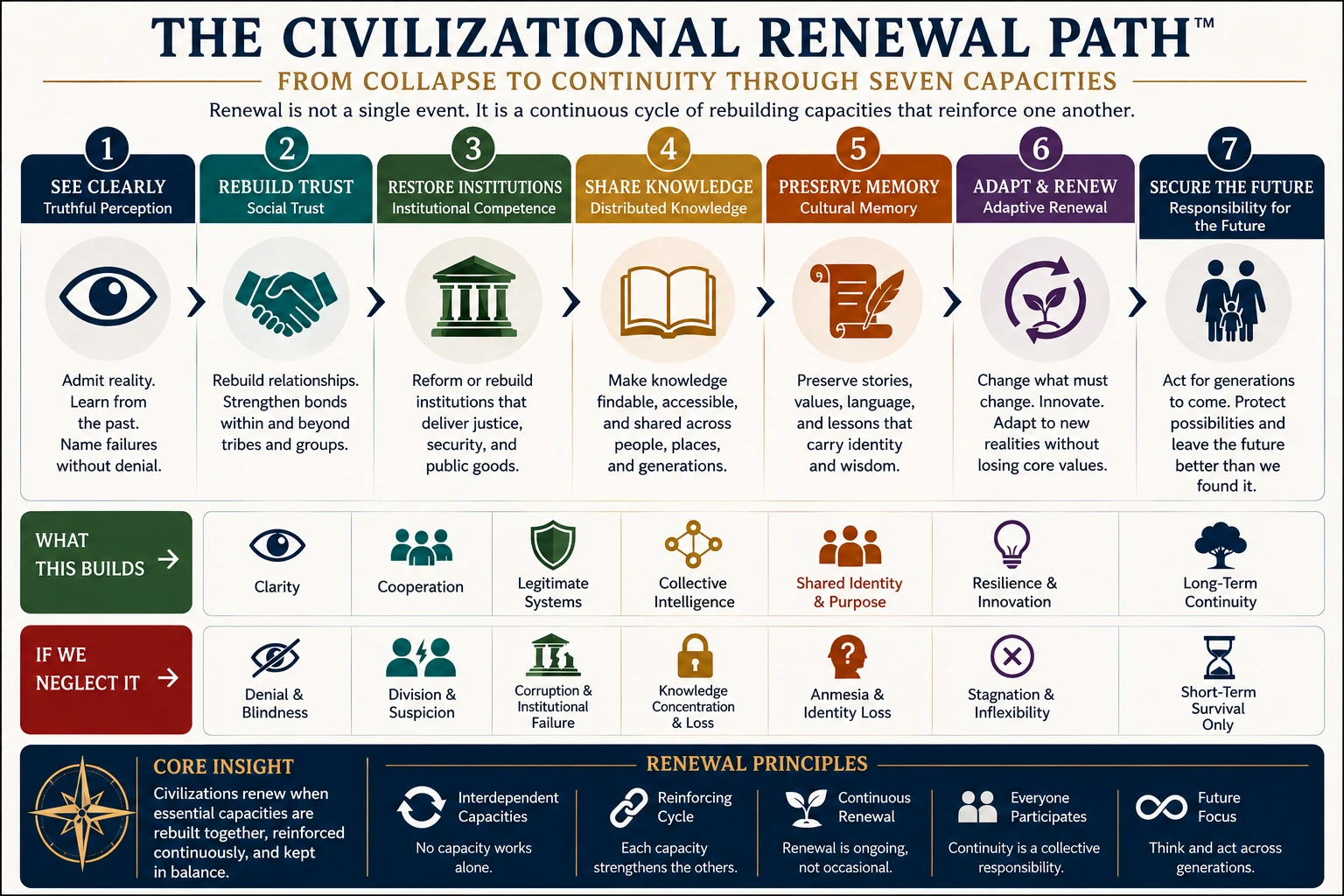
The path begins with clear perception because repair cannot start from denial. It moves through trust because accurate diagnosis without cooperation remains inert. Institutions convert cooperation into reliable public action. Distributed knowledge prevents reconstruction from depending on one center. Cultural memory restores orientation. Adaptive renewal changes obsolete forms. Responsibility for the future ensures that recovery does not solve the present by making later survival impossible.
The order is useful as a narrative, but real renewal is iterative. Rebuilding one institution may reveal new truths. Restoring an archive may change collective memory. A local success may rebuild trust. New trust may make broader institutional reform possible. Renewal advances through reinforcing cycles rather than a single linear program.
The Civilizational Survival Assessment™
The assessment below translates the framework into a qualitative diagnostic. It should not be converted into a false-precision score. Historical and modern systems are too complex for one number to predict collapse. The purpose is to reveal weak dependencies, contradictions, and capacities that require attention.
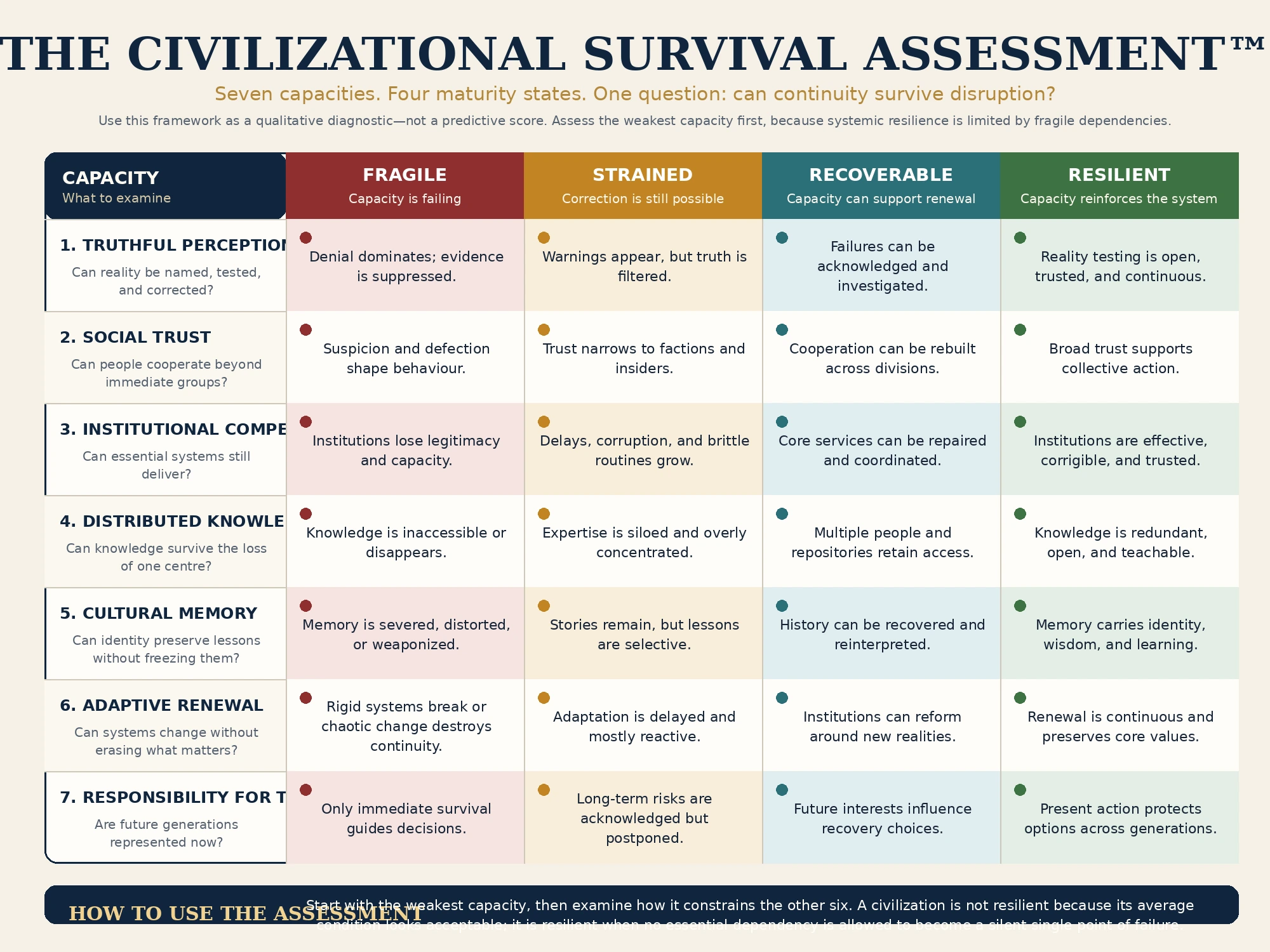
Four questions improve the assessment:
- Where is the evidence? Distinguish public narratives from observable performance.
- Who experiences the system differently? A capacity may look resilient from the center and fragile at the margins.
- What happens under pressure? Normal conditions may conceal dependencies that only appear during disruption.
- Can the system correct itself? Temporary weakness is less dangerous than a structure that blocks learning.
Assessment should lead to a portfolio of interventions rather than one grand reform. Some capacities need protection; others need redesign. Some require national coordination; others require local redundancy. Some can be improved through law; others depend on culture, education, professional norms, or repeated experience of fair cooperation.
What Should a Civilization Preserve?
Not everything old deserves survival. Not everything new deserves adoption. The purpose of continuity is not to preserve civilization as an object, but to preserve the conditions under which people can remain human, learn, choose, cooperate, and create a future worth inhabiting.
A practical preservation hierarchy begins with:
- Human dignity: people must not become disposable inputs into the survival of a system.
- Truthful inquiry: no civilization can renew if evidence, correction, and dissent become impossible.
- Freedom joined to responsibility: agency matters, but choices must account for consequences imposed on others and the future.
- Knowledge and learning capacity: preserving facts without preserving interpretation and education is insufficient.
- Trust and cooperation: collective capability depends on relationships, legitimacy, and fair rules.
- Corrigible institutions: institutions must be strong enough to act and open enough to change.
- Meaningful options for future generations: recovery should enlarge their freedom rather than consume it.
This hierarchy connects survival with human flourishing as the ultimate goal of civilization. A civilization is not successful because it lasts forever. It is successful when its continuity creates better conditions for dignity, agency, meaning, knowledge, security, and responsibility across generations.
The hardest test is not whether a civilization can protect itself. It is whether it can protect what makes its survival worth wanting.
From Surviving Collapse to Guarding Eternity
This article explains the capacities that allow civilization to retain continuity. But explanation stops at the edge of experience. It cannot fully show what responsibility feels like when truth threatens safety, when preserving one future may close another, or when the power to guard something begins to resemble the power to control it.
Those Who Guard Eternity, the first novel in the Eternity Saga, carries those questions into a philosophical fantasy story about time, reality, consciousness, freedom, truth, and human choice. The full book is available to read online free on Cokos.org, with no registration, download, subscription, or locked chapters.
Read Those Who Guard Eternity Free Explore Philosophical Fantasy Books
Conclusion: Capacity Carries Civilization Into Tomorrow
Civilizations do not survive because they avoid every rupture. They survive because rupture does not erase every path back to truthful perception, cooperation, competence, knowledge, memory, renewal, and responsibility.
Wealth can finance these capacities, but cannot replace them. Power can defend them, but can also suppress the correction they require. Technology can distribute knowledge, but can also concentrate dependency. Tradition can preserve memory, but can also prevent adaptation. None of these forces is sufficient without a system capable of learning.
The decisive work therefore begins before the visible emergency. It begins when a society protects dissent while confidence is high, maintains infrastructure while it still works, distributes knowledge before a center fails, teaches history before memory becomes political ammunition, and represents future generations before immediate survival consumes every option.
A civilization does not need to preserve every form it has inherited. It needs to preserve the capacities from which wiser forms can be built.
Frequently Asked Questions
How do civilizations survive collapse?
Civilizations survive collapse by preserving enough capacity to perceive reality, cooperate through trust, maintain essential institutions, distribute knowledge, carry cultural memory, adapt failing systems, and protect future possibilities. Survival does not require every political structure to remain intact.
Can a civilization recover after collapse?
Yes. Recovery is possible when people, knowledge, trust, institutions, and cultural memory remain sufficient to support renewed coordination. Recovery may create a transformed civilization rather than restore the previous order exactly.
What usually survives when a society collapses?
Survival varies, but local communities, languages, religious traditions, practical skills, stories, family networks, legal ideas, and fragments of institutions may outlive centralized political systems. Physical artifacts survive only when people and institutions can still interpret and use them.
Is civilizational collapse the same as human extinction?
No. Collapse usually refers to a major loss of political integration, complexity, institutional reach, or coordinated capacity. Human extinction means the disappearance of humanity itself. A civilization can collapse while populations and cultures continue in smaller or transformed forms.
Why is social trust essential to civilizational survival?
Trust reduces the cost of cooperation. It allows people to share information, accept fair burdens, follow legitimate rules, and coordinate beyond immediate groups. When trust collapses, wealth and expertise become harder to mobilize collectively.
How can knowledge be preserved through systemic collapse?
Knowledge is more resilient when it is distributed across locations, formats, languages, institutions, communities, and generations. Copies alone are insufficient; people must also retain the context, skills, education, and practical experience needed to interpret and apply what survives.
Can technology make civilization more resilient?
Yes, when it improves redundancy, communication, prediction, access, repair, and distributed capability. It can also create brittleness when essential systems depend on centralized platforms, proprietary formats, narrow expertise, continuous energy, or inaccessible infrastructure.
What is the difference between resilience and resistance to change?
Resistance attempts to preserve an existing form. Resilience preserves essential functions and values while adapting form to new conditions. A rigid system may resist change for a long time and then fail suddenly because it cannot renew.
What do present generations owe future generations?
Present generations owe future people meaningful options: a livable environment, accessible knowledge, corrigible institutions, cultural memory, and enough freedom to shape lives that the present cannot fully design for them.
What is Those Who Guard Eternity about?
It is the first philosophical fantasy novel in the Eternity Saga. The story explores time, reality, consciousness, truth, freedom, memory, and human choice in a world where Eternity may be guarded, shaped, or hidden. It can be read online free on Cokos.org.
Continue Exploring
Sources and Further Reading
The historical and institutional evidence below supports specific claims in the article. The named frameworks—the Seven Capacities, Continuity System, Continuity Threshold, Renewal Path, Memory–Renewal Balance, Knowledge Redundancy Network, and Survival Assessment—are interpretive models developed for this article, not predictive scientific instruments.
- Cambridge University Press, “The Classic Maya Collapse,” in Understanding Collapse, on the multi-causal and regionally uneven nature of Classic Maya political decline.
- UNESCO, “Language: Itza, Guatemala”, noting that roughly 30 Mayan languages remain spoken; and UNESCO, “Indigenous languages: gateways to the world’s cultural diversity”, on languages as carriers of worldviews, history, science, and culture.
- OECD, Building Trust to Reinforce Democracy, identifying reliability, responsiveness, integrity, openness, and fairness as major drivers of public trust.
- World Bank, Building for Peace: Reconstruction for Security, Equity, and Sustainable Peace in MENA, on moving beyond physical reconstruction toward social cohesion, inclusive institutions, human capital, and sustainable peace.
- UNESCO, Recommendation Concerning the Preservation of, and Access to, Documentary Heritage Including in Digital Form, on preserving accessible documentary memory across formats and institutions.
- United Nations, Declaration on Future Generations, establishing a contemporary international framework for responsibility toward future generations.
- Cambridge University Press, “The Law of New Rome: Byzantine Law,” in The Cambridge Companion to Roman Law; and “The Law of the Post-Roman Kingdoms”, on the adaptation of Roman law in Byzantium and its continued role in post-Roman practice and administration.
- World Bank and UNESCO, Culture in Post-Crisis Situations: Opportunities for Peacebuilding and Sustainable Recovery, on culture as a resource for identity, peacebuilding, social connection, and recovery.
- World Bank, Resilience and Disaster Management, on anticipation, preparedness, risk reduction, financial protection, and inclusive recovery.
Read the Question as a Story
Civilizations survive when someone accepts responsibility for possibilities they will never own. Enter a story about what happens when Eternity itself must be guarded.
Start Reading Free on Cokos.org