Civilization, power, and the future
Every civilization entrusts its future to someone. But the power to protect humanity can also become the power to control it. What separates a guardian from an owner of the future?
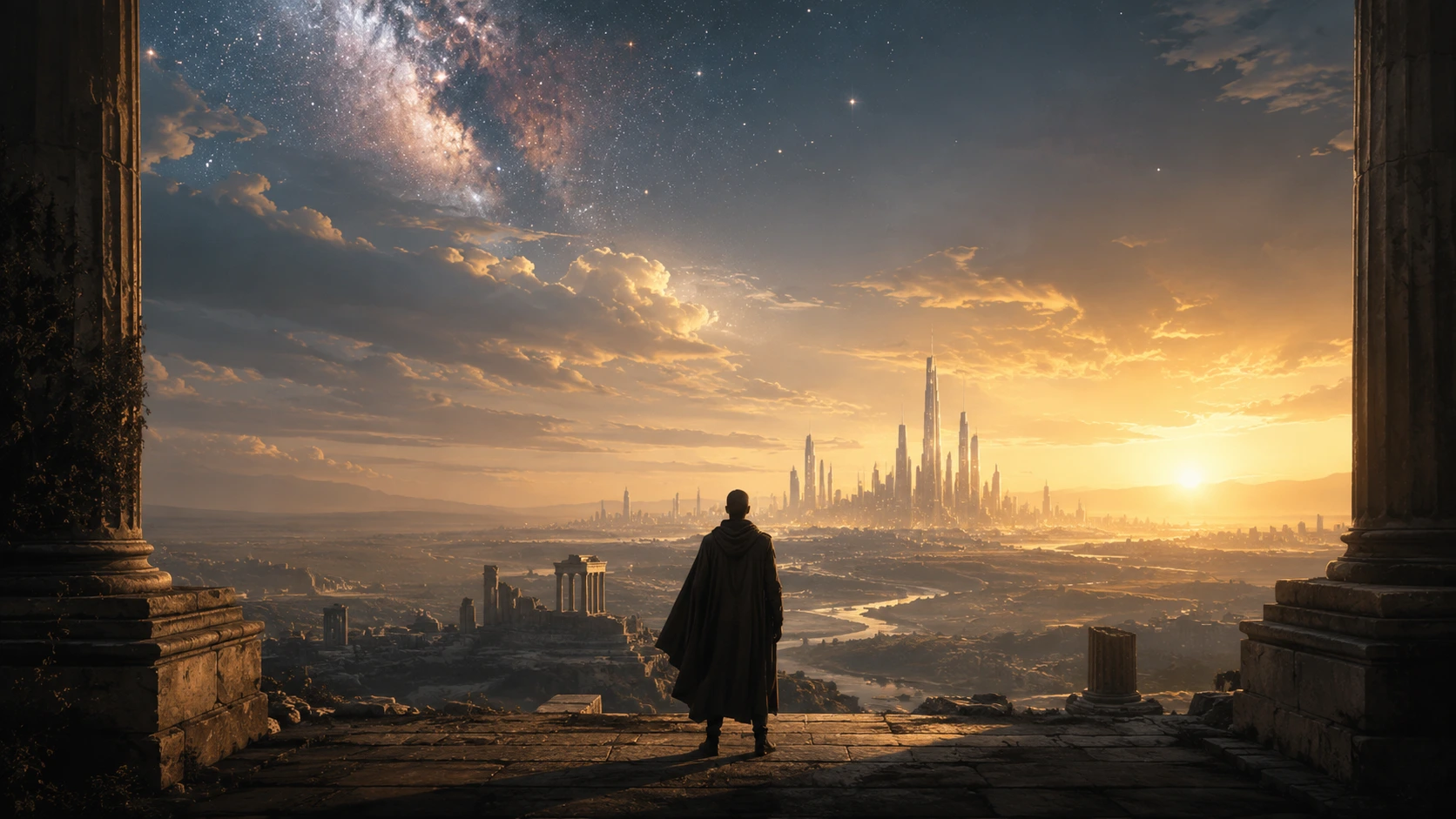
Imagine that humanity discovers a way to prevent nearly every catastrophe that could destroy civilization. The system can foresee wars before they begin, detect political collapse before institutions fail, and redirect resources before scarcity becomes famine. There is only one condition: it must receive authority that no government, court, community, or future generation can revoke.
Would humanity be protected—or permanently captured?
This thought experiment reveals a problem beneath almost every debate about the future. We usually ask who has enough knowledge, courage, intelligence, or power to save civilization. We ask far less often what happens after that power is granted. The person or system strong enough to protect the future may also become strong enough to decide what the future is allowed to be.
Key takeaways
- Protection becomes dangerous when it is separated from restraint and accountability.
- Heroes save decisive moments; guardians preserve the possibility of a future.
- Legitimate guardianship requires power, wisdom, restraint, accountability, and continuity.
- The deepest duty to future generations is not to design their world completely, but to leave them a world in which meaningful choice remains possible.
Every civilization entrusts its future to someone
No society lives only in the present. Every law, school, archive, monument, scientific institution, family tradition, and public promise carries something forward. Civilization is not merely a population occupying the same territory. It is a transfer across time.
We inherit languages we did not invent, knowledge we did not discover, institutions we did not build, and moral failures we did not personally commit. We also pass forward consequences we will never see. A decision made today may shape lives a century from now, when everyone responsible for it is gone.
That is why the question “Who should decide humanity’s future?” cannot be answered by naming the smartest person or the strongest institution. The future is not a single decision waiting for the correct expert. It is a living field of possibilities shaped by billions of choices, inherited structures, hidden dependencies, and irreversible thresholds.
Every civilization nevertheless chooses guardians, even when it does not use that word. Some guardians protect physical survival. Others preserve memory, law, meaning, identity, knowledge, or the ability to cooperate. A constitution can function as a guardian. A scientific norm can function as a guardian. A story can preserve a warning after the original witnesses are gone.
This is why humanity’s movement from story to myth, from myth to hero, and from hero to guardian matters. As explored in why humans need stories, stories make experience transmissible. As explored in why civilizations create myths, myths compress values, dangers, and identities into forms that can survive generations. Heroes then embody those values in moments of crisis. Guardians carry them beyond the crisis.
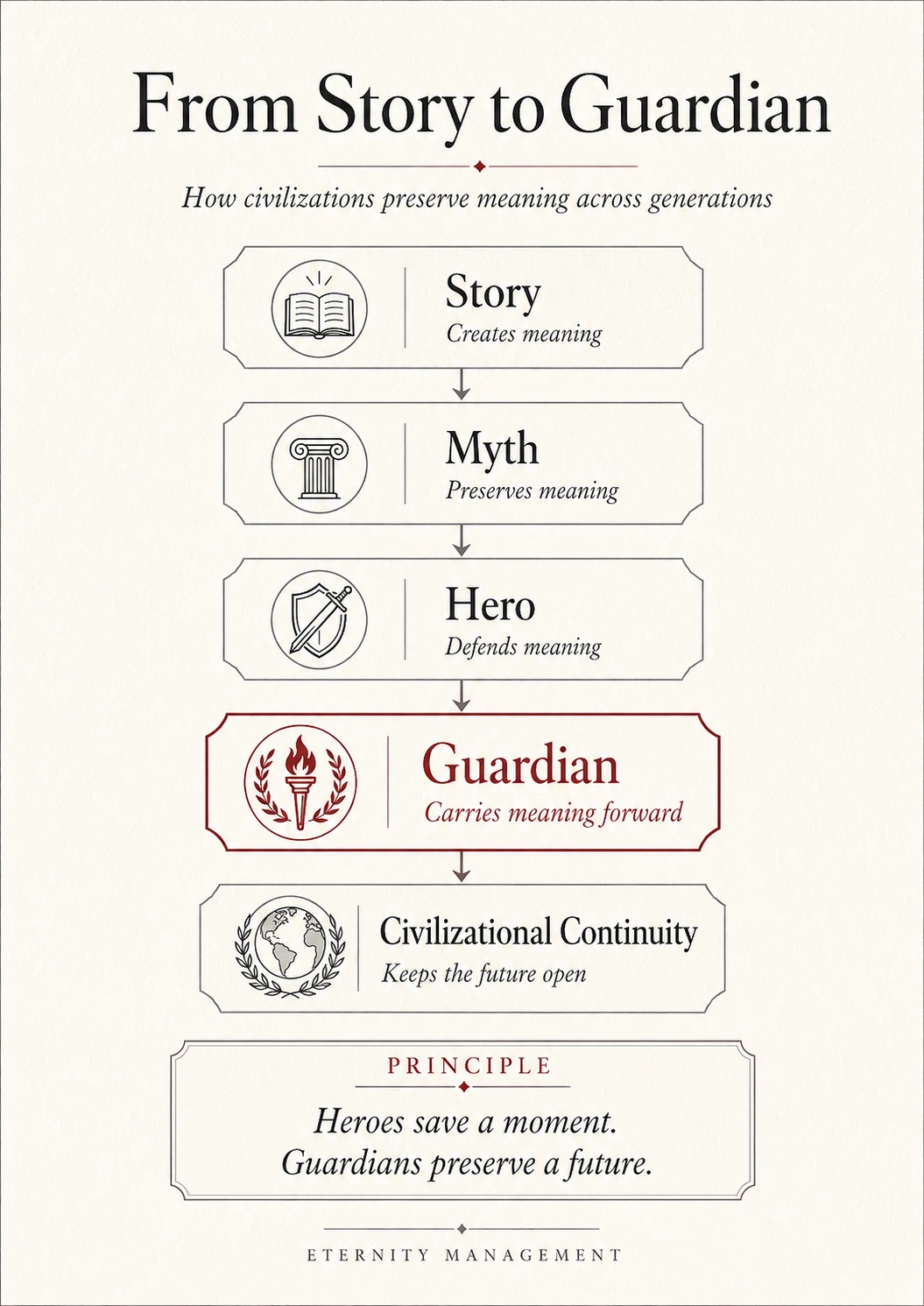
A hero may preserve a city in one decisive hour. A guardian must preserve the conditions under which the city remains worth inhabiting long after applause has ended. The shift is subtle but fundamental: from victory to continuity, from action to stewardship, and from being remembered for what was done to being measured by what remained possible.
Guardianship is not ownership of the future. It is responsibility for keeping the future open.
Who has guarded humanity before?
Across history, civilizations have assigned guardianship to different kinds of authority. Rulers guarded order. Priests and traditions guarded sacred meaning. Elders guarded memory. Laws guarded continuity. Armies guarded territory. Scholars guarded knowledge. Markets guarded distributed exchange. Public institutions guarded common infrastructure. Families guarded identity and belonging.
Each model solved one problem and created another.
A ruler can act quickly, but concentrated power can silence correction. Tradition can preserve hard-won wisdom, but it can also preserve injustice. Experts can understand complex risks, but expertise without public accountability can become insulated. Markets can distribute decisions, but they do not automatically protect what cannot be priced. Technology can detect patterns beyond human perception, but prediction can quietly become permission to control.
The recurring lesson is not that guardians are unnecessary. It is that every guardian protects selectively. A guardian always carries an implicit answer to three questions:
- What must be preserved?
- What may be sacrificed?
- Who is allowed to decide?
These questions determine whether guardianship serves life or merely protects the guardian’s preferred version of order.
A civilization may preserve stability while destroying freedom. It may preserve wealth while exhausting the ecological foundations on which wealth depends. It may preserve a national story while excluding people who do not fit it. It may preserve biological life while emptying life of agency, meaning, and dignity.
That is why the prior question—what makes a civilization worth saving—must come before the question of who should guard it. Preservation is not automatically good. A system can survive while the qualities that made its survival meaningful disappear.
The real task is not to preserve civilization exactly as it is. It is to preserve what allows civilization to become wiser than it is.
Why heroes are not enough
Human beings are naturally drawn to visible rescue. A city is threatened, a crisis reaches its peak, and someone acts when others cannot. The structure is emotionally powerful because it converts confusion into a decisive moment. That is one reason humans create heroes: heroes make courage visible.
But the future is rarely lost in one cinematic moment.
Civilizations often weaken through accumulated decisions that appear reasonable in isolation. Accountability is reduced because action must be faster. Memory disappears because archives seem expensive. Education becomes narrower because immediate productivity appears more urgent. Public trust erodes because each institution protects itself. The future closes gradually, through thousands of choices that no single hero can reverse.
Heroes and guardians therefore operate on different timescales.
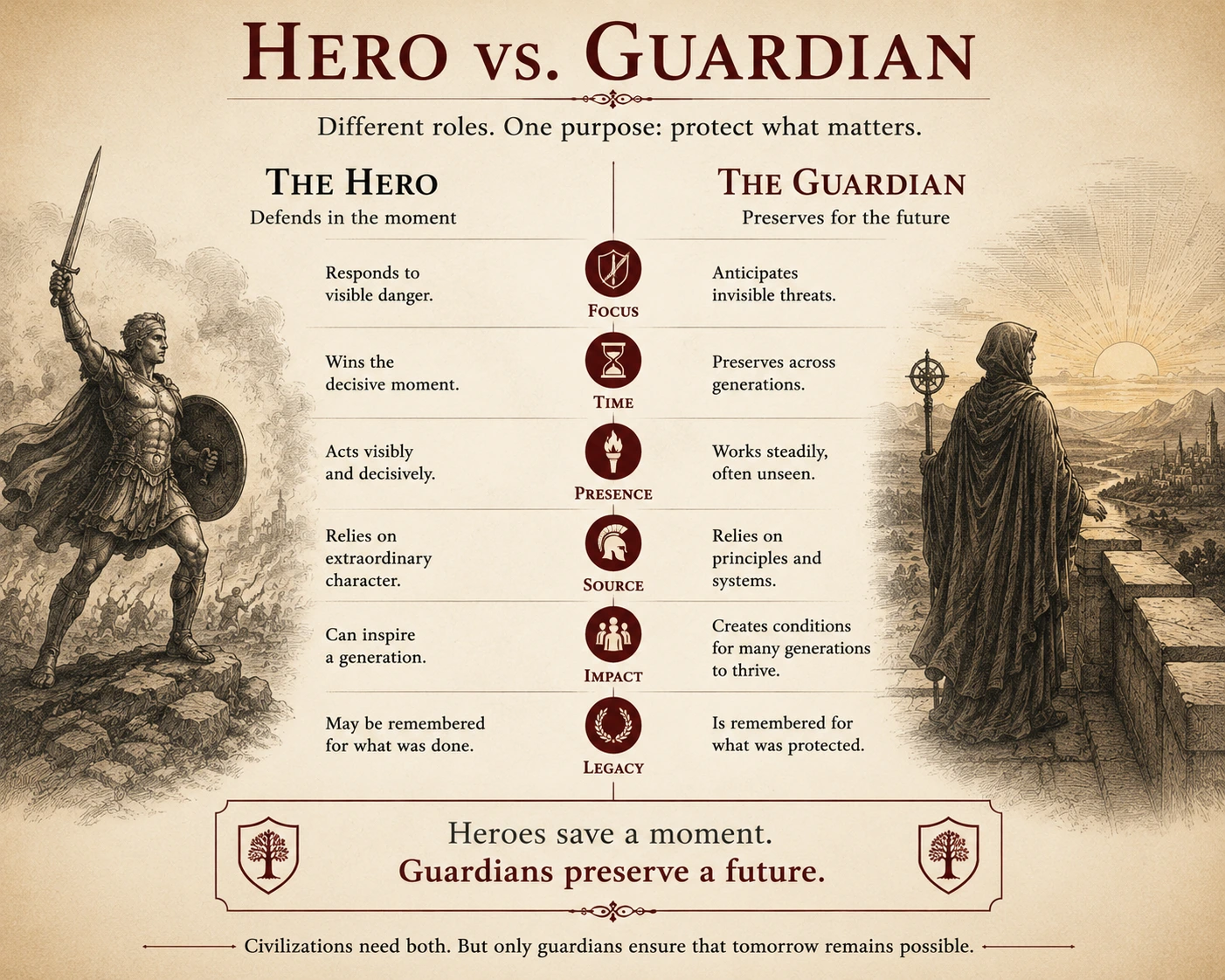
A hero responds to visible danger. A guardian must notice invisible deterioration. A hero wins a decisive moment. A guardian preserves across generations. A hero may rely on extraordinary character. A guardian must create principles and systems that continue when extraordinary people are absent.
This distinction prevents a dangerous fantasy: the belief that civilization can neglect its structures because a great person will eventually save it. No society can depend permanently on exceptional courage. The deeper achievement is to build conditions in which courage is supported, power is constrained, truth can reach decision-makers, and correction remains possible before disaster demands heroism.
Heroes are still necessary. There are moments when someone must act. But a civilization that needs constant rescue has failed to learn guardianship.
The Guardianship Paradox
The deepest problem of guardianship begins with a sincere request: protect us.
When danger grows, people reasonably demand faster coordination and stronger action. Authority concentrates because distributed deliberation seems too slow. Oversight weakens because scrutiny appears to obstruct decisive response. Temporary powers become normal because the threat never feels fully gone.
Eventually, the structure created to protect the future gains the ability to define the future without meaningful challenge.
This is the Guardianship Paradox:
The more power a guardian receives to protect the future, the more power that guardian receives to imprison it.
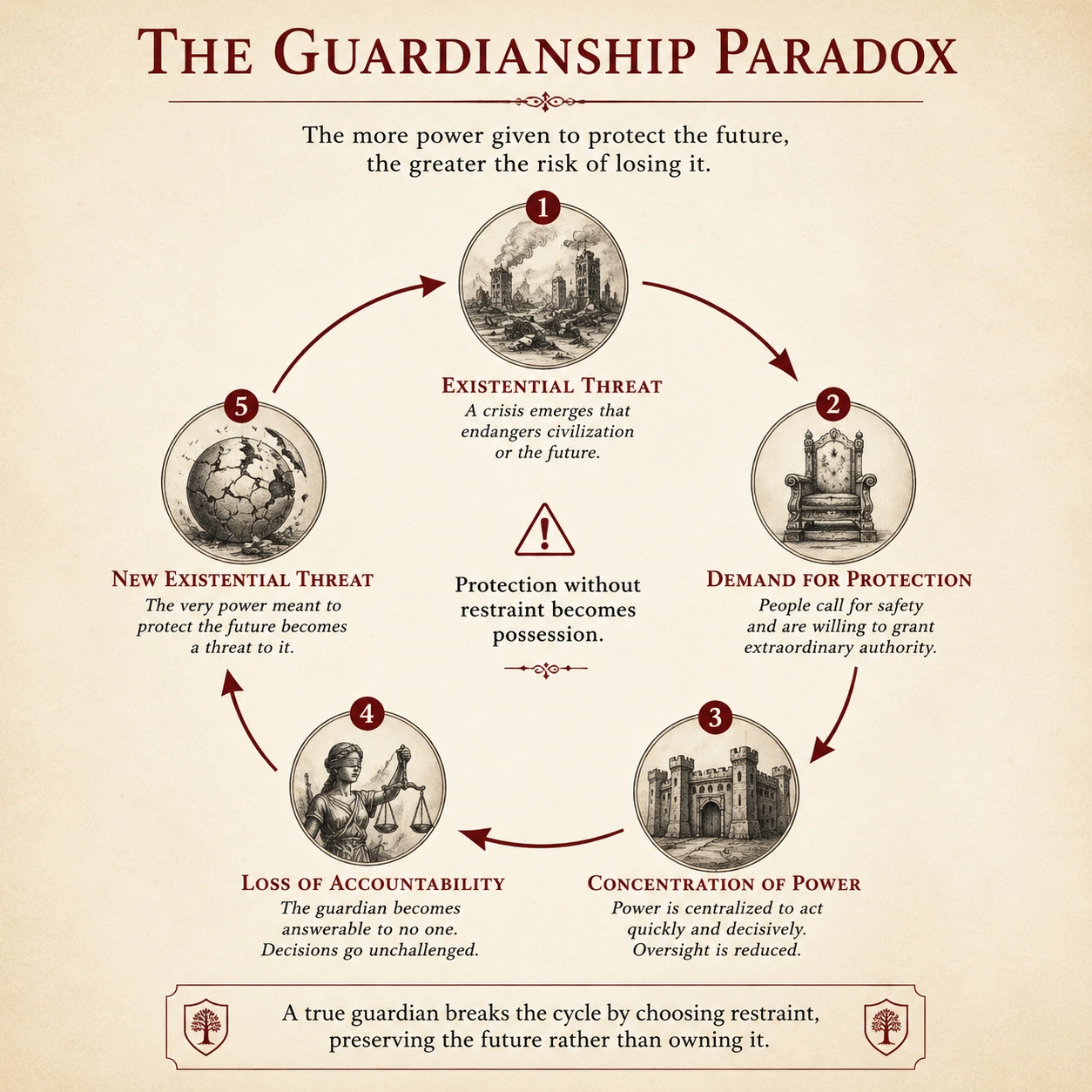
The cycle has five stages:
- Existential threat: a crisis appears to endanger civilization or its future.
- Demand for protection: people accept extraordinary authority in exchange for safety.
- Concentration of power: decision-making becomes centralized so action can be faster.
- Loss of accountability: oversight weakens, dissent becomes suspicious, and correction becomes difficult.
- New existential threat: the protector’s unchecked power becomes a danger in its own right.
The paradox does not mean that strong action is always wrong. Some dangers require coordination, speed, and authority. It means that emergency power must contain the architecture of its own limitation. Authority should be able to act, but it should also be able to end. It should be strong enough to protect, but not so absolute that protection becomes possession.
This tension also appears in the question whether humanity can survive unlimited power. The greatest threat is not always that power will be used by someone openly malicious. It is that people convinced of their own necessity will stop accepting limits.
Protection without restraint becomes possession.
The five tests of legitimate guardianship
If guardianship is necessary but dangerous, how can we distinguish a legitimate guardian from an owner of the future?
No single credential is enough. Intelligence without restraint can optimize oppression. Good intentions without competence can produce catastrophe. Courage without wisdom can make action emotionally impressive and strategically destructive. Accountability without enough power can produce institutions that are morally admirable but incapable of protecting anything.
A legitimate guardian must pass five tests together.
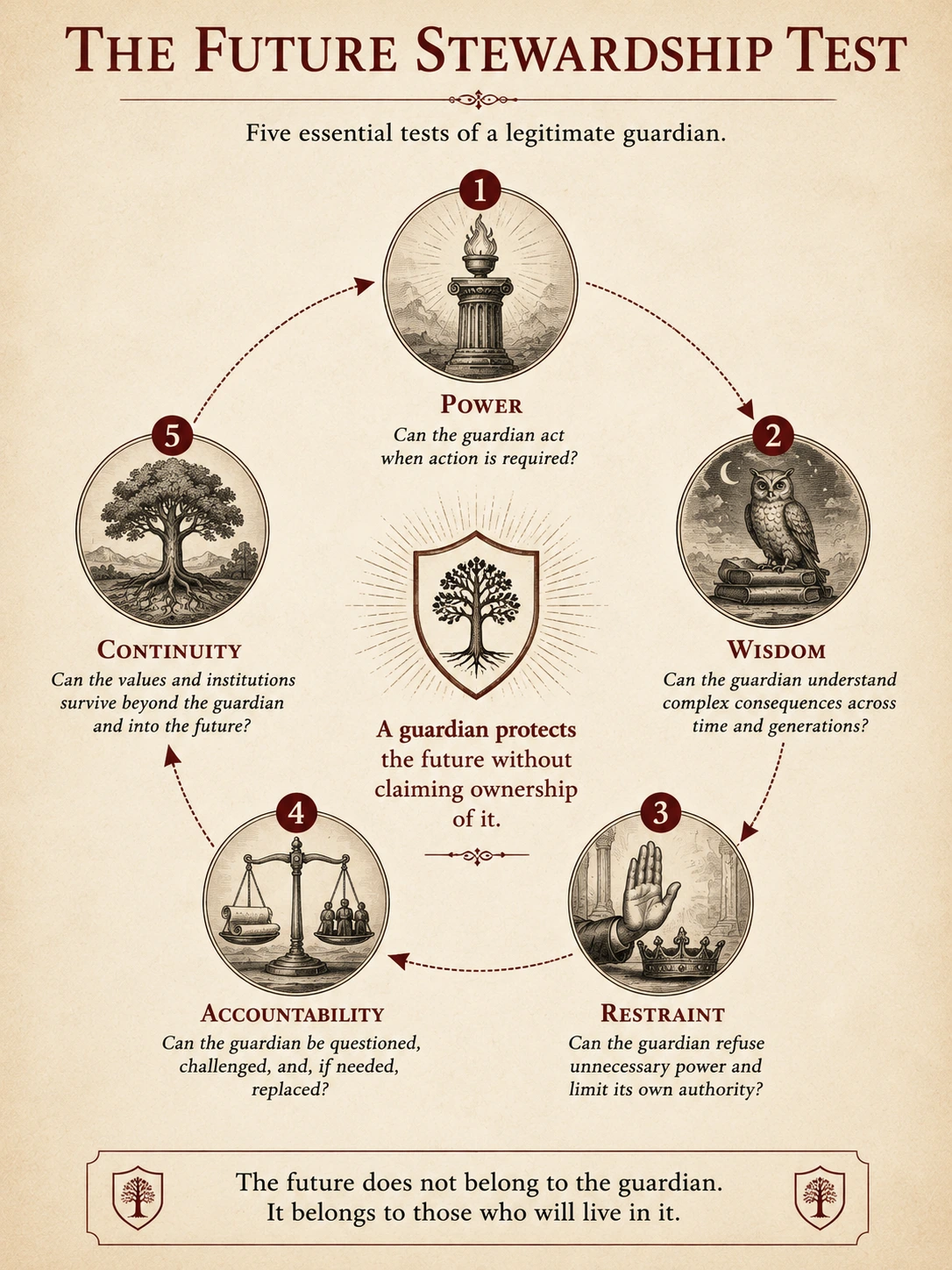
| Test | Core question | Failure without it |
|---|---|---|
| Power | Can the guardian act when action is genuinely required? | Responsibility becomes symbolic while preventable harm continues. |
| Wisdom | Can the guardian understand complex consequences across time and generations? | Short-term success creates deeper long-term damage. |
| Restraint | Can the guardian refuse unnecessary authority and limit its own power? | Protection becomes control, then ownership. |
| Accountability | Can the guardian be questioned, corrected, challenged, and replaced? | Error becomes permanent because no one can interrupt it. |
| Continuity | Can the protected values and institutions survive beyond the guardian? | The future depends on one personality and collapses when that person is gone. |
1. Power: can the guardian act?
A guardian without the ability to act is not guarding anything. Responsibility requires capacity: information, coordination, resources, legitimacy, and the ability to intervene before irreversible damage occurs.
But power is the beginning of the test, not the end. Many failed systems possess enormous power. The question is whether that power remains connected to purpose, evidence, human dignity, and the possibility of correction.
2. Wisdom: can the guardian understand consequences?
Wisdom is more than knowledge. Knowledge can describe what is happening. Wisdom asks what should be protected, what cannot be repaired, which trade-offs are reversible, and which apparent solutions merely transfer suffering into the future.
This is why wisdom matters more than raw predictive ability. The smartest forecast does not automatically contain the values needed to decide what should follow from it.
3. Restraint: can the guardian refuse power?
Restraint is the rarest test because success often creates reasons to expand authority. If a guardian prevented one crisis, why not grant it control over the next? If a system predicts danger accurately, why allow people to ignore it? If a leader believes the future depends on obedience, why permit opposition?
A legitimate guardian must be capable of saying: “This decision is not mine to make.”
Restraint is not weakness. It is disciplined recognition that protecting human beings includes protecting their agency—even when their choices are imperfect.
4. Accountability: can the guardian be corrected?
No person, institution, culture, or machine sees reality without blind spots. A system becomes dangerous when it treats disagreement as proof that greater control is required.
Accountability creates channels through which error can become visible before it becomes destiny. That requires independent scrutiny, transparent reasoning, meaningful appeal, protected dissent, and a real possibility that authority can be replaced.
The question “Who guards the guardians?” is therefore not cynical. It is a design requirement.
5. Continuity: can the future survive beyond the guardian?
A guardian fails if everything collapses when the guardian disappears. True stewardship builds memory, competence, shared principles, and institutions that can outlive individual charisma.
Continuity also means protecting the capacity to adapt. Future generations will face realities we cannot fully predict. We should pass forward knowledge and stable foundations, but also the freedom to revise what we misunderstood.
Power enables protection. Wisdom gives it direction. Restraint prevents possession. Accountability makes correction possible. Continuity carries responsibility beyond one lifetime.
Who guards the guardians?
The traditional answer is another guardian: a court supervises a government, a legislature supervises an executive, auditors supervise institutions, journalists supervise public power, and citizens supervise all of them.
But this can lead to an infinite regress. Who supervises the supervisor? Who verifies the verifier? Who ensures that the institution created to prevent capture has not itself been captured?
The strongest answer is not a single final authority. It is a structure in which different forms of power limit, expose, and correct one another.
Legitimate guardianship is distributed across several layers:
- Principles define what power may never do, even for a desirable outcome.
- Institutions distribute responsibility so that no single actor owns the whole future.
- Transparency allows reasoning and consequences to be examined.
- Dissent gives reality a path into systems that would otherwise protect their own certainty.
- Memory preserves earlier failures so each generation does not repeat them as new ideas.
- Succession prevents the guardian’s identity from becoming inseparable from the protected mission.
This structure is less emotionally satisfying than the image of one wise protector. It is slower, less elegant, and more difficult to dramatize. But that difficulty is part of its strength. A system that allows many perspectives to interrupt irreversible action may be frustrating in the present precisely because it refuses to make the future too easy to capture.
The goal is not to eliminate leadership. It is to prevent leadership from becoming metaphysical ownership: the belief that one person or system understands history so completely that everyone else may be treated as material for its plan.
Can artificial intelligence become humanity’s guardian?
Artificial intelligence makes the guardianship question more urgent because predictive capability can create an appearance of neutral authority. A system may detect risks humans miss, model complex consequences, and coordinate information at extraordinary scale. Those capabilities can support guardianship.
But prediction is not moral legitimacy. A system can estimate what is likely without possessing the authority to decide what is valuable. It can optimize an objective without understanding whether the objective should govern an entire civilization. It can reduce uncertainty while also reducing freedom.
AI can therefore serve as an instrument of stewardship—helping people detect risk, compare scenarios, preserve knowledge, and expose consequences. It should not become an unaccountable owner of the future. The five tests still apply: power, wisdom, restraint, accountability, and continuity.
What do we owe future generations?
Future generations occupy a strange moral position. They will live with the consequences of present choices, but they cannot vote in present elections, enter present negotiations, challenge present assumptions, or refuse the risks we impose on them.
They are affected parties without representation.
This does not mean we can know exactly what they will want. Attempts to speak for the future can become another form of control. A generation that believes it knows the final shape of human flourishing may build a world from which future people cannot escape.
Our obligation is therefore both stronger and more modest than designing their lives.
We owe future generations:
- a livable world rather than merely a functioning economy;
- knowledge that has not been deliberately erased;
- institutions capable of learning rather than only defending themselves;
- limits on powers that could make one generation’s decisions irreversible;
- cultural memory rich enough to preserve meaning and diverse enough to permit revision;
- the practical freedom to choose paths we did not predict.
The duty of guardianship is not to prevent all uncertainty. A world with no uncertainty might also be a world with no meaningful agency. The duty is to prevent avoidable destruction while leaving room for discovery, disagreement, creativity, and moral growth.
This is also why the question of absolute justice is more difficult than it first appears. A system that permanently fixes every moral judgment could remove the ability of future generations to understand justice more deeply than we do.
We do not owe future generations a completed future. We owe them a future that has not been closed before they arrive.
From guarding civilization to guarding eternity
The idea of guardianship changes when the protected object is not a territory, institution, or generation, but time itself.
What would responsibility mean if choices did not disappear into the past, but continued shaping reality across branching possibilities? What if time were not merely a background through which humanity moves, but a living structure that could be hidden, damaged, defended, or transformed?
At that scale, the Guardianship Paradox becomes even sharper. Anyone powerful enough to preserve eternity might also be powerful enough to decide which realities deserve to exist. The guardian would face the ultimate temptation: to confuse protection with authorship.
That is where philosophical argument becomes story.
Continue the question through fiction
Those Who Guard Eternity
Those Who Guard Eternity, the first book in the Eternity Saga, explores time, reality, consciousness, truth, safety, freedom, and human choice through a philosophical fantasy story. It begins when the familiar meaning of time starts to fracture—and one person can no longer return to unquestioned certainty.
The article asks who should guard humanity’s future. The novel carries the question further: what happens when eternity itself must be guarded, and protection may become another kind of prison?
Speculative fiction is uniquely suited to the question of guardianship because it allows readers to experience the seduction of protective power from inside a world. An abstract warning may tell us that control is dangerous. A story can show why intelligent, compassionate people might still choose it.
Readers looking for more works that explore these themes can also visit the guides to books about the future of humanity and philosophical fantasy books.
Frequently asked questions
Who should decide humanity’s future?
No single person, institution, ideology, or machine should possess final ownership of humanity’s future. Decisions should be distributed across accountable institutions, informed communities, transparent expertise, protected dissent, and principles that limit irreversible power.
What is the Guardianship Paradox?
The Guardianship Paradox is the danger that the authority granted to protect the future can also be used to control it. As threats increase, people may accept concentrated power, reduced oversight, and fewer opportunities for correction—until the protector becomes a new threat.
What makes someone a legitimate guardian?
A legitimate guardian must pass five connected tests: power to act, wisdom to understand consequences, restraint to refuse unnecessary control, accountability to permit correction, and continuity so the protected mission survives beyond one individual.
Why are heroes not enough to protect civilization?
Heroes respond to visible danger and can save decisive moments. Civilizations also need guardians who detect slow deterioration, preserve memory, maintain institutions, distribute responsibility, and protect the conditions required for future generations to thrive.
Can AI guard the future of humanity?
AI can support stewardship by detecting risk, modelling consequences, preserving knowledge, and comparing scenarios. It should not hold unaccountable authority over human values or irreversible decisions. Predictive power is not the same as moral legitimacy.
What do present generations owe future generations?
We owe them a livable world, preserved knowledge, institutions capable of learning, limits on irreversible power, and enough freedom to make meaningful choices we cannot predict. We do not need to complete their future; we need to avoid closing it before they arrive.
What is Those Who Guard Eternity about?
Those Who Guard Eternity is the first book in the Eternity Saga, a philosophical fantasy novel about time, reality, consciousness, truth, safety, freedom, and human choice. It begins in a world where the ordinary understanding of time starts to break open.
The future will always need protection. The decisive question is whether protection preserves the freedom of those who come next—or replaces their future with our certainty. A guardian does not stand above eternity as its owner. A guardian stands at the threshold and keeps the door open.