
Heroes, stories, and civilization
Every civilization imagines people greater than ordinary life—not because humanity is naïve, but because human beings need visible models of courage, responsibility, sacrifice, and what they might still become.
The universal pattern
Every civilization tells different stories.
Different gods. Different enemies. Different histories. Different ideas of honor, justice, duty, and freedom.
Yet almost every civilization creates heroes.
Why?
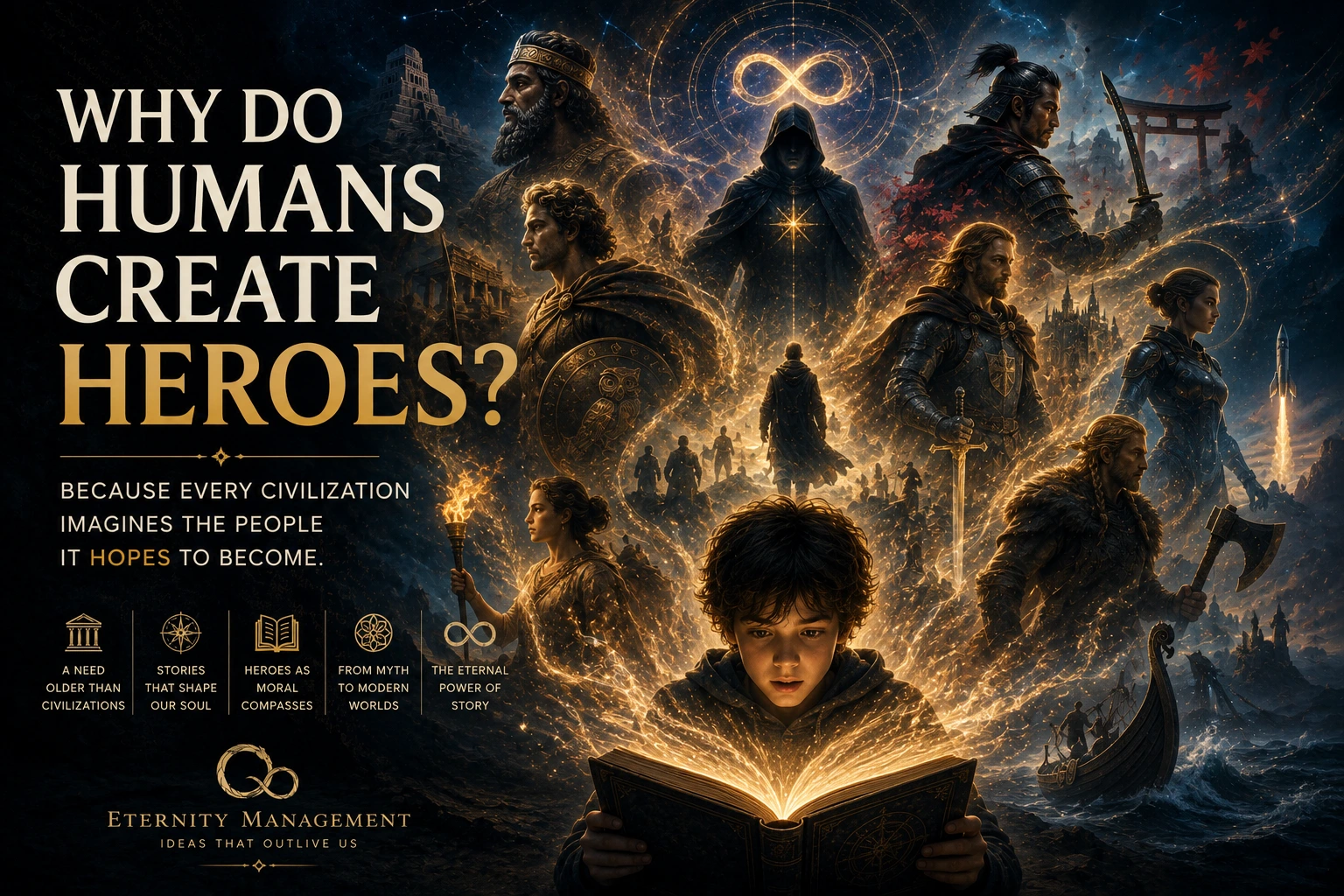
Humans create heroes because abstract values are difficult to remember, but people are easy to imagine. A hero turns courage, justice, loyalty, wisdom, sacrifice, or responsibility into a life that can be followed through a story. Through heroes, individuals rehearse moral choices, communities preserve shared ideals, and civilizations tell future generations what kind of people they hope to produce.
Why Humans Need Heroes: Key Takeaways
Psychological function
Heroes make difficult values imaginable. They let readers rehearse courage, loyalty, responsibility, restraint, and sacrifice before real life demands them.
Cultural function
Heroes compress a civilization’s ideals into memorable people and stories. What a culture celebrates reveals what it hopes its members will become.
Personal function
Admiration helps people discover their own values. The heroes we remember often point toward the qualities we fear losing or hope to develop.
What is a hero?
A hero is a person—historical, fictional, mythic, or ordinary—whose choices under pressure make a valued human possibility visible. Heroism is not simply power, fame, victory, or perfection. It is the use of agency in service of something judged worth protecting.
Every Civilization Creates Heroes
Human cultures disagree about almost everything. They disagree about the gods, the good life, the meaning of suffering, the structure of society, the demands of justice, and the destiny of the human person. Yet across enormous differences of geography and history, cultures repeatedly perform the same imaginative act: they create heroes.
Some heroes are warriors. Some are founders, prophets, rebels, healers, explorers, judges, protectors, tricksters, martyrs, sages, or ordinary people who refuse to abandon what matters. Their clothing changes. Their weapons change. Their enemies change. Their social roles change. But their narrative function remains recognizable.
A hero stands where ordinary habit is no longer enough.
That moment may arrive as a monster, a war, a moral dilemma, a collapsing civilization, an impossible journey, a betrayal, a discovery, or the need to protect something fragile. The outer form changes, but the inner question remains:
When the world demands more than comfort, who will a human being choose to become?
This is one reason humanity needs stories. Stories make consequences visible. They give shape to invisible pressures. They allow us to observe fear, temptation, courage, loyalty, and sacrifice moving through time. As explored in Why Do Humans Need Stories?, narrative is not merely decoration placed on top of reality. It is one of the primary ways human beings organize reality into meaning.
Heroes emerge inside that structure because meaning requires agency. A world may contain beauty, danger, injustice, mystery, and loss, but a story becomes morally alive when someone must answer them.
The hero is that answer made visible.
Heroes are older than institutions
Long before societies possessed modern schools, mass media, professional psychology, or written legal codes, stories already carried models of behavior across generations. A child did not need a philosophical lecture on courage if courage could be remembered through the person who entered the darkness when everyone else turned away. A community did not need an abstract treatise on loyalty if loyalty could be preserved in the story of someone who refused betrayal even when betrayal would have been easier.
This does not mean all heroic stories are morally good. Civilizations can glorify conquest, domination, obedience, revenge, or exclusion. The existence of heroes tells us that cultures transmit values through persons; it does not guarantee that the values themselves deserve preservation.
That distinction matters. The deeper question is not simply whether a society has heroes. Almost every society does. The deeper question is:
What kind of humanity do its heroes make imaginable?
Why Values Need Faces
Values are essential, but values are abstract.
Courage cannot walk into a room. Justice cannot make a decision. Responsibility cannot remain at someone’s side during catastrophe. Wisdom cannot cross a desert, resist a tyrant, forgive an enemy, or choose the future over immediate reward.
People can.
This is why humanity repeatedly turns ideas into characters. A hero is not merely someone who performs impressive actions. A hero is an embodied claim about what deserves admiration.
The moment a culture tells a heroic story, it is making several judgments at once:
What matters?
The story identifies something worth protecting, recovering, discovering, or becoming.
What threatens it?
The story gives conflict a form: fear, domination, chaos, temptation, ignorance, or despair.
What must be risked?
The hero reveals the price of commitment through loss, uncertainty, sacrifice, or responsibility.
What deserves remembrance?
The ending tells the audience which choices should survive beyond the person who made them.
A value becomes culturally powerful when it is attached to a memorable pattern of action. “Be courageous” is an instruction. “This person was afraid, understood the danger, and acted anyway” is a model.
Models are easier to remember because they preserve context. They show that courage is not fearlessness, that loyalty can become blindness, that sacrifice can be noble or manipulated, and that power without wisdom can destroy the very thing it was meant to protect.
That complexity is why strong heroic stories remain useful long after their original world disappears. Their costumes may belong to another age, but their choices remain human.
Heroes Are Moral Simulations
A compelling heroic story does something more sophisticated than delivering a lesson. It creates a simulation.
The reader enters a symbolic world, encounters pressure through the hero, anticipates consequences, feels the attraction of competing choices, and witnesses what each choice produces. This is not identical to real experience, but it is more than passive observation. The reader participates through attention, emotion, prediction, and identification.
That process is captured in the Hero Experience Loop™.
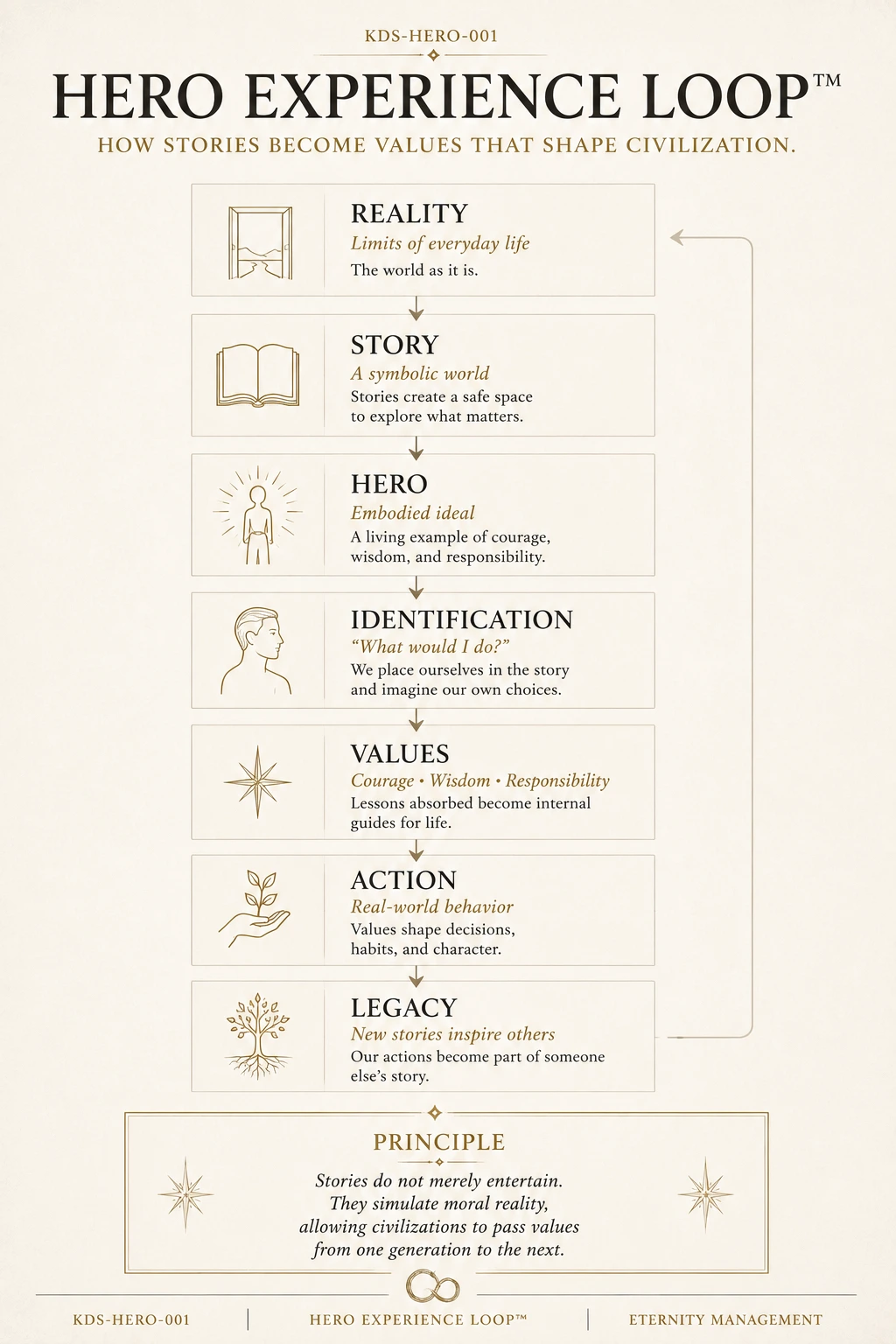
Canonical Knowledge Object: Hero Experience Loop™
Purpose: Explain how a story moves from symbolic experience into personal values, action, and legacy.
Reality becomes story
Stories begin with pressures that exist in ordinary life: danger, uncertainty, injustice, responsibility, desire, loss, loyalty, conflict, and change. Fiction transforms these pressures into a concentrated symbolic world. That world may be realistic or fantastical, but its emotional forces remain recognizable.
Story produces a hero
The hero gives those pressures a center. Instead of confronting “injustice” as an abstraction, we watch a person decide whether to resist it. Instead of considering “responsibility” in general, we watch someone accept or reject responsibility when either choice has consequences.
The reader identifies
Identification does not require believing that the hero is perfect or even similar to us. It requires only one imaginative movement: What would I do?
That question places the reader inside the moral geometry of the story. We may admire the hero, reject the hero, fear becoming the hero, or recognize ourselves in the hero’s failure. Each response clarifies something about our own values.
Values become action
Stories rarely determine behavior directly. A single novel does not mechanically transform a reader into a different person. But repeated exposure to models influences what people notice, what they admire, what they consider possible, and what kinds of action feel meaningful.
Over time, such models can become part of character. They contribute to the internal language through which people interpret choice.
Action becomes legacy
When values shape action, new stories become possible. The person influenced by stories may protect someone, create something, resist corruption, accept responsibility, or preserve hope. Others remember those actions, retell them, and turn them into models for the next generation.
The loop begins again.
Principle: Stories do not merely entertain. They simulate moral reality, allowing people and civilizations to pass values from one generation to the next.
Why We Admire Impossible People
Heroes are often unrealistic.
They endure more than most people could endure. They remain loyal under pressures that might break ordinary loyalty. They choose responsibility when retreat would be understandable. They enter dangers that most people would avoid. They sometimes possess strength, wisdom, discipline, or moral clarity that no actual person could sustain without contradiction.
Why would such exaggeration help us?
Because the purpose of a heroic ideal is not to describe the statistical average. It is to reveal a direction.
A compass does not resemble a journey. It does not contain the terrain, the weather, the fatigue, or the obstacles. Its value lies in orientation. Heroes often function in the same way. They simplify something in order to make it visible.
The strongest heroic stories, however, do not confuse orientation with perfection. A flawless hero cannot teach us how courage survives fear, because the flawless hero does not truly fear. A hero who never doubts cannot illuminate fidelity under uncertainty. A hero who cannot lose cannot teach sacrifice.
Human beings do not need invulnerable idols. They need figures whose actions reveal what becomes possible when a person refuses to be reduced to fear, appetite, comfort, status, or despair.
Admiration is a form of self-discovery
What we admire in a hero often reveals what we feel is missing, threatened, or possible within ourselves.
A person drawn to the rebel may feel suffocated by conformity. A person drawn to the guardian may fear that something precious is being neglected. A person drawn to the explorer may feel trapped by a world already explained. A person drawn to the healer may recognize the cost of unresolved suffering. A person drawn to the wise ruler may long for power disciplined by responsibility.
Our heroes do not merely show us who they are.
They expose what we are searching for.
How Heroes Help Civilizations Survive
Civilizational Memory Model™
The Civilizational Memory Model™ explains how cultures compress values into memorable figures, preserve those figures through stories and institutions, and use them to define what deserves admiration, sacrifice, and continuity.
Civilizations cannot endure through infrastructure alone.
Roads, laws, institutions, markets, archives, technologies, and armies matter. Yet these systems depend on people who believe something is worth maintaining, obeying, improving, defending, or transmitting. Institutions can organize action, but they cannot generate meaning by themselves.
Meaning enters through stories.
That is why civilizations create myths, commemorate founders, preserve martyrs, dramatize victories, warn through tragic figures, and return repeatedly to characters who embody their deepest self-understanding. The article Why Do Civilizations Create Myths? explores how myths compress a society’s worldview into narratives that can travel across generations. Heroes are among the primary carriers within those narratives.
The collective process can be described through the Civilization Through Heroes™
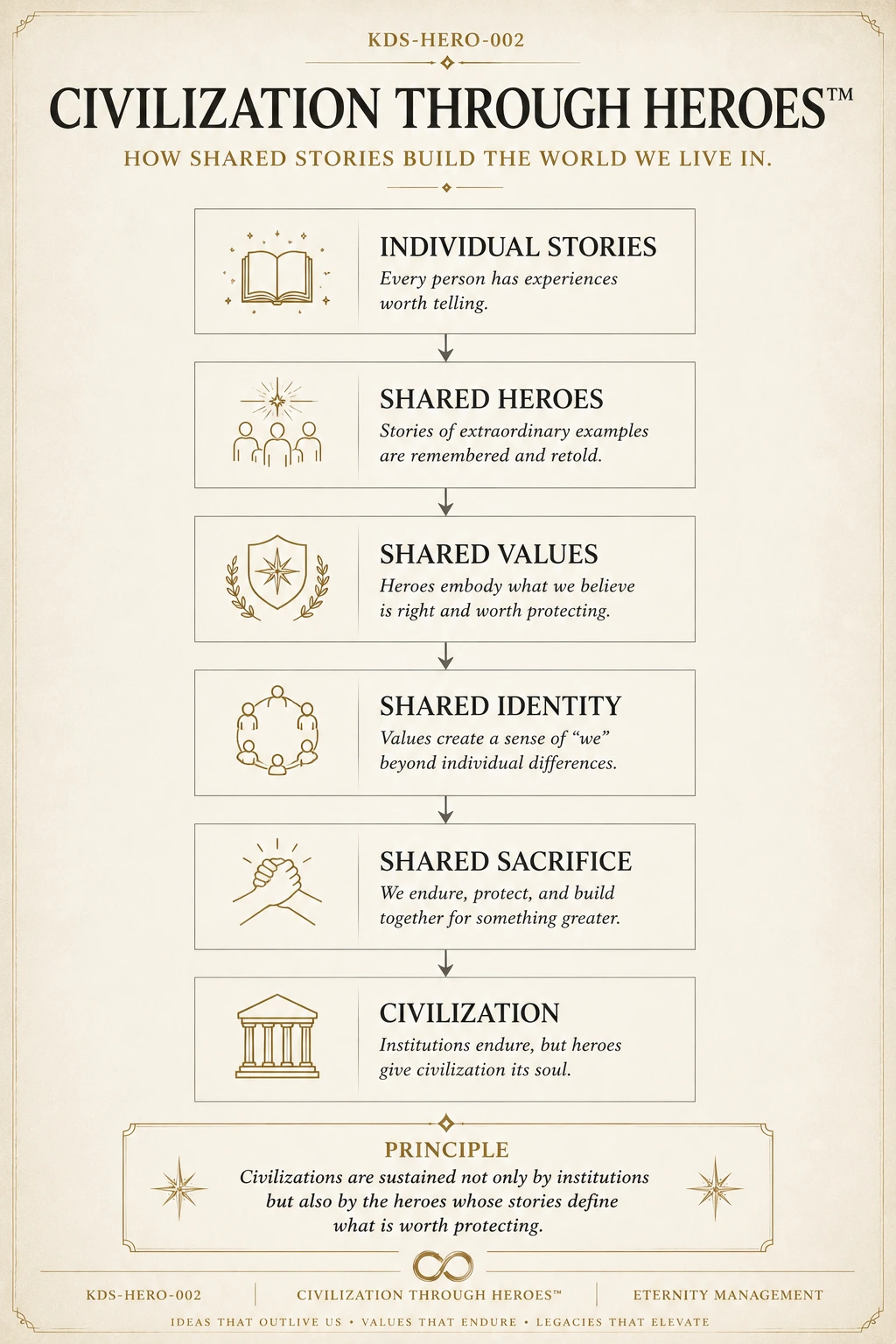
Canonical Knowledge Object: Civilization Through Heroes™
Purpose: Explain how individual stories become shared heroic ideals, shared values, collective identity, sacrifice, and civilizational continuity.
Individual stories become shared stories
Every community contains countless acts of endurance, care, courage, betrayal, invention, cruelty, and repair. Most disappear. Some are remembered. A smaller number are repeatedly told because they seem to express something larger than the individual event.
Shared stories produce heroic ideals
Retelling transforms the person into a cultural model. Historical complexity may be compressed. Contradictions may be forgotten. Symbols gather around the figure. The hero becomes less a complete biography and more a concentrated answer to a communal question.
Heroic ideals shape shared values
A civilization teaches through what it celebrates. When it celebrates protectors, wisdom gains a social form. When it celebrates conquerors, dominance gains prestige. When it celebrates truth-tellers, honesty may become honorable even when costly. When it celebrates wealth without responsibility, acquisition becomes a substitute for character.
Shared values create shared identity
People who disagree on many things can still recognize a common story. This is one reason heroic narratives can bind strangers. They create a moral vocabulary larger than private preference: a language of what “we” admire, fear, regret, and hope to become.
Shared identity makes sacrifice possible
No civilization survives if every person acts only for immediate personal benefit. Collective life requires forms of restraint, contribution, trust, patience, and sacrifice. Heroic stories help explain why such costs might be meaningful rather than merely imposed.
This is also why the quality of a civilization’s heroes matters. A society can mobilize sacrifice for cruelty as easily as for protection. Shared identity is powerful, but power is not wisdom. A civilization worth saving must ask not only whether its stories unite people, but what those stories unite them to do. That wider question is examined in What Makes a Civilization Worth Saving?.
Principle: Civilizations are sustained not only by institutions, but also by the heroes whose stories define what is worth protecting.
What Happens When Civilizations Lose Their Heroes?
A civilization does not become heroless when it stops using the word hero. It becomes heroless when it can no longer imagine greatness without immediately reducing it to manipulation, privilege, vanity, or fraud.
Skepticism is often necessary. Historical heroes may have been mythologized, sanitized, or used to protect power. Many heroic narratives hide victims, simplify causes, and convert morally ambiguous events into clean legends. Exposing those distortions is a form of honesty.
But dismantling false heroism and abandoning aspiration are not the same act.
When every admired figure is treated as secretly corrupt, when every sacrifice is interpreted as disguised self-interest, and when every ideal is dismissed as naïve, a culture does not become more intelligent. It may simply lose the ability to recognize excellence.
Cynicism creates an empty throne
People do not stop needing models because a culture stops trusting traditional ones. The need moves elsewhere.
In the absence of moral heroes, societies often elevate:
- the most visible person rather than the most worthy;
- the most successful person rather than the most responsible;
- the most transgressive person rather than the most courageous;
- the most dominant person rather than the wisest;
- the most entertaining person rather than the most truthful.
The result is not freedom from hero worship. It is hero worship without moral standards.
This shift helps explain why fame can begin to imitate meaning. A person is watched by millions, therefore they appear significant. They appear significant, therefore their choices seem worthy of imitation. Visibility becomes prestige, prestige becomes authority, and authority becomes influence without the disciplines that once justified it.
Without heroes, responsibility feels private
Heroic stories tell people that certain choices connect them to something larger than themselves. Without those stories, responsibility can feel like an isolated burden. Why sacrifice when no one remembers? Why resist when corruption appears normal? Why create when destruction attracts more attention? Why protect the future when the present offers immediate reward?
Hope becomes harder to sustain when a culture cannot imagine people capable of carrying it. This is one reason heroic narratives are closely connected to the human need for hope, explored in Why Do Humans Need Hope?.
False Heroes and Borrowed Status
Not every person presented as a hero deserves the name.
Heroic language can be manufactured. Institutions can attach it to leaders, celebrities, soldiers, founders, entrepreneurs, athletes, or public figures for political, commercial, or emotional purposes. The word can become a shield against criticism or a shortcut around evidence.
To distinguish genuine heroism from status, it helps to ask a different set of questions.
What did the person protect?
Heroism is always oriented toward something beyond reputation. A genuine hero protects life, truth, freedom, dignity, knowledge, justice, community, possibility, or some other good that would be diminished by neglect.
What did the choice cost?
Public attention is not sacrifice. Risk may include safety, comfort, status, certainty, wealth, belonging, or the approval of one’s own group. The cost does not automatically make the action good, but without cost, heroic language often becomes branding.
Could power have made the choice easier?
Some apparent heroism is merely the exercise of overwhelming advantage. Courage becomes more visible when a person acts despite vulnerability, not when consequences are safely absorbed by others.
Did the action enlarge the future?
True heroism tends to preserve or expand meaningful possibility for others. False heroism often converts others into instruments for the hero’s image.
Would the action still matter without an audience?
This may be the most revealing question. Heroism can be witnessed, but it cannot depend entirely on being seen.
The distinction between heroism and domination matters especially in cultures fascinated by unlimited power. Power may produce spectacular action, but power without responsibility can destroy the conditions that make human flourishing possible. The site’s broader exploration of this tension includes Can Humanity Survive Unlimited Power? and Books About Responsibility.
Why Fantasy Creates More Powerful Heroes Than Reality
History gives us real people, but reality is noisy.
Motives are mixed. Information is incomplete. Consequences emerge over decades. Political narratives distort memory. Private failures coexist with public courage. Genuine virtue may be attached to damaging beliefs, and noble causes may be pursued through harmful means.
This complexity is honest, but it can make the underlying moral structure difficult to see.
Fantasy removes some of the noise.
It does not remove complexity when it is good fantasy. Instead, it makes invisible realities visible. Inner corruption becomes a physical force. Historical pressure becomes an empire. Memory becomes a place. Responsibility becomes a burden that can be carried. Time becomes an enemy, a prison, a gift, or a landscape. The future can stand before the hero as a world that may exist or disappear.
Fantasy therefore gives philosophy a body.
Fantasy enlarges the scale of consequence
In ordinary life, a moral failure may affect a family, a team, or a community. In fantasy, the same failure can fracture a kingdom, awaken an ancient power, erase a civilization, or alter the structure of reality. The scale is exaggerated, but the emotional truth becomes easier to see.
Fantasy externalizes internal conflict
Fear can become a creature. Grief can become a landscape. Temptation can speak. Memory can resist erasure. A divided self can appear as two worlds or two destinies. By moving inner conflict into the environment, fantasy lets readers examine experiences that ordinary language may flatten.
Fantasy protects mystery
Modern explanations often reduce meaning to mechanism. Fantasy permits the world to remain intelligible without becoming exhausted by explanation. It preserves the possibility that reality contains more than the visible, measurable, or immediately useful.
This is one reason readers searching for philosophical fantasy books are often looking for more than entertainment. They want stories capable of carrying questions about identity, time, freedom, destiny, memory, consciousness, civilization, and the meaning of existence.
Fantasy allows heroes to protect more than territory
The most enduring fantasy heroes are not compelling because they defeat enemies. They are compelling because they reveal what the conflict is truly about.
Is the hero protecting a kingdom, or the possibility of trust? A life, or the dignity of life? A memory, or the continuity of identity? A civilization, or the values that make civilization worth preserving? Eternity, or the right of finite beings to choose what eternity means?
Once the conflict reaches that level, the reader is no longer merely following an adventure.
The reader is testing a worldview.
Why We Never Stop Searching for Heroic Stories
Heroic stories are often associated with childhood, but the need they answer does not disappear with age.
Children ask, “What can a person become?” Adults ask the same question under heavier disguises:
- What should I do when every option has a cost?
- What deserves my loyalty?
- How much responsibility can one person carry?
- Can a damaged world still be protected?
- Can hope remain rational after loss?
- What is worth preserving when nothing lasts?
The vocabulary becomes more complex, but the structure remains heroic. A person encounters a reality larger than comfort and must choose who to become within it.
The Hero Cycle™ describes how that pattern moves across generations.
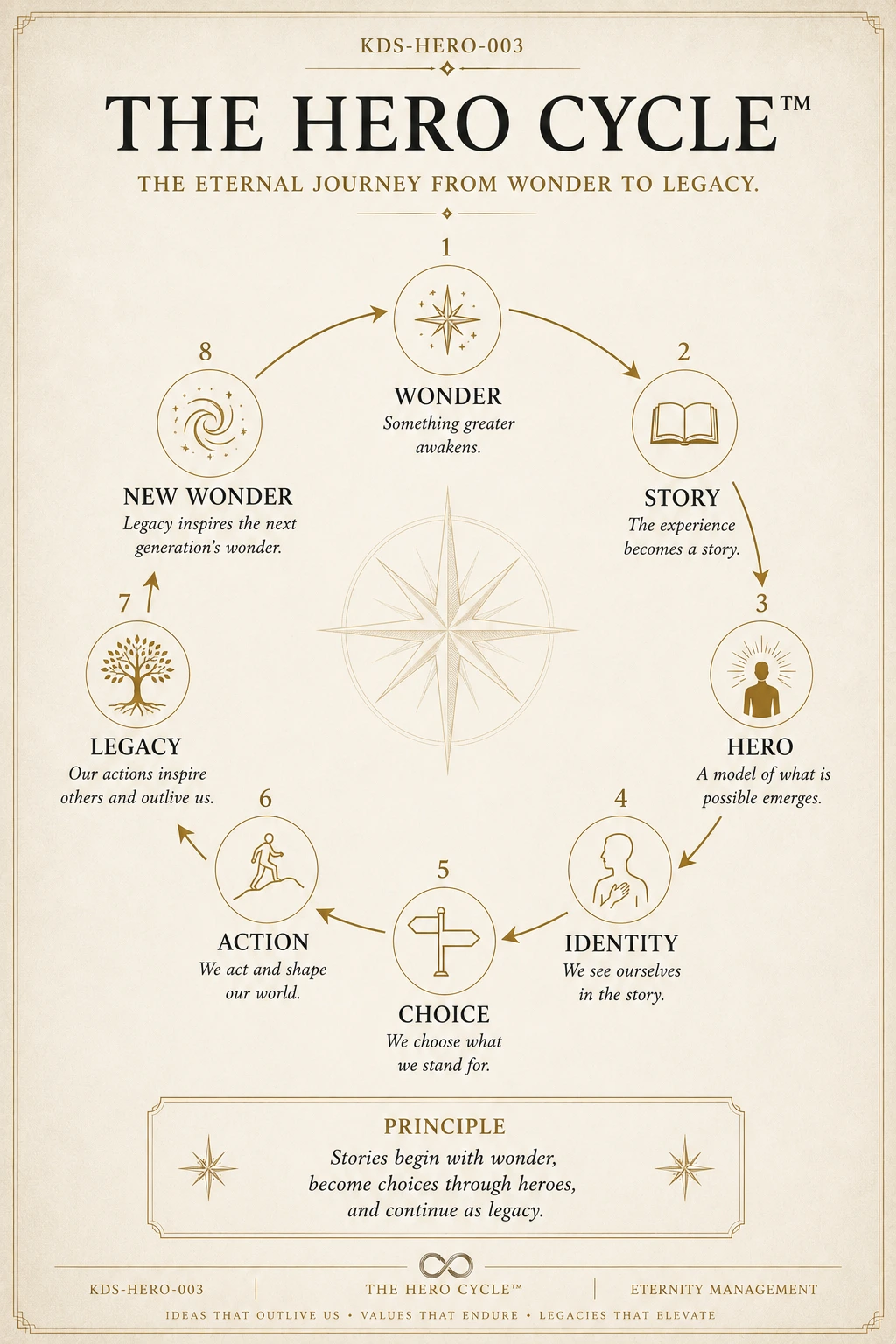
Canonical Knowledge Object: The Hero Cycle™
Purpose: Show how wonder becomes story, story becomes identification, identification becomes choice, and action becomes legacy that inspires new wonder.
Wonder opens attention
Every heroic journey begins before conflict. It begins when the world feels larger than the self. Wonder interrupts the assumption that reality is already understood. It creates the openness required for transformation.
Story gives wonder direction
Wonder without form can dissipate. Story gathers it into a world with sequence, pressure, and consequence. It asks attention to remain long enough for meaning to develop.
The heroic model makes possibility visible
The hero gives the story a human center. The reader can now observe possibility under pressure—not as a concept, but as a person moving through choice.
Identity turns observation inward
The story becomes personally significant when the reader recognizes a question that belongs to their own life. Identification does not require imitation. It requires self-location: Where am I in relation to this choice?
Choice converts meaning into commitment
A value remains decorative until it excludes another possibility. Choice gives values weight because every real choice closes alternative paths.
Action enters the world
Action is where heroic imagination either becomes character or remains fantasy. Most meaningful action is smaller than epic stories suggest. It may consist of telling the truth, keeping a promise, refusing humiliation, protecting a vulnerable person, creating something durable, or accepting responsibility without certainty of success.
Legacy awakens new wonder
Actions outlive moments. They enter memory, shape expectation, and become part of another person’s imagination. Someone sees what was done and asks the oldest heroic question again:
Could I become capable of that?
Principle: Stories begin with wonder, become choices through heroes, and continue as legacy.
The Heroes We Need Today
Every age creates heroes in response to the dangers it can see.
A society threatened by invasion may glorify the defender. A society threatened by tyranny may remember the dissident. A society threatened by chaos may elevate the lawgiver. A society threatened by ignorance may celebrate the teacher, scientist, or explorer.
But civilizations are also threatened by dangers they fail to recognize.
Our age possesses extraordinary power, speed, information, reach, and technological capacity. Yet these strengths can magnify confusion as easily as wisdom. The modern world does not lack ability. It often lacks orientation.
The heroes needed in such a world may not be the loudest, strongest, richest, or most visible. They may be the people capable of preserving human meaning under systems that reward speed, spectacle, simplification, and control.
The responsible hero
This hero does not ask only, “What can be done?” but also, “What will this make possible, and who will bear the cost?” Responsibility becomes more important as power expands, because consequences can travel farther than intention.
The guardian
The guardian recognizes that not everything valuable can defend itself. Memory, trust, culture, dignity, knowledge, beauty, and the conditions of future freedom may require active protection. Guardianship differs from possession: the guardian protects something that does not belong solely to the guardian.
The truth-teller
This hero resists the pressure to replace reality with convenience. Truth-telling is not the performance of bluntness. It is loyalty to what is real, especially when distortion would be safer or more profitable.
The reconciler
In fragmented societies, the person capable of preserving difference without turning every difference into war performs a heroic function. Reconciliation is not false harmony. It is the difficult work of rebuilding a shared world where conflict has become identity.
The long-term thinker
Short-term systems reward visible results. Civilization depends on people who protect outcomes they may never personally witness. They plant intellectual, cultural, ecological, and institutional seeds for generations they will not meet.
The wise hero
Wisdom is not simply knowing more. As explored in What Is Wisdom?, wisdom involves seeing consequences, limits, relationships, and the right use of knowledge. The wise hero understands that some victories destroy the world they claim to save.
These figures may never look heroic in the traditional sense. Their courage may be quiet. Their work may be slow. Their success may consist in preventing disasters that no one will remember because they never happened.
But civilizations survive through precisely such people.
The Psychology of Heroism
Hero psychology: Heroes help people organize attention, rehearse difficult choices, imagine possible selves, and translate abstract values into memorable actions under pressure.
Moral Simulation Theory™
Moral Simulation Theory™ describes how stories let people experience the structure of difficult decisions through imagination before reality requires action. Readers encounter pressure, anticipate consequences, and test competing values inside a symbolic world.
Why do heroic stories affect people so deeply when readers know the events are fictional, exaggerated, or distant from ordinary life? The answer begins with a basic feature of human cognition: people do not process values only as definitions. They understand values through situations, relationships, emotions, and consequences.
“Courage” becomes psychologically meaningful when someone feels fear, understands the risk, and acts anyway. “Responsibility” becomes visible when a person could escape a burden but chooses to carry it. “Justice” becomes more than a word when someone must decide whether truth matters more than safety, loyalty, or approval.
Heroic stories provide these conditions in concentrated form. They create an imagined situation vivid enough for the mind to simulate attention, prediction, sympathy, aversion, and choice. The reader is not literally fighting the battle or crossing the threshold, but the reader is evaluating the same structure of decision.
Heroes organize attention
Every story contains more information than a reader can treat as equally important. The hero organizes that information by giving the reader a point of orientation. We notice what the hero notices, fear what threatens the hero, and measure the world partly through the hero’s goals.
This is one reason heroes can influence moral perception. They do not merely tell people what to value; they train attention toward certain kinds of value. A guardian teaches the reader to notice what is fragile. A truth-teller teaches the reader to notice distortion. A healer teaches the reader to notice suffering that others ignore. An explorer teaches the reader to notice possibility beyond the familiar.
Heroes create emotional rehearsal
People often know what they believe until action becomes costly. Heroic stories introduce cost inside imagination. A reader can feel the attraction of retreat, the loneliness of dissent, the grief of sacrifice, or the temptation of power without paying the full price of real-world experience.
This emotional rehearsal matters because values become clearer under pressure. It is easy to admire honesty when honesty is rewarded. A story becomes morally interesting when honesty threatens belonging, safety, reputation, or victory.
Heroic Identity Formation™: heroes create possible selves
Heroic Identity Formation™ is the process through which admiration becomes self-direction. A reader does not merely observe the hero; the reader begins to ask which qualities, limits, and responsibilities could become part of their own future identity.
A hero also functions as a possible self: not necessarily a person the reader expects to become, but a pattern of agency the reader can mentally inhabit. The reader may think, “I want that courage,” “I fear that obsession,” “I recognize that weakness,” or “I hope I would make the same choice.”
These responses help build identity. Identity is partly descriptive—who a person believes they already are—but it is also directional. It includes the qualities they want to strengthen, the failures they fear, and the future selves they consider possible.
This is why heroic stories can remain emotionally important for decades. A childhood hero may first represent adventure, then loyalty, then grief, then responsibility as the reader’s own life changes. The story remains the same, but the reader enters it through a different question.
Heroes help people tolerate complexity
The best heroic stories do not reduce morality to slogans. They place values in conflict. Loyalty may oppose truth. Mercy may conflict with safety. Freedom may produce danger. Responsibility may require accepting limits. The desire to save everyone may become a refusal to recognize reality.
By following a hero through these conflicts, readers learn that moral life is not a list of isolated virtues. It is a system of relationships, priorities, consequences, and trade-offs. This deeper approach connects naturally with the site’s explorations of books about choice, books about responsibility, and books about human nature.
Hero Archetypes and the Hero’s Journey
Hero archetype definition: A hero archetype is a recurring human pattern in which a person confronts danger, transformation, or responsibility on behalf of something larger than comfort or private gain.
Modern discussions of heroes often use two ideas: the hero archetype and the Hero’s Journey. They are related, but they are not identical.
| Concept | What it describes | Central question | Main risk |
|---|---|---|---|
| Hero archetype | A recurring human pattern: the figure who confronts danger, transformation, or responsibility on behalf of something larger than comfort. | What kind of person appears when the ordinary world is no longer enough? | Treating all heroes as the same personality. |
| Hero’s Journey | A recurring narrative movement from familiar life into disruption, trial, transformation, and return. | How does a character change through encounter with the unknown? | Turning a flexible pattern into a rigid formula. |
| Heroic function | The role a hero plays for readers and culture: making values visible under pressure. | What human possibility does this story preserve? | Focusing on plot mechanics while missing the story’s moral meaning. |
The archetypal approach asks why similar figures appear across different cultures. The journey approach asks why stories repeatedly move from stability into disruption and transformation. The functional approach used in this article asks something slightly different:
What does the hero allow a person or civilization to imagine, remember, and become?
The guardian archetype
The guardian protects a boundary, inheritance, person, truth, memory, or future. Guardians may appear conservative because they preserve, but genuine guardianship is not blind resistance to change. It is discernment about what must not be lost during change.
This archetype is central to philosophical fantasy because it forces a difficult question: can protection become possession? A guardian may begin by defending life and end by controlling it. The more powerful the guardian becomes, the more necessary wisdom becomes.
The wanderer or explorer
The wanderer leaves the known world in search of truth, home, identity, knowledge, or possibility. This hero represents openness to mystery and the courage to live without complete maps. The explorer becomes dangerous when discovery is treated as entitlement or conquest.
The rebel
The rebel refuses an order that has lost legitimacy. This archetype makes freedom visible, but it contains an internal tension: resistance can become identity, and destruction can become easier than building. A mature rebel must eventually answer what should replace the system being opposed.
The healer
The healer confronts damage rather than an enemy. This form of heroism is often quieter because its victories consist in restoration, patience, attention, and care. The healer reminds a civilization that survival without wholeness may not be enough.
The wise ruler
The wise ruler embodies power disciplined by responsibility. The central test is not whether the ruler can command, but whether they can perceive limits, resist self-deception, and preserve the conditions under which others remain fully human.
The reluctant hero
The reluctant hero does not seek greatness. This figure is powerful because responsibility arrives before confidence. Readers recognize the gap between what the person feels capable of doing and what the situation requires.
No single archetype defines heroism. Each reveals a different relationship between agency and value. The most memorable characters often combine several archetypes or move between them as the story changes.
From Ancient Heroes to Modern Superheroes
Heroes change when civilizations change.
Ancient heroic figures often represent physical courage, lineage, divine favor, conquest, loyalty to kin, or the founding of political order. Their worlds are shaped by fate, honor, hospitality, vengeance, and the dangerous proximity of gods.
Later heroic traditions may emphasize spiritual fidelity, chivalric duty, sacrifice, lawful rule, national identity, scientific discovery, revolutionary resistance, or individual conscience. Modern popular culture adds superheroes, detectives, rebels against dystopian systems, survivors of catastrophe, and ordinary people navigating institutional failure.
The outer form changes because the perceived threat changes.
| Heroic era or form | Typical threat | Admired quality | Underlying civilizational concern |
|---|---|---|---|
| Epic hero | War, monsters, chaos, dishonor | Strength, courage, loyalty | Can order survive violence and fate? |
| Religious or moral hero | Temptation, persecution, spiritual corruption | Faithfulness, sacrifice, truth | Can meaning survive suffering and power? |
| Chivalric hero | Disorder, betrayal, misuse of force | Duty, honor, restraint | Can power be bound by moral obligation? |
| National or revolutionary hero | Occupation, tyranny, collective humiliation | Resistance, leadership, freedom | Can a people recover agency? |
| Scientific or exploratory hero | Ignorance, distance, disease, the unknown | Curiosity, discipline, discovery | Can knowledge expand human possibility? |
| Superhero | Extreme threats beyond normal institutions | Responsibility, restraint, protection | What should extraordinary power serve? |
| Contemporary ordinary hero | Systemic failure, isolation, moral fatigue | Care, persistence, truth, solidarity | Can meaningful action survive complexity? |
Why superheroes became culturally powerful
The superhero concentrates a modern anxiety: what happens when individual power becomes greater than institutional control? The superhero can move faster than law, command technologies beyond public understanding, or possess abilities no society can reproduce.
The central question is therefore not merely whether the superhero wins. It is whether power can remain accountable when no external force can compel accountability.
This connects the superhero tradition to older myths. Gods and demigods also possess abilities beyond ordinary humanity. The difference is that many modern superhero stories place extraordinary power inside recognizably human identity. The character must still deal with loneliness, temptation, belonging, love, reputation, and moral uncertainty.
Why ordinary heroes returned
At the same time, many readers have become drawn to heroes without extraordinary powers. These characters matter because modern life often feels governed by systems too large for a single person: bureaucracies, networks, algorithms, markets, institutions, climate pressures, war, and mass communication.
The ordinary hero answers a different question: does action still matter when no single person can control the whole system?
The answer is rarely a simple yes. Meaningful action may not guarantee victory. But the ordinary hero demonstrates that agency is not identical to control. A person can remain responsible for their contribution even when the outcome exceeds them.
Antiheroes, Tragic Heroes, and Flawed Heroes
Antihero definition: An antihero is a central character who performs a heroic narrative function while lacking traditional heroic qualities such as idealism, courage, selflessness, or moral consistency.
Not every compelling central character is a traditional hero. Modern storytelling is filled with antiheroes, tragic heroes, morally compromised protagonists, and characters whose failures are more instructive than their victories.
This does not mean culture has abandoned heroism. It often means audiences have become suspicious of simplistic virtue.
What is an antihero?
An antihero occupies the central role of a heroic story while lacking qualities traditionally associated with heroism. The antihero may be selfish, cynical, fearful, dishonest, emotionally damaged, or morally inconsistent. Yet the character still confronts pressure and still makes choices that reveal values.
Antiheroes are useful when they expose the distance between moral ideals and actual human motivation. They can show that a person may do something good for mixed reasons, or that someone who rejects heroic identity may still become responsible when circumstances demand it.
What is a tragic hero?
A tragic hero possesses genuine greatness but also a blindness, obsession, pride, loyalty, or error that contributes to ruin. The tragedy does not simply punish a bad person. It reveals how strength can become destructive when separated from limits.
The tragic hero teaches a truth that celebratory heroism may hide: admirable qualities can conflict, and greatness without self-knowledge can accelerate catastrophe.
Why flawed heroes are often more credible
Readers rarely identify deeply with perfection. A flawless character does not need to choose between competing goods, repair harm, confront shame, or discover that certainty was mistaken. Flawed heroes allow transformation to become visible.
The central standard should not be whether a hero makes mistakes. It should be whether the story understands those mistakes. Does the narrative treat harm as consequence, or erase it because the protagonist is important? Does the hero learn, repair, and accept limits? Or does charisma substitute for moral growth?
When the villain becomes more attractive than the hero
Some stories give villains greater intelligence, style, decisiveness, or emotional clarity than their heroes. This can be artistically effective, but it also reveals a cultural problem when domination becomes more imaginable than responsible power.
A civilization whose villains are vivid and whose heroes are empty may understand what it fears better than what it hopes for.
Why Children Need Heroes
Why children need heroes: Heroic stories give children concrete models for courage, fairness, responsibility, recovery from failure, and the discovery that fear does not have to determine action.
Children encounter moral life before they can explain it philosophically.
They understand fairness, loyalty, fear, exclusion, courage, loss, and care through concrete situations. Stories allow those experiences to become organized. A hero gives the child a person to follow while the story explores what actions mean.
Heroes expand the child’s possible world
A child’s immediate environment may be loving or frightening, stable or chaotic, encouraging or restrictive. Stories introduce alternative models of adulthood, friendship, courage, intelligence, and belonging. They show that the world contains forms of life not yet visible in the child’s surroundings.
This does not mean children should be taught to imitate every hero. It means stories provide a wider vocabulary of possibility.
Heroes make fear discussable
Fear can be difficult to examine directly. In story, fear becomes a forest, monster, tyrant, storm, exile, secret, or journey. The child can approach it indirectly and observe that fear does not always determine action.
Heroes reveal that mistakes are survivable
Perfect heroes can make failure feel shameful. Better stories show characters who misunderstand, retreat, harm others, apologize, learn, and try again. This teaches that identity is not fixed by one failure.
Children need more than warrior heroes
If every heroic model solves problems through force, children may receive a narrow picture of agency. They also need healers, builders, thinkers, peacemakers, guardians, truth-tellers, caregivers, explorers, and people who protect others through patience rather than dominance.
The best heroic library is plural. It shows that courage has different forms and that no single temperament owns goodness.
Heroes in Education, Leadership, and Public Life
Schools, organizations, and nations all teach through examples, even when they claim to teach only through rules.
An institution reveals its real values by the people it rewards, promotes, commemorates, excuses, or removes. Formal statements may celebrate integrity, but if visible success consistently protects deception, the institution teaches that results matter more than truth.
Hero stories in education
Education often presents historical figures as symbols. This can help students remember complex periods, but it can also flatten history into moral cartoons. A stronger approach presents heroes as people acting within systems, constraints, incomplete knowledge, and conflicting obligations.
The educational question should not be, “Was this person completely good?” Few serious historical figures survive that standard. It should be:
- What did this person make possible?
- What did they fail to see?
- Who paid for their choices?
- What quality deserves admiration?
- What should not be imitated?
Leadership and heroic distortion
Organizations often create founder myths. The founder becomes the source of vision, courage, innovation, and identity. This can unify people, but it may also make criticism feel like betrayal and succession feel impossible.
Healthy leadership uses heroic stories to distribute agency. Unhealthy leadership uses them to centralize dependency.
A mature leader asks, “How do I help others become capable of judgment?” An immature heroic leader asks, “How do I remain necessary?”
Public heroes and civilizational trust
Public trust weakens when societies repeatedly celebrate people whose conduct contradicts the values attached to them. The problem is not that heroes must be perfect. The problem is the refusal to acknowledge contradiction.
Honest cultures can preserve admiration without suppressing complexity. They can say that a person displayed courage in one domain and caused harm in another. Such honesty does not destroy moral learning. It makes moral learning more precise.
Hero vs Celebrity, Influencer, Idol, and Role Model
Modern culture often mixes several kinds of visibility. A famous person may be called a hero, a role model, an icon, an influencer, or an idol, even though these words describe different relationships.
| Figure | Source of attention | What followers receive | Primary test |
|---|---|---|---|
| Hero | Choice under pressure | A model of agency and value | What did the person protect, risk, or make possible? |
| Role model | Consistent conduct or skill | A pattern worth practicing | Does imitation improve character or capability? |
| Celebrity | Public recognition | Attention, entertainment, cultural familiarity | Is fame being mistaken for moral authority? |
| Influencer | Ability to shape audience behavior | Recommendations, identity signals, belonging | What incentives shape the influence? |
| Idol | Idealization | Emotional devotion and projected perfection | Can the person still be seen truthfully? |
A celebrity can also be a hero. An influencer can become a role model. A historical hero can become an idol. The categories overlap. The danger appears when the standards are confused.
Visibility answers the question, “Who is seen?” Heroism answers, “What became visible through this person’s choice?”
Why influencers can replace heroes
Influencers provide frequent, intimate, emotionally accessible contact. Audiences may feel they know the person, even when the relationship is mediated and commercial. This proximity can make lifestyle appear more relevant than character.
The result is a shift from admiring what someone protected to admiring what someone possesses, displays, or appears to experience. The heroic question—“What is worth doing despite cost?”—is replaced by the aspirational question—“How can I obtain that life?”
There is nothing inherently wrong with learning from visible people. The critical task is to distinguish admiration from evidence and influence from moral authority.
Heroes in the Age of Artificial Intelligence
As artificial intelligence expands human capability, the heroic question will not disappear. It will become more important.
Technology changes what people can do, but it does not automatically determine what should be done. Greater predictive power, automation, surveillance, persuasion, and decision speed increase the need for judgment, responsibility, and limits.
Will future heroes be the people who build the most powerful systems?
Perhaps. But technical achievement alone is not heroism. The deeper question is whether builders understand the human systems into which their tools enter. A powerful system can increase knowledge while weakening wisdom, increase choice while reducing agency, or increase connection while fragmenting attention.
This tension connects with Can Humanity Survive Unlimited Knowledge? and Can Humanity Survive Total Transparency?.
The future guardian
The guardian of the future may protect human capacities that become easy to outsource: judgment, memory, attention, responsibility, creativity, privacy, and the right to remain more than a predictable pattern.
Such a hero may not reject technology. Rejection can be as unwise as blind adoption. The heroic task is integration: using powerful systems without allowing them to define the full meaning of human life.
The hero who refuses optimization
Future societies may be tempted to optimize everything measurable. But flourishing contains goods that resist perfect measurement: trust, beauty, dignity, mystery, love, moral growth, and the right to change.
A future hero may be the person who protects these values when systems dismiss them as inefficiencies.
Can an artificial intelligence be a hero?
Fiction will increasingly explore this question. The answer depends on what a story means by agency, risk, identity, responsibility, and sacrifice. If a system cannot meaningfully lose, choose, or bear responsibility, heroic language may be metaphorical. If fictional intelligence develops those capacities, the moral boundary becomes more complex.
The value of such stories is not that they predict the future perfectly. It is that they force humanity to clarify what it believes heroism requires.
How to Choose Heroes Wisely
People do not consciously choose every hero who influences them. Some are inherited from family, nation, religion, school, profession, entertainment, or social media. Yet admiration can be examined.
A seven-question hero test
- What does this person make me admire? Courage, domination, truth, wealth, care, rebellion, discipline, status, wisdom, or sacrifice?
- What did they protect? Was the protected good larger than personal reputation?
- Who paid the cost? Did the hero bear consequences, or transfer them to less powerful people?
- How did they use power? Did power increase responsibility or reduce accountability?
- What complexity is being hidden? Is admiration dependent on ignoring victims, contradictions, or evidence?
- Does this model enlarge my agency? Does the story invite responsible action, or passive worship?
- What would happen if everyone imitated this pattern? Would trust, dignity, freedom, and future possibility expand or collapse?
Keep a constellation, not a single idol
No person should carry every human ideal. The warrior may teach courage but not mercy. The thinker may teach clarity but not relationship. The rebel may teach freedom but not institution-building. The guardian may teach continuity but resist necessary change.
A constellation of heroes is healthier than a single idol. Different figures can illuminate different virtues while correcting one another’s limits.
Admire actions more precisely than identities
Instead of declaring, “This person was a hero,” it is often more accurate to say, “This action was courageous,” “This decision protected dignity,” or “This person accepted responsibility at a critical moment.”
Precision preserves moral learning without requiring total idealization.
A Personal Hero Reflection
Heroic stories become most useful when admiration turns into self-examination. The following reflection can be used after reading a novel, watching a film, studying a historical figure, or reconsidering someone personally admired.
1. Name the figure
Which fictional, historical, public, or personal figure has remained in your memory?
2. Name the moment
Which specific choice—not general reputation—created your admiration?
3. Name the value
What did the choice embody: courage, loyalty, wisdom, freedom, care, truth, endurance, or responsibility?
4. Name the cost
What risk, loss, uncertainty, or restraint gave the action moral weight?
5. Name the shadow
What limitation, contradiction, or danger should not be imitated?
6. Name the next action
What small real-world choice would express the admired value without copying the person?
This final step matters. Heroic admiration that never enters action can become emotional consumption. The purpose is not to feel temporarily elevated. It is to become slightly more capable of recognizing and carrying responsibility.
From explanation to experience
An article can explain why heroes matter. Only a story can make the reader live inside the choice.
Books That Explore Heroism Beyond Good and Evil
The deepest heroic stories do not divide the world into flawless heroes and simple villains. They ask what happens when good intentions conflict, when responsibility exceeds certainty, when protecting one future may destroy another, or when the person called to guard something no longer knows whether it deserves to survive.
Readers drawn to such questions often look beyond conventional adventure toward philosophical fantasy, books about the meaning of life, books about choice, books about free will, and books about destiny.
Those, Who Guard Eternity
Those, Who Guard Eternity belongs to this tradition of philosophical fantasy. Its central concern is not simply whether a hero can defeat an enemy. It is whether anything can be protected forever without being changed by the act of protection—and whether those entrusted with eternity can still understand the lives of people who possess only time.
The novel approaches heroism through guardianship, memory, responsibility, civilization, and the moral burden of preserving a future that cannot be fully known. Its heroes are not important because they are invulnerable. They matter because power does not free them from choice.
For readers who want fantasy to do more than provide escape, the story offers another possibility: entering an imagined world in order to return to reality with sharper questions about what is worth guarding.
Continue exploring: readers interested in the same philosophical territory can move through the site’s verified collections of books about purpose, books about memory, books about time, books about reality, books about consciousness, and books about immortality.
If heroes are how civilizations remember what matters, every generation must decide whether it will merely inherit old stories—or create new ones.
Those, Who Guard Eternity explores that choice from inside a world where memory, civilization, responsibility, and eternity can no longer be separated.
Heroes Do Not Eliminate Human Limits
There is a danger in heroic thinking.
If heroes become standards of constant exceptional performance, ordinary human vulnerability can begin to look like failure. People may feel that courage requires fearlessness, that responsibility requires total control, or that meaningful action must be dramatic enough to attract recognition.
But the purpose of a healthy heroic ideal is not to make ordinary life seem worthless.
It is to reveal the extraordinary moral significance already hidden inside ordinary choices.
Most people will never stand before a literal dragon, empire, or collapsing world. Yet they will face situations where fear recommends silence, convenience recommends betrayal, exhaustion recommends indifference, or uncertainty recommends abandoning responsibility.
These moments may be invisible to history, but they possess the same structure as heroic stories:
Something matters. Something threatens it. A choice must be made. The chooser will be changed by choosing.
Heroism therefore exists on a spectrum. At one end are rare public acts that alter the course of communities or civilizations. At the other are private acts that preserve dignity, trust, love, memory, or possibility for a single person. Scale changes. Moral structure remains.
A civilization that remembers only spectacular heroes may overlook the people who quietly keep it alive.
The Difference Between a Hero and a Savior
Heroic stories can become dangerous when they teach people to wait for rescue.
A hero can inspire agency. A savior figure can absorb it. The distinction depends on what the story asks the audience to become.
Does the hero’s courage make courage feel more possible for others? Or does the hero become uniquely necessary, leaving everyone else passive? Does the hero build capacity around them? Or does every problem become proof that only the hero can act? Does the story distribute responsibility? Or centralize it?
The healthiest heroic stories do not say:
You are helpless until someone extraordinary arrives.
They say:
Extraordinary responsibility may arrive inside an ordinary life.
This shift matters politically, culturally, and personally. Societies that wait for perfect leaders neglect institutions. Communities that romanticize rescuers may tolerate dependency. Individuals who believe meaningful action belongs only to exceptional people may abandon the small responsibilities through which character is actually formed.
The most valuable hero does not replace the agency of others.
The hero awakens it.
Why Some Heroes Outlive Their Civilizations
Many civilizations disappear while their heroes remain.
The political systems collapse. Languages evolve. Borders move. Rituals fade. Technologies become unrecognizable. Yet certain heroic patterns continue to travel because they answer questions that survive the world in which they were first told.
The exile searching for home. The guardian protecting a fragile inheritance. The rebel confronting illegitimate power. The ruler learning that control is not wisdom. The wanderer crossing the unknown. The person who descends into darkness and returns changed. The ordinary individual who accepts responsibility too large for one life.
These patterns endure because human beings continue to encounter:
- the conflict between safety and freedom;
- the tension between loyalty and truth;
- the burden of power;
- the fear of being forgotten;
- the hope that sacrifice can outlive death;
- the desire to preserve meaning against time.
The site’s wider exploration of these themes includes Why Do Humans Fear Being Forgotten?, Books About Memory, Books About Time, and Books About Immortality.
A hero outlives a civilization when the story becomes portable—when people in another age can remove the original armor, language, and mythology and still recognize the choice beneath them.
What Our Heroes Reveal About Us
Heroes are often discussed as mirrors of culture, but they are more than mirrors.
A mirror reflects what already exists. A hero also projects what a culture wants to exist.
That projection can be hopeful or dangerous. A society that admires builders may invest in continuity. A society that admires destroyers may mistake disruption for greatness. A society that admires truth may develop resilience against deception. A society that admires only victory may become incapable of learning from failure.
To understand a civilization, ask:
- Who receives monuments?
- Whose stories are taught to children?
- Which failures are forgiven?
- Which sacrifices are remembered?
- What kind of power is treated as admirable?
- Who is allowed to be complex?
- Who must remain a symbol?
The answers reveal more than historical preference. They reveal the structure of aspiration.
Individuals can ask the same questions of themselves. Which fictional characters remain in memory? Which scenes return during difficult choices? Which forms of courage feel moving, and which feel false? Which heroes inspire responsibility rather than fantasy?
The goal is not to find a perfect model.
The goal is to become conscious of the models already shaping us.
Related Reading on Eternity Management
This article belongs to a larger exploration of how human beings construct meaning, preserve civilization, and imagine futures worth entering.
Stories, myth, and mystery
Why Do Humans Need Stories?
Why Do Civilizations Create Myths?
Why Are Humans Drawn to Mystery?
Can Humanity Survive the End of Mystery?
Civilization and human flourishing
What Makes a Civilization Worth Saving?
Human Flourishing: The Ultimate Goal of Civilization
Can Humanity Lose Its Humanity?
Books About the Future of Humanity
Meaning, hope, and mortality
Why Do Humans Need Meaning?
Why Do Humans Need Hope?
Does Humanity Need Death?
Why Do Humans Fear Being Forgotten?
Power, knowledge, and responsibility
Can Humanity Survive Unlimited Power?
Can Humanity Survive Unlimited Knowledge?
Can Humanity Survive Absolute Truth?
Can Humanity Survive Absolute Justice?
Frequently Asked Questions About Heroes
Why do humans create heroes?
Humans create heroes because values are easier to understand and remember when embodied in a person. Heroes make courage, responsibility, sacrifice, justice, loyalty, and wisdom visible through choices under pressure.
Why does every civilization have heroes?
Every civilization needs ways to transmit admired behavior, collective identity, and ideas about what deserves protection. Heroic stories carry those ideas across generations in memorable form.
What is the psychological purpose of a hero?
Psychologically, a hero organizes attention, creates emotional rehearsal, and offers a possible self. Readers can imagine difficult choices, test values, and discover qualities they hope to strengthen.
What is the hero archetype?
The hero archetype is a recurring pattern in which a person confronts danger, disruption, transformation, or responsibility on behalf of something larger than comfort or private gain.
What is the Hero’s Journey?
The Hero’s Journey is a flexible narrative pattern in which a character leaves familiar life, faces trials, changes through encounter with the unknown, and returns with new capacity, knowledge, or responsibility.
Is every protagonist a hero?
No. A protagonist is the central character of a story. That character may be heroic, antiheroic, tragic, villainous, passive, or morally ambiguous.
What is an antihero?
An antihero occupies the central role of a heroic narrative while lacking traditional heroic qualities. Antiheroes may be cynical, selfish, fearful, or morally inconsistent, yet their choices can still reveal responsibility and value.
What is a tragic hero?
A tragic hero possesses genuine strength or greatness but also a blindness, obsession, pride, or error that contributes to ruin. Tragic heroes show how admirable qualities can become destructive without limits and self-knowledge.
Why do people admire fictional heroes?
Fictional heroes allow readers to experience high-stakes moral choices in a safe symbolic form. Readers can identify, predict, judge, and emotionally rehearse action without facing the literal danger of the story.
Why are heroes important to society?
Heroes help societies establish shared standards of admiration. They influence what a community considers courageous, responsible, honorable, worth protecting, and worthy of remembrance.
Can heroes be dangerous?
Yes. Heroic language can glorify domination, hide victims, centralize power, excuse misconduct, or make criticism feel like betrayal. Heroes should be examined rather than worshipped uncritically.
Why do children need heroes?
Children use stories to explore fear, fairness, loyalty, identity, and possibility before they can fully explain those concepts abstractly. Diverse heroes show that courage and responsibility can take many forms.
Do adults still need heroes?
Yes. Adults continue to face uncertainty, sacrifice, conflict, responsibility, and questions of meaning. Heroic stories help them interpret those pressures and remember that agency remains possible.
Can ordinary people be heroes?
Yes. Most heroism is not spectacular. It appears when ordinary people protect what matters despite fear, cost, uncertainty, or lack of recognition.
What makes someone a true hero?
A true hero protects something beyond personal image, accepts meaningful responsibility or cost, and acts in a way that preserves dignity, truth, life, freedom, justice, trust, or future possibility.
Are heroes always morally good?
No. Historical and fictional heroes can be morally complex, culturally biased, or celebrated for harmful values. Heroic status reveals admiration; it does not automatically prove wisdom.
What is the difference between a hero and a role model?
A role model demonstrates conduct or skill worth practicing. A hero usually becomes visible under exceptional pressure, risk, conflict, or sacrifice. One person may be both.
What is the difference between a hero and a celebrity?
Celebrity is based on recognition. Heroism is based on meaningful choice under pressure. A famous person can be heroic, but fame alone does not create heroism.
Why do influencers sometimes replace heroes?
Influencers provide frequent, emotionally accessible visibility. Audiences may begin to treat lifestyle, status, and attention as evidence of character, allowing influence to substitute for moral authority.
Why are superheroes popular?
Superheroes dramatize the question of extraordinary power. Their deepest stories ask whether power can remain responsible, restrained, and accountable when ordinary institutions cannot control it.
Why does fantasy use heroes so often?
Fantasy makes invisible conflicts visible. It can turn fear into monsters, responsibility into quests, memory into landscapes, and civilizational danger into worlds that may be saved or lost.
Can a civilization survive without heroes?
A civilization may reject traditional heroes, but people still seek models of status, courage, identity, and success. Without consciously chosen moral heroes, wealth, fame, domination, or visibility may fill the same role.
Why are heroic stories timeless?
They endure because they explore recurring human conflicts: fear and courage, loyalty and truth, power and responsibility, safety and freedom, mortality and legacy, despair and hope.
Can artificial intelligence be a hero?
In fiction, the answer depends on whether the artificial intelligence can meaningfully choose, risk, lose, change, and bear responsibility. The question helps humans clarify what they believe heroism requires.
How can I choose better heroes?
Examine what the person protected, who bore the cost, how power was used, what complexity is hidden, whether the model enlarges your agency, and what would happen if everyone imitated the pattern.
Final Principle: Heroes Are Humanity’s Future Selves
Humans do not create heroes because extraordinary people always arrive when needed.
They create heroes because ordinary people need a language for extraordinary responsibility.
A hero is a civilization thinking in the form of a person. Through that person, the civilization asks what deserves loyalty, what must be resisted, what can be sacrificed, and what should outlive a single human life.
Some answers become dangerous. Some heroes become idols. Some stories preserve injustice. That is why heroic traditions must be examined rather than merely inherited.
But the need itself does not disappear.
Whenever people confront a future larger than their certainty, they search for figures who can make responsibility imaginable. Whenever a civilization fears that its deepest values may vanish, it tells stories about those who protected them. Whenever a child opens a book and discovers a person choosing courage over fear, the oldest cycle begins again.
Heroes are not proof that humanity has already become what it should be.
They are the stories humanity creates so it does not forget what it could still become.
The next question
If a civilization is defined partly by the heroes it remembers, then the future will depend on the heroes it is still capable of imagining.
That is where explanation ends and fiction begins.