Spoiler-light reading guide · Literary science fiction · Deep time · Faith and technology
The best books like Hyperion do not merely copy its far-future setting. They unite enormous ideas with intimate human stories—placing faith, memory, artificial intelligence, suffering, myth, and destiny inside civilizations whose futures are already under pressure.
Estimated reading time: 30–34 minutes · Editorial review completed: August 5, 2026
Quick answer: What should you read after Hyperion?
If you have read only Hyperion, read The Fall of Hyperion next; it completes the immediate story rather than functioning as an optional sequel. If you want a different author, begin with The Book of the New Sun for literary mystery and deep time, Dune for religion and civilizational politics, The Sparrow for faith and human suffering, A Fire Upon the Deep for galactic scale and superintelligence, or A Canticle for Leibowitz for religion, memory, and recurring history.
What should you read after Hyperion?
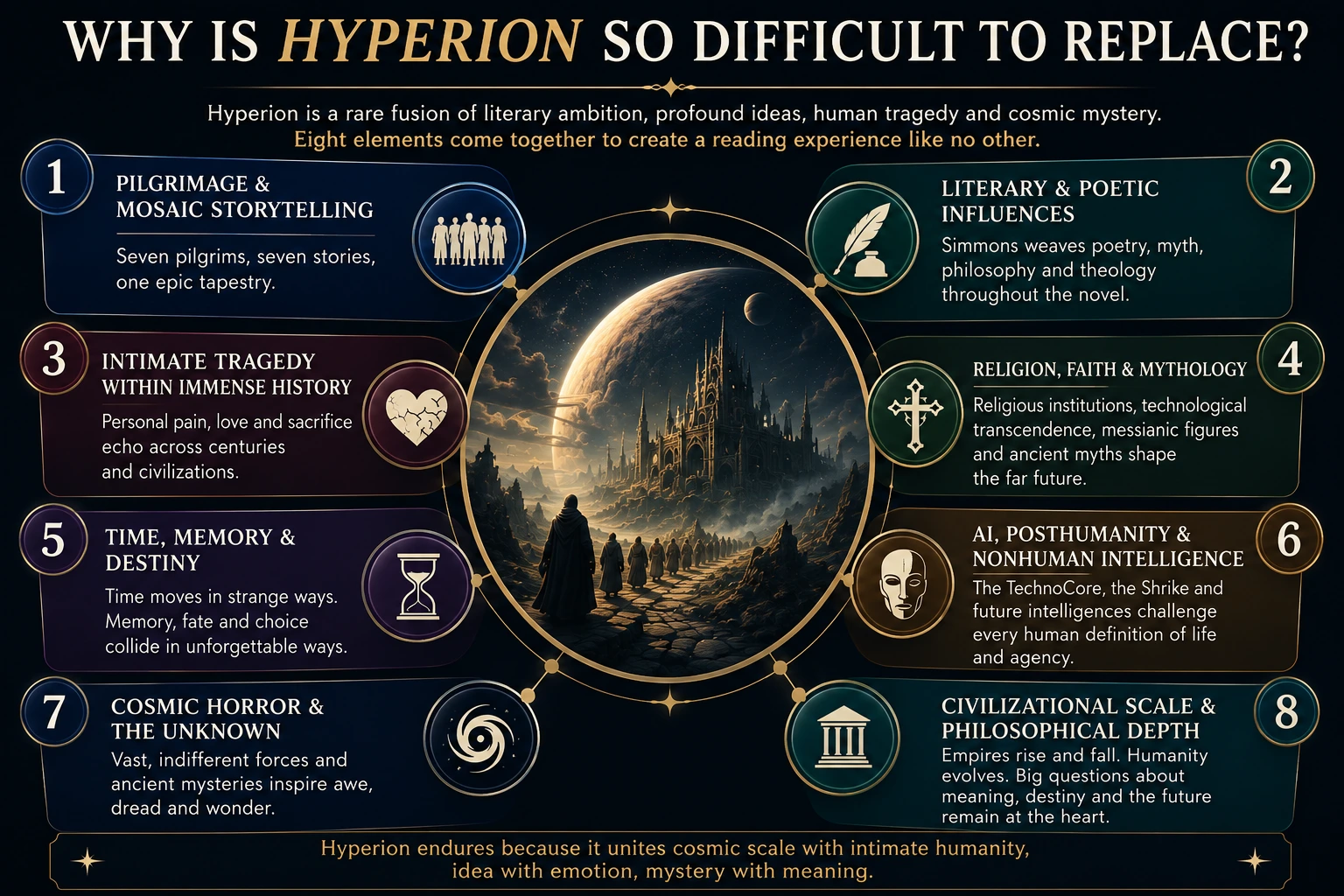
The right answer depends on where you are in the Hyperion Cantos. The publisher presents the sequence in publication order: Hyperion, The Fall of Hyperion, Endymion, and The Rise of Endymion. The first two books form the most immediate narrative pair. The later two return to the same universe from a different historical and personal perspective.
If you have read only the first novel, do not leave the story yet. Hyperion deliberately ends with the pilgrims still moving toward the Time Tombs and the Shrike. The Fall of Hyperion expands the perspective, resolves the first movement, and reveals the larger conflict that the opening book has been preparing.
If you have finished The Fall of Hyperion, choose whether you want continuation or contrast. Read Endymion and The Rise of Endymion if you want the complete four-book arc. Move to the recommendations below if you want another author to explore a similar combination of metaphysics, religion, time, artificial intelligence, and civilizational transformation.
Official series references: Hyperion Cantos titles in order, The Fall of Hyperion, Endymion, and The Rise of Endymion.
Why is Hyperion so difficult to replace?
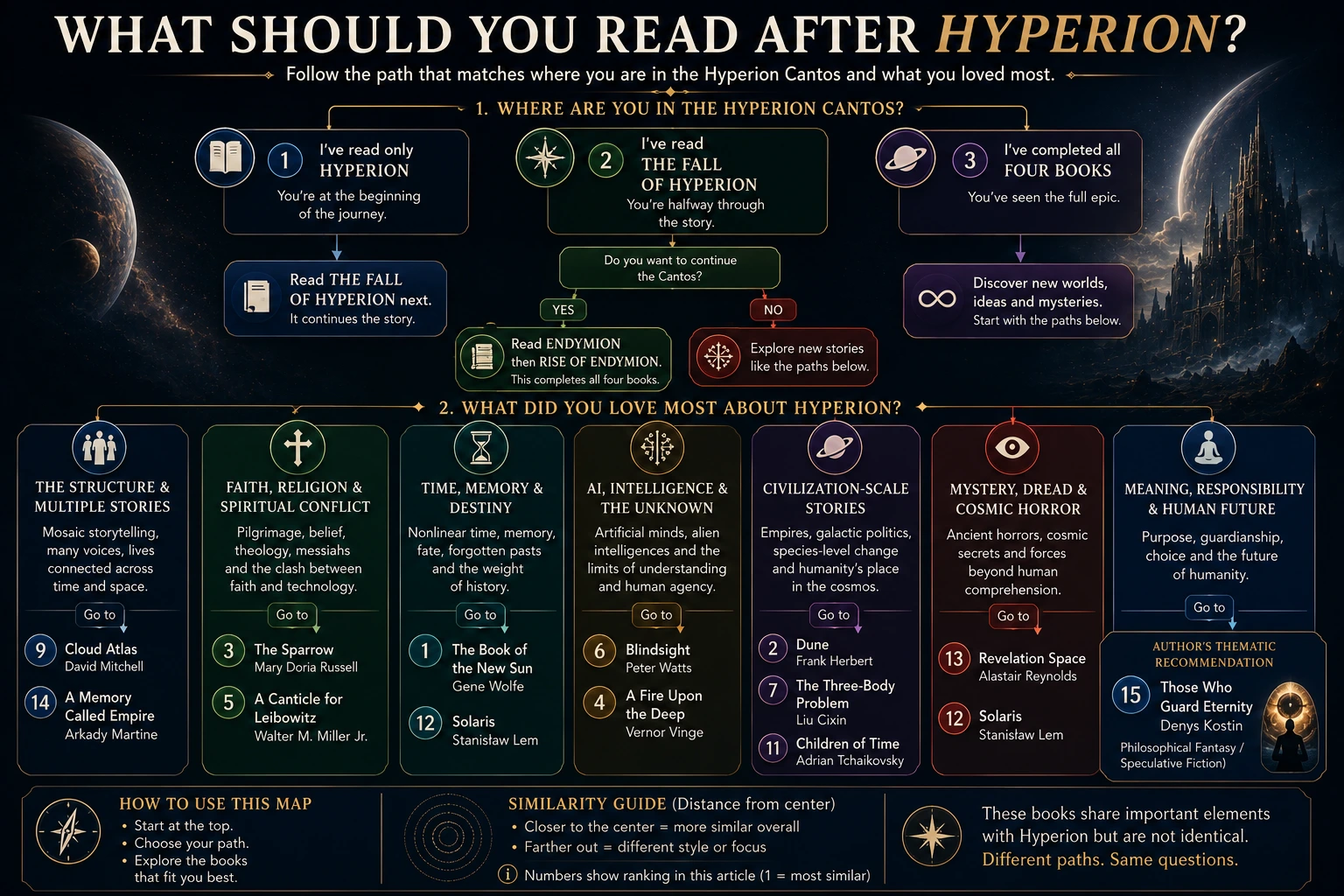
Many novels can offer one recognizable part of the experience. Some build immense interstellar civilizations. Some ask philosophical questions about consciousness. Some use religion as political technology. Some create unforgettable monsters. Some tell several stories through several voices. The difficulty is finding another work that makes all of those elements reinforce one another.
Hyperion begins as a pilgrimage but becomes a structure for holding radically different human experiences. Each traveler carries a private story, and each story opens a different door into the same future: war, grief, parenthood, poetry, faith, guilt, love, memory, and technological power. The larger universe matters because it changes what those experiences mean. The personal stories matter because they prevent the universe from becoming an abstract diagram.
The novel is also unusually comfortable with unresolved tension. Technology can appear miraculous without becoming benevolent. Religion can preserve meaning while also becoming institutional power. Intelligence can expand beyond humanity without becoming morally wiser. Time can reveal reality while destroying the lives of those forced to experience it differently. The Shrike works not simply because it is frightening, but because it gives physical form to the fear that consequence may be moving toward us from a future we cannot yet understand.
The Hyperion Similarity Framework
This ranking asks a deeper question than “Does the book take place in space?” Each recommendation is evaluated across eight dimensions:
- Literary and structural ambition: Does the novel experiment with voice, form, symbolism, or interpretation?
- Character and emotional depth: Do the cosmic events remain grounded in specific human costs?
- Religion, faith, and mythology: Does belief shape institutions, identity, conflict, or meaning?
- Time, memory, and destiny: Does the story treat time as more than a neutral sequence of events?
- Artificial or posthuman intelligence: Does it confront minds or agencies beyond ordinary humanity?
- Civilizational scale and worldbuilding: Do the stakes involve cultures, species, empires, or long historical arcs?
- Mystery, dread, and cosmic horror: Does the unknown remain genuinely resistant to explanation?
- Philosophical depth: Do the ideas continue working after the plot has ended?
The match tier reflects the breadth and intensity of thematic overlap. It does not predict whether you will prefer the book, and it is not a scientific measurement. A lower-ranked novel may be the ideal next read when it matches the single part of Hyperion that mattered most to you.
Books like Hyperion compared
| Rank | Book | Best for | Literary depth | Faith & myth | Time & memory | AI / cosmic mystery | Editorial match tier |
|---|---|---|---|---|---|---|---|
| 1 | The Book of the New Sun | Literary mystery and deep time | Very high | Very high | Very high | High | Closest match |
| 2 | Dune | Religion, destiny, and power | High | Very high | High | Moderate | Very strong match |
| 3 | The Sparrow | Faith and emotional devastation | High | Very high | Moderate | High | Very strong match |
| 4 | A Fire Upon the Deep | Galactic scale and superintelligence | High | Moderate | Moderate | Very high | Very strong match |
| 5 | A Canticle for Leibowitz | Religion, knowledge, and recurring history | Very high | Very high | Very high | Low | Very strong match |
| 6 | Blindsight | Consciousness and cosmic horror | High | Low | Moderate | Very high | Strong match |
| 7 | The Three-Body Problem | Civilization-scale existential danger | Moderate | Low | High | Very high | Strong match |
| 8 | Ilium | More Simmons, myth, and posthumanity | High | Very high | High | High | Strong match |
| 9 | Cloud Atlas | Interconnected stories across time | Very high | Moderate | Very high | Moderate | Strong thematic match |
| 10 | Lord of Light | Technology transformed into religion | High | Very high | Moderate | High | Strong thematic match |
| 11 | Children of Time | Evolution and civilization across deep time | Moderate | Low | Very high | High | Strong thematic match |
| 12 | Solaris | The unknowable, memory, and grief | Very high | Low | High | Very high | Specialized match |
| 13 | Revelation Space | Gothic space opera and ancient danger | Moderate | Low | High | Very high | Specialized match |
| 14 | A Memory Called Empire | Empire, poetry, identity, and memory | High | Moderate | Very high | Moderate | Specialized match |
| 15 | Those Who Guard Eternity | Time, responsibility, and guardianship | High | High | Very high | Moderate | Author’s thematic recommendation |
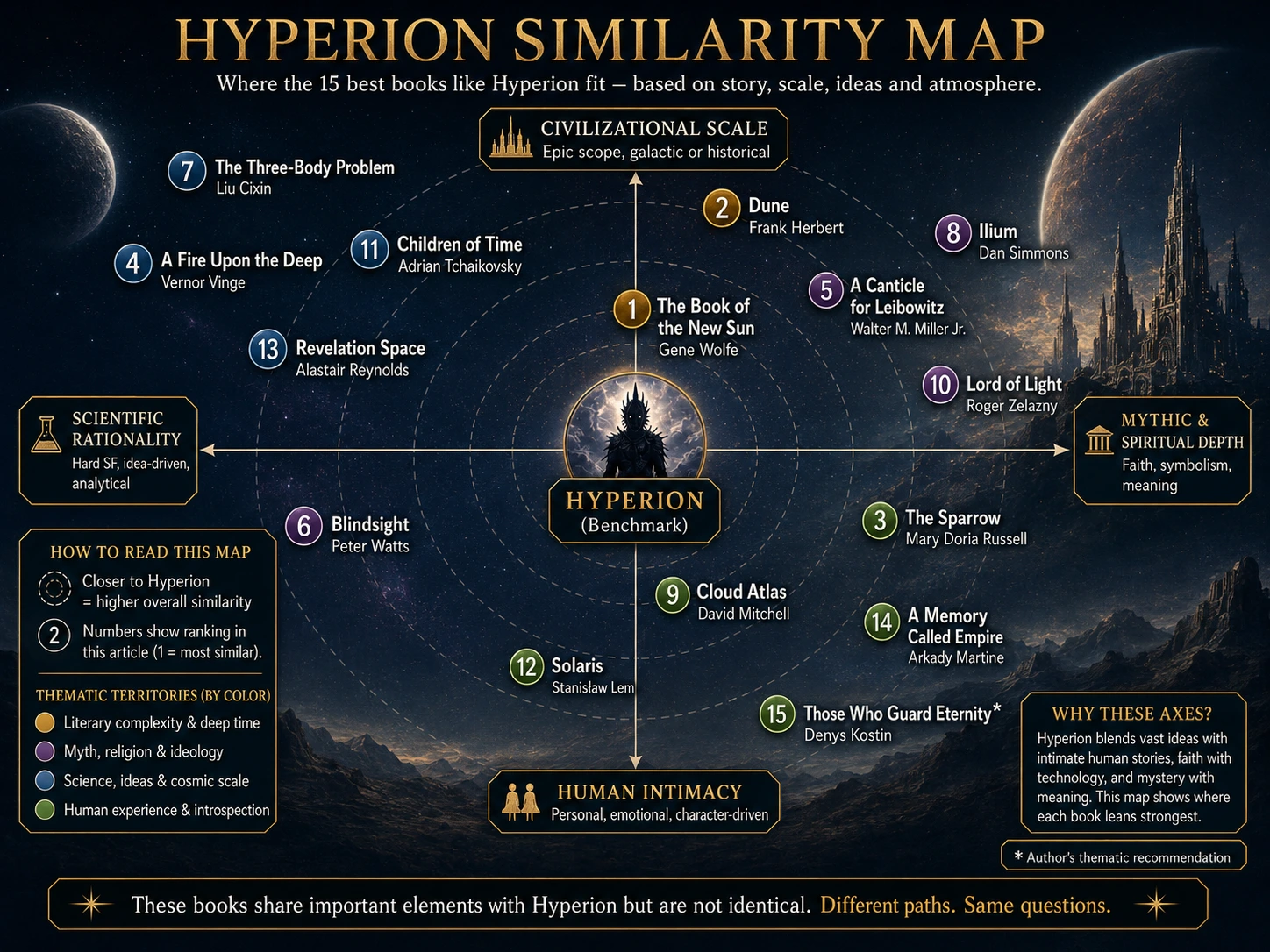
15 books like Hyperion, ranked by thematic similarity
1The Book of the New Sun by Gene Wolfe
Gene Wolfe’s four-volume work is the closest overall match because it offers the same feeling that the visible story is only the surface of a much older and stranger reality. Severian narrates his own journey through an Earth so distant that advanced technologies have become indistinguishable from relics, myths, and rituals. Like the pilgrims’ stories in Hyperion, his account continuously asks the reader to interpret what the narrator understands, what he misunderstands, and what he chooses not to explain.
The strongest connection is not plot but reading experience. Both works reward attention to language, repeated symbols, religious imagery, buried histories, and details that acquire new meanings later. Both combine science fiction and fantasy so completely that separating the genres becomes less useful than asking what kind of reality the characters inhabit.
The difference is accessibility. The Book of the New Sun is slower, more cryptic, and more dependent on inference. Readers who loved Hyperion for clear emotional stories may find Wolfe colder at first. Readers who loved the sense that every answer contains another mystery may find their ideal next book.
Strongest overlap: literary ambition, deep time, unreliable knowledge, mythic science, and a hidden civilizational history.
Important difference: more difficult, more solitary, and less conventionally structured as space opera. Official Macmillan page for The Complete Book of the New Sun.
2Dune by Frank Herbert
Dune is the clearest recommendation for readers who were fascinated by the interaction of religion, historical forces, and power. Frank Herbert builds a civilization in which belief is not decorative worldbuilding. It organizes identity, legitimizes rule, shapes rebellion, and becomes a technology that institutions attempt to control.
Like Hyperion, the novel asks what happens when individuals become symbols inside systems larger than themselves. Foresight does not create simple freedom; it can narrow possibility by turning expectation into destiny. Political decisions operate across generations. Ecology, economy, religion, and violence form one system rather than separate plot devices.
The emotional architecture differs. Dune is more concentrated around dynastic struggle, strategic adaptation, and the consequences of charismatic leadership. It does not use the same mosaic of confessional stories, and its horror is less gothic. Yet few books match Hyperion so well in their willingness to place personal choices inside vast historical machinery.
Strongest overlap: myth-making, religion as power, destiny, human transformation, and civilization-scale consequence.
Important difference: more politically concentrated and less structurally fragmented. Explore the verified internal guide to books like Dune. Official Macmillan page for Dune.
3The Sparrow by Mary Doria Russell
Readers who remember the priest’s story most intensely should move The Sparrow near the top of their list. The novel follows a Jesuit-led first-contact mission and examines what happens when sincere faith, intellectual confidence, and human goodwill meet a reality that does not fit the meanings people bring to it.
Its deepest similarity to Hyperion is the collision between theology and suffering. Neither novel treats belief as stupidity or as automatic wisdom. Faith can give people courage, purpose, and a language for sacrifice. It can also create expectations about the universe that become unbearable when events refuse to confirm them.
The scale is smaller and the narrative is more concentrated, but that concentration intensifies the emotional impact. Where Hyperion moves among several lives and centuries of consequence, The Sparrow keeps returning to the human cost of interpretation: what people thought they were doing, what they failed to understand, and how they live after meaning collapses.
Strongest overlap: faith under pressure, first contact, suffering, moral ambiguity, and intimate tragedy inside a larger mystery.
Important difference: narrower civilizational scope and a more focused emotional narrative. Official Penguin Random House page for The Sparrow.
4A Fire Upon the Deep by Vernor Vinge
Vernor Vinge’s novel is the best choice when the TechnoCore, posthuman intelligence, and the scale of the Web fascinated you. Its galaxy is divided into regions that place different limits on thought and technology. At its highest levels, intelligence can become so powerful that ordinary beings experience it almost as divinity.
The book combines a galaxy-level threat with a far more intimate story involving vulnerable humans and a genuinely nonhuman species. That movement between scales resembles one of Hyperion’s greatest strengths: the fate of civilizations never removes the importance of specific lives. Vinge also understands that communication networks and advanced minds do not automatically produce trustworthy knowledge.
Its tone is more adventurous and its conceptual machinery more openly scientific. Religion and poetry play smaller roles. But the prospect of intelligence escaping human categories—and the danger of ancient powers returning through systems nobody fully understands—creates a strong thematic bridge.
Strongest overlap: superintelligence, nonhuman consciousness, galactic networks, ancient danger, and species-level stakes.
Important difference: faster, more adventurous, and less theological. Official Macmillan page for A Fire Upon the Deep.
5A Canticle for Leibowitz by Walter M. Miller Jr.
After catastrophe, a monastic order preserves fragments of technical knowledge that the surrounding world no longer understands. Across long historical intervals, the novel follows the return of learning, political power, and destructive capability. The central question is not simply whether knowledge can survive. It is whether moral development can keep pace with recovered power.
That question belongs naturally beside Hyperion. Both novels treat memory as a civilizational force. Institutions carry meaning across generations, but preservation alone cannot guarantee wisdom. History can repeat because knowledge changes what people can do without necessarily changing what they are prepared to become.
Miller’s work is quieter, more ironic, and tied to a ruined Earth rather than an interstellar future. Yet it shares the combination of theology, historical scale, sacrifice, and dread that makes Hyperion more than a conventional adventure. It is especially powerful for readers interested in the relationship between memory and collapse.
Strongest overlap: faith, memory, sacrifice, recurring history, and the moral burden created by knowledge.
Important difference: post-apocalyptic and cyclical rather than galactic and expansionary. See also how civilizations survive collapse. Official Penguin Random House page for A Canticle for Leibowitz.
6Blindsight by Peter Watts
Blindsight is the recommendation for readers who want the unsettling intelligence of Hyperion without its religious warmth or romantic grandeur. A first-contact mission confronts an entity that forces the characters—and the reader—to question whether consciousness is an evolutionary advantage, a costly illusion, or something intelligence may not require at all.
The novel’s power comes from refusing to make the unknown reassuringly human. Its characters possess altered minds, specialized perceptions, and competing definitions of personhood. The encounter becomes frightening not because the alien intelligence is merely hostile, but because it may demonstrate that humanity has misunderstood the relationship between awareness and capability.
Compared with Hyperion, the prose is colder and the ideas more aggressively scientific. The emotional register is intentionally constrained. Yet both books produce cosmic horror by attacking the reader’s confidence that human experience is the natural center of reality.
Strongest overlap: posthuman minds, unknowable intelligence, consciousness, dread, and the collapse of human categories.
Important difference: harder, colder, and less mythic. Explore related books about consciousness. Official Macmillan page for Blindsight.
7The Three-Body Problem by Liu Cixin
Liu Cixin begins with scientific disruption and gradually expands the frame until individual decisions become part of a species-level crisis. The result resembles Hyperion in scale: knowledge discovered in one historical moment can transform the options available to humanity far into the future.
The novel is particularly strong at showing how civilizations interpret threat. People do not respond as a single rational organism. They divide into factions, build myths around incomplete information, project desires onto the unknown, and make irreversible choices before they understand the full system in which they are acting.
The main difference is emphasis. The Three-Body Problem is more idea-driven and scientific, with less attention to religion, poetry, and confessional storytelling. Readers who loved Hyperion primarily for the pilgrims may find it emotionally distant. Readers who loved the feeling that humanity’s entire future was entering a new strategic reality will find a powerful continuation.
Strongest overlap: existential threat, long-term strategy, scientific upheaval, civilizational factions, and humanity’s uncertain future.
Important difference: more analytical and less emotionally mosaic-like. See the complete guide to books like The Three-Body Problem. Official Macmillan page for The Three-Body Problem.
8Ilium by Dan Simmons
Ilium is not another Hyperion, but it reveals what happens when the same author turns a different literary inheritance into enormous speculative architecture. Instead of Chaucer, Keats, and Christian imagery, the novel draws heavily on Homeric war, gods, heroism, and the instability between story and reality.
The scale is again extravagant: posthuman powers, sentient machines, transformed worlds, and literary history operate inside the same narrative system. Simmons retains his interest in beings who appear divine because their technology exceeds ordinary comprehension. He also returns to the question of whether inherited myths control human action or provide the language through which people can resist control.
The result is more playful, kinetic, and openly intertextual than Hyperion. Its characters do not carry the same concentrated emotional tragedies as the pilgrims. Read it when you want Simmons’s appetite for impossible combinations rather than a reproduction of the Cantos’ atmosphere.
Strongest overlap: literary mythology, posthuman powers, artificial intelligence, epic scale, and genre fusion.
Important difference: Homeric, more exuberant, and less intimate. Official HarperCollins page for Ilium.
9Cloud Atlas by David Mitchell
Readers who loved the architecture of the pilgrims’ tales should consider Cloud Atlas. Its six narratives occupy different periods, styles, and genres, yet each becomes part of a larger pattern. Lives separated by history echo one another through documents, stories, art, exploitation, resistance, and memory.
The similarity lies in the conviction that form can become meaning. The reader is not simply told that history is connected; the structure makes connection part of the reading experience. Individual choices appear small within the scale of centuries, yet they help reproduce or interrupt systems of domination.
This is not primarily a space opera, although some sections are speculative and far-future. It offers less cosmic horror and less technological metaphysics. What it shares with Hyperion is the ability to let different voices change how we understand the whole—and to make the emotional truth of one life resonate beyond its own time.
Strongest overlap: mosaic structure, multiple voices, historical recurrence, human connection, and literary ambition.
Important difference: cross-genre literary fiction rather than sustained galactic science fiction. Official Penguin Random House page for Cloud Atlas.
10Lord of Light by Roger Zelazny
Roger Zelazny imagines a far-future colony where powerful humans use advanced technology, controlled reincarnation, and the names of Hindu gods to establish a divine political order. The distinction between religion and technology becomes deliberately unstable: belief is real as a social force even when its miracles have technical mechanisms.
This makes Lord of Light a strong companion to the religious and posthuman dimensions of Hyperion. Both books are interested in what happens when technological asymmetry becomes sacred authority. Both ask whether people can resist institutions that control not only bodies and resources, but the stories through which reality is understood.
Zelazny’s novel is shorter, more compressed, and often more playful. Its mythic references dominate the design rather than emerging from a mosaic of personal tragedies. It lacks the same gothic dread, but it delivers one of science fiction’s clearest examinations of divinity as a political technology.
Strongest overlap: technological gods, myth, reincarnation, institutional power, and rebellion against manufactured transcendence.
Important difference: more compressed, ironic, and mythologically focused. Official HarperCollins page for Lord of Light.
11Children of Time by Adrian Tchaikovsky
Children of Time expands the scale of character by making civilization itself part of the protagonist. Across immense periods, intelligence develops under unusual evolutionary conditions while the remnants of humanity struggle with their own decline, memory, and assumptions about ownership.
The book resembles Hyperion in its willingness to move beyond one human lifetime and ask how minds, institutions, and meanings change. Its strongest achievement is making a nonhuman civilization understandable without simply turning it into humanity wearing a different body. Communication, cooperation, religion, technology, and historical memory emerge through a distinct evolutionary path.
It is less literary in structure and less concerned with theology as human spiritual experience. Its emotional force comes from long development, repeated misunderstanding, and the possibility that survival may require changing the definition of “us.” Readers who loved the Cantos’ evolutionary and civilizational questions will find that expansion compelling.
Strongest overlap: deep time, nonhuman intelligence, civilizational development, survival, and transformation.
Important difference: more evolutionary and less religious or gothic. Official Pan Macmillan page for Children of Time.
12Solaris by Stanisław Lem
On a station above Solaris, researchers confront a planetary intelligence that resists every human framework used to describe it. The encounter becomes personal when the ocean produces manifestations drawn from memory, guilt, and private psychological realities. Science observes the phenomenon, but observation does not produce mastery.
The connection to Hyperion lies in the relationship between mystery and suffering. The unknown is not merely a puzzle waiting for a clever solution. It changes the people who encounter it, exposes the limits of their self-knowledge, and makes human categories feel provincial. Memory becomes an active force rather than a passive archive.
Solaris is claustrophobic where Hyperion is expansive. It has no galactic civilization, pilgrimage, or large cast of stories. Yet few novels match the Cantos so closely in the feeling that contact with a greater intelligence may reveal more about humanity’s blindness than about the alien itself.
Strongest overlap: unknowable intelligence, memory, grief, cognitive limits, and existential mystery.
Important difference: psychologically concentrated rather than epic. Explore related books about memory. Official Stanisław Lem site page for Solaris.
13Revelation Space by Alastair Reynolds
Alastair Reynolds builds a future where distance, time, biotechnology, and the ruins of earlier civilizations create an atmosphere of grandeur and decay. An archaeological mystery gradually opens into a much larger question about why intelligent species disappear and what may be waiting for civilizations that become visible.
The strongest overlap with Hyperion is atmospheric. Both universes feel old, layered, and haunted by technologies whose full histories are not available to the people using them. Both place human ambition inside a cosmos that may contain mechanisms designed to punish or prevent expansion.
Revelation Space is harder in its scientific constraints and more sustained in its darkness. It has less religion, less poetry, and less emotional variety than the pilgrims’ stories. Choose it when the Time Tombs, vanished civilizations, the Shrike’s menace, and the sense of a future built over dangerous ruins were your favorite elements.
Strongest overlap: ancient mysteries, civilizational extinction, dark technology, deep time, and cosmic dread.
Important difference: more technical, colder, and less theological. Official Alastair Reynolds page for Revelation Space.
14A Memory Called Empire by Arkady Martine
Arkady Martine’s novel follows an ambassador entering a powerful interstellar empire whose language, poetry, etiquette, and historical self-image are inseparable from political authority. The protagonist also carries a technology intended to preserve memory and continuity, making identity both personal and institutional.
The connection to Hyperion is subtle but important. Both treat poetry as more than decoration. Cultural texts shape how people perceive power and belonging. Memory technologies promise continuity while creating difficult questions about where one person ends and another begins. Empire attracts even those who recognize its danger because domination can coexist with beauty, intelligence, and meaning.
The scale is politically intimate rather than cosmically apocalyptic. There is less horror, metaphysics, and religious conflict. Choose it when you want the Cantos’ attention to poetry, memory, identity, and imperial systems in a more focused diplomatic story.
Strongest overlap: poetry, imperial culture, memory technology, identity, and individuals living inside larger systems.
Important difference: a political mystery rather than a metaphysical pilgrimage. Official Macmillan page for A Memory Called Empire.
15Those Who Guard Eternity by Denys Kostin
The relevant connection begins where many of Hyperion’s largest questions converge: time, perception, knowledge, choice, and responsibility. Those Who Guard Eternity imagines time not as a neutral background but as a structure that can be observed, damaged, preserved, and shaped. The central tension is therefore not only who possesses power, but who is capable of carrying its consequences.
Readers drawn most strongly to the Time Tombs, destiny, hidden systems, and the question of who should protect humanity’s future may find a meaningful bridge. Both works use speculative settings to ask what happens when people discover that reality is larger—and less stable—than their inherited understanding.
The difference should remain clear. This is philosophical fantasy with symbolic and metaphysical worldbuilding, not a novel of interstellar politics, hard science, or Chaucerian mosaic structure. Read it for the movement from mystery toward guardianship, not because it reproduces the Cantos.
Strongest overlap: time, destiny, hidden structures of reality, consequential knowledge, and guardianship.
Important difference: philosophical fantasy rather than literary space opera.
Choose your next book by what you loved in Hyperion
The wider reading cluster on Eternity Management can help refine the choice. Compare books like Foundation for institutional and historical scale, explore books about the future of humanity, or follow the thematic guides to books about time, consciousness, and fate.
Why big ideas are not enough
A common search for “books like Hyperion” produces novels with large concepts: interstellar empires, artificial intelligence, alien contact, future history, or cosmic threats. Those features matter, but they do not explain why the Cantos remains emotionally powerful. Scale alone creates spectacle. It does not automatically create significance.
The novel’s ideas are carried by grief, love, parenthood, guilt, faith, artistic failure, fear, and sacrifice. A time anomaly becomes unforgettable because of what it does to a family. A religious institution matters because a person must decide what belief means after suffering. A galactic network matters because its convenience changes where power can hide. The future matters because someone has to live inside it.
This is the most useful test for every recommendation on the list: does the concept change a life, or does it remain outside the characters as intellectual scenery? The closest matches transform their ideas into pressure. They force characters to choose, lose, misunderstand, adapt, or become responsible for something they did not ask to know.
That is why The Sparrow can feel closer to Hyperion than a larger space opera, and why Cloud Atlas can belong on this list despite spending much of its length outside conventional science fiction. Similarity is not a count of spaceships. It is the relationship between human intimacy and cosmic scale.
From cosmic mystery to human responsibility
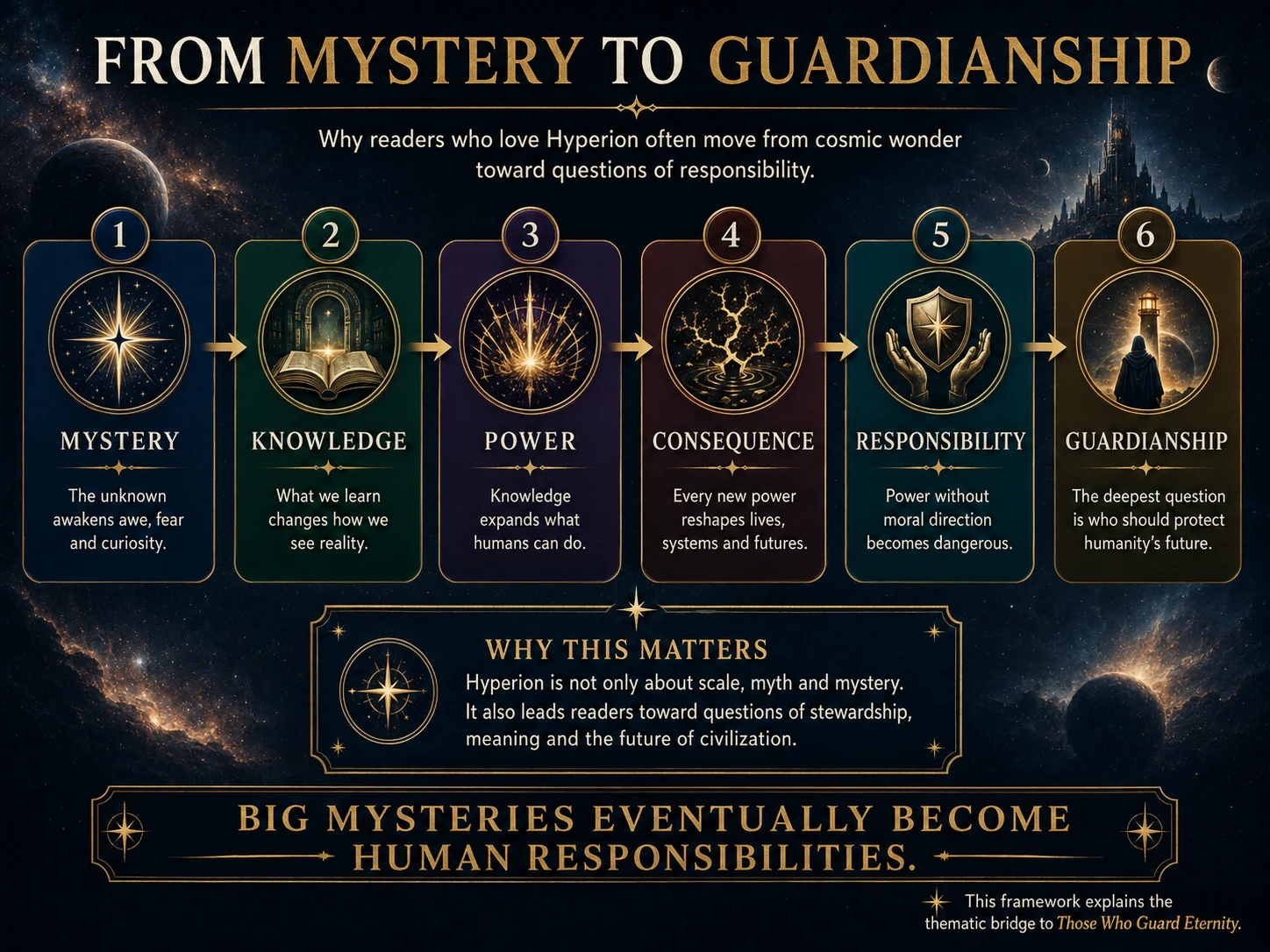
The deepest path through these books begins with mystery. The unknown awakens curiosity, fear, and wonder. Investigation produces knowledge. Knowledge expands capability. Capability changes systems and futures. Those changes create consequences, and consequences transform power into a moral question.
This sequence explains why philosophical science fiction so often moves from “What is possible?” to “Who should decide?” A civilization may discover new intelligence, master time, recover forbidden technology, or predict long-term outcomes. None of those achievements answers the question of whether it has become wise enough to use them.
Eternity Management develops that final question through the idea of guardianship: not domination, ownership, or control, but responsibility toward futures that cannot protect themselves in the present. This is a thematic interpretation, not a claim that Hyperion endorses the same framework. The bridge exists because both works make knowledge consequential.
Read the author’s thematic recommendation free
Those Who Guard Eternity begins the Eternity Saga, a philosophical fantasy series about time, reality, consciousness, choice, and the responsibility created by seeing more than others can see.
Read Those Who Guard Eternity online
No registration is required. This is the author’s own book and is presented separately from the independent recommendations above.
Frequently asked questions about books like Hyperion
What should I read immediately after Hyperion?
Read The Fall of Hyperion. The first novel establishes the pilgrims, their histories, the Time Tombs, and the approaching crisis; the second completes that immediate movement and reveals the larger structure of the conflict.
What book is most similar to Hyperion?
The Book of the New Sun is the closest overall match in this ranking because it combines literary difficulty, deep time, religious symbolism, hidden history, science that feels mythic, and a reality that becomes stranger as the reader understands more. Dune is the stronger choice for politics, religion, and civilizational power.
Is Dune similar to Hyperion?
Yes, but the similarity is thematic rather than structural. Both explore religion, destiny, historical power, human transformation, and civilization-scale consequences. Dune is more focused on political and ecological systems, while Hyperion uses multiple personal narratives, poetry, time anomalies, and cosmic horror.
Is Foundation similar to Hyperion?
Both operate across large historical scales and consider the future of civilization. Foundation emphasizes institutions, prediction, and historical strategy; Hyperion places more weight on individual suffering, religion, literary symbolism, artificial intelligence, and metaphysical mystery. The comparison is explored further in the guide to books like Foundation.
Is The Book of the New Sun like Hyperion?
It is one of the strongest recommendations for readers who loved Hyperion’s literary references, deep future, religious imagery, mystery, and demand for active interpretation. It is more cryptic, slower, and centered on one narrator rather than seven pilgrims.
What is the correct Hyperion Cantos reading order?
Read the four novels in publication order: Hyperion, The Fall of Hyperion, Endymion, and The Rise of Endymion. The first two form one closely connected movement; the later pair continues the universe and develops its long-term consequences.
Should I read Endymion after The Fall of Hyperion?
Read Endymion when you want the full Cantos and are comfortable with a different protagonist, historical period, and narrative rhythm. Stop after The Fall of Hyperion only when you prefer the first pair as a more concentrated experience and want to move to another author.
Which science-fiction books combine religion and technology?
The strongest choices here are Dune, The Sparrow, A Canticle for Leibowitz, and Lord of Light. Each uses religion differently: as political power, a structure of meaning under suffering, a method of preserving knowledge, or an authority manufactured through technology.
Which books have both philosophical ideas and strong characters?
Begin with The Sparrow, The Book of the New Sun, Cloud Atlas, and A Memory Called Empire. Dune and Children of Time offer broader civilizational perspectives, while Blindsight deliberately places conceptual pressure above emotional comfort.
Are these recommendations spoiler-free?
The guide is spoiler-light. It describes premises, themes, structures, and differences without revealing endings or major late-book resolutions. The reading-order section necessarily explains that The Fall of Hyperion continues the first novel’s unfinished immediate story.
Is Those Who Guard Eternity science fiction?
It is best described as philosophical fantasy and speculative fiction. It shares themes of time, consciousness, hidden reality, choice, and responsibility with philosophical science fiction, but it is not a hard-science or space-opera substitute for Hyperion.
Where can I read Those Who Guard Eternity?
The English book can be read online free through its official page on Cokos.org. The authorship relationship is disclosed because the recommendation appears on the author’s own project site.
Sources and editorial methodology
Official publisher, author, and series pages verify bibliographic facts, series order, and high-level premises. Denys Kostin developed the selection, framework, ranking, match tiers, “best for” labels, and comparative judgments. This page is a researched thematic guide rather than a controlled review experiment or a claim of a fresh cover-to-cover reread of every title. Its judgments are transparent editorial interpretation, not scientific scores or a promise that every reader will experience the books in the same way. The guide is spoiler-light and distinguishes verified source facts from its own literary comparison.
- Penguin Random House: Hyperion
- Penguin Random House: Hyperion Cantos series
- Macmillan: The Complete Book of the New Sun
- Macmillan: Dune
- Penguin Random House: The Sparrow
- Macmillan: A Fire Upon the Deep
- Penguin Random House: A Canticle for Leibowitz
- Macmillan: Blindsight
- Macmillan: The Three-Body Problem
- HarperCollins: Ilium
- Penguin Random House: Cloud Atlas
- HarperCollins: Lord of Light
- Pan Macmillan: Children of Time
- Official Stanisław Lem site: Solaris
- Alastair Reynolds: Revelation Space
- Macmillan: A Memory Called Empire
- Cokos.org: Those Who Guard Eternity
About the author: Denys Kostin is the creator of Eternity Management and author of the Eternity Saga. His work explores time, consciousness, reality, memory, choice, civilization, and the responsibility created by consequential knowledge.