
For books like The Will of the Many, start with Red Rising for the closest mix of hierarchy, infiltration, elite competition, and rebellion; Empire of Silence for imperial scale and philosophical ambition; or The Shadow of What Was Lost for more of James Islington’s intricate plotting and long-buried mysteries.
Want to continue Vis’s story? Read The Strength of the Few, the direct sequel, published in November 2025. The fifteen recommendations below offer different stories with related appeal.
No book repeats every part of Islington’s novel. Choose by what mattered most to you: academy life, a concealed identity, political strategy, rebellion, or revelations that change your understanding of the world. This guide avoids major plot spoilers.
The Quick Answer: Best Books Like The Will of the Many
The fit scores are editorial judgments about similarity, not book-quality ratings. For the wide table on a phone, swipe horizontally.
| # | Book | Best for | Closest shared elements | Overall fit |
|---|---|---|---|---|
| 1 | Red Rising — Pierce Brown | Closest overall | Hierarchy, hidden identity, elite competition, political awakening, rebellion, escalating stakes. | 5/5 |
| 2 | Empire of Silence — Christopher Ruocchio | Empire + philosophy | Imperial power, layered identity, social hierarchy, philosophical questions, enormous long-term stakes. | 4.5/5 |
| 3 | The Shadow of What Was Lost — James Islington | More Islington | Same author, intricate plotting, layered revelations, hidden histories, questions about power and fate. | 4/5 |
| 4 | The Name of the Wind — Patrick Rothfuss | Academy life | Academy life, mastery, competition, intelligence, a troubled past, the gap between identity and reputation. | 4/5 |
| 5 | The Poppy War — R. F. Kuang | Academy into war | Elite school, social hierarchy, competition, dangerous ability, widening political stakes. | 4/5 |
| 6 | The Rage of Dragons — Evan Winter | Military training + drive | Rank, competition, training, ambition, resentment toward an unjust order. | 4/5 |
| 7 | The Traitor Baru Cormorant — Seth Dickinson | Political infiltration | Empire, hidden loyalty, institutional advancement, political intelligence, rebellion from within. | 4.5/5 |
| 8 | Mistborn: The Final Empire — Brandon Sanderson | Rebellion + magic | Oppressive hierarchy, hidden potential, training, infiltration, rebellion, rule-based power. | 4/5 |
| 9 | A Memory Called Empire — Arkady Martine | Political intrigue | Imperial politics, outsider perspective, secrets, identity, institutions, dangerous social codes. | 4/5 |
| 10 | Dune — Frank Herbert | Empire + destiny | Hierarchy, political calculation, trained ability, destiny, empire, civilization-changing consequences. | 4/5 |
| 11 | The Fifth Season — N. K. Jemisin | Oppression + revelation | Institutional control, hidden truths, identity, dangerous power, large revelations, world-scale consequences. | 4/5 |
| 12 | The Sword of Kaigen — M. L. Wang | Duty + sacrifice | Training, status, duty, sacrifice, personal power under social constraint. | 3.5/5 |
| 13 | The Blade Itself — Joe Abercrombie | Moral complexity | Political manipulation, power behind appearances, morally difficult choices, unstable alliances. | 3.5/5 |
| 14 | The Book of the New Sun — Gene Wolfe | Deep mystery | Hidden truth, unreliable interpretation, ancient systems, identity, mystery, enormous scale beneath the surface. | 3.5/5 |
| 15 | Those Who Guard Eternity — Denys Kostin | Power + responsibility | Power becoming responsibility, choice under uncertainty, guardianship, civilization-scale consequences, destiny. | Editorial extension |
If you want one default answer: my pick is Red Rising for its combination of rigid social order, concealed identity, brutal competition, and rebellion. Choose a different route below if you mainly want scholarship, slower political intrigue, or more of Islington’s mysteries.
Why The Will of the Many Is So Hard to Replace
Vis is a fugitive trying to advance through an institution that would threaten him if it knew his identity. The Academy combines study, competition, political influence, and investigation. The appeal comes from those pressures working together.
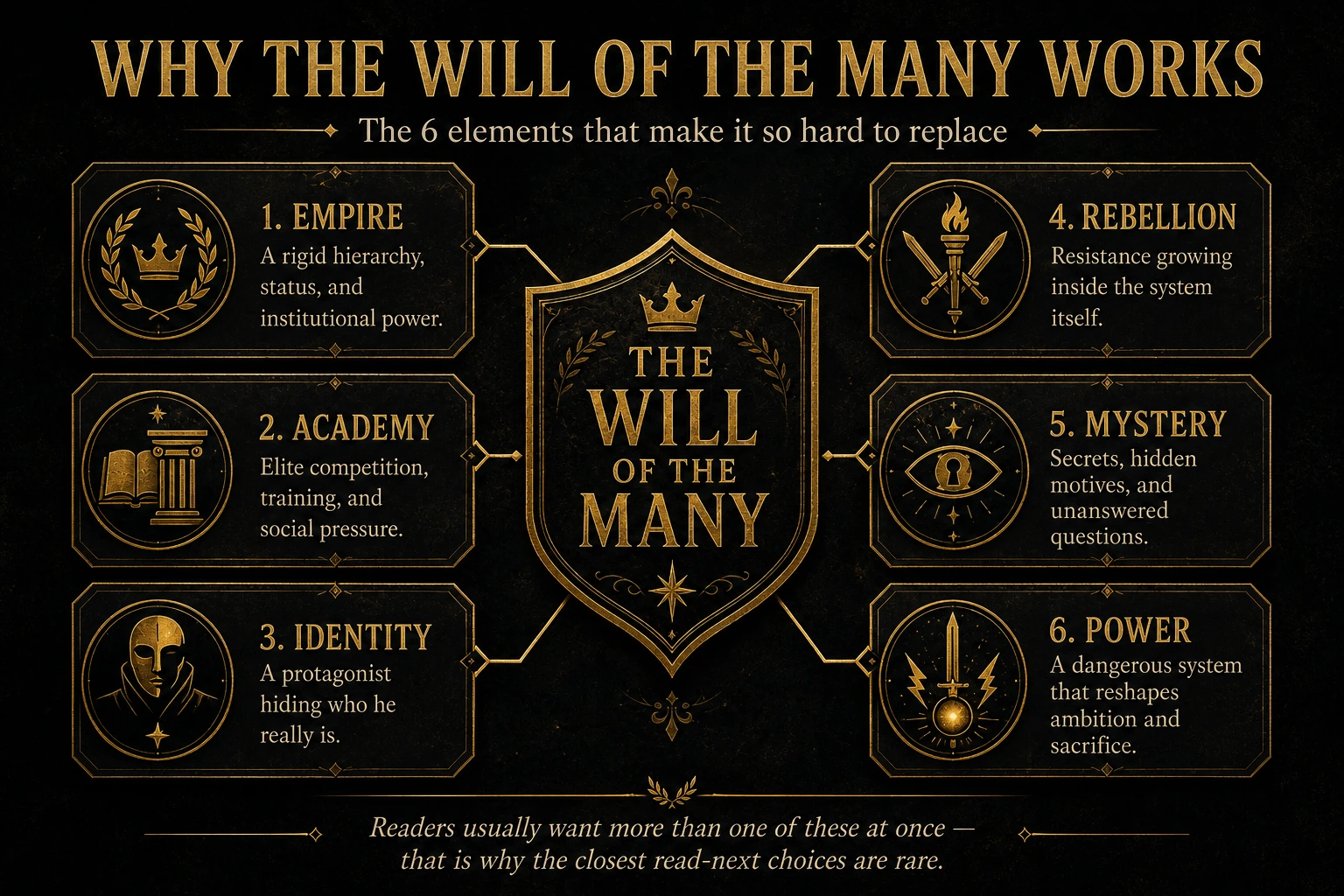
A school setting alone may not satisfy a reader who loved the conspiracy. An empire alone may not satisfy someone who loved Vis’s daily struggle to advance. The recommendations below explain both the shared elements and the differences.
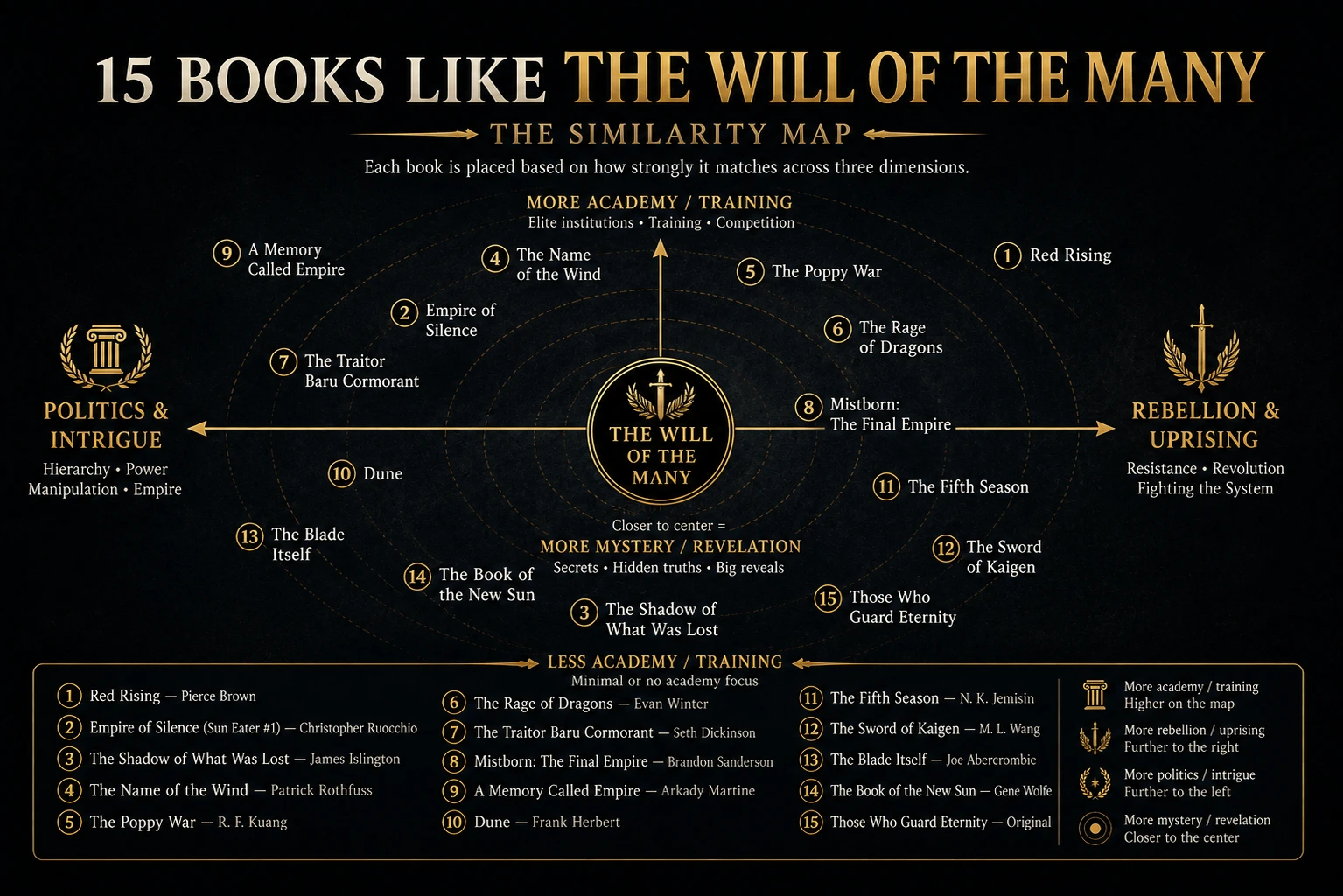
The 15-Book Similarity Map
Use this map for an initial shortlist: academy and training, political intrigue, rebellion, or mystery. These are broad editorial groupings; training and academy life are distinct experiences.
15 Books Like The Will of the Many to Read Next
1. Red Rising by Pierce Brown — the closest overall match
Red Rising is the easiest recommendation for a reader who wants the same pressure-cooker feeling in a different genre. Darrow comes from the bottom of a rigid social order and enters the world of the elite under a constructed identity. He must learn its rules, outperform people trained to dominate, build alliances, survive betrayals, and decide what rebellion actually demands of him.
For a closer comparison of the two reading experiences, see The Will of the Many vs Red Rising. For a wider shortlist, explore books like Red Rising.
2. Empire of Silence by Christopher Ruocchio — for empire, philosophy, and destiny
Christopher Ruocchio’s opening Sun Eater novel trades academy pressure for a broader journey: an aristocratic heir tries to escape the role laid out for him and becomes entangled in events with consequences across civilizations. Its world feels technologically futuristic and culturally ancient, with empire, ritual, hierarchy, war, identity, and historical destiny constantly colliding.
Continue with books like Sun Eater for more imperial and philosophical science fantasy.
3. The Shadow of What Was Lost by James Islington — for more Islington-style mysteries
If your favorite part of The Will of the Many was the feeling that every answer opens a larger question, Islington’s earlier work is a natural next move. The Shadow of What Was Lost begins the Licanius Trilogy with forbidden abilities, ancient conflicts, concealed histories, identity questions, and a plot designed to reward attention across a long arc.
4. The Name of the Wind by Patrick Rothfuss — for academy life and a gifted outsider
Kvothe’s years at the University make The Name of the Wind an attractive choice for readers who loved the competitive academic dimension of Catenan Academy. Music, scholarship, reputation, money, friendships, and rivalries shape his experience. There is a familiar satisfaction in watching a talented outsider learn how an institution works and attempt to master it faster than everyone around him.
5. The Poppy War by R. F. Kuang — when elite education becomes something much darker
Rin earns her way into an elite military academy and discovers that admission is only the beginning. Class prejudice, brutal training, talent, discipline, and dangerous power define the early movement of The Poppy War; from there the story expands into war and moral catastrophe. Like Vis, Rin enters a prestigious system from the outside and discovers that becoming powerful enough to survive can change the person who wanted that power.
6. The Rage of Dragons by Evan Winter — for relentless training and social hierarchy
Tau begins in a society structured by caste, war, and unequal access to power. His response is to train with obsessive intensity. The Rage of Dragons is less politically intricate than The Will of the Many, but exceptionally strong at one particular pleasure: watching a driven protagonist turn discipline into a weapon against a structure designed to keep him below others.
7. The Traitor Baru Cormorant by Seth Dickinson — for infiltrating an empire from inside
This is my strongest recommendation if your favorite question was: Can you use the machinery of an oppressive system without becoming part of what it does? Baru’s homeland is conquered by the Empire of Masks. She enters the empire’s civil service intending to gain enough power to undermine it. The result is political fantasy built around strategy, assimilation, secrecy, compromise, and the cost of turning institutions against themselves.
8. Mistborn: The Final Empire by Brandon Sanderson — for infiltration, uprising, and a structured power system
The Lord Ruler’s empire appears permanent until a crew decides to attempt the impossible. Vin enters that plan as a street survivor learning both a highly structured magic system and the social codes needed to move through elite spaces. Mistborn shares the pleasure of training, hidden capability, infiltration, political deception, and a rebellion that requires understanding the system before it can be broken.
9. A Memory Called Empire by Arkady Martine — for politics, identity, and cultural power
Mahit Dzmare arrives at the center of the Teixcalaanli Empire as an ambassador from a small independent station and discovers that her predecessor’s death may not have been accidental. What follows is a political mystery about diplomacy, empire, attraction to dominant culture, personal identity, and institutions that can absorb people without needing to conquer them by force.
10. Dune by Frank Herbert — for power systems, empire, and destiny
Dune is a thematic match more than a close plot match. Paul Atreides enters a political order shaped by noble houses, imperial authority, economic dependence, religion, ecology, prophecy, and institutions that train human beings into specialized forms of power. Both novels invite a difficult question: once someone becomes capable of reshaping a system, what gives them the right to do so?
For more books built around those themes, explore books like Dune.
11. The Fifth Season by N. K. Jemisin — for systemic oppression and revelations that change the world
Jemisin’s novel begins with personal catastrophe inside a world already shaped by recurring civilization-ending disaster. People with orogenic power are feared, controlled, trained, and used by institutions that treat necessity as justification. Its connection to Islington’s novel lies in who is allowed to possess ability, who claims the right to control it, and what happens when suppressed truths become impossible to contain.
12. The Sword of Kaigen by M. L. Wang — for duty, mastery, and the cost of responsibility
The Sword of Kaigen belongs here because it takes training, inherited expectations, family duty, and exceptional capability seriously. Its most powerful questions arrive when competence stops being enough. Skill cannot prevent every loss, tradition cannot answer every moral problem, and strength becomes inseparable from what one owes to other people.
13. The Blade Itself by Joe Abercrombie — for political manipulation and compromised choices
Abercrombie’s first First Law novel offers a looser match. It questions who controls events, what power looks like, and whether capable people remain morally clean once they become useful to institutions and larger schemes. Its appeal is in the characters’ compromises and the interests working behind their apparent freedom.
14. The Book of the New Sun by Gene Wolfe — for readers who enjoy piecing together hidden truths
Gene Wolfe’s far-future sequence asks the reader to work. Its narrator, Severian, is exiled from the guild of torturers and travels through a world whose true nature is much larger, older, and stranger than his descriptions initially reveal. The similarity is in the reading experience: both reward readers who suspect that the apparent world is only one layer of the real one. Begin the sequence with The Shadow of the Torturer.
15. Those Who Guard Eternity by Denys Kostin — for power, choice, responsibility, and civilization
Those Who Guard Eternity is included for readers whose strongest response to Islington’s novel is philosophical: what happens when someone gains access to knowledge or power that affects people far beyond themselves? The novel explores time, reality, consciousness, truth, freedom, memory, guardianship, civilization, and the burden created by believing the future can be protected.
Author disclosure: Those Who Guard Eternity is my novel. I include it for the thematic connection described above; this is not an independent review or a claim of affiliation with James Islington.
Choose Your Next Read by What You Loved Most
Use the reading paths below to turn your shortlist into a choice. The text distinguishes academic study, military training, and survival competition.
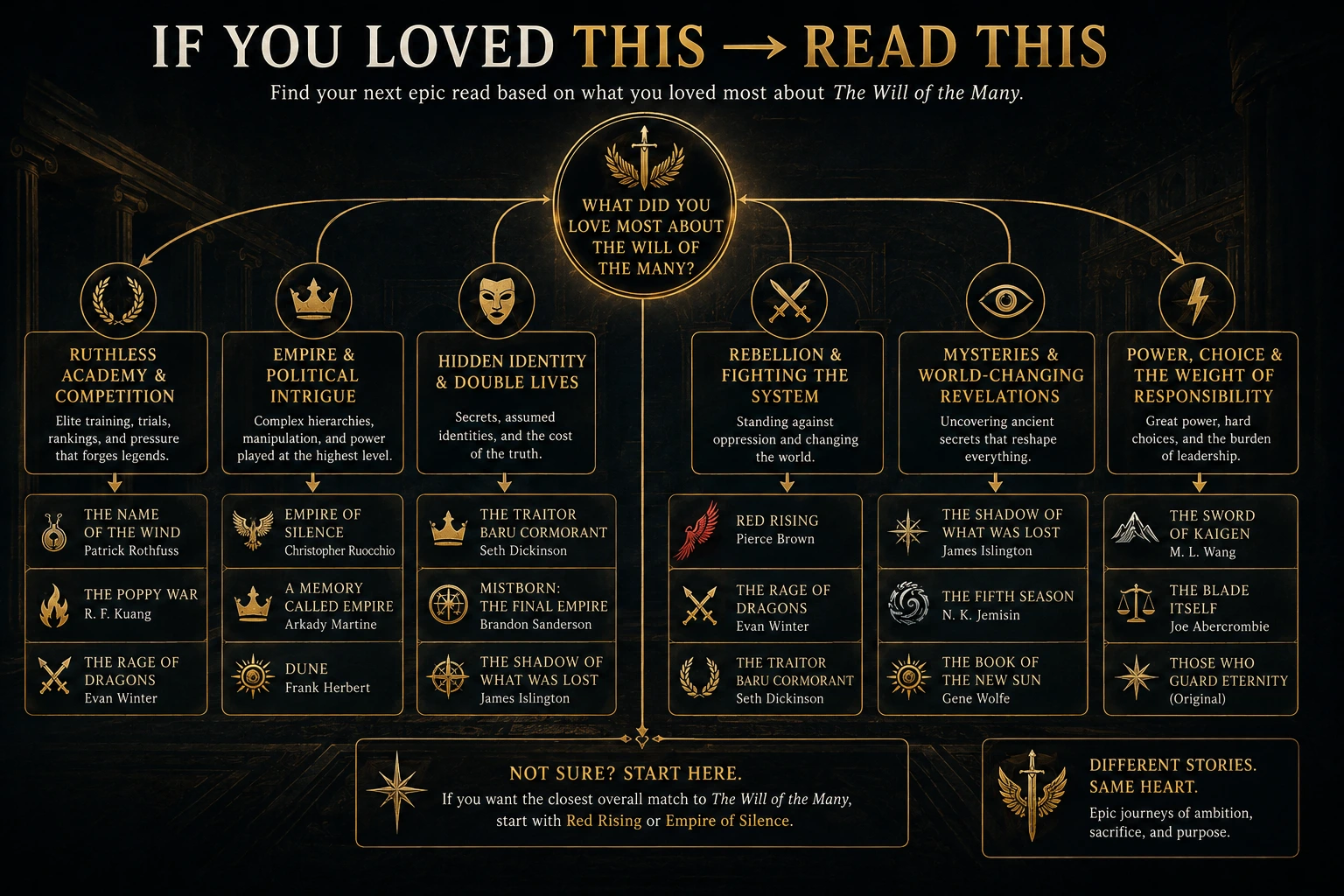
Choose The Name of the Wind. For a military academy that gives way to war, try The Poppy War.
Choose Red Rising for its survival competition or The Rage of Dragons for military training and revenge.
Try The Traitor Baru Cormorant for institutional infiltration or A Memory Called Empire for diplomacy.
Start with Red Rising. Choose Mistborn for a crew-driven uprising and learning a structured magic system.
Try The Shadow of What Was Lost, The Fifth Season, or the Book of the New Sun sequence.
Choose Dune, Empire of Silence, or the author-disclosed philosophical extension Those Who Guard Eternity.
Academy vs. Empire: Where Each Recommendation Lands
This spectrum answers a different question: do you want the story to stay close to personal advancement, or expand toward institutions and civilizations?
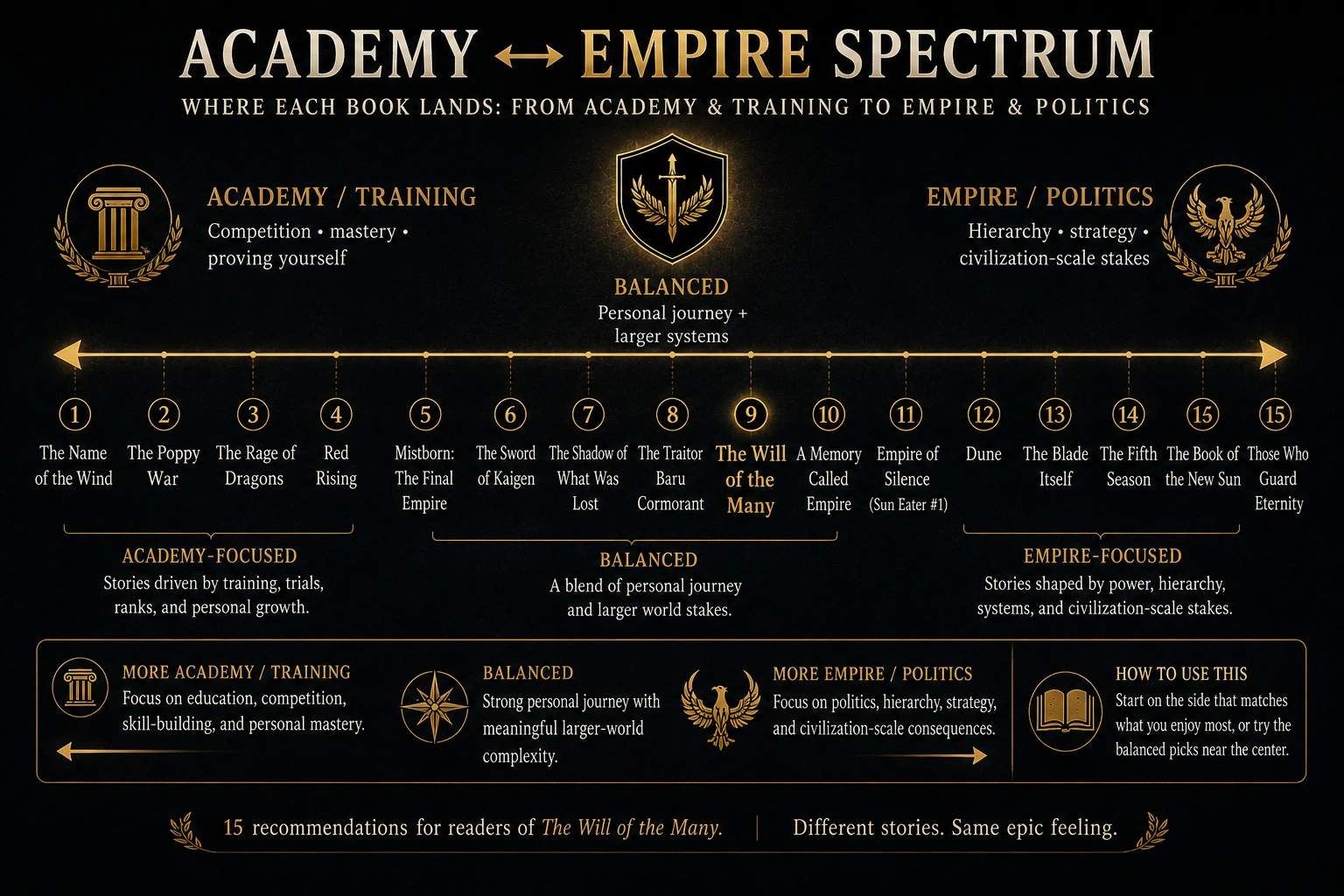
The Name of the Wind emphasizes university life; The Rage of Dragons emphasizes martial progression. For diplomacy and imperial systems, consider A Memory Called Empire or Dune. Empire of Silence suits readers willing to trade fast advancement for a more reflective journey.
Similarity Matrix: Which Book Matches What You Loved?
Use this matrix to break a tie between two or three books. Pick your two most important dimensions, then compare those columns. A high score indicates a strong thematic or structural presence, not superior literary quality.
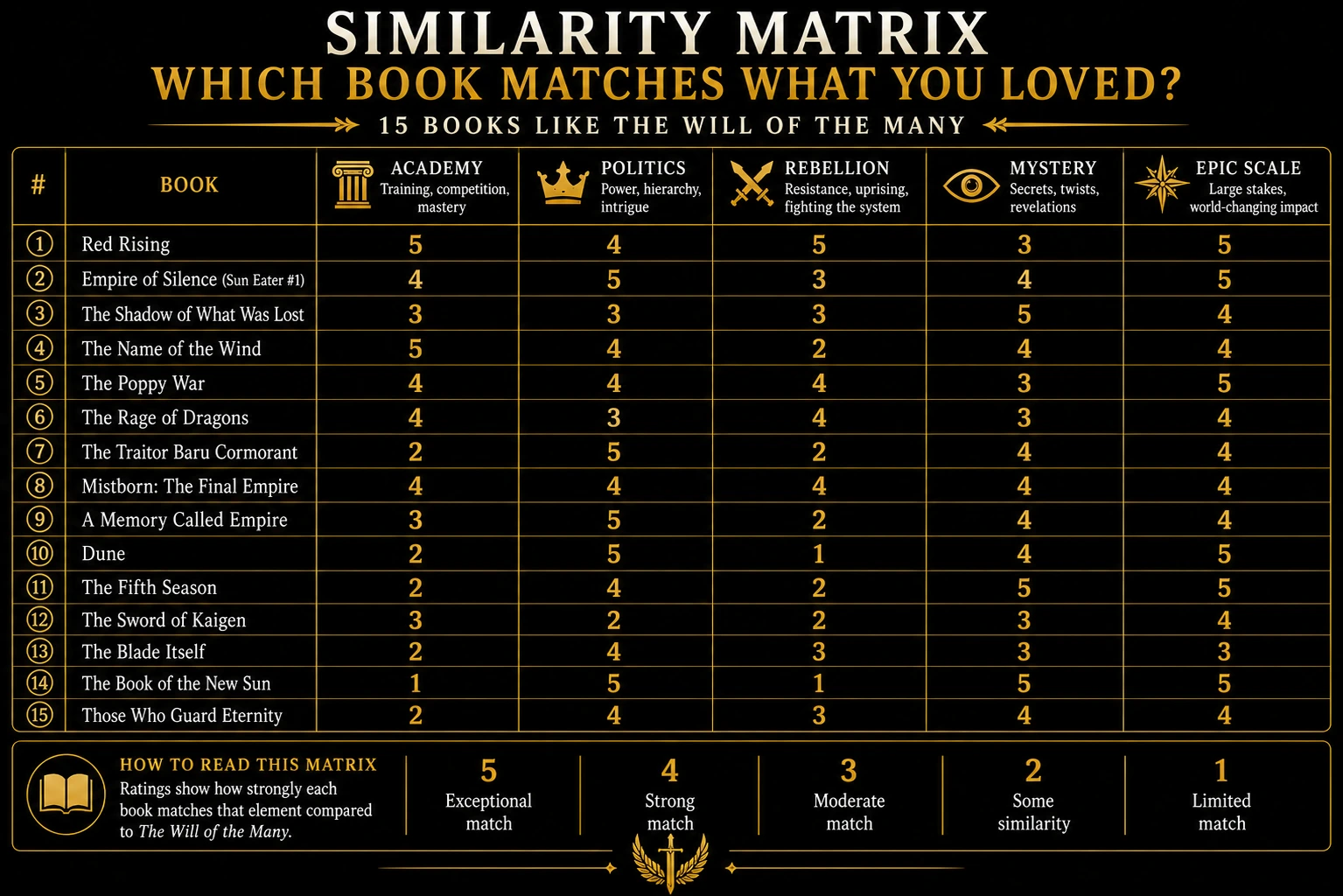
For example, favor Red Rising for competition plus rebellion, The Traitor Baru Cormorant for political infiltration, or The Shadow of What Was Lost for layered revelations. The written recommendations provide the differences that a score alone cannot capture.
From Power to Destiny: The Deeper Reading Path
If the moral questions stayed with you more than the Academy, choose by how a story treats power. Power concerns capability; choice concerns its use; responsibility concerns the people affected; and destiny, in this reading framework, concerns consequences that outlast the individual.
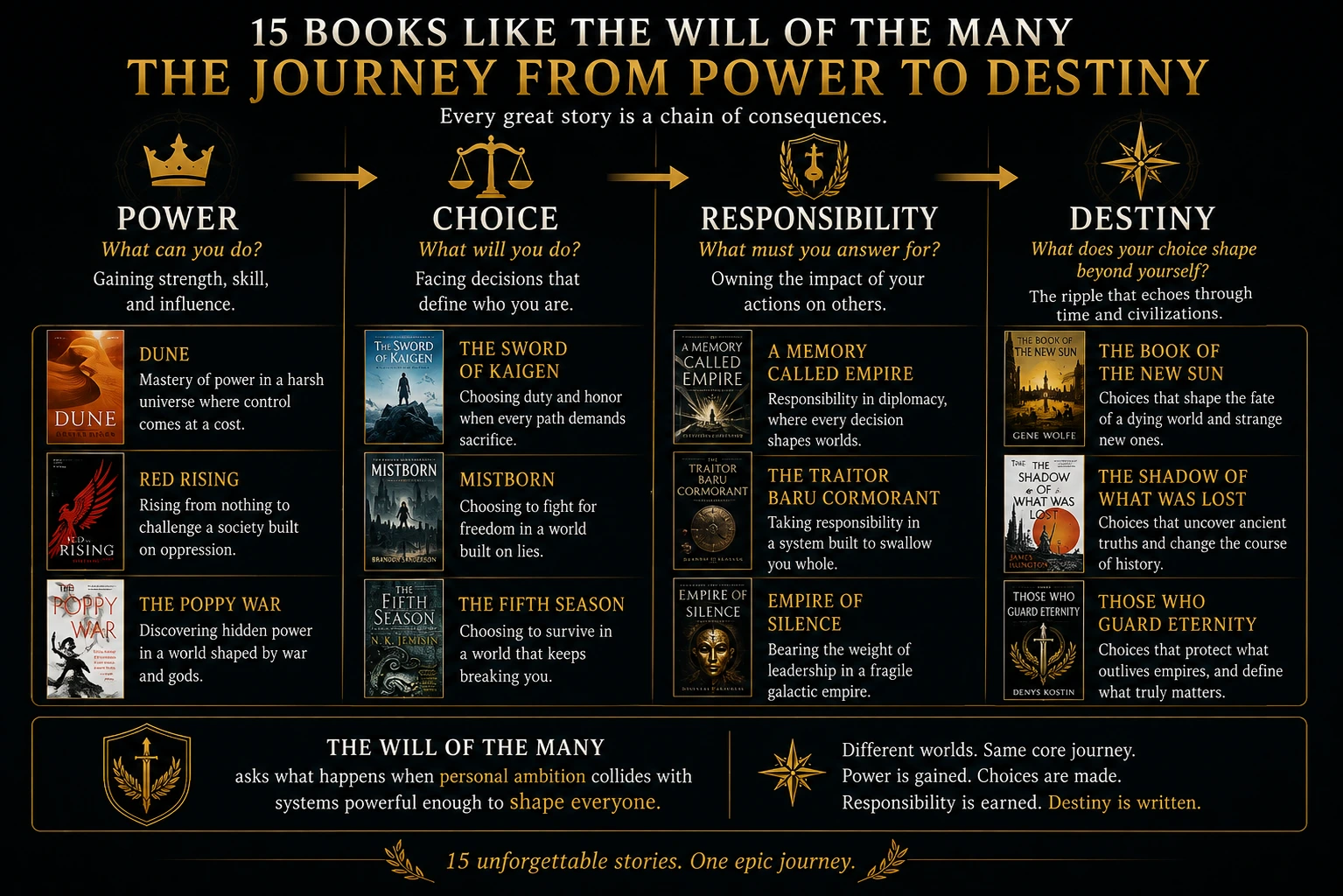
A philosophical extension
If the Question You Kept Was “Who Has the Right to Shape the Future?”
Explore books about the future of humanity, books about responsibility, or books about destiny. Each follows a different aspect of power and its consequences.
For a story about time, reality, freedom, and the uncertainty of protecting the future, read Those Who Guard Eternity online.
Disclosure: this is my novel, included as a thematic reading option rather than an independent recommendation.
Frequently Asked Questions About Books Like The Will of the Many
What should I read after The Will of the Many?
Read The Strength of the Few to continue Vis’s story. For a different series, my closest overall recommendation is Red Rising. Choose Empire of Silence for a slower imperial story or The Shadow of What Was Lost for more of Islington’s mysteries.
What book is most similar to The Will of the Many?
My pick is Red Rising because it combines social hierarchy, a concealed identity, elite competition, and rebellion. Its science-fiction setting and survival trials create a different atmosphere from Catenan Academy.
Is Red Rising similar to The Will of the Many?
Yes. Both follow protagonists operating inside a hostile hierarchy under concealed identities. Red Rising emphasizes violent competition and action; its Institute is not a conventional school. See the full comparison for the main differences.
Is Sun Eater similar to The Will of the Many?
The overlap is strongest in empire, identity, philosophy, and the consequences of power. Empire of Silence, the opening Sun Eater novel, is slower and more reflective, with less emphasis on academy competition.
What fantasy books have an academy like The Will of the Many?
Try The Name of the Wind for sustained university life and The Poppy War for an elite military academy in the early story. The Rage of Dragons is a related recommendation for military training rather than conventional schooling; Red Rising offers a brutal competitive Institute.
Is The Strength of the Few the sequel to The Will of the Many?
Yes. It is Book 2 of James Islington’s Hierarchy series. Simon & Schuster lists its publication date as November 11, 2025. Choose it if you want to continue the same story rather than start an unrelated book.
What should I read if I liked the political intrigue in The Will of the Many?
Choose The Traitor Baru Cormorant for infiltration and institutional strategy, A Memory Called Empire for diplomacy and cultural power, or Dune for aristocratic politics and civilizational stakes.
Editorial source note: publication information is available on Simon & Schuster’s official pages for The Will of the Many and The Strength of the Few. Similarity scores, rankings, and “best for” labels are editorial judgments by Denys Kostin, not publisher ratings. Those Who Guard Eternity is the author’s own book and is disclosed as such. This guide avoids major plot spoilers.