The Will of the Many vs Red Rising: start with James Islington’s novel if you want academy intrigue, concealed motives, and layered mysteries. Choose Pierce Brown’s Red Rising if you want a more visceral contest of survival, alliances, and rebellion. Both follow outsiders entering an oppressive elite, but they create different kinds of tension.
Spoiler boundary: this guide discusses the first novels and their advertised premises. It avoids endings, identities behind major reveals, and the outcomes of betrayals. Any series context is labeled separately.

The useful question is not simply which book is better. It is which kind of pressure you want to spend your next reading sessions inside. Do you want to wonder what an institution is hiding, or watch a dangerous contest force people to choose whom to trust? The novels offer both pleasures in different proportions.
This comparison focuses on those differences. If you have already finished both, the related reading links near the end will take you to broader recommendations.
The Will of the Many vs Red Rising at a glance
Use this table as a starting point, then read the sections that matter most to you. The reader-fit judgments describe emphasis; “more mystery” does not mean one book lacks action, and “more action” does not mean the other lacks ideas.
On a small screen, swipe the table sideways to compare both books.
| What matters to you | The Will of the Many | Red Rising |
|---|---|---|
| Author | James Islington | Pierce Brown |
| Starting world | Roman-inspired fantasy republic | Future Mars and a color-coded society |
| Protagonist | Vis, a fugitive concealing his past | Darrow, a Red entering the world of the Golds |
| Institution | Catenan Academy: study, rank, rivalry, and investigation | The Institute: a proving ground for the ruling caste |
| Power structure | Will is ceded upward through the hierarchy | Inherited caste assigns status and social roles |
| Main reading appeal | Uncovering secrets while navigating an elite school | Surviving competition while testing loyalty and leadership |
| Pacing preference | Good fit for readers who enjoy accumulating clues | Good fit for readers who enjoy urgent tactical reversals |
| Content expectations | Violence, coercion, danger, and loss | Graphic violence, enslavement, cruelty, and sexual violence |
| Choose it for | Academy intrigue and the questions beneath the visible world | Rebellion, alliances, and the personal cost of winning |
The starting premises are documented in the official publisher descriptions for The Will of the Many and Red Rising. Recommendations about atmosphere and reader fit below are editorial interpretation.
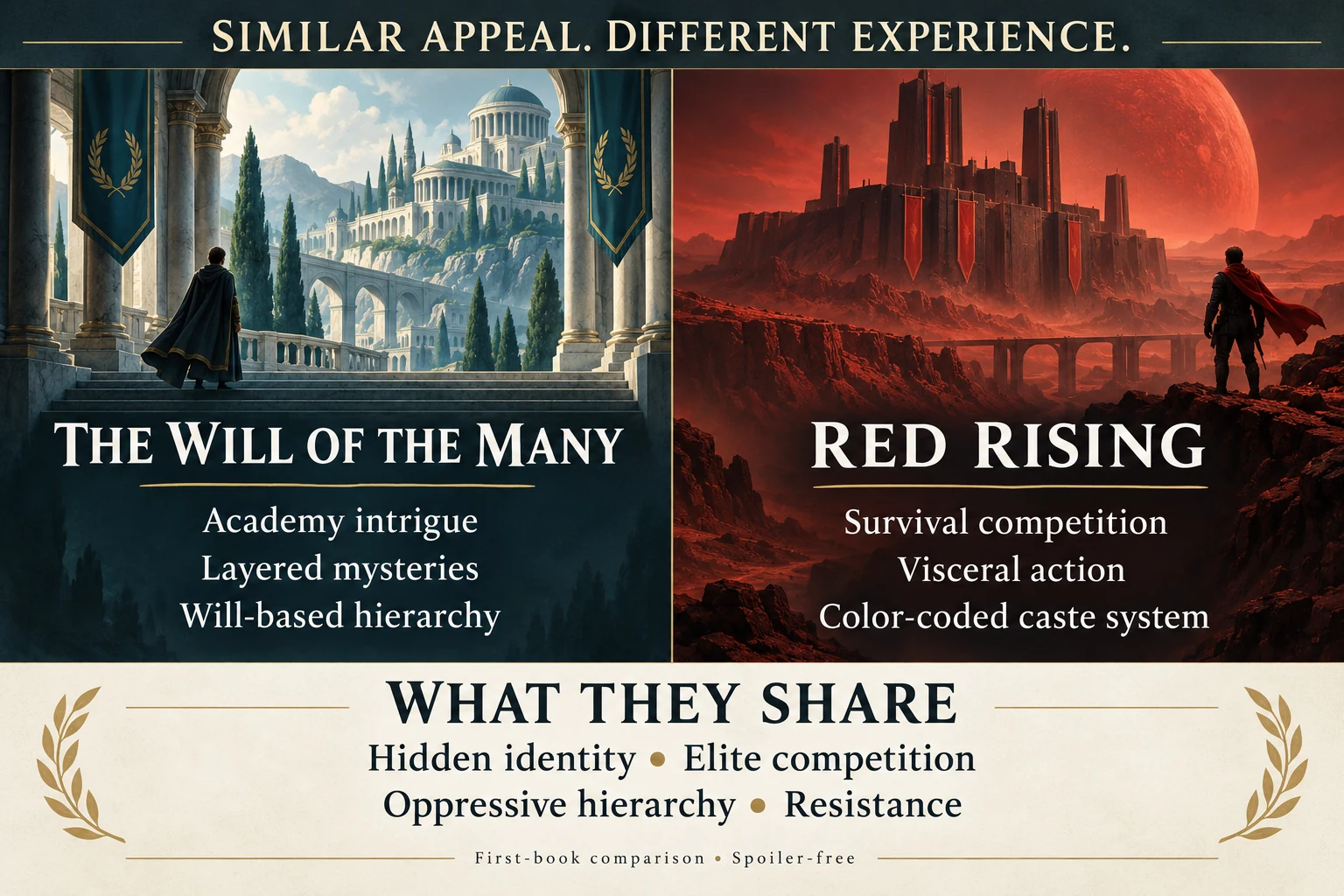
Why readers compare The Will of the Many and Red Rising
The strongest similarity is the relationship between the protagonist and the institution. Each must become convincing inside a privileged world whose authority he rejects. Learning its customs is a survival skill, but performing belonging can also become psychologically costly.
That creates a productive tension for the reader. You can enjoy a protagonist’s success while questioning the institution that rewards it. That divided response is one of the strongest reasons these books belong in the same conversation.
Competition intensifies that tension. A rival may be an obstacle, a potential ally, or someone whose own assumptions have never been challenged. Friendship matters because personal relationships can complicate political categories. An unjust institution can contain people the protagonist comes to care about.
Readers who enjoy concealed identities, capable outsiders, and the pressure of earning trust therefore have good reasons to try both. Readers mainly seeking the same setting or the same style of revelation should expect a larger adjustment. Shared ingredients do not produce an identical experience.
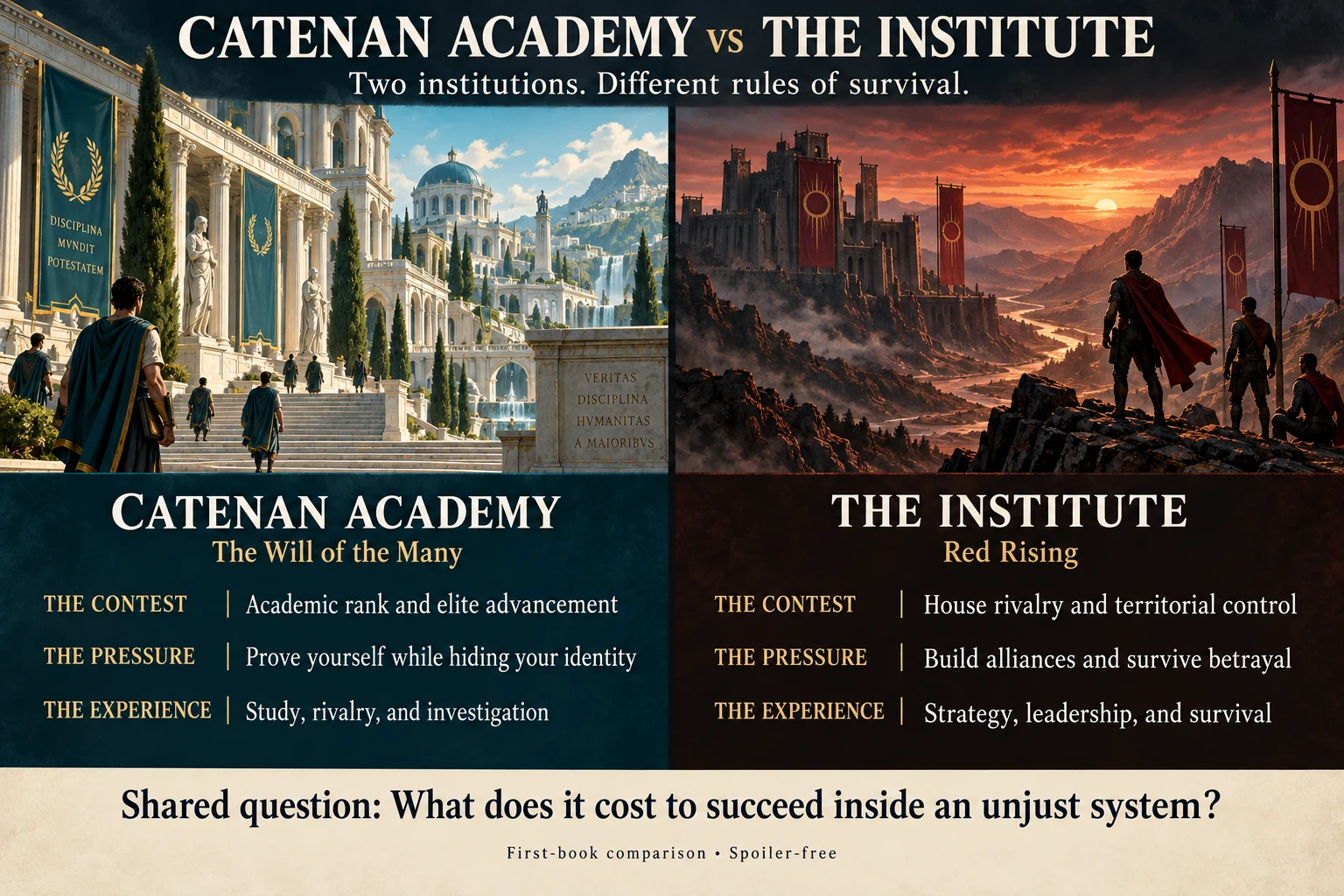
Catenan Academy vs the Institute: different rules of competition
Catenan Academy: advancement while investigating
In The Will of the Many, the school offers a recognizable structure of study, ranking, and social maneuvering. Vis’s need to progress intersects with his need to discover what powerful people are concealing. Ordinary institutional success can become a means of reaching extraordinary information.
For a reader, that makes small interactions worth watching. An evaluation, an invitation, or an apparently helpful person can matter beyond its immediate purpose. If your favorite fictional school scenes involve interpreting motives as carefully as learning lessons, this is the stronger starting point.
The Institute: authority tested through survival
The Institute places more emphasis on competition between groups, control of territory, and the ability to make others follow. Its house-based war games make leadership an immediate practical problem. Kirkus’s review describes that war-game structure, although the full review contains opening-plot spoilers. This is why the Institute is a better match for a survival-contest preference than a classroom-centered one.
The interesting reader question is often whether a strategy creates durable loyalty or merely temporary obedience. Winning a confrontation and building a group capable of enduring the next one are different achievements. That distinction gives the competition its political weight.
If academic intrigue is your main interest, our guide to books like The Will of the Many offers alternatives beyond this pair. Neither institution provides a gentle school experience.
Vis vs Darrow: concealment, trust, and becoming powerful
Vis and Darrow both have to manage the gap between what they know about themselves and what others are allowed to see. That makes apparent confidence ambiguous. A display of competence can provide protection while also attracting dangerous attention.
A concrete example from Islington’s opening: Vis plays Foundation with Hrolf, then scrutinizes an unexpected visitor’s behavior and authorization. Strategy and social observation appear together before the Academy becomes the main setting. This is a useful sample of his watchful narrative voice, rather than proof of how every later chapter will feel. You can read the scene in the publisher’s Chapter I excerpt.
Darrow’s opening contrast is work and belief: the publisher’s synopsis introduces him as a miner who believes his labor serves future generations, before that account of his society breaks down. His entry into the elite therefore carries a conflict between the values he was taught and the order he discovers. That premise helps explain the emotional force of his rebellion. See the official Red Rising description and sample.
These are differences in emphasis, not a division between a thinking hero and a fighting hero. Both books ask their protagonists to adapt. The useful distinction is whether you want more pleasure from deciphering the situation or more pressure from acting inside a volatile one.
Pacing, worldbuilding, mystery, and violence
Which reading rhythm suits you?
The Will of the Many is a good fit when you enjoy holding unanswered questions in mind. Part of the attraction is noticing that the available explanation may be incomplete. That reading style rewards patience with institutional detail and curiosity about why something does not quite fit.
Red Rising is the stronger default when you want immediate pressure around a goal, a rival, or an alliance. Its momentum often comes from the need to respond. Readers who find an urgent problem easier to engage with than an accumulating mystery may find this a more inviting entry.
These pacing descriptions are recommendations, not measured reading speeds. Both books need time to establish their worlds. A useful test is to read their official opening samples: do you want to follow the voice even before the central institutional contest begins? If so, a slower stretch is less likely to break your engagement.
Fantasy versus science fiction
The genre difference changes the texture of the worlds. Islington’s republic connects institutional authority to a fantastical form of power. Brown’s setting connects social hierarchy to a future civilization. In both cases, the speculative premise matters because it shapes what people can do and what they are expected to accept.
Choose based on how much that texture matters to you. A reader who wants overtly fantastical mechanisms may prefer Islington. A reader attracted to future societies may prefer Brown. Neither choice requires treating the other genre as off-limits.
Content considerations without plot spoilers
Both novels contain disturbing material. Red Rising includes graphic violence, enslavement, abuse, and sexual violence; its competitive setting should not be mistaken for a light adventure. The Will of the Many also includes violence, coercion, and loss. A preference for its mysteries is not a guarantee of a gentler experience. For a separate assessment of mature content, consult Common Sense Media’s Red Rising guide; detailed content information may include spoilers.
If a particular subject is a firm boundary, consult a detailed content guide before reading; such guides may disclose plot information. This comparison offers broad orientation rather than an exhaustive inventory or an age-suitability rating.
Which should you read first?
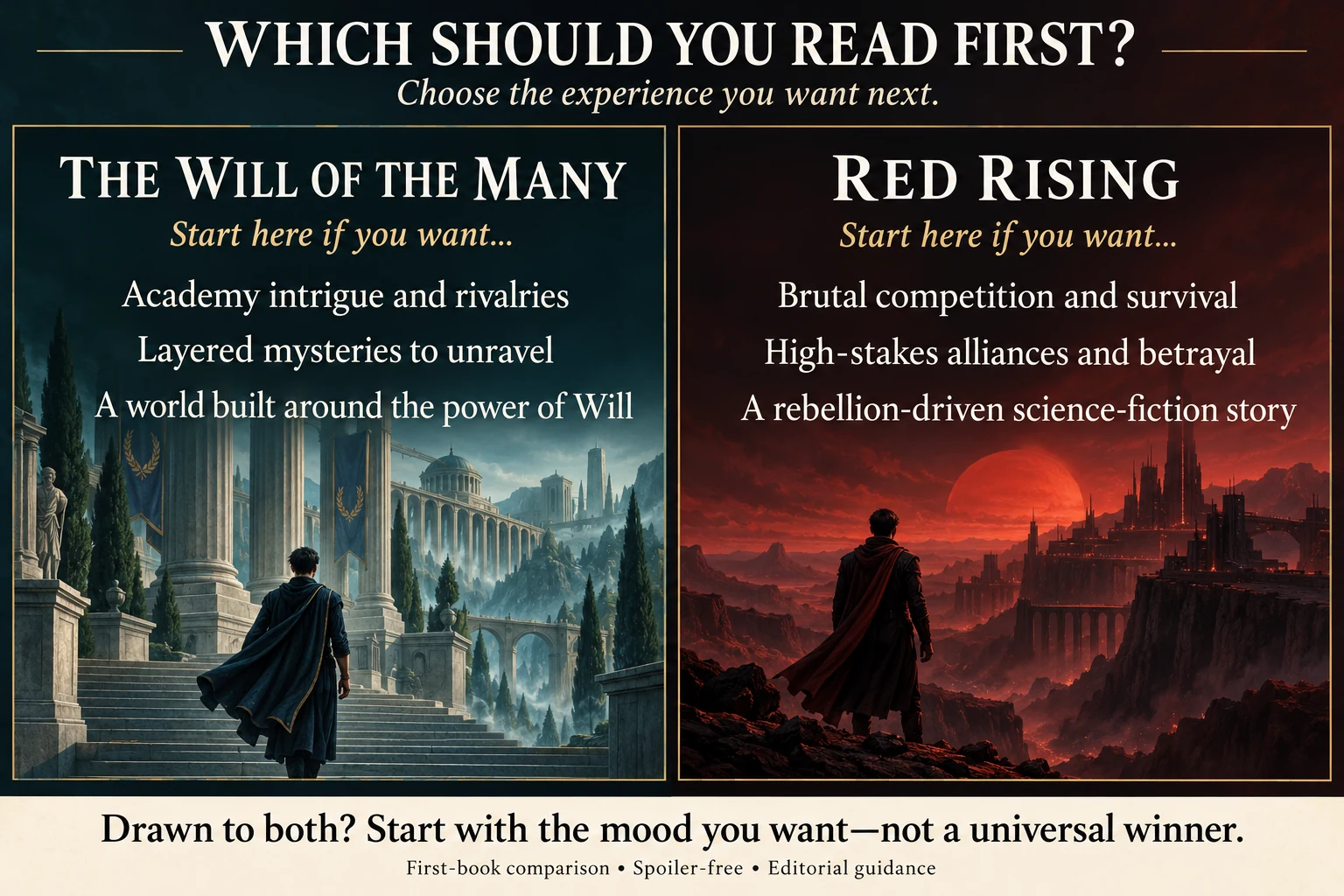
Start with The Will of the Many if your ideal evening involves discovering a new institution, forming theories, and wondering which explanation can be trusted. Its appeal is particularly strong when school rivalry and the world’s deeper secrets are equally important to you.
Start with Red Rising if you want the urgency of an outsider trying to survive among the powerful. Choose it when shifting alliances, command decisions, and resistance to an inherited order sound more compelling than academic life.
If both appeal, decide by mood. Want to speculate about what is hidden? Choose Islington. Want to test each decision against immediate danger? Choose Brown. You can enjoy the same themes through different reading rhythms at different times.
If you have already read one, identify what you most want repeated. A fan of Red Rising who loved elite infiltration has a strong reason to try Islington; a fan who mainly wants expansive military science fiction should explore the wider books like Red Rising guide. Likewise, an Islington reader who loved competition may connect quickly with Brown, while one seeking a similar mystery structure should adjust expectations.
Series context: these are opening novels. Golden Son follows Red Rising; The Strength of the Few follows The Will of the Many. An opening book’s institutional setting is not a promise that every sequel repeats it. This guide does not disclose how either story expands. After continuing Vis’s story, the Strength of the Few reading guide provides a separate next step.
The deeper connection: power, freedom, and responsibility
Both novels become more interesting when the question moves beyond whether the protagonist can rise. Advancement can be real without making the institution fair. An exceptional person’s ability to win says little about the lives of people who never receive the same opportunity.
That is a useful way to interpret the two power structures. In Islington’s world, the upward transfer of Will makes dependence part of the premise. In Brown’s, caste makes inherited advantage fundamental to social order. Different mechanisms support a similar question: whose restricted freedom makes another person’s power possible?
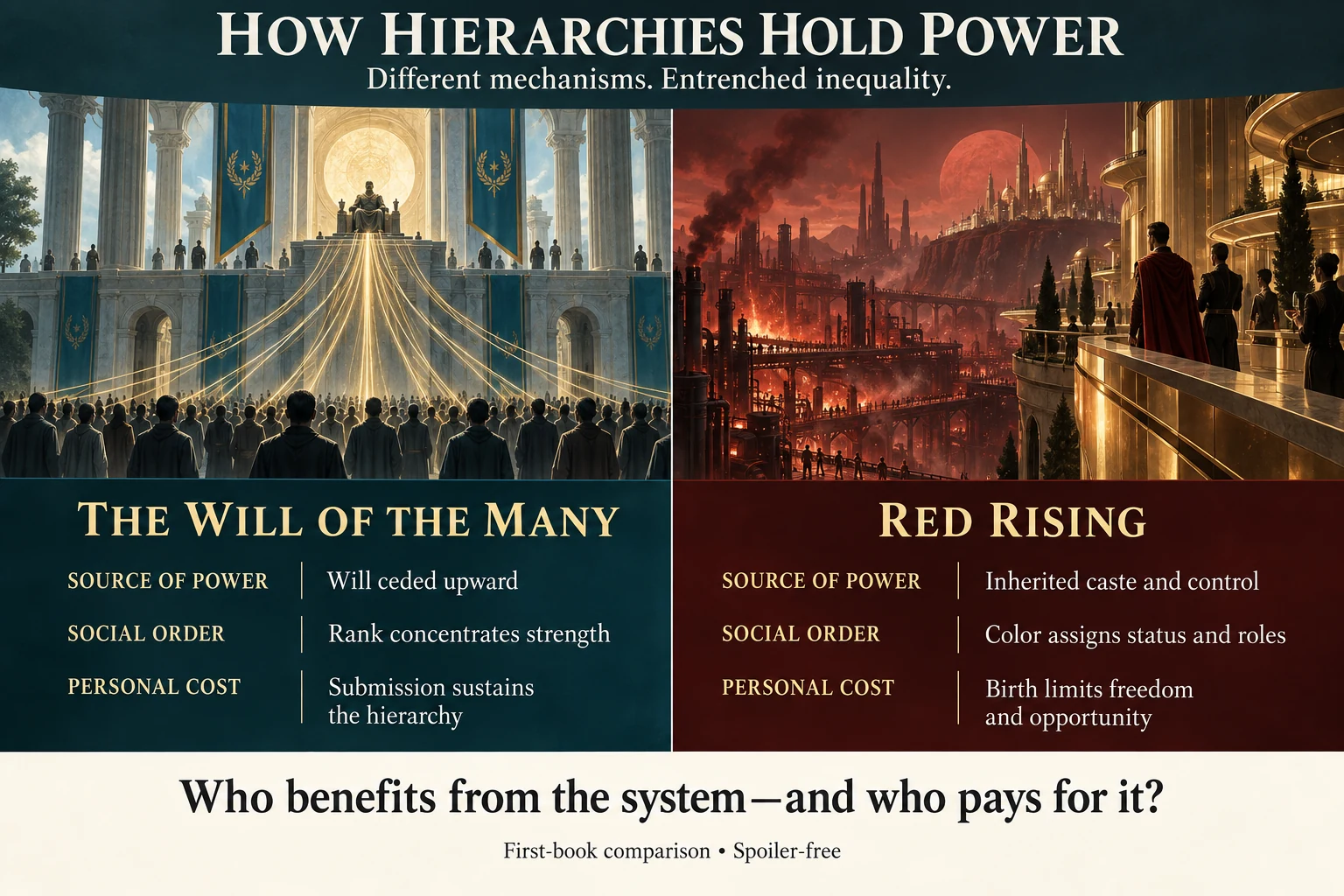
The illustrations simplify these ideas. In particular, the image of Will concentrating above a crowd is symbolic; it is not a literal diagram of the Republic’s government or every step of its hierarchy.
Three questions make a rewarding spoiler-free lens for either novel:
- What is rewarded? Separate demonstrated skill from the behavior an institution needs people to perform.
- Who bears the cost? Look beyond the winner to the people whose work, obedience, or exclusion makes winning possible.
- What follows success? Ask whether new power expands other people’s freedom or merely changes who controls them.
This is also why an action scene or an academic rivalry can carry philosophical weight without stopping for a lecture. A decision becomes an argument about what matters. The consequences test that argument more convincingly than a character’s declaration of good intentions.
Beyond these two books: when the hidden system is reality itself
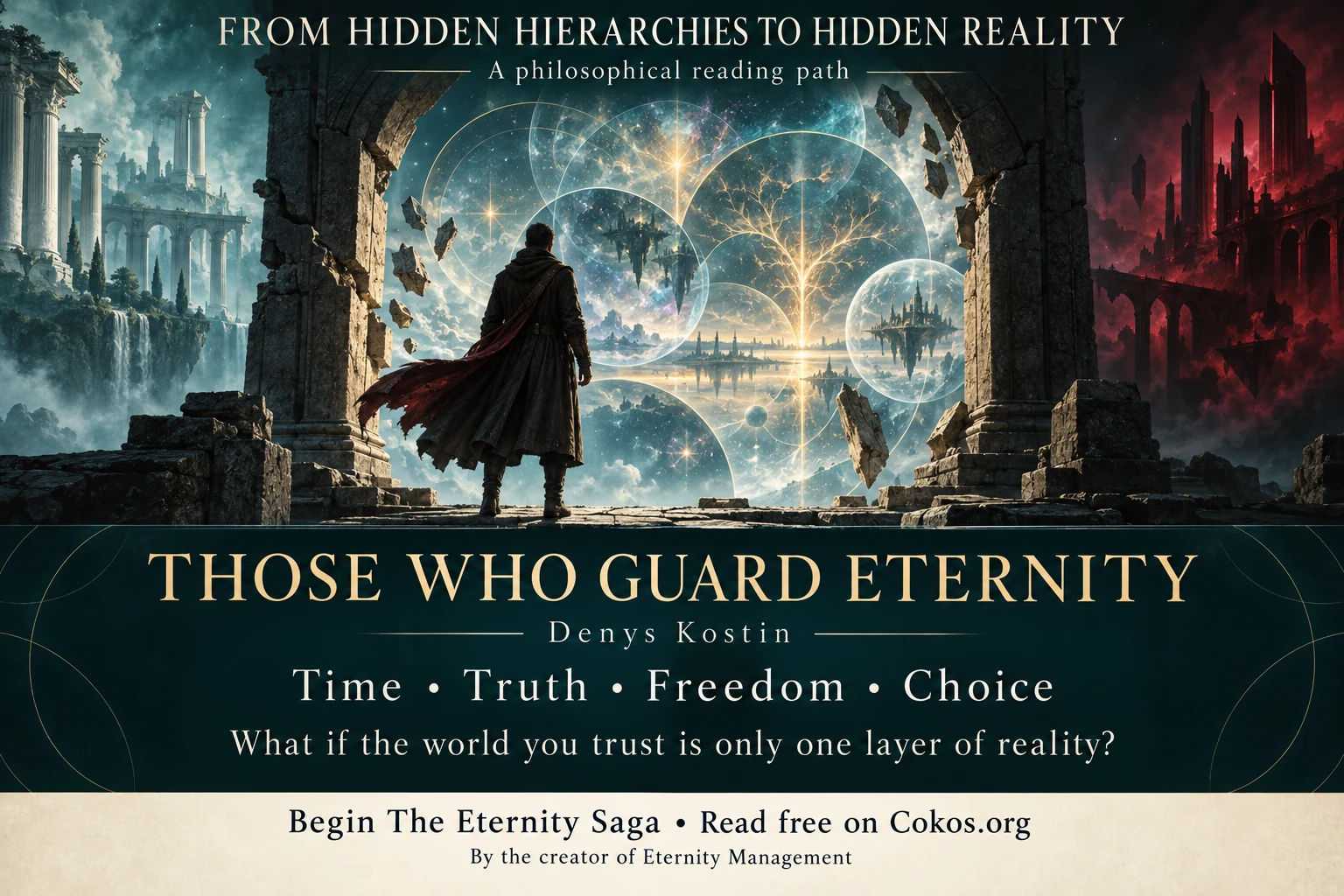
Some readers leave stories about hierarchy thinking less about who won than about what everyone had accepted as inevitable. If that is the question you want to follow, philosophical fantasy offers another direction: what if the structure limiting freedom is embedded in the experience of reality?
Frequently asked questions
Is The Will of the Many like Red Rising?
Yes, in its combination of hierarchy, hidden identity, elite competition, and resistance. The strongest difference is emphasis: Islington foregrounds academy intrigue and layered mysteries, while Brown gives more space to survival competition and the pressures of leadership.
Which is better: The Will of the Many or Red Rising?
There is no universal winner. Choose The Will of the Many for institutional secrets and a fantasy academy; choose Red Rising for a more visceral science-fiction contest. How you respond to the narrative voice may matter more than the number of shared tropes.
Is Red Rising a magic-school book?
No. The Institute trains and tests an elite, but it is not a magic school. Its competition emphasizes survival, alliances, territory, and command. Readers seeking classes and academic advancement should expect a different kind of institution.
Should I read both?
Both are worth considering if you enjoy capable outsiders navigating unjust systems. Their overlap can make the second book accessible without making it redundant. Take a break between them if you want a change from concealed identities and elite competition.
Do I need to read another series first?
No. Each is the starting point of its own series. You do not need to read Islington’s Licanius Trilogy before The Will of the Many, and Red Rising begins Darrow’s story.
What should I read after finishing them?
Continue each series if you want more of its characters. For a different story, choose the element you want to preserve: academy life, political infiltration, rebellion, or philosophical questions. The reading guides linked above separate those preferences rather than treating every dystopian or fantasy novel as the same kind of recommendation.
Editorial approach: publisher descriptions and Islington’s opening excerpt ground the examples; Kirkus supports the Institute’s war-game structure. Full reviews may contain spoilers; comparative judgments are this guide’s interpretation, not author endorsements or numerical ratings. The illustrations are conceptual artwork. The Cokos book description supplies the synopsis and reading-access information for Those Who Guard Eternity.