Full spoilers for The Will of the Many, including the epilogue. This explanation stops at Book 1 and does not use sequel plot revelations to resolve its open questions.
The ending in brief: what actually changes
The ending of The Will of the Many reveals that Vis exists in three worlds: Res, Luceum, and Obiteum. His passage through the ancient labyrinth leads to more than one continuing version of him. The epilogue, Synchronism, expands the story beyond Caten’s political struggle and shows that his escape was only one part of what happened.
Keep two conclusions separate. The Academy storyline ends with a costly victory and a choice of political allegiance. The epilogue then changes the reader’s understanding of the world in which that victory occurred. Knowing one conclusion does not explain every detail of the other.
Below, events are separated from character explanations and literary interpretation. For a factual outline of the ending, consult the plot overview.
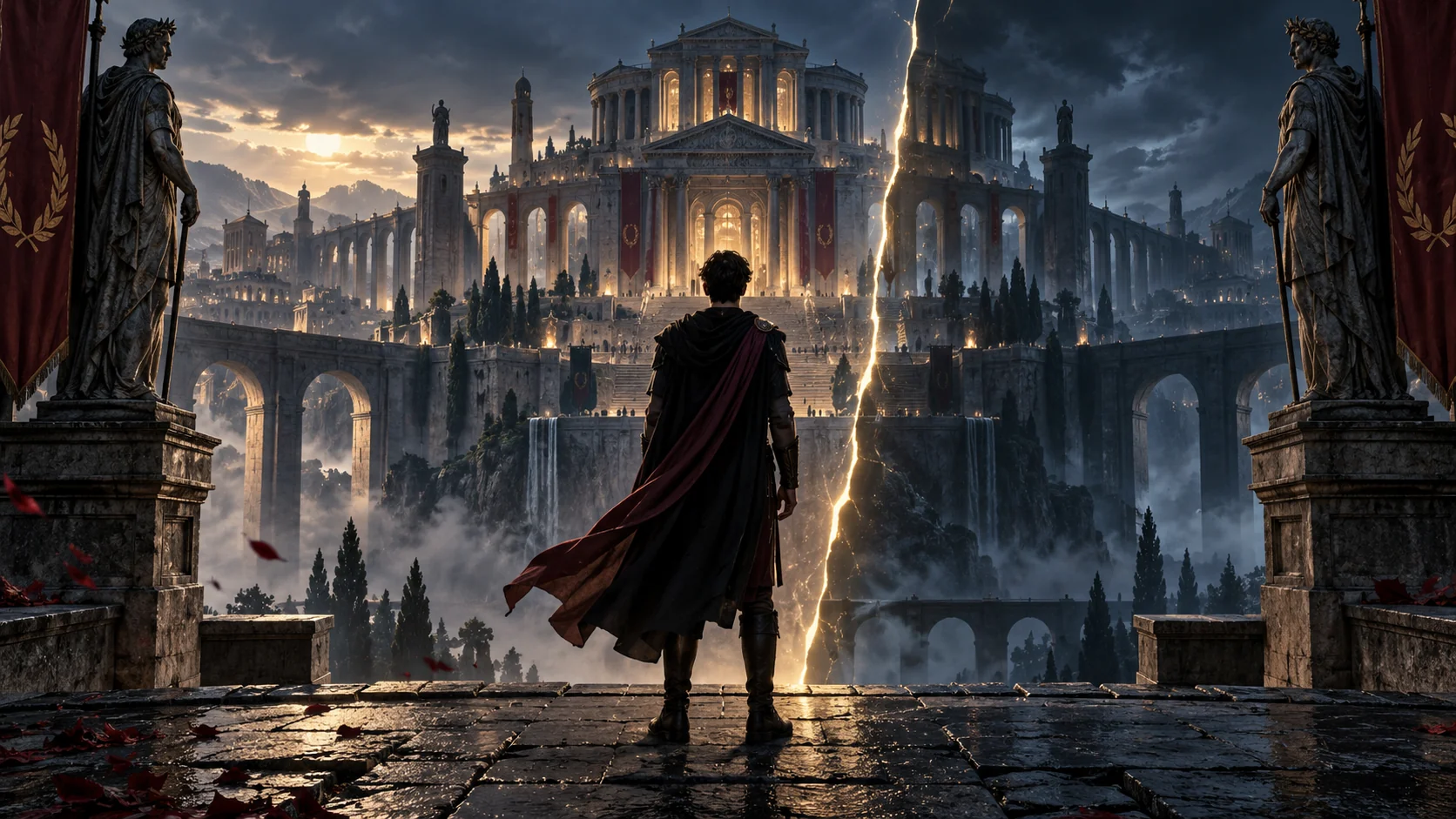
The final events, in order
- The labyrinth: during the Iudicium, Vis reaches the ancient chamber. A strange bite and writing that appears on his arm become central to his survival.
- The attack: the students’ competition becomes a real killing ground when Anguis infiltrators replace the safety teams.
- The losses: Emissa attacks Vis after seeing his wound; Callidus later dies as Vis tries to bring him back.
- The aftermath: Vis survives, loses an arm, and chooses Governance rather than the Religion position Veridius wants him to take.
- The epilogue: further versions of Vis awaken elsewhere, including one who encounters Caeror in Obiteum.
Res, Luceum, and Obiteum explained
The epilogue revisits the chamber from different continuations of Vis’s experience. It is not simply showing his later arrival in a new country. The familiar Academy world is one of three settings in which he now exists.
| World | What happens | Connection or open question |
|---|---|---|
| Res | Vis escapes the ruins and returns to the Academy storyline. | The warning on his arm points beyond his own perspective. |
| Luceum | Passage costs him his left arm; he emerges near snow and mountains. | The toll is explicit. Its full governing rules are not. |
| Obiteum | Caeror meets Vis and urgently discusses saving him in Res. | The versions can be connected; the full mechanism remains incomplete. |
The epilogue recap records the Luceum toll and the Obiteum encounter. Islington’s official glossary confirms the three names.
Interpretation: the twist changes the scale of the mystery. Political deception takes place within a reality the characters do not fully understand. Knowing who controls the Academy is no longer enough to explain what happens there.
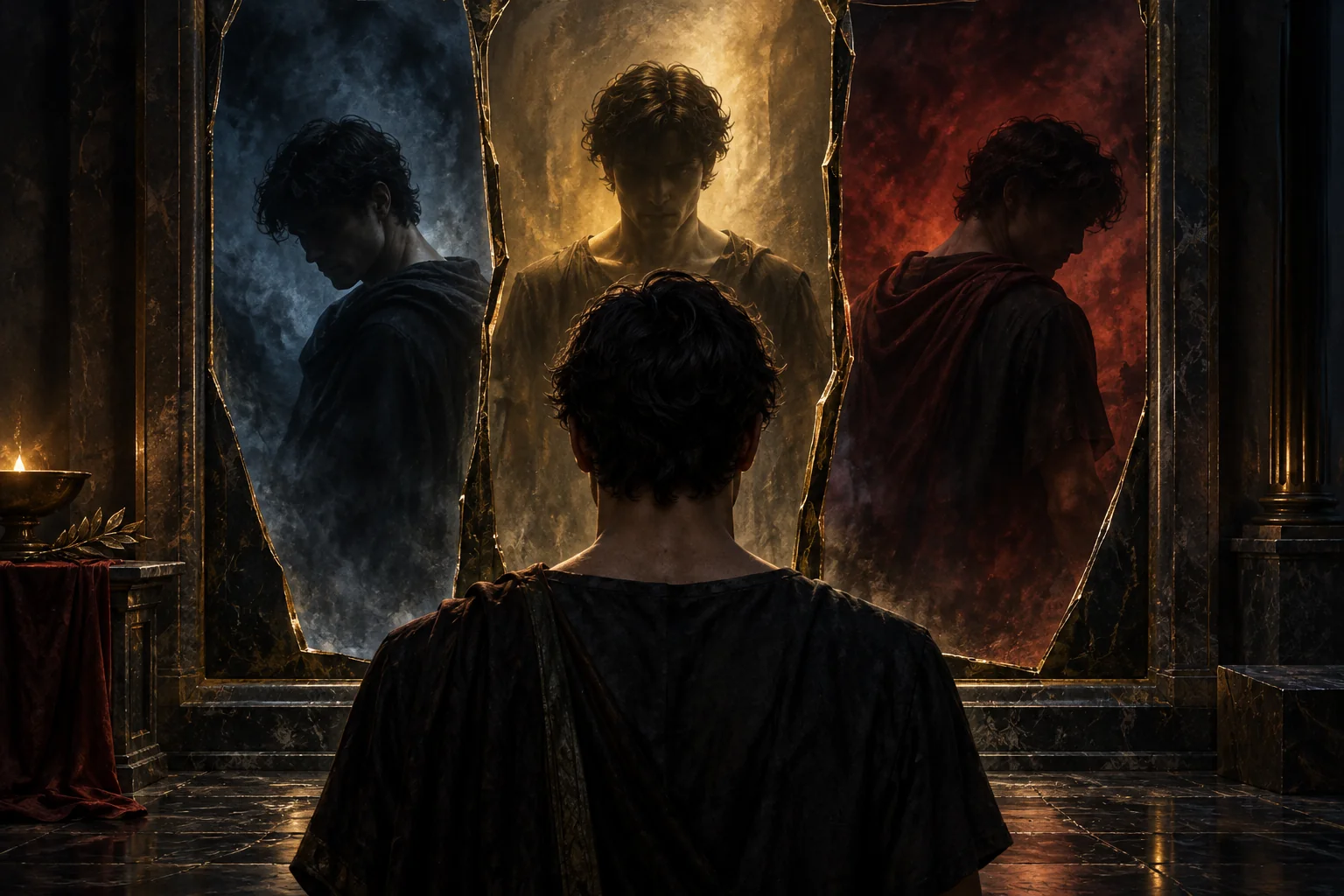
What does Synchronism mean for Vis?
Synchronism is the epilogue’s heading and the key to reading the repeated awakenings: Vis has multiple continuing versions. The epilogue should be read as a development in the fictional world, rather than merely a dream or an image of his conflicting feelings. The novel has moved beyond the question of which name he uses.
Interpretation: one history can now lead into different experiences. That creates a philosophical question without requiring an immediate answer: if more than one person remembers being Vis, what would make one of them the only legitimate self?
For broader reading around that question, explore books about identity.
Book 1 introduces this situation without giving a complete rulebook. In particular, a connection between versions does not establish that they automatically share every new thought or decision.
The wound, the missing arm, and the messages
The closing sequence places bodily damage alongside information Vis cannot initially explain. The bite, the writing on his arm, and the eventual amputation belong to the ending’s cluster of mysteries. The SuperSummary plot summary corroborates the warning marks and the amputation in the Academy aftermath.
The strongest implication is that the warning cuts come from help across worlds. Caeror’s urgency and knife connect the marks to a rescue attempt. That is a close reading of the ending; it should not be expanded into a claim that any message or injury can always be transmitted.
Interpretation: the body functions as evidence that Vis’s ordinary understanding is inadequate. Readers meet a consequence before they have a reliable explanation for its mechanism. That order creates the mystery: first something happens, then the available explanation must change.
Why does Emissa try to kill Vis?
The immediate trigger is her reaction to his wound. Veridius subsequently tells Vis that Emissa believed he was tainted and beyond saving. That explanation comes from Veridius; it is not an independent guarantee that her judgment was correct or that his account is complete. The plot summary records both the attack and his later explanation.
Interpretation: this is a conflict between intimacy and classified knowledge. Emissa responds to something she recognizes, while Vis experiences a betrayal he cannot adequately interpret. The scene is disturbing because two people can occupy the same moment with radically different understandings of its stakes.
Understanding a motive does not excuse an act. Even if Emissa believes she is responding to a danger, that belief does not prove the danger, establish that killing is necessary, or erase Vis’s experience. Conversely, the attack alone cannot prove that every earlier expression of affection was fabricated.
Why Callidus’s death and Governance matter
Callidus’s death and Vis’s decision to enter Governance are both part of the final aftermath. Vis chooses a path connected to Callidus’s father instead of accepting Veridius’s invitation into Religion. The same plot summary records those outcomes.
Interpretation: the ending denies the comforting equation between winning and succeeding. An institution can record a victory while the person who “wins” experiences an irreplaceable loss. The official result and the human result are not interchangeable measures.
That makes the choice of Governance more than a career preference. It can be read as an attempt to recover some control over where Vis seeks information and whose terms he accepts. Refusing one powerful sponsor, however, does not remove him from the political system.
Nor should the existence of other worlds become an easy way to dismiss grief. The revelation creates possibilities, but possibility is not a demonstrated reversal of loss. A Book 1 explanation should preserve the emotional reality of what Vis has lived through instead of treating the epilogue as an automatic reset.
Caeror, Veridius, and the limits of an explanation
Caeror is Ulciscor’s brother, whose supposed death was central to Vis’s Academy mission. His appearance in Obiteum reopens that mystery. His presence does not tell us exactly what Ulciscor knows or how Veridius’s actions should be judged.
Apply the same discipline to Veridius. His stated aim of preventing another Cataclysm gives his actions a claimed purpose. It does not automatically establish his honesty, validate his methods, or make accepting his offer Vis’s only rational option.
The Will, the Hierarchy, and the cost of power
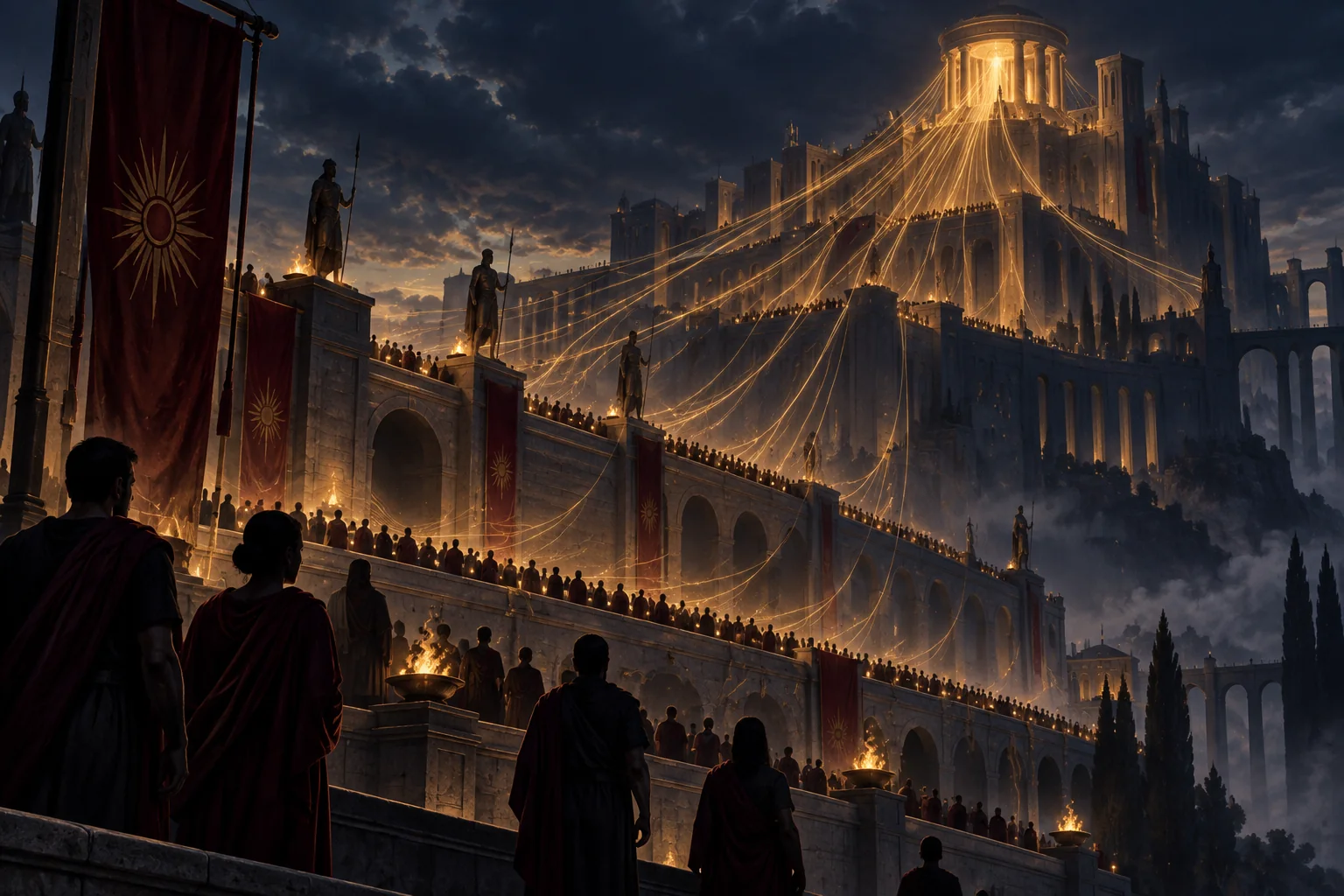
In Islington’s official glossary, ceding means transferring half of one’s Will to a person in the rank above. The Aurora Columnae are the inherited devices that make ceding possible. This is a concrete mechanism of the setting, as well as a source of political meaning.
Interpretation: the title directs attention toward the source of power. Those who command enormous capacity may appear individually exceptional, yet their position depends on what others surrender. Read this way, the visible strength of a ruler is also evidence of a largely invisible dependence.
That is why “collective power” should not be confused with democratic agreement. A system can gather resources from many people without giving those people a meaningful say in their use. Participation under pressure is not the same thing as free consent.
Vis’s refusal to cede therefore carries significance beyond stubbornness. It asks whether advancement is worth the surrender demanded by the institution. The ending makes that question more difficult: acquiring knowledge and access can increase someone’s options while also placing them inside new relationships of dependence.
The three-world revelation does not make the political story irrelevant. Instead, it offers a reason to revisit the limits of what the Republic knows and controls. A state may wield inherited mechanisms without possessing the complete explanation of the reality behind them.
Which earlier clues deserve a reread?
A useful reread follows a small set of questions rather than hunting for a secret meaning in every detail:
- The repeated world names: when are Res, Luceum, and Obiteum mentioned together, and what does the speaker actually know?
- The labyrinth: which assumptions come from the Academy’s presentation of it, and which come from Vis’s experience?
- Caeror’s history: who witnessed an event, and who is repeating an account received from somebody else?
- The physical anomalies: what is directly observed before a character tries to explain it?
- Offers of protection: what information or commitment is demanded in exchange?
What the ending means: freedom without full knowledge
My reading of the ending is that autonomy requires judgment under uncertainty. Vis cannot wait until every powerful person has told him the truth before deciding how to act. Yet moving forward without complete knowledge leaves him vulnerable to people who understand more than he does.
Those questions connect naturally with books about free will and the broader tradition of philosophical fantasy.
Five questions to check your interpretation
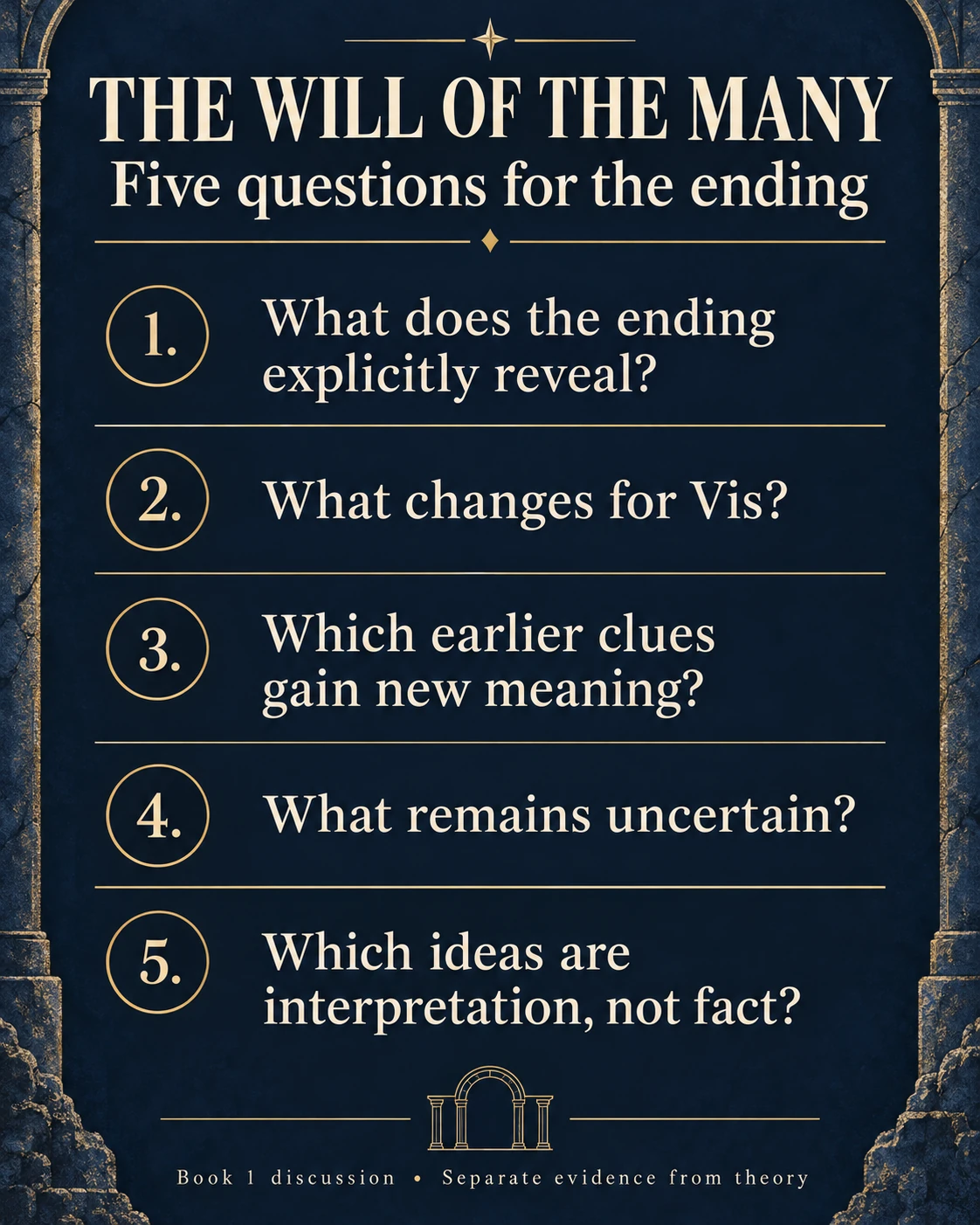
- What does the ending explicitly reveal? Start with an event rather than a theory.
- What changes for Vis? Separate his knowledge, circumstances, relationships, and choices.
- Which earlier clues gain new meaning? Name the connection you can support.
- What remains uncertain? An unanswered question is not a reading failure.
- Which ideas are interpretation, not fact? Label your inference so another reader can assess it.
Frequently asked questions
What does the toy ship mean?
Vis recognizes the bedside ship as something he carved for his father; it bears his birth name, Diago. It signals that someone knows his concealed past. The object alone does not identify its sender. See the final-chapter recap.
Are there three versions of Vis at the end?
Yes. The ending introduces his continuing existence across Res, Luceum, and Obiteum. The larger explanation of their relationship goes beyond this Book 1 discussion.
Does the ending explain every mystery?
No. It changes how several mysteries fit together while leaving motives and mechanisms open. A clearer question can be the intended result of a reveal.
What should I read next in the series?
The Strength of the Few is the second Hierarchy novel. It was published in November 2025. This article avoids its plot developments. Consult James Islington’s official updates for series information.
For readers drawn to hidden reality
If the part that stays with you is the cost of discovering a larger reality, Those Who Guard Eternity offers another philosophical fantasy route. Its protagonist, Antem, questions the nature of time and the relationship between truth, safety, and choice.
Author disclosure: Those Who Guard Eternity is by Denys Kostin, the author behind Eternity Management. This recommendation is included for its thematic connection; it is not an independent review or a claim of connection to Islington’s series.
Read Book 1 of The Eternity Saga free in English — no registration is required.
Sources and scope
This is a Book 1 explanation with clearly labeled literary interpretation. Names and setting terminology were checked against the author’s glossary; closing events were cross-checked against public plot summaries. No quotations or page numbers from an unexamined edition are presented.
- James Islington: official Hierarchy glossary and maps — names, places, and Will terminology.
- The Will of the Many: plot overview — closing sequence and epilogue cross-check.
- SuperSummary: public plot summary — the wound, Emissa’s attack, and the Academy aftermath.
- SuperSummary: Chapter 69–epilogue recap — arm toll, Caeror, and the toy ship.
- James Islington: official series updates — publication context; the linked page may mention later books.