
Emissa tries to kill Vis after seeing the bite wound on his arm. Veridius later explains that she believed Vis was tainted and beyond saving. That is Book 1’s offered explanation of her motive—not independent proof that her judgment was correct, that killing him was necessary, or that their earlier relationship was a lie.
The distinction matters because this scene contains two shocks: someone Vis trusts attacks him, and someone else subsequently asks him to understand that attack through knowledge he does not possess. Explaining the second does not undo the first.
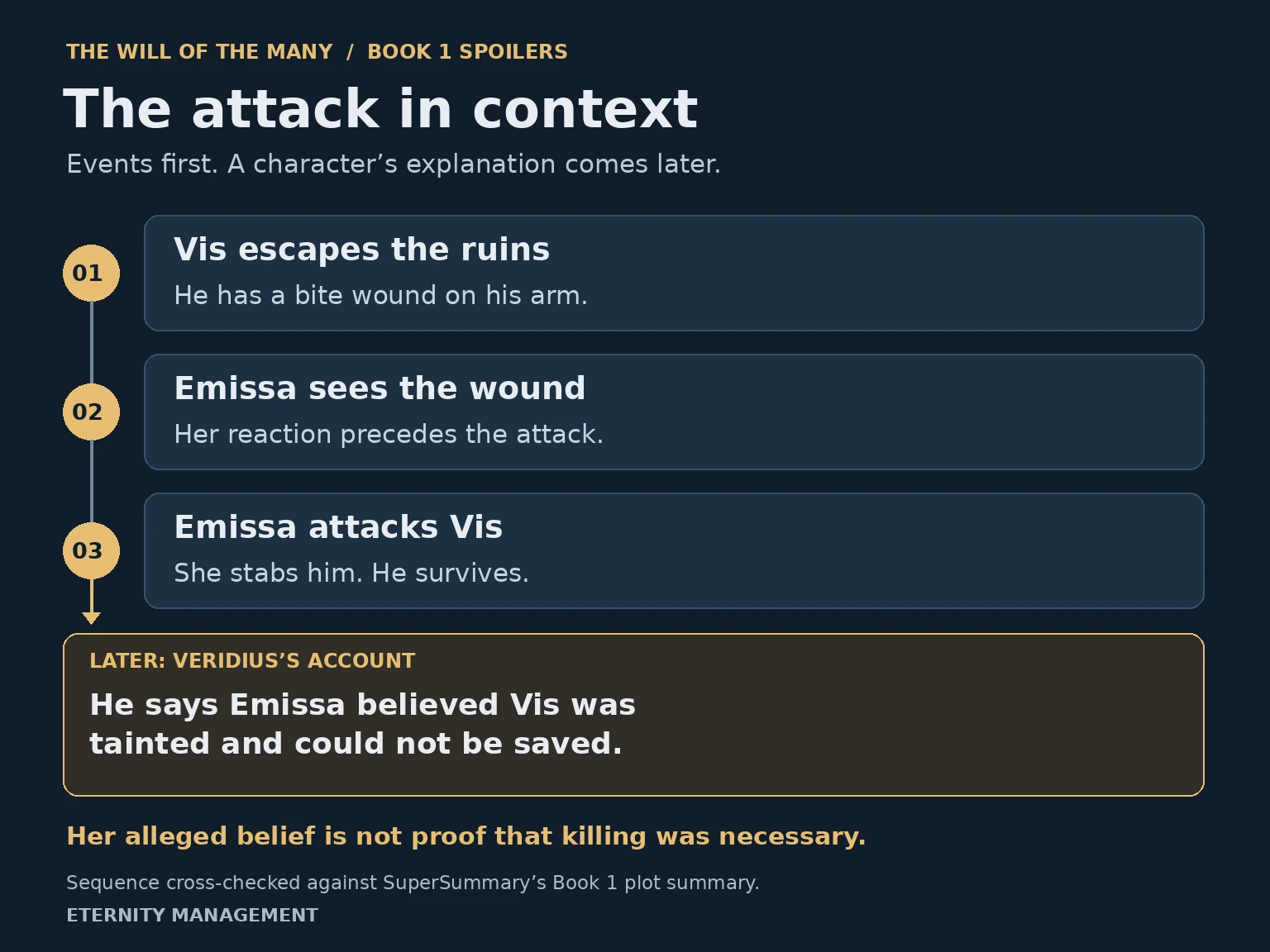
What happens before Emissa attacks Vis?
During the Iudicium, Vis returns from the ruins carrying a strange bite wound. The competition has become a genuine emergency: Anguis infiltrators have replaced the safety teams. At the tower, Emissa kills an attacker before turning on Vis. She notices his injury, demands the Heart, and insists on winning. She then stabs him; he falls into the river and survives.
This sequence is corroborated by the closing-chapter recap. It is important to retain the demand for the Heart rather than simplifying the scene into a tidy explanation that arrives only afterward.
Interpretation: her demand makes competitive ambition a plausible immediate reading for Vis and the reader. However, the timing of her response to the wound, followed by Veridius’s account, complicates a purely “she wanted to win” explanation. The scene invites suspicion before supplying context.
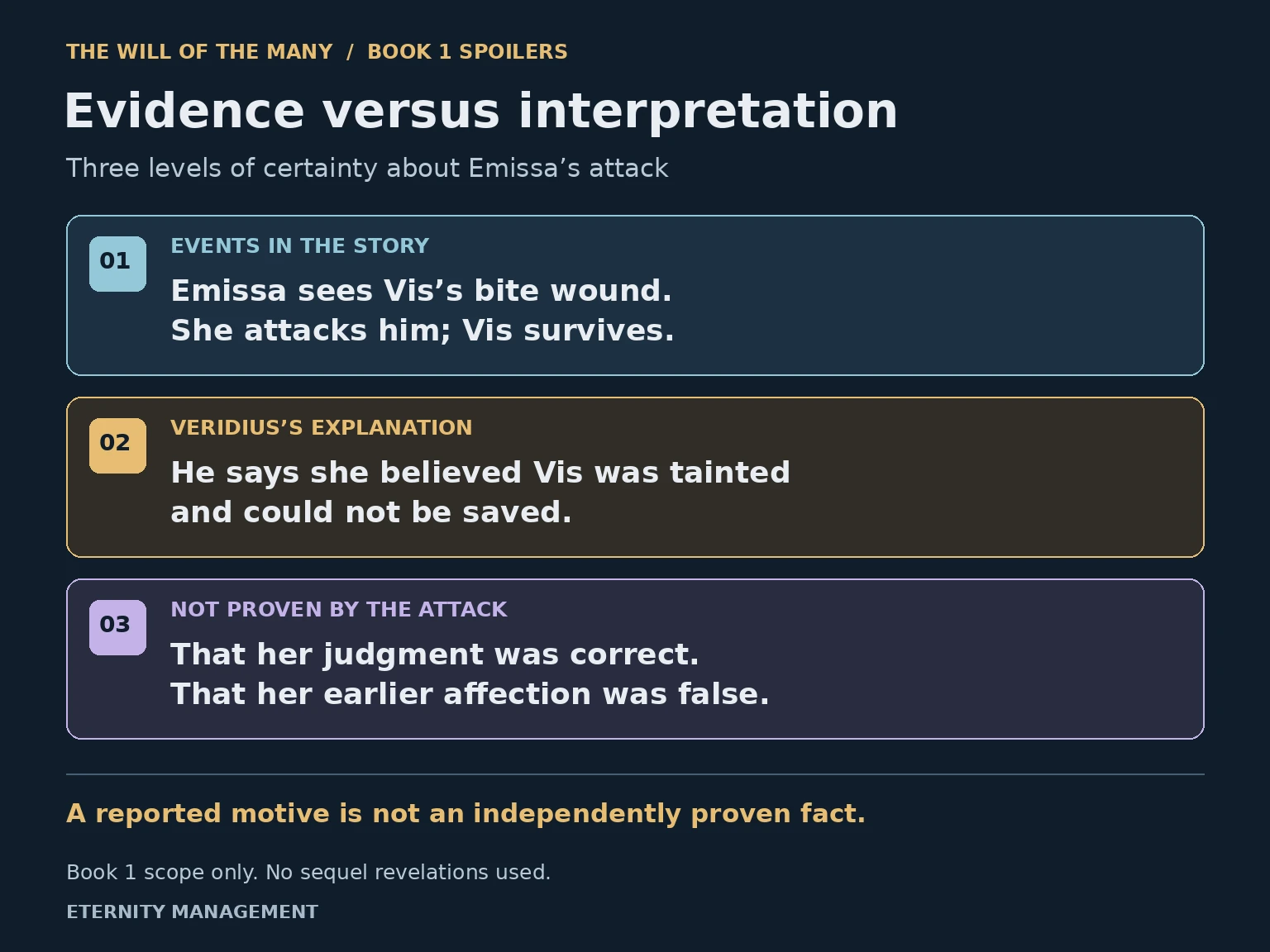
Why does Vis’s wound change Emissa’s reaction?
The wound is the immediate trigger, not an ordinary injury that the scene treats as incidental. The Book Series Recaps summary connects her change in behavior to his altered blood and records the later explanation about its significance.
My reading: the crucial gap is between recognizing a sign and correctly understanding it. Emissa appears to recognize something alarming; Vis cannot evaluate the conclusion she draws. A reader should not silently turn her recognition into a complete account of what has happened to him.
Notice the order of disclosure: the reader sees a response before receiving an explanation. That makes the wound a clue to reread, not a complete answer on its own. The later account changes the possible meaning of her action without changing what Vis experienced.
For the wider mysteries surrounding his body and the epilogue, use the full ending explanation. This article stays with the narrower question of Emissa’s decision.
What does Veridius’s explanation establish?
Veridius says Emissa believed Vis could not be saved. His explanation reframes her apparent betrayal as a response to what she thought had happened to him. The Recaptains recap also records his defense of her actions and Vis’s resistance to it.
Interpretation: this account is meaningful evidence, but it is still testimony from a person inside the mystery. Treating it cautiously does not require declaring Veridius a liar. It means retaining the difference between what a character reports and what the reader can independently establish.
For a reread, compare two moments: her demand for the Heart and his later explanation. The first is part of the confrontation; the second offers a reason for her response to the wound. Any interpretation should account for both, rather than selecting whichever makes her seem simplest to judge.
Was Emissa’s relationship with Vis a lie?
The attack alone does not establish that all her earlier affection was false. That is a limit on the conclusion we can draw, not a guarantee of sincerity or a defense of her conduct.
Literary interpretation: affection and harmful choices can coexist. A person might care about someone yet place an alarming belief, an obligation, or another loyalty above that relationship. Those possibilities explain why a betrayal can be emotionally complicated; they do not establish which possibility accounts for every part of Emissa’s behavior.
The useful rereading question is not simply “Was every tender moment fake?” Ask instead whether a scene establishes affection, access to information, or trustworthiness. Those are different qualities. Evidence of one does not automatically prove the others.
From Vis’s perspective, the practical problem is immediate: he can no longer assume that closeness makes him safe. He does not need a complete theory of Emissa’s inner life to recognize that their relationship has changed. Understanding a motive later would not, by itself, restore the trust lost in that moment.
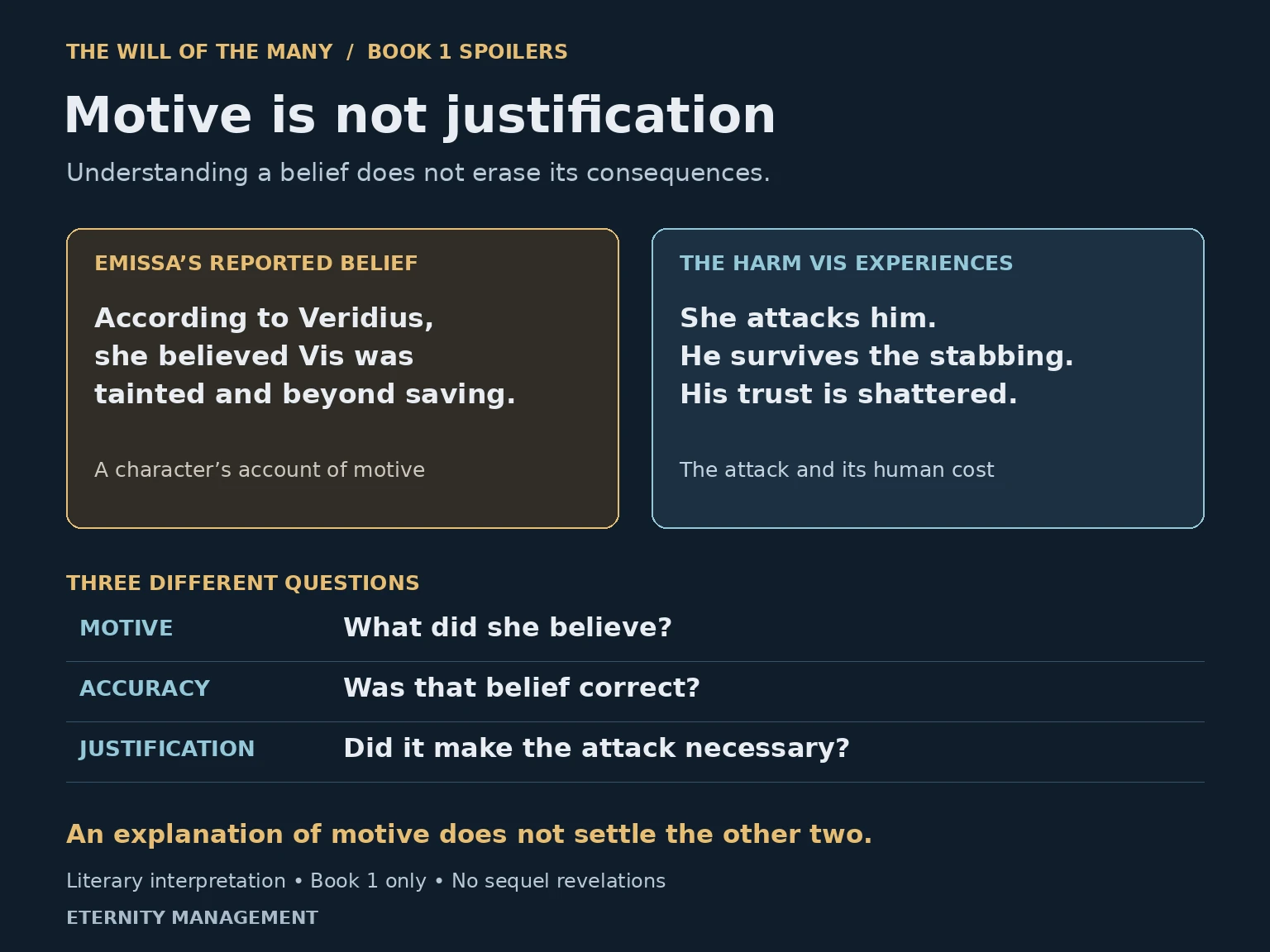
Does believing Vis was beyond saving excuse the attack?
My interpretation is no: the belief alone is not enough. A moral assessment requires more than identifying a motive. It also asks whether the belief was accurate and whether the action was necessary. Book 1’s explanation should not be made to answer all three questions at once.
This is what makes the episode more disturbing than a simple reversal of romantic loyalty. The person acted upon is excluded from the reasoning used to decide his fate. Even if the decision-maker believes an action is protective, that does not remove the need to examine its grounds.
The ethical tension connects with the novel’s wider interest in who gets to decide for others. Readers interested in that question can explore books about free will. Here, however, the human cost should remain visible: explaining the attack must not turn Vis into a mere example of someone else’s difficult decision.
What remains unresolved within Book 1?
A careful explanation can identify the offered motive without pretending to settle every related question. Use these boundaries when comparing interpretations.
On a narrow screen, swipe the table horizontally.
| Question | Careful conclusion |
|---|---|
| Why does she demand the Heart? | The demand belongs to the scene, but does not by itself establish whether winning is her sole motive. |
| What does she understand about the wound? | Her reaction suggests recognition. It does not give the reader a complete account of her knowledge. |
| Was her earlier affection sincere? | The attack changes how earlier scenes are read, but does not prove every feeling was fabricated. |
| Does Veridius tell Vis everything? | His explanation is partial. Treating it as evidence need not mean assuming it is exhaustive. |
The best answer is neither total certainty nor unrestricted speculation. Keep the supported explanation in view, state its limits, and resist filling those limits with invented dialogue or motives. Further answers belong to a separately marked sequel discussion, not an unannounced spoiler in a Book 1 guide.
Frequently asked questions
Did Emissa attack Vis just to win the Iudicium?
Her demand for the Heart supports that initial suspicion, but it is incomplete as a summary of Book 1. Veridius’s later account connects her decision to what she believed about Vis’s condition.
Does Vis die when Emissa attacks him?
No. He survives. Survival does not make the attack harmless or resolve the question of her motive.
Does Veridius prove that Emissa was right?
No. His explanation gives a reason attributed to her; accepting that as evidence of motive is different from proving the reason was sound.
Does this article include The Strength of the Few spoilers?
No. It deliberately stops at Book 1. It does not claim that questions left open here remain unanswered in later books.
Further reading: trust, hidden knowledge, and choice
For the larger story around this episode, read The Will of the Many ending explained. For a new reading choice, explore books like The Will of the Many.
When discovering the truth changes what safety means
If that question is what stays with you, Those Who Guard Eternity follows Antem into doubts about time, reality, and the relationship between truth and freedom. It offers a philosophical reading direction rather than a close equivalent of Emissa and Vis’s story.
Read Those Who Guard Eternity free in English — no registration required.
Author disclosure: this is my novel, by Denys Kostin. It is offered for its thematic connection, not as an independent review or a claim of affiliation with James Islington.
Sources and editorial scope
This is a focused Book 1 interpretation, not a complete recap. Plot details were cross-checked against public summaries; no quotation or page number from an unexamined edition is presented. The interpretive arguments are the author’s analysis.
- SuperSummary: closing chapters and epilogue — the tower sequence and subsequent conversation.
- Book Series Recaps: Book 1 recap — cross-check of the injury and attack.
- Recaptains: Book 1 recap — cross-check of the aftermath.