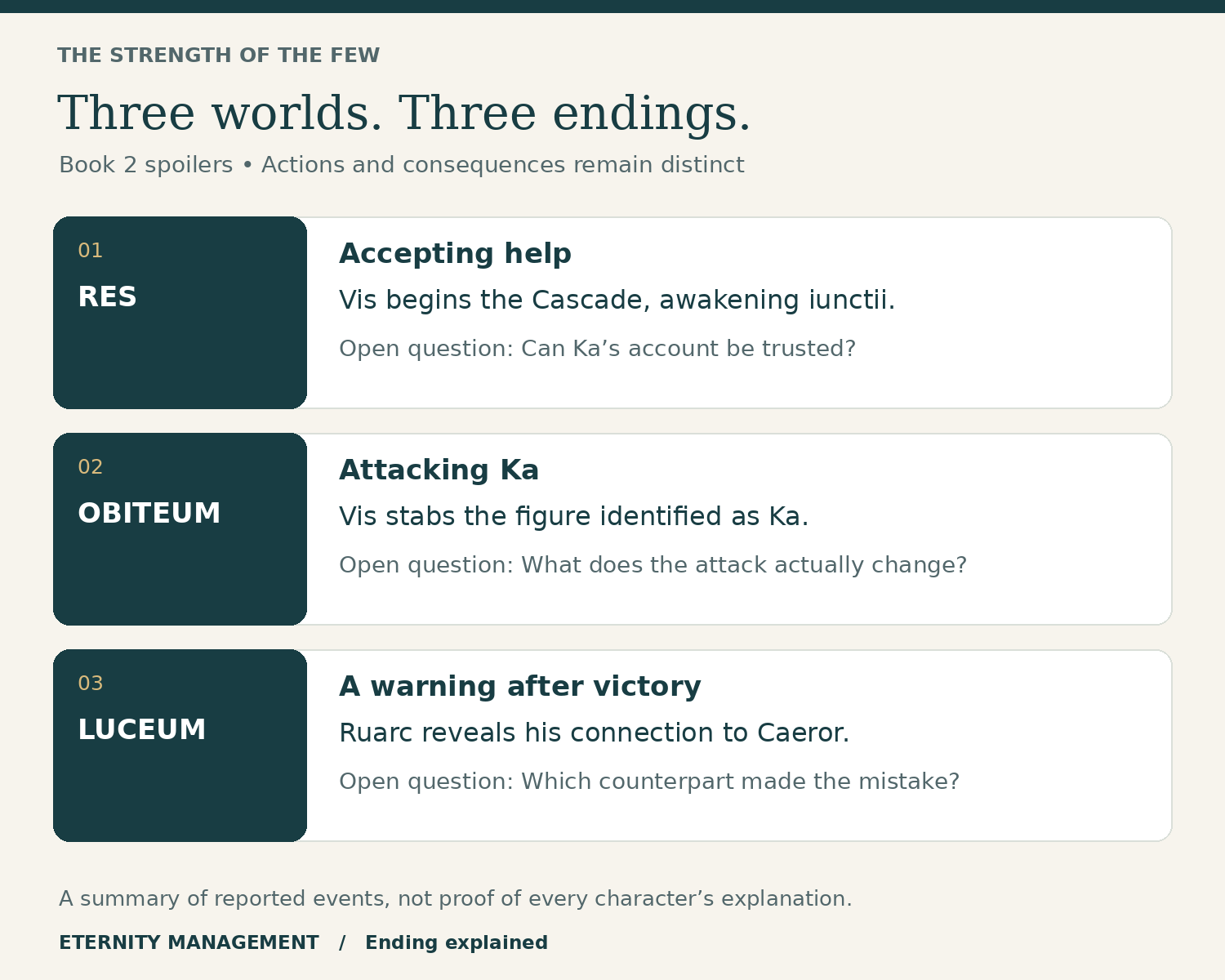
The ending of The Strength of the Few leaves Vis pursuing incompatible-looking solutions across three worlds. In Res, he accepts Ka’s assistance and begins awakening the dead. In Obiteum, his counterpart attacks the man he identifies as Ka. In Luceum, victory is followed by a warning about another version of himself. The immediate outcomes differ, but the central question is shared: does Vis understand the power he is using well enough to know whom it serves?
Start with the table below, then read the explanation for the world that confused you. For the earlier split, see our explanation of The Will of the Many ending.
The three endings at a glance
On a phone, swipe the table sideways to see all columns. These rows group storylines; they do not establish a synchronized cross-world timeline.
| World | Name used | Final development | Question to carry forward |
|---|---|---|---|
| Res | Vis / Catenicus | Starts the Cascade with Ka’s help. | Can this alliance end the violence without creating another form of control? |
| Obiteum | Siamun | Reaches the pyramid and stabs the figure identified as Ka. | What has the attack actually accomplished? |
| Luceum | Deaglán | Survives the conflict and learns that Ruarc is this world’s Caeror. | What does Ruarc know about the other versions of Vis? |
The storyline distinctions and names are cross-checked against the SuperSummary overview and Books of Brilliance recap. See the source note for verification limits.
Res: why Vis accepts Ka’s help
Vis accepts Ka’s help because Caten is being destroyed by civil war and he wants the power to stop it. He and Eidhin make contact with a speaker controlled by Ka: an iunctus, rather than Ka’s own body. That distinction matters when comparing this encounter with the attack in Obiteum.
Ka directs them into the Necropolis, where nearly 80,000 preserved dead offer the basis for an army. Eidhin objects, but Vis begins the Cascade. During the awakening he recognizes his mother and sister Ysa. These details are described in the Books of Brilliance recap.
The order is important: Vis chooses to start the process before the reunion. The return of his family is an emotional consequence of the choice, not the reason he initially makes it. The ending therefore combines a decision about power with a discovery that makes that decision intensely personal.
Our reading: Vis’s immediate objective is understandable, but accepting a means of intervention also exposes him to the person supplying it. Whether he can use that power without accepting Ka’s wider agenda is a question the finale leaves open.
Obiteum: what happens inside Ka’s pyramid?
Vis reaches the figure he believes is Ka and stabs him; the wider success of the mission is not established. Netiqret and Kiya help create an opening into the temple. Inside the pyramid, Vis finds a motionless man. With Gleaners approaching, he carries out the attack. Recap & Ruin describes this closing sequence.
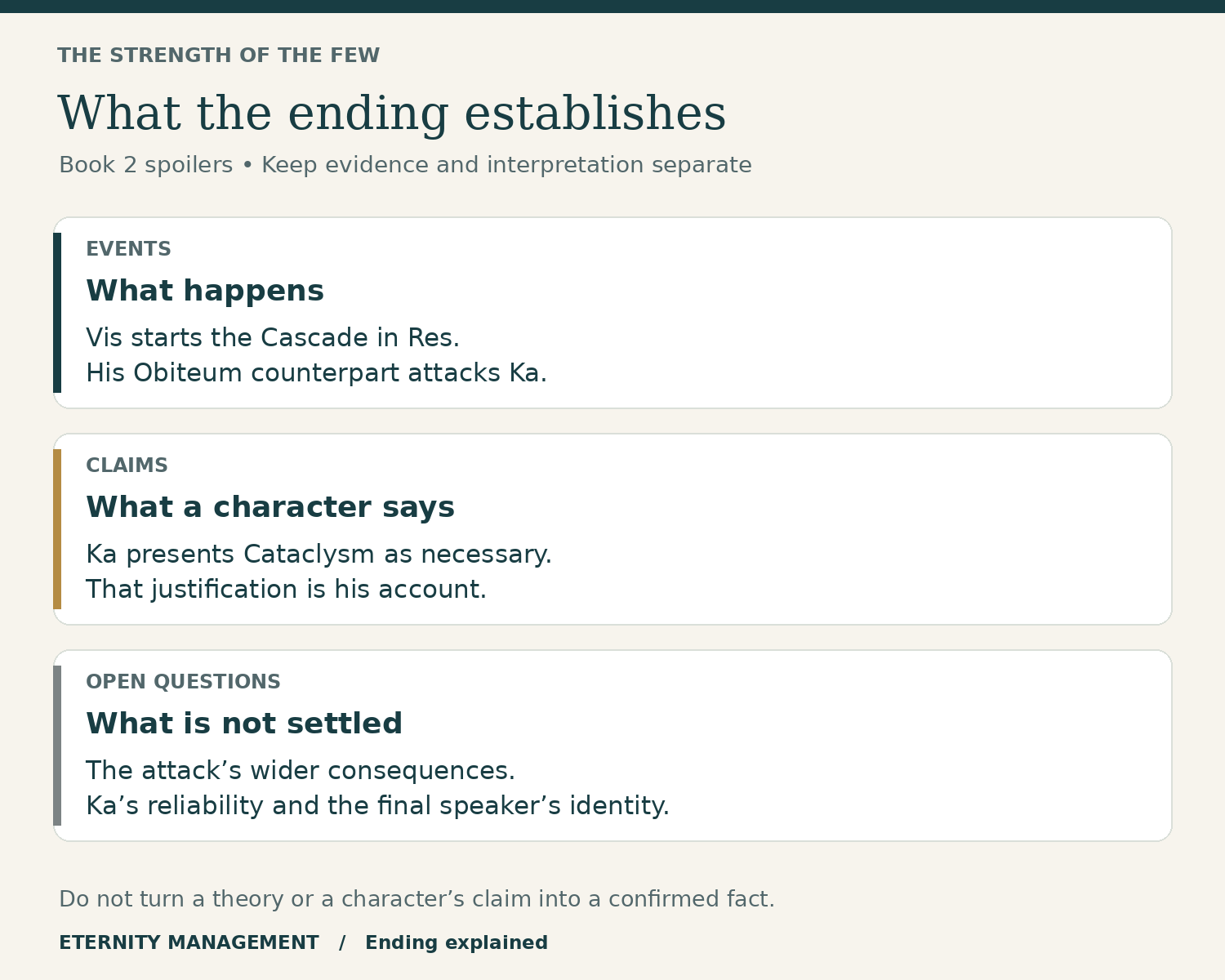
The apparent contradiction with Res becomes less straightforward once we distinguish a body from a channel of communication. Ka speaks in Res through an iunctus. An attack on the man in the pyramid does not, by itself, tell us when or whether that communication must stop.
That is not proof that Ka survives unharmed. It explains why “Vis stabs Ka” is a narrower conclusion than “Ka can no longer act anywhere.” Nor does carrying out the mission prove that its original explanation was correct or that the Cataclysms have been prevented.
The versions of Vis have also accumulated different experiences. A reader comparing their chapters can see a conflict that neither individual may fully understand. For the original split, see our Book 1 Synchronism explanation.
Luceum: the silver arm and Ruarc’s revelation
Luceum gives Vis a victory and then undermines his confidence about the larger struggle. The silver arm originates in the trial at Fornax. During the later conflict, Cristoval sacrifices the vitaerium sustaining him to save Vis. Vis returns with the arm and defeats Gallchobhar. The sequence is covered in Recap & Ruin’s Luceum account.
Afterward, Ruarc identifies himself as the Luceum counterpart of Caeror and warns that another Vis has made a serious mistake. This revelation is also recorded in SuperSummary’s overview. It changes the significance of the other finales without identifying a solution to their conflict.
Ruarc’s warning invites comparison between the Obiteum attack and the Res bargain. Assigning it definitively to either one would go beyond what the accounts consulted establish. His identity explains why his testimony matters; it does not make every assertion automatically reliable.
Ka and the Concurrence: who should we believe?
Ka says he is fighting the Concurrence, not that he is the Concurrence. His explanation describes it as a collective system of linked iunctii. He argues that sacrificing one world through Cataclysm is necessary to prevent the destruction of two worlds and the enslavement of the remaining one. These are claims within the story, not a neutral narrator’s verdict. Miscellany of Fiction’s ending discussion also separates the account from proof that the sacrifice is necessary.
This reframes the decision Vis faces. If the explanation is accurate, attacking Ka might undermine an attempted defense. If it is deceptive or incomplete, accepting his help might extend another system of domination. The finale creates tension by making both possibilities relevant before giving Vis a secure way to choose between them.
The crucial missing step is evidence that no less destructive alternative exists. Ka’s ability to offer immediate help does not establish that every part of his larger argument follows. Readers should keep his demonstrated capabilities separate from his historical account and moral justification.
What is the Cascade, and what does it cost?
The Cascade turns a small initial awakening into a multiplying source of Will and manpower. Vis begins with a few iunctii. Their contributions help awaken others, who can contribute in turn. The final-chapter summary describes the process as a route to Princeps-level strength and command of a large force.
This explains why the offer answers the immediate military problem: it supplies both people and concentrated power. It also explains Eidhin’s objection. The proposal uses the preserved dead as the material for an army, so the capacity to act and the moral cost arrive together.
The interpretive issue is consent. Remembering a life or recognizing a loved one does not, on its own, establish freedom to refuse service. To judge what the awakening means, ask whether those restored can disobey, leave, or pursue purposes independent of the person commanding them.
Who says “Hail, Vis” at the end?
Callidus is a plausible interpretation of the familiar voice, but the identity is not verified here from the novel. Eidhin looks past Vis and smiles before the greeting “Hail, Vis.” SuperSummary names Callidus among the returning figures; Books of Brilliance treats that identification as a possibility rather than confirmation.
The shared friendship makes Callidus a coherent reading of Eidhin’s response. It should still be distinguished from an explicit naming of the speaker. We should not replace that distinction with a competing identity presented as fact.
The reunion’s meaning is broader than the identity question. Recognition offers emotional relief while leaving the conditions of return unsettled. A familiar person may be present again, but the reader still needs to know what autonomy and obligations accompany that presence.
What does “the strength of the few” mean?
Our interpretation: the title invites a question about the authority of exceptional people. Being unusually capable may make someone able to intervene; it does not automatically make that person entitled to determine everybody else’s future.
There is also a distinction between a few people acting together and a few people commanding everyone else. Both can look like concentrated strength from a distance. Their moral character depends on participation, accountability and the ability to disagree.
Applied to the ending, this reading asks whether Vis will evaluate his own authority by the standards he applies to others. A compassionate objective does not remove the need for those standards. The harder test comes when restraint would mean surrendering an advantage that appears urgently necessary.
This is literary interpretation, not an official explanation of the title. It gives the three endings a common question without requiring a single answer about which version of Vis has chosen correctly.
What remains unresolved for The Justice of One?
James Islington’s official website identifies The Justice of One as Hierarchy Book 3. The questions below are a reading agenda for that continuation, not predictions of its plot:
- What consequences follow from the attack in Obiteum?
- How much of Ka’s explanation survives scrutiny?
- What knowledge passes between counterparts, and what remains local?
- Can those exercising extraordinary power be challenged by the people affected?
- Will recognition of a returning loved one be accompanied by meaningful freedom for that person?
A useful way to revisit the finale is to record each explanation beside its speaker. When new information arrives, that record makes it easier to tell whether a rule changed, a claim was disproved, or a character simply lacked information.
Frequently asked questions
Is this the ending of the Hierarchy series?
No. The Strength of the Few is Book 2, and the author lists The Justice of One as Book 3. This article does not assume a release date or a final series length.
Is there a separate epilogue?
The chapter listings consulted end with Chapter LXXX, set in Res. This guide calls it the final chapter rather than a separate epilogue.
Should I read this before finishing the novel?
No. Even the opening table reveals major outcomes. If you are preparing to start Book 2, use our Book 1 recap before The Strength of the Few instead.
What to read next
If you want another novel after this ending, explore our books like The Strength of the Few, organized around political intrigue, layered mysteries and questions of power. If you want to revisit the starting point, the Book 1 ending guide separates the original revelations from sequel knowledge.
Sources and editorial scope
This explanation uses the publisher for the premise and cross-checks public secondary accounts for the ending. It was not verified against a complete edition of the novel. The final speaker remains qualified where discussed; thematic judgments are this article’s interpretation. Agreement between summaries is corroboration, not a substitute for primary-text verification.
- Simon & Schuster: official book page and authorized excerpt — premise and publication context, not verification of the final chapter.
- James Islington: official website — series titles and numbering.
- SuperSummary: public overview — names, major storyline outcomes and its identification of Callidus.
- Books of Brilliance: Book 2 recap — cross-world distinctions and the closing Res sequence.
- Recap & Ruin: spoiler recap — Obiteum’s final attack and the unnamed final greeting.
- Miscellany of Fiction: summary and ending discussion — comparison of the endings and caution around Ka’s account.
- Chapter Summaries: chapter breakdown — the Cascade mechanism and final-chapter structure.