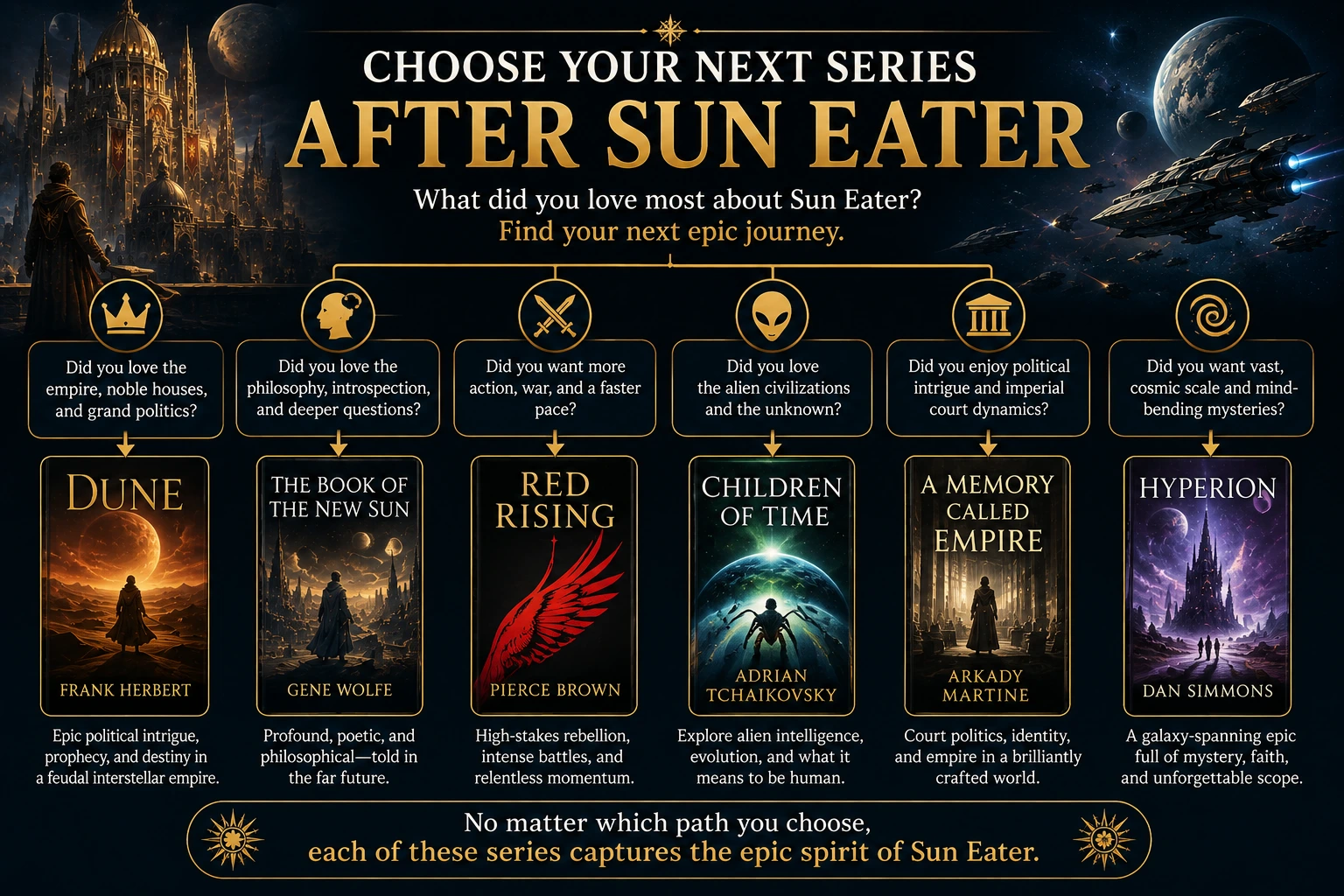
If you finished Christopher Ruocchio’s Sun Eater and want another story with imperial politics, philosophical weight, enormous historical stakes, ancient-feeling civilizations, alien mysteries, and a protagonist caught between destiny and choice, the best place to start is Dune, Hyperion, The Book of the New Sun, Red Rising, or The Will of the Many.
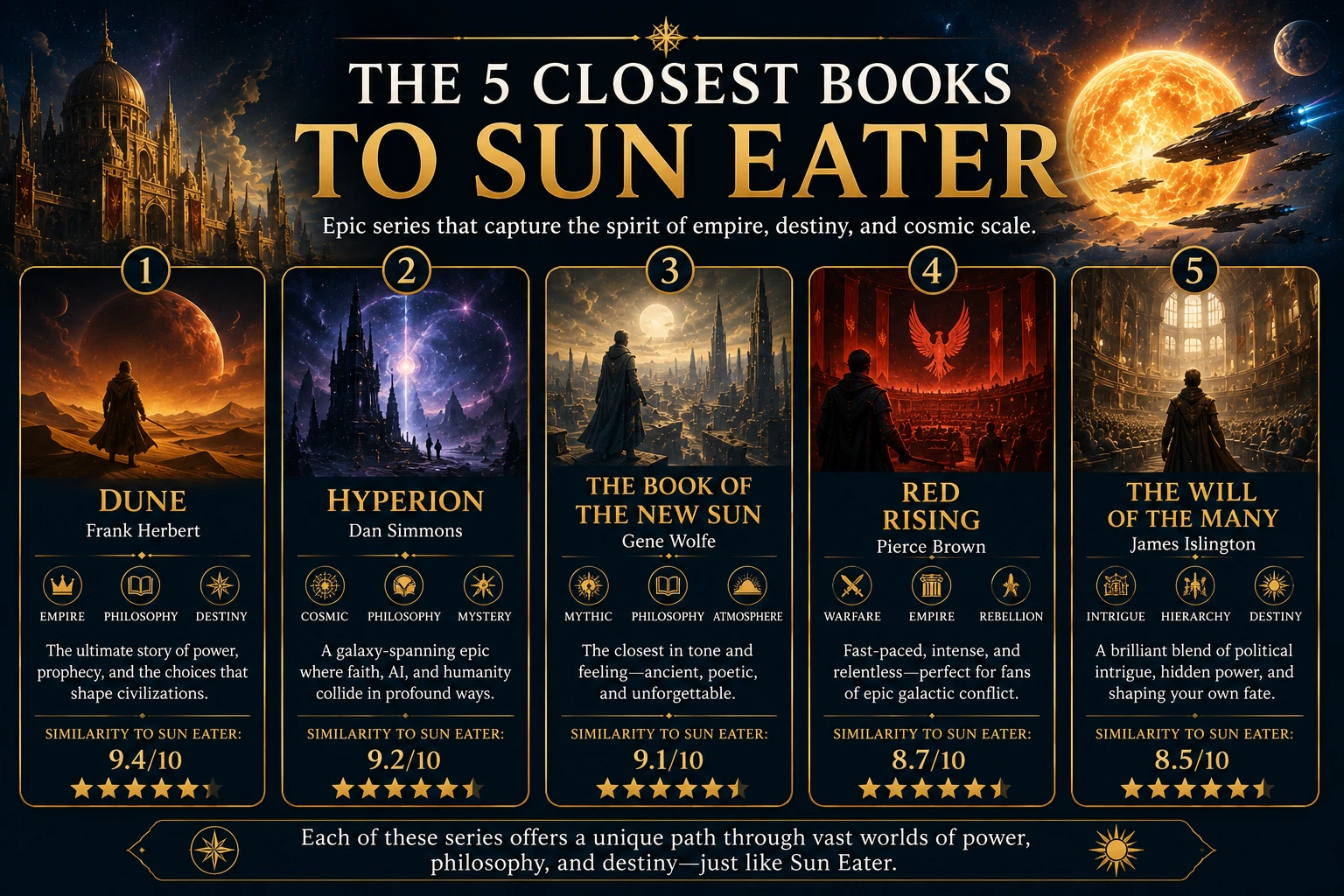
The closest books to Sun Eater overall are Dune, Hyperion, The Book of the New Sun, Red Rising, and The Will of the Many.
The best series like Sun Eater do not simply copy its setting. No single series reproduces everything that makes Sun Eater distinctive. Some books match its reflective, confessional voice. Others capture the Sollan Empire’s political scale, the collision of civilizations, the sense of myth unfolding inside a technological future, or the tension between personal responsibility and events that reshape history. This guide therefore ranks books by what they share with Sun Eater—and also explains where each recommendation differs.
At its core, Sun Eater sits between space opera and epic fantasy. That hybrid is the key to choosing useful read-alikes: the strongest matches are not simply “space books,” but stories in which technology, empire, myth, identity, war, and civilization collide.
The Quick Answer: Best Books Like Sun Eater
Closest overall: start with Dune if the imperial politics, religion, power, and destiny were your favorite parts of Sun Eater. Choose Hyperion if you want more literary strangeness and cosmic mystery. Choose The Book of the New Sun if what you loved most was the sensation of reading a myth from a remote future. If your main wish is simply “give me the same scale, but faster,” go to Red Rising.
What Makes a Book Feel Like Sun Eater?
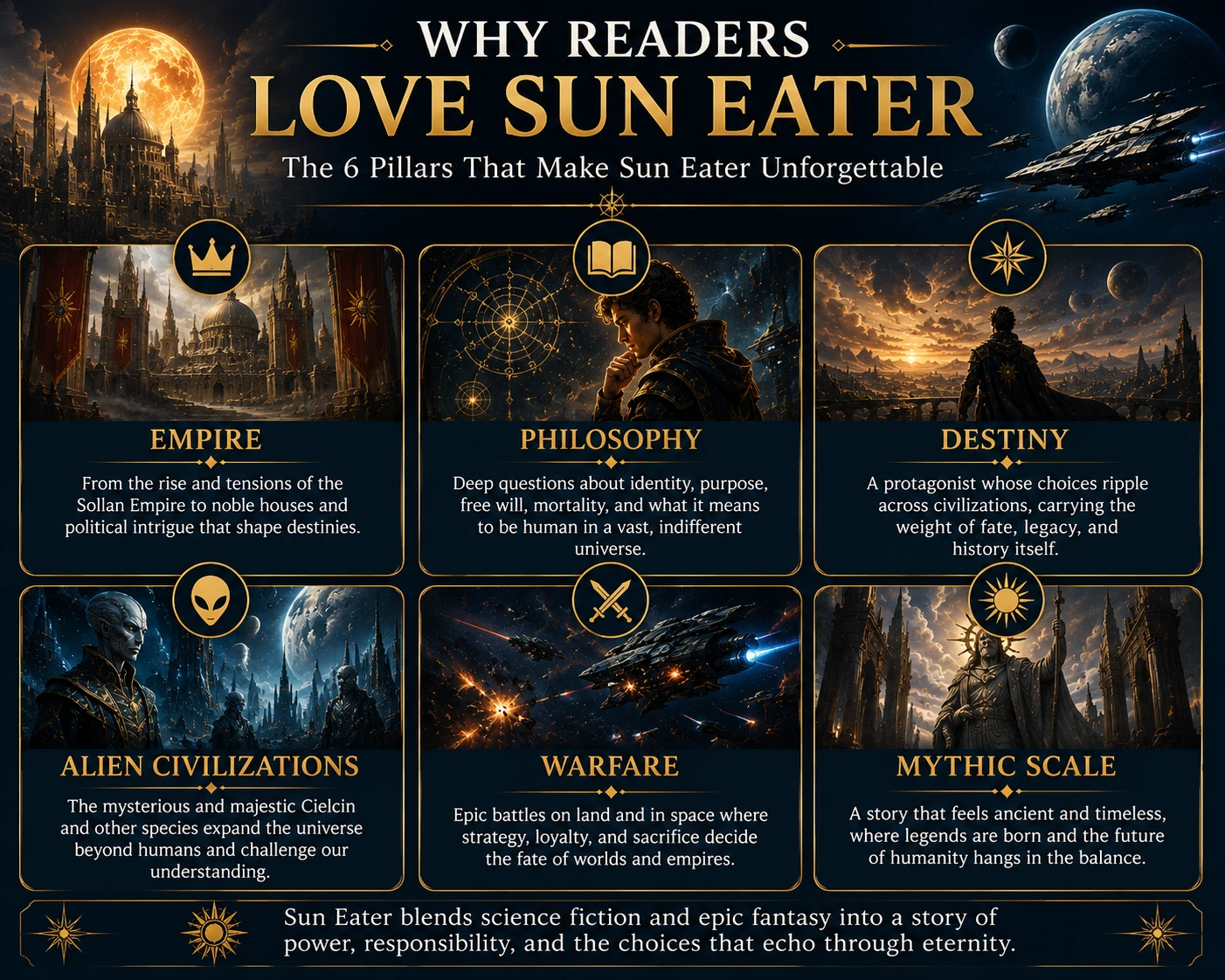
A useful Sun Eater read-alike needs more than spaceships. The series works because several different traditions overlap: space opera, epic fantasy, memoir-like narration, political drama, philosophical fiction, military conflict, and cosmic mystery.
Empire and aristocratic power
The Sollan Empire gives the story institutions, class structures, noble expectations, political loyalties, and conflicts that feel older than the technology surrounding them. Readers drawn to that layer should prioritize books where empires and social systems matter as much as battles.
A protagonist becoming a legend
Hadrian Marlowe tells his story with the weight of what history will eventually make of him. That retrospective structure creates a powerful tension: the reader knows that a private life will become a civilization-scale story long before the younger protagonist understands how.
Philosophy and introspection
Sun Eater repeatedly returns to identity, duty, mortality, free will, belief, violence, responsibility, and what it means to remain human inside systems larger than any individual. Readers who value this dimension may prefer slower, denser books over superficially similar action-first space opera.
Science that feels like fantasy
The world may contain advanced technology and interstellar travel, yet its rituals, hierarchies, swords, architecture, inherited power, and mythic language often evoke epic fantasy. This is why fantasy titles can sometimes be better recommendations than conventional hard science fiction.
Civilizations, not just characters
Human institutions, alien species, empires, religions, and historical forces all operate at once. The story asks what civilizations become under pressure and what individuals owe to societies that may be flawed, threatened, or changing beyond recognition.
Tragic destiny
The series constantly links choice to consequence. The scale may be galactic, but the drama remains personal because history emerges from decisions made by imperfect people who cannot fully see what those decisions will become.
15 Books Like Sun Eater
1. Dune — Frank Herbert
Dune is the clearest first recommendation because it combines aristocratic houses, imperial politics, religion, inherited power, prophecy, ecology, war, and philosophical questions about leadership. Like Sun Eater, it makes an individual life feel inseparable from the fate of institutions and civilizations.
The tonal overlap is strongest when Sun Eater feels less like conventional science fiction and more like a dynastic epic set among the stars. Both worlds treat history, bloodlines, belief, and political legitimacy as forces with material consequences.
Where it differs: Herbert is more compressed and systems-oriented, while Sun Eater spends more time inside Hadrian’s retrospective voice and personal evolution. If you finish Herbert and want more adjacent recommendations, see Books Like Dune.
2. Hyperion — Dan Simmons
Hyperion is ideal for readers who loved the feeling that Sun Eater was reaching toward something older, stranger, and larger than politics alone. It mixes intimate human stories with religion, artificial intelligence, war, time, memory, and a cosmic mystery that refuses to stay at a human scale.
Its structure is very different, but the emotional effect can be similar: individual lives become windows into a civilization confronting forces it only partly understands. The result is philosophical space opera with literary ambition and a strong sense of the sacred, terrifying, and unknowable.
Where it differs: Hyperion begins as a multi-voice pilgrimage rather than a single autobiographical saga. For a broader set of adjacent reads, see Books Like Hyperion.
3. The Book of the New Sun — Gene Wolfe
If your favorite part of Sun Eater is its ancient-feeling future, reflective narrator, dense symbolism, and uneasy boundary between science fiction and fantasy, Gene Wolfe may be the strongest tonal match on this list. The technology is old enough to look like myth, institutions carry enormous historical weight, and the narrator’s account is itself part of the mystery.
Wolfe asks the reader to interpret rather than simply consume. Identity, memory, truth, faith, violence, and perception all matter, making this a particularly strong recommendation for readers who want to go deeper rather than faster.
Where it differs: it is substantially more opaque and demanding. Readers seeking momentum first may find Red Rising or The Will of the Many easier next steps.
4. Red Rising — Pierce Brown
Red Rising shares the grand political stakes, stratified society, charismatic central figure, military conflict, loyalty, betrayal, and transformation of a civilization. It is one of the easiest recommendations for readers who loved the scale of Sun Eater but want more immediate velocity.
As the series expands, the political and military canvas grows dramatically. Personal ambition becomes inseparable from institutional collapse, revolution, and the question of what kind of order should replace the one being destroyed.
Where it differs: pacing. Red Rising is much more action-driven and propulsive, especially compared with the introspective stretches of Sun Eater. Explore more options in Books Like Red Rising.
5. The Will of the Many — James Islington
This is the strongest fantasy-first recommendation. It offers hierarchy, elite institutions, hidden identity, political secrets, social systems built around power, and a protagonist forced to navigate structures he does not trust. Readers who enjoy the imperial and educational dimensions of Sun Eater should feel at home quickly.
The resemblance comes less from setting than from pressure: a talented individual is pulled into a system whose rules, loyalties, and underlying truths are larger than he initially understands.
Where it differs: it is fantasy rather than space opera and moves more like a mystery-thriller. Choose it when intrigue and hierarchy matter more to you than starships.
6. The Expanse — James S. A. Corey
The Expanse is less mythic, but it is excellent for readers fascinated by factions, political systems, war, diplomacy, human expansion, and what happens when societies separated by distance begin to develop different identities and interests.
It also handles escalation well. Local disputes become system-wide crises, and contact with something beyond ordinary human politics changes the scale of the story without making human institutions irrelevant.
Where it differs: the tone is more contemporary and pragmatic, with less aristocratic grandeur and less confessional philosophy. Continue through the cluster with Books Like The Expanse.
7. Children of Time — Adrian Tchaikovsky
Children of Time is the recommendation for readers who cared most about the encounter between humanity and forms of intelligence that do not simply mirror us. Its real subject is civilization: how intelligence develops, how societies preserve knowledge, how species misunderstand one another, and whether coexistence is possible.
The book expands the idea of “alien” beyond an enemy to be defeated. That makes it especially useful after Sun Eater if the Cielcin and the broader question of how civilizations perceive one another were more interesting to you than imperial court politics.
Where it differs: it is more evolutionary and systems-focused than character-confessional. See Books Like Children of Time for more civilization-scale science fiction.
8. The Three-Body Problem — Cixin Liu
This trilogy belongs here because it thinks at the scale of species, history, survival, technological asymmetry, and contact between civilizations. Like Sun Eater, it eventually forces the reader to ask what humanity should become when its familiar assumptions are no longer sufficient.
The strongest overlap is conceptual rather than stylistic. Both stories turn the future of humanity into a moral and strategic problem rather than a simple backdrop.
Where it differs: the prose, characterization, and narrative texture are very different, and the series leans harder into ideas and scientific speculation. For adjacent recommendations, visit Books Like The Three-Body Problem.
9. A Memory Called Empire — Arkady Martine
Arkady Martine’s novel is a strong match for readers who were fascinated by empire not merely as a government, but as a culture that shapes language, taste, ambition, loyalty, and identity. Its protagonist enters an imperial center as both participant and outsider, which makes political belonging feel deeply personal.
The book is especially good at asking why powerful civilizations are attractive even to people who understand their dangers. That tension between admiration, resistance, identity, and assimilation gives it philosophical weight without sacrificing intrigue.
Where it differs: it is more diplomatic and court-centered than martial. Readers interested in similar questions can also explore Eternity Management’s books about identity.
10. Revelation Space — Alastair Reynolds
Revelation Space is for the reader who wants the universe to feel ancient, dangerous, and full of traces left by civilizations that may have understood far more than humanity does. Its appeal lies in deep time, archaeological mystery, advanced technology, and the unsettling possibility that survival has rules humanity has not yet discovered.
That atmosphere pairs well with the parts of Sun Eater in which human political struggles suddenly look small beside older cosmic forces.
Where it differs: Reynolds is colder and more hard-SF in texture, with less mythic autobiography and fewer fantasy-coded institutions.
11. Shards of Earth — Adrian Tchaikovsky
If you want huge alien threats, interstellar factions, military tension, strange technology, and a much faster reading experience, Shards of Earth is an excellent pivot. The novel combines civilization-scale danger with a crew-level story, so enormous stakes remain emotionally accessible.
The threat is not merely another political faction; it challenges humanity’s assumptions about power and survival. That creates a useful bridge from Sun Eater’s imperial conflicts to more kinetic modern space opera.
Where it differs: it is ensemble-driven, faster, and less philosophically introspective.
12. Ancillary Justice — Ann Leckie
Ancillary Justice approaches empire through identity, memory, distributed consciousness, loyalty, and the internal contradictions of imperial power. It is particularly rewarding for readers who want another science-fiction story where the political structure cannot be separated from questions about personhood.
The scale is large, but the emotional engine is focused: what remains of a self when identity has been stretched across bodies, institutions, histories, and obligations?
Where it differs: its voice and conceptual interests are more experimental than Sun Eater’s epic-fantasy mode. If that aspect appeals to you, see Eternity Management’s books about consciousness.
13. The Mercy of Gods — James S. A. Corey
This is a good next step for readers who want contact with a powerful alien civilization to dominate the story. Rather than treating first contact as an abstract scientific puzzle, the novel centers the experience of humans forced to understand a larger, more dangerous system on terms they did not choose.
The appeal for Sun Eater readers is the asymmetry: humanity is not automatically the measure of all intelligence or power, and survival depends on interpreting motives, structures, and assumptions that may not be human at all.
Where it differs: the storytelling is more ensemble-oriented and less dynastic.
14. The Name of the Wind — Patrick Rothfuss
This is the deliberate outlier on the list: it is fantasy, not science fiction. It belongs because readers who love Hadrian’s retrospective narration may respond strongly to another protagonist telling the story of how a complicated life became a legend.
The similarities are structural and emotional—memory, reputation, self-interpretation, talent, pride, consequence, and the gap between the person who lived events and the myth other people remember.
Where it differs: nearly everything about the setting. Choose it for voice and myth-making, not for aliens or galactic politics. For more adjacent fantasy, browse philosophical fantasy books.
15. Pandora’s Star — Peter F. Hamilton
Pandora’s Star is for readers who mainly want another vast future to inhabit. It offers interstellar civilization, advanced technology, political and economic systems, multiple viewpoints, alien danger, and a scale that keeps expanding as apparently separate threads begin to connect.
The pleasure is cumulative: the world feels large before the central danger becomes fully visible. That makes it a good final recommendation for anyone who values scope and immersion more than matching Sun Eater’s exact narrative voice.
Where it differs: it is sprawling and multi-character rather than centered on one mythic autobiographical protagonist.
Which Book Should You Read Based on What You Loved About Sun Eater?
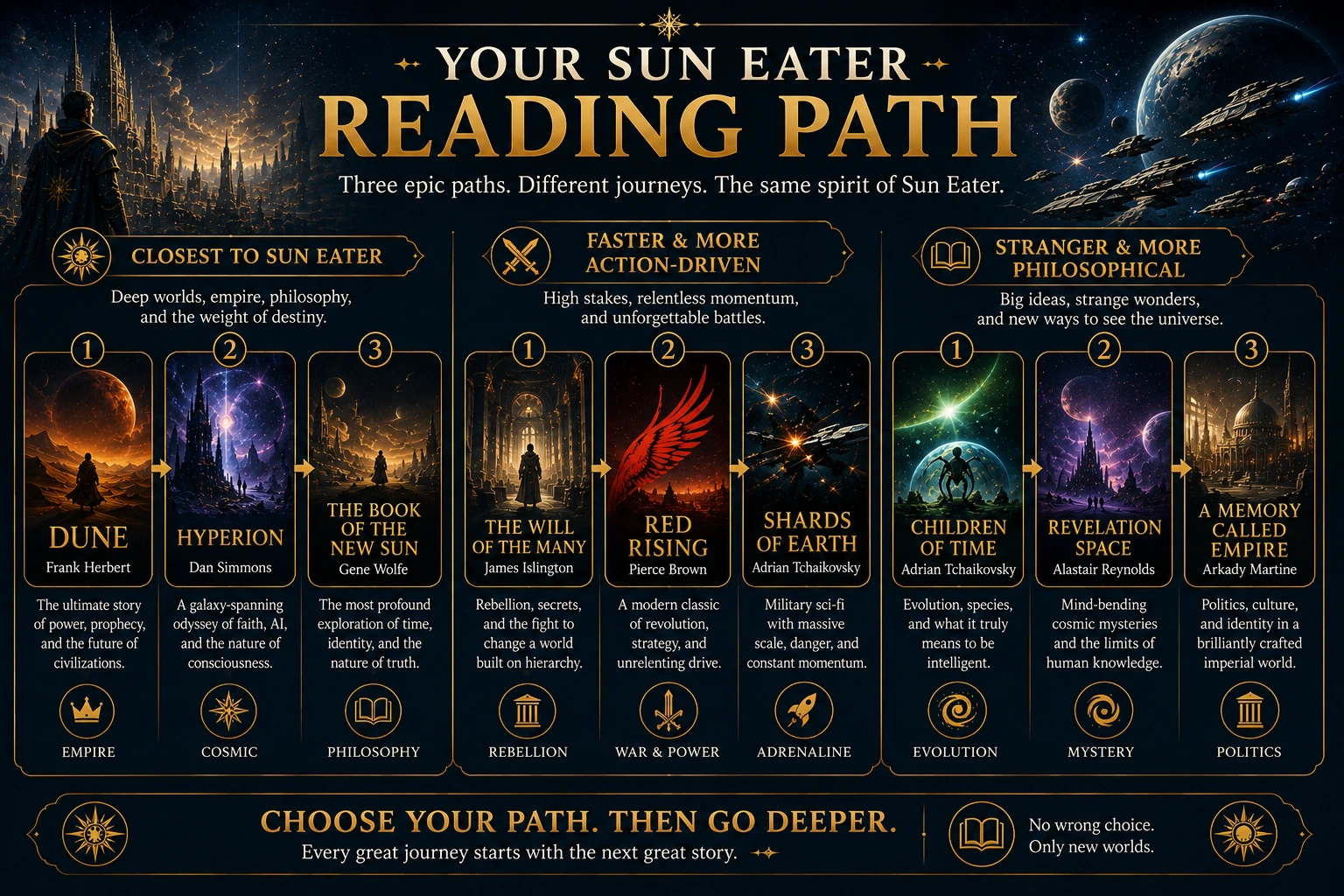
The phrase “books like Sun Eater” hides several different searches. A reader who loved Hadrian’s voice is not necessarily looking for the same book as a reader who loved imperial warfare. Use the paths below to match your next series to the part you actually want more of.
If you loved Hadrian’s philosophical voice
The Book of the New Sun → Hyperion → The Name of the Wind
If you loved the Sollan Empire
Dune → A Memory Called Empire → The Will of the Many
If you loved the wars
Red Rising → The Expanse → Shards of Earth
If you loved alien civilizations
Children of Time → The Mercy of Gods → The Three-Body Problem
If you loved the sheer scale
Hyperion → Revelation Space → Pandora’s Star
If you wanted Sun Eater to move faster
Red Rising → Shards of Earth → The Will of the Many
Sun Eater Read-Alikes Compared
The fastest way to avoid a disappointing recommendation is to separate similarity from quality. A brilliant space opera can still be a poor Sun Eater substitute if it lacks the quality you care about most.
| Book / series | Best match | Pace | Philosophy | Politics / empire | Cosmic scale |
|---|---|---|---|---|---|
| Dune | Empire + destiny | Moderate | Very high | Very high | High |
| Hyperion | Literary cosmic mystery | Slow–moderate | Very high | Moderate | Very high |
| The Book of the New Sun | Mythic far future | Slow | Very high | Moderate | High |
| Red Rising | War + rebellion | Fast | Moderate | High | High |
| The Will of the Many | Hierarchy + intrigue | Fast | Moderate | High | Moderate |
| The Expanse | Political realism | Moderate–fast | Moderate | High | High |
| Children of Time | Alien civilization | Moderate | High | Low–moderate | Very high |
| A Memory Called Empire | Culture + identity | Moderate | High | Very high | Moderate |
| Revelation Space | Deep time + danger | Slow–moderate | Moderate | Moderate | Very high |
| Shards of Earth | Alien threat + action | Fast | Low–moderate | Moderate | Very high |
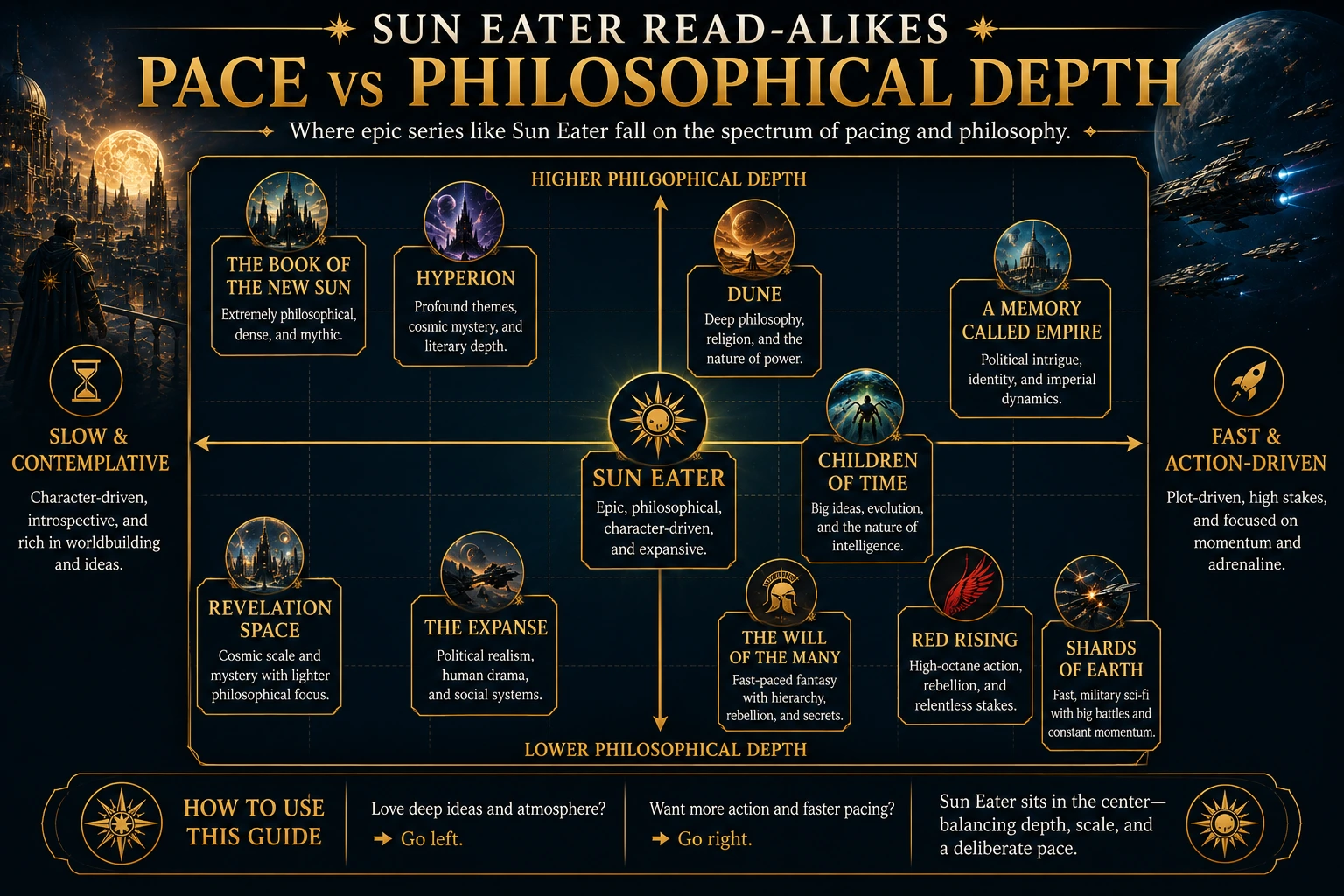
If you want deeper, slower reading, move toward The Book of the New Sun and Hyperion. If you want momentum, move toward Red Rising and Shards of Earth. Dune remains unusually strong because it combines philosophy, politics, religion, and epic scope without being as opaque as Wolfe.
What to Read After Sun Eater
If you want the closest overall experience: read Dune.
If you want the closest literary and cosmic experience: read Hyperion or The Book of the New Sun.
If you want more action and warfare: read Red Rising.
If you want alien civilizations and big ideas: read Children of Time.
If you want court politics and identity: read A Memory Called Empire.
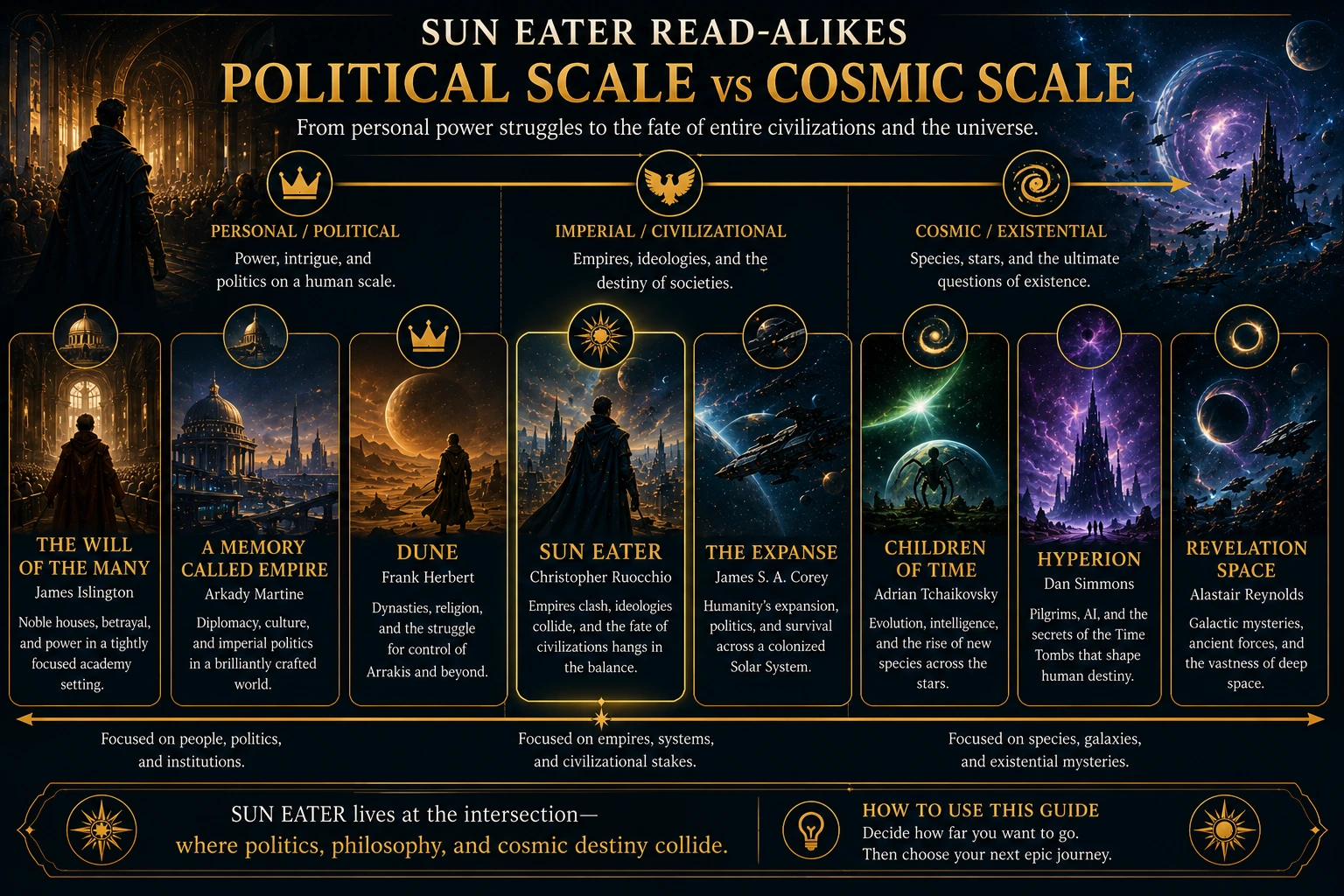
That is also why a single “most similar” answer can be misleading. Sun Eater occupies an unusual middle ground. It can feel intimate and historical, philosophical and violent, technologically futuristic and culturally ancient. The right next series depends on which of those tensions you want to preserve.
More Epic and Philosophical Science Fiction
If this list sends you deeper into civilization-scale speculative fiction, continue with books about the future of humanity for stories centered on what our species may become, or explore philosophical fantasy books for speculative fiction that puts meaning, power, identity, and moral choice at the center.
The individual recommendations above already connect contextually to the most relevant Dune, Hyperion, Red Rising, The Expanse, Children of Time, and Three-Body Problem reading clusters, so this section intentionally points to broader topic hubs rather than repeating the same links.
If Sun Eater Made You Think About Who Should Shape Humanity’s Future
The deepest overlap between epic speculative fiction and philosophy appears when power becomes responsibility: when individuals or institutions gain the ability to influence not merely a battle, but the future of entire societies.
If that is the part of Sun Eater you keep thinking about, Those Who Guard Eternity explores time, reality, consciousness, truth, human choice, and the burden carried by those who believe the future can—and perhaps must—be guarded. The full novel can be read online free.
Frequently Asked Questions About Books Like Sun Eater
What should I read if I liked Sun Eater?
Start with Dune if you loved empire, philosophy, religion, and destiny; Hyperion if you want literary cosmic mystery; The Book of the New Sun if you want a dense mythic far future; or Red Rising if you want similar scale with much faster action.
What book series is most similar to Sun Eater?
No series is identical, but Dune is the strongest overall thematic match. Hyperion is closer in literary and cosmic ambition, while The Book of the New Sun is closer in mythic atmosphere and reflective narration. The best answer depends on which aspect of Sun Eater you value most.
Is Red Rising similar to Sun Eater?
Yes, especially in its imperial scale, warfare, hierarchy, loyalty, political transformation, and civilization-changing protagonist. The major difference is pace: Red Rising is substantially faster and more action-driven, while Sun Eater devotes more space to introspection, philosophy, and slow historical development.
Is Dune similar to Sun Eater?
Very much so in themes rather than plot. Both combine aristocratic power, empire, religion, political legitimacy, destiny, war, and individuals whose choices affect civilizations. Sun Eater is more autobiographical and character-immersive, while Dune is more compressed and systems-focused.
What should I read after Empire of Silence?
If you want to continue Hadrian Marlowe’s story, the direct next novel is Howling Dark. If you mean a different series with a similar feel, choose Dune, Hyperion, The Book of the New Sun, or Red Rising depending on whether you want politics, cosmic mystery, philosophical depth, or action.
Are there fantasy books similar to Sun Eater?
Yes. The Will of the Many is a strong choice for hierarchy, hidden identity, institutions, and political intrigue. The Name of the Wind is much less similar in setting, but its retrospective legendary narrator can appeal to readers who particularly enjoy Hadrian’s voice and the gap between a person and the myth history creates.