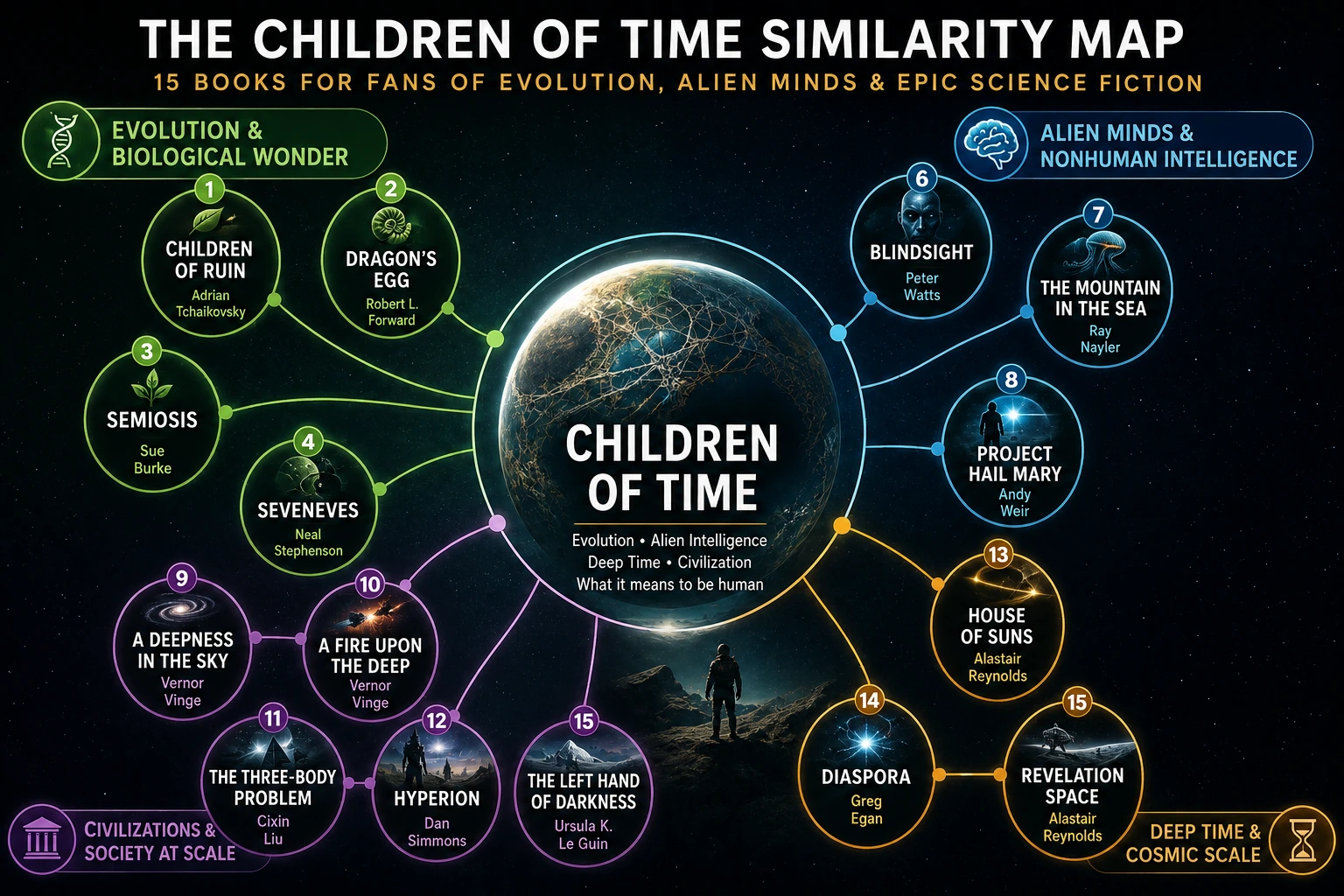
If you’re looking for books like Children of Time by Adrian Tchaikovsky, these 15 science-fiction novels are the strongest next reads for alien intelligence, evolutionary change, deep time, first contact, and civilizations that grow in unexpected directions.
By Eternity Management · Editorial reading guide · Updated August 8, 2026
Best Books Like Children of Time at a Glance
This list prioritizes thematic and structural similarity, not just “big space opera.” Some books are here because they imagine minds unlike ours. Others explore evolution across generations, first contact, the rise and fall of societies, or futures measured on civilizational rather than individual scales.
| # | Book | Best for | Closest shared element | Similarity |
|---|---|---|---|---|
| 1 | Children of Ruin | Closest overall match | Evolution + alien intelligence | 10/10 |
| 2 | A Deepness in the Sky | Alien civilization | Society + nonhuman minds | 9.5/10 |
| 3 | Dragon’s Egg | Evolution at radical scale | Biology + accelerated civilization | 9.5/10 |
| 4 | Semiosis | Nonhuman intelligence | Ecology + communication | 9/10 |
| 5 | A Fire Upon the Deep | Epic alien societies | Civilizational scale | 9/10 |
| 6 | Blindsight | Alien consciousness | Intelligence vs consciousness | 8.5/10 |
| 7 | Project Hail Mary | Cross-species communication | First contact + cooperation | 8.5/10 |
| 8 | Seveneves | Humanity after catastrophe | Survival + long-term adaptation | 8.5/10 |
| 9 | The Three-Body Problem | Civilization-scale first contact | Cosmic risk + civilizations | 8/10 |
| 10 | House of Suns | Immense timescales | Deep time + far-future humanity | 8/10 |
| 11 | Diaspora | Posthuman evolution | Identity + intelligence | 8/10 |
| 12 | Hyperion | Epic future civilization | Humanity + cosmic mystery | 7.5/10 |
| 13 | Revelation Space | Ancient civilizations | Deep history + cosmic danger | 7.5/10 |
| 14 | The Mountain in the Sea | Nonhuman consciousness | Language + alien cognition | 7.5/10 |
| 15 | The Left Hand of Darkness | Biology shaping society | Difference + civilization | 7/10 |
How These Recommendations Were Chosen
This guide ranks books by similarity to the reading experience of Children of Time, not by literary quality or popularity. The editorial criteria are: evolutionary or biological speculation, genuinely nonhuman intelligence, first-contact difficulty, civilization-scale storytelling, deep-time perspective, and the extent to which a book challenges human assumptions about intelligence or survival.
Similarity scores are qualitative editorial judgments. A 9/10 means a book overlaps strongly with several of those dimensions; it does not mean the book is objectively “better” than a 7/10 recommendation. Plot descriptions are intentionally spoiler-light.
Core bibliographic and series details were cross-checked against authoritative publisher/catalog pages where available, including Pan Macmillan’s Children of Time page, Pan Macmillan’s series listing, Penguin Random House’s Project Hail Mary listing, and Penguin Random House’s The Left Hand of Darkness listing.
Why Readers Love Children of Time
Children of Time is difficult to match because its appeal does not come from one genre element. It combines evolutionary speculation, planetary-scale history, first contact, social development and a persistent question about what intelligence actually is.
Evolution becomes part of the story
Many science-fiction novels begin after a society already exists. Children of Time makes development itself part of the drama. Biology, environment, culture and technology influence one another across generations. That is why the strongest recommendations are books in which change is not background information but a central narrative force.
Intelligence does not have to look human
One of the novel’s most memorable achievements is making the reader take seriously a form of intelligence that did not emerge from the human evolutionary path. The best books in this list resist the easy assumption that an alien mind would simply be a human personality in a different body.
Civilizations become characters
The scale is larger than the fate of a single protagonist. Cultures accumulate knowledge, misunderstand one another, form institutions, preserve memory and sometimes carry old mistakes forward. If that was what fascinated you, you may also enjoy Eternity Management’s broader reading on what makes a civilization worth saving and how civilizations survive collapse.
Deep time changes the meaning of survival
When a story stretches beyond one lifetime, “survival” stops meaning only keeping individuals alive. It becomes a question of whether knowledge, values, institutions, adaptability and identity can persist through transformation. That same lens runs through Eternity Management’s work on books about the future of humanity.
15 Best Books Like Children of Time
1. Children of Ruin — Adrian Tchaikovsky
Similarity: 10/10 · Best for: the closest overall experience
The most obvious next step is also the most defensible. Children of Ruin returns to the same broad intellectual territory while refusing to simply repeat the first novel. It expands the evolutionary and first-contact questions into new forms of life, new misunderstandings and new ways of asking how separate intelligences can recognize one another.
Read it if what you loved most was the feeling that biology itself could generate an unfamiliar civilization. The series’ strength is not just its scale, but its willingness to build cognition from different starting conditions. That makes this the safest recommendation for anyone who finishes Children of Time and immediately wants “more of that,” without settling for a weaker imitation.
2. A Deepness in the Sky — Vernor Vinge
Similarity: 9.5/10 · Best for: another alien civilization treated seriously
Vernor Vinge’s A Deepness in the Sky is one of the best choices for readers who loved watching an unfamiliar society develop under unusual conditions. Its power comes from the collision between different civilizations, different technological assumptions and different ideas about control.
Like Children of Time, it rewards readers who enjoy thinking at the level of species, societies and historical trajectories rather than only individual adventure. It is particularly strong if your favorite parts of Tchaikovsky’s novel involved the gradual emergence of social complexity and the dangers created when one civilization interprets another through its own assumptions.
3. Dragon’s Egg — Robert L. Forward
Similarity: 9.5/10 · Best for: radically different biology and accelerated civilization
Dragon’s Egg begins from a striking speculative premise: what might life look like under physical conditions profoundly unlike those on Earth? The novel follows the consequences seriously, imagining intelligence and social development on a scale that challenges ordinary human intuitions about time.
This is an excellent match for readers fascinated by the evolutionary side of Children of Time. The overlap is not that the books tell the same story; it is that both derive civilization from biology and environment rather than treating “alien society” as a decorative reskin of human culture.
4. Semiosis — Sue Burke
Similarity: 9/10 · Best for: ecosystems and intelligence outside the human template
Semiosis is ideal if the most exciting question in Children of Time was not “Can humans survive?” but “What else might intelligence be?” Sue Burke explores a world where human settlers cannot treat the environment as passive scenery. Survival depends on learning how to recognize agency and negotiate with forms of life that do not share human priorities.
The result is science fiction driven by ecology, communication and adaptation. It offers the same pleasure of watching assumptions break down as characters discover that intelligence can be distributed through systems we are not prepared to interpret correctly.
5. A Fire Upon the Deep — Vernor Vinge
Similarity: 9/10 · Best for: alien societies at enormous scale
If Children of Time made you want stranger minds and a larger canvas, A Fire Upon the Deep delivers both. Vinge imagines a universe populated by radically different forms of intelligence and societies shaped by conditions that make familiar human assumptions unreliable.
It is more sprawling and space-operatic than Tchaikovsky’s novel, but the intellectual connection is strong: cognition, communication and civilization are treated as variables rather than constants. This is the book to choose if you want to move from one extraordinary evolutionary experiment to a much broader ecosystem of minds.
6. Blindsight — Peter Watts
Similarity: 8.5/10 · Best for: the hardest question about alien intelligence
Blindsight is darker, colder and more philosophically aggressive than Children of Time. Its central fascination is the relationship between intelligence and consciousness: must an entity possess anything like human subjective awareness in order to be highly capable?
That makes it a powerful recommendation for readers who were most interested in the limits of anthropomorphism. Where Tchaikovsky asks us to empathize with a genuinely different evolutionary path, Watts pushes further toward the possibility that “intelligence” itself may not imply the qualities humans instinctively attach to it.
7. Project Hail Mary — Andy Weir
Similarity: 8.5/10 · Best for: communication across species
Project Hail Mary is more immediate, humorous and problem-solving driven, but it shares one of Children of Time’s most satisfying experiences: the gradual construction of understanding between minds that do not begin with a shared language or body plan.
Choose it if you want first contact to feel like a process rather than a revelation. The pleasure comes from observation, inference, cooperation and the slow realization that radically different beings can still discover common ground. For many readers, it is the most accessible bridge from evolutionary science fiction into contact-centered science fiction.
8. Seveneves — Neal Stephenson
Similarity: 8.5/10 · Best for: survival turning into long-term human transformation
Seveneves begins with catastrophe, but its deeper interest is what happens when survival becomes a multi-generational design problem. Institutions, engineering, genetics, identity and cultural memory all become part of the question of what humanity might be after the crisis has passed.
It is a strong recommendation if you loved Children of Time for the way individual events become seeds of very long historical consequences. The book asks not merely whether humans can continue, but what continuity means when the descendants who inherit the future are no longer quite the society that began the journey.
9. The Three-Body Problem — Cixin Liu
Similarity: 8/10 · Best for: first contact as a civilizational problem
Cixin Liu’s The Three-Body Problem is less focused on evolutionary biology and more focused on what contact means when entire civilizations become strategic actors. It is a natural next read for people who like science fiction where the scale of the problem expands far beyond the individual characters.
The overlap with Children of Time lies in its willingness to ask how civilizations interpret danger, knowledge and survival over long horizons. If that is your preferred direction, see our dedicated guide to books like The Three-Body Problem.
10. House of Suns — Alastair Reynolds
Similarity: 8/10 · Best for: deep time and far-future humanity
House of Suns is one of the strongest choices for readers who want the sense of temporal vastness that makes civilizations feel temporary and history feel almost geological. Alastair Reynolds uses an immense far-future setting to explore identity, memory, distance and what remains meaningful when lives and societies operate on extraordinary scales.
It does not mimic the evolutionary structure of Children of Time, but it creates a similar change in perspective: the future becomes so large that ordinary human timescales are no longer sufficient for understanding what is happening.
11. Diaspora — Greg Egan
Similarity: 8/10 · Best for: posthuman intelligence and radical futures
If what fascinated you was the possibility that intelligence could leave familiar human form behind, Diaspora is one of the most intellectually ambitious books on this list. Greg Egan explores identity, embodiment and existence in a future where “human” is no longer a single biological category.
It is denser than Children of Time and less interested in conventional emotional pacing, but it pushes the same foundational question in a different direction: if minds can change their substrate, structure and environment, which parts of humanity remain essential—and which were merely contingent features of our origin?
12. Hyperion — Dan Simmons
Similarity: 7.5/10 · Best for: epic future civilization and existential mystery
Hyperion approaches the future through a very different narrative structure, yet it belongs here because its real subject is larger than any one character. Religion, artificial intelligence, empire, human transformation and the pressures of history all converge within a civilization facing forces it does not fully understand.
Choose it if you want the grandeur of Children of Time more than its evolutionary mechanics. We also have a dedicated list of books like Hyperion for readers who want to continue further into philosophical space opera and civilization-scale science fiction.
13. Revelation Space — Alastair Reynolds
Similarity: 7.5/10 · Best for: ancient civilizations and cosmic-scale danger
Revelation Space is a strong fit for readers drawn to the archaeological feeling of deep history: the sense that civilizations can rise, disappear and leave traces that become warnings to whoever comes next. Its universe makes survival a problem with a past as well as a future.
The connection to Children of Time is less about shared plot mechanics than shared perspective. Both make the reader think beyond a single generation and ask what happens when intelligence enters a universe already shaped by long chains of cause and consequence.
14. The Mountain in the Sea — Ray Nayler
Similarity: 7.5/10 · Best for: nonhuman consciousness close to home
The Mountain in the Sea is a particularly good recommendation if you were captivated by the attempt to understand a mind produced by a different evolutionary lineage. Rather than placing that question on a distant planet, Ray Nayler brings it into an ecological and technological context that feels much closer to our own world.
The novel’s appeal lies in the difficulty of interpretation. What would count as language? What counts as culture? How quickly do humans project themselves onto another intelligence? Those are exactly the kinds of questions that make Children of Time more than a conventional adventure.
15. The Left Hand of Darkness — Ursula K. Le Guin
Similarity: 7/10 · Best for: biology, culture and the assumptions we carry into other societies
Ursula K. Le Guin’s The Left Hand of Darkness is the least mechanically similar book on this list, but one of the most valuable conceptual companions. Its strength is showing how deeply biology, culture and social expectations shape what people consider “normal.”
It belongs here for readers who loved the perspective-shifting effect of Children of Time. Both novels force the reader to confront the limits of human categories. The lesson is not that another society is simply strange; it is that our own assumptions become visible only when we encounter a world built from different premises.
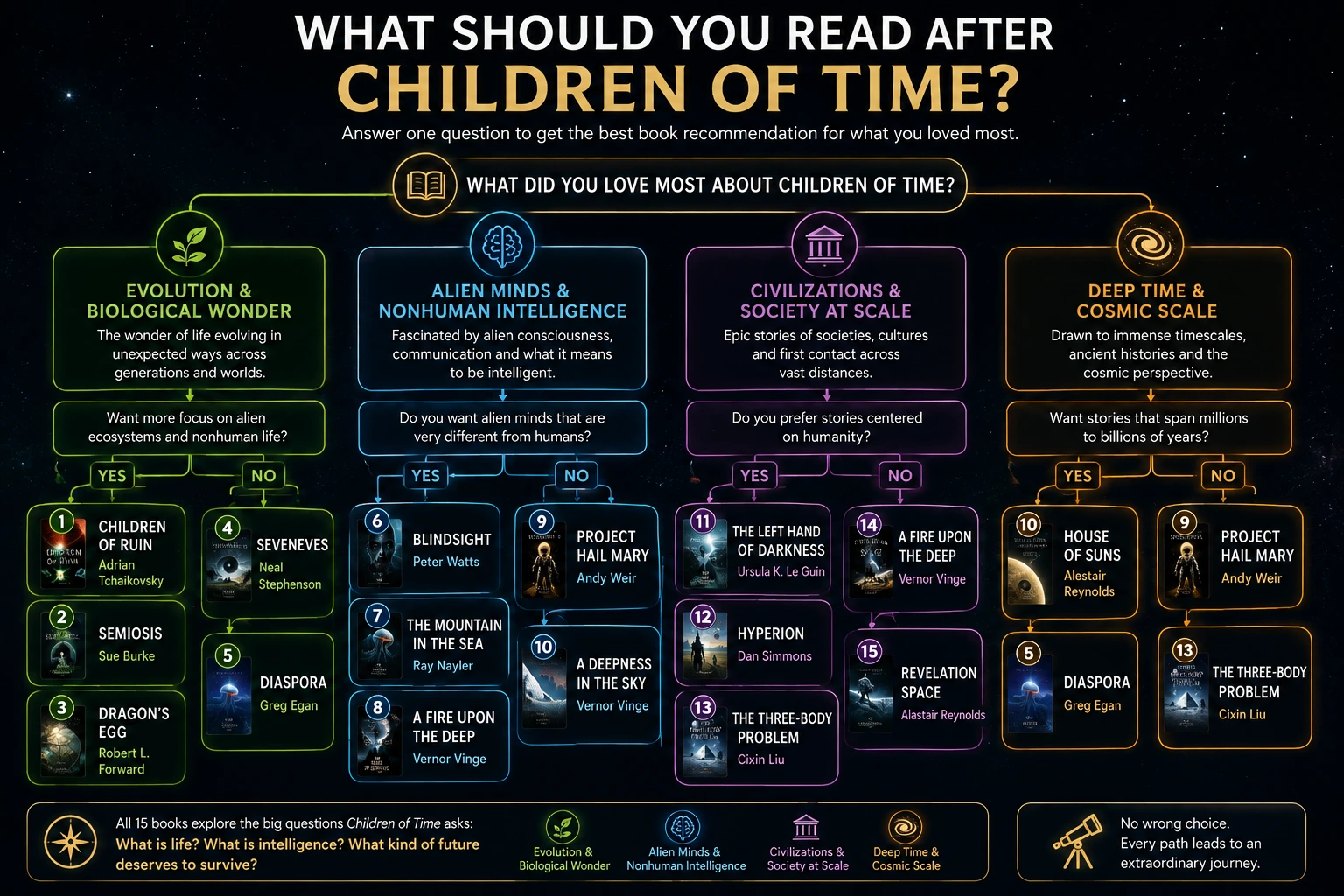
What Should You Read After Children of Time?
The easiest way to choose is to identify the element you most want to experience again.
If you loved the evolutionary worldbuilding
Start with Children of Ruin, Dragon’s Egg or Semiosis. These books make biology, environment and adaptation part of the engine of the story rather than background decoration.
If you loved the alien intelligence
Choose Blindsight, The Mountain in the Sea or Project Hail Mary. They approach the problem from very different tones, but all take communication across cognitive difference seriously.
If you loved civilizations unfolding at scale
Read A Deepness in the Sky, A Fire Upon the Deep, The Three-Body Problem or Hyperion. These are the choices for readers who want societies, institutions and historical trajectories to matter as much as individual protagonists.
If you loved deep time and the cosmic perspective
Try House of Suns, Diaspora or Revelation Space. They widen the horizon until ordinary human timescales become only one layer of the story.
From Human Scale to Cosmic Time
One reason these books feel related is that they repeatedly shift the unit of attention. Some begin with a person trying to understand something new. Others follow generations, entire societies or histories so large that individual lifetimes become brief events inside a much longer process.
That change of scale matters. At the human level, science fiction asks how someone survives or understands the unknown. At the generational level, it asks what a society inherits. At the civilizational level, it asks how cultures adapt, fracture or endure. At the deepest scale, it asks whether intelligence itself has a durable place in the universe.
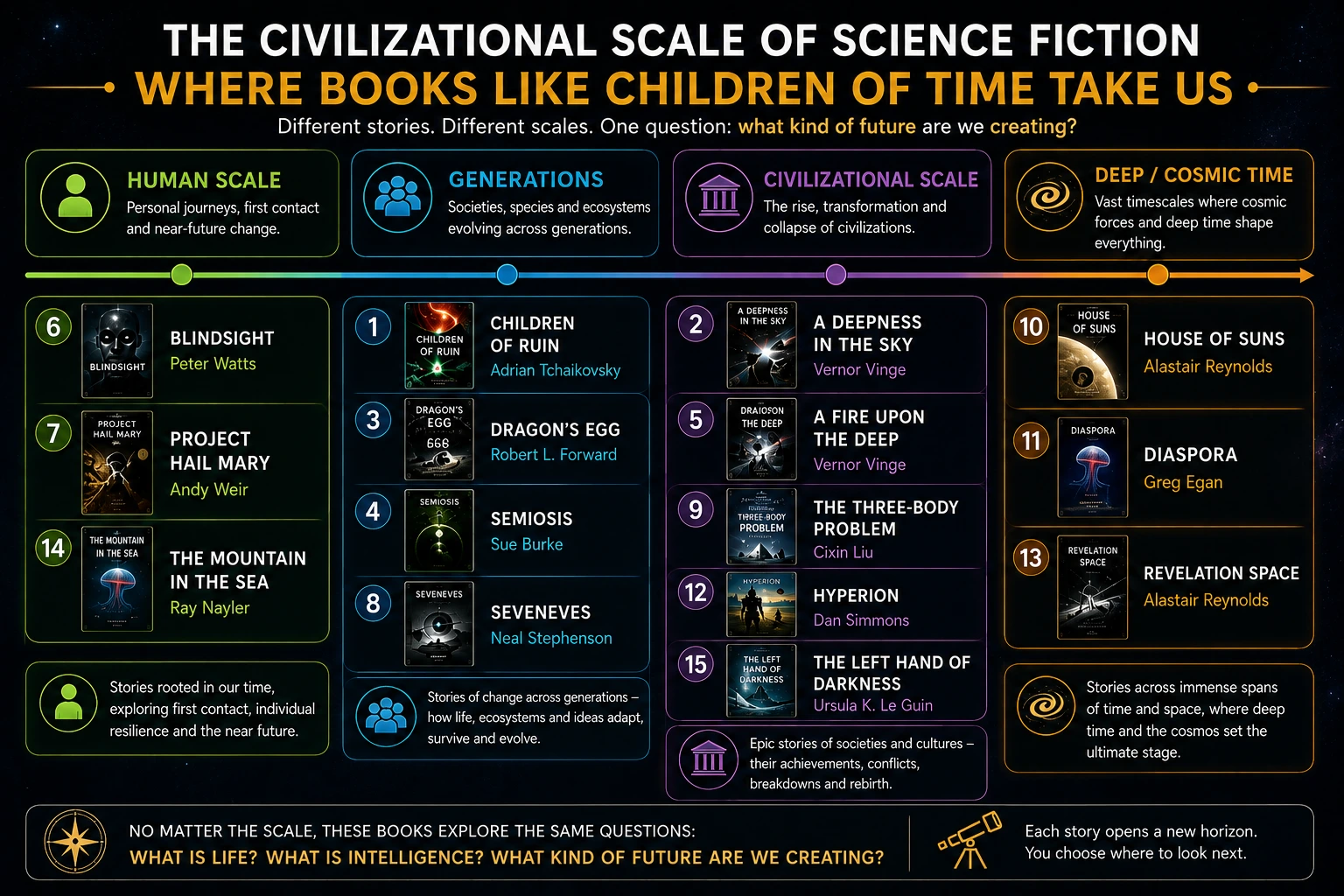
If this is the part of Children of Time that stayed with you, you may also enjoy books like Foundation, books like Dune and books like The Expanse. Each explores, in a different way, what happens when individual choices become embedded in systems larger than the people who made them.
If What You Loved Most Was the Future of Civilization
Children of Time ultimately raises a question larger than whether humanity survives: what deserves to inherit the future? Survival without learning may only reproduce old mistakes. Intelligence without understanding may create new forms of conflict. Civilization without adaptability may preserve itself only long enough to become brittle.
That is why the novel fits naturally beside questions such as who should guard the future of humanity, whether a civilization can remain worthy of continuation, and how societies carry knowledge across periods of disruption.
If you read science fiction for the questions beneath the plot—time, responsibility, civilization, memory and the future—continue with Eternity Is Shaped.
Frequently Asked Questions About Books Like Children of Time
What should I read after Children of Time?
Start with Children of Ruin if you want the closest continuation. For another alien civilization, choose A Deepness in the Sky. For radical evolution, try Dragon’s Egg or Semiosis. For difficult questions about alien consciousness, read Blindsight. For first-contact communication, Project Hail Mary is the most accessible option.
What books have alien intelligence like Children of Time?
Semiosis, Blindsight, The Mountain in the Sea, A Deepness in the Sky and Project Hail Mary are all strong choices. They differ in tone, but each treats nonhuman intelligence as a genuine problem of cognition and communication rather than simply giving an alien body a familiar human psychology.
Are there other science-fiction books about evolution like Children of Time?
Yes. Dragon’s Egg, Semiosis, Seveneves and Children of Ruin all make biological or long-term adaptive change central to the story. They are particularly good choices if you enjoyed seeing environment, biology and social development interact across generations.
Is Children of Ruin worth reading after Children of Time?
Yes—especially if you want the closest thematic continuation. Children of Ruin expands the series’ interest in evolution, communication and unfamiliar intelligence rather than simply repeating the structure of the first book.
What books are similar to Children of Time but darker?
Blindsight is the strongest choice if you want a darker and more philosophically unsettling treatment of intelligence and consciousness. Revelation Space also offers a colder cosmic atmosphere, while The Three-Body Problem frames first contact through civilizational risk and strategic uncertainty.
What books like Children of Time focus most on civilizations?
Choose A Deepness in the Sky, A Fire Upon the Deep, The Three-Body Problem, Hyperion or House of Suns. These books shift attention from individual survival toward cultures, institutions, historical change and the long-term consequences of contact or technological development.
What should I read if I liked the spiders in Children of Time?
If what you loved was watching a nonhuman species develop intelligence and society, start with Children of Ruin, Dragon’s Egg, Semiosis and A Deepness in the Sky. They offer the closest combination of unfamiliar biology, emergent culture and perspective-shifting worldbuilding.
Final Verdict: The Best Next Book After Children of Time
If you want one answer, read Children of Ruin. If you want a new universe with a similarly serious treatment of alien civilization, choose A Deepness in the Sky. If evolutionary speculation was the main attraction, choose Dragon’s Egg. And if the question of what intelligence really means was the part you cannot stop thinking about, choose Blindsight.
The deeper connection among all 15 books is not simply that they are “epic science fiction.” They make the future feel structurally different from the present. They ask what happens when life adapts, minds diverge, societies transform and history becomes larger than any single human lifetime.
That is the real reason readers go looking for books like Children of Time: not to find the same story again, but to experience the same expansion of possibility.
Editorial note: similarity scores are a qualitative reading guide based on shared themes, narrative scale and conceptual overlap; they are not objective ratings of literary quality.