Spoiler-light reading guide · Hard science fiction · Political space opera · Civilizational survival
The best books like The Expanse do not merely put crews in spaceships. They make survival depend on physics, resources, institutions, trust, and choices whose consequences can expand from one damaged vessel to the future of civilization.
Estimated reading time: 31–35 minutes · Editorial review completed: August 6, 2026
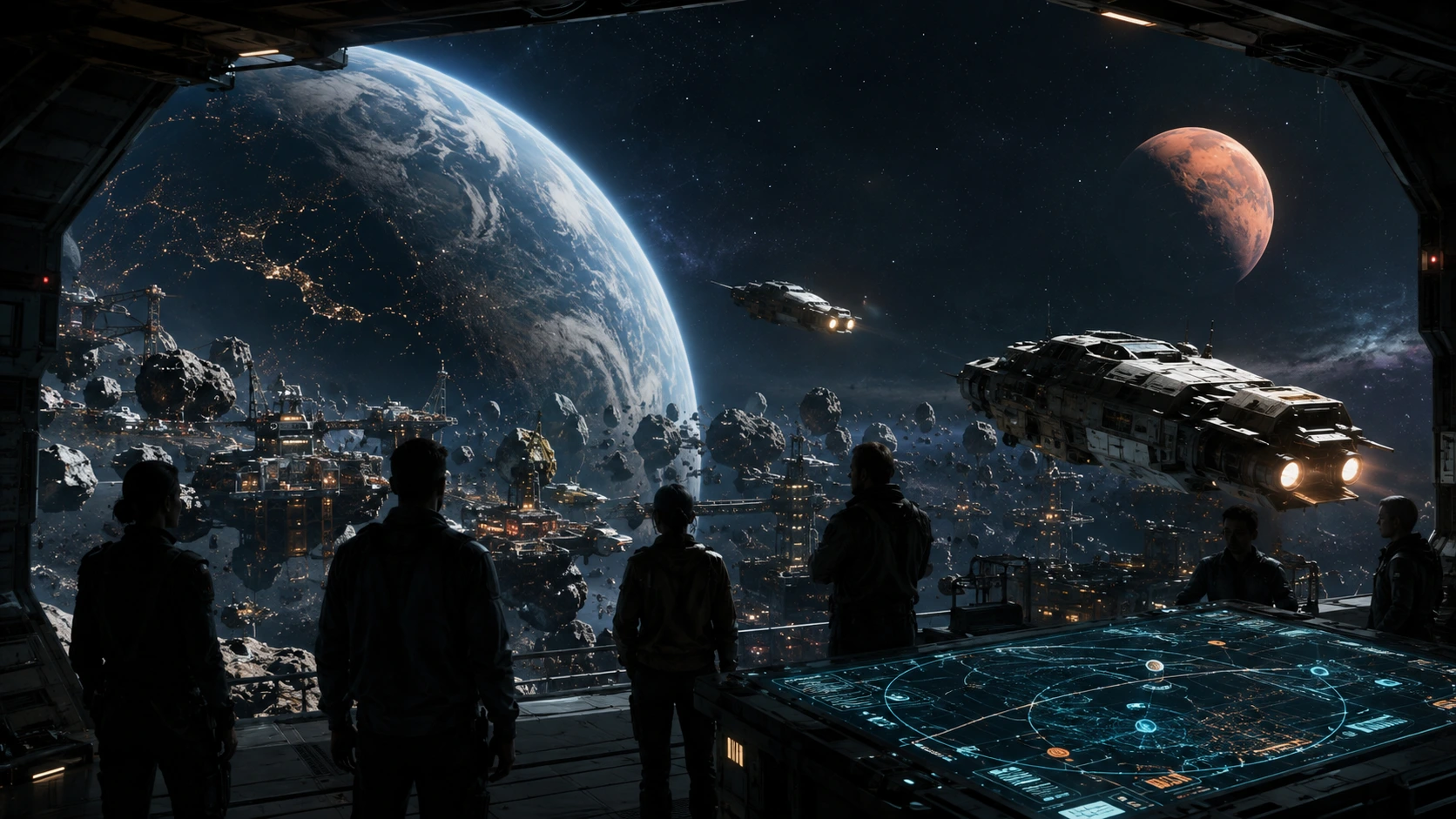
Quick answer: What should you read after The Expanse?
The closest match depends on what you want to experience again. Choose Red Mars for realistic colonization and political conflict, Delta-v for near-future asteroid industry, A Memory Called Empire for diplomacy and imperial power, Revelation Space for hard science fiction and ancient alien mystery, or Shards of Earth for a close-knit crew facing an existential threat.
If you watched the television adaptation but have not read the novels, begin with Leviathan Wakes. If you finished the nine main novels, continue with Memory’s Legion, the collected shorter fiction set in the same universe.
What should you read after The Expanse?
The most useful answer begins with where you are in the story. Someone who has watched the television adaptation needs a different recommendation from someone who has completed all nine novels. A third reader may be ready to leave James S. A. Corey’s universe entirely but still want the same mixture of hard constraints, political systems, lived-in ships, and unsettling discovery.
If you watched the television series
Start with Leviathan Wakes. The official publisher recommends reading the full series from the beginning. That route preserves the novels’ characterization, political development, and long-form setup instead of treating the books as a transcript of the adaptation.
If you want to continue immediately after the show
The publisher identifies Persepolis Rising, the seventh novel, as the point that follows the televised ending. This is a practical shortcut, but starting with book one remains the stronger choice for readers who want the complete literary arc.
If you finished the nine main novels
Read Memory’s Legion. It collects the shorter fiction from the Expanse universe, including stories that illuminate characters, institutions, and consequences that the main novels cannot always pause to explore.
If you want a new universe
Begin with Red Mars, Delta-v, A Memory Called Empire, Revelation Space, or Shards of Earth, depending on whether you want realism, economics, politics, cosmic mystery, or crew-centered adventure.
Official reading-order reference: Orbit’s guide to reading after the television adaptation. Collection reference: Memory’s Legion.
Why is The Expanse so difficult to replace?
Many science-fiction novels can reproduce one recognizable feature of The Expanse. A technically rigorous novel can make acceleration, distance, radiation, maintenance, and fuel matter. A political space opera can build rival governments, corporate interests, military factions, and competing visions of order. A crew-centered adventure can create loyalty, friction, humor, and found family. A first-contact story can introduce an intelligence that overturns human assumptions. The challenge is finding a book that makes these elements interact rather than merely coexist.
The series feels unusually convincing because power is never separate from infrastructure. Earth, Mars, and the Belt are not only cultural identities; they are positions inside material systems. Gravity changes bodies. Air and water can become political leverage. Shipping routes shape economic possibility. A damaged component can matter as much as a speech. The world feels large because its conflicts emerge from connected layers: bodies, ships, settlements, corporations, governments, technologies, and species-level risk.
It also refuses the comforting idea that expansion automatically creates freedom. New worlds create opportunity, but they also create new dependencies. Colonies need life support, knowledge, maintenance, transport, legitimacy, and people capable of coordinating under pressure. The unknown does not arrive in an empty political space; every discovery is interpreted by institutions already competing for advantage.
Finally, the series keeps civilization-scale stakes human. The reader experiences enormous changes through people who must repair equipment, negotiate trust, absorb grief, question authority, and decide whom to protect. The result is neither pure hard science fiction nor pure political allegory. It is a story about how systems become personal—and how personal choices can reshape systems.
The Expanse Similarity Framework
To compare books without pretending that similarity is objective, this guide uses six dimensions. The weights show editorial emphasis, not precise measurement. A novel may be an exceptional recommendation because it matches one beloved quality strongly, even if it differs in setting, pace, or tone.
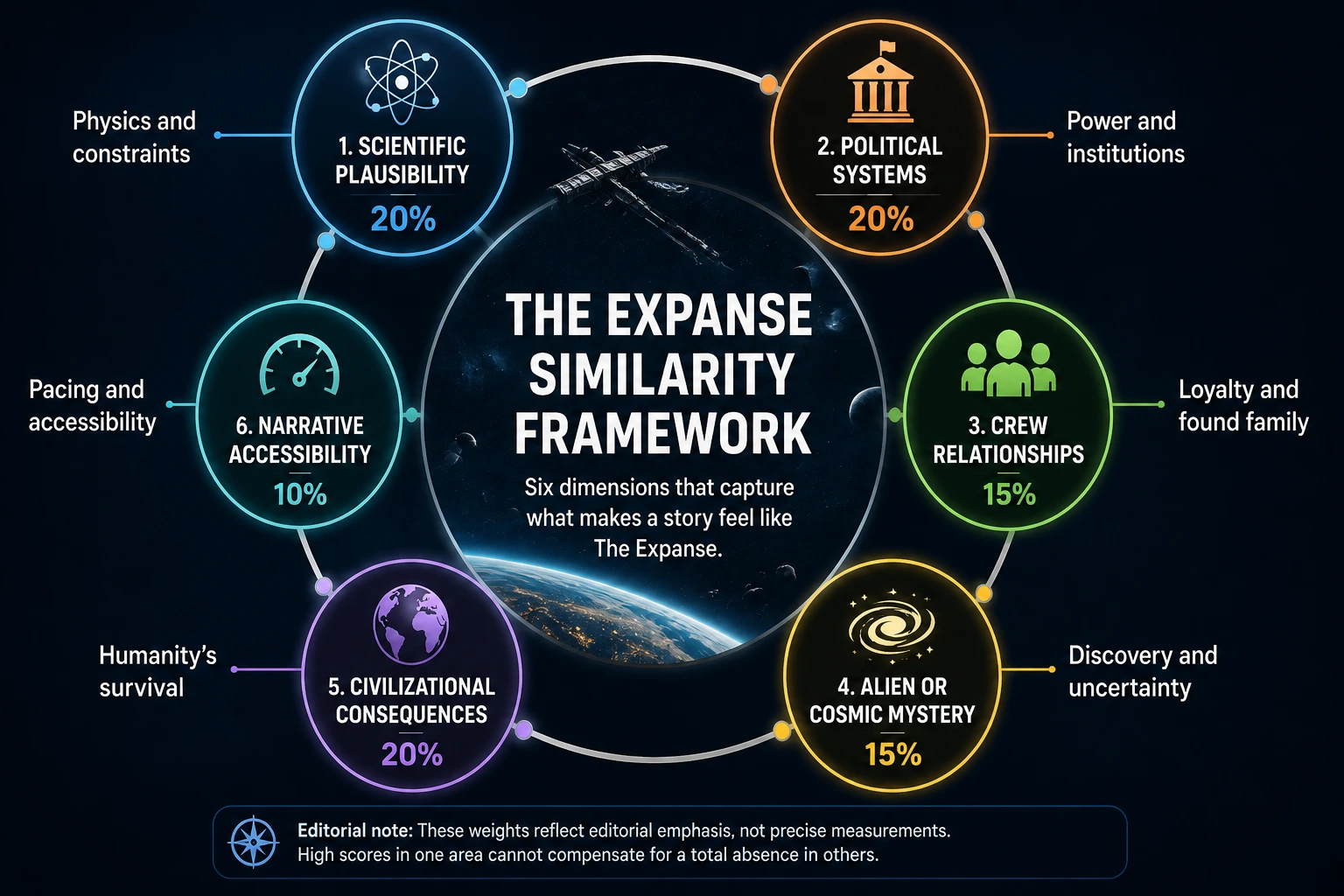
How to interpret the scores: A five means an exceptional thematic match within that dimension, not proof of superior literary quality. A two does not mean a weak novel; it means that the book emphasizes something else. The overall tier reflects the pattern across dimensions rather than a simple arithmetic average.
Books like The Expanse compared
The visual matrix presents the first eight recommendations in a mobile-oriented format. The complete HTML table below includes all fifteen titles and remains accessible to search engines, screen readers, and readers who want the underlying editorial judgments.
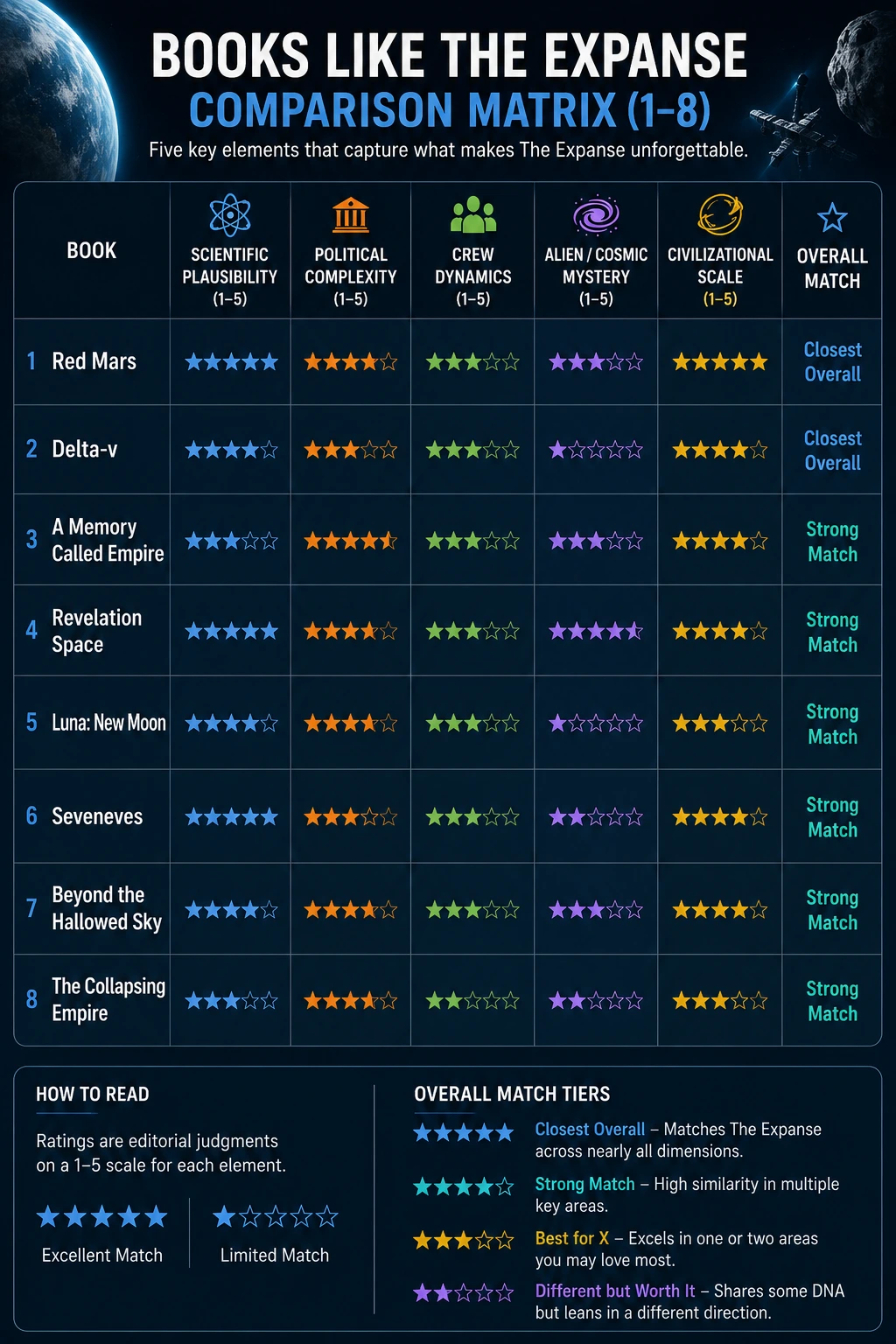
| Rank and book | Closest similarity | Science | Politics | Crew | Mystery | Scale | Overall |
|---|---|---|---|---|---|---|---|
| 1. Red Mars Kim Stanley Robinson | Realistic colonization and political conflict | 5/5 | 5/5 | 3/5 | 2/5 | 5/5 | Closest overall |
| 2. Delta-v Daniel Suarez | Asteroid industry and near-future realism | 4/5 | 3/5 | 3/5 | 1/5 | 4/5 | Closest overall |
| 3. A Memory Called Empire Arkady Martine | Diplomacy, empire, and institutional identity | 3/5 | 5/5 | 3/5 | 3/5 | 4/5 | Strong match |
| 4. Revelation Space Alastair Reynolds | Hard science and ancient cosmic mystery | 5/5 | 4/5 | 3/5 | 5/5 | 4/5 | Strong match |
| 5. Luna: New Moon Ian McDonald | Resource economics and lunar factionalism | 4/5 | 4/5 | 3/5 | 1/5 | 3/5 | Strong match |
| 6. Seveneves Neal Stephenson | Engineering realism and survival | 5/5 | 3/5 | 3/5 | 2/5 | 5/5 | Strong match |
| 7. Beyond the Hallowed Sky Ken MacLeod | International politics, hard science, and first contact | 4/5 | 4/5 | 3/5 | 3/5 | 4/5 | Strong match |
| 8. The Collapsing Empire John Scalzi | Interdependent civilization facing infrastructure failure | 3/5 | 4/5 | 3/5 | 2/5 | 4/5 | Strong match |
| 9. Shards of Earth Adrian Tchaikovsky | Found-family crew and existential alien threat | 3/5 | 4/5 | 5/5 | 4/5 | 5/5 | Strong match |
| 10. Ancillary Justice Ann Leckie | Empire, military power, AI, and identity | 3/5 | 4/5 | 3/5 | 3/5 | 4/5 | Strong match |
| 11. Children of Time Adrian Tchaikovsky | Evolution, survival, and nonhuman civilization | 4/5 | 3/5 | 2/5 | 4/5 | 5/5 | Strong thematic match |
| 12. The Long Way to a Small, Angry Planet Becky Chambers | Found family and everyday life aboard a working ship | 3/5 | 2/5 | 5/5 | 1/5 | 3/5 | Best for crew |
| 13. All Systems Red Martha Wells | Corporate control, survival, and character voice | 3/5 | 3/5 | 4/5 | 2/5 | 3/5 | Best for action |
| 14. Aurora Kim Stanley Robinson | Ecological limits and the difficulty of colonization | 5/5 | 3/5 | 3/5 | 2/5 | 4/5 | Best for realism |
| 15. The Praxis Walter Jon Williams | Space warfare, institutional order, and political transition | 3/5 | 4/5 | 3/5 | 2/5 | 4/5 | Best for politics |
The 15 best books like The Expanse
1Red Mars by Kim Stanley Robinson
Red Mars is the strongest overall recommendation for readers who believe the deepest appeal of The Expanse lies in the relationship between environment, infrastructure, ideology, and power. Mars is not a painted backdrop. Its conditions shape settlement design, labor, scientific choices, political movements, and disagreement over what humanity is entitled to change.
The resemblance is strongest in the refusal to separate technology from politics. Terraforming, habitation, transport, and resource control become arguments about ownership, identity, legitimacy, and the future. Different characters do not merely compete for office; they embody incompatible visions of development. That gives the conflict a systemic quality familiar to readers interested in Earth, Mars, and Belt tensions.
Major difference: the novel is more patient, panoramic, and idea-dense. Readers seeking the pace of a thriller or the intimacy of one central crew may find it slower. Its strength is accumulation: scientific detail, political transformation, and long-term consequence gradually become inseparable.
Spoiler-light verdict: Choose Red Mars when you want the politics of space settlement treated as seriously as the engineering.
Publisher reference: Red Mars at Penguin Random House.
2Delta-v by Daniel Suarez
Delta-v narrows the scale from interplanetary civilization to the frontier where such a civilization might begin: a risky commercial attempt to extract resources from an asteroid. The appeal for Expanse readers lies in the practical chain linking ambition to hardware, training, logistics, finance, human endurance, and the possibility that a small failure can become fatal.
The book understands that space industry would not emerge from technology alone. It would require investors, organizational secrecy, competing incentives, specialized teams, and people willing to accept risks that institutions may prefer to conceal. This makes it especially relevant to readers fascinated by the Belt as an economic system rather than only as an aesthetic.
Major difference: there is little alien mystery, and the political field is narrower. The story is near-future techno-thriller territory, driven more by a specific mission than by competing planetary civilizations.
Spoiler-light verdict: Read Delta-v when you want to imagine how the industrial foundations of a Belt-like economy might actually begin.
Publisher reference: Delta-v at Penguin Random House.
3A Memory Called Empire by Arkady Martine
This is the recommendation for readers who loved the political intelligence of The Expanse: negotiations in which every phrase carries institutional meaning, small powers living beside large ones, and individuals forced to represent communities whose survival may depend on decisions made far from home.
Ambassador Mahit Dzmare enters the center of an expanding empire during political instability and must operate inside a culture she understands deeply but cannot safely become part of. The novel’s strongest connection to The Expanse is not military spectacle. It is the tension between admiration and resistance, dependence and autonomy, personal identity and the role an institution requires someone to perform.
Major difference: the science is less mechanically foregrounded. Language, memory, diplomacy, bureaucracy, and cultural prestige matter more than thrust, fuel, or habitat engineering. The emotional center is also more solitary than crew-based.
Spoiler-light verdict: Choose this when Chrisjen Avasarala’s world of negotiation, leverage, and institutional survival was your favorite part of the series.
Publisher reference: A Memory Called Empire at Macmillan.
4Revelation Space by Alastair Reynolds
Revelation Space is one of the best choices for readers who want the alien mystery of The Expanse to become darker, older, and more central. Its universe feels immense because travel, communication, technology, and historical evidence impose constraints. Discovery emerges through incomplete records, competing motives, and the unsettling possibility that intelligence may leave dangerous traces.
The novel’s science-fiction imagination is expansive without making space frictionless. That creates a familiar tension: humanity has achieved remarkable capability, yet remains vulnerable to distance, error, ambition, and forces it has not fully understood. The cosmic mystery does not erase politics or character conflict; it intensifies them by making knowledge itself strategically dangerous.
Major difference: the tone is colder and more gothic, the structure denser, and the emotional warmth of the Rocinante family less prominent. Readers should expect atmosphere, scale, and intellectual unease rather than the same balance of humor and accessibility.
Spoiler-light verdict: Read it when the protomolecule and the unanswered history beyond humanity were the parts you most wanted to follow into deeper space.
Publisher reference: Revelation Space at Gollancz.
5Luna: New Moon by Ian McDonald
Luna: New Moon translates the resource politics of the Belt into a fiercely competitive lunar society. Survival depends on systems that provide air, water, data, mobility, contracts, and protection. Economic power is therefore never abstract: it reaches directly into the conditions that make life possible.
The novel’s most Expanse-like quality is its understanding that a settlement environment can create a political culture. Scarcity, family power, corporate structures, and local identity interact until every alliance carries material consequences. Readers who were interested in how Belter society grew from exploitation, danger, and mutual dependence will recognize the same underlying logic in a different form.
Major difference: the story leans toward dynastic rivalry and family competition. It has less investigative mystery and less of the everyday competence culture associated with a working ship’s crew.
Spoiler-light verdict: Choose it for a concentrated study of how economics, law, family, and survival might fuse inside a permanent off-world society.
Publisher reference: Luna: New Moon at Macmillan.
6Seveneves by Neal Stephenson
Seveneves takes the engineering realism that gives The Expanse credibility and places it under immediate species-level pressure. Orbital mechanics, habitats, tools, procedures, and organizational decisions matter because there is no narrative permission for the environment to become forgiving.
The strongest parallel is the way technical problems become political problems. Survival requires coordination, but coordination generates authority, conflict, inequality, and disagreement over whose plan should define the future. Expertise becomes indispensable without becoming morally sufficient. The people who understand the systems still need institutions capable of using that understanding well.
Major difference: this is not primarily a crew-family narrative, and it does not offer a comparable alien mystery. Its structure also changes scale dramatically. Some readers will find its technical attention exhilarating; others may find it more exhaustive than emotionally intimate.
Spoiler-light verdict: Read Seveneves when you want the terrifying implication behind every Expanse repair scene: civilization survives only when people can keep complex systems working under impossible pressure.
Publisher reference: Seveneves at HarperCollins.
7Beyond the Hallowed Sky by Ken MacLeod
This novel belongs high on the list because it combines three qualities that are often separated: technological speculation, international political competition, and first contact. A breakthrough does not arrive outside history. It enters a world of governments, scientific institutions, conflicting interests, and people whose ability to explain what they know may be as important as the discovery itself.
That balance makes it especially suitable for readers who liked The Expanse when it moved between laboratories, political offices, spacecraft, and the consequences of knowledge that no faction could safely monopolize. The story understands that a new capability can destabilize institutions before society has agreed on what it means.
Major difference: it is less centered on one iconic ship and less focused on a long-established off-world working class. Its future is closer to the present and its political geography remains more recognizably terrestrial.
Spoiler-light verdict: Choose it when you want hard-science discovery to collide directly with present-day political systems and first-contact uncertainty.
Publisher reference: Beyond the Hallowed Sky at Orbit.
8The Collapsing Empire by John Scalzi
The central idea is immediately relevant to Expanse readers: human settlements have been organized around a transport system that appears stable until evidence suggests it is changing. An empire built on interdependence must confront the possibility that its worlds could become isolated—and that institutions benefiting from the old arrangement may resist the truth.
The novel is particularly strong on the political difficulty of acting before a system visibly fails. Knowledge is distributed unevenly. Authority is contested. Economic power shapes which warnings receive attention. The crisis is physical, but the possibility of survival depends on whether people can translate evidence into coordinated action before denial becomes irreversible.
Major difference: the tone is lighter, faster, and more openly comic. The science is a narrative premise rather than a detailed simulation, and the characters often move through the crisis with more verbal playfulness than the grimest parts of The Expanse.
Spoiler-light verdict: Read it for a sharp, accessible political space opera about a civilization whose connective infrastructure is becoming its greatest vulnerability.
Publisher reference: The Collapsing Empire at Tor Publishing Group.
9Shards of Earth by Adrian Tchaikovsky
Shards of Earth is the strongest recommendation for readers who want another imperfect, capable crew operating from a ship while larger powers pursue their own agendas. The crew’s relationships matter because survival depends on trust among people who do not possess equal power, history, or certainty.
The alien threat is civilization-scale and difficult to interpret. Humanity’s political divisions do not disappear merely because extinction is possible; the threat becomes another force that states, factions, and institutions try to manage, weaponize, deny, or survive. This is one of the clearest thematic bridges to the way The Expanse integrates personal loyalty with species-level danger.
Major difference: the setting is farther future and more openly space-operatic. The technology is less constrained by near-future plausibility, and the action moves with a more exuberant, high-adventure energy.
Spoiler-light verdict: Choose it when the Rocinante crew and the return of a civilization-ending mystery were equally important to you.
Publisher reference: Shards of Earth at Pan Macmillan.
10Ancillary Justice by Ann Leckie
Ancillary Justice approaches empire through a perspective that makes military infrastructure intimate. Its central consciousness has been connected to a warship and distributed across many bodies; what remains must navigate memory, identity, loyalty, revenge, and the political contradictions of an expansionist civilization.
The link to The Expanse lies in the refusal to treat institutions as background scenery. Empire shapes language, bodies, relationships, law, and the categories through which people understand themselves. Technology is therefore not neutral equipment. It becomes part of identity and part of the mechanism through which power reproduces itself.
Major difference: this is more conceptually estranging and less interested in engineering procedure. Its emotional and philosophical questions are filtered through a highly unusual narrator rather than a familiar ensemble of human viewpoints.
Spoiler-light verdict: Read it when you want political space opera to ask what imperial systems do inside the minds and bodies they command.
Publisher reference: Ancillary Justice at Orbit.
11Children of Time by Adrian Tchaikovsky
Children of Time expands the civilizational dimension of The Expanse across evolutionary and historical time. Humanity’s survivors search for a new home, but the world they expect to inherit has developed a civilization of its own. The resulting conflict is not simply a contest over territory; it is a confrontation between incompatible histories, assumptions, and definitions of intelligence.
The novel is especially relevant to readers who were fascinated by the moment when humanity discovered that the universe contained structures and intentions that did not fit human categories. It treats nonhuman intelligence as a civilization with its own development rather than as a puzzle designed only for human protagonists.
Major difference: the emotional continuity of one crew is less central, and the story often thinks in generations rather than episodes. Its scale is broader and more evolutionary, while its politics are less grounded in a familiar Solar-System economy.
Spoiler-light verdict: Choose it when you want first contact to become a question about who deserves a future—and whether survival is possible without learning to recognize another form of civilization.
Publisher reference: Children of Time at Pan Macmillan.
12The Long Way to a Small, Angry Planet by Becky Chambers
This recommendation isolates one of the most emotionally important parts of The Expanse: the ship as workplace, home, social system, and chosen family. The crew of the Wayfarer must live with different species, habits, histories, needs, and vulnerabilities while doing practical work that connects distant places.
The book’s strength is attention to coexistence. Competence matters, but so do patience, communication, cultural interpretation, and the difficult work of becoming trustworthy to people who are not like you. Readers who cared more about meals, conversations, private loyalties, and the accumulated texture of shipboard life than about the next military escalation may find this the most satisfying recommendation on the list.
Major difference: the tone is warmer, gentler, and less driven by institutional crisis. Politics and danger exist, but the novel does not seek the same relentless pressure or civilizational menace.
Spoiler-light verdict: Read it when your favorite part of The Expanse was not the protomolecule or the war, but the gradual creation of a family aboard a ship.
Publisher reference: The Long Way to a Small, Angry Planet at Hachette.
13All Systems Red by Martha Wells
All Systems Red compresses corporate control, hazardous exploration, unreliable incentives, security failure, and reluctant loyalty into a fast novella. Its self-aware security unit would prefer entertainment and distance from humans, but the practical demands of survival repeatedly force it to observe, protect, improvise, and decide what kind of relationship it is willing to have with vulnerable people.
The Expanse connection is strongest in the world’s assumptions about corporate space activity. Safety can become a contract term rather than a moral commitment. Equipment quality reflects incentives. People survive because someone notices what the official system failed to prioritize. Competence and distrust are therefore not personality decorations; they are survival tools.
Major difference: the scale is initially smaller, the tone more sardonic, and the political analysis more implicit. Readers should expect a concentrated character voice rather than a panoramic account of competing civilizations.
Spoiler-light verdict: Choose it when you want a short, intelligent, funny story about a capable outsider protecting people inside a system that treats safety as an expense.
Publisher reference: All Systems Red at Tor Publishing Group.
14Aurora by Kim Stanley Robinson
Aurora examines a generation ship not as a romantic symbol of escape but as a fragile ecology. A closed environment must preserve biological balance, technical function, social continuity, and knowledge over timescales longer than individual lives. Small failures can compound until the entire mission’s assumptions become questionable.
This makes it one of the most important recommendations for readers who appreciated the material seriousness of The Expanse. A habitat is not merely metal surrounding people. It is an interdependent system whose maintainability, adaptability, and limits shape every political and moral decision. The novel asks whether the ability to depart is the same as the ability to arrive and remain.
Major difference: it is more contemplative and ecologically focused, with less factional action and no central alien mystery. Its skepticism about expansion can feel like a direct challenge to traditional space-opera optimism.
Spoiler-light verdict: Read it when you want the hardest question behind all off-world settlement stories: can human beings actually sustain the environments on which their survival depends?
Publisher reference: Aurora at Hachette Book Group.
15The Praxis by Walter Jon Williams
The Praxis is the recommendation for readers who want fleet operations, institutional hierarchy, inherited order, and the destabilizing consequences of political transition. Its empire has been held together by a rigid system whose future becomes uncertain when the authority at its center can no longer preserve the old arrangement.
The Expanse-like appeal comes from the interaction between professional competence and institutions that do not necessarily reward it. Military systems depend on doctrine, status, logistics, and chains of command, yet crises expose the gap between formal authority and practical ability. People must operate inside structures they did not design while deciding whether preserving order is the same as preserving a future worth having.
Major difference: the science is less central than military and political organization, and there is little alien mystery in the Expanse sense. The tone is more classical military space opera.
Spoiler-light verdict: Choose it when your favorite Expanse threads involved fleets, command decisions, institutional failure, and the struggle to build legitimacy after the old order weakens.
Publisher reference: The Praxis at HarperCollins.
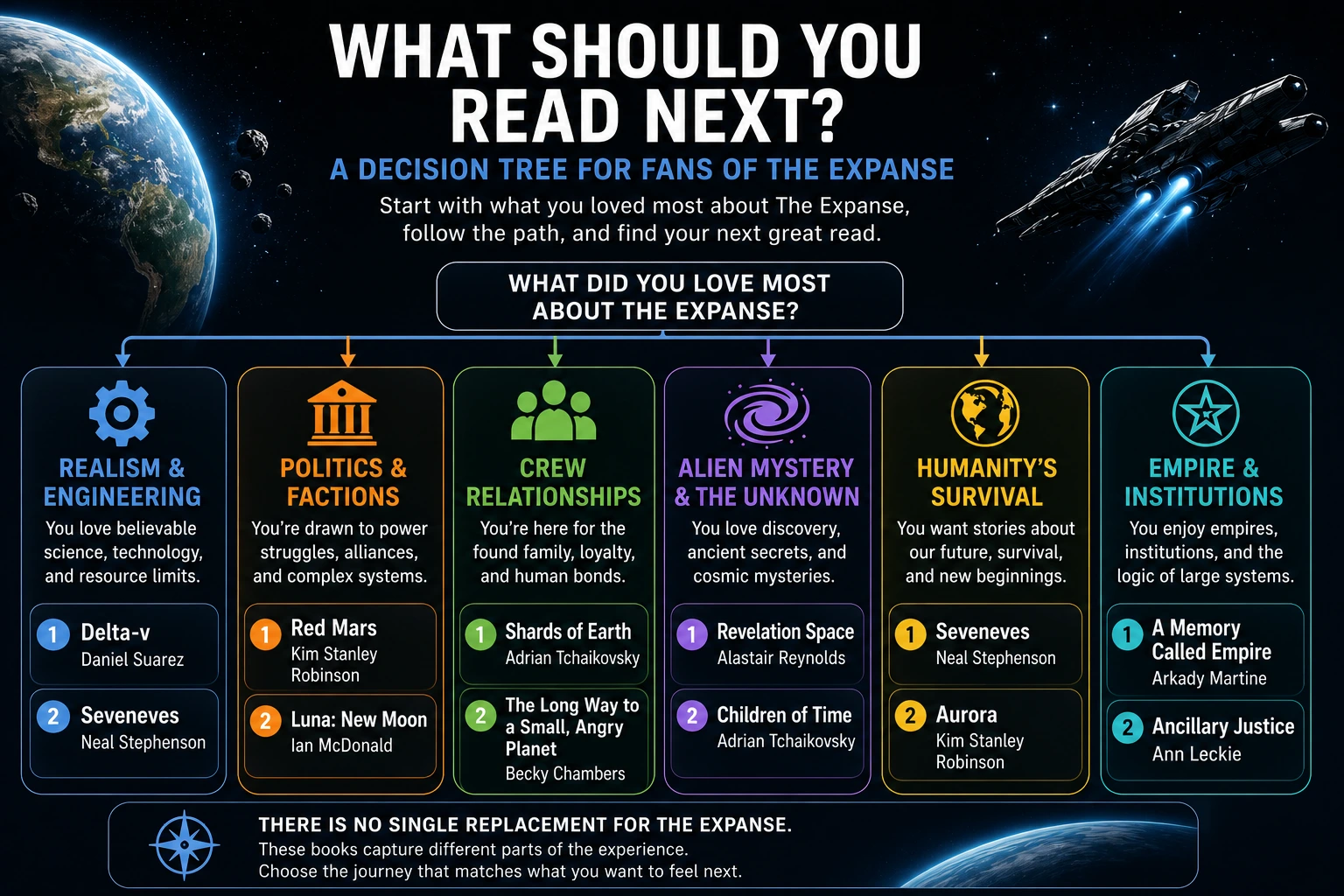
Choose your next book by what you loved most
A ranking can suggest where to begin, but it cannot know which part of The Expanse mattered most to you. Use the paths below as a faster decision tool.
For realistic space travel and engineering
Start with Delta-v, Seveneves, Aurora, or Red Mars. These books make material limits active forces rather than decorative research.
For Earth–Mars–Belt-style political conflict
Choose Red Mars, Luna: New Moon, or Beyond the Hallowed Sky. Each links political identity to resources, location, and unequal power.
For the Rocinante’s crew dynamic
Read Shards of Earth, The Long Way to a Small, Angry Planet, or All Systems Red. All three emphasize trust created through shared danger and repeated choices.
For alien mystery
Choose Revelation Space, Shards of Earth, or Children of Time. These books make contact a challenge to human assumptions rather than a simple encounter.
For empire and institutional politics
Start with A Memory Called Empire, Ancillary Justice, The Collapsing Empire, or The Praxis.
For humanity’s long-term survival
Read Seveneves, Children of Time, Aurora, or Red Mars. Their central question is not merely whether people survive, but what kind of future survival creates.
The space-opera spectrum: from industrial realism to cosmic philosophy
Space opera is not one uniform genre. Stories can begin with practical industry, move through Solar-System politics and galactic empire, then continue toward cosmic mystery and philosophical questions about civilization. The Expanse is powerful partly because it travels across much of this spectrum without abandoning its human center.
Readers who begin at the realism end usually want machinery, maintenance, habitats, and risk to remain credible. Those drawn to the political middle want institutions, factions, and unequal systems of dependence. At the cosmic end, the central pleasure becomes contact with histories and intelligences that exceed human categories. Philosophical civilization stories then ask what survival, continuity, identity, and responsibility mean after the scale of human possibility has changed.
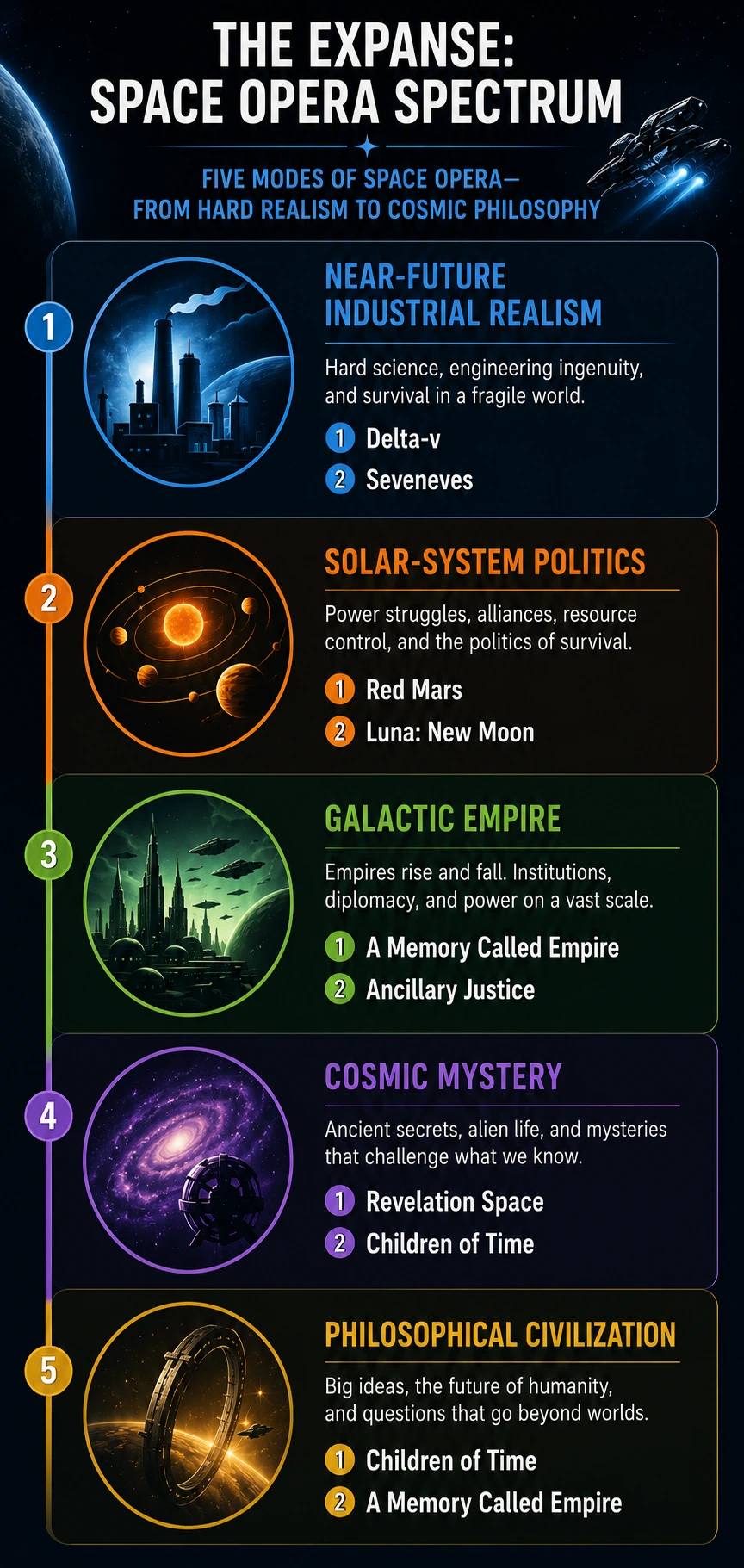
This spectrum also explains why two readers can disagree about the “closest” book and both be reasonable. Someone who values believable industrial expansion may choose Delta-v. Someone who values crew loyalty may choose Shards of Earth. Someone who values the unknown may choose Revelation Space. Someone who values the future of civilization may choose Children of Time. Similarity depends on the dimension the reader refuses to lose.
Why realistic space opera is really about dependence
Space is often imagined as the ultimate form of freedom: distance from old governments, new worlds, new resources, and the possibility of beginning again. Realistic space fiction reveals the opposite truth. The farther human beings move from a naturally survivable environment, the more intensely they depend on engineered systems and on one another.
Biological dependence
A human body in space survives only inside a maintained environment. Air composition, pressure, temperature, radiation protection, gravity, water, nutrition, medicine, and waste processing become continuous obligations. Freedom of movement therefore rests on systems that cannot be ignored for long.
Economic dependence
Habitats and colonies require parts, energy, knowledge, transport, and exchange. A settlement may produce one critical resource while remaining dependent on distant producers for many others. This creates bargaining power, inequality, and vulnerability. The politics of a colony begins long before a constitution; it begins in the network of things the colony cannot provide for itself.
Political dependence
Infrastructure determines who can interrupt life-support, control transport, certify safety, allocate scarce resources, and define acceptable risk. Institutions become unavoidable because complex systems require rules, authority, information, and coordination. Yet the same institutions can hide failure, protect privilege, or treat dependent populations as instruments.
Civilizational dependence
Expansion multiplies the number of systems that must remain intelligible, maintainable, and legitimate across distance. A civilization can possess extraordinary technology while becoming fragile if knowledge is concentrated, trust collapses, or institutions lose the ability to correct themselves. The deepest question is therefore not whether humanity can reach new worlds. It is whether human systems can remain cooperative and adaptive when failure becomes physically unforgiving.
Space does not remove dependence. It makes dependence visible.
This is why the best books like The Expanse are not only about ships or planets. They are about the relationship between scarcity, competence, trust, power, and time. A civilization survives when it can recognize pressure early, distribute knowledge, preserve cooperation, and adapt without destroying the people whose lives depend on it.
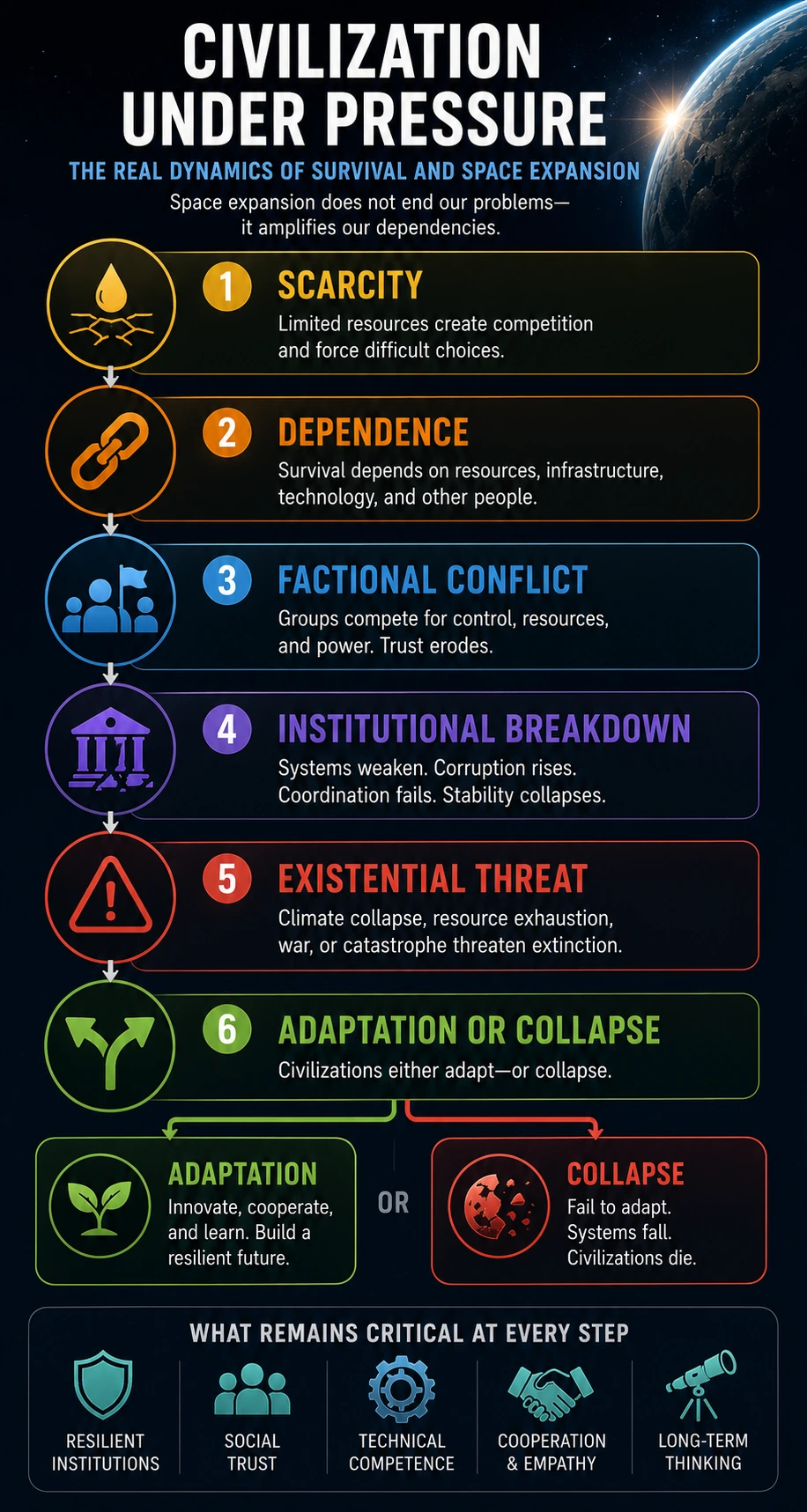
For a deeper exploration of this model, read why civilizations collapse even when they are rich and how civilizations survive collapse. Both articles examine why accumulated capability is insufficient when coordination, knowledge, legitimacy, and renewal begin to fail.
A philosophical bridge from space opera to guardianship
Disclosure: Those Who Guard Eternity is written by Denys Kostin, the author of this guide and creator of Eternity Management. It is philosophical fantasy, not hard science fiction, and it is not presented as a direct replacement for The Expanse.
Its connection lies in the questions beneath the machinery: Who should carry responsibility for a future others cannot yet see? What happens when knowledge creates power over time, reality, memory, and choice? Can guardianship protect humanity without becoming another form of domination?
Readers who move from space politics toward metaphysical responsibility may find the transition meaningful. The setting and genre differ, but the civilizational concern remains: the future is shaped not only by what humanity can do, but by who is trusted to decide what should be preserved.
Read Those Who Guard EternityExplore the related question: Who Should Guard the Future of Humanity?
Frequently asked questions
What book series is most similar to The Expanse?
No single series reproduces the full combination. Kim Stanley Robinson’s Mars trilogy is the closest overall for realistic colonization, political conflict, and long-term transformation. Revelation Space is closer for hard science and ancient mystery, while the Final Architecture trilogy beginning with Shards of Earth is closer for crew dynamics and existential alien danger.
What should I read after finishing The Expanse?
Read Memory’s Legion if you have completed the nine main novels but not the shorter fiction. For a different universe, choose Red Mars for colonization politics, Delta-v for asteroid realism, A Memory Called Empire for diplomacy, or Revelation Space for cosmic mystery.
What should I read after watching The Expanse?
Begin with Leviathan Wakes. The official publisher recommends reading the whole novel series from the start. Viewers determined to continue directly beyond the televised ending can begin with Persepolis Rising, but they will miss differences and development established in the earlier books.
Should I read Leviathan Wakes after watching the series?
Yes. The novels and adaptation share the same core universe, but the books provide their own pacing, viewpoints, characterization, and long-form political development. Starting with book one is the most coherent reading experience.
Which books like The Expanse have the most realistic science?
Red Mars, Seveneves, Aurora, Delta-v, and Revelation Space are the strongest choices in this guide. They emphasize different sciences—planetary settlement, orbital survival, closed ecologies, asteroid industry, and relativistic space opera.
Which science-fiction books combine politics and space travel?
Red Mars, A Memory Called Empire, Luna: New Moon, Beyond the Hallowed Sky, The Collapsing Empire, Ancillary Justice, and The Praxis all make political systems central to the story rather than background context.
Is Red Mars similar to The Expanse?
Yes, especially in its treatment of colonization, environmental constraints, political identity, resource conflict, and long-term institutional change. It is slower, more panoramic, and less crew-centered than The Expanse.
Is Revelation Space similar to The Expanse?
It is a strong match for readers who want hard science, large-scale space travel, archaeological mystery, and threats connected to ancient nonhuman intelligence. It is darker, denser, and less emotionally warm.
Are there books like The Expanse with a found-family crew?
Shards of Earth is the closest high-stakes option. The Long Way to a Small, Angry Planet offers the strongest emphasis on found family and everyday shipboard relationships. All Systems Red provides a shorter, sharper variation built around reluctant trust.
Are these recommendations spoiler-free?
They are spoiler-light. The article discusses premises, themes, and differences needed to make useful comparisons, but avoids major resolutions, late revelations, and detailed plot outcomes.
About the author
Denys Kostin is the creator of Eternity Management and author of the Eternity Saga. His work explores civilization, time, consciousness, responsibility, institutional fragility, and how present choices shape futures that later generations must inherit.
Sources and methodology
Official publisher and series pages were used to verify bibliographic details, reading order, and high-level premises. The Expanse Similarity Framework, weights, scores, match tiers, and rankings are interpretive editorial models developed for this article. They are not scientific instruments, aggregate review scores, or claims about objective literary quality.
- Orbit Books, What to Read After Watching The Expanse.
- Orbit Books, Memory’s Legion: The Complete Expanse Story Collection.
- Penguin Random House, Red Mars.
- Penguin Random House, Delta-v.
- Macmillan, A Memory Called Empire.
- Gollancz, Revelation Space.
- Macmillan, Luna: New Moon.
- HarperCollins, Seveneves.
- Orbit Books, Beyond the Hallowed Sky.
- Tor Publishing Group, The Collapsing Empire.
- Pan Macmillan, Shards of Earth.
- Orbit Books, Ancillary Justice.
- Pan Macmillan, Children of Time.
- Hachette, The Long Way to a Small, Angry Planet.
- Tor Publishing Group, All Systems Red.
- Hachette Book Group, Aurora.
- HarperCollins, The Praxis.
Editorial note: No publisher paid for placement. Links contain no UTM parameters. The article is designed to be converted later into a draft-status Gutenberg-safe WordPress import without re-importing media.