If you are searching for books like Red Rising, you probably do not just want another story set in space. Pierce Brown’s series is difficult to replace because it combines a rigid social hierarchy, hidden identity, brutal competition, political betrayal, military escalation, personal transformation, and civilization-scale consequences.
The best next book therefore depends on which part of Red Rising you want more of. If you want another enormous science-fiction saga, start with Empire of Silence. If the Institute, elite hierarchy, and infiltration plot were your favorite elements, choose The Will of the Many. For relentless action, try The Rage of Dragons. For imperial politics, read Dune. For solar-system warfare, choose Leviathan Wakes.
This guide compares 15 science-fiction and fantasy novels by the things that actually make them feel similar to Red Rising: rebellion, hierarchy, political intrigue, combat, transformation, and epic scale. It also explains where each recommendation differs, so you can choose the right book instead of simply the most famous one.
What Makes a Book Feel Like Red Rising?
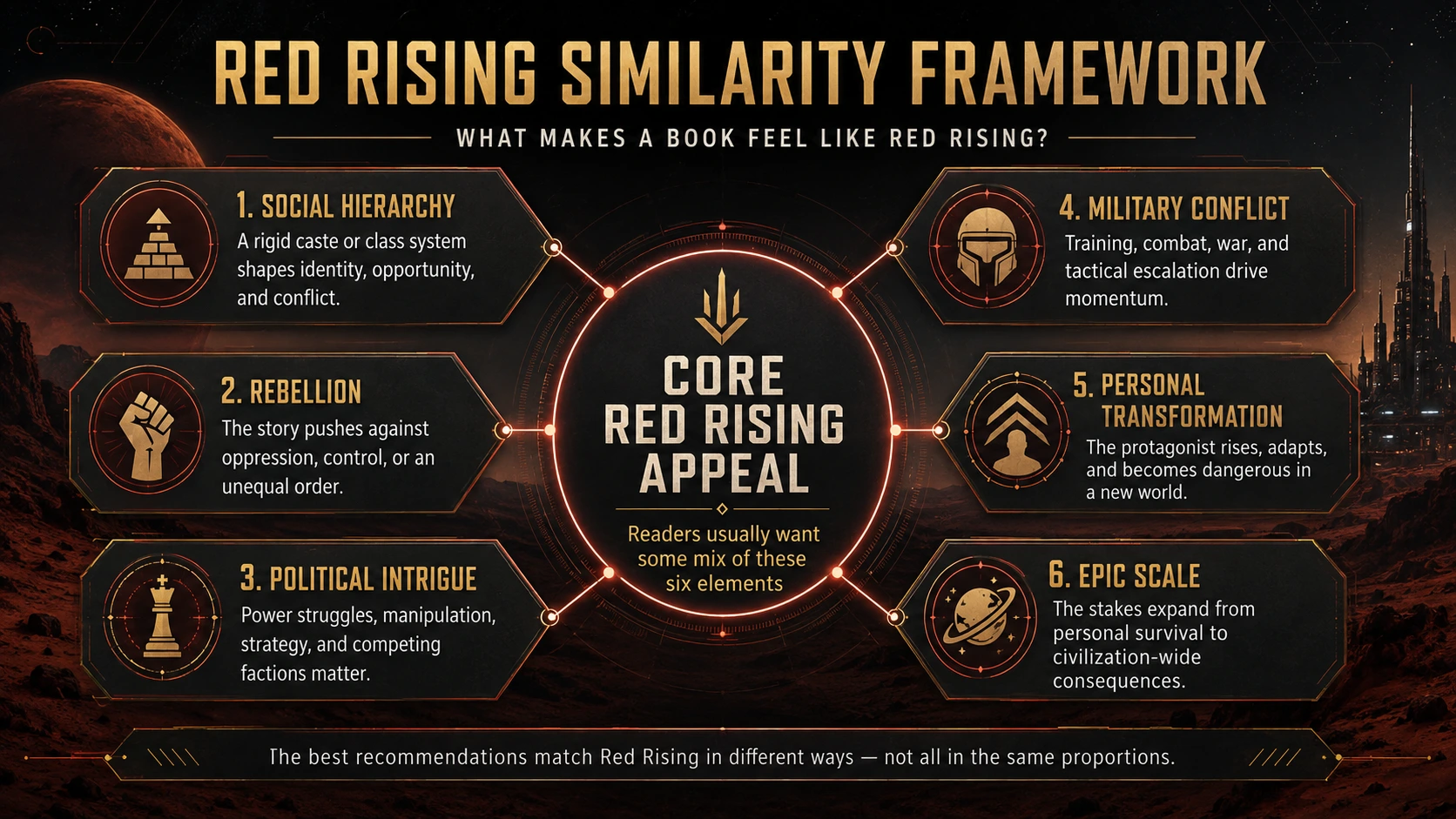
A book does not need a Mars-like setting or a color-coded caste system to appeal to Red Rising readers. What matters is the underlying experience. The strongest recommendations usually reproduce several of six core elements.
- Social hierarchy: power is built into institutions, classes, castes, schools, empires, or inherited status.
- Rebellion: characters challenge an order designed to keep them beneath someone else.
- Political intrigue: alliances, manipulation, ideology, loyalty, and betrayal matter as much as physical strength.
- Military conflict: training, combat, tactics, and escalating war create momentum.
- Personal transformation: the protagonist must become someone capable of surviving a larger and more dangerous world.
- Epic scale: the stakes grow from individual survival to the fate of societies, empires, or civilizations.
No recommendation matches all six dimensions in exactly the same proportion. That is why The Will of the Many may feel closer to the first Red Rising novel, while Empire of Silence, Dune, or Leviathan Wakes may better satisfy readers who love the later books’ expanding political and galactic scope.
The Best Books Like Red Rising at a Glance
How we chose these books: each recommendation was evaluated across six dimensions that define the Red Rising reading experience: social hierarchy, rebellion, political intrigue, military conflict, personal transformation, and epic scale. A book does not need to match all six. It belongs here when it strongly reproduces several of them and offers a clear next step for a specific kind of Red Rising reader.
If you want the short version, use this table to match your favorite part of Red Rising with the strongest alternative. The similarity judgments below are editorial comparisons, not objective scores.
| Book | Closest Red Rising Element | Biggest Difference | Best For |
|---|---|---|---|
| Empire of Silence | Galactic empire and enormous stakes | Much slower and more reflective | Readers who want an epic long-form saga |
| The Will of the Many | Elite infiltration and hierarchy | Fantasy rather than space opera | Fans of the Institute |
| The Rage of Dragons | Relentless ascent through violence | Military fantasy setting | Action and revenge |
| Dune | Power, empire, ideology | More philosophical and deliberate | Political intrigue |
| Leviathan Wakes | Solar-system conflict | Ensemble-driven rather than one central ascent | Space warfare |
| Ender’s Game | Training, strategy, leadership | Less focused on revolution | Military strategy |
| The Hunger Games | Oppressive hierarchy and survival | Smaller geopolitical scale | Competition and rebellion |
| Mistborn: The Final Empire | Overthrowing a rigid order | Epic fantasy rather than science fiction | Revolution |
| The Fifth Season | Oppression and civilizational crisis | More structurally experimental | Power and social systems |
| The Poppy War | Ambition, war, moral escalation | Darker historical-fantasy influence | Consequences of power |
| Iron Widow | Rage against hierarchy | More overtly stylized | Defiance and revenge |
| A Memory Called Empire | Imperial politics | More diplomatic than action-driven | Political maneuvering |
| Ancillary Justice | Empire, identity, loyalty | More cerebral and unconventional | Big ideas |
| The Traitor Baru Cormorant | Fighting a system from within | Economic and political strategy dominate | Infiltration and sacrifice |
| The Combat Codes | Combat, training, advancement | Narrower scope | Competition and martial progression |
15 Books Like Red Rising
1. Empire of Silence by Christopher Ruocchio
Best overall for readers who want another enormous science-fiction saga.
Empire of Silence, the opening novel of the Sun Eater series, is one of the strongest choices for readers who want the later Red Rising books’ sense of scale: empires, war, ideology, history, and a protagonist whose personal choices become inseparable from the fate of civilizations.
Why it feels like Red Rising: both stories follow ambitious central figures moving through rigid structures of power while the world around them expands into something far larger than the life they began with. Both are interested in leadership, legacy, violence, and the cost of changing history.
Where it differs: Empire of Silence is slower, more introspective, and more overtly philosophical. It spends more time on memory, civilization, identity, and the interpretation of a life after the fact.
Read this if: you want Red Rising’s galactic ambition with more reflection and a slower burn.
Closest match: empire · scale · transformation · politics
2. The Will of the Many by James Islington
Best if you loved the Institute, hidden identity, and climbing through an elite hierarchy.
The structural similarities are immediately compelling: an outsider enters a powerful institution, conceals crucial parts of himself, studies the rules of a social order he does not trust, and must survive competition among people groomed to rule.
Why it feels like Red Rising: the pleasure comes from watching a capable protagonist learn an elite system from inside it. Social rank is not background decoration; it determines safety, opportunity, influence, and danger.
Where it differs: the setting is fantasy rather than interplanetary science fiction, and the story leans more heavily into mystery and institutional intrigue.
Read this if: the first Red Rising is still your favorite because of infiltration, competition, and social hierarchy.
Closest match: hierarchy · infiltration · competition · politics
3. The Rage of Dragons by Evan Winter
Best for relentless action, obsession, revenge, and brutal self-transformation.
The Rage of Dragons delivers the emotional velocity many readers associate with Red Rising: rage becomes discipline, discipline becomes capability, and capability becomes a weapon against a world organized by inequality.
Why it feels like Red Rising: the protagonist refuses the place society has assigned him and pushes himself through increasingly punishing trials. Combat is not separate from character development; it is one of the ways identity is forged.
Where it differs: this is military fantasy rather than science fiction, and revenge is more central to the engine of the story.
Read this if: you want speed, training, combat, fury, and a protagonist who simply refuses to remain powerless.
Closest match: action · transformation · hierarchy · ambition
4. Dune by Frank Herbert
Best for political power, empire, ideology, and the danger of charismatic leadership.
Dune is less similar to Red Rising at the level of pacing but deeply similar at the level of political imagination. Both ask what happens when personal destiny, elite power, inherited hierarchy, warfare, and belief become intertwined.
Why it feels like Red Rising: political factions matter, families and institutions compete for control, and individual decisions can reshape the future of entire populations. Power is never merely personal.
Where it differs: Dune is more deliberate, philosophical, ecological, and suspicious of heroic myth.
Read this if: you loved the politics, houses, empires, ideological conflict, and civilization-level consequences of Red Rising.
If that is your preferred side of epic science fiction, continue with our guide to books like Dune.
Closest match: politics · empire · ideology · civilization
5. Leviathan Wakes by James S. A. Corey
Best for space warfare, competing factions, and a believable inhabited solar system.
Leviathan Wakes begins on a more grounded scale than the later Red Rising novels, but its universe quickly becomes defined by conflict among planetary populations, political interests, military forces, and people caught between them.
Why it feels like Red Rising: factional identity matters, political systems are unstable, and individual choices can trigger consequences far beyond what the characters initially understand.
Where it differs: the story is more ensemble-driven and less centered on one person’s rise through a hierarchy.
Read this if: fleet conflict, solar-system politics, tactical tension, and large-scale science fiction are what you want next.
For more novels with that mix of human politics and space-opera scale, see our list of books like The Expanse.
Closest match: warfare · factions · space opera · political escalation
6. Ender’s Game by Orson Scott Card
Best for strategy, training, competition, and the psychological burden of leadership.
Readers fascinated by the Institute may appreciate the way Ender’s Game turns training into a social and strategic battlefield. Success depends not simply on physical ability but on understanding opponents, adapting systems, and thinking several moves ahead.
Why it feels like Red Rising: young people are placed inside a brutal competitive structure and shaped into instruments of larger conflicts. Leadership emerges under pressure.
Where it differs: revolution and class hierarchy are not the central concerns.
Read this if: you loved Darrow as a strategist as much as you loved him as a fighter.
Closest match: strategy · training · leadership · pressure
7. The Hunger Games by Suzanne Collins
Best for survival inside a system built on inequality and spectacle.
The Hunger Games and Red Rising both understand that oppressive systems survive not only through force but through stories, rituals, symbols, and divisions between social groups.
Why it feels like Red Rising: a protagonist from the exploited edge of society enters an arena controlled by elites and becomes increasingly important to a wider rebellion.
Where it differs: the scope is tighter and the prose more direct, with less emphasis on galactic politics or military campaigns.
Read this if: you want high-stakes competition, resistance, class conflict, and the transformation of an individual into a political symbol.
Closest match: oppression · competition · rebellion · symbolism
8. Mistborn: The Final Empire by Brandon Sanderson
Best for overthrowing an apparently unbreakable social order.
Mistborn: The Final Empire begins with a question that should feel familiar to Red Rising readers: what would it actually take to destroy a hierarchy that has made its own dominance feel permanent?
Why it feels like Red Rising: rebellion is strategic rather than abstract. The characters must understand the system, exploit its weaknesses, build alliances, and survive the consequences of challenging those at the top.
Where it differs: it is fantasy with a magic system rather than futuristic science fiction.
Read this if: the revolutionary core of Red Rising matters more to you than the space setting.
Closest match: revolution · hierarchy · team dynamics · hope
9. The Fifth Season by N. K. Jemisin
Best for oppression, systemic power, and civilization under existential pressure.
The Fifth Season is a more structurally challenging novel, but it shares Red Rising’s interest in societies that categorize human beings according to usefulness and then normalize the violence required to preserve that order.
Why it feels like Red Rising: hierarchy, exploitation, survival, and civilizational instability are inseparable. The world itself pressures characters into becoming different people.
Where it differs: it is less interested in the momentum of military ascent and more interested in trauma, systems, identity, and recurring catastrophe.
Read this if: you want a darker, more literary examination of who pays the price when civilizations preserve themselves.
Closest match: oppression · systems · transformation · civilizational crisis
10. The Poppy War by R. F. Kuang
Best for ambition, war, and the moral destruction that can accompany power.
The Poppy War begins with advancement through an elite institution and expands into a far more brutal story about warfare, ideology, trauma, and the choices made by people who gain access to extraordinary power.
Why it feels like Red Rising: personal ambition becomes entangled with national conflict, and the cost of victory grows heavier as the protagonist’s influence expands.
Where it differs: it is darker, harsher, and rooted in historical-fantasy influences rather than futuristic space opera.
Read this if: you are most interested in what power does to someone after the fantasy of heroic ascent begins to collapse.
Closest match: ambition · war · transformation · moral cost
11. Iron Widow by Xiran Jay Zhao
Best for furious rebellion against a violent hierarchy.
Iron Widow channels anger directly into its world-building. Its protagonist confronts a social and military system that treats certain lives as expendable and then begins breaking the assumptions on which that system depends.
Why it feels like Red Rising: there is defiance, spectacle, social stratification, dangerous power, and the refusal to accept an identity imposed from above.
Where it differs: the tone is more stylized and the narrative embraces a different kind of intensity.
Read this if: your favorite part of Red Rising is the rage of someone discovering that the structure itself is the enemy.
Closest match: rebellion · hierarchy · rage · identity
12. A Memory Called Empire by Arkady Martine
Best for readers who want imperial politics rather than constant combat.
A Memory Called Empire explores what it means to enter the center of an empire when you come from somewhere that could be absorbed by it. Language, culture, status, memory, loyalty, and political survival become weapons.
Why it feels like Red Rising: the protagonist must operate inside a powerful system whose values are both seductive and dangerous.
Where it differs: diplomacy, culture, and political interpretation matter more than battlefield action.
Read this if: you loved infiltration, elite maneuvering, and the tension between belonging to a system and resisting it.
Closest match: empire · politics · identity · infiltration
13. Ancillary Justice by Ann Leckie
Best for empire, identity, loyalty, and ambitious science-fiction ideas.
Ancillary Justice approaches empire from a very different direction, but its scale and moral questions make it valuable for readers who want to move beyond the action surface of Red Rising into deeper questions about institutions and personhood.
Why it feels like Red Rising: empire creates identities, loyalties, enemies, and contradictions that become impossible to separate from individual choices.
Where it differs: the narrative is more cerebral, formally unusual, and less focused on tournament-like competition or heroic ascent.
Read this if: you want the civilization-level questions behind space opera to become the center of the story.
Closest match: empire · identity · loyalty · big ideas
14. The Traitor Baru Cormorant by Seth Dickinson
Best for defeating an empire by entering its machinery.
Few recommendations capture the strategic logic of infiltration as sharply as The Traitor Baru Cormorant. Its protagonist chooses to work inside the system that conquered her home because understanding power may be the only way to destroy it.
Why it feels like Red Rising: disguise, ambition, intelligence, sacrifice, and the tension between becoming powerful and becoming what you hate are all central.
Where it differs: economics, administration, and political strategy are much more important than physical combat.
Read this if: your favorite Red Rising question is whether someone can use an oppressive system without being remade by it.
Closest match: infiltration · politics · sacrifice · rebellion
15. The Combat Codes by Alexander Darwin
Best for readers who want training, martial competition, and advancement through skill.
The Combat Codes narrows the focus to physical mastery and competitive hierarchy. It is a strong choice for readers who miss the immediacy of the Institute and want more stories in which competence is earned under pressure.
Why it feels like Red Rising: characters operate inside a structured system where combat determines status and where training reveals character.
Where it differs: the scope is more concentrated and less politically expansive than Red Rising.
Read this if: you want the competition-and-training energy without needing another galaxy-spanning epic.
Closest match: training · competition · combat · progression
Which Part of Red Rising Do You Want More Of?
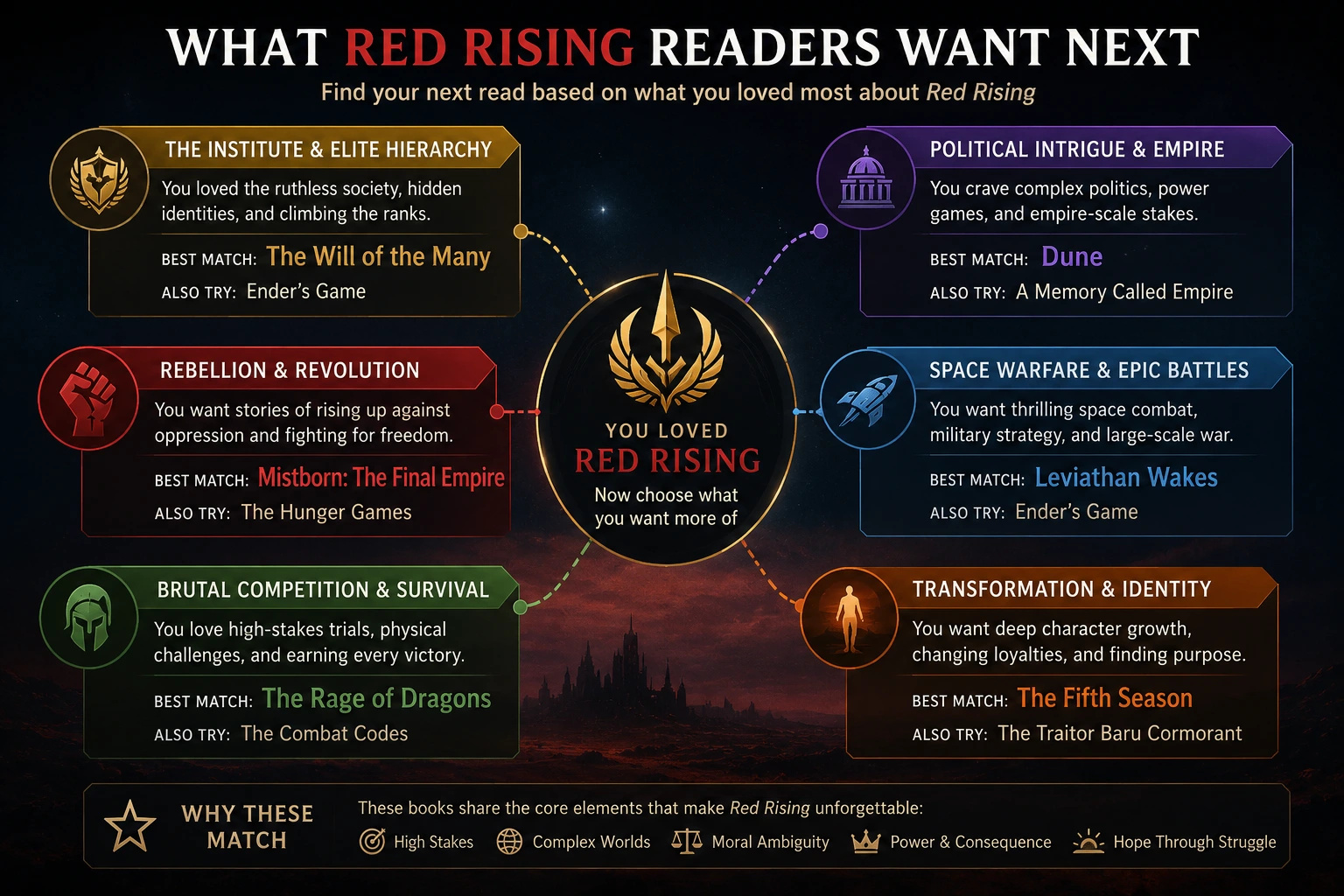
The fastest way to choose your next read is to stop asking which book is “most similar” in general and ask which experience you want repeated.
- The Institute and elite hierarchy: The Will of the Many
- Rebellion against oppression: Mistborn: The Final Empire
- Relentless action and personal ascent: The Rage of Dragons
- Political strategy and empire: Dune
- Space warfare and factions: Leviathan Wakes
- Galactic history and enormous scale: Empire of Silence
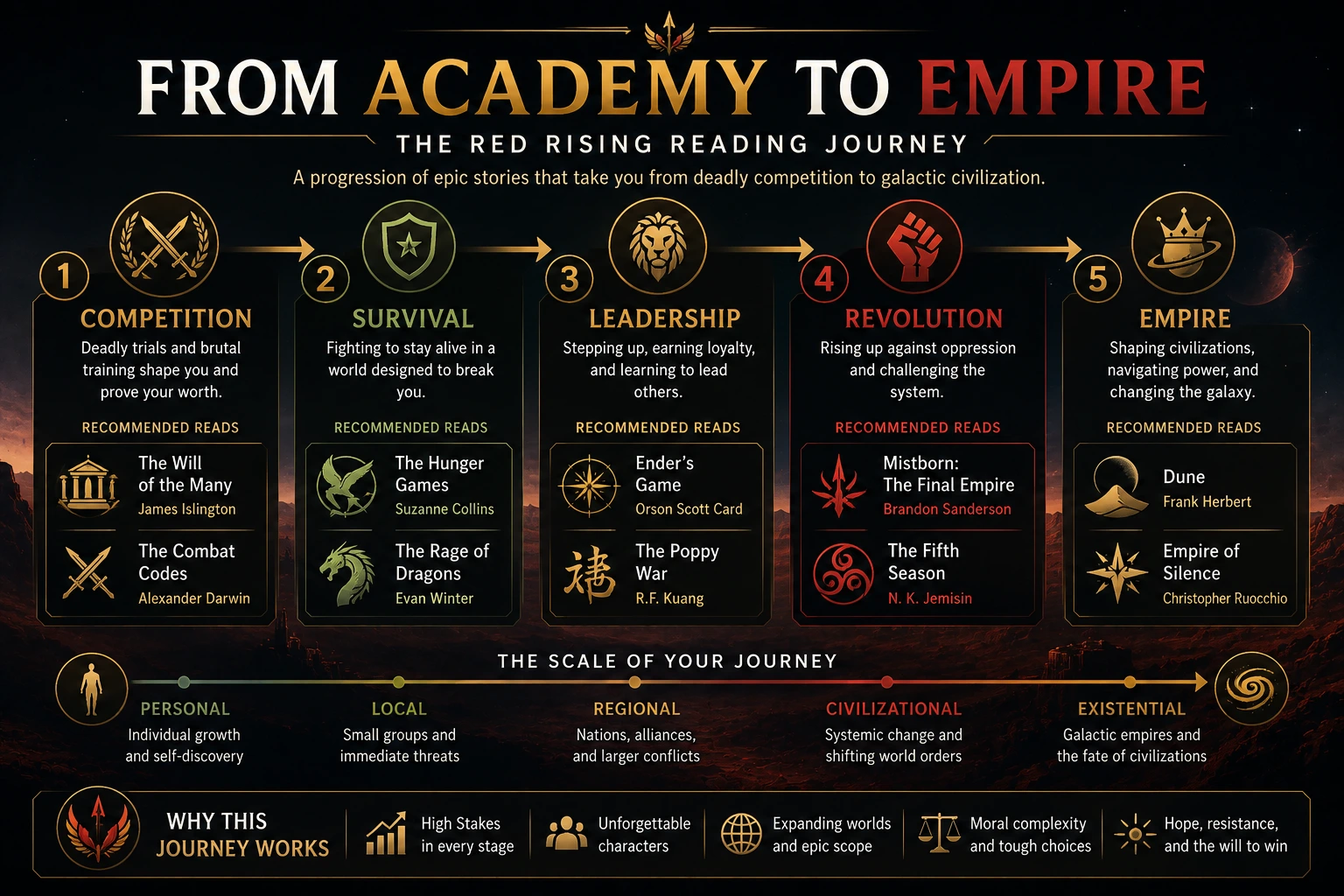
If You Loved the Institute: From Competition to Empire
One reason the series feels so satisfying is that its scale does not remain fixed. The early story emphasizes competition and survival; later books demand leadership, revolution, and decisions with consequences for entire societies. You can recreate that progression across different books.
Start with The Will of the Many or The Combat Codes for structured competition. Move to The Hunger Games or The Rage of Dragons for survival and defiance. Choose Ender’s Game for leadership under strategic pressure. Read Mistborn: The Final Empire for revolution. Then move outward to Dune or Empire of Silence when you want the fate of civilizations to dominate the story.
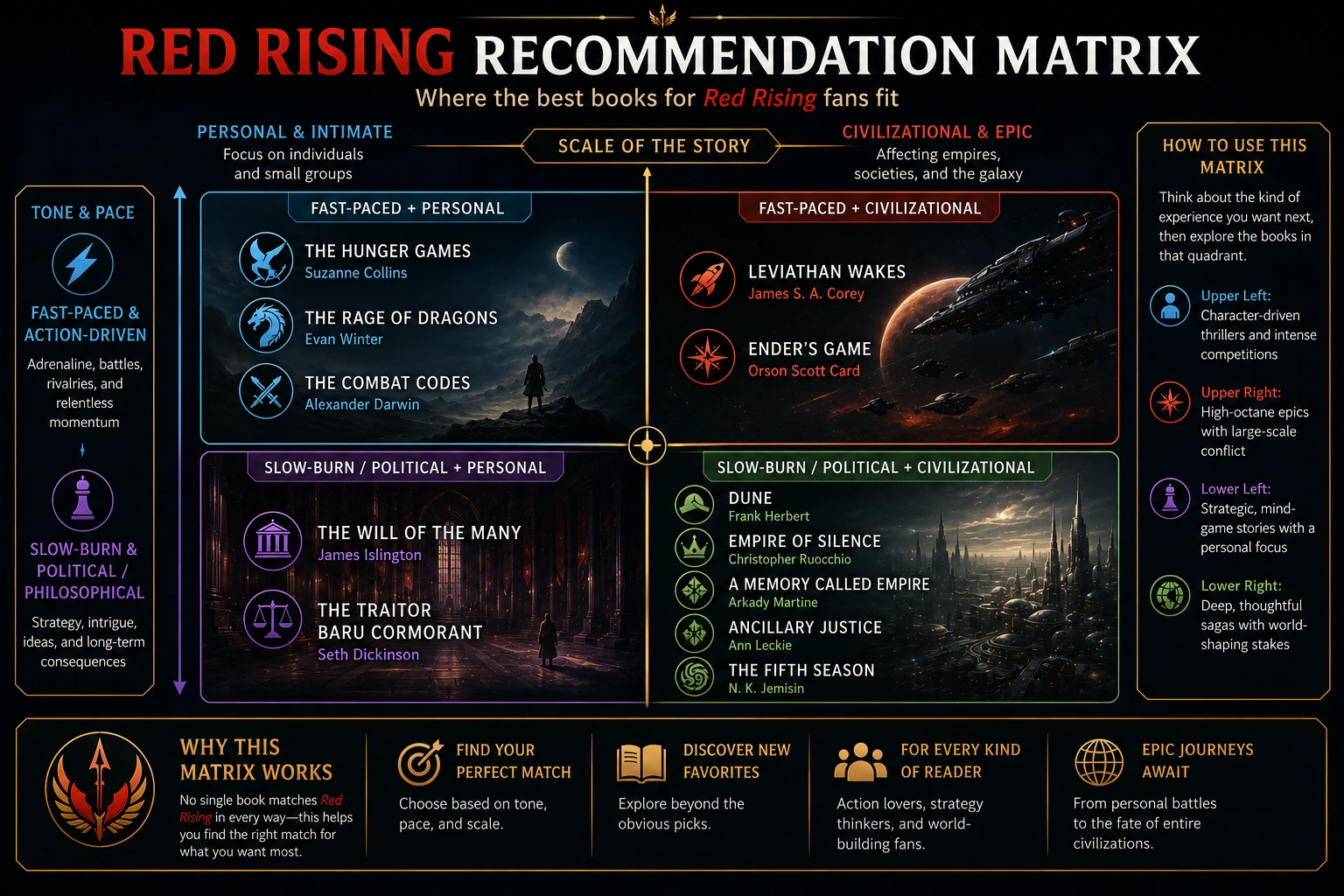
Red Rising Recommendation Matrix: Choose by Pace and Scale
Another useful distinction is pace versus scale. Some readers want adrenaline; others want politics. Some want character-level stakes; others want civilizations in motion.
For fast, personal conflict, start with The Hunger Games, The Rage of Dragons, or The Combat Codes. For fast conflict on a wider stage, choose Leviathan Wakes or Ender’s Game. For slower political tension with a personal focus, try The Will of the Many or The Traitor Baru Cormorant. For slow-burn civilizational depth, choose Dune, Empire of Silence, A Memory Called Empire, Ancillary Justice, or The Fifth Season.
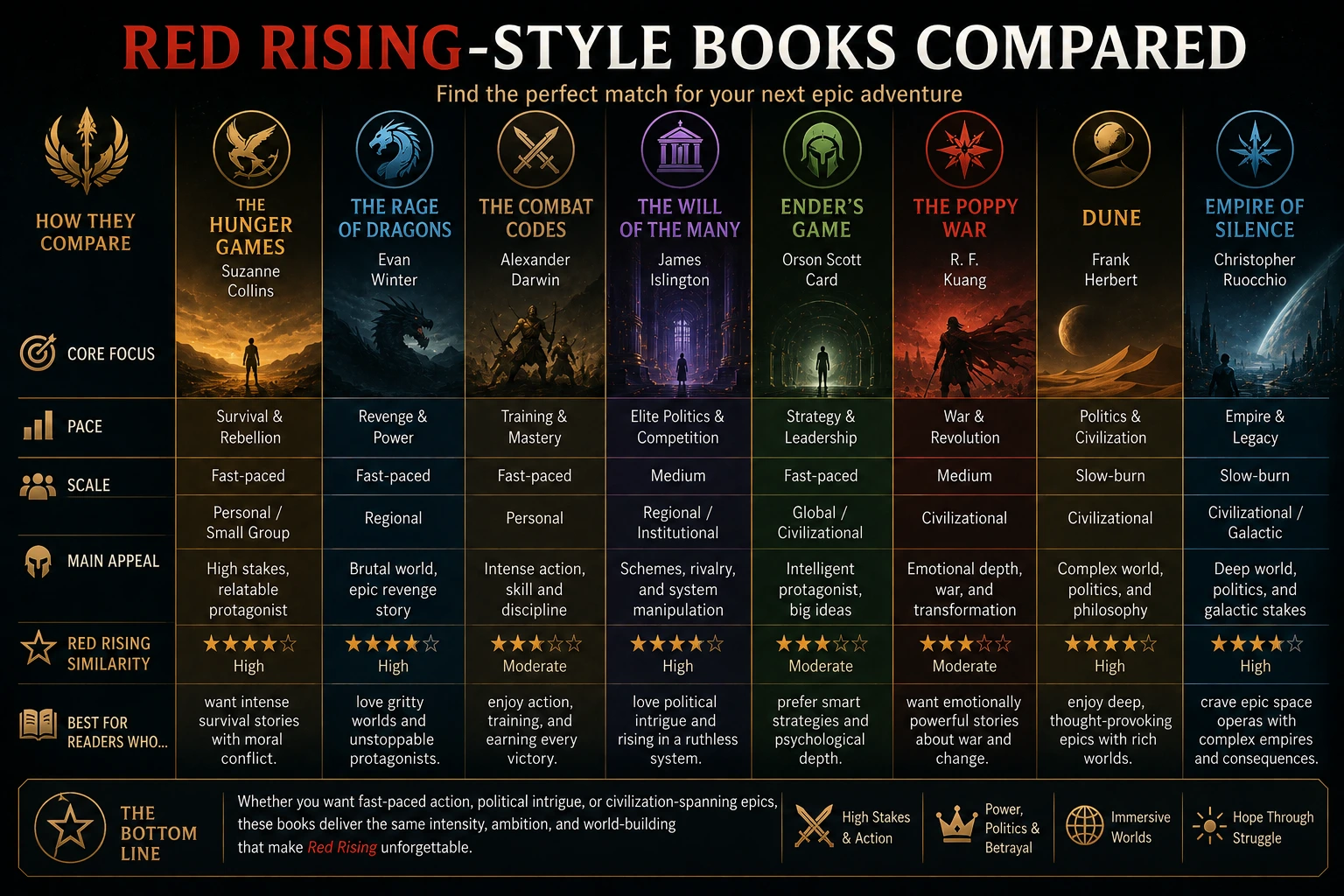
How the Closest Red Rising Alternatives Compare
There is no single replacement for Red Rising. The closest alternatives succeed for different reasons. The Will of the Many is stronger on elite hierarchy and political competition. The Rage of Dragons is stronger on relentless training and revenge. Dune goes deeper into politics, religion, and civilizational power. Empire of Silence offers the broadest long-form galactic saga. The Hunger Games concentrates rebellion and class conflict into a tighter survival narrative.
That distinction matters because a book can be highly similar in theme while very different in reading experience. A reader seeking momentum may be disappointed by a slower philosophical epic even if the political themes match perfectly.
Books Like Red Rising for Adults
If by “more adult” you mean more emphasis on institutions, political consequences, ambiguity, culture, or civilization—and less emphasis on academy-style competition—the strongest choices are Empire of Silence, Dune, The Fifth Season, A Memory Called Empire, Ancillary Justice, and The Traitor Baru Cormorant.
Empire of Silence is the best bridge if you still want a huge central protagonist and an expanding space-opera canvas. Dune is the choice for political and philosophical depth. A Memory Called Empire is ideal for diplomacy and imperial culture. The Traitor Baru Cormorant is the strongest choice if you want the idea of defeating a system from inside to become the central strategic problem.
If civilization-scale speculative fiction is what you are really seeking, you may also like our guides to books like Foundation, books like Hyperion, and books like Children of Time.
If You Loved the Politics and Empire
Start with Dune if political mythology and the danger of power fascinate you. Choose Empire of Silence if you want a longer personal journey through galactic history. Read A Memory Called Empire for diplomacy, cultural power, and the seductive force of empire. Choose Ancillary Justice if you want questions about identity and imperial loyalty to become stranger and more philosophical.
This is also where Red Rising connects to a broader question: what kinds of systems deserve to survive, and who should have the authority to shape what comes next? If that aspect interests you, continue with Who Should Guard the Future of Humanity?
If You Loved the Space Battles
Leviathan Wakes is the clearest next choice because its conflicts emerge from believable political tensions among populations spread across the solar system. Ender’s Game is better if tactics and command interest you more than factional politics. Empire of Silence becomes the stronger option when you want warfare embedded in a much longer historical and civilizational arc.
Readers who care more about the vulnerability of enclosed societies than fleet warfare may prefer our recommendations for books like Silo.
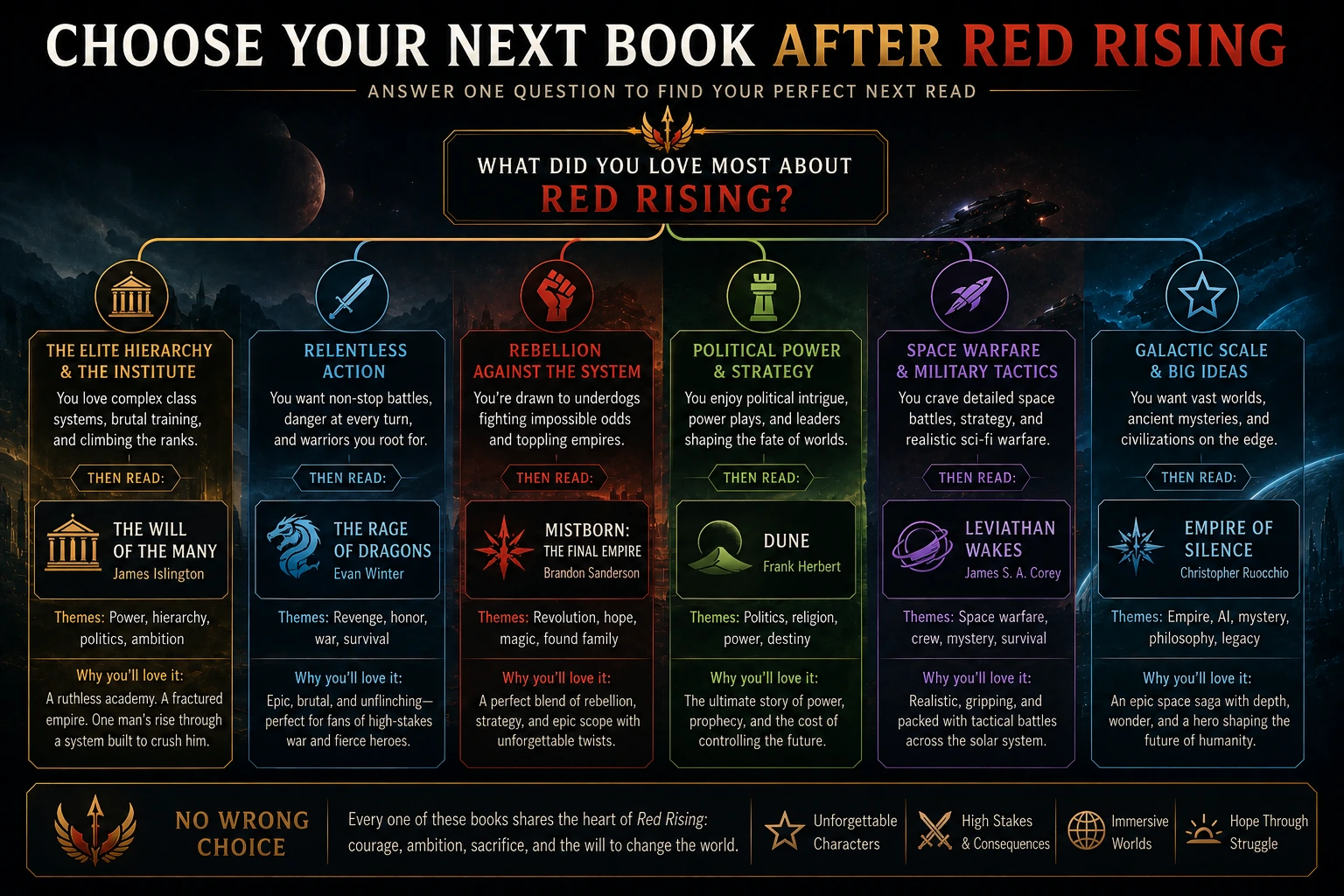
Which Book Should You Read After Red Rising?
If you want one decisive recommendation, choose according to the element you most want to preserve:
- Closest overall epic-sci-fi experience: Empire of Silence
- Closest to the Institute and elite hierarchy: The Will of the Many
- Best for relentless action: The Rage of Dragons
- Best for rebellion: Mistborn: The Final Empire
- Best for politics and empire: Dune
- Best for space warfare: Leviathan Wakes
If you are still undecided, the decision tree below is the simplest way to choose.
Frequently Asked Questions
What book is most similar to Red Rising?
Empire of Silence is the strongest overall recommendation if you want another ambitious science-fiction saga about empire, war, personal transformation, and civilization-scale consequences. If you specifically want the elite-school, hidden-identity, and hierarchy dynamics of the first Red Rising, The Will of the Many is the closer structural match.
What should I read immediately after Red Rising?
Choose The Will of the Many for elite competition, The Rage of Dragons for action, Dune for political power, Leviathan Wakes for space warfare, or Empire of Silence for another huge science-fiction saga.
Is The Will of the Many similar to Red Rising?
Yes, particularly to the early Red Rising experience. Both feature an outsider navigating a powerful hierarchy, concealed motives, elite competition, political danger, and the need to understand a system from within.
Is Sun Eater like Red Rising?
The Sun Eater series, beginning with Empire of Silence, shares Red Rising’s interest in empire, war, leadership, transformation, and enormous historical stakes. It is substantially slower and more reflective, so the thematic resemblance is stronger than the pacing resemblance.
What books are like Red Rising but more adult?
For greater emphasis on political systems, ambiguity, culture, and civilizational consequences, try Empire of Silence, Dune, A Memory Called Empire, The Fifth Season, Ancillary Justice, or The Traitor Baru Cormorant.
What should I read if I loved the Institute in Red Rising?
Start with The Will of the Many. For more competitive training and strategic pressure, try The Combat Codes, Ender’s Game, or The Hunger Games.
Final Verdict
The best books like Red Rising are not necessarily the books with the most similar settings. They are the ones that recreate the tension between the individual and the system: who gets power, who is denied it, what someone must become to challenge an established order, and what happens when a personal rebellion grows large enough to reshape a civilization.
For the closest all-around follow-up, begin with Empire of Silence. For the Institute experience, choose The Will of the Many. For pure momentum, choose The Rage of Dragons. For politics, choose Dune. For war across the solar system, choose Leviathan Wakes.
And if the part of Red Rising that stays with you is not the battles but the future they are fighting over, explore our broader guide to books about the future of humanity.