Looking for books like Silo or Wool? Start with Metro 2033 if you want another underground civilization under survival pressure, The Penultimate Truth if the hidden reality beyond the official story fascinated you most, The City of Ember for a failing enclosed city and a secret from the past, and The Last Murder at the End of the World for a modern mystery built around controlled knowledge and the survival of an isolated community.
The best books like Silo are not simply post-apocalyptic novels. Hugh Howey’s world works because several pressures reinforce one another: people live inside a closed system, the past is incomplete, information is controlled, survival seems to justify harsh rules, and eventually someone asks whether preserving order is still the same thing as preserving humanity.
This spoiler-light guide ranks 15 books by those deeper similarities. The recommendations are compared across five editorial dimensions: closed world, hidden truth, information control, survival pressure, and rebellion. The ratings are qualitative judgments designed to make the logic of the list transparent rather than pretend that literary similarity can be measured with scientific precision.
Current-context note: Apple says the third season of Silo premiered on July 3, 2026, and is releasing weekly through September 4, 2026. The series is based on Hugh Howey’s bestselling Silo trilogy. This guide focuses primarily on books, so it remains useful whether you arrived through Wool, the complete trilogy, or the television adaptation.
Estimated reading time: 26–30 minutes · Editorial review: August 21, 2026 · Primary search intent: what to read after Silo or Wool.
Table of Contents
- Quick answer: what should you read after Silo?
- If you watched Silo but have not read the books
- Why Silo is hard to replace
- The Silo similarity framework
- 15 books like Silo and Wool compared
- The 15 best books like Silo and Wool
- Choose by what you loved most
- What Silo really asks about civilization
- A philosophical extension: Those Who Guard Eternity
- Frequently asked questions
- Sources and editorial methodology
Quick Answer: What Should You Read After Silo?
If you want one default recommendation, choose Metro 2033 by Dmitry Glukhovsky. It is the strongest overall match for readers who want another enclosed underground civilization shaped by fear of the surface, scarcity, competing systems of belief, and the constant pressure to survive.
If your favorite part of Silo was something more specific, use this shortcut:
- Closest underground-survival match: Metro 2033.
- Closest hidden-truth premise: The Penultimate Truth.
- Best failing underground-city mystery: The City of Ember.
- Best modern controlled-society mystery: The Last Murder at the End of the World.
- Best existential confinement novel: I Who Have Never Known Men.
- Best for erased memory and authoritarian control: The Memory Police.
- Best for claustrophobic underground danger: The Luminous Dead.
- Best for rebellion against a manufactured hierarchy: Red Rising.
- Best for civilizational memory after catastrophe: A Canticle for Leibowitz.
- Best same-author extension: Sand by Hugh Howey.
Readers already exploring Eternity Management’s science-fiction cluster can also compare books like The Three-Body Problem, books like The Expanse, books like Foundation, books like Children of Time, and books like Dune.
If You Watched Silo but Have Not Read the Books
Before looking for another author, consider reading the trilogy that created the world. Hugh Howey’s own series pages establish the sequence clearly: Wool → Shift → Dust. Wool introduces the silo and the people living inside it, Shift expands the history behind the system, and Dust brings the trilogy toward its conclusion.
That matters because the television adaptation and the books are not interchangeable experiences. A screen version can preserve the central premise while changing pacing, characterization, chronology, emphasis, and the order in which mysteries are revealed. If what you want is simply “more Silo,” the original trilogy is still the most direct route.
The 15 recommendations below are therefore mostly new worlds rather than additional Silo volumes. The goal is to help you identify what made the experience compelling and then find another book that activates the same part of your imagination.
Why Is Silo So Hard to Replace?
Many dystopian novels contain oppressive governments. Many post-apocalyptic novels contain scarcity. Many mysteries contain hidden information. What makes Wool and the wider Silo series distinctive is the way those ingredients become one system.
The world is physically closed. Boundaries are not abstract. Stairs, levels, machinery, sealed spaces, dangerous thresholds, and the unknown surface shape daily life. Geography becomes politics because access determines what people can see, know, and do.
The past is incomplete. The society inherits rules without possessing a fully trustworthy account of why those rules exist. That turns history into a form of power. A population that cannot compare the present with the past has fewer tools for judging whether the current order is necessary, temporary, corrupted, or deliberately misleading.
Information is consequential. Knowledge does not sit harmlessly in books or databases. A fact can destabilize authority. A memory can change identity. A discovery can be treated as a threat because it alters the range of choices people believe they have.
Survival gives control a plausible justification. This is one of the series’ most important tensions. Restrictions are harder to reject when the alternative may genuinely be death. That ambiguity produces better dystopian fiction than a simple division between good rebels and evil rulers because the reader has to ask which safeguards are necessary and which have become self-protecting structures.
Rebellion begins as a question. The system becomes vulnerable when someone notices a contradiction and refuses to leave it alone. Curiosity becomes political because an apparently small question can expose a much larger architecture of control.
The Silo Similarity Framework
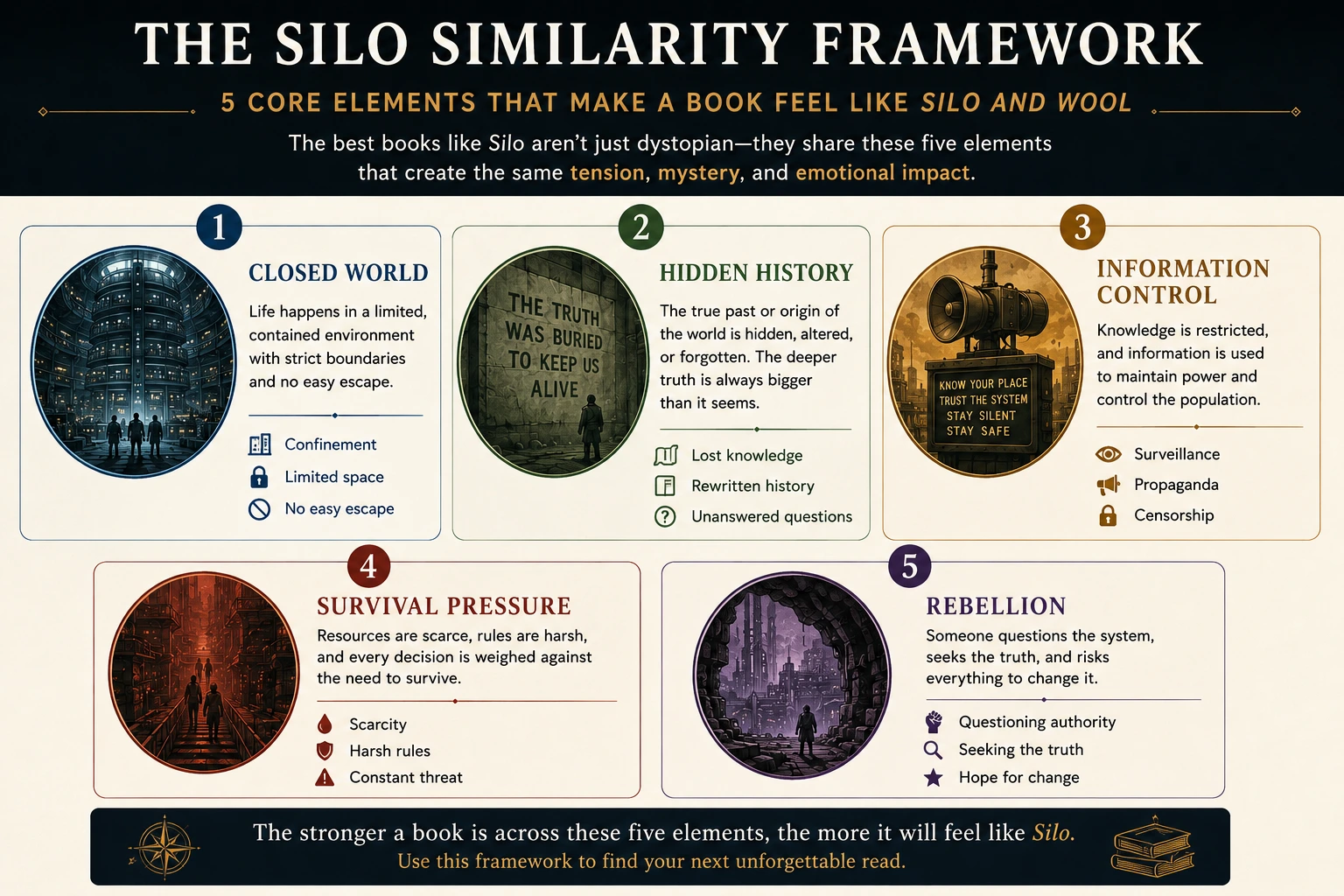
The ranking below uses five dimensions. They are intentionally simple enough to be useful while browsing, but specific enough to explain why two books in the same genre can feel very different.
- Closed world: Is life constrained by an enclosed, isolated, sealed, or socially bounded environment?
- Hidden truth: Does the story involve buried history, incomplete memory, concealed origins, or a reality larger than the characters have been allowed to understand?
- Information control: Is knowledge censored, filtered, erased, manipulated, monopolized, or used to maintain authority?
- Survival pressure: Do scarcity, infrastructure, ecological danger, disease, violence, or systemic collapse make daily survival materially difficult?
- Rebellion: Do characters challenge the system, question its legitimacy, resist its hierarchy, or act on truths the system would prefer to suppress?
A high-ranking book does not need to reproduce every detail of Silo. The Memory Police is not an underground-survival novel, but it is exceptionally strong on controlled memory and the political meaning of disappearance. The Luminous Dead is not a civilization-scale dystopia, but it recreates claustrophobia, dependence on unreliable information, and the danger of being physically trapped inside a hostile environment. Red Rising is much more expansive and action-driven, but its manufactured hierarchy and internal rebellion strongly echo the question of what happens when people discover that the social reality presented to them was designed.
15 Books Like Silo and Wool Compared
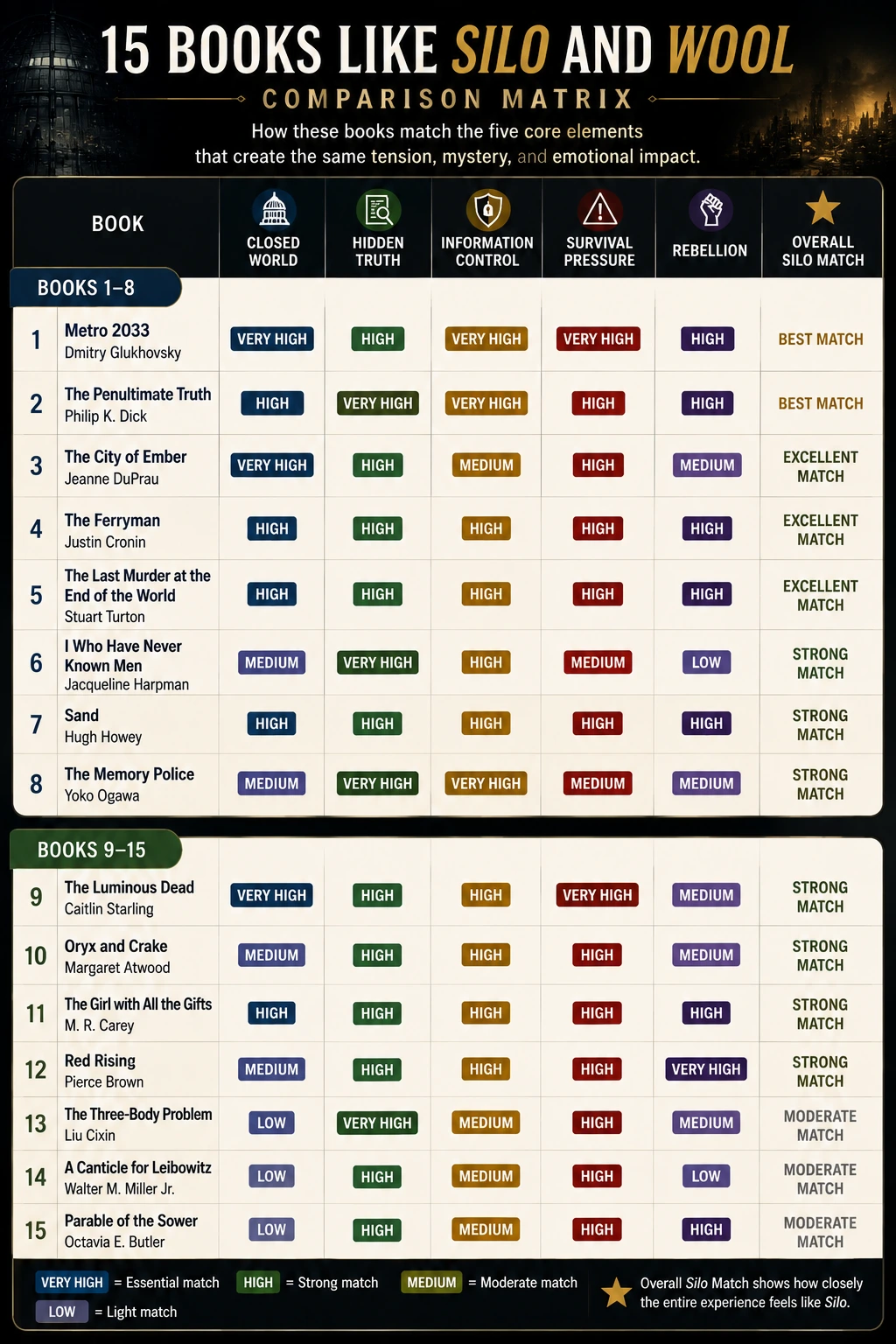
The matrix below is an editorial comparison, not a scientific scorecard. “Very high,” “high,” “medium,” and “low” describe how strongly each title reproduces a specific part of the Silo experience.
| Rank | Book | Closed world | Hidden truth | Information control | Survival pressure | Rebellion | Overall Silo match |
|---|---|---|---|---|---|---|---|
| 1 | Metro 2033 | Very high | High | Very high | Very high | High | Best match |
| 2 | The Penultimate Truth | High | Very high | Very high | High | High | Best match |
| 3 | The City of Ember | Very high | High | Medium | High | Medium | Excellent |
| 4 | The Ferryman | High | High | High | High | High | Excellent |
| 5 | The Last Murder at the End of the World | High | High | High | High | High | Excellent |
| 6 | I Who Have Never Known Men | Medium | Very high | High | Medium | Low | Strong |
| 7 | Sand | High | High | High | High | High | Strong |
| 8 | The Memory Police | Medium | Very high | Very high | Medium | Medium | Strong |
| 9 | The Luminous Dead | Very high | High | High | Very high | Medium | Strong |
| 10 | Oryx and Crake | Medium | High | High | High | Medium | Strong |
| 11 | The Girl with All the Gifts | High | High | High | High | High | Strong |
| 12 | Red Rising | Medium | High | High | High | Very high | Strong |
| 13 | The Three-Body Problem | Low | Very high | Medium | High | Medium | Moderate |
| 14 | A Canticle for Leibowitz | Low | High | Medium | High | Low | Moderate |
| 15 | Parable of the Sower | Low | High | Medium | High | High | Moderate |
The 15 Best Books Like Silo and Wool
1. Metro 2033 by Dmitry Glukhovsky
Best for: underground civilization, scarcity, ideology, danger beyond the safe zone, and survival inside a closed system · Editorial match: Best overall
If the physical structure of the silo was central to your enjoyment, Metro 2033 is the strongest place to go next. Glukhovsky imagines the survivors of nuclear catastrophe living in the Moscow Metro after the surface becomes uninhabitable. Stations become settlements. Routes become borders. Movement through tunnels is dangerous. Survival depends not only on food, weapons, and infrastructure but on the political systems people build inside confinement.
The deepest similarity is that the environment is never neutral. Underground geography shapes information, fear, identity, and authority. Different communities construct different explanations for what survival requires. The result is a world where people are physically close but politically fragmented, and where the unknown beyond a familiar boundary becomes almost mythic.
Metro 2033 is darker, stranger, and more overtly influenced by horror, militarism, and competing ideologies. It is less focused on one administrative system than Silo, but it recreates the feeling that civilization has been compressed into enclosed spaces where every belief carries material consequences.
Strongest overlap: underground society, fear of the surface, survival pressure, constrained movement, and contested truth.
2. The Penultimate Truth by Philip K. Dick
Best for: hidden reality, underground populations, political deception, and the discovery that the official emergency may not be what it seems · Editorial match: Best conceptual match
Philip K. Dick’s The Penultimate Truth may be the most direct recommendation for readers who loved the question at the heart of Silo: what if the people underground are making life-and-death decisions using a reality constructed for them by those with more information?
The novel places large numbers of people in subterranean shelters where they believe an ongoing war makes life on the surface impossible. Their labor and obedience are organized around that belief. The power of the premise comes from the possibility that the crisis justifying the system has become inseparable from the interests of those who benefit from maintaining it.
This is classic Philip K. Dick territory: reality is political because whoever controls the explanation of reality controls behavior. The book is more satirical, more overtly paranoid, and less interested in the day-to-day engineering of an underground community than Wool. But its conceptual overlap is exceptional.
Strongest overlap: subterranean life, manipulated information, a hidden surface reality, and authority built on controlled knowledge.
3. The City of Ember by Jeanne DuPrau
Best for: a failing underground city, inherited rules, infrastructure decay, clues from the past, and younger protagonists discovering a way beyond the accepted world · Editorial match: Excellent
The City of Ember is younger in audience than Silo, but its structural similarity is so strong that it belongs near the top of the list. Ember was built as a refuge for humanity. Generations later, the city’s great lamps begin to fail. The people living there inherit a system they did not design, depend on infrastructure they cannot fully replace, and possess only fragments of the knowledge needed to understand why the city exists.
The pleasure comes from watching a physical problem turn into an epistemic one. Failing systems force questions. Questions lead to clues. Clues expose the possibility that the accepted boundaries of the world are not absolute.
The differences are equally important. The City of Ember is more accessible, more hopeful, and less morally ambiguous. It does not build the same dense political machinery of secrecy and coercion. But for readers who loved the combination of enclosed civilization, failing infrastructure, inherited rules, and hidden exits, it is one of the cleanest matches available.
Strongest overlap: underground refuge, mechanical failure, lost instructions, discovery, and the possibility of another world beyond the walls.
4. The Ferryman by Justin Cronin
Best for: controlled society, concealed reality, unsettling perfection, identity, and the slow recognition that the world may be fundamentally different from what its inhabitants believe · Editorial match: Excellent
The Ferryman is a strong choice for readers who prefer the mystery of Silo to its physical setting. Justin Cronin builds a society that appears stable, ordered, and protected. Its rules are integrated into everyday life so thoroughly that they can feel less like oppression than like the natural architecture of existence.
That makes discovery more destabilizing. The central appeal is not simply learning a secret. It is experiencing the moment when an apparently coherent social reality begins to produce contradictions. Once enough contradictions accumulate, the protagonist has to decide whether the problem is personal, institutional, or something much larger.
Compared with Wool, this is a more dreamlike and identity-centered novel. The physical claustrophobia is lower, while psychological uncertainty is much higher. Readers who need underground machinery may prefer Metro 2033 or The City of Ember. Readers who loved the sense that every answer in Silo creates a larger question should put The Ferryman near the top.
Strongest overlap: apparently protective order, concealed truth, controlled life, and escalating reality revision.
5. The Last Murder at the End of the World by Stuart Turton
Best for: isolated community, rules that preserve survival, controlled knowledge, mystery, and questions that threaten the social order · Editorial match: Excellent
Stuart Turton’s novel takes place on an island community protected from a destroyed world by a system its inhabitants rely on. The villagers live inside a carefully managed order shaped by scientists, routines, boundaries, and assumptions about what survival requires. Then a murder turns social stability into a puzzle with existential consequences.
The Silo connection is especially strong because the mystery is systemic. Solving the immediate crime means asking questions about the world’s architecture, who possesses information, why certain rules exist, and whether obedience can remain rational when the people giving the instructions know more than everyone else.
The tone is different: Turton leans harder into puzzle-box mystery and compressed countdown suspense. The setting is open-air rather than subterranean, and the book is more structurally playful. Yet readers who loved Silo because Juliette’s questions keep turning local problems into larger truths should find this transition natural.
Strongest overlap: isolated survivors, existential rules, asymmetric knowledge, questioning authority, and mystery as a route to hidden reality.
6. I Who Have Never Known Men by Jacqueline Harpman
Best for: existential confinement, unexplained imprisonment, erased context, survival after release, and the emotional consequences of living without a reliable past · Editorial match: Strong
I Who Have Never Known Men begins deep underground, where women are confined under guard with little explanation of how they arrived or why they are being held. The youngest narrator has almost no meaningful memory of a life before confinement. That makes the novel a radical exploration of what a human being can become when culture, history, ordinary relationships, and explanations have been stripped away.
The similarity to Silo is less political and more existential. Both stories understand that controlled space also controls imagination. If you do not know what exists outside the boundary, you cannot easily evaluate the rules governing life inside it.
Harpman’s novel is quieter, lonelier, and more philosophical. It does not build toward rebellion in the same way, and it offers fewer institutional mechanisms to analyze. The mystery itself becomes a condition of existence rather than a puzzle guaranteed to produce satisfying answers.
Strongest overlap: underground confinement, missing history, unknown purpose, isolation, and the question of what remains human when explanation disappears.
7. Sand by Hugh Howey
Best for: another Hugh Howey survival world, buried civilization, dangerous environments, lost technology, family, and the physical recovery of the past · Editorial match: Strong
If you want another world built by Hugh Howey rather than another literal silo, Sand is the most natural extension. The old world lies buried beneath shifting dunes. Survival depends on extracting relics and useful material from what has been lost below. The environment creates a civilization shaped by scarcity, risk, specialized labor, and incomplete knowledge of the past.
The thematic connection is clear: the remnants of an earlier world are physically present but difficult to access, and the people living now have built an entire social order around surviving without full knowledge of what came before. In both settings, history is not merely something remembered. It is infrastructure buried under daily necessity.
Sand feels more adventurous and open than Wool. Its landscape expands horizontally rather than vertically, and family dynamics carry more of the emotional weight. But Howey’s recurring interest in survival, buried systems, inherited worlds, and people forced to act with incomplete information makes it a meaningful companion.
Strongest overlap: same authorial sensibility, buried past, survival labor, lost technology, and a world shaped by catastrophe.
8. The Memory Police by Yoko Ogawa
Best for: erased memory, authoritarian control, disappearance, quiet resistance, and the relationship between knowledge and identity · Editorial match: Strong
Yoko Ogawa’s The Memory Police is one of the most important recommendations on this list if the strongest part of Silo for you was not the bunker but the politics of forgetting. On an unnamed island, things disappear. Most people gradually lose their connection to what has vanished, while those who still remember become dangerous to the authorities responsible for enforcing forgetting.
This turns memory into contraband. A person who remembers possesses access to an alternative reality—evidence that the present is not complete. That logic is deeply compatible with Silo, where knowledge of the past and the outside world can threaten a social order built on restricted information.
The narrative is quieter, stranger, and more literary than Howey’s. Survival pressure is psychological and political rather than primarily mechanical. There is less infrastructure, less overt rebellion, and more attention to loss, language, art, and the erosion of self.
Strongest overlap: enforced forgetting, information control, suppressed truth, and memory as a source of freedom.
9. The Luminous Dead by Caitlin Starling
Best for: claustrophobia, underground danger, unreliable guidance, survival equipment, dependence, and mistrust · Editorial match: Strong
If your favorite part of Silo was the visceral experience of moving through dangerous enclosed spaces, The Luminous Dead offers a much more intimate version of that pressure. The novel follows a caver on a dangerous expedition where equipment, communication, environmental hazards, and the person controlling information from the surface all become part of the same survival system.
The book does not contain a full underground civilization, but it understands the psychology of dependence exceptionally well. When your route, suit, supplies, map, and interpretation of danger depend on someone else, information becomes physical. A lie is not merely manipulative; it can change whether you survive the next hour.
That creates a concentrated version of one of Silo’s core questions: what happens when survival requires trusting a system or person you have reason to doubt?
Strongest overlap: confinement, physical risk, controlled information, unreliable authority, and the fear that the environment contains more than you were told.
10. Oryx and Crake by Margaret Atwood
Best for: engineered catastrophe, corporate power, reconstructing how civilization failed, biotechnology, and the moral consequences of knowledge without restraint · Editorial match: Strong
Oryx and Crake is a looser setting match but an important thematic one. Margaret Atwood moves between survival after catastrophe and the world that helped create it. The result is a story about how knowledge, markets, technological capability, and insulated elites can combine into systemic danger long before society recognizes the full consequences.
Readers who loved Silo because the present cannot be understood without recovering the past will find the structure familiar. The mystery is not “what is outside the bunker?” but “how did a civilization with enormous knowledge produce a world in which survival itself became uncertain?”
The book is more satirical, more focused on biotechnology and corporate culture, and less centered on a rebellion against one visible institution. Its relevance comes from civilizational causality: hidden decisions accumulate, systems normalize dangerous incentives, and catastrophe can emerge from intelligence without wisdom.
Strongest overlap: concealed history, system failure, existential consequences, and the danger of concentrated technological power.
11. The Girl with All the Gifts by M. R. Carey
Best for: post-collapse survival, institutional secrecy, constrained life, dangerous outside environments, and discoveries that challenge the category of “human” · Editorial match: Strong
M. R. Carey begins with a protagonist whose everyday life is intensely controlled. Movement, education, restraint, authority, and danger are built into routine before the reader fully understands why. That makes the early experience particularly effective for Silo readers: rules arrive before context, and the meaning of those rules changes as the wider reality becomes clearer.
The story then expands beyond confinement into a post-collapse world where survival and scientific understanding become inseparable. The strongest similarity is the way new information forces characters to reconsider not only what is safe, but what kind of future is worth preserving.
It differs from Wool through its biological focus and its more direct horror elements. The political system is less extensive, while the ethical question of adaptation is more pronounced.
Strongest overlap: restricted life, hidden purpose, dangerous exterior world, scientific secrecy, and survival choices that redefine humanity’s future.
12. Red Rising by Pierce Brown
Best for: manufactured hierarchy, rebellion from within, social engineering, caste systems, identity transformation, and high-stakes resistance · Editorial match: Strong
Red Rising is much faster, larger, and more action-oriented than Silo, but it earns its place because of one powerful shared mechanism: a population’s behavior depends on what it has been taught about the structure of reality.
The novel’s central hierarchy is not merely political. It is reinforced by identity, labor, education, biology, mythology, and the belief that the social order reflects necessity. Rebellion becomes possible only when the protagonist learns that the world presented to him is not the whole world.
That revelation is pure Silo territory. A hidden truth changes the meaning of sacrifice. Once the official story collapses, obedience can no longer feel neutral. The protagonist must then enter the system deeply enough to understand how power reproduces itself.
The biggest difference is scale and tone. Red Rising becomes an expansive revolutionary saga with warfare, competition, and elite politics. Readers who want quiet mystery may find it too kinetic. Readers who loved the moment when hidden truth turns into resistance may find it irresistible.
Strongest overlap: false social reality, hierarchy, discovery, identity, and rebellion against a system designed to perpetuate itself.
13. The Three-Body Problem by Cixin Liu
Best for: hidden existential reality, scientific mystery, civilization-scale threat, strategic information, and discoveries that radically widen the reader’s frame · Editorial match: Moderate
The Three-Body Problem is not a closed-world novel, but it belongs on this list for readers who loved the way Silo keeps enlarging the meaning of what the characters think they know. Scientific anomalies and hidden networks gradually reveal that the real problem is much bigger than its first visible symptoms.
The shared pleasure is epistemic escalation. A strange detail becomes evidence. Evidence implies hidden structure. Hidden structure changes strategy. Once knowledge expands, the characters cannot return to the smaller world they inhabited before.
The difference is enormous in scale. Cixin Liu moves toward cosmic and civilizational questions, while Silo remains intensely focused on the lived experience of a bounded human community. The emotional texture is also colder and more strategic.
If that broader direction appeals, continue with Eternity Management’s dedicated guide to books like The Three-Body Problem.
14. A Canticle for Leibowitz by Walter M. Miller Jr.
Best for: civilizational memory, preserved knowledge, repeated catastrophe, institutional continuity, and the question of whether humanity can learn enough to avoid destroying itself again · Editorial match: Moderate
A Canticle for Leibowitz moves far beyond the claustrophobic setting of Silo, but it attacks one of the same deepest problems from another angle: what must survive when civilization collapses?
Long after catastrophic destruction, a religious order preserves fragments of knowledge whose meaning is only partly understood. Across generations, those fragments become part of humanity’s attempt to reconstruct science, culture, and civilization. Memory is therefore both salvation and danger. Knowledge can rebuild the world, but knowledge alone does not guarantee that humanity will use power wisely.
This makes the novel especially relevant to readers who saw the silo not simply as a bunker but as a civilizational memory system—a structure deciding what future generations are allowed to inherit.
Strongest overlap: preserved knowledge, catastrophe, institutional memory, survival across generations, and the moral limits of control.
15. Parable of the Sower by Octavia E. Butler
Best for: social collapse, adaptive survival, community-building, belief, leadership, and moving from the failure of one protected enclosure toward a new model of collective life · Editorial match: Moderate
Parable of the Sower is the least physically similar book in the ranking and one of the most useful philosophically. Octavia E. Butler begins with a protected community surrounded by worsening social instability. The central question is not how to preserve the enclosure forever. It is what happens when the enclosure can no longer preserve the people inside it.
That shift creates a revealing contrast with Silo. Closed systems can protect life, but protection becomes fragile if the system cannot adapt to changing conditions. Survival may eventually require mobility, new forms of trust, new beliefs, and the ability to build community among people who did not begin with a shared structure.
Butler’s novel is more social, more immediate, and more focused on change as a constant condition. It is less about hidden history and more about seeing present deterioration clearly enough to act before inherited assumptions become fatal.
Strongest overlap: survival under systemic collapse, limits of protected communities, adaptation, leadership, and the search for a future worth building.
Choose Your Next Book by What You Loved Most About Silo
The ranking is useful if you want one ordered list. But literary similarity is personal. The better question is often: which part of Silo do you want again?
If you loved the underground world
Start with Metro 2033 for a full subterranean civilization, The City of Ember for a failing underground refuge, or The Luminous Dead for pure claustrophobic danger. These books make physical enclosure part of the storytelling rather than a decorative setting.
If you loved uncovering the truth
Choose The Penultimate Truth, The Ferryman, or The Last Murder at the End of the World. Each begins with a world that appears coherent enough to function, then reveals contradictions that make the accepted explanation increasingly difficult to trust.
If you loved information control
Read The Memory Police for enforced forgetting, Red Rising for a hierarchy sustained by manufactured reality, or Oryx and Crake for the consequences of powerful institutions making world-changing decisions outside meaningful public control.
If you loved rebellion against the system
Red Rising is the strongest choice for explicit revolutionary energy. The Girl with All the Gifts is better if you want resistance to emerge from a changing understanding of identity and survival. Parable of the Sower is best if you want to move from rebellion toward the harder problem of building something new.
If you loved the bigger civilization question
Choose A Canticle for Leibowitz for memory across collapse, The Three-Body Problem for existential strategy, I Who Have Never Known Men for a radically existential view of survival, or Parable of the Sower for adaptation when inherited systems fail.
What Silo Really Asks About Civilization
The most interesting question in Silo is not whether the bunker is good or bad. It is more difficult:
Can a civilization remain worth preserving if survival depends on preventing people from understanding the truth about their own world?
Closed systems often begin with a rational purpose. A threat creates the need for coordination. Coordination requires rules. Rules require authority. Authority needs reliable information. Under pressure, leaders may conclude that information itself must be restricted because panic, disagreement, or uncontrolled action could endanger everyone.
The problem appears later. Once control becomes the main defense against risk, the system can begin suppressing the very signals it needs in order to adapt. People closest to a problem may stop reporting it. Historical memory may be narrowed to preserve legitimacy. Dissent becomes indistinguishable from danger. The structure becomes safer in the short term while becoming more fragile in the long term.
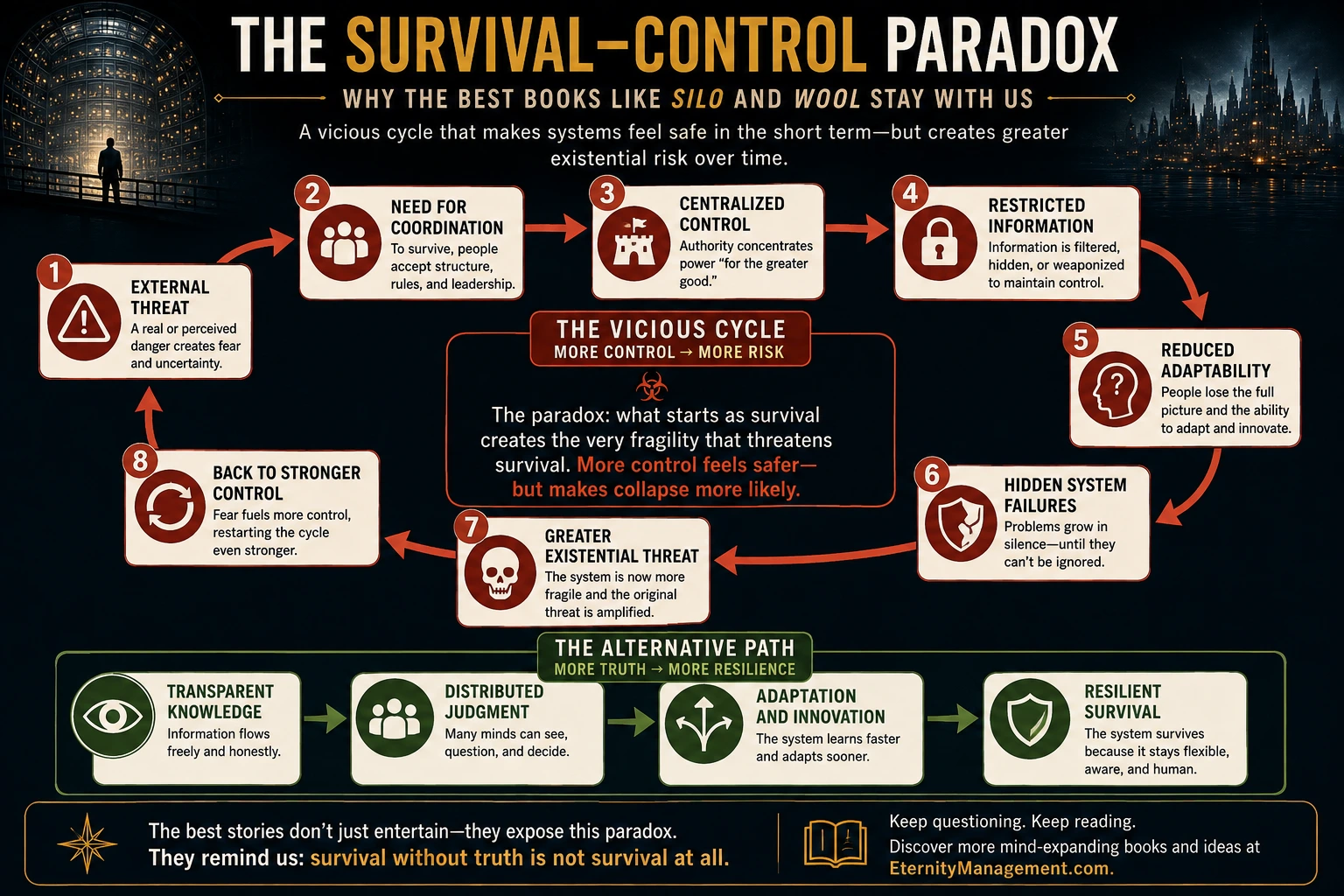
The vicious cycle can be summarized as:
External threat → need for coordination → centralized control → restricted information → reduced adaptability → hidden system failures → greater existential threat → stronger control.
The alternative is not the absence of structure. Resilient survival still requires institutions, coordination, expertise, and responsibility. The difference is whether knowledge can move through the system fast enough for people to detect problems and correct them.
A more adaptive path looks like:
Transparent knowledge → distributed judgment → adaptation and innovation → resilient survival.
This is also why Silo belongs naturally beside Eternity Management’s wider articles on why civilizations collapse even when they are rich, how civilizations survive collapse, and who should guard the future of humanity. The shared concern is not merely survival. It is the architecture of survival: knowledge, authority, memory, legitimacy, adaptation, and responsibility.
A Philosophical Extension: Those Who Guard Eternity
If you loved Silo because it asks who has the right to control consequential knowledge, what protection becomes when it limits freedom, and whether a small group can legitimately make choices for people who do not know the full truth, there is a thematic bridge to Those Who Guard Eternity.
The connection is philosophical rather than literal. Those Who Guard Eternity is not an underground dystopian novel and should not be treated as a direct substitute for Wool. Its overlap lies in hidden structures, dangerous knowledge, responsibility across time, the burden of seeing more than others can see, and the moral problem created when guardianship begins to resemble control.
Author disclosure: Those Who Guard Eternity was written by Denys Kostin, the creator of Eternity Management and author/editor of this guide. It is presented separately from the ranked 15 so readers can distinguish independent recommendations from the author’s own thematic extension.
Read the philosophical extension free
Begin Those Who Guard Eternity, Book 1 of the Eternity Saga, and explore a story about time, reality, consciousness, truth, choice, responsibility, and the price of possessing consequential knowledge.
Related Reading on Eternity Management
- Books Like The Three-Body Problem — for concealed existential reality, first contact, strategic information, and civilization-scale danger.
- Books Like The Expanse — for survival, political systems, technology, and lived-in civilization under pressure.
- Books Like Foundation — for institutions, civilizational continuity, long-term strategy, and the preservation of knowledge.
- Books Like Children of Time — for adaptation, intelligence, evolution, and civilization across deep time.
- Books Like Dune — for power, controlled narratives, political systems, and humanity’s future.
- Books About the Future of Humanity — for a wider reading path through collapse, transformation, survival, and what humanity may become.
- Why Civilizations Collapse Even When They Are Rich — for the systems problem behind resources, coordination, legitimacy, and adaptation.
- How Civilizations Survive Collapse — for the role of knowledge, memory, institutions, and culture across rupture.
Frequently Asked Questions About Books Like Silo
What should I read after Silo?
Start with Metro 2033 if you want another underground civilization under constant survival pressure. Choose The Penultimate Truth if hidden reality and information control mattered more, The City of Ember for a failing underground refuge, or The Last Murder at the End of the World for a modern mystery about an isolated society protected by rules it does not fully understand.
What order should I read the Silo books in?
Read Hugh Howey’s Silo trilogy in this order: Wool → Shift → Dust. Wool establishes the silo and its central mysteries, Shift expands the history and origins behind the system, and Dust brings the trilogy toward its conclusion. If you came from the television adaptation, this is the clearest book-reading sequence.
What book is most similar to Silo?
Metro 2033 is the closest overall match in this ranking because it combines underground life, fear of the surface, scarcity, political fragmentation, controlled information, and survival inside a closed environment. The Penultimate Truth is the closest conceptual match if the central appeal for you was discovering that an underground population may be living inside a manufactured version of reality.
What books are similar to Wool by Hugh Howey?
Metro 2033, The Penultimate Truth, The City of Ember, The Ferryman, The Last Murder at the End of the World, and I Who Have Never Known Men are strong choices. Each reproduces a different element of Wool: enclosed life, hidden history, unreliable authority, controlled knowledge, survival pressure, or the discovery that the world is larger than the official story.
Is Wool the same story as Silo?
Wool is the first major volume in Hugh Howey’s Silo trilogy, followed by Shift and Dust. Apple’s television series Silo is based on that trilogy, but the adaptation and the books should be treated as related rather than identical experiences because screen adaptations can change pacing, chronology, characterization, and when information is revealed.
What should I read after Wool, Shift, and Dust?
For the closest underground-survival atmosphere, read Metro 2033. For hidden social reality, read The Penultimate Truth. For another Hugh Howey world built around catastrophe, buried history, and survival labor, read Sand. For a more philosophical treatment of memory and control, choose The Memory Police or A Canticle for Leibowitz.
Are there other books set underground like Silo?
Yes. Metro 2033 centers on survivors living in the Moscow Metro. The City of Ember takes place in an underground refuge whose infrastructure is failing. I Who Have Never Known Men begins with women imprisoned underground without a reliable explanation of how they arrived. The Luminous Dead focuses on a dangerous caving expedition rather than an underground civilization, but it delivers exceptional claustrophobia.
What dystopian books have hidden societies like Silo?
The Penultimate Truth, The Ferryman, Red Rising, and The Memory Police are especially relevant. They differ dramatically in setting and tone, but each explores a social order whose stability depends on asymmetrical knowledge, hidden history, manufactured reality, or the suppression of information that could change how people understand the system.
Is Metro 2033 similar to Silo?
Yes, especially in its underground setting, survival pressure, dangerous surface, restricted movement, political fragmentation, and the way enclosed geography shapes culture and authority. Metro 2033 is darker and more horror-influenced, while Silo is more concentrated on one institutional system and the mysteries surrounding its origin.
Is The City of Ember like Silo?
Yes, structurally. Both involve underground refuge, inherited rules, failing infrastructure, missing knowledge from the past, and characters who begin to suspect that the accepted boundaries of their world are incomplete. The City of Ember is written for a younger audience and is more hopeful and straightforward, but its core premise makes it one of the strongest read-alikes.
What should I read if I liked the Silo TV series?
If you have not read Hugh Howey’s trilogy, begin with Wool, then Shift and Dust. If you already know the books, move to Metro 2033 for underground civilization, The Penultimate Truth for concealed surface reality, The Ferryman for controlled-world mystery, or Red Rising for rebellion after discovering a manufactured social order.
Sources and Editorial Methodology
This guide is a researched, spoiler-light recommendation article. Rankings are editorial judgments based on thematic and structural similarity, not review aggregates, paid placement, retailer commission, or a claim that literary experience can be objectively scored. High-level premises, series relationships, and current adaptation details were checked against author, publisher, and official platform pages where available.
Selected primary and publisher sources:
- Hugh Howey — Wool
- Hugh Howey — Shift
- Hugh Howey — Dust
- Hugh Howey — Sand
- Apple TV Press — Silo season 3 and trilogy basis
- Dmitry Glukhovsky — Metro 2033
- Hachette — The Penultimate Truth
- Penguin Random House — The City of Ember
- Penguin Random House — The Ferryman
- Bloomsbury — The Last Murder at the End of the World
- Transit Books — I Who Have Never Known Men
- Penguin Random House — The Memory Police
- Caitlin Starling — The Luminous Dead
- Orbit — The Girl with All the Gifts
- Penguin Random House — A Canticle for Leibowitz
- Octavia E. Butler — Parable of the Sower
- Penguin Random House — Oryx and Crake
- Penguin Random House — Red Rising
- Tor / Macmillan — The Three-Body Problem
Image methodology: The diagrams in this article are original editorial visuals created for Eternity Management. Their comparison labels are explanatory judgments, not publisher ratings or empirical measurements.
Final Thoughts: Where Do You Go After the Silo?
Finding books like Silo is not really a search for another staircase, bunker, sheriff, or forbidden door. It is a search for stories in which the architecture of survival becomes the architecture of truth.
If you want the closest overall match, start with Metro 2033. If you want the sharpest hidden-reality premise, choose The Penultimate Truth. If you want a failing underground city and a secret left by the past, read The City of Ember. If you want a modern mystery where survival depends on questioning the rules of an isolated society, choose The Last Murder at the End of the World. If you want the most existential version of confinement and lost context, read I Who Have Never Known Men.
The deeper thread connecting them is the same question that keeps Silo compelling long after the immediate mystery begins: what must a civilization preserve in order to remain worth preserving? Bodies are not enough. Infrastructure is not enough. Order is not enough. A civilization also needs memory, truth, adaptability, agency, and people capable of recognizing when protection has become a system for protecting itself.
That is why the best read after Silo is not necessarily the book with the closest setting. It is the one that makes you question the walls you did not notice until someone showed you where to look.