Full spoilers for The Will of the Many, including the epilogue. This guide stays within Book 1 and does not use revelations from The Strength of the Few to answer its mysteries.
Synchronism in The Will of the Many is the epilogue’s central revelation: Vis has continuing versions in Res, Luceum, and Obiteum. The repeated awakenings show different experiences after the labyrinth. They expand his story beyond the familiar Academy world, without giving readers a complete rulebook for how the connection works.
Below, the three experiences are compared scene by scene, followed by an explanation of the arm marks and the difference between a shared past and shared awareness.

Need to check a name or connection before exploring the ending? Our The Will of the Many character guide covers the main cast, with clearly marked Book 1 spoilers.
What is Synchronism in The Will of the Many?
Synchronism names the epilogue that reframes Vis’s passage through the labyrinth. Caeror describes Vis as having been copied. Read together, the closing scenes point to multiple continuations of one person rather than a straightforward journey from one location to the next.
The key is multiple continuations, not one traveler making three consecutive visits. Reading the awakenings as an ordinary itinerary is what makes the epilogue seem contradictory.
For the surrounding events, including the Academy aftermath, see the full ending explanation of The Will of the Many. This guide concentrates on the connections between the closing scenes.
Res, Luceum, and Obiteum at a glance
Islington’s official Book 1 glossary lists all three names but offers deliberately limited descriptions. The ending gives us experiences to compare, rather than a comprehensive geography or cosmology.
On a narrow screen, swipe the table horizontally.
| Scene / world | What Vis experiences | The arm and its significance |
|---|---|---|
| Main narrative: Res | Writing appears on his arm after the gate. He escapes and returns to the Academy storyline. | His injured arm is later amputated. This is part of the main narrative’s aftermath. |
| First epilogue sequence: Luceum | A repeated awakening leads to another escape sequence and a snowy rotunda. | The passage requires a toll; he discovers that his left arm is gone. |
| Second epilogue sequence: Obiteum | Caeror greets Vis, describes copying, and says that Vis in Res needs saving. | Caeror takes out a knife and reaches for Vis’s arm, inviting a connection with the earlier writing. |
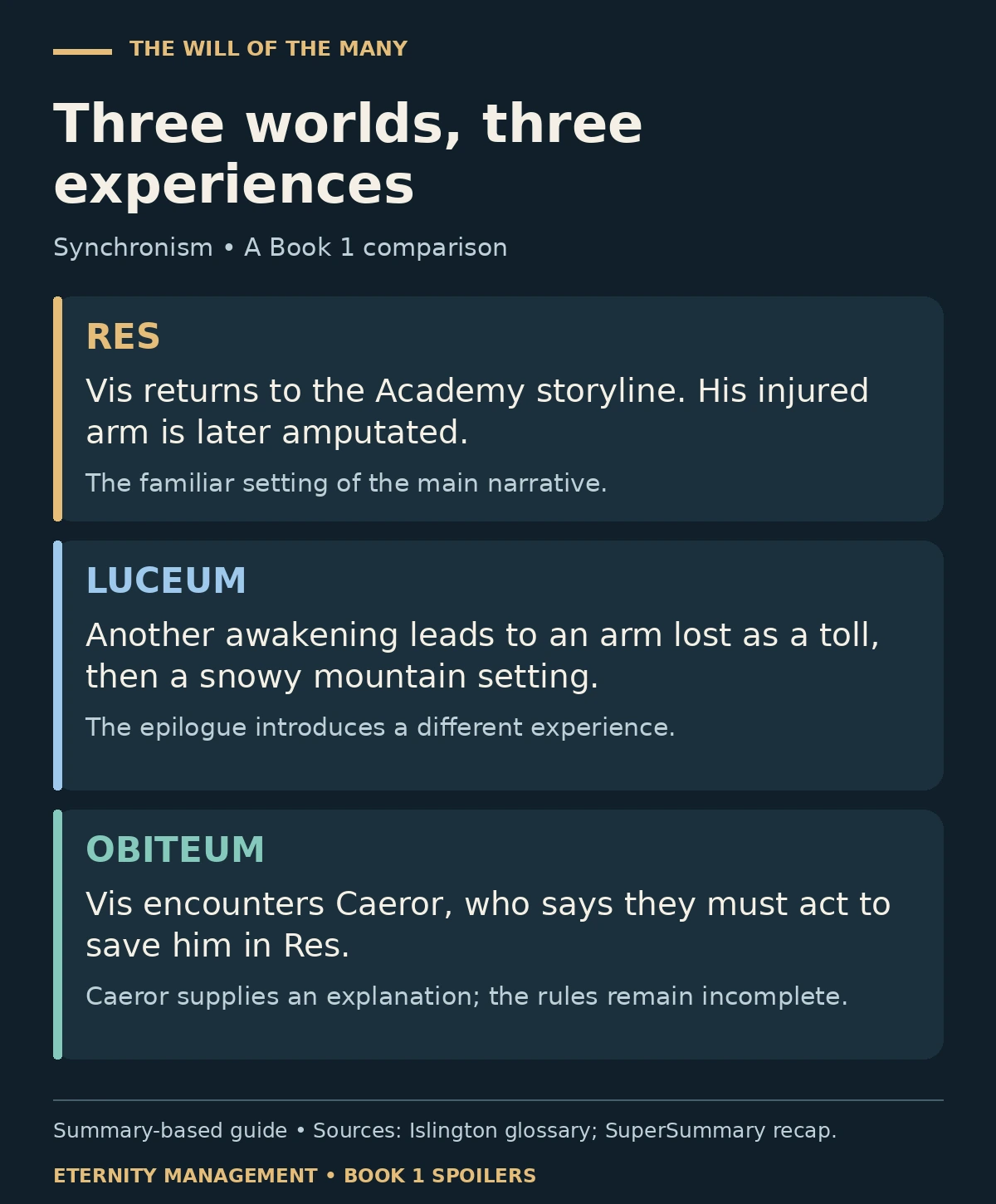
The crucial distinction: the amputation in Res and the toll in the Luceum sequence occur in different contexts. The knife in Obiteum is a further clue, not a third description of that same amputation. The closing-chapter summary and Recaptains recap both distinguish these scenes.
How to read the epilogue’s repeated awakenings
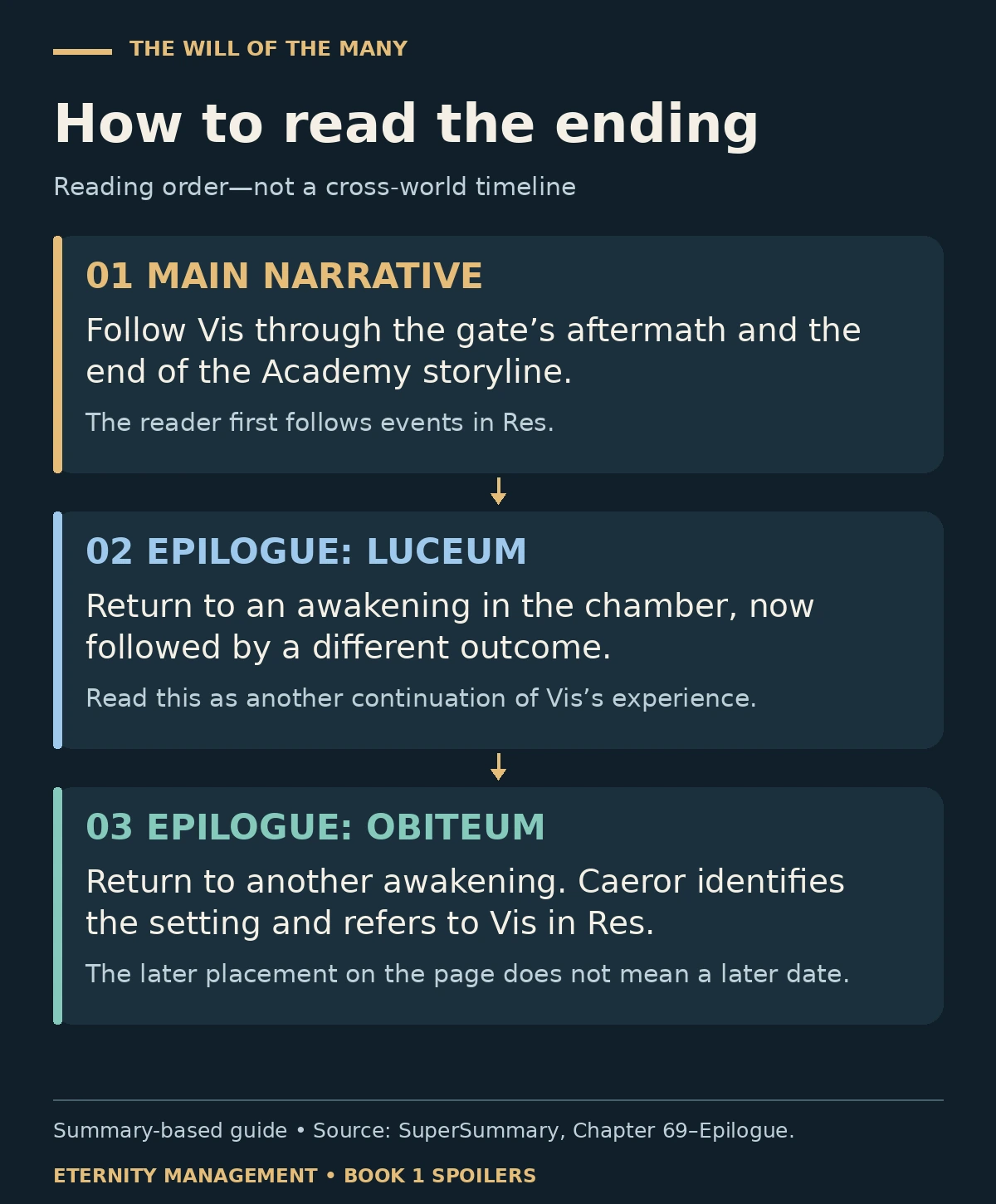
The epilogue returns to the awakening after the gate. Its position after the Academy aftermath does not make it a straightforward account of what Vis does next. It revisits a turning point through other continuations.
- Finish the main narrative. Keep its consequences in view.
- Read the Luceum sequence as a new continuation. Notice where the familiar awakening leads somewhere different.
- Read the Obiteum sequence alongside it. Caeror’s reference to saving Vis in Res connects this experience to the danger elsewhere.
On a reread, compare the chamber scenes side by side. Notice the repeated starting point, then track the first difference. This makes the reveal easier to follow than trying to join every scene into one continuous journey.
Are the three versions of Vis the same person?
The reveal presents continuations of Vis, but shared history does not automatically mean shared awareness. Remembering the same earlier life and receiving every new experience from another version are different claims.
Consider a hypothetical example, rather than an additional claim about the novel: two people remember making the same promise. One then witnesses a betrayal; the other does not. Their memories before that moment may agree while their next decisions differ. Shared history alone cannot tell us whether new information is shared.
Interpretation: the interesting question is not which version deserves to be dismissed as a copy. It is what responsibility, trust, and personal identity mean once experiences diverge. Calling one version “the real Vis” can conceal that question instead of answering it.
For a broader reading path through these ideas, explore books about identity.
What do the wounds and messages reveal?
The arm clues are easier to understand in three parts: writing conveys information; injury threatens the body; the toll belongs to a passage. Combining them into one event erases the distinctions the closing scenes make.
Strong implication: Caeror’s urgency, knife, and attention to the arm suggest that the earlier warning marks are part of a rescue attempt across worlds. The reader encounters the apparent result before being shown its likely source.
That connection explains the usefulness of the messages. It does not, by itself, prove that every injury or thought must transfer in the same way. A demonstrated connection and a universal rule are different things.
Emissa’s reaction introduces a related question about what she believes the wound means. That deserves its own discussion: why Emissa tried to kill Vis.
What Book 1 establishes—and what remains a theory
Use this distinction when evaluating a theory about Synchronism:
| Category | Example | How to use it |
|---|---|---|
| Reported event | The narrative presents additional awakenings. | Start with what the scenes show. |
| Character explanation | Caeror describes copying and a danger in Res. | Attribute the account to its speaker. |
| Interpretation | The arm marks and rescue attempt indicate a connection. | Explain the evidence without inventing a complete system. |
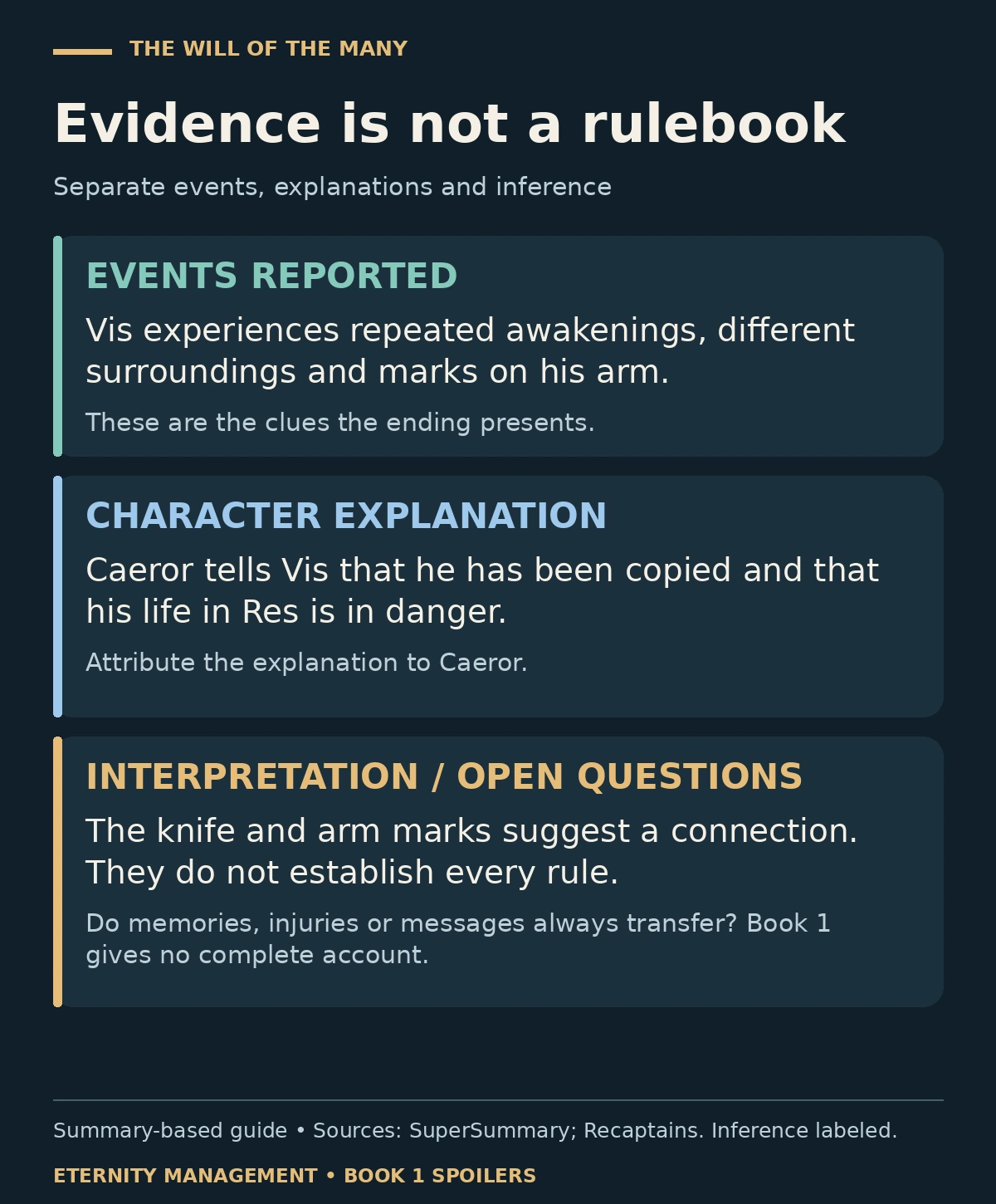
Book 1 leaves the connection’s full limits unresolved. In particular, these scenes do not establish unrestricted memory-sharing or a rule that every bodily change must affect every version.
Why Synchronism changes the stakes for Vis
Interpretation: a concealed identity becomes a problem of multiple identities. Earlier, the practical question is who knows the truth about Vis. After this reveal, another question becomes possible: what can any version of him know about the experiences of the others?
Help can arrive before its source is understood. A person may need to act on information whose origin they cannot verify. The twist therefore changes both the scale of the story and the conditions under which Vis must decide whom to trust.
Frequently asked questions about Synchronism
Is Synchronism the same as the Hierarchy’s Will system?
Do not treat the terms as interchangeable. Will belongs to the established system of transferred power; Synchronism introduces a different problem involving Vis and multiple worlds. This Book 1 guide does not claim a complete explanation of how the two relate.
Do the versions of Vis share memories?
A common past is different from automatically sharing every subsequent experience. Book 1 does not provide a complete account of ongoing memory-sharing, so the connection should not be described as unrestricted shared awareness.
Does Book 1 explain all the rules of the three worlds?
No. It introduces the larger situation through scenes, clues, and partial explanations. A diagram can organize those clues; it cannot supply rules that the story has not established.
Can I understand this guide before reading The Strength of the Few?
Yes, provided you have finished The Will of the Many. This explanation includes its ending but deliberately leaves sequel revelations out.
Where to read next
Return to the ending explained for the wider plot, or explore books like The Will of the Many for another novel with political intrigue, hidden identities, or deeper mysteries.
For readers interested in hidden reality and consequential choices
Those Who Guard Eternity explores time, perception, and the cost of questioning an accepted reality. Author disclosure: it is my own novel, offered here as a separate reading suggestion, not as a source for interpreting Islington’s work.
Sources and editorial scope
This guide combines original interpretation with plot details cross-checked against published summaries. Names were checked against Islington’s glossary. The relevant passages of the novel have not been directly verified for this article. The scope is Book 1 only.
- James Islington’s official glossary for The Will of the Many: names and terminology.
- SuperSummary: Chapter 69–Epilogue: closing scenes and order of presentation.
- Recaptains: The Will of the Many recap: a second account of the aftermath and epilogue.
- Wikipedia: plot overview: broad context for the novel’s power system and ending.
The hero is an original symbolic illustration. The three supporting diagrams organize summary-based information; their captions distinguish reading order, character explanations, and interpretation.
Already finished the sequel? Our The Strength of the Few ending explanation compares Vis’s choices across Res, Luceum, and Obiteum. Full Book 2 spoilers.