
The Iudicium in The Will of the Many is the Catenan Academy’s competitive final test on Solivagus. Students compete in teams, but the rewards do not give every teammate the same interests. Understanding that tension makes the closing part of James Islington’s novel much easier to follow.
This guide explains the competition’s central rules, separates its tracking devices, and then follows the key events. It is a focused companion to the novel, rather than a chapter-by-chapter retelling.

What is the Iudicium?
The Iudicium connects Academy achievement with the prospect of advancement. It is useful to distinguish three things: the school’s class system, the Republic’s Will hierarchy, and the title earned through the contest. They interact, but they are not interchangeable labels.
James Islington’s official glossary is a useful reference for the setting and terminology. For the difference between school placement and political power, see our Will system and Hierarchy ranks explanation.
Read the competition on two levels: what participants must do to satisfy the rules, and what they must decide about the people helping them. The second level is where a simple objective becomes a difficult test of judgment.
Iudicium rules at a glance
The following is a selective guide to the mechanics introduced around Chapter 63, not an exhaustive rulebook for every boundary or penalty.
| Element | Central rule |
|---|---|
| Team | A Class Three commander selects two lower-class teammates; the briefing distinguishes Third and Fourth roles. |
| Objective | Recover the Heart of Jovan and return it to its statue at the Academy. |
| Commander’s reward | A victorious Third becomes Domitor. |
| Subordinates’ incentives | Private offers create alternatives to simply helping the commander win. |
| Starting information | Tracking advantages depend on the teams’ rankings. |
These mechanics are described in SuperSummary’s Chapters 61–68 guide. The important distinction is between a shared task and a shared interest: working together does not mean everyone receives the same benefit from the outcome.
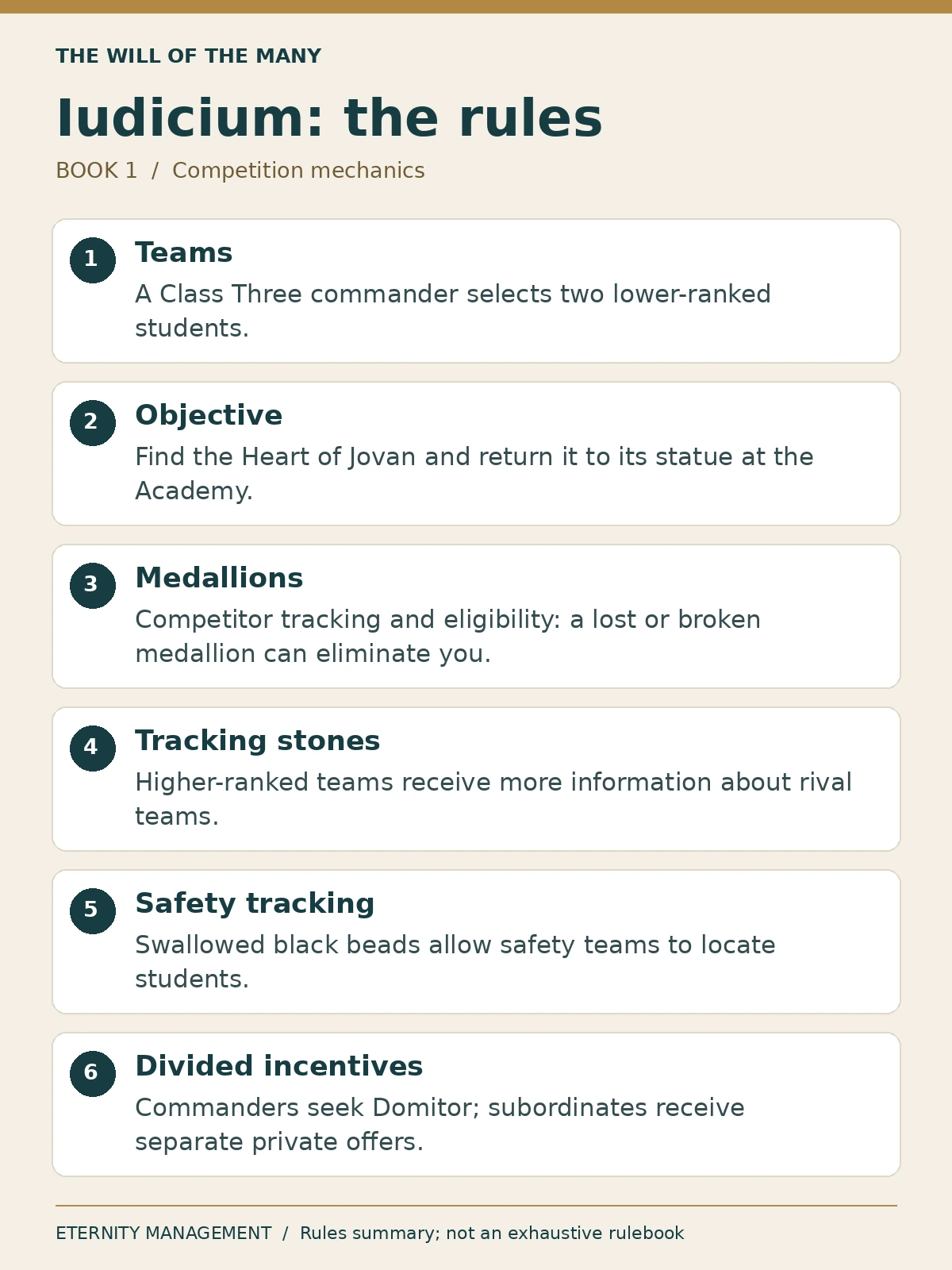
Medallions, tracking stones, and safety beads
The Chapter 63 briefing distinguishes four connected pieces of equipment. Their functions overlap, but they are not interchangeable.
| Equipment | Function |
|---|---|
| Third’s medallion | Required to complete the objective. Taking or breaking it can eliminate its holder. |
| Fourth’s medallion | Links to a Third’s medallion. That connection matters both for sharing a Third’s victory and for a Fourth returning the Heart. |
| Coloured tracking stones | Track other medallions or the Heart. Higher-ranked Thirds receive more of them. |
| Internal safety tracker | The Third swallows a bead paired with their medallion. Separating the pair too far alerts the safety teams. |
Why the links matter: Fourths can change allegiance by changing their medallion connection. Possessing the Heart is therefore not the only condition for a valid finish. These details also qualify the simplified rules graphic above: its safety-tracking row describes the mechanism generally, not a requirement that every participant swallows a bead.
The narrative consequence is important: hiding from another team and hiding from the people supervising the contest are different problems. When reading a tracking scene, ask three questions: What is being tracked? Who can see the information? What happens if the object moves without its owner? That approach is more useful than remembering a single vague idea of a magical tracker.
For example, moving a medallion can change what opponents believe about a competitor’s position. That does not necessarily conceal the person from the separate safety system. Keep the two audiences for tracking information distinct.
Who is on Vis’s team?
Vis competes with Callidus and Aequa. Eidhin is an earlier choice but withdraws because participation could endanger his people. Aequa becomes his replacement. This is a change in the team’s formation, not evidence that Eidhin competes alongside the final trio.
For names and affiliations, use the The Will of the Many character guide. The Recaptains Book 1 recap provides additional context for Vis’s relationships and the pressures surrounding the contest.
Interpretation: Team selection turns an abstract question about trust into a practical choice. Choosing someone means accepting their ability to act when you cannot watch them. A commander can demand obedience, but that does not establish loyalty; nor does a friendship remove every conflicting obligation.
What happens during the Iudicium?
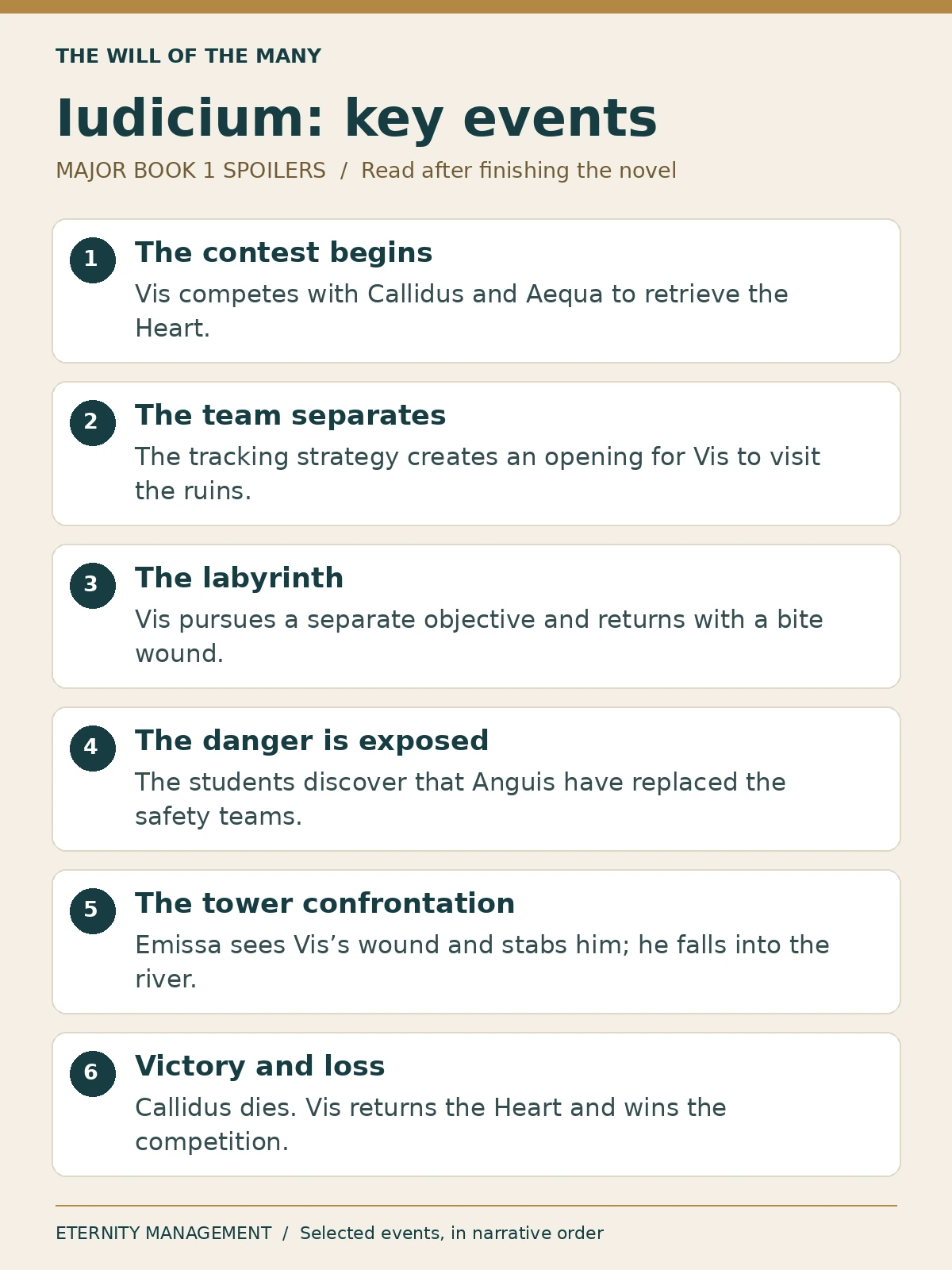
The sequence below follows the main turning points. It separates Vis’s competition strategy from his secret mission and the later emergency.
- The teams enter the contest. Vis, Callidus, and Aequa pursue the Heart while navigating rival teams and unequal information.
- An ambush tests the team’s trust. Iro’s group captures Vis and Callidus. Aequa appears to switch sides, but returns to free them. Her apparent defection should not be mistaken for a lasting abandonment of Vis.
- The team seeks better information. Aequa works to recover Vis’s medallion; Vis and Callidus target a safety team’s tracker. Their lack of ordinary tracking stones makes that information valuable.
- Vis gets an opening to investigate the ruins. After the tracker operation separates him from Callidus, he takes the opportunity to pursue his other mission.
- He runs the labyrinth. He later rejoins the competition with a bite wound.
- The students discover the attack. After reuniting, the team uses tracking information to plan its next move. Vis and Aequa then discover bodies and recognize that Anguis infiltrators have replaced the safety teams. Warning others becomes more urgent than outplaying them.
- Emissa confronts Vis. After noticing his wound, she stabs him; he falls into the river.
- Vis returns to the Academy. Callidus dies, and Vis completes the contest by returning the Heart.
The later sequence is cross-checked against SuperSummary’s Chapters 69–epilogue guide. For a broader recap, see Fantasy Book Recaps.
Is the labyrinth part of the Iudicium?
It is not the publicly announced objective. The Heart is the competition target; Vis’s investigation of the ruins belongs to the larger mystery. The two become entangled because he tries to pursue them during the same period.
This distinction prevents a common reading error: treating every danger encountered during the Iudicium as a legitimate part of its rules. A setting can contain a contest, a covert mission, and an attack at once. Their overlap does not make them one coordinated exercise.
The ruins also change the questions the reader must ask. A competition asks who can win under known constraints. The labyrinth raises questions about what those constraints fail to explain. For the larger ending, continue to The Will of the Many ending explained; for the epilogue’s worlds and parallel experiences, use the Synchronism explanation.
Who wins—and what does victory cost?
Vis wins the Iudicium and becomes Domitor. The return of the Heart completes the formal objective. Callidus’s death makes that result inseparable from loss.
Interpretation: The ending separates institutional success from personal success. An institution can register a winner without capturing what the winner has lost. That difference matters because it prevents the contest from resolving into a reassuring claim that the best competitor received the best outcome.
The title records a result; it does not establish that the system was fair, that its safeguards worked, or that every decision leading to victory was justified. Reading the conclusion through those separate questions preserves its moral discomfort.
Confirmed events vs. uncertain motives
The physical sequence is clearer than every participant’s understanding of it. In particular, an explanation offered by a character is not automatically an independent account of the whole truth.
| What the story establishes | What needs qualification |
|---|---|
| The safety operation is compromised. | A full account of every organizer’s prior knowledge. |
| Emissa attacks Vis after seeing his wound. | Her complete understanding and all her motives. |
| Vis completes the contest. | Whether winning represents a moral endorsement of the Academy. |
Veridius later offers an explanation of Emissa’s actions. Present it as his explanation, not as an omniscient verdict. Our analysis of why Emissa tried to kill Vis examines that question separately.
A useful reading discipline is to keep three columns in your notes: what happened, what someone said it meant, and what you infer. A persuasive theory can belong in the third column without being promoted into the first.
What the competition reveals about power
Interpretation: The Iudicium tests the gap between command and trust. A commander’s authority does not remove a teammate’s private incentives, while a team’s formal success does not guarantee that its members are protected.
The medallion links make allegiance operational: it can change the result. Vis’s dependence on people acting beyond his sight makes loyalty personal. Those two meanings of belonging are not always the same.
The conclusion exposes a second gap: an institution can record a winner without accounting for the human cost. That is why the title of Domitor resolves the contest without resolving the reader’s questions about responsibility.
Frequently asked questions
Is it Iudicium or ludicium?
The name begins with a capital I: Iudicium. In some fonts it resembles a lowercase l. Use the spelling in the author’s glossary when searching or taking notes.
Is Domitor a Will rank?
Domitor is an Academy distinction, not one of the Will hierarchy ranks. Keep school achievements separate from the Republic’s power structure.
Can a Fourth win the Iudicium?
Yes. Returning the Heart is not reserved to a Third, but the Fourth’s medallion must remain linked to a Third’s medallion for the finish to count. This is one reason the private offers create tension inside teams.
Why is the Iudicium confusing?
Several problems overlap: the official contest, incomplete information, private incentives, Vis’s separate mission, and the attack. Track each problem independently before trying to explain their connections.
Does this guide cover The Strength of the Few?
No. Its scope ends with Book 1. Later revelations should not be silently inserted into an explanation written for readers who have just finished the first novel.
What to read next
If you want another novel with academy rivalry, hidden identities, or political pressure, explore our books like The Will of the Many.
Sources and scope
This Book 1 guide uses James Islington’s official glossary for names and terminology, alongside the linked SuperSummary chapter guides and independent recaps for event checks. The commentary about trust, incentives, and the limits of victory is our interpretation.
The equipment distinctions refer to the Iudicium briefing in Chapter 63 of James Islington’s The Will of the Many (2023). Secondary summaries sometimes generalize the Thirds’ trackers to all students. This guide separates those roles, but is not a transcription of every rule, boundary, deadline, or exception. A complete check against a licensed edition remains outstanding. Chapter references are used instead of edition-dependent page numbers.
The hero is an imaginative illustration. The rules graphic is a selective reference, and the timeline contains major Book 1 spoilers.