Civilization · Resilience · Long-term responsibility
Prosperity can make a civilization look invulnerable while its capacity to perceive danger, correct failure, coordinate action, and protect the future is quietly disappearing.
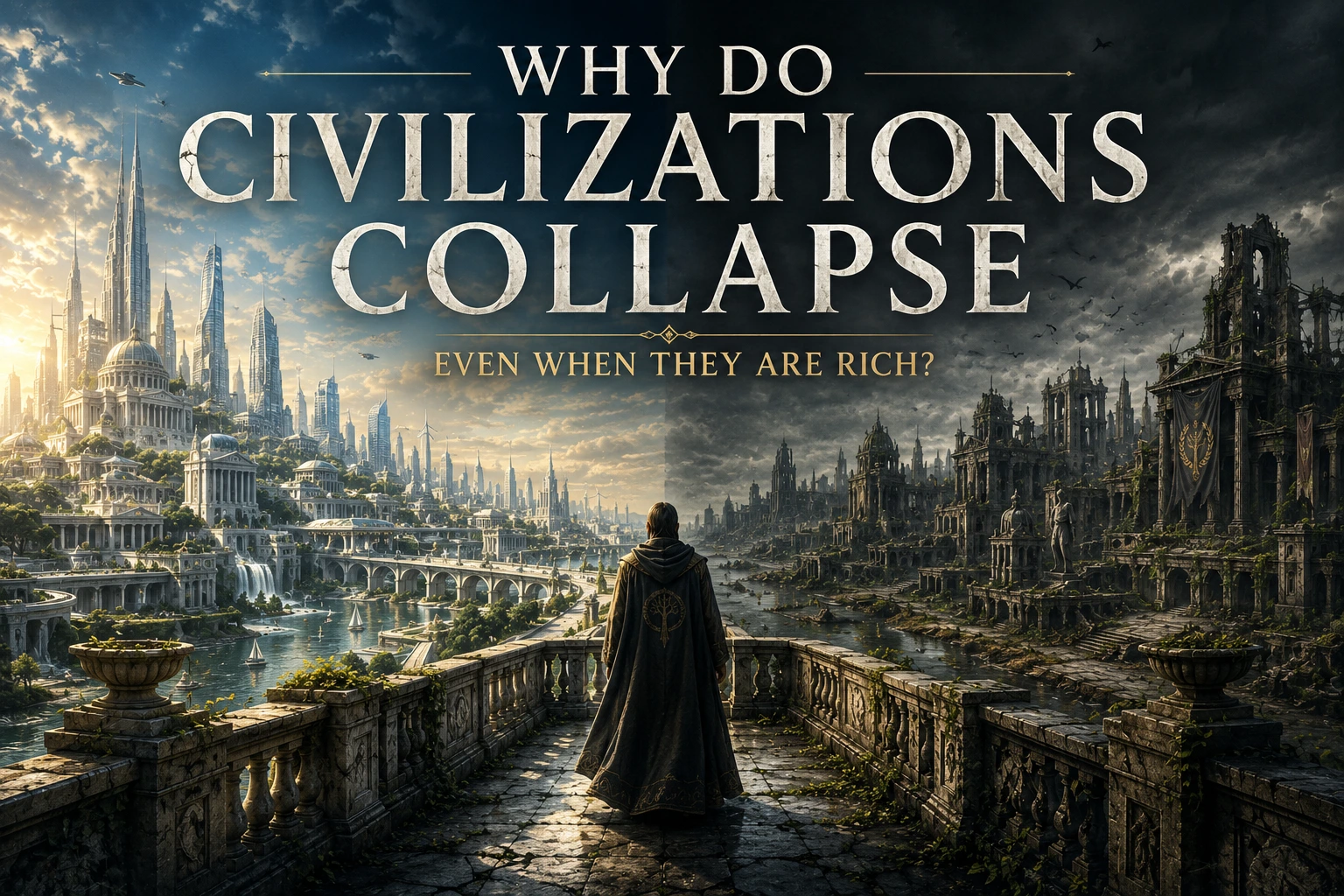
Why do civilizations collapse when they possess wealth, technology, educated populations, powerful institutions, and vast stores of knowledge? The question appears paradoxical only if prosperity is mistaken for resilience. A civilization may be rich in assets while becoming poor in coordination. It may expand its infrastructure while losing the competence required to maintain it. It may produce more information while becoming less capable of recognizing truth. It may possess enormous power while becoming unable to use that power wisely.
The most dangerous stage of decline is therefore not visible ruin. It is the period in which the surface still looks successful. Markets function. Towers rise. Bureaucracies grow. Entertainment multiplies. Political leaders announce progress. Yet beneath the visible layer, trust is falling, institutional feedback is weakening, maintenance is deferred, incentives reward the present at the expense of the future, and responsibility is transferred from one actor to another.
Direct answer: Civilizations collapse when their institutions, trust, legitimacy, shared reality, and capacity for long-term coordination deteriorate faster than material wealth can compensate. Prosperity can postpone visible failure, but it can also hide structural decay. Collapse becomes likely when accumulated fragility meets a shock that the civilization can no longer understand, absorb, or answer collectively.
This does not mean wealth causes collapse. Nor does it mean every crisis ends a civilization. Wealth can fund resilience, knowledge can improve judgment, and complexity can solve problems that simpler societies cannot solve. The decisive question is whether prosperity strengthens the systems that make correction possible—or merely expands what must be protected while weakening the ability to protect it.
What Does Civilizational Collapse Actually Mean?
Images of collapse usually show burning cities, fallen monuments, abandoned roads, and empty public squares. Those scenes are memorable because they make decline visible. But they are usually the final expression of a deeper process. The physical ruin arrives after systems of maintenance, legitimacy, cooperation, knowledge transmission, and coordinated action have already weakened.
Civilizational collapse is not necessarily extinction. People often remain. Families continue. Languages, religions, technologies, and local communities may survive. In some cases, life improves for groups who were burdened by the old political order. What collapses is a society’s capacity to sustain a former level of political integration, economic complexity, institutional reach, infrastructure, security, knowledge preservation, or cultural continuity.
Joseph Tainter’s influential work treats collapse as a rapid simplification of a complex political system rather than as the disappearance of all human life.1 That distinction matters. A civilization can end as a coordinated order while its people reorganize into smaller systems. Collapse is therefore not one event but a change in what a society can reliably do together.
Decline
A sustained reduction in capability, legitimacy, confidence, or performance. Decline may be reversed and does not necessarily cross a systemic threshold.
Crisis
An acute period in which ordinary routines no longer solve urgent problems. A crisis can produce renewal, repression, fragmentation, or collapse.
Collapse
A rapid loss of complexity and coordinated capacity relative to the civilization’s previous form. Institutions may fail, fragment, or retreat.
Transformation
A reorganization in which the old system loses its form but essential functions are rebuilt through new institutions, identities, or technologies.
These categories overlap. Historians disagree about when decline becomes collapse and whether a political ending should be called failure, adaptation, or transition. That disagreement is useful because it prevents a simplistic story in which civilizations rise as unified beings and then suddenly die. Civilizations are plural systems. Different regions, classes, communities, and institutions can experience the same transition in radically different ways.
The central question is not whether everything disappears. It is whether the society can still preserve the functions on which its people depend.
Why Wealth Is Not the Same as Resilience
Wealth is accumulated capacity. It includes infrastructure, capital, energy, technology, knowledge, productive institutions, skilled people, and access to resources. Resilience is different. It is the ability to detect threats, process reality accurately, coordinate across divisions, absorb disruption, learn from failure, adapt institutions, and recover without sacrificing the civilization’s deepest values.
A wealthy society may possess a thousand tools and still lack the judgment to choose the right one. It may know that a bridge is deteriorating but postpone repair because maintenance produces less political reward than a new project. It may have excellent scientists but weak channels for translating evidence into trusted action. It may have powerful agencies whose incentives encourage them to protect reputation rather than reveal failure.
Resilience therefore depends on conversion: can the civilization convert resources into legitimate, coordinated, long-term action? Wealth that cannot be converted into correction becomes symbolic strength. The society remains impressive, but increasingly brittle.
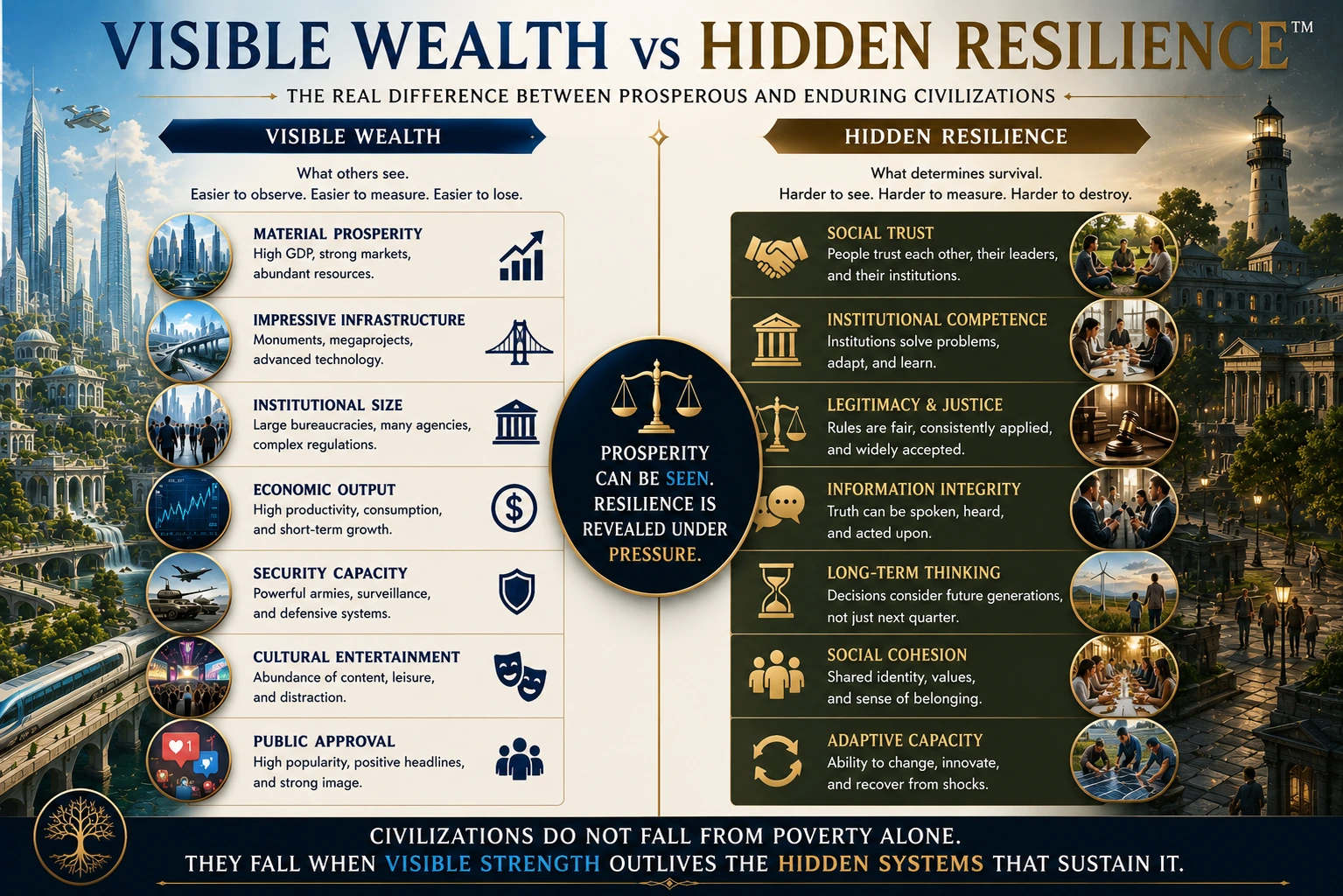
| Visible capacity | Hidden question |
|---|---|
| Large institutions | Can they recognize mistakes and change course? |
| Advanced infrastructure | Is maintenance protected when budgets tighten? |
| High information volume | Can accurate information reach decision-makers without distortion? |
| Strong economic output | Does growth increase future capacity or consume it? |
| Powerful security systems | Do they protect legitimate order or compensate for disappearing trust? |
| Technological sophistication | Does technology expand adaptability or create dependencies no one can repair? |
This distinction also clarifies the meaning of human flourishing as the goal of civilization. A civilization is not successful merely because it produces more. It succeeds when its capabilities help people live with dignity, agency, meaning, knowledge, security, and responsibility. Wealth is a means. When it becomes the sole measure of success, the civilization may optimize its visible indicators while degrading the conditions that make prosperity worth having.
Why Civilizations Collapse: The Prosperity–Decay Paradox™
The Prosperity–Decay Paradox™ explains how material success can coexist with declining resilience. It does not claim that prosperity automatically creates decadence or failure. It identifies a specific danger: success can weaken the signals that normally force a system to correct itself.
When resources are abundant, mistakes can be absorbed. Reserves cover inefficiency. Old infrastructure continues to function because earlier generations built it well. Debt moves costs into the future. Talented individuals compensate for defective procedures. Citizens endure administrative friction because daily life remains comfortable. Leaders can postpone difficult reforms because the consequences are not immediate.
This buffering capacity is beneficial—until it becomes concealment. The system appears stable precisely because it is consuming the reserves that once made it stable. Prosperity becomes a mask over declining foundations.
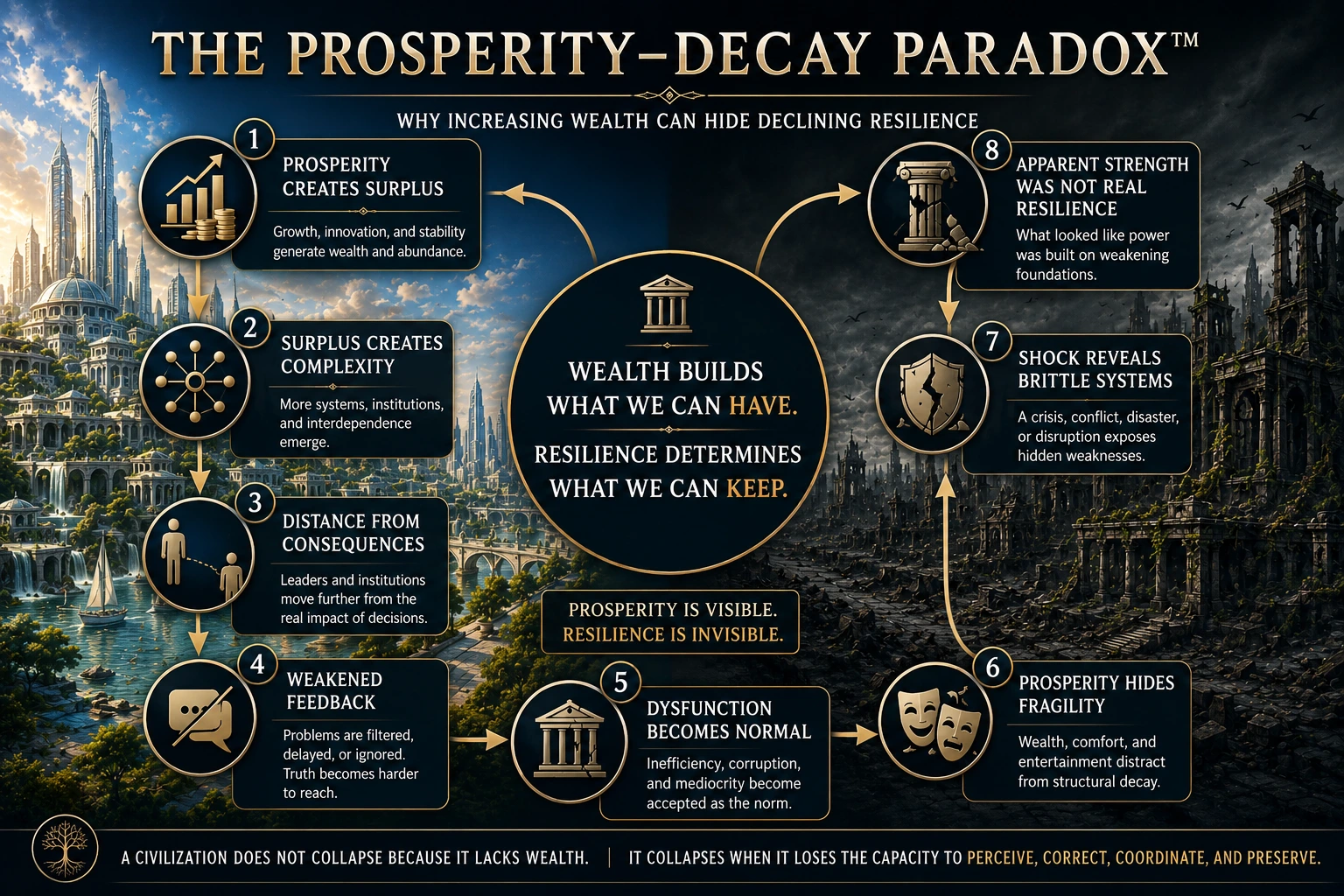
Stage 1: Prosperity creates surplus
Growth, stability, innovation, trade, and institutional competence generate additional resources. Surplus allows a civilization to educate more people, build infrastructure, fund research, support the arts, create safety nets, and solve problems that previously seemed permanent.
Stage 2: Surplus creates complexity
Successful solutions become permanent systems. Agencies, professions, laws, technologies, markets, standards, and interdependencies multiply. Complexity is not inherently bad; it is often the form intelligence takes at scale. But every additional layer creates coordination costs, maintenance obligations, and new opportunities for information to be filtered.
Stage 3: Leaders become distant from consequences
As institutions expand, those who make decisions may no longer experience their effects directly. Reports replace observation. Metrics replace contact. Responsibility is distributed across committees, contractors, jurisdictions, and software systems. A decision can harm thousands while no individual feels fully accountable for the outcome.
Stage 4: Feedback weakens
Bad news becomes costly. Employees learn which facts damage careers. Leaders reward reassurance. Institutions measure what is easy rather than what matters. Citizens lose faith that reporting a problem will produce correction. Reality still exists, but the system’s ability to hear it declines.
Stage 5: Dysfunction becomes normal
Delays, waste, corruption, decaying services, contradictory rules, and falling standards become part of ordinary life. People adapt individually to collective failure. They purchase private substitutes, use personal connections, accept lower expectations, or leave. Because individuals find workarounds, pressure for systemic reform weakens further.
Stage 6: Prosperity hides fragility
Consumption, entertainment, strong asset values, impressive architecture, and technological novelty maintain the appearance of momentum. The civilization may still be rich enough to compensate for defects, but less capable of correcting them. Its wealth is increasingly being used to manage symptoms rather than rebuild foundations.
Stage 7: A shock reveals brittle systems
A war, epidemic, financial crisis, environmental disruption, energy shortage, political rupture, cyberattack, or supply-chain failure creates demands that ordinary buffers can no longer absorb. The trigger is visible, so it receives most of the blame. Yet the same shock would have produced a different outcome in a more adaptive system.
Stage 8: Apparent strength proves weaker than expected
Institutions lose legitimacy, coordination breaks down, and local failures cascade through tightly connected systems. The civilization discovers that many of its strengths depended on trust, competence, maintenance, and shared responsibility that had already eroded.
The trigger is not always the cause. A shock can expose weakness without having created it. The deepest cause is often the long period during which warning signals were filtered, repairs were deferred, and prosperity allowed the system to avoid learning.
Seven Ways Prosperity Can Conceal Civilizational Decline
1. Complexity grows faster than coordination
Complex civilizations can produce medicine, global logistics, advanced engineering, mass education, and scientific discovery. Yet complexity also creates dense networks of dependence. A hospital depends on energy, software, supply chains, trained personnel, regulation, finance, transport, public trust, and reliable information. When these systems are efficient but lack redundancy, a small disruption can travel farther than anyone expects.
The danger is not complexity itself. The danger is complexity without intelligibility. When no institution understands how the whole system works, decision-makers cannot see where risk is accumulating. They manage fragments while assuming someone else protects the whole.
2. Inequality weakens reciprocal obligation
Every complex society contains differences in power, wealth, status, and opportunity. The civilizational danger appears when these differences destroy the belief that people still belong to a shared moral order. If one group can avoid the consequences of failing public systems while another group absorbs them, common sacrifice becomes harder to justify.
The problem is not only resentment. It is the collapse of reciprocity. Citizens stop asking, “What must we preserve together?” and begin asking, “Why should I carry costs that others can escape?” Once obligations are perceived as one-directional, trust turns into strategic compliance.
3. Institutions begin protecting themselves
Institutions are created to serve purposes: justice, education, public safety, health, knowledge, coordination, infrastructure, or representation. Over time, survival can become the institution’s unspoken primary goal. Budgets, authority, reputation, and procedural stability receive more protection than outcomes.
An institution can therefore remain administratively active while becoming functionally hollow. It produces documents, meetings, announcements, targets, and reforms, yet the original problem remains unsolved. Procedure continues after purpose has faded.
4. Decision-makers become separated from consequences
Good governance requires information to travel upward and consequences to travel back toward those who make decisions. In brittle systems, information moves upward only after being softened, while consequences move downward toward people with the least influence.
This separation creates moral and operational blindness. Leaders can sincerely believe a policy is working because the indicators reaching them were designed by the same system being evaluated. The greater the institutional distance, the easier it becomes to confuse compliance with success.
5. Short-term success consumes future capacity
Maintenance is politically quiet. Prevention is difficult to celebrate because its success is an event that did not happen. Long-term education, soil health, institutional memory, research capacity, public trust, demographic stability, and infrastructure renewal often lose against visible short-term rewards.
A civilization becomes fragile when it repeatedly finances present comfort by consuming future options. The cost may appear as debt, degraded ecosystems, lost expertise, brittle supply chains, exhausted workers, neglected systems, or the inability of younger generations to build stable lives.
6. Shared reality fragments
Disagreement is normal and necessary. A healthy civilization does not require one ideology. It requires enough shared reality for disagreement to remain productive. People can dispute values, priorities, and solutions while still accepting evidence, procedures, and the legitimacy of correction.
Fragmentation becomes dangerous when groups no longer disagree about what should be done but about whether any common evidence exists. Information then becomes tribal property. Every correction is interpreted as attack. Power replaces persuasion because no trusted arena remains in which competing claims can be tested.10
7. Responsibility becomes permanently externalized
Leaders blame previous governments. Institutions blame insufficient budgets. Citizens blame institutions. Companies blame consumers. Consumers blame companies. Generations blame one another. Every explanation may contain truth, yet the system still fails because no actor accepts a meaningful sphere of responsibility.
A civilization cannot coordinate if everyone can describe the problem but no one can say, “This part depends on me.” Responsibility does not require accepting blame for everything. It requires identifying the next action that cannot be delegated without loss.
Trust Is the Invisible Infrastructure of Civilization
Roads, power grids, ports, courts, schools, hospitals, communications networks, and financial systems are visible infrastructure. Trust is the invisible infrastructure that allows them to function without unbearable friction.
Trust reduces the number of checks required before cooperation. It allows strangers to exchange, professionals to rely on standards, citizens to follow emergency guidance, institutions to accept one another’s records, and leaders to ask for sacrifice without relying entirely on force. When trust falls, the cost of every transaction rises. More surveillance, verification, enforcement, documentation, and security are required to produce the same level of coordination.
This is why trust should not be confused with naïveté. Healthy trust is not blind belief in authority. It emerges when institutions are competent, rules are applied consistently, information is accessible, wrongdoing can be corrected, and people believe that cooperation will not be exploited indefinitely. The limits of openness are explored further in Can Humanity Survive Total Transparency?.
Recent cross-national research on public institutions continues to treat reliability, responsiveness, integrity, fairness, and openness as central drivers of trust.2 A civilization cannot command these qualities into existence. It must demonstrate them repeatedly.
Low-trust systems can remain orderly. They do so by replacing voluntary coordination with monitoring, legal compulsion, private protection, and centralized control. This may preserve short-term stability, but it is expensive and often reduces the feedback needed for adaptation.
The relationship between trust and civilization also connects to the role of stories, myths, and heroes. Stories help societies imagine shared obligations; civilizational myths encode identity and purpose; and heroes embody the behavior a culture wishes to reproduce. These symbolic systems can strengthen trust when they orient people toward responsibility. They can also become dangerous when they replace truth, excuse power, or divide humanity into those whose suffering matters and those whose suffering does not.
Why Institutions Fail Before Buildings Do
A building can stand after the institution that created it has lost its purpose. A ministry can keep its name while becoming unable to perform its mission. A university can preserve ceremonies while discouraging difficult inquiry. A court can maintain procedure while justice becomes inaccessible. A company can report excellent metrics while its products deteriorate.
Institutional decay begins when four layers separate:
- Declared purpose: what the institution says it exists to do.
- Incentives: what behavior is actually rewarded or punished.
- Operational reality: what people inside the system really do.
- Public outcome: what the institution produces for society.
When these layers align, institutions can learn. When they separate, reform becomes theatrical. New language is introduced without changing incentives. New departments are added without removing contradictory responsibilities. Failures are reclassified, renamed, or moved between categories. The organization appears active because it is constantly changing, yet its capacity to solve the underlying problem continues to decline.
Institutional memory without institutional learning
Modern societies store extraordinary amounts of information. But archives are not the same as memory, and memory is not the same as learning. Learning occurs only when preserved knowledge changes future behavior.
A brittle institution may document every failure and repeat it anyway. The records exist, but incentives favor continuity. Lessons are written after crises and forgotten before the next budget cycle. Experienced people leave, and tacit knowledge disappears with them. The institution remembers formally while forgetting operationally.
When procedure replaces judgment
Rules protect fairness and make complex systems predictable. Yet no set of rules can anticipate every situation. Institutions require judgment: the capacity to understand purpose, context, trade-offs, and consequences.
When fear of accountability becomes stronger than responsibility, people follow procedure even when they know the outcome will be harmful. The rule becomes a shield against moral agency. Everyone can prove compliance; no one can explain why the system failed.
Why Collapse Is Usually Slow—and Then Sudden
Many complex systems do not decline in a smooth, visible line. They absorb disturbance, compensate for failure, and remain near an apparently stable state. As hidden fragility increases, recovery becomes slower and more expensive. Eventually a disturbance pushes the system beyond a threshold, and change accelerates.
Research on critical transitions in ecological and other complex systems has explored early-warning signals and the possibility that systems can shift abruptly after long periods of gradual pressure.3 Human civilizations are not simple ecological models, and historical prediction remains uncertain. The analogy is useful only if treated carefully: social systems contain agency, institutions, learning, power, culture, and deliberate adaptation. Thresholds are not fate. They are points at which the cost and difficulty of correction can change rapidly.
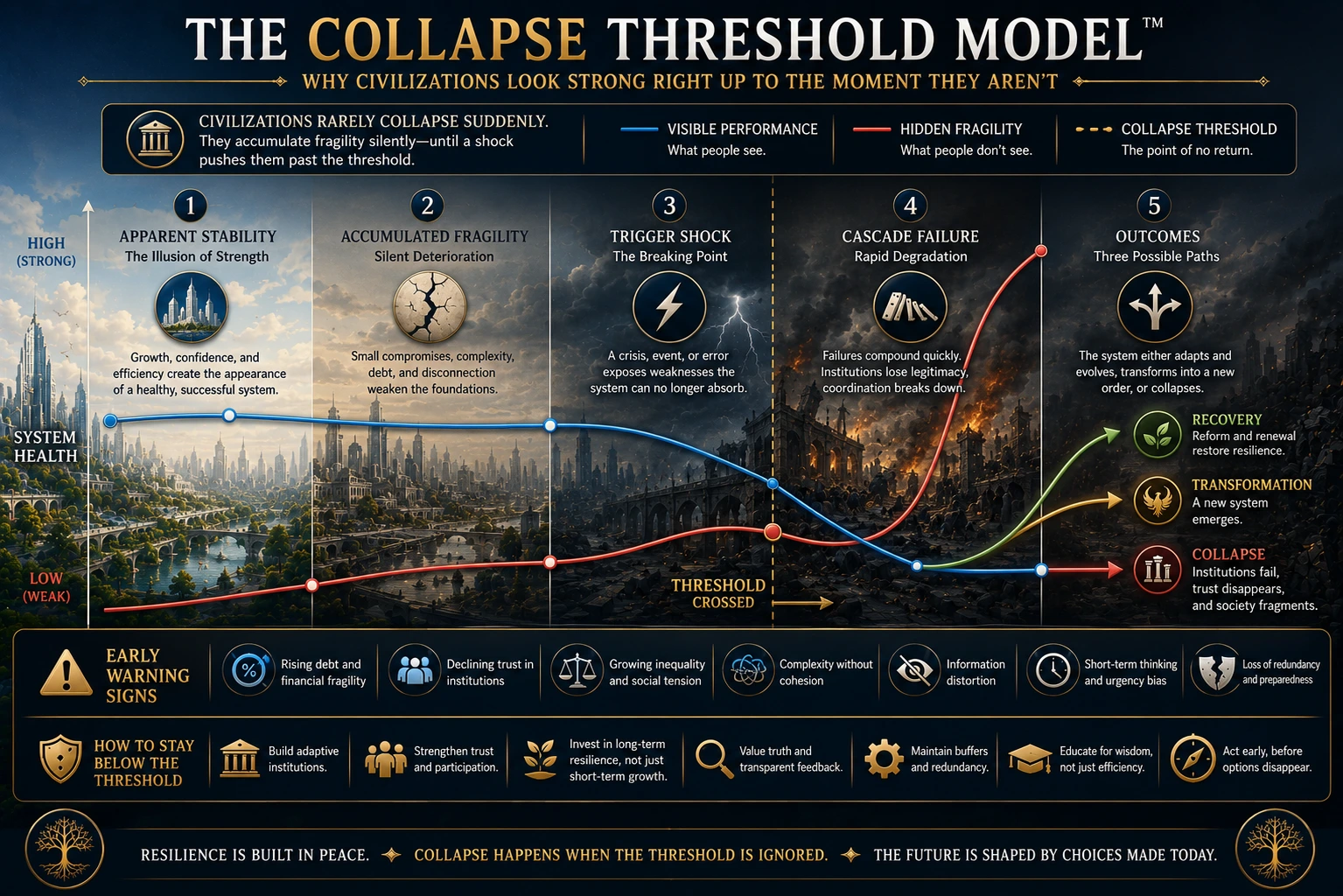
Why does the collapse feel sudden? Because the final failure is concentrated in time, while the loss of resilience was distributed across years or generations. The public sees the bridge fall in one day. It does not see every postponed repair, distorted report, exhausted engineer, missing component, and budget decision that made the final event possible.
Several buffers can preserve the appearance of normality:
- financial reserves and access to debt;
- high-quality infrastructure inherited from earlier investment;
- experienced professionals compensating for weak systems;
- private workarounds that conceal public failure;
- geographic regions that remain productive while others decline;
- external allies, trade networks, or resource suppliers;
- public narratives that reinterpret deterioration as temporary.
Buffers are essential to resilience, but they become dangerous when leaders treat them as proof that reform is unnecessary. A reserve is not a permanent source of strength. It is time purchased for correction.
The Civilizational Brittleness Loop™
The collapse threshold explains when failure accelerates. The Civilizational Brittleness Loop™ explains why fragility keeps increasing before that point.
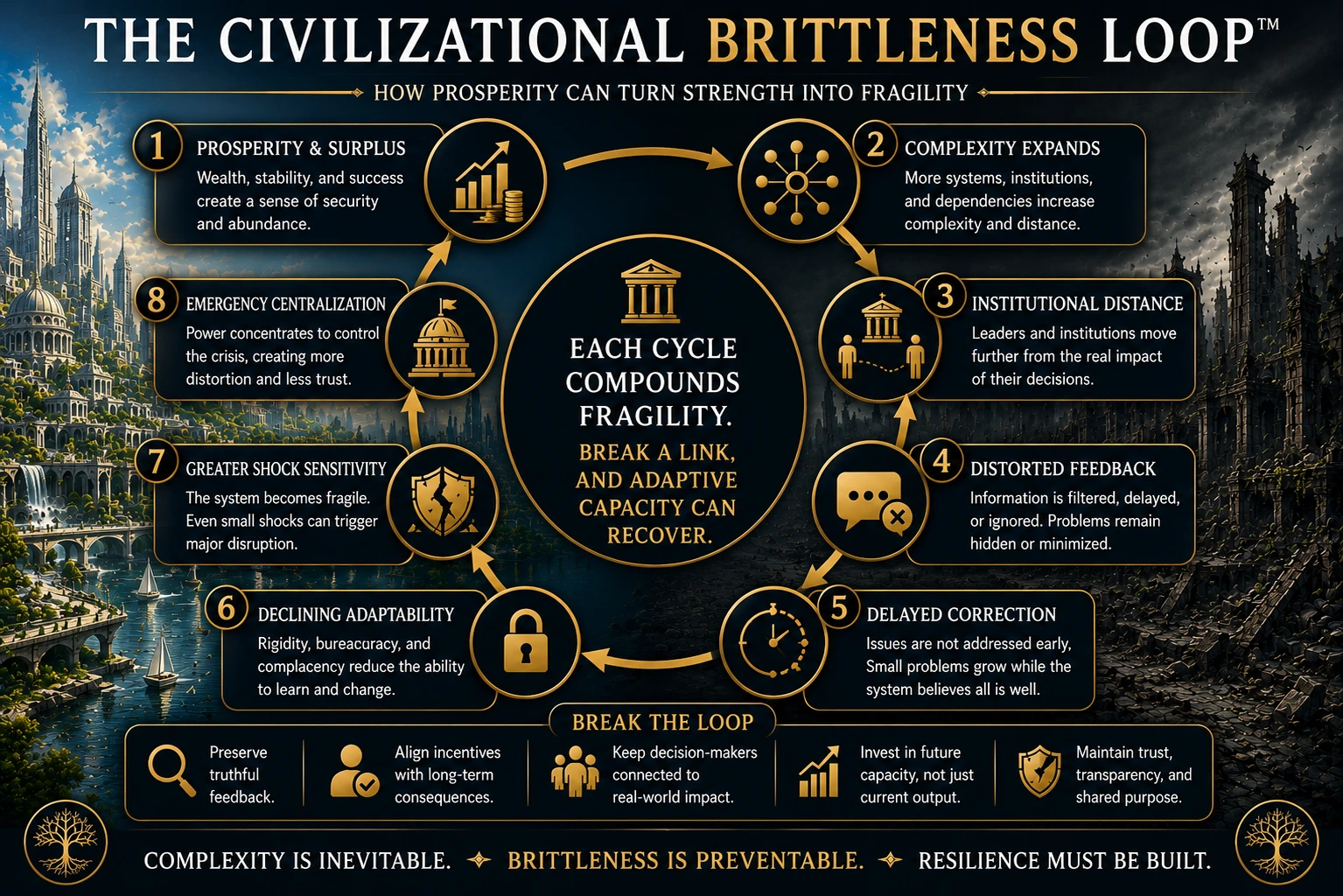
The loop begins with prosperity and expanding complexity. Complexity increases institutional distance. Distance distorts feedback. Distorted feedback delays correction. Delayed correction reduces adaptability. Lower adaptability increases sensitivity to shocks. Shocks encourage emergency centralization, which may suppress information and concentrate decision-making further. The loop then reinforces itself.
Emergency centralization is not always wrong. Crises may require rapid coordination and temporary concentration of authority. The danger appears when emergency structures become permanent, when criticism is treated as sabotage, or when leaders use control to replace the trust and competence that the system has lost.
Complexity is inevitable. Brittleness is preventable. Resilience must be built. The loop can be interrupted through truthful feedback, aligned incentives, institutional accountability, preserved redundancy, and decision-makers who remain connected to real consequences.
Historical Patterns Without Simple Explanations
History does not provide a universal formula for collapse. Civilizations differ in geography, technology, political structure, ecology, culture, trade, warfare, and scale. Scholars also debate the meaning of “collapse” in each case. The most responsible conclusion is not that one factor always destroys civilizations, but that interacting stresses become dangerous when adaptation fails.
The Late Bronze Age: interdependence without sufficient resilience
The Eastern Mediterranean of the Late Bronze Age contained wealthy palace economies, long-distance trade, diplomacy, writing systems, specialized production, and powerful states. Around the end of the thirteenth and beginning of the twelfth century BCE, many major centers were destroyed or abandoned, political systems fragmented, and regional trade networks contracted.
Explanations include drought, conflict, migration, internal rebellion, earthquakes, trade disruption, and political fragility. Environmental research has linked prolonged drought with the wider crisis, while archaeological scholarship continues to emphasize multiple interacting causes rather than a single event.4 The broader lesson is systemic: a highly connected world can spread prosperity, but it can also transmit disruption when essential regions and trade routes fail together.
The Western Roman Empire: capacity under accumulating pressure
Rome possessed extraordinary infrastructure, administration, military organization, urban systems, trade, law, and cultural influence. Its western political order did not collapse because it lacked achievement. It faced interacting pressures that included civil conflict, changing fiscal and military burdens, political fragmentation, external warfare, demographic shocks, and disease. Recent scholarship has renewed attention to climate and pandemics while also producing substantial debate about their relative weight.512
The Roman case warns against confusing the grandeur of accumulated assets with the health of the system maintaining them. Roads, cities, and legal forms can endure while the fiscal, military, demographic, and political capacities supporting them become increasingly difficult to coordinate.
Classic Maya political decline: environmental stress meets political vulnerability
In parts of the Maya lowlands, the Terminal Classic period saw major political disintegration, declining monument construction, demographic change, and abandonment of some urban centers. High-resolution climate research has linked severe drought periods to this transition, but drought did not act on an empty landscape. Political competition, warfare, land use, local ecology, social inequality, and institutional responses shaped how different communities experienced the pressure.6
The important question is not whether drought “caused” collapse in isolation. It is why some systems could not reorganize water, authority, production, and legitimacy quickly enough to absorb prolonged stress.
Angkor: infrastructure can become a source of vulnerability
Angkor developed one of the premodern world’s most extensive urban and hydraulic systems. This infrastructure supported a large, complex society, but it also required continuous coordination and maintenance. Research has argued that multidecadal droughts, intense monsoons, infrastructural damage, economic change, and geopolitical pressure interacted to reduce the system’s adaptive capacity.7
Angkor demonstrates a recurring pattern: infrastructure solves yesterday’s problems but creates tomorrow’s obligations. The larger and more integrated a system becomes, the more important maintenance, flexible governance, and local adaptation become.
Historical caution: No ancient case is a direct blueprint for the present. History offers mechanisms and questions, not automatic predictions. The same pressure can produce collapse in one context, reform in another, and uneven transformation in a third.
Can a Modern Technological Civilization Collapse?
Modern civilization has capacities ancient societies did not possess: global scientific networks, rapid communication, advanced medicine, satellite observation, industrial production, widespread literacy, data systems, and the ability to move resources across vast distances. These capabilities make many forms of adaptation possible.
They also create new dependencies. Electricity supports communications, finance, water treatment, healthcare, logistics, and governance. Digital systems depend on hardware, energy, networks, cybersecurity, specialized personnel, and international supply chains. Food systems depend on transport, energy, fertilizer, finance, climate stability, and coordination across borders. Efficiency connects everything—and can allow failure to spread quickly.8
Technology increases capability and dependency
A technological system is resilient when it can be repaired, substituted, understood, and governed. It is brittle when essential knowledge is concentrated in too few people, components have no alternatives, institutions do not practice recovery, and users assume continuous availability.
The presence of advanced technology therefore proves little by itself. A civilization must ask who can maintain it, whether replacement parts exist, how quickly systems can recover, and whether communities can function when automation fails.
Global integration can distribute risk—or transmit it
Trade allows regions to survive local shortages and gives societies access to resources they could not produce alone. It can also create concentrated dependencies. When multiple sectors rely on the same ports, chips, fuels, platforms, financial channels, or transport corridors, local disruptions acquire global consequences.9
The answer is not isolation. Self-sufficiency in every domain is impossible and often inefficient. The answer is deliberate redundancy: multiple suppliers, interoperable systems, strategic reserves, local capabilities, transparent risk mapping, and institutions able to coordinate across borders.
Artificial intelligence cannot replace legitimacy
Artificial intelligence can help model risks, identify patterns, allocate resources, translate knowledge, and support decisions. It can also amplify errors, centralize dependence, and create the illusion that difficult political or moral questions are merely technical optimization problems.11
No algorithm can independently create legitimate authority, shared purpose, public trust, moral responsibility, or willingness to sacrifice for future generations. Intelligence can reveal options. Civilization still requires humans and institutions to decide what should be preserved, who bears the cost, and which values cannot be optimized away.
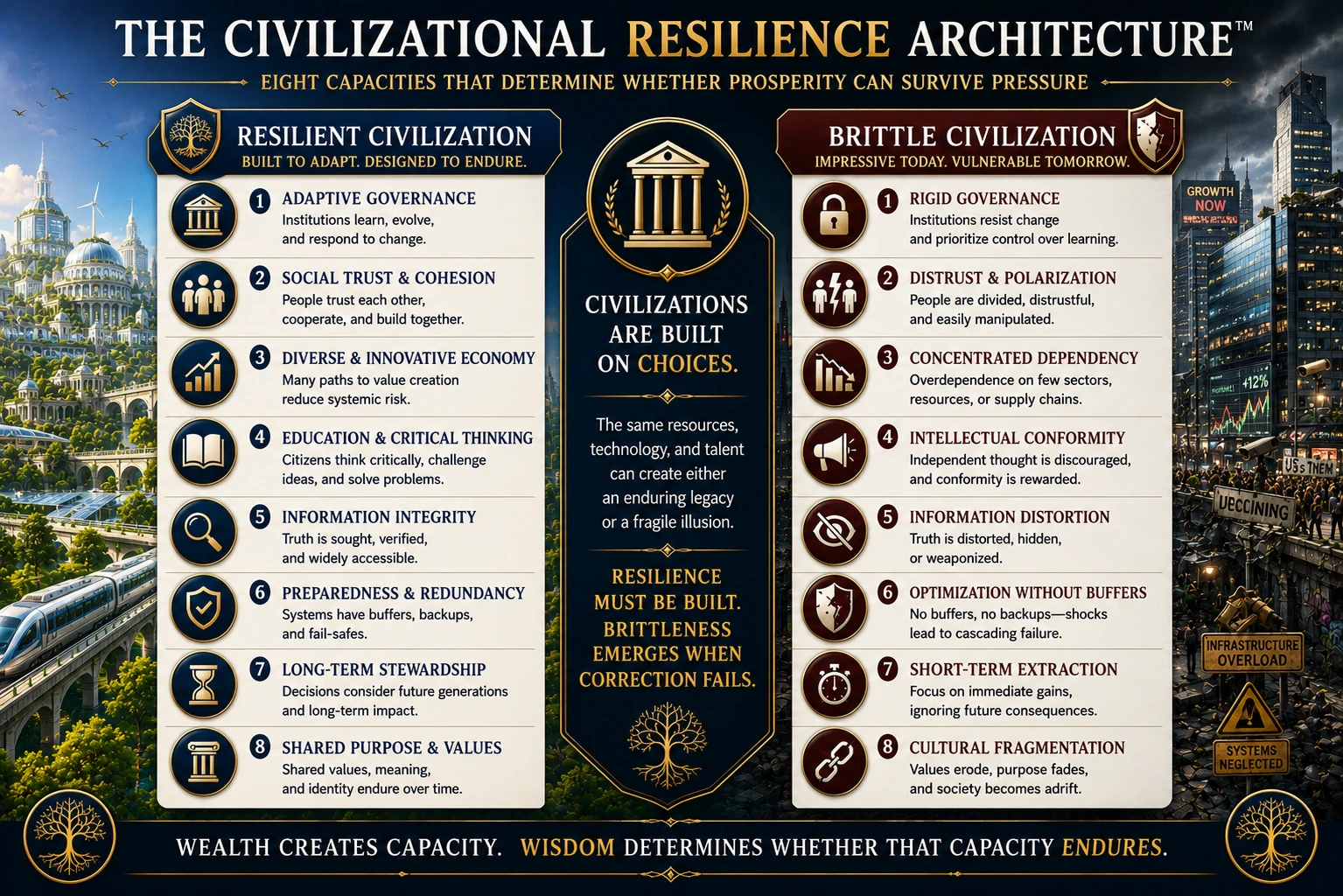
The eight capacities of an enduring civilization
- Adaptive governance: institutions can learn, revise decisions, and respond without treating change as defeat.
- Social trust and cohesion: people retain enough shared obligation to cooperate across difference.
- A diverse and innovative economy: value creation is not dependent on one sector, resource, or fragile chain.
- Critical thinking and education: citizens can evaluate claims, understand systems, and challenge error.
- Information integrity: truthful signals can be produced, heard, tested, and acted upon.
- Preparedness and redundancy: essential systems possess buffers, backups, and practiced recovery plans.
- Long-term stewardship: decisions protect future capacity rather than maximizing only present output.
- Shared purpose and values: the civilization knows what it is trying to preserve and why sacrifice is justified.
These capacities reinforce one another: trustworthy information supports learning; accountability protects trust; redundancy enables adaptation; and shared purpose gives long-term sacrifice a legitimate reason. The architecture fails when one capacity is treated as a substitute for the rest.
How Civilizations Avoid Collapse
Civilizations do not avoid collapse by eliminating all shocks. That is impossible. They avoid collapse by preserving the ability to respond before pressure becomes irreversible. The task is not permanent stability but continuous renewal.
1. Preserve truthful feedback
Bad news must be able to move through the system without destroying the messenger. Independent expertise, protected inquiry, transparent data, local reporting, investigative institutions, and open disagreement help a civilization detect failure early.
Truthful feedback does not require agreement on every interpretation. It requires mechanisms through which claims can be tested and corrected. A society that punishes uncomfortable evidence will eventually be governed by problems it refused to name.
2. Reward institutional competence
Public legitimacy cannot rest on communication alone. Institutions must solve problems reliably. This requires clear missions, capable people, realistic resources, measurable outcomes, and the authority to remove obsolete processes.
Competence also requires humility. Institutions must be allowed to admit failure without assuming that every admission will be used to destroy them. Accountability should make learning possible, not make concealment rational.
3. Maintain redundancy in essential systems
Efficiency removes unused capacity. Resilience preserves enough unused capacity to survive surprise. Hospitals need surge capability. Grids need alternatives. Supply chains need substitutes. Archives need multiple formats. Organizations need succession plans. Communities need local knowledge.8
Redundancy looks wasteful during calm periods. Its value becomes visible only when the primary system fails. This is why resilient societies protect buffers before urgency arrives.
4. Protect legitimate disagreement
Disagreement is a form of distributed intelligence. People in different positions observe different parts of reality. A civilization that allows dissent can integrate more information than a system that requires uniformity.
Legitimate disagreement still needs boundaries: evidence, nonviolence, procedural fairness, and recognition of common humanity. The goal is not endless conflict but a system in which correction does not require revolution.
5. Reduce the distance between decisions and consequences
Decision-makers should encounter the systems they govern. Feedback should include lived experience, not only aggregated metrics. Responsibilities should be clear enough that success and failure cannot disappear inside bureaucracy.
Local autonomy can help when local knowledge matters, while central coordination is essential for problems that cross boundaries. The resilient balance is neither total centralization nor total fragmentation. It is authority placed at the level where information, consequences, and capability can be connected.
6. Invest in future capacity
Long-term investment is not merely spending more. It is protecting the conditions that allow future generations to decide. These include education, research, ecological stability, institutional memory, maintainable infrastructure, social mobility, public health, and the ability to form families and communities.
A civilization that leaves descendants impressive assets but no ability to maintain them has transferred monuments, not resilience.
7. Maintain a shared reason for preservation
People will not sacrifice indefinitely for a civilization understood only as an economic machine. They need a credible answer to the question: what are we preserving?
The answer cannot be wealth alone. It must include human dignity, freedom, justice, truth, memory, belonging, possibility, and the ability of future people to live meaningful lives. This is where resilience connects to wisdom: the capacity to use power without destroying the conditions that make power valuable.
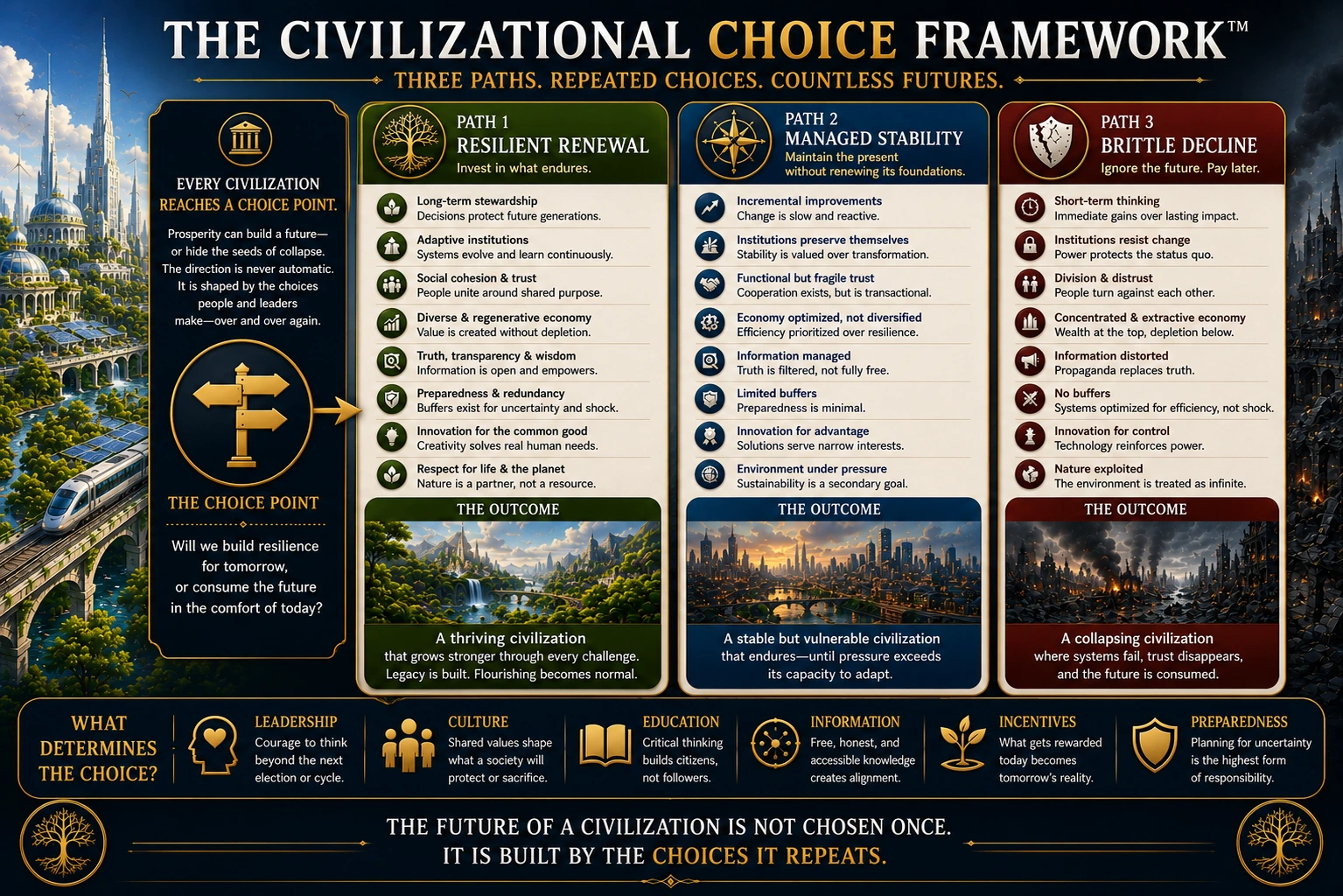
Three paths through pressure
Resilient renewal increases future capacity through adaptive institutions, trust, economic diversity, truthful information, buffers, stewardship, and innovation directed toward shared needs.
Managed stability preserves the present through incremental improvement while postponing deeper renewal; it can endure, but vulnerability rises when institutions become self-protective and preparedness remains thin.
Brittle decline protects immediate output, concentrated power, extraction, and efficiency without buffers, consuming future options to preserve present appearances.
Civilizations move among these paths through repeated decisions across leadership, institutions, markets, education, culture, media, families, and communities. Renewal is not a permanent achievement; it is a recurring practice.
The Civilizational Stewardship Test™
A civilization should not evaluate itself only by output, military capacity, technological novelty, or the size of its institutions. It should ask whether its success increases the ability of future generations to perceive reality, coordinate action, and choose wisely.
The following questions form the Civilizational Stewardship Test™:
- Can institutions openly recognize failure? Or must every problem be hidden until it becomes undeniable?
- Do decision-makers experience consequences? Or are costs transferred downward and forward?
- Can citizens agree on basic evidence? Or has information become inseparable from identity and power?
- Are essential systems maintained before they fail? Or does visible expansion always outrank invisible repair?
- Does economic success increase future capacity? Or does it depend on debt, depletion, fragility, and exclusion?
- Can society coordinate without permanent coercion? Or must control continually expand as trust disappears?
- Are younger generations inheriting options? Or only obligations created by earlier prosperity?
- Can power be challenged without destroying the whole system? Or is correction possible only through rupture?
- Is responsibility distributed clearly? Or can every actor explain why someone else must act?
- Does the civilization know what it is preserving? Or is survival itself treated as sufficient purpose?
No civilization will answer every question perfectly. The purpose is not moral purity. It is diagnostic honesty. The most dangerous answer is not “we are weak.” It is “we do not need to ask.”
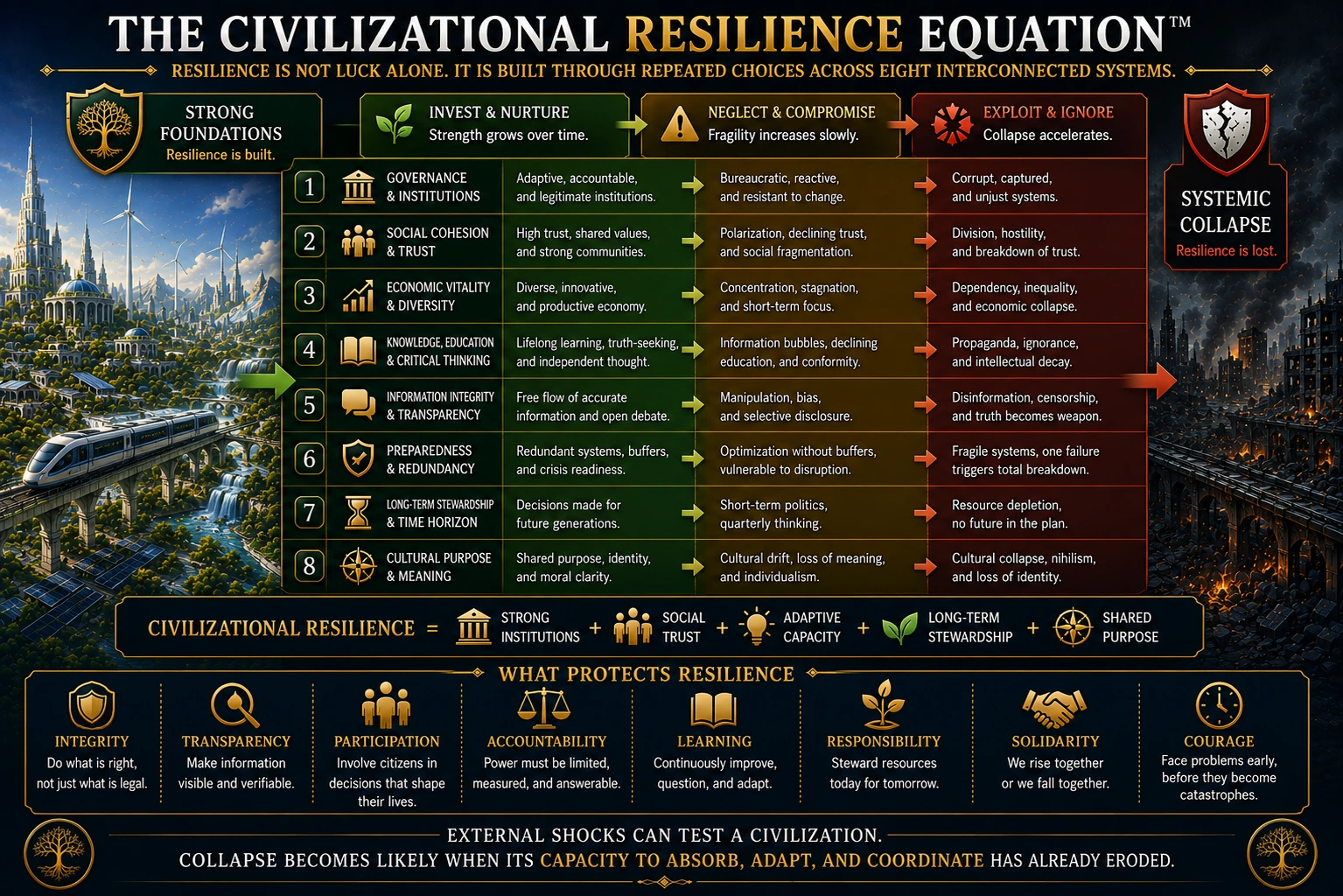
The Civilizational Resilience Equation™
The equation is not mathematical in a predictive sense. It is a synthesis model:
Civilizational resilience = strong institutions + social trust + adaptive capacity + long-term stewardship + shared purpose.
The equation is a synthesis, not a predictive formula. Institutions depend on integrity and competence; trust on fairness and reciprocity; adaptability on information, experimentation, redundancy, and courage; stewardship on responsibility across time; and purpose on a moral horizon that includes future generations.
External shocks test these capacities. Collapse becomes more likely when the ability to absorb, adapt, and coordinate has already eroded—so resilience must be built while danger still feels distant.
A Civilization Can Survive and Still Lose Its Humanity
Not every system that survives deserves to be called successful. A civilization may preserve territory, administration, production, security, and technological capacity while losing dignity, freedom, truth, responsibility, and meaning. Any durable model of civilization must therefore account for human nature rather than treating people as replaceable components.
This creates a deeper danger than physical collapse: the system endures by destroying the values it was supposed to protect. Surveillance replaces trust. Propaganda replaces truth. Obedience replaces participation. Efficiency replaces compassion. People survive, but only as inputs into a machine that no longer recognizes them as ends.
This question is explored more directly in Can Humanity Lose Its Humanity? The central principle is that preservation must include moral continuity. A civilization that avoids ruin by becoming inhuman has not solved the problem of collapse. It has changed the form of the loss.
That is also why the question What Makes a Civilization Worth Saving? must come before any program of survival. Resilience is not the ability to keep every institution forever. It is the ability to preserve what is essential while changing what no longer serves life.
What should endure?
- the dignity of persons rather than the convenience of systems;
- truthful inquiry rather than enforced certainty;
- freedom joined to responsibility rather than freedom without consequence;
- justice capable of correction rather than power protected from accountability;
- memory that supports learning rather than memory used to preserve grievance;
- knowledge that expands agency rather than knowledge monopolized for control;
- hope grounded in action rather than optimism used to deny danger.
A civilization needs hope because reform requires belief that action can still matter. But hope is not denial. Mature hope begins by seeing reality clearly enough to accept responsibility for it.
From Civilizational Collapse to Guardianship
Once a civilization understands that prosperity cannot protect it automatically, a harder question appears: who is responsible for preserving the conditions on which its future depends?
The obvious answer is “leaders,” but no group of leaders can guard a civilization alone. Political authority can coordinate large systems, yet it is vulnerable to short time horizons, concentrated incentives, and distorted feedback. Experts can identify risks, but expertise does not create democratic legitimacy. Markets can allocate resources, but prices do not represent every form of value. Citizens can demand change, but public attention is fragmented and often reactive.
Guardianship must therefore be distributed. It belongs to institutions that preserve truth, engineers who maintain invisible systems, teachers who develop judgment, journalists who reveal inconvenient reality, communities that sustain trust, leaders who accept consequences, creators who preserve meaning, and citizens who refuse to transfer every responsibility elsewhere.
Yet guardianship contains its own paradox. Those empowered to protect the future may begin to believe they own it. Protection can become control. Expertise can become exclusion. Emergency authority can become permanent. The guardian can become more dangerous than the threat.
This tension is examined in Who Should Guard the Future of Humanity? No institution should possess unlimited authority over what comes next. The future must be protected through accountable, plural, transparent systems that preserve both continuity and freedom.
From Explanation to Story
An article can explain why civilizations become fragile. A story can place the reader inside the moment when truth, safety, freedom, responsibility, and preservation can no longer be separated.
Those Who Guard Eternity, the first novel in the Eternity Saga, begins with a world whose ordinary understanding of time and reality starts to fracture. It explores what happens when seeing the deeper structure of the world creates a responsibility that cannot be avoided.
Frequently Asked Questions
Why do civilizations collapse?
Civilizations collapse when they lose enough institutional capacity, trust, legitimacy, adaptability, and coordination that they can no longer sustain their previous level of complexity. External shocks often contribute, but the outcome depends on the resilience that existed before the shock.
Can a rich civilization still collapse?
Yes. Wealth can fund resilience, but it can also conceal decay by compensating for inefficient institutions, deferred maintenance, weak feedback, and declining trust. A civilization may remain materially rich while becoming operationally brittle.
What is the difference between decline and collapse?
Decline is a sustained reduction in capability or legitimacy that may still be reversed. Collapse is a more rapid loss of political integration, economic complexity, institutional reach, or coordinated capacity relative to the civilization’s earlier form.
Does inequality cause civilizational collapse?
Inequality is not a universal single cause. It becomes dangerous when it destroys reciprocity, separates decision-makers from consequences, blocks social mobility, weakens legitimacy, and convinces groups that they no longer share a common future.
Why is trust important to civilization?
Trust lowers the cost of cooperation. It allows people and institutions to coordinate without relying entirely on surveillance, force, verification, and private protection. Healthy trust depends on competence, fairness, transparency, and accountability.
Do civilizations collapse suddenly?
The visible failure can be sudden, but fragility usually accumulates over time. Reserves, inherited infrastructure, private workarounds, and strong professionals may preserve normality until a shock pushes the system beyond a threshold.
Can technology prevent societal collapse?
Technology can improve observation, production, medicine, communication, and recovery. It cannot by itself create legitimate authority, shared purpose, social trust, moral responsibility, or institutions willing to correct their own failures.
Can a civilization recover after collapse?
People, communities, knowledge, and institutions can survive and reorganize after political collapse. Recovery may restore parts of the old system, create a new order, or produce smaller and more adaptive forms of organization. Recovery is rarely a simple return to the past.
What makes a civilization resilient?
Resilience depends on adaptive institutions, social trust, truthful information, economic diversity, critical thinking, redundancy, long-term stewardship, shared purpose, and the ability to act before warning signs become emergencies.
Are modern societies more resilient than ancient civilizations?
Modern societies possess greater scientific, technological, medical, and logistical capacity. They also depend on tightly connected global systems that can transmit disruption rapidly. Their resilience depends on whether advanced capability is matched by redundancy, maintainability, trust, and effective coordination.
Conclusion: Wealth Can Delay the Reckoning, Not Remove It
Civilizations do not collapse only when they become poor. They collapse when they lose the ability to recognize what is failing, agree on what matters, and accept responsibility for a future no living generation will fully possess.
Wealth can postpone that reckoning. It can fund repairs, create reserves, import solutions, and compensate for weak institutions. But if prosperity is used mainly to preserve appearances, the civilization becomes more impressive and less capable at the same time.
The deepest measure of success is therefore not how much a civilization controls. It is whether power increases wisdom, whether complexity remains corrigible, whether institutions can hear truth, whether citizens can cooperate across difference, and whether the present expands rather than consumes the possibilities of the future.
A civilization is not protected by what it has accumulated. It is protected by its continuing capacity to perceive, correct, coordinate, and preserve.
The final question is not whether a civilization is powerful enough to survive. It is whether it is wise enough to remain worth preserving.
Sources and further reading
- Joseph A. Tainter, The Collapse of Complex Societies, Cambridge University Press. ↩
- OECD, OECD Survey on Drivers of Trust in Public Institutions – 2026 Results. ↩
- Marten Scheffer and colleagues, research on early-warning signals for critical transitions, Nature Communications. ↩
- David Kaniewski and colleagues, Environmental Roots of the Late Bronze Age Crisis, PLOS ONE. ↩
- Kyle Harper, The Fate of Rome: Climate, Disease, and the End of an Empire, Princeton University Press; see also subsequent scholarly debate on the relative weight of climate and disease. ↩
- Douglas J. Kennett and colleagues, Development and Disintegration of Maya Political Systems in Response to Climate Change, Science. ↩
- Brendan M. Buckley and colleagues, Climate as a Contributing Factor in the Demise of Angkor, Cambodia, Proceedings of the National Academy of Sciences. ↩
- World Bank, Lifelines: The Resilient Infrastructure Opportunity, a systems framework for infrastructure that continues serving users during and after disruption. ↩
- OECD, OECD Supply Chain Resilience Review, on dependencies, adaptability, diversification, and the limits of indiscriminate relocalisation. ↩
- OECD, Facts not Fakes: Tackling Disinformation, Strengthening Information Integrity. ↩
- OECD, Recommendation of the Council on Artificial Intelligence, revised in 2024, emphasizing human-centred values, transparency, robustness, safety, and accountability. ↩
- Peter Heather, The Fall of the Roman Empire: A New History of Rome and the Barbarians, Oxford University Press, offering an additional interpretation that gives substantial weight to geopolitical and military transformation. ↩
Method note: The proprietary frameworks in this article are interpretive models designed to organize recurring mechanisms. They are not deterministic forecasts and should not be treated as a single-cause theory of historical collapse.