For as long as human beings have existed, death has been treated as the ultimate enemy.
We built civilizations to protect ourselves from it.
We developed medicine to postpone it.
We created religions to understand it.
We wrote stories in the hope of overcoming it, if only symbolically.
The assumption has always seemed obvious.
If death ends life, then eliminating death must be one of humanity’s greatest achievements.
Every medical breakthrough that extends life expectancy is celebrated as progress.
Every disease we defeat feels like another victory.
Every year added to the average human lifespan appears to confirm the same belief:
Longer life is always better.
Today, that belief is becoming more ambitious than ever before.
Artificial intelligence accelerates medical discoveries.
Gene editing promises to eliminate inherited diseases.
Longevity research is no longer confined to science fiction.
For the first time in history, serious scientific discussions are beginning to ask whether aging itself might one day become a treatable condition rather than an unavoidable destiny.
At first glance, this sounds like humanity’s oldest dream finally becoming possible.
Who would willingly choose death over life?
Who would reject the opportunity to spend more years with the people they love?
Who would not want another decade to learn, create, explore, and experience the world?
Yet beneath these perfectly reasonable questions lies another one that humanity rarely asks.
We spend enormous effort trying to answer:
How can we defeat death?
Far fewer people stop to consider a different possibility.
What if death is not merely a biological limitation—but one of the conditions that gives human life its meaning?
At first, the question feels almost offensive.
Death causes suffering.
It separates families.
It ends stories that still deserve another chapter.
No one should romanticize death.
And nothing in this article argues that humanity should stop fighting disease, aging, or preventable loss.
Instead, this article asks a different philosophical question.
Not whether death is desirable.
But whether mortality has shaped humanity far more profoundly than we usually recognize.
Because every limit changes behavior.
Every deadline changes priorities.
Every ending changes the meaning of what comes before it.
Perhaps death does not simply end life.
Perhaps it silently shapes the entire structure of human existence while life is still unfolding.
When we know our time is limited, every decision excludes countless others.
Every “yes” becomes meaningful because it contains thousands of invisible “no” answers.
Every day becomes unique because it cannot be repeated.
Perhaps this is why mortality has influenced not only biology but also philosophy, ethics, culture, science, and civilization itself.
In our previous article, Why Are People Afraid of Being Forgotten?, we explored how humans seek not merely remembrance but the continuation of their influence beyond their own lives. This article takes the next step by asking an even deeper question: could mortality itself be one of the reasons that such influence matters at all?
Because if humanity eventually succeeds in overcoming biological death, we may discover that the greatest challenge was never living longer.
The greatest challenge may be preserving everything that mortality quietly gave us.
What if death is not only the end of life—but one of the reasons life feels worth living in the first place?
Does Humanity Need Death? A Short Answer
There is no simple answer. Death causes suffering and loss, yet mortality has shaped human civilization by creating urgency, responsibility, generational renewal, and the search for meaning. The real question may not be whether humanity can overcome death, but whether it can preserve meaning after doing so.
Death Was Never an Accident. It Became a Condition for Evolution
To understand whether humanity needs death, we must step away from philosophy for a moment and look at life itself.
Every living organism exists within a world of limited resources.
There is not enough food for everyone.
There is not enough space for everyone.
There is not enough energy for everyone.
Life has therefore never been a static system.
It is constantly renewing itself.
Each generation inherits successful adaptations from those before it.
Unsuccessful strategies gradually disappear.
Useful innovations accumulate over time.
This continuous process is what we call evolution.
Yet evolution depends on a condition we rarely acknowledge.
For new generations to emerge, previous generations must eventually make room for them.
This observation may sound uncomfortable.
But throughout Earth’s history, mortality has allowed life to renew itself instead of remaining permanently fixed.
Without that renewal, countless species—including our own—might never have appeared.
This does not mean death is good.
It means death has played a fundamental role in the story of life.
Interestingly, the same principle appears far beyond biology.
New ideas replace outdated assumptions.
Scientific revolutions challenge accepted knowledge.
Every civilization evolves because each generation questions what the previous one considered permanent.
Progress rarely comes from preserving everything exactly as it is.
It comes from allowing change to happen.
This same principle appears throughout the philosophical questions explored on Eternity Management. In Can Humanity Survive Absolute Truth?, we examined what happens when ideas stop being challenged. Here we encounter a similar question: what happens when life itself stops renewing?
Life survives not despite change, but because change never completely stops.
The Moment Humans Became Aware of Death
Human mortality differs from every other form of mortality in one crucial way.
Most animals instinctively avoid danger.
Human beings can do something far more extraordinary.
We know that one day we will die.
That awareness changed everything.
It transformed survival into civilization.
People began building houses they would never fully inhabit.
Planting trees whose shade they would never enjoy.
Writing books for readers who had not yet been born.
Creating laws, universities, libraries, and works of art designed to outlive their creators.
Mortality pushed humanity beyond immediate survival.
It encouraged us to think in generations instead of days.
In our article Why Do People Need Meaning?, we explored how meaning emerges when our actions become connected to something larger than ourselves.
Mortality intensifies that connection.
If life were endless, every important decision could always wait until tomorrow.
A book could always be written later.
An apology could always be postponed.
A dream could always begin next century.
But because our time is limited, the word today becomes extraordinarily valuable.
Mortality transforms time from an abstract measurement into our most precious resource.
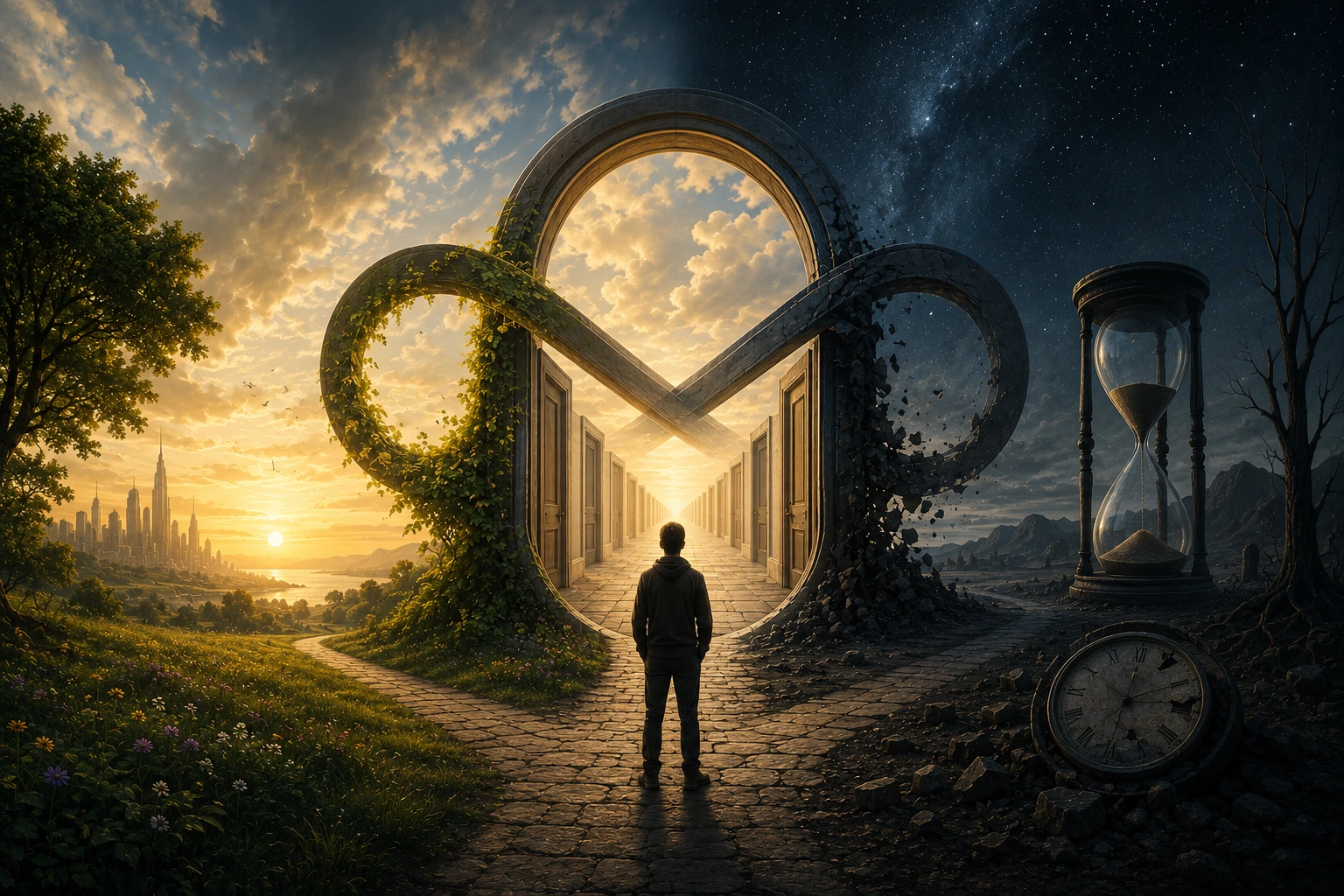
Perhaps death does not merely limit human life. Perhaps it gives time its value—and through time, gives our choices their meaning.
This realization leads to an even more profound question.
If mortality is woven so deeply into human psychology, culture, and civilization, what happens if humanity eventually succeeds in removing it?
| Mortality | Biological Immortality |
| Limited time | Unlimited time |
| Urgency | Risk of postponement |
| Generational renewal | Potential stagnation |
| Scarcity | Abundance |
| Finite choices | Infinite possibilities |
What Happens to Civilization When Death Is No Longer the Rule?
Imagine that humanity finally achieves what countless generations only dreamed about.
Aging is no longer inevitable.
Most diseases have disappeared.
People routinely live for centuries.
Perhaps they can even live indefinitely.
At first, this sounds like the greatest victory in human history.
Yet this is precisely where the most difficult questions begin.
How would civilization function if almost nobody ever left their place?
What would happen to innovation if every major institution remained under the influence of the same individuals for hundreds of years?
Would young generations still have the opportunity to reshape the world?
Or would history gradually slow until progress itself became rare?
We usually think of death as an individual tragedy.
But on the scale of civilization, mortality has also served another purpose.
It continuously created space for new generations.
Each generation challenged inherited assumptions.
Each generation questioned traditions that once seemed permanent.
Each generation introduced perspectives that previous generations could never fully imagine.
Scientific revolutions.
Political transformations.
New philosophies.
Most emerged because humanity never remained completely unchanged.
If biological immortality eventually became reality, civilization would face an entirely different challenge.
Not how to survive death.
But how to survive permanence.
This is why immortality cannot be understood as merely a medical breakthrough.
It would reshape economics.
Politics.
Education.
Leadership.
Culture.
Even our understanding of progress itself.
That is why, in Can Humanity Survive Immortality Without Purpose?, we argued that extending life may ultimately create a deeper crisis than death itself. The greatest challenge may not be living forever—it may be finding reasons to continue growing once time no longer imposes limits.
Civilizations may collapse not only because they run out of time—but because they eventually have too much of it.
Why Limits Create Meaning
There is a pattern that appears throughout nature, art, and human experience.
The things we value most almost always exist within limits.
A rare work of art.
A brief moment with someone we love.
A sunrise that cannot be repeated.
A single lifetime.
Scarcity alone does not create value.
But scarcity forces choice.
And choice gives meaning to our actions.
If every opportunity remained available forever, deciding between them would gradually lose significance.
If tomorrow always existed, today would become less important.
If nothing ever ended, beginning something new would become strangely unnecessary.
This may explain why human beings experience time so differently from every other resource.
Money can be earned again.
Knowledge can be expanded.
Possessions can be replaced.
Time never returns.
Every day immediately becomes part of history.
Perhaps that is why mortality silently gives every ordinary moment extraordinary significance.
In Why Do Humans Want to Live Forever?, we explored humanity’s ancient desire to escape death. Yet perhaps the deeper question is not why we seek endless life, but whether endless life would preserve everything that makes life meaningful in the first place. XML Sitemap posts eternity .pdf
Perhaps we value life not despite its fragility—but because fragility transforms every moment into something that can never be repeated.
And this realization leads us to the central philosophical challenge of the future.
If death disappears, will humanity remain fundamentally human—or will removing our oldest limitation transform us into something entirely different?
Perhaps We Have Been Asking the Wrong Question
After exploring mortality from biological, psychological, and civilizational perspectives, a surprising realization begins to emerge.
Perhaps humanity has spent thousands of years asking the wrong question.
We have always asked:
“How can we defeat death?”
But perhaps the more important question is this:
“How can we preserve our humanity if death is no longer part of the human experience?”
These are fundamentally different questions.
The first is technological.
The second is philosophical.
The first asks what humanity will be capable of doing.
The second asks who humanity will become.
This distinction matters because history repeatedly shows that solving one problem often creates entirely new ones.
Electricity transformed civilization.
The internet transformed communication.
Artificial intelligence is transforming knowledge itself.
Each breakthrough solved old limitations while introducing challenges previous generations had never imagined.
Immortality would almost certainly follow the same pattern.
It would not simply eliminate death.
It would redefine almost every concept that has shaped human civilization.
What would courage mean if death became optional?
Would sacrifice still inspire us if every loss could eventually be reversed?
Would urgency survive in a world where tomorrow never truly runs out?
Would ambition become stronger—or slowly disappear?
These questions extend far beyond medicine.
They belong to ethics.
Psychology.
Political philosophy.
Economics.
And perhaps most importantly, they belong to human identity.
This is precisely why the central questions explored throughout Eternity Management are interconnected. What happens if humanity gains unlimited knowledge? We explored that in Can Humanity Survive Unlimited Knowledge?. What if unlimited freedom becomes reality? That question continues in Can Humanity Survive Infinite Freedom?. What if human beings acquire unlimited power? We examined that possibility in Can Humanity Survive Unlimited Power?. Although these topics appear different, they all investigate the same underlying question: what happens when humanity removes the limits that have shaped it for thousands of years? XML Sitemap posts eternity .pdf
Every limitation is also one of the invisible conditions that makes human life possible.
The Eternity Management Perspective
Most stories about immortality end the moment death is defeated.
The Eternity Management universe begins at that exact moment.
Because overcoming mortality would not conclude the human story.
It would begin an entirely new chapter.
A chapter in which humanity would have to redefine nearly every idea that has guided civilization until now.
- What is meaning?
- What is responsibility?
- What is freedom?
- What is love?
- What is identity?
- What does it truly mean to be human?
This is why philosophical fiction matters.
Its purpose is not simply to imagine new technologies.
Its purpose is to explore the kind of humanity those technologies might create.
If these questions resonate with you, you may also enjoy our curated collections of books about immortality, books about the future of humanity, books about human nature, books about the meaning of life, and books about consciousness. Together, they form the broader philosophical map that Eternity Management is gradually building. XML Sitemap posts eternity .pdf
Perhaps humanity’s greatest achievement will never be defeating death.
Perhaps it will be discovering how to remain deeply human after death is no longer what defines us.
Frequently Asked Questions
There is no simple answer. Death causes suffering and loss, yet mortality has shaped human civilization by creating urgency, responsibility, generational renewal, and the search for meaning.
People fear death for many reasons, including survival instincts, uncertainty, the loss of loved ones, and the possibility that their lives may end before fulfilling their purpose. Mortality is deeply connected to our search for meaning and legacy.
The desire for immortality reflects humanity’s wish to overcome biological limits and continue experiencing life. We explore this question further in Why Do Humans Want to Live Forever?.
Not necessarily. Living indefinitely could eliminate the fear of death while introducing entirely new challenges related to purpose, motivation, and civilization. Learn more in Can Humanity Survive Immortality Without Purpose?.
Because limited time forces us to choose. Every meaningful decision excludes countless alternatives, making our actions more valuable precisely because they cannot be repeated forever.
It might—but not without profound changes. Politics, economics, leadership, education, innovation, and human relationships would all have to adapt to a world where generations no longer naturally replace one another.
History suggests that generational change has been one of the driving forces behind cultural, scientific, and philosophical progress. Whether humanity can preserve innovation without mortality remains an open question.
Eternity Management examines how humanity changes when its oldest limitations begin to disappear. Mortality, memory, truth, freedom, knowledge, and identity are explored together because they are all connected parts of the same philosophical future. Browse the complete collection in the Eternity Management Blog.
If mortality disappeared, humanity might gain:
- Longer lives
- More accumulated knowledge
- Reduced fear of death
But it could also lose:
Conclusion: Perhaps Death Was Never Humanity’s Greatest Enemy
- Urgency
- Meaning created by limitation
- Generational renewal
- Natural civilizational adaptation
We began this journey with a question that initially seemed almost impossible to answer.
Does humanity need death?
At first, the very idea felt uncomfortable.
Death causes suffering.
It separates families.
It ends stories that deserved another chapter.
Nothing in this article suggests that death should be celebrated.
Nor does it argue that humanity should stop fighting disease, aging, or preventable loss.
But throughout this exploration, another realization gradually emerged.
Mortality has shaped civilization far more deeply than we usually recognize.
It shaped our relationship with time.
It gave urgency to our decisions.
It encouraged us to build a future we would never personally see.
It inspired us to leave behind knowledge, art, institutions, and ideas capable of surviving their creators.
Death became more than a biological event.
It quietly became one of the foundations upon which human civilization was built.
Yet this realization does not mean mortality must remain humanity’s permanent destiny.
Perhaps science will eventually extend life far beyond anything previous generations imagined.
Perhaps biological immortality will one day become possible.
If that day comes, humanity will not simply solve an ancient problem.
It will inherit an entirely new responsibility.
How do we remain human after overcoming one of the very conditions that helped shape humanity itself?
This question lies at the heart of every philosophical exploration on Eternity Management.
Together, these articles explore what happens when humanity begins removing the limits that have defined it for thousands of years. We have already examined why humans fear being forgotten, whether civilization could survive perfect memory, absolute truth, the end of mystery, total transparency, and immortality without purpose. Each article explores a different consequence of the same fundamental transformation. XML Sitemap posts eternity .pdf
This article adds another essential piece to that larger conversation.
Perhaps death has never been humanity’s greatest problem.
Perhaps the greater question has always been what we choose to do with the limited time we are given.
Time—not death itself—is what gives weight to our choices.
Time gives urgency to love.
Time gives responsibility its meaning.
Time transforms ordinary moments into irreplaceable experiences.
Perhaps mortality has never been valuable because it ends life.
Perhaps it has been valuable because it teaches us that life cannot be postponed forever.
One day humanity may overcome biological death.
But even then, one question will remain.
Not how long we can live.
But why life should matter once it no longer has an obvious end.
Perhaps humanity’s greatest achievement will not be defeating death. Perhaps it will be preserving meaning—even in a future where death is no longer what gives life its urgency.
That may ultimately become the defining challenge of our civilization.
Because the future will not be determined only by the technologies we invent.
It will also be determined by whether we remain wise enough to understand what those technologies change about ourselves.