
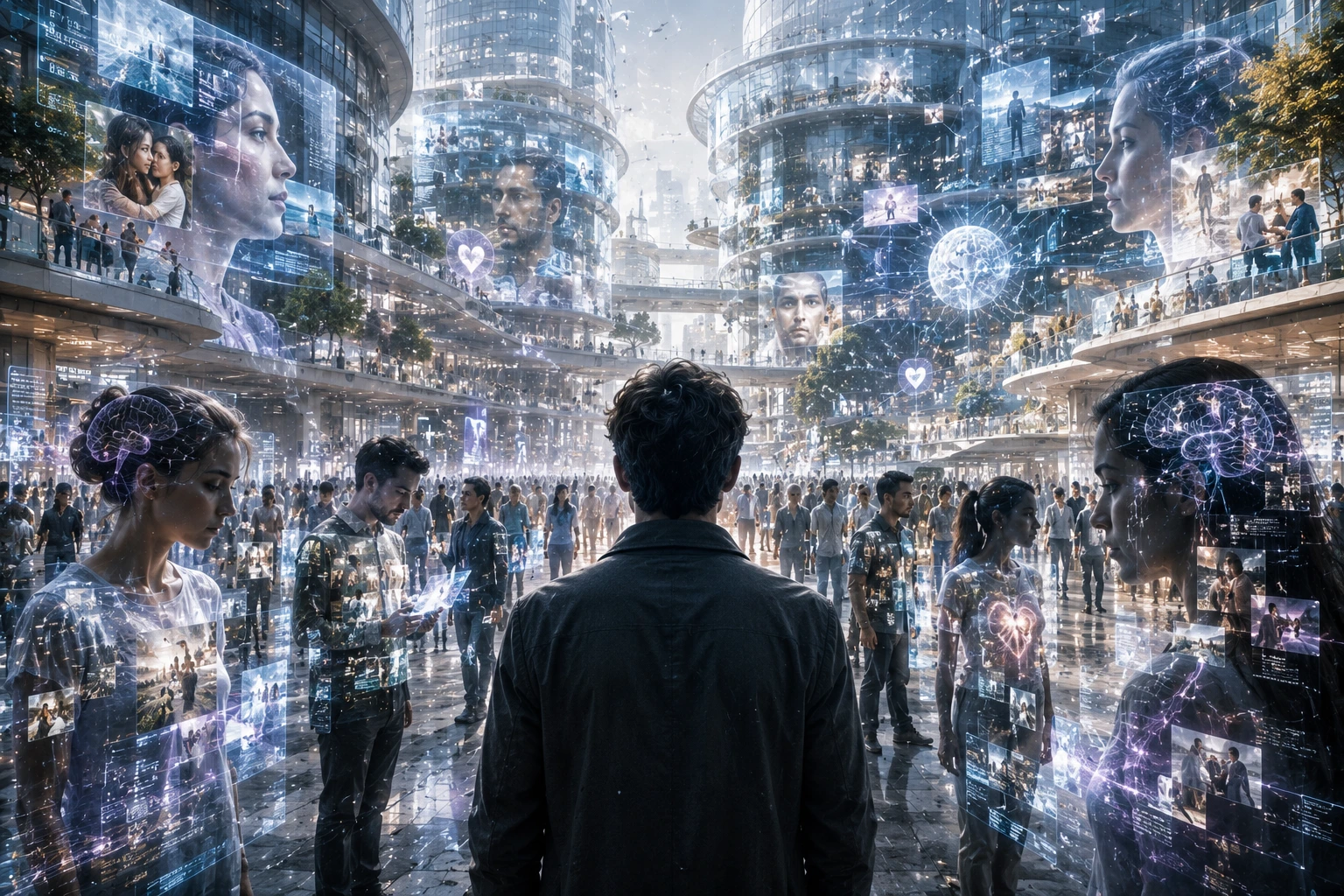
Can humanity survive total transparency? What happens when nothing can be hidden anymore?
Not because governments become stronger. Not because surveillance becomes unavoidable. But because transparency itself becomes perfect.
Every memory visible. Every thought accessible. Every intention understandable. Every secret exposed.
At first glance, this sounds like the solution to countless human problems: no lies, no corruption, no manipulation, no hidden agendas, no betrayal.
But could humanity survive total transparency?
Privacy Has Always Protected Human Identity
Privacy is often treated as a luxury. In reality, privacy may be one of the foundations of individuality.
Human beings do not reveal everything they think. They do not share every fear, every doubt, every contradiction or every unfinished version of themselves.
Privacy creates space for growth. It allows unfinished ideas to develop. It allows mistakes to remain temporary rather than permanent.
Without privacy, identity itself may become fragile. This is why questions of transparency belong beside books about identity and books about consciousness.
Who Are You When Your Inner Self Becomes Public?
Total transparency creates a difficult identity problem.
Are you your actions? Your thoughts? Your motives? Your memories? Your temporary emotions? Your worst impulse? Your best intention?
Human beings are not single, finished objects. They are changing inner worlds.
If every passing thought becomes visible, society may begin treating temporary mental states as permanent identity.
A person may become trapped not by what they did, but by everything they once felt, feared, imagined or almost became.
Could Trust Exist Without Secrets?
Most people assume transparency automatically creates trust.
The relationship may be more complicated.
Trust is not simply the absence of secrets. Trust is the willingness to remain vulnerable despite uncertainty.
A friendship without uncertainty may not require trust at all. A relationship in which every thought is visible may eliminate deception, but it may also eliminate generosity, mystery and forgiveness.
Trust may depend partly on choosing to believe rather than being forced to know.
What Happens When Thoughts Become Visible?
Imagine a world where emotions can be seen, memories can be shared instantly and hidden motivations become impossible.
At first, this may sound liberating.
But human beings often think contradictory thoughts. Anger appears and disappears. Fear appears and disappears. Doubt appears and disappears.
Many thoughts are temporary visitors rather than true intentions.
Would people still tolerate one another if every passing thought became public?
Would Love Survive Perfect Transparency?
Relationships survive partly because people interpret one another with generosity.
Misunderstandings are repaired. Impulsive emotions fade. People change.
A world of perfect transparency may remove misunderstanding, but it may also remove mercy.
If every emotional reaction becomes permanently visible, relationships may become less forgiving rather than more honest.
Love may not require knowing everything. It may require knowing enough and still choosing to stay.
Can Forgiveness Exist If Nobody Can Forget?
Total transparency becomes even more dangerous when combined with perfect memory.
If every mistake remains visible and every private failure remains accessible, forgiveness may become much harder.
Human relationships depend on the possibility that people can change without being permanently trapped by every earlier version of themselves.
This is why total transparency connects directly to Can Humanity Survive Perfect Memory?. A world that remembers everything and hides nothing may become unable to let anyone begin again.
Could Society Function Without Privacy?
Civilizations depend on private spaces.
Homes. Conversations. Reflection. Experimentation. Political dissent. Emotional recovery. Unfinished thought.
Privacy is not only the ability to hide wrongdoing. It is the space where people become ready to speak truth responsibly.
A civilization without privacy may become extremely stable. It may also become incapable of producing anything truly new.
Creativity Needs Hidden Space
Innovation rarely begins as a polished public truth.
It often begins as a strange idea, an unpopular question, a private doubt or an unfinished experiment.
Artists, scientists and thinkers need spaces where ideas can fail before they are judged.
If every unfinished idea becomes visible too early, creativity may become safer, cleaner and less alive.
A transparent civilization may know more about itself while becoming less capable of surprising itself.
Transparency and the Problem of Freedom
Freedom requires the possibility of private choice.
The ability to think without observation. The ability to question without punishment. The ability to become someone different from who you were yesterday.
Total transparency may not destroy freedom directly. It may destroy the conditions that allow freedom to exist.
This connects naturally to the questions explored in books about free will and books about responsibility.
Could Total Transparency Become a New Form of Control?
Historically, power depended on controlling information.
A transparent civilization changes the equation.
The greatest power may belong not to those who hide information, but to those who decide how information is interpreted.
The future may not belong to secrecy. It may belong to narrative.
If everything is visible, the decisive question becomes: who explains what it means?
Consciousness Was Never Designed to Be Public
Human consciousness evolved as a private experience.
Thoughts emerge before they are filtered. Emotions appear before they are understood. Identity develops through internal dialogue.
If consciousness becomes transparent, the boundary between self and society may begin to disappear.
Human beings may no longer fear being misunderstood. They may fear becoming incapable of being alone.
This is why total transparency is not only a political question. It is a question about human nature, consciousness and the future of civilization.
Why This Question Belongs to Philosophical Science Fiction
The best philosophical science fiction rarely asks what humanity can build.
It asks what humanity can survive.
Could humanity survive unlimited knowledge? Could humanity survive perfect happiness? Could humanity survive infinite freedom? Could humanity survive unlimited power?
Could humanity survive perfect memory? Could humanity survive absolute truth? Could humanity survive the end of mystery? Could humanity survive immortality without purpose?
And now another question emerges:
Could humanity survive total transparency?
The Eternity Management Question
In the world of Eternity Management, the greatest danger is often not destruction.
Sometimes the greatest danger is success.
Unlimited knowledge may destroy humility. Absolute truth may destroy trust. The end of mystery may destroy wonder. Immortality without purpose may destroy meaning.
And total transparency may destroy the private space where humanity itself grows.
The real question is not whether humanity can create a transparent civilization.
The real question is whether humanity can remain human when nothing remains hidden.
Frequently Asked Questions About Total Transparency
What is total transparency?
Total transparency is a hypothetical future in which thoughts, memories, intentions, emotions and personal information become fully visible or accessible.
Would total transparency eliminate lies?
Probably, but it might also eliminate privacy, personal boundaries and the protected inner space people need to grow.
Would relationships become stronger?
Not necessarily. Perfect information does not automatically create empathy, mercy or forgiveness.
Is privacy necessary for freedom?
Yes. Freedom often requires spaces where people can think, question, change and develop without constant observation.
Could creativity survive total transparency?
Possibly, but creativity may become weaker if unfinished ideas are exposed and judged too early.
Could humanity survive total transparency?
Perhaps. But humanity might become fundamentally different if privacy disappears completely.
Read More
- Books About Consciousness
- Books About Identity
- Books About Free Will
- Books About Responsibility
- Books About Human Nature
- Books About the Future of Humanity
- Books About Existence
- Can Humanity Survive Perfect Memory?
- Can Humanity Survive Absolute Truth?
- Can Humanity Survive the End of Mystery?
- Can Humanity Survive Immortality Without Purpose?