
Use this character list to look up Vis, the Telimus family, and the students and staff of the Catenan Academy.
Spoiler scope: The table gives introductory roles. Concealed identities appear later under a Book 1 spoiler warning.
The Will of the Many characters at a glance
| Character | Quick identifier |
|---|---|
| Vis | Protagonist |
| Ulciscor Telimus | Senator; sponsors Vis |
| Relucia Telimus | Ulciscor’s wife |
| Lanistia Scipio | Vis’s tutor |
| Caeror Telimus | Ulciscor’s brother |
| Callidus Ericius | Academy student; Class Seven in the glossary |
| Eidhin Breac | Academy student; Class Six in the glossary |
| Emissa Corenius | Academy student; Class Three in the glossary |
| Aequa Claudius | Academy student; Class Four in the glossary |
| Indol Quiscil | Academy student; Class Three in the glossary |
| Belli Volenis | Academy student; Class Three in the glossary |
| Veridius Julii | Academy head |
Names and identifiers are checked against the author’s official glossary. These are introductory reference points, not summaries of anyone’s final circumstances.
Vis: the character at the centre
Vis is a young fugitive entering the elite Catenan Academy while concealing his past. The publisher’s premise establishes the central conflict: he must succeed within an empire he opposes, investigate its secrets, and protect an identity that could put him in danger.
That makes two questions useful throughout the novel: What does Vis know about this person? and What does this person know about Vis? Those questions need not have matching answers. Readers should distinguish his outward role from what he privately wants.
Reading lens: access and safety are different things. An invitation, a useful introduction, or an opportunity to advance can create obligations as well as possibilities. Tracking what an interaction asks of Vis is often more helpful than immediately deciding whether the other person is an ally.
This guide places his concealed identity in the spoiler section below. If you are still reading, the name Vis is enough for the main reference.
The Telimus circle: family, sponsorship, and teaching
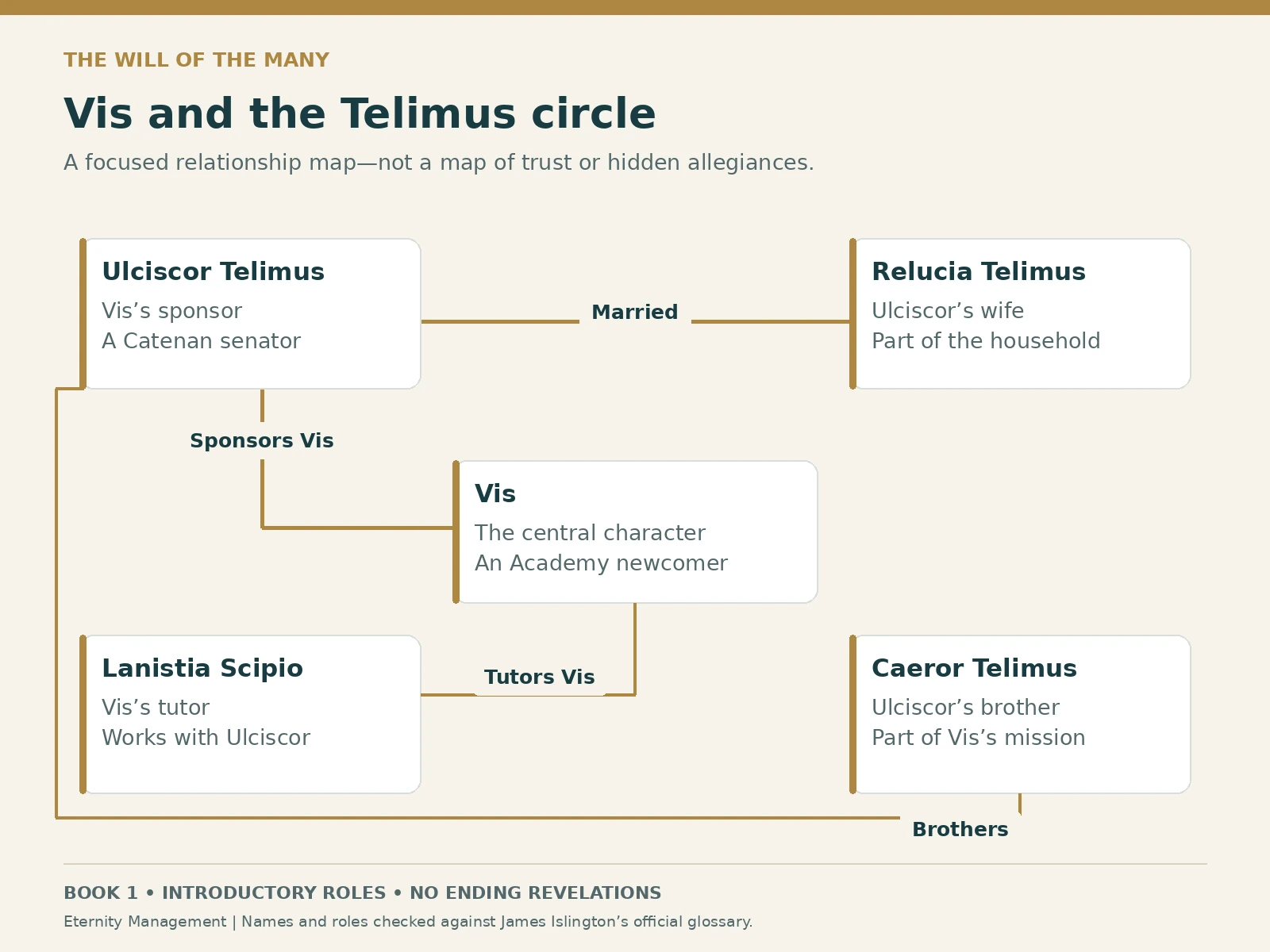
Ulciscor Telimus: adoptive father and sponsor
Ulciscor is a Military senator who adopts Vis and sends him to investigate the Academy. He wants answers about his brother Caeror’s reported death. His sponsorship gives Vis access, but also gives him a mission he did not freely design.
Reading distinction: “father,” “sponsor,” and “person directing an investigation” describe different parts of this relationship. Treating only one as important obscures the pressure created by the others.
Relucia Telimus: a member of Vis’s new family
Relucia is Ulciscor’s wife. That places her within the household Vis enters. Her introductory identity is enough for the relationship map; further information about her belongs in the concealed-identity section below.
Lanistia Scipio: preparation before the Academy
Lanistia tutors Vis at Villa Telimus and helps Ulciscor investigate Caeror’s reported death. She connects Vis’s preparation to the investigation he is being asked to undertake.
Reading distinction: Lanistia is not one of the Academy’s classroom Praeceptors. Her teaching relationship with Vis begins in a different setting and serves a particular purpose.
Caeror Telimus: the person behind the investigation
Caeror is Ulciscor’s brother. The circumstances of his reported death at the Academy are central to Ulciscor’s interest in sending Vis there. Treat that reported history as the starting point of a mystery, not as a complete account of what the book eventually establishes.
Academy students: names worth keeping separate
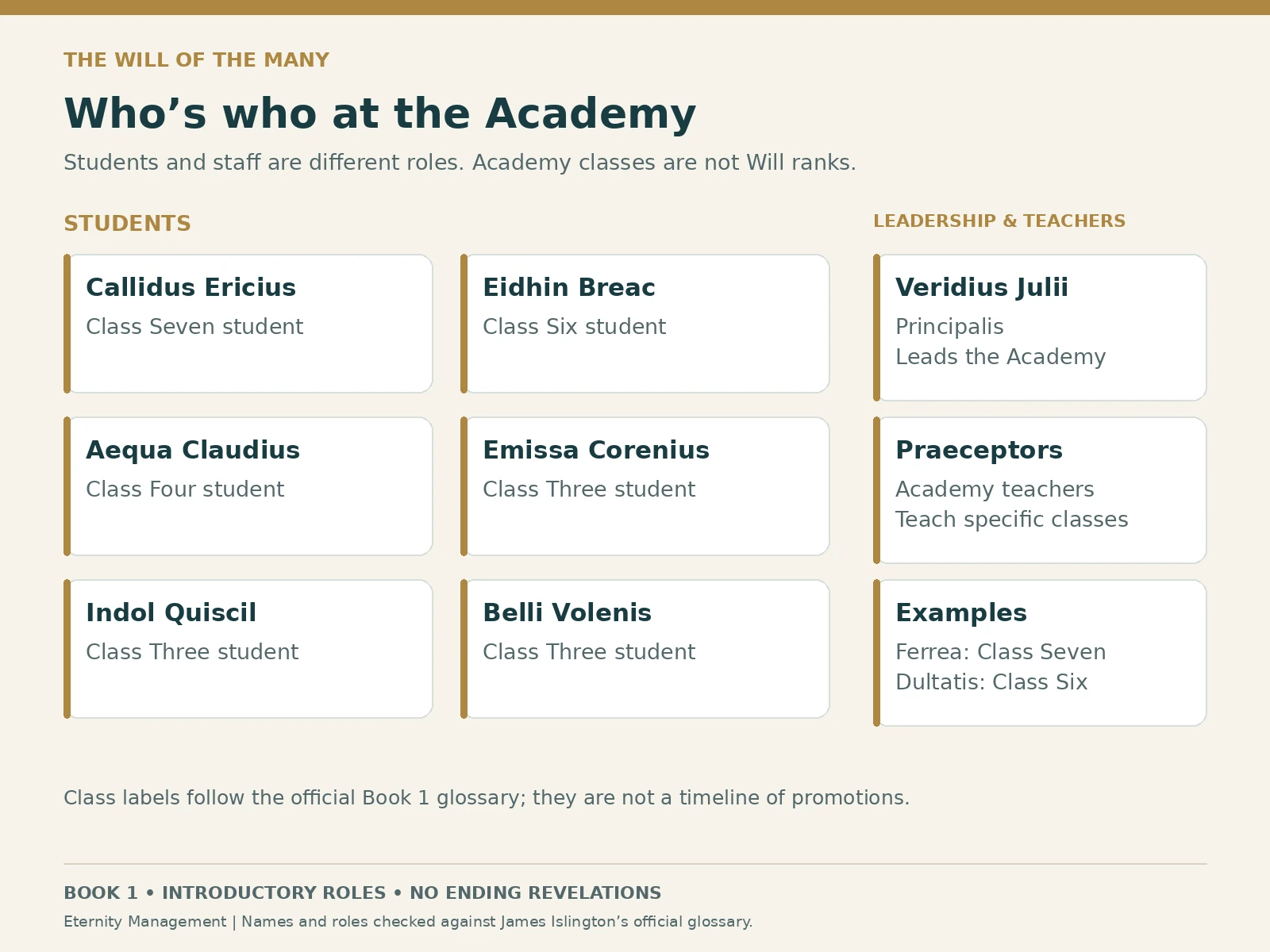
These six students occupy different positions in Vis’s Academy life. Class numbers below follow the author’s glossary and serve as reference points, not a timeline of promotions. The descriptions include developing friendships and rivalries, but omit their ending outcomes.
Callidus Ericius: Vis’s bookish friend
Class reference: Seven. Callidus becomes a close friend of Vis. Intelligent and fond of reading, he has a powerful Governance family behind him, yet his low class placement does not reflect a lack of ability. Vis finds companionship and someone with whom he can discuss ideas.
Why he matters: Callidus makes the gap between institutional standing and personal worth visible. Read his placement as a question to investigate, rather than a reliable measure of what he can do. The explanation behind that placement belongs to later developments.
Eidhin Breac: a Cymrian student and fighter
Class reference: Six. Eidhin comes from Cymr. His difficulty with the Catenan language contrasts with his fighting skill. Vis helps him with language; their relationship develops through training and a shared hostility toward the Republic.
Why he matters: Eidhin gives the Academy’s idea of merit a concrete test. Difficulty expressing yourself in an institution’s preferred language does not establish a lack of intelligence or skill. Keep the language barrier separate from his judgment and abilities.
Emissa Corenius: training and a growing personal bond
Class reference: Three. Emissa helps Vis train and negotiate Academy social life. Their connection also develops romantically. She therefore belongs in both the competitive and personal sides of his story, rather than in only one of those categories.
Why she matters: a practical partnership and an emotional attachment create different expectations. Noticing both explains why interactions between Vis and Emissa carry more weight than a simple exchange of useful advice. Her later actions are discussed only through the marked spoiler links below.
Aequa Claudius: an accomplished, suspicious peer
Class reference: Four. Aequa is the daughter of Governance senator Advenius Claudius. She suspects that Vis uses Will to cheat. Her relationship with him is shaped by that suspicion as well as by the demands of Academy exercises.
Why she matters: Aequa makes a useful distinction between what a person observes and how they explain it. Her suspicion is a character’s judgment, not a fact this guide endorses. Track the evidence available to her separately from what you know through Vis.
Indol Quiscil: a leading student with Military connections
Class reference: Three. Indol is a leading Academy student and the son of Dimidius Quiscil of Military. His family background puts him within the political elite that Vis is learning to navigate.
Why he matters: Indol connects school competition to the world beyond graduation. Keep the student’s choices separate from his father’s position. Family affiliation is useful context, but it cannot by itself explain every decision an individual makes.
Belli Volenis: a formidable competitor
Class reference: Three. Belli is associated with exceptional performance at Foundation and the Labyrinth. Remember her as a competitor whose skill matters, rather than as another interchangeable name among the higher classes.
Why she matters: the Academy contains different forms of competition. Foundation tests strategic play; a character’s standing does not tell the entire story of how they pursue an advantage. Details of Belli’s influence over other students are intentionally left out of this introductory profile.
Veridius and the Academy’s teaching roles
Veridius Julii is the Principalis. The teaching title Praeceptor refers to instructors; it is not another personal name. Ferrea and Dultatis are examples of teachers named in the glossary.
For readers, the distinction is practical: identify whether a scene concerns the institution’s leadership, a classroom relationship, or a student interaction. Different kinds of authority can shape the same encounter.
Reading lens: separate position from credibility. A character’s office explains why others may listen to them, but the office alone cannot settle whether a particular explanation is complete. Conversely, uncertainty about an explanation does not establish that every statement is false.
For the separate question of how power and advancement work, read the Will system and Hierarchy ranks explained. That guide covers the mechanics without requiring this character reference to repeat them.
Names, titles, and affiliations: how to avoid confusion
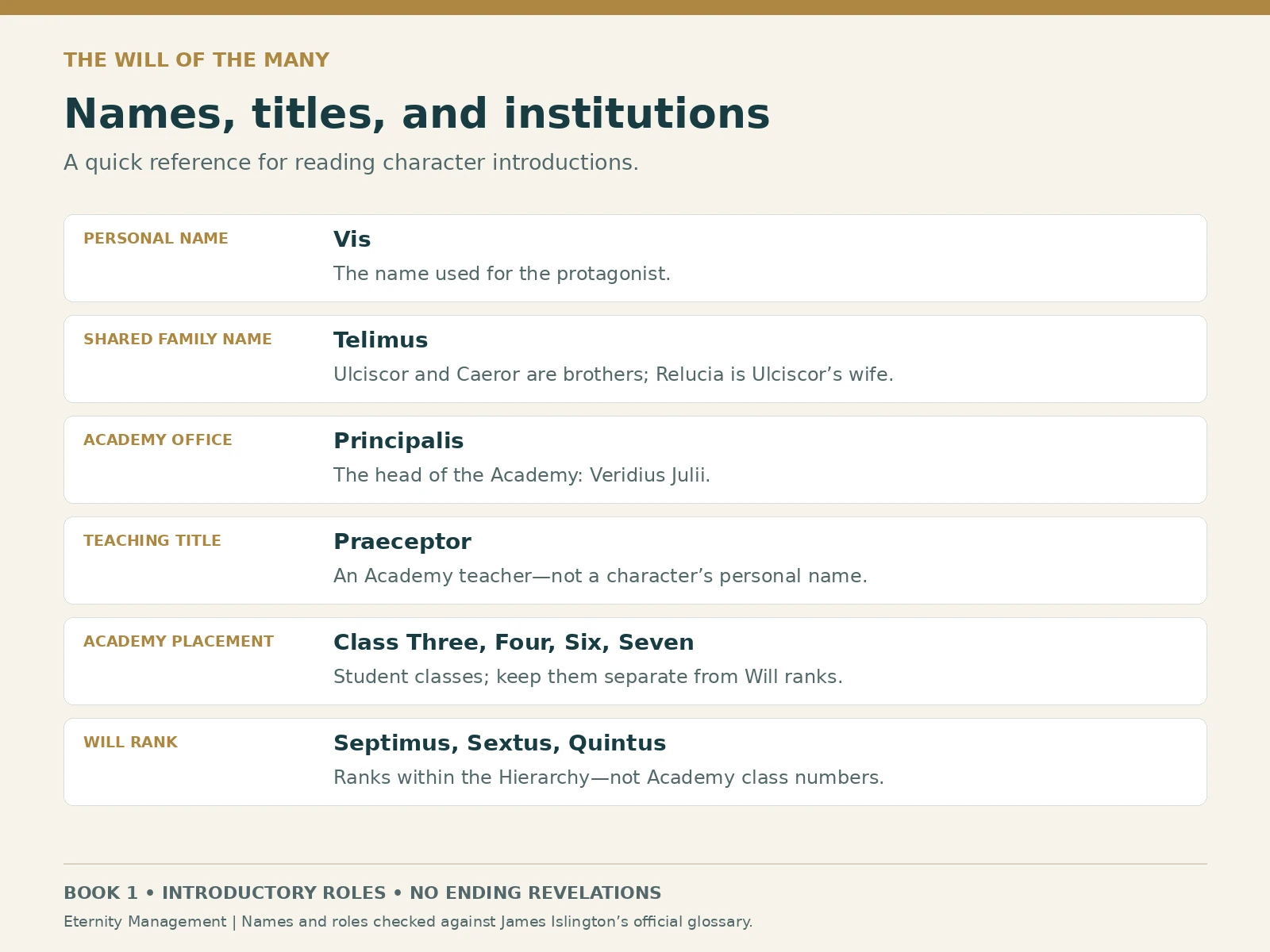
A dense cast becomes easier to follow when you identify what kind of word you are looking at. A personal name identifies an individual; a family name establishes a naming connection; a title describes a role. A class number and a Will rank should be recorded separately.
Also distinguish a public affiliation from a demonstrated motive. “Belongs to an institution” and “wants the same outcome as everyone in it” are not equivalent claims. When a character gives a reason for acting, attribute that reason to the speaker until the narrative supports a stronger conclusion.
Three questions make an effective relationship check:
- What is the connection: family, teaching, sponsorship, or shared institution?
- What has this person directly shown Vis?
- Which part of my judgment is still an inference?
This approach keeps a relationship map useful. It explains connections without turning every line into a prediction of betrayal or loyalty.
Book 1 spoilers: concealed names and connections
Stop here if you want to avoid hidden-identity revelations. The expandable section below contains Book 1 identity information. It excludes sequel revelations.
Reveal Book 1 identity spoilers
Vis and Diago
Diago is Vis’s birth name. Cristoval is his father; Ysabel and Carinza are his sisters. These names belong to his background in Suus.
Relucia and Sedotia
Relucia also operates as Sedotia, an Anguis agent. This concealed affiliation changes how her household identity should be understood.
Estevan and Melior
Estevan is also called Melior and leads the Anguis. His prior connection to Vis includes tutoring.
Interpretation: an alias does more than add another entry to a cast list. It changes how readers connect an earlier relationship to a later encounter. Update your existing entry when a name is revealed; do not automatically treat every name as a new person.
For the closing events, use The Will of the Many ending explained. For the specific attack involving Emissa, see the explanation of Emissa’s actions. The Synchronism guide addresses the epilogue’s larger revelation. All three links contain ending spoilers.
Frequently asked questions
Who is the main character in The Will of the Many?
Vis is the protagonist. The story follows his effort to navigate the Catenan Academy while concealing his past. His hidden identity is discussed only in the marked spoiler section above.
Are Ulciscor and Caeror the same person?
No. They are brothers. Keep separate entries for them even though both use the surname Telimus.
Who runs the Academy?
Veridius Julii holds the position of Principalis. Praeceptors are teachers, so those terms should not be treated as interchangeable.
Is this character guide completely spoiler-free?
No. The main reference includes roles, developing friendships, romantic interest, and rivalries. These are mild story spoilers if you have only just started. Concealed identities are placed in an expandable spoiler section, and ending-related links are marked. No sequel revelations are included.
Should I memorize every character before reading?
No. Begin with the central cast and return when a name becomes relevant. A short personal note tied to a scene you have actually read is usually more useful than memorizing a long list without context.
Where can I check character pronunciations?
The author’s official glossary includes pronunciation guidance. Its descriptions contain story information, so consult it with the same care you would use for a cast list intended for readers who have finished the book.
What to read next
Finished Book 1 and need a refresher before The Strength of the Few? Read our The Will of the Many recap to revisit the main events and where the story leaves Vis. Contains full Book 1 spoilers, including the ending; no sequel spoilers.
If you want another novel with a related appeal, explore books like The Will of the Many. If you are choosing between two popular entry points, our comparison with Red Rising focuses on the reading experience.
Sources and editorial scope
Written by Denys Kostin. Reference check: October 17, 2026.
- James Islington’s official Hierarchy glossary and maps: names, introductory roles, selected relationships, and identity cross-references. The glossary contains spoilers.
- SuperSummary: character list: supplementary checks on student relationships and concealed identities; contains major spoilers.
- SuperSummary: character analysis: supplementary checks on Callidus and Eidhin; contains ending spoilers.
- Simon & Schuster: The Will of the Many: the published premise and Vis’s Academy mission.
This is a selective reference with original reading guidance, not an exhaustive cast list or a chapter-by-chapter synopsis. Names and roles were checked against the official glossary, while relationship details were cross-checked against public summaries. The novel’s relevant passages have not been directly verified for this article. Interpretive “why they matter” notes are editorial analysis, not additional plot claims. No unverified page numbers or direct quotations from the novel are supplied.
The hero is a symbolic illustration, not a set of canonical character portraits. Supporting visuals organize selected reference information. Interpretive reading suggestions are distinguished from character identifiers.