Looking for books like Project Hail Mary? Start with The Martian if you want more scientific problem-solving, Children of Time if the encounter with nonhuman intelligence mattered most, Seveneves for hard science under extinction-level pressure, and Contact for a more reflective story of communication across the unknown. The best next book depends on which part of Andy Weir’s novel you most want to experience again.
Project Hail Mary is unusually difficult to replace because its appeal does not come from one ingredient. It combines engineering, survival, suspense, humor, discovery, first contact, emotional connection, and a problem large enough to determine humanity’s future. A recommendation can resemble its setting and still miss its experience.
This spoiler-light guide therefore compares books by what they actually reproduce: scientific problem-solving, survival stakes, discovery, connection, nonhuman intelligence, accessibility, and humanity-scale consequence. The rankings are qualitative editorial judgments, not scientific measurements.
Editorial note: This is a researched, spoiler-light recommendation guide prepared for Eternity Management. The comparisons synthesize verified book premises and thematic fit against the framework below; they are editorial judgments, not claims that every title was freshly reread cover to cover for this article. Official publisher and author pages were used to verify authorship, series relationships, and high-level premises. No outside publisher paid for inclusion. Denys Kostin is the site author/editor, and his own novel is separated and disclosed rather than included in the ranked 15.
Estimated reading time: 25–29 minutes · Editorial review: August 12, 2026 · Primary search intent: what to read after Project Hail Mary.
Table of Contents
- Quick answer: what should you read after Project Hail Mary?
- Why Project Hail Mary is hard to replace
- The Project Hail Mary similarity framework
- 15 books like Project Hail Mary compared
- The 15 best books like Project Hail Mary
- Choose by what you loved most
- If first contact was your favorite part
- A philosophical extension: Those Who Guard Eternity
- Frequently asked questions
- Sources and editorial methodology
Quick Answer: What Should You Read After Project Hail Mary?
If you want one default recommendation, read The Martian by Andy Weir. It is the closest match for practical scientific reasoning, isolation, engineering under pressure, humor, and the pleasure of watching a protagonist turn impossible constraints into solvable problems.
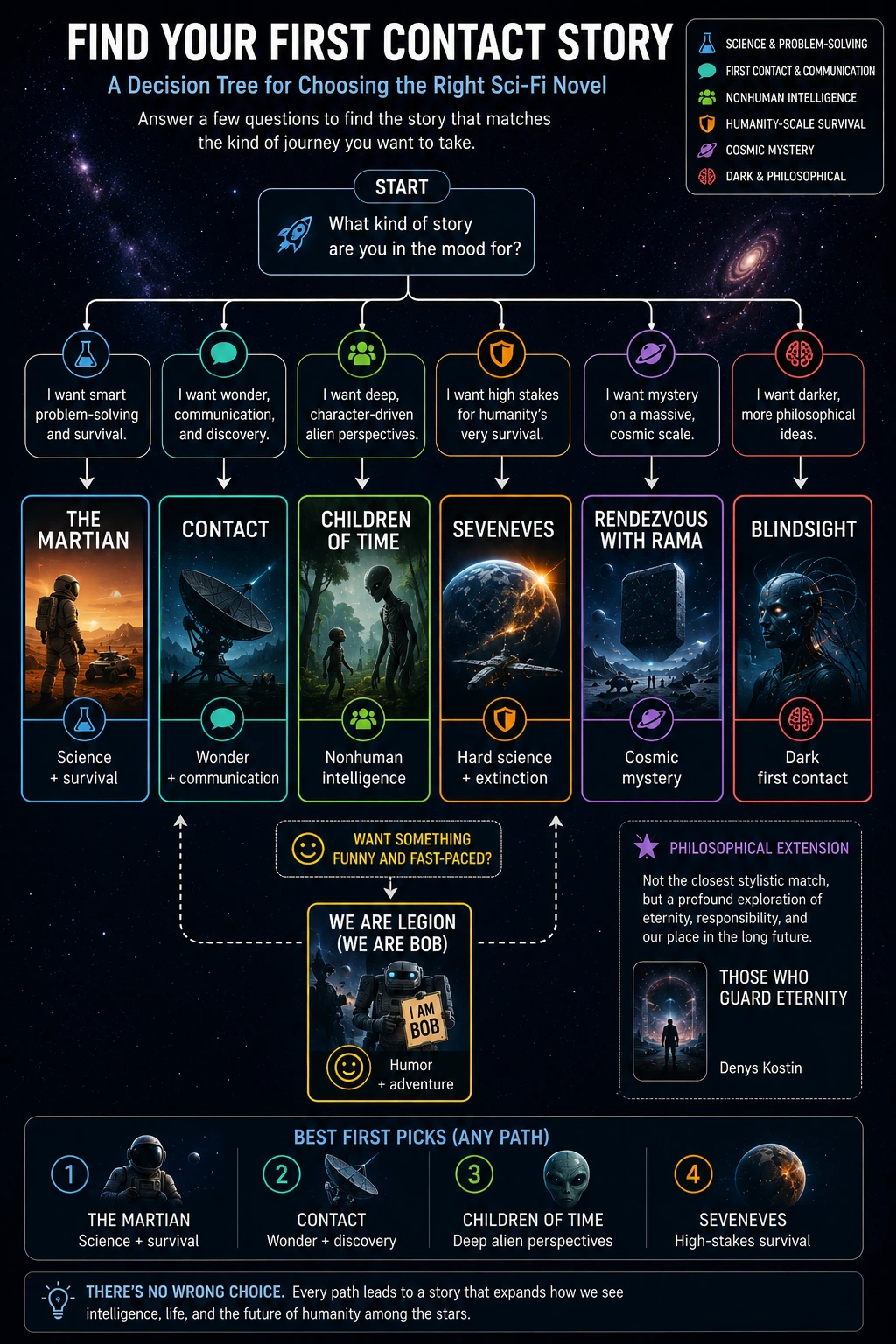
But the most satisfying next book changes with your favorite part of Project Hail Mary:
- For scientific problem-solving: The Martian, Saturn Run, or Delta-v.
- For nonhuman intelligence: Children of Time, Semiosis, or The Mountain in the Sea.
- For first contact and communication: Contact or Rendezvous with Rama.
- For humanity-scale survival: Seveneves or The Three-Body Problem.
- For humor and accessible pacing: We Are Legion (We Are Bob) or Artemis.
- For darker philosophical first contact: Blindsight.
- For space adventure with escalating mystery: Leviathan Wakes.
Readers already exploring Eternity Management’s science-fiction cluster can also compare books like Children of Time, books like The Three-Body Problem, books like The Expanse, books like Foundation, and books like Dune.
Why Is Project Hail Mary So Hard to Replace?
Many science-fiction novels contain a brilliant scientist, a damaged spacecraft, a mysterious signal, an alien intelligence, or an existential threat. Fewer make those elements feel like parts of one coherent emotional machine.
The first source of the appeal is science as action. Scientific ideas do not sit in the background as decoration. Problems have constraints. Hypotheses have consequences. Knowledge is useful only when it can be converted into a decision before time runs out. This creates a distinctive form of suspense: the reader is not merely waiting to discover what happens, but watching whether understanding can arrive fast enough to change what happens.
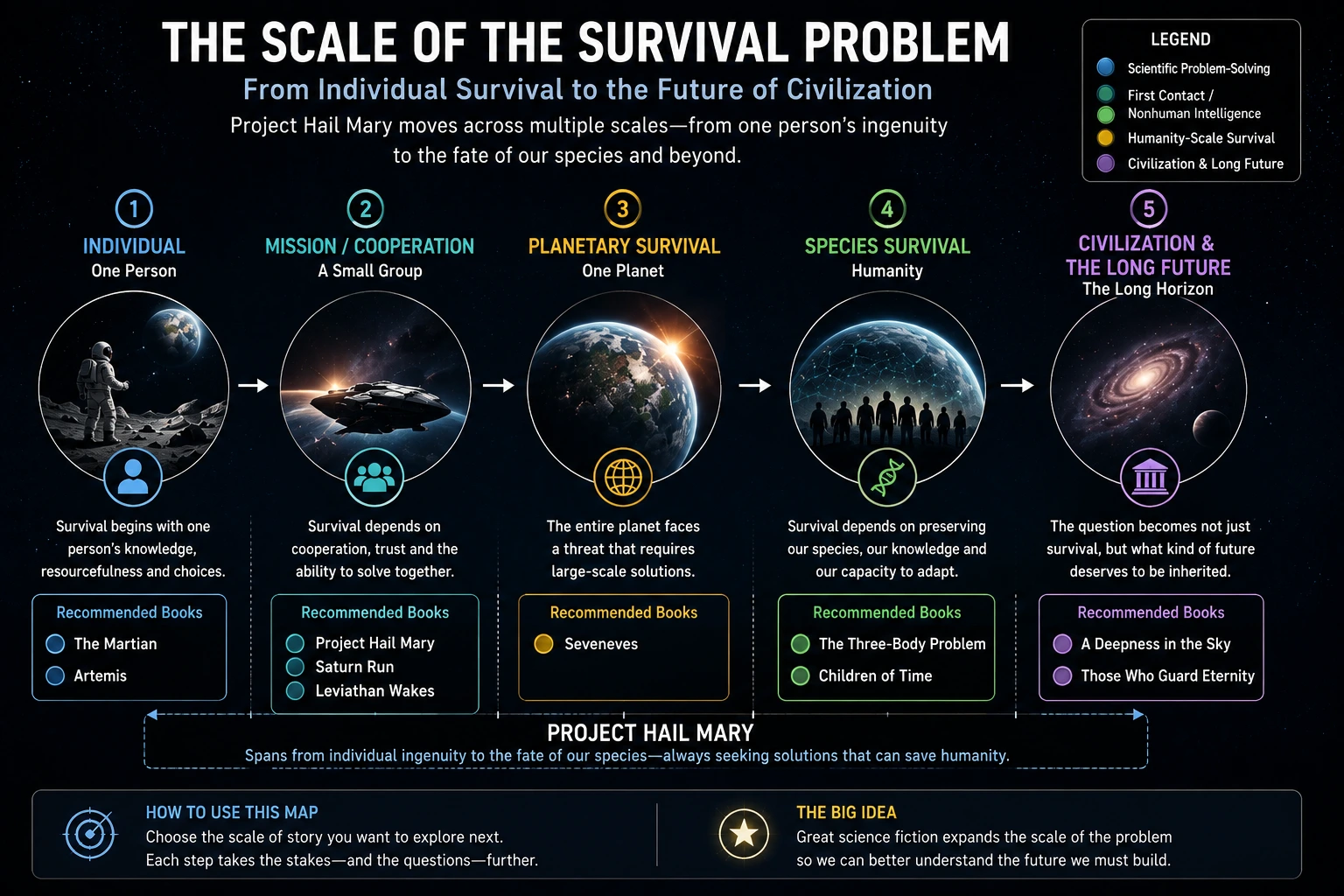
The second is scale. The story can feel intensely personal while the consequences reach far beyond one life. That movement from an individual mind to humanity’s future is one reason the novel feels larger than a conventional survival thriller. It also connects naturally to other speculative books about the future of humanity.
The third is discovery. The unknown is not simply an enemy. It is something to observe, model, misunderstand, revisit, and eventually interpret. That makes curiosity a survival skill. The story repeatedly rewards the willingness to revise an assumption when reality refuses to cooperate.
The fourth is connection. The most memorable science fiction does not only ask whether an unfamiliar intelligence can be detected. It asks whether different minds can build enough shared understanding to act together. Communication therefore becomes an engineering problem, an emotional problem, and an ethical problem at the same time.
Finally, the book remains accessible. Technical material is carried by urgency, humor, character, and clear goals. Readers can enjoy the science without needing the experience to become a textbook. That balance is harder to reproduce than the presence of equations or spacecraft.
The Project Hail Mary Similarity Framework
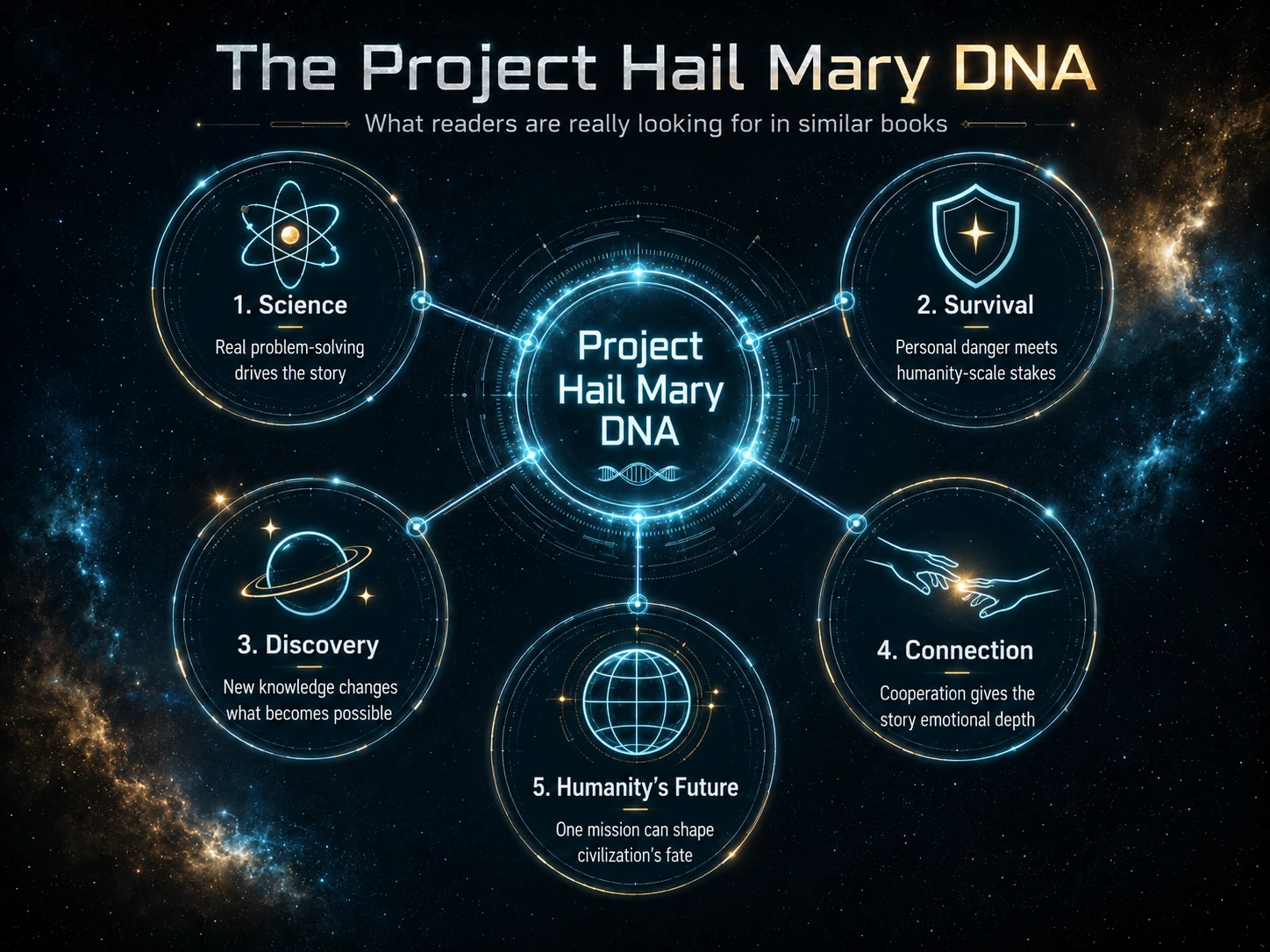
This ranking evaluates each recommendation across seven editorial dimensions. The goal is not to produce a fake numerical certainty, but to make the comparison transparent.
- Scientific problem-solving: Does reasoning, experimentation, engineering, or technical constraint actively drive the plot?
- Survival pressure: Do characters need to solve immediate material problems rather than merely discuss large ideas?
- Discovery: Does new knowledge repeatedly change what the characters believe is possible?
- Nonhuman intelligence or first contact: Does the story seriously engage with minds, life, artifacts, or civilizations beyond familiar humanity?
- Connection and cooperation: Does survival depend on trust, translation, teamwork, or mutual understanding?
- Humanity-scale stakes: Do consequences extend to a planet, species, civilization, or long future?
- Accessibility and momentum: Can a reader who loved Weir’s pace and clarity move through the ideas without losing the story?
A book can rank highly without matching all seven. Blindsight, for example, is far darker and less emotionally welcoming, but it is exceptionally relevant to readers fascinated by nonhuman intelligence and consciousness. We Are Legion (We Are Bob) is lighter and more playful, yet it recreates the pleasure of technical ingenuity and conversational momentum. Children of Time is less similar in narrative voice but much closer in its sustained interest in understanding unfamiliar intelligence.
15 Books Like Project Hail Mary Compared
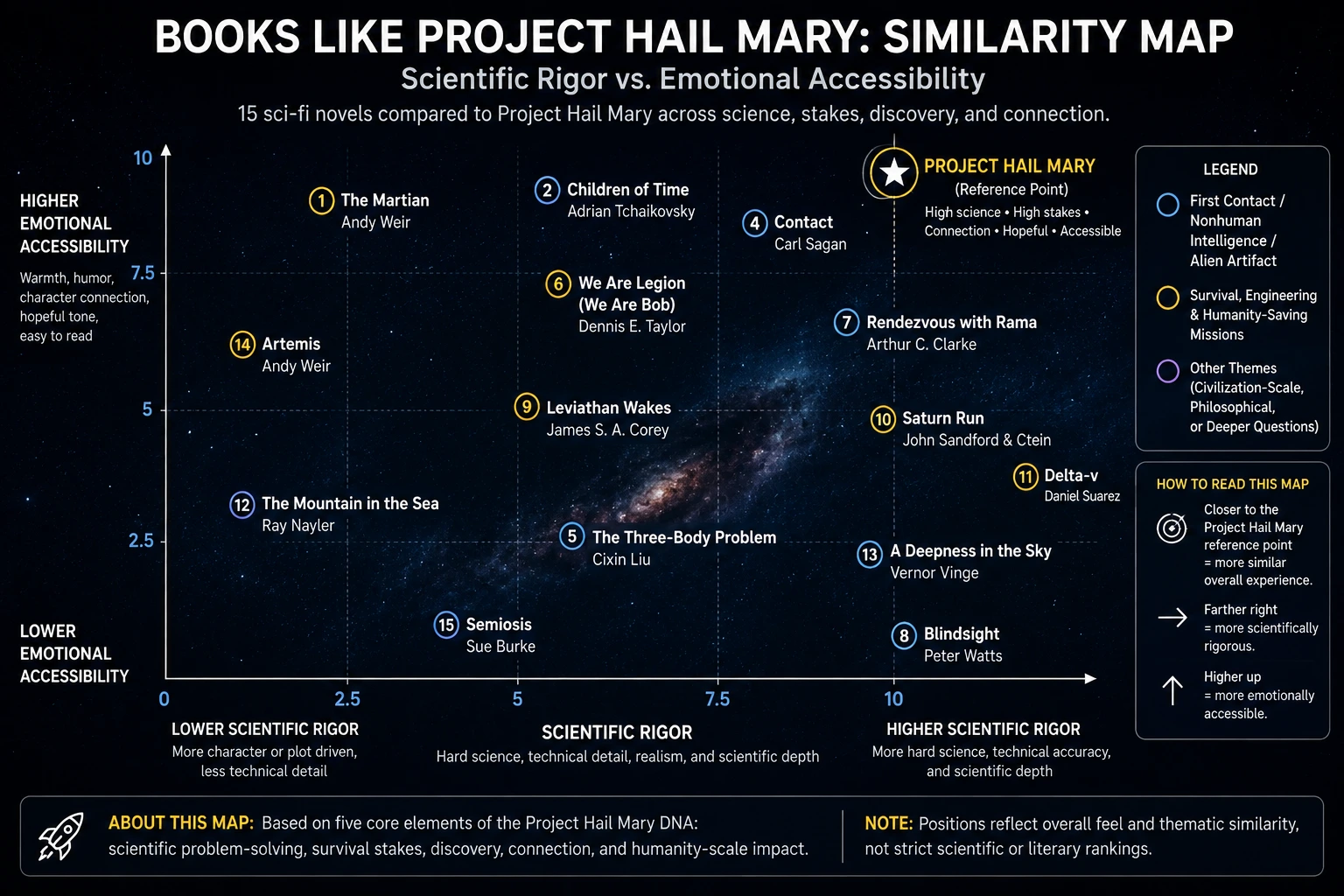
| Rank | Book | Best for | Science | First contact / nonhuman intelligence | Tone | Editorial match |
|---|---|---|---|---|---|---|
| 1 | The Martian | Problem-solving and survival | Very high | No | Funny, tense | Closest overall |
| 2 | Children of Time | Nonhuman intelligence | High | Very high | Expansive, thoughtful | Very strong |
| 3 | Seveneves | Hard science and species survival | Very high | No | Serious, urgent | Very strong |
| 4 | Contact | Communication and wonder | High | Very high | Reflective, hopeful | Very strong |
| 5 | The Three-Body Problem | Civilization-scale first contact | High | Very high | Darker, strategic | Strong |
| 6 | We Are Legion (We Are Bob) | Humor, engineering, momentum | Moderate–high | Moderate | Playful, fast | Strong |
| 7 | Rendezvous with Rama | Scientific mystery | High | High | Cool, wondrous | Strong |
| 8 | Blindsight | Consciousness and dark first contact | Very high | Very high | Cold, unsettling | Strong but demanding |
| 9 | Leviathan Wakes | Space survival and escalating mystery | Moderate | Indirect | Fast, cinematic | Specialized |
| 10 | Saturn Run | Mission engineering | Very high | Alien artifact | Technical thriller | Specialized |
| 11 | Delta-v | Near-future engineering | Very high | No | Practical, tense | Specialized |
| 12 | The Mountain in the Sea | Communication with nonhuman minds | Moderate–high | Very high | Cerebral, intimate | Specialized |
| 13 | A Deepness in the Sky | Alien civilization and long-range strategy | High | Very high | Epic, complex | Specialized |
| 14 | Artemis | More Andy Weir voice and engineering | High | No | Fast, comic | Specialized |
| 15 | Semiosis | Mutual communication and alien ecology | Moderate–high | Very high | Thoughtful, strange | Specialized |
The 15 Best Books Like Project Hail Mary
1. The Martian by Andy Weir
Best for: scientific problem-solving, isolation, engineering, humor, and survival · Editorial match: Closest overall
If the pleasure of Project Hail Mary came from watching a smart person convert catastrophe into a sequence of solvable technical problems, The Martian is the obvious first choice. Its premise is narrower in scale, but its storytelling engine is remarkably similar: observe the failure, identify constraints, form a hypothesis, improvise with limited resources, test the result, survive the consequences, and try again.
The strongest overlap is not simply that Andy Weir wrote both novels. It is the way intelligence becomes dramatic. Calculation does not slow the story; it creates momentum. A technical detail matters because getting it wrong can kill someone. Humor functions as resilience rather than decoration, allowing the protagonist—and the reader—to remain psychologically mobile while the situation keeps deteriorating.
The major difference is that The Martian lacks the first-contact dimension and carries more concentrated personal stakes. Its emotional architecture is built around isolation, persistence, and the possibility of rescue rather than communication across radically different minds.
Strongest overlap: real problem-solving, survival, humor, technical improvisation, and forward momentum.
Important difference: personal survival rather than first contact and species-level cooperation.
2. Children of Time by Adrian Tchaikovsky
Best for: nonhuman intelligence, evolution, communication, survival, and civilizations learning to understand one another · Editorial match: Very strong
Children of Time is the strongest recommendation for readers who finished Project Hail Mary thinking less about the equations than about the possibility of genuinely different intelligence. Adrian Tchaikovsky builds a story in which cognition, evolution, culture, language, and civilization develop along paths that do not need to imitate humanity.
The result creates a similar pleasure of discovery. The reader repeatedly encounters behavior that first appears strange and then becomes intelligible once the underlying system is understood. That movement—from unfamiliarity to pattern recognition—is one of the deepest connections between the books. Both ask whether survival becomes more likely when intelligence is willing to learn instead of insisting that the unknown behave like the familiar.
The difference is structural. Children of Time operates across longer timescales, distributes attention across populations and generations, and is less dependent on one immediately accessible protagonist. It is more evolutionary and civilizational; Project Hail Mary is more concentrated and mission-driven.
For a deeper comparison, see the dedicated guide to books like Children of Time.
3. Seveneves by Neal Stephenson
Best for: hard science, extinction-level survival, engineering under pressure, and humanity’s long future · Editorial match: Very strong
If the phrase “save humanity” was the part of Project Hail Mary that gave the science its emotional force, Seveneves should move near the top of your list. Neal Stephenson treats survival as a systems problem: orbital mechanics, infrastructure, resource limits, social organization, and long-term continuity all become parts of one crisis.
The similarity lies in the refusal to separate technical feasibility from human consequence. A civilization-scale emergency cannot be solved by inspiration alone. It demands physical constraints, trade-offs, redundancy, ugly choices, and the recognition that saving lives now may shape what humanity becomes later.
The tonal difference is significant. Seveneves is denser, more severe, and less buoyant. Where Weir often uses humor to keep the reader close to a problem-solving protagonist, Stephenson is willing to linger over systems, procedures, and the long consequences of catastrophe.
Readers interested in this scale can continue into Eternity Management’s guide to books about the future of humanity.
4. Contact by Carl Sagan
Best for: first contact, communication, scientific wonder, evidence, and humanity confronting a larger reality · Editorial match: Very strong
Contact is the recommendation for readers who loved the transition from “something is out there” to “how can we understand it?” Carl Sagan gives scientific curiosity moral and emotional weight. The unknown is approached through observation, evidence, interpretation, skepticism, hope, and the difficult question of what humanity should do when a signal changes its understanding of the universe.
The strongest connection to Project Hail Mary is epistemic: knowledge arrives in fragments, and those fragments must be translated into meaning. Communication is not instant. Neither intelligence nor good intentions guarantee mutual understanding. The work is in building a bridge between minds that do not share the same assumptions.
The difference is pacing and emphasis. Contact is less of a survival-engineering thriller and more interested in institutions, belief, interpretation, public meaning, and the human response to evidence that overturns old certainties.
5. The Three-Body Problem by Cixin Liu
Best for: civilization-scale first contact, scientific mystery, existential risk, and strategic consequences · Editorial match: Strong
The Three-Body Problem begins from a much darker emotional premise than Project Hail Mary, but it belongs on this list because it takes first contact seriously as a problem that can alter civilization before any face-to-face encounter occurs. Scientific anomalies, hidden motives, institutional reactions, and the arrival of knowledge from beyond Earth gradually widen the scale of the story.
Both books understand that contact is not only a discovery. It changes strategy. Once another intelligence exists and has intentions, information itself becomes consequential. What should be shared? What should be hidden? Who gets to decide on behalf of people who do not yet understand the threat? How does a civilization coordinate when different groups interpret the same reality differently?
The difference is emotional orientation. Project Hail Mary builds toward cooperation and mutual problem-solving. The Three-Body Problem is more suspicious, political, and destabilizing. Its central pressures concern trust, power, fear, and the strategic consequences of asymmetry.
Continue with the full comparison of books like The Three-Body Problem.
6. We Are Legion (We Are Bob) by Dennis E. Taylor
Best for: humor, engineering, artificial intelligence, exploration, and fast-moving problem-solving · Editorial match: Strong
Readers who loved the conversational energy of Project Hail Mary may find We Are Legion (We Are Bob) one of the easiest transitions on the list. Dennis E. Taylor builds much of the pleasure around an engineer’s mindset confronting increasingly strange circumstances. Problems arrive, systems are designed, copies and contingencies multiply, and technical competence becomes a source of both comedy and survival.
The book also expands naturally into questions of identity and intelligence. What happens when a human mind can be copied? Does continuity of memory preserve the self? When many versions of one person diverge through experience, when do they become genuinely different people? Those questions give the humor a deeper speculative foundation.
The difference is that the Bobiverse is more openly playful and episodic. Its humor is broader, its identity problems are more digital, and its expanding scale comes from replication and exploration rather than a single desperate mission.
7. Rendezvous with Rama by Arthur C. Clarke
Best for: cosmic mystery, scientific observation, alien artifacts, and awe without easy answers · Editorial match: Strong
Rendezvous with Rama captures a different part of the Project Hail Mary experience: the pleasure of confronting something that clearly has structure and purpose before anyone knows what that purpose is. The unknown is approached as an object of investigation. Characters observe, measure, enter, map, compare, and revise their expectations.
That emphasis makes the book feel unusually clean. Rather than rushing to turn mystery into conflict, Arthur C. Clarke allows scale, engineering, geometry, and unanswered questions to create wonder. The scientific attitude is not “we can explain everything.” It is “we can learn more if we look carefully enough.”
The major difference is emotional intimacy. Rendezvous with Rama is cooler, less character-centered, and less interested in the warmth of cross-species relationship. Its alienness remains more remote.
8. Blindsight by Peter Watts
Best for: hard science fiction, consciousness, alien intelligence, cognition, and existential unease · Editorial match: Strong but demanding
Blindsight is what to read when you want the first-contact questions in Project Hail Mary pushed into much darker philosophical territory. Peter Watts is interested in a disturbing possibility: intelligence and consciousness may not be the same thing, and human beings may overestimate the evolutionary value of the inner experience they consider central to personhood.
The overlap lies in the encounter with radically unfamiliar cognition. Both stories force human assumptions to fail. Both require characters to infer the capabilities of something they cannot simply interpret through ordinary social intuition. Both make the unknown intellectually consequential rather than merely visually strange.
Everything else is different in tone. Blindsight is colder, denser, more abrasive, and far less reassuring. Cooperation is not its emotional center. The pleasure comes from conceptual pressure: what if the categories we use to define intelligence are themselves the problem?
Readers drawn to that question may also explore Eternity Management’s books about consciousness.
9. Leviathan Wakes by James S. A. Corey
Best for: space survival, escalating mystery, lived-in technology, and human systems under pressure · Editorial match: Specialized
Leviathan Wakes is less focused on hard-science puzzles than the top recommendations, but it offers a strong bridge for readers who want space to feel material, dangerous, and operational. Life beyond Earth has costs. Bodies experience acceleration. Resources and habitats matter. Political systems are shaped by where people live and what they depend on.
The book begins with human conflicts and a mystery whose scale keeps expanding. That widening pattern resembles the way Project Hail Mary continually reframes what the real problem is. A local event can turn out to be evidence of something much larger. The characters must act before they fully understand what they are dealing with.
The difference is ensemble and politics. Leviathan Wakes belongs to a broad space-opera system involving factions, economies, loyalties, and multiple viewpoints. Its science supports worldbuilding and action rather than functioning as a near-continuous sequence of explicit technical puzzles.
See the dedicated guide to books like The Expanse for more options in this direction.
10. Saturn Run by John Sandford and Ctein
Best for: realistic mission design, engineering, scientific mystery, and the race to investigate an alien artifact · Editorial match: Specialized
Saturn Run deserves more attention from readers whose favorite part of Project Hail Mary was mission engineering. Its basic attraction is direct: an anomalous observation implies technology where ordinary celestial mechanics should be, and that discovery turns into a race to reach Saturn.
The book treats the journey as a technical problem. Propulsion, heat, mission design, logistics, risk, and the physical limits of what a spacecraft can do matter continuously. That commitment to engineering makes it one of the closest matches on this list in terms of practical scientific texture.
Its emotional and philosophical center is different. The story is more geopolitical and competitive, with institutions and national interests shaping decisions. First contact is approached through artifact and investigation rather than the kind of intimate reciprocal communication that gives Project Hail Mary much of its warmth.
11. Delta-v by Daniel Suarez
Best for: near-future engineering, space operations, resource constraints, and plausible technological ambition · Editorial match: Specialized
Delta-v strips away the alien-contact component and concentrates on a different pleasure: people trying to do something in space that is difficult enough to expose every weak assumption in their plan. The mission centers on deep-space resource extraction, but the real appeal is the chain of engineering, economic, and human constraints that must all work together.
That systems perspective makes it relevant to Project Hail Mary. A technically possible idea is not automatically an operationally survivable idea. Equipment fails. Incentives matter. Human endurance becomes part of the design. Small mistakes can propagate into mission-threatening consequences.
The difference is that the speculative horizon is nearer and more human. There is no radically alien intelligence to interpret, and the stakes emerge from technological ambition rather than an external species-level emergency.
12. The Mountain in the Sea by Ray Nayler
Best for: nonhuman intelligence, language, consciousness, communication, and the ethics of recognizing other minds · Editorial match: Specialized
The Mountain in the Sea may be the most interesting recommendation here for readers who care about the question beneath first contact: how do we recognize intelligence when it does not look like us? Ray Nayler turns that question toward nonhuman minds on Earth rather than extraterrestrial life, which makes the encounter feel simultaneously closer and more destabilizing.
The connection to Project Hail Mary is the work of communication. Intelligence has to be inferred from behavior. Meaning must be distinguished from projection. The observer has to ask whether a pattern belongs to the other mind or has been imposed by the human interpreting it. Scientific curiosity therefore becomes inseparable from humility.
The difference is pace and atmosphere. Nayler’s book is more meditative, ecological, and philosophical. The problem is not primarily “How do we survive this mission?” but “What obligations arise when we realize another form of intelligence has been present all along?”
13. A Deepness in the Sky by Vernor Vinge
Best for: alien civilization, long-range spacefaring cultures, first contact, power, and technological strategy · Editorial match: Specialized
A Deepness in the Sky expands the problem of contact from individuals to civilizations. Human groups approach an alien species while carrying their own competing systems of power, commerce, coercion, and technological ambition. The unknown civilization therefore becomes both an object of discovery and a mirror for the human societies trying to reach it.
The connection to Project Hail Mary is the need to understand before acting. Biology, culture, technology, and communication cannot be reduced to one simple “alien” category. Different intelligences operate inside different histories and constraints. Misreading those constraints can become dangerous.
The difference is density. Vinge works on a larger political and historical canvas, with multiple factions and a more intricate long-term structure. Readers coming directly from Weir may find it less immediately accessible, but those who want the first-contact theme enlarged into a civilizational systems problem will find the expansion rewarding.
14. Artemis by Andy Weir
Best for: more Andy Weir, lunar engineering, humor, practical science, and fast pacing · Editorial match: Specialized
If your search for books similar to Project Hail Mary is really a search for more Andy Weir, Artemis is the direct route. The setting changes from an emergency mission to a lunar city, and the plot is driven more by crime and improvisation, but the recognizable pleasure remains: practical knowledge affects what characters can attempt.
Materials, pressure, infrastructure, economics, and the physical realities of living somewhere hostile to human biology shape the story. Technical knowledge is frequently turned into action, and the prose maintains the fast, irreverent energy readers associate with Weir.
The difference is substantial enough that it should not rank higher. Artemis lacks the first-contact element, the deep emotional partnership, and the species-level survival problem. Its stakes are more local and its narrative structure more like a caper or techno-thriller.
15. Semiosis by Sue Burke
Best for: alien ecology, communication, mutual dependence, survival, and intelligence that does not resemble a human mind · Editorial match: Specialized
Semiosis belongs here because it turns communication into an ecological problem. Human colonists arrive in an environment they do not fully understand, and survival depends on interpreting a world where agency may exist in forms they are not prepared to recognize.
The strongest connection to Project Hail Mary is mutual dependence. Communication is valuable not because it satisfies curiosity, but because different forms of life may need one another. That changes the ethical structure of survival. The other intelligence cannot simply be treated as an obstacle or resource once its agency becomes undeniable.
The narrative operates across generations and gives less emphasis to one central problem-solving voice. It is slower, stranger, and more ecological than Weir’s mission thriller. Yet readers fascinated by the transition from misunderstanding to cooperation may find it one of the most conceptually satisfying books on the list.
Choose Your Next Book by What You Loved Most
The rankings above answer “Which books are most similar overall?” A better personal recommendation often begins with a narrower question: what do you want more of?
If You Loved the Science and Problem-Solving
Start with The Martian. If you already know it, choose Saturn Run for mission engineering or Delta-v for near-future space operations. All three make physical constraints part of the dramatic structure rather than decorative realism.
If You Loved First Contact and Communication
Choose Contact for scientific wonder and evidence, Children of Time for unfamiliar intelligence and evolving understanding, or Semiosis for communication built through ecological interdependence.
If You Loved the Humor and Accessible Pacing
Read We Are Legion (We Are Bob) for the strongest combination of engineering, comedy, momentum, and large speculative ideas. Choose Artemis if you mainly want more Andy Weir.
If You Loved the Humanity-Scale Stakes
Read Seveneves if you want engineering under extinction pressure. Choose The Three-Body Problem if you want first contact to become a strategic question for an entire civilization.
If You Loved the Mystery of the Unknown
Choose Rendezvous with Rama when you want awe, observation, and an alien artifact that refuses to explain itself. Choose The Mountain in the Sea when you want the mystery to be a mind rather than a machine.
If You Wanted Something Darker
Read Blindsight. It takes the question “What is intelligence?” into territory where greater understanding does not necessarily produce comfort, friendship, or moral clarity.
If First Contact Was Your Favorite Part
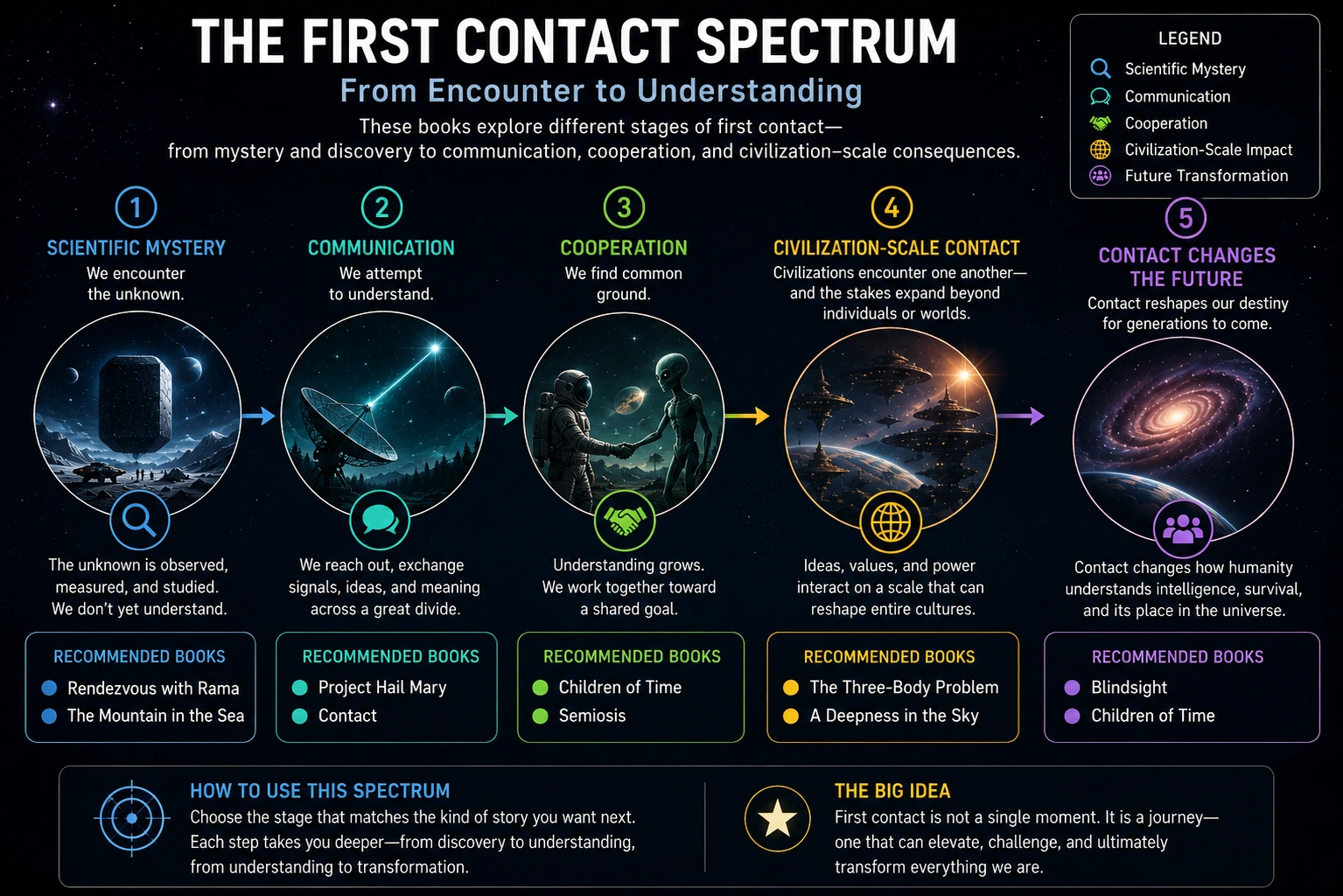
First contact stories are often grouped together as though they ask the same question. They do not. “We are not alone” is only the beginning. The deeper difference is what happens next.
Some stories focus on detection: can humanity recognize evidence of another intelligence? Others focus on translation: can signals become shared meaning? Others ask whether understanding can produce cooperation. At larger scales, the problem becomes political and civilizational: what happens when entire cultures encounter one another with unequal technology, incompatible values, or different time horizons?
Project Hail Mary is unusually optimistic within this spectrum because it makes cooperation a technical and emotional achievement. Difference creates difficulty, but difficulty can be worked on. That is why Contact, Children of Time, and Semiosis are especially useful follow-ups: they take the work of understanding seriously.
The Three-Body Problem and A Deepness in the Sky broaden the scale. Contact becomes inseparable from strategy and power. Blindsight turns in the opposite emotional direction and asks whether intelligence may exist without the inner qualities humans expect to find behind it.
Why Scientific Accuracy Alone Is Not Enough
Hard-science accuracy alone does not recreate Project Hail Mary. A rigorous novel can still feel emotionally distant, while a warmer first-contact story may contain less explicit engineering. The closest matches are the books where ideas create pressure on characters: science changes what can be attempted, discovery changes what must be believed, and communication changes who can become an ally.
That is why this list is not a universal quality ranking. Readers who prioritize humor may prefer We Are Legion; readers fascinated by consciousness may choose Blindsight; readers drawn to alien cognition may find Children of Time closer than The Martian. The useful question is not which book copies Weir, but which one continues the part of the experience you want to keep exploring.
A Philosophical Extension: Those Who Guard Eternity
Some readers finish Project Hail Mary wanting more hard science or first contact. Others remain with a different question: what responsibility follows when one person can perceive a danger to humanity’s future that others cannot yet see?
That is the point where Those Who Guard Eternity becomes relevant—but the genre difference should be explicit.
Those Who Guard Eternity is philosophical fantasy and speculative fiction, not hard science fiction. It is not presented here as a direct stylistic substitute for Andy Weir. Its connection lies in the movement from knowledge to responsibility. The novel begins from the possibility that the familiar understanding of time and reality is incomplete. As its characters see more, greater perception does not simply create power. It creates obligations and choices whose consequences extend beyond one life.
The thematic bridge is therefore not astrophysics. It is guardianship. When knowledge can affect the future of other people, what makes intervention legitimate? Is survival enough, or must something about freedom, memory, truth, meaning, and choice also be preserved? Can a person protect a future without turning protection into control?
Author disclosure: Those Who Guard Eternity was written by Denys Kostin, the creator of Eternity Management and author of this guide. It is included separately so the relationship is clear and so readers can distinguish an independent ranked recommendation from the author’s own thematic extension.
Read the philosophical extension free
Begin Those Who Guard Eternity, Book 1 of the Eternity Saga, and explore a story about time, reality, consciousness, truth, choice, and the burden created by seeing more.
Related Reading on Eternity Management
- Books Like Children of Time — for evolution, nonhuman intelligence, and civilization across deep time.
- Books Like The Three-Body Problem — for first contact, existential strategy, and cosmic-scale danger.
- Books Like The Expanse — for lived-in space civilization, political systems, and survival.
- Books Like Foundation — for civilization, institutions, history, and long-term strategy.
- Books Like Dune — for power, ecology, destiny, and civilization-scale transformation.
- Books About the Future of Humanity — for long-term survival and what humanity may become.
- Books About Consciousness — for intelligence, perception, identity, and the nature of mind.
- Who Should Guard the Future of Humanity? — for the ethical problem of responsibility across generations.
Frequently Asked Questions About Books Like Project Hail Mary
What should I read after Project Hail Mary?
Start with The Martian for the closest overall problem-solving match, Children of Time for nonhuman intelligence, Seveneves for hard-science survival, or Contact for communication and wonder.
What book is most similar to Project Hail Mary?
The Martian is the closest overall match for science-driven problem-solving, isolation, engineering, humor, and survival; choose Children of Time if first contact and nonhuman intelligence matter more.
Is The Martian similar to Project Hail Mary?
Yes. Both turn scientific reasoning and technical improvisation into suspense, but The Martian stays focused on personal survival while Project Hail Mary adds first contact and species-level stakes.
Is Children of Time like Project Hail Mary?
Yes, especially for readers who loved nonhuman intelligence, discovery, and communication; it is broader, spans longer timescales, and is less centered on one problem-solving protagonist.
What hard science-fiction books are like Project Hail Mary?
Try The Martian, Seveneves, Saturn Run, Delta-v, or Blindsight, depending on whether you want survival engineering, extinction-scale systems, mission design, near-future operations, or cognition.
What books like Project Hail Mary have first contact?
Strong choices include Contact, Children of Time, The Three-Body Problem, Rendezvous with Rama, Blindsight, A Deepness in the Sky, and Semiosis.
What should I read if I liked the science in Project Hail Mary?
Begin with The Martian; then choose Saturn Run for mission engineering, Delta-v for near-future operations, or Seveneves for a denser extinction-scale problem.
What should I read if I liked the relationship with a nonhuman intelligence?
Start with Children of Time, then try Semiosis for mutual dependence, The Mountain in the Sea for language and consciousness, or Contact for communication across distance.
What should I read if I want something funnier?
Choose We Are Legion (We Are Bob) for humor, engineering, and momentum, or Artemis if you primarily want more of Andy Weir’s voice.
What should I read if I want something darker than Project Hail Mary?
Read Blindsight for a disturbing examination of intelligence and consciousness, or The Three-Body Problem for first contact treated as strategic civilizational risk.
What should I read after watching the Project Hail Mary movie?
The same paths apply: The Martian for Weir’s problem-solving style, Children of Time for nonhuman intelligence, Contact for wonder, or Seveneves for harder survival science.
Are these recommendations spoiler-free?
The guide is spoiler-light: it discusses central premises, tone, and thematic fit while avoiding endings and major late-story solutions.
Is Those Who Guard Eternity science fiction?
It is best described here as philosophical fantasy and speculative fiction; its connection is thematic—knowledge, responsibility, truth, choice, and humanity’s future—not hard-science realism.
Where can I read Those Who Guard Eternity?
The complete English book is available to read free at Cokos.org; the authorship relationship is disclosed because it appears on the author’s own project site.
Sources and Editorial Methodology
Official publisher and author pages were used to verify titles, authorship, series placement, and high-level premises. The ranking, “best for” labels, similarity framework, thematic comparisons, and match tiers are editorial synthesis prepared for Eternity Management and published under Denys Kostin’s byline. They are not measured scores, reader-vote aggregates, or claims that one book is objectively better than another.
The guide is intentionally spoiler-light. Publisher language was used only as factual verification; the comparative prose above is original editorial analysis.
- Penguin Random House: Project Hail Mary
- Penguin Random House: The Martian
- Pan Macmillan: Children of Time
- HarperCollins: Seveneves
- Simon & Schuster: Contact
- Macmillan: The Three-Body Problem
- Simon & Schuster: We Are Legion (We Are Bob)
- HarperCollins: Rendezvous with Rama
- Macmillan: Blindsight
- Orbit: Leviathan Wakes
- Penguin Random House: Saturn Run
- Penguin Random House: Delta-v
- Ray Nayler: The Mountain in the Sea
- Macmillan: A Deepness in the Sky
- Penguin Random House: Artemis
- Macmillan: Semiosis
- Cokos.org: Those Who Guard Eternity
About the Author
Denys Kostin is the creator of Eternity Management and author of the Eternity Saga. His work explores time, consciousness, reality, memory, choice, civilization, and the responsibility created by consequential knowledge. This guide separates independent science-fiction recommendations from the author’s own thematic work so readers can see where editorial comparison ends and self-recommendation begins.
Final Thoughts
The best book after Project Hail Mary depends on the question you want to keep alive.
If you want another brilliant person solving physical problems under impossible constraints, read The Martian. If you want to meet an intelligence that evolved along a radically different path, read Children of Time. If you want to watch engineering operate under the pressure of human extinction, read Seveneves. If you want first contact as a scientific and human act of communication, read Contact. If you want the encounter to become darker and more philosophical, read Blindsight.
The strongest science fiction does more than enlarge the universe. It enlarges the set of futures, minds, risks, and responsibilities the reader can imagine.
And once a story makes humanity’s future feel real, the next question is no longer only whether we can survive. It is what kind of future would be worth surviving for.