The Will system in The Will of the Many turns individual capacity into a hierarchy of power. People cede half their Will to someone above them, allowing higher ranks to draw on those below. The eight ranks run from Octavus at the bottom to Princeps at the top. Imbuing is how that power is applied.
The confusing part is that a person’s rank, the number of people supporting them, and the Will they retain are different things. This guide separates those ideas, walks through the lower-rank arithmetic, and explains why Academy classes belong to a different system.
By Denys Kostin · Eternity Management

How does the Will system work?
Will encompasses a person’s physical and mental capacity. The publisher’s description of the novel connects it with qualities such as energy, focus, and vitality. It is a resource within the fictional world, not simply another word for determination.
Three questions help when reading a scene:
- Who supplies the Will? Look downward through the person’s supporting pyramid.
- Who retains it? Check whether that person is also ceding onward.
- How is it used? Consider the application, rather than treating rank as a complete description of ability.
These questions separate the source of power from the person visibly exercising it. A spectacular action may be performed by one individual while depending on contributions from many others.
Hierarchy ranks in order
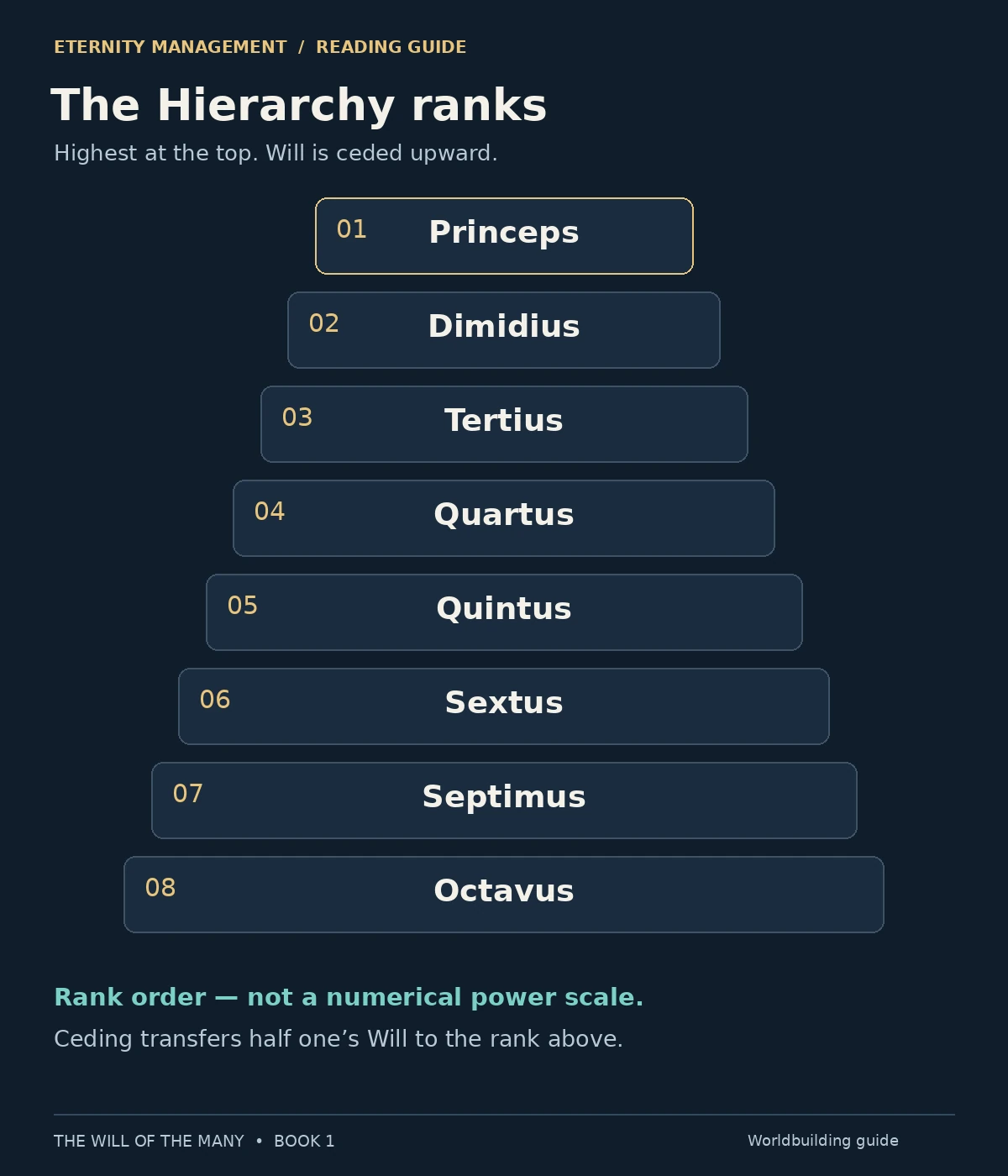
The rank order below runs from lowest to highest. Use it to orient yourself when a title appears in dialogue; it is not a chart of exact fighting ability.
| Level | Title | Reading aid | Place in the system |
|---|---|---|---|
| 8 | Octavus | Octavii | Base rank; contributes upward without receiving Will from a lower rank. |
| 7 | Septimus | Septimii | Receives from Octavii; may cede onward to a Sextus. |
| 6 | Sextus | Sextii | Receives from Septimii; may cede onward to a Quintus. |
| 5 | Quintus | Quintii | Between Sextus and Quartus; may head a pyramid as a Totius Quintus. |
| 4 | Quartus | Quartii | Above Quintus and below Tertius in the rank ladder. |
| 3 | Tertius | Tertii | One of the upper ranks, between Quartus and Dimidius. |
| 2 | Dimidius | Dimidii | Immediately below Princeps and above Tertius. |
| 1 | Princeps | Highest rank | The apex of the rank ladder; no higher rank receives its Will. |
The reading-aid column gives plural forms for Octavus through Dimidius. These are groups of people with the same rank, not additional ranks. Princeps is shown by its position rather than an inferred plural. On a phone, swipe the table horizontally.
Lower rank numbers indicate higher positions. The image reverses the table’s direction so the highest rank appears at the top, like a pyramid. Its widths are illustrative; they do not represent population or a measured quantity of Will.
What does ceding half your Will mean?
Islington’s official glossary defines ceding as giving half your Will to someone in the rank directly above. The key to the arithmetic is that a recipient can also be a contributor: Will arrives from below, combines with their own, and may be divided again.
Think of the calculation as a ledger. First record what arrives, then add the recipient’s own contribution, then record any onward transfer. Skipping the final step makes the same amount appear available to two people at once.
Also keep headcount separate from capacity. Counting every person in a pyramid tells you how many people support it. That is a different calculation from how much reaches and remains with a particular person after successive divisions.
A worked example: Octavus to Sextus
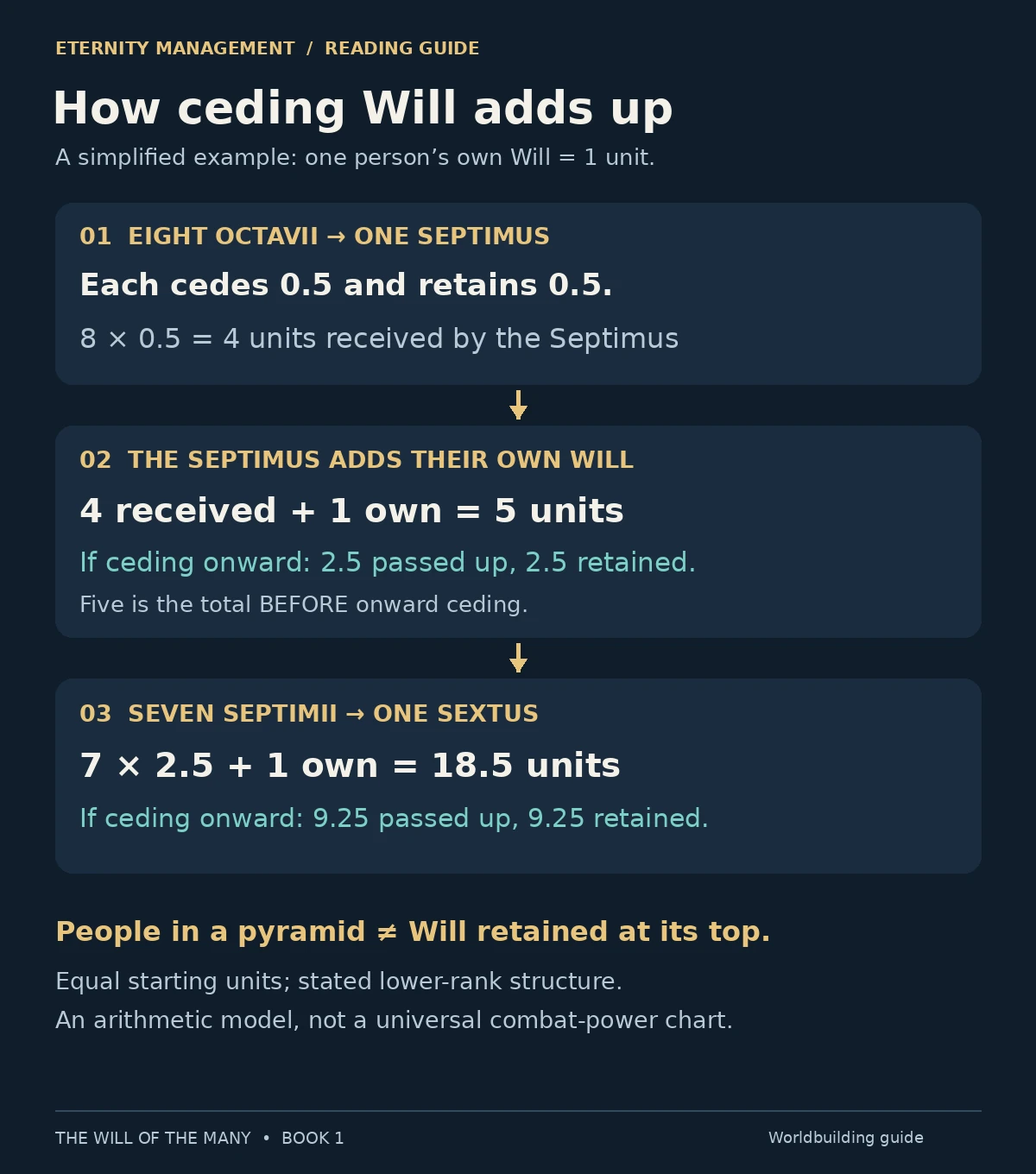
For this illustration, assign each person’s own Will a starting value of one unit. The lower-rank setup is eight Octavii supporting one Septimus, then seven Septimii supporting one Sextus. The eight-to-one and seven-to-one relationships are independently summarized in Sasha Bonkowsky’s review for Reactor. The calculations below show the consequences of that setup and the half-ceding rule.
1. Eight Octavii supply one Septimus
Each Octavus contributes 0.5 units. Eight contributions supply four units; the Septimus’s own unit makes five.
8 × 0.5 + 1 = 5 units before onward ceding.
2. The Septimus may cede onward
If that Septimus is ceding to a Sextus, half the combined amount passes upward. The other half remains.
5 ÷ 2 = 2.5 transferred and 2.5 retained.
3. Seven Septimii supply one Sextus
Seven contributions of 2.5 units make 17.5. Adding the Sextus’s own unit gives 18.5. If the Sextus also cedes onward, the retained amount is 9.25.
7 × 2.5 + 1 = 18.5; then 18.5 ÷ 2 = 9.25.
Primary-text cross-check: in the licensed ebook preview on Everand, Vis identifies a ceding Sextus’s nominal strength as nine and a quarter people, while distinguishing that figure from practical self-imbuing ability. That supports the 9.25 result; it does not establish equal strength or skill for every person. Only the accessible preview was checked, not the complete edition.
Notice the difference between “has received enough to total five” and “retains five.” Always ask whether a quoted number is before or after onward ceding. The illustration states that condition explicitly to avoid mixing the two.
What does Totius mean?
Totius identifies someone at the top of their own pyramid, rather than adding a ninth rank. An early passage, reproduced in public Kindle highlights, describes the mayor of Letens as a Totius Sextus at the top of his pyramid and the provincial governor as a Totius Quintus. This passage is a reader-posted cross-check; it was not available in the licensed preview examined here. A pyramid therefore need not extend to Princeps.
The practical distinction is onward ceding. A person topping their pyramid retains the combined Will rather than passing half to another superior. When comparing two people of the same rank, check this condition before comparing numbers. “Totius” is not a separate spell or a temporary attack mode.
Ceding vs. imbuing
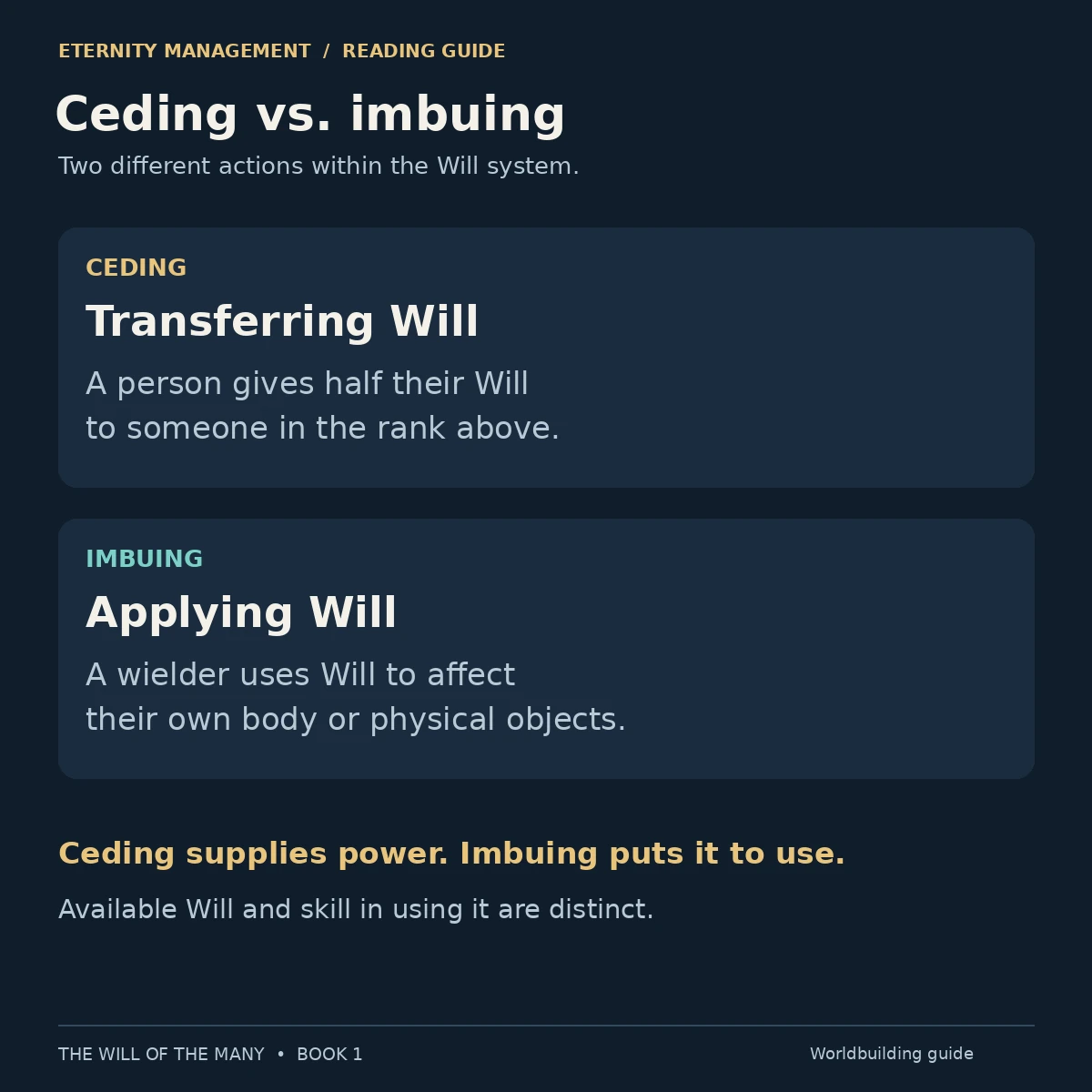
Ceding transfers Will; imbuing applies it. The distinction is like asking where a resource comes from versus what someone can do with it. In the novel, Will can be applied to the wielder’s own body and to physical objects.
Jou Montfort’s analysis highlights a useful limit: the book’s transfer arithmetic does not provide a complete specification for every application of imbuing. A precise contribution total is therefore not a guarantee that every contest has a predictable numerical outcome.
When a scene introduces an unfamiliar use, ask what it actually demonstrates. Does it show a new application, a skilled practitioner, or a general rule? One successful action is not automatically evidence that every person of the same rank could repeat it under any conditions.
Aurora Columnae and Sappers
Aurora Columnae enable ceding. The publisher’s authorized opening excerpt describes a ritual at these ancient devices, after which ceding can occur without returning to the pillar each time. They are not simply a destination for every routine transfer.
Sappers impose extraction. The prison setting in that excerpt shows them as instruments of coercion. They should not be treated as another name for the Aurora Columnae or as an ordinary promotion within the rank ladder.
This distinction matters when reading Vis’s explanations. Something he suspects about his own circumstances is a character’s working theory, not necessarily the complete operating manual for every device.
Academy classes vs. Hierarchy ranks
Academy classes describe students’ positions within the school. Hierarchy ranks describe positions in the wider society. The author’s glossary uses numbered classes for students and titles such as Septimus or Sextus for other characters.
The resemblance can mislead a reader: Class Seven is not another spelling of Septimus, and moving to Class Six is not the same event as becoming a Sextus. School competition can influence later opportunities without making the two classifications interchangeable.
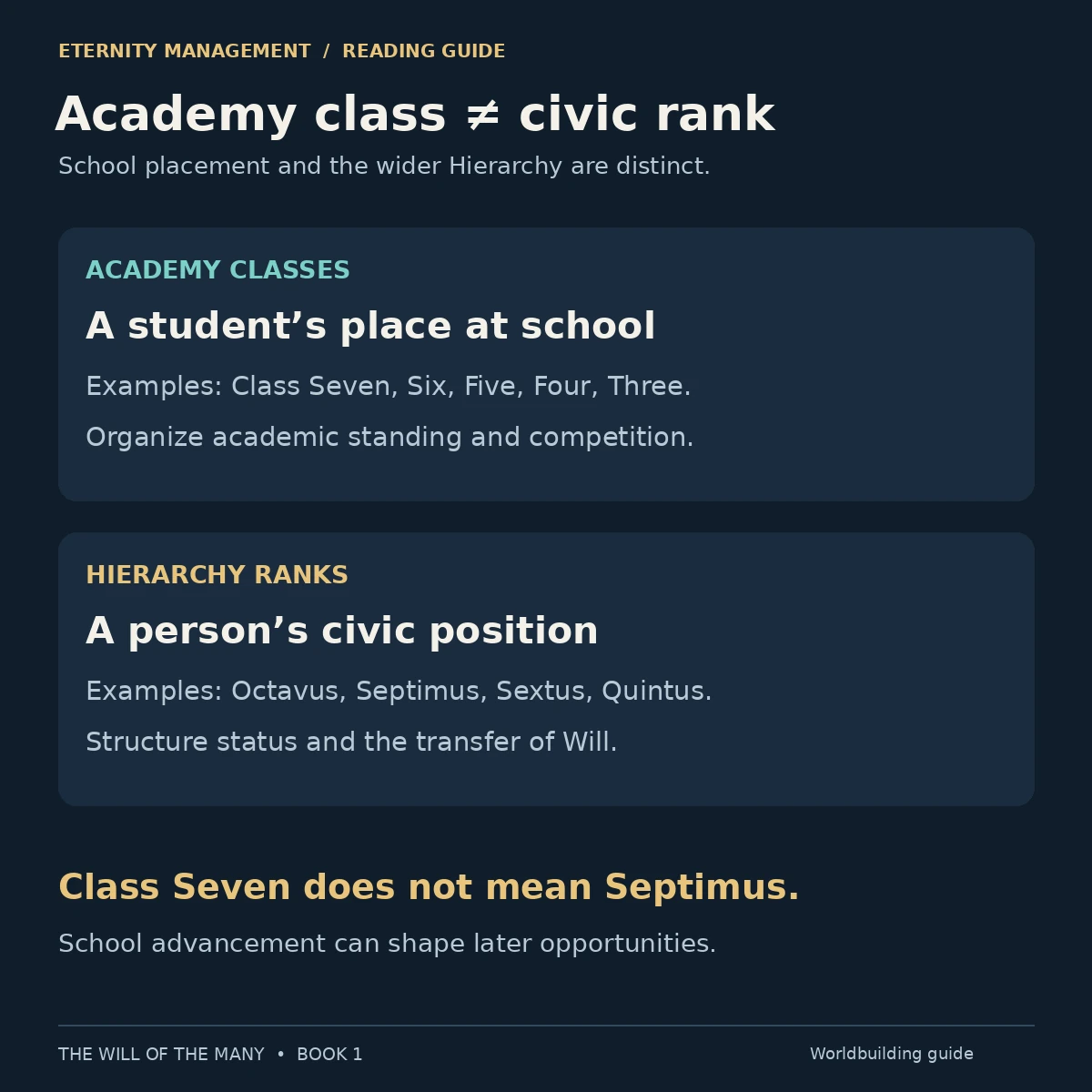
When a number appears, first identify the institution being discussed. Is this a classroom, a student competition, an official title, or a Will-transfer relationship? That small reading habit prevents several apparent contradictions.
For a reference to the people behind these ranks and Academy roles, see our The Will of the Many character guide, covering students, teachers, and political figures.
Why does Vis refuse to cede?
Vis’s refusal belongs to the novel’s stated premise: he does not want to surrender his Will to the empire responsible for his family’s destruction. The publisher introduces his Academy mission as a struggle to advance while concealing that resistance.
Interpretation: the conflict makes ambition uncomfortable. Advancement can provide protection and opportunity, while drawing someone further into the institution they oppose. Success inside a system does not automatically mean freedom from its demands.
The word “cede” can sound like consent. Read alongside the pressures surrounding Vis, it raises a harder question: how meaningful is agreement when refusal threatens your future? The story’s power lies partly in keeping that question attached to ordinary choices, rather than restricting it to spectacular confrontations.
For a comparison of institutional pressure and concealed identity across two novels, see The Will of the Many vs Red Rising.
What the system does not explain
The arithmetic is useful within its assumptions. It does not settle every question about the world. Keep these four boundaries in mind:
- Rank is not a complete character sheet. It does not describe every skill or circumstance.
- A diagram is not a census. A tidy pyramid illustrates relationships without establishing the Republic’s whole population.
- A character’s explanation has a perspective. Separate what they observe from what they infer.
- An unresolved rule is not permission to invent one. Leave a question open when the available evidence does not settle it.
If your question concerns the epilogue rather than ordinary ceding, use our Synchronism explanation. That guide contains full Book 1 ending spoilers.
Frequently asked questions
What is the lowest rank in The Will of the Many?
Octavus is the lowest of the eight ranks. The ladder rises through Septimus, Sextus, Quintus, Quartus, Tertius, and Dimidius to Princeps.
Is Sextus higher than Septimus?
Yes. Sextus is one level above Septimus. In the simplified lower-rank example, seven Septimii contribute to one Sextus.
Does a Septimus keep five people’s Will?
Five units is the example’s total before onward ceding. If the Septimus cedes half to a Sextus, 2.5 units remain. The answer depends on whether onward ceding applies.
Is Totius higher than Princeps?
No. Totius qualifies a position at the top of its own pyramid; it is not a rank above Princeps.
Is Will the same as willpower?
Not in the ordinary sense. Determination is part of the language surrounding it, but the novel treats Will as a transferable capacity with physical consequences.
Do I need to understand every calculation to enjoy the book?
No. Follow who contributes, who benefits, and what participation costs. The arithmetic helps distinguish amounts, but the character conflicts remain intelligible without memorizing a power table.
What to read next
- Books like The Will of the Many — choose your next read by academy rivalry, political intrigue, or hidden identity.
- The Will of the Many ending explained — the closing events and their implications. Full ending spoilers.
When power becomes a question of responsibility
What stays with me about this kind of fantasy is the question of what a person owes others once they understand more than those around them. That offers a thematic route into Those Who Guard Eternity, a philosophical fantasy about time, truth, safety, and choice.
Author disclosure: this is my novel, not an independent recommendation or an official companion to James Islington’s series.
Read Those Who Guard Eternity free in English on Cokos.org, with no registration required.
Sources and scope
The author’s glossary and authorized opening excerpt support the basic terminology. The licensed ebook preview directly supports the ceding Sextus example and the distinction between nominal capacity and practical ability. The rank sequence and contribution ratios were cross-checked with published criticism; Totius examples were checked through a reader-posted passage. The arithmetic is an explicit model, and thematic observations are interpretation. No complete-edition reread or edition-specific page-number verification is claimed.
- Licensed ebook preview on Everand — direct check of the early Sextus calculation, practical ability, and lower-rank plural forms; preview access may vary.
- Reactor: review by Sasha Bonkowsky — independent corroboration of the rank sequence and lower-rank contribution ratios.
- James Islington: official Hierarchy glossary — ceding, devices, and character terminology. The glossary itself contains spoilers.
- Simon & Schuster: book description and authorized excerpt — the premise and opening treatment of ceding, Aurora Columnae, and Sappers.
- Jou Montfort: worldbuilding and theme — discussion reproducing the lower-rank example and considering imbuing. The review contains spoilers.
- Public Kindle highlights from The Will of the Many — an additional cross-check for the lower-rank passage and Totius examples; a reader-posted source, not an official glossary.