Looking for books like The Witcher? Start with Foul Days by Genoveva Dimova if you want the closest blend of Slavic folklore, monsters, dark humor, and dangerous magic. Choose The Blacktongue Thief for a grim but witty adventure, Empire of the Vampire for professional monster hunting in a brutal world, The Justice of Kings for law, politics, and morally costly choices, or The Shadow of the Gods for mythic violence and vengeance.
The difficult part is that The Witcher is not memorable because it contains monsters. Its appeal comes from a rarer combination: folklore that feels older than the people living inside it, violence that has consequences, political factions with conflicting interests, intimate relationships under pressure, and choices where the morally clean option often does not exist.
This spoiler-light guide therefore compares recommendations by what they reproduce from the Witcher experience, not by whether they merely contain swords, magic, or a grim setting. The match tiers and placements below are editorial comparisons, not scientific measurements and not ratings of literary quality.
Editorial note: This guide was researched for Eternity Management using official publisher and author pages to verify authorship, series relationships, and high-level premises. No outside publisher paid for placement. The ranked 15 are independent recommendations. Those Who Guard Eternity, written by the creator of Eternity Management, appears separately as a disclosed philosophical extension rather than inside the ranking.
Research and editorial review: Denys Kostin · Updated August 15, 2026
Estimated reading time: 25–30 minutes · Primary search intent: what to read after The Witcher.
Table of Contents
- Quick answer: what should you read after The Witcher?
- Why The Witcher is so hard to replace
- The Witcher similarity framework
- 15 books like The Witcher compared
- The 15 best books like The Witcher
- Choose by what you loved most
- If you loved the monster hunting
- If you loved the folklore
- If you loved Geralt-style moral dilemmas
- Books for fans of The Witcher games or TV series
- Why monsters are rarely the real monsters
- From monster hunting to guardianship
- Related reading on Eternity Management
- Frequently asked questions
- Sources and editorial methodology
Quick Answer: What Should You Read After The Witcher?
If you want one default recommendation, read Foul Days by Genoveva Dimova. Macmillan explicitly positions it as “The Witcher meets Naomi Novik,” and its fast-paced fantasy world is rooted in Slavic folklore. That makes it unusually close to the combination of monsters, old legends, dangerous magic, and sharp human survival that many Witcher readers are actually seeking.
But the best next book changes according to the part of The Witcher you most want to experience again:
- Closest overall: Foul Days.
- For dark humor and dangerous adventure: The Blacktongue Thief.
- For monster hunting and grim survival: Empire of the Vampire.
- For moral ambiguity and politics: The Justice of Kings.
- For myth, monsters, vengeance, and brutal combat: The Shadow of the Gods.
- For secret hunters and old European atmosphere: The Lights of Prague.
- For cynical characters and moral grayness: The Blade Itself.
- For folklore, spirits, and winter magic: The Bear and the Nightingale.
- For fairy-tale darkness and corrupted magic: Uprooted.
- For gritty travel, danger, and a Witcher-adjacent tone: The Winter Road.
If you already enjoy Eternity Management’s recommendation cluster, you may also want books like Dune for power, destiny, and civilization-scale transformation, or the broader guide to philosophical fantasy books for stories where fantasy becomes a vehicle for questions about choice, identity, meaning, and responsibility.
Why Is The Witcher So Hard to Replace?
Plenty of fantasy novels have monsters. Plenty have grim violence. Plenty have politics, magic, or morally compromised protagonists. What makes The Witcher difficult to replace is the way those elements interact.
The first layer is folklore. The world feels inhabited by old stories rather than decorated with generic fantasy creatures. Monsters often arrive with histories, local beliefs, taboos, misunderstandings, and social meanings. The supernatural is embedded in culture. That makes the world feel remembered rather than merely invented.
The second layer is moral ambiguity. A monster may be dangerous without being the only source of evil. A human institution may protect order while committing cruelty. A reasonable choice can still harm someone. The story repeatedly asks the reader to separate appearance from responsibility.
The third layer is professional competence without moral certainty. A monster hunter may know how to fight a creature and still not know what the right outcome should be. Skill solves physical problems. It does not remove ethical ones.
The fourth layer is politics. Kingdoms, armies, factions, elites, persecuted groups, and personal loyalties overlap. Power is rarely abstract. It changes who can speak, who is believed, who is protected, and who becomes expendable. The political world is not separate from the monster-hunting world; it changes the meaning of every hunt.
The fifth layer is human attachment. Found family, loyalty, friendship, romance, mentorship, and betrayal give the larger conflicts emotional weight. A story can have excellent monsters and still feel unlike The Witcher if nobody matters to anyone.
Finally, the series repeatedly returns to destiny versus choice. Prophecy, inheritance, political expectation, supernatural forces, and history may narrow what seems possible, but character is revealed by what people do inside those constraints. That is why books about destiny, choice, and free will belong naturally beside this reading list.
The Witcher Similarity Framework
To make the recommendations transparent, this guide evaluates each book across seven recurring dimensions. The weights describe how important each dimension is to this specific comparison. They do not claim to measure literary quality.
- Monster hunting & supernatural danger — 25%: creatures, curses, hunts, or supernatural threats actively shape the story.
- Moral ambiguity & difficult choices — 20%: right and wrong are rarely cleanly separated, and decisions create meaningful consequences.
- Folklore, myth & old-world magic — 15%: legends, cultural memory, mythic structures, or traditional supernatural ideas give the world depth.
- Politics, factions & power struggles — 15%: kingdoms, institutions, elites, war, alliances, or social conflict change the stakes.
- Character relationships & found family — 10%: loyalty, friendship, family, mentorship, romance, or betrayal matter to the narrative.
- Dark atmosphere & brutal reality — 10%: danger has weight, survival costs something, and hope is not guaranteed.
- Destiny, choice & philosophical depth — 5%: the story meaningfully explores fate, free will, responsibility, identity, or the consequences of power.
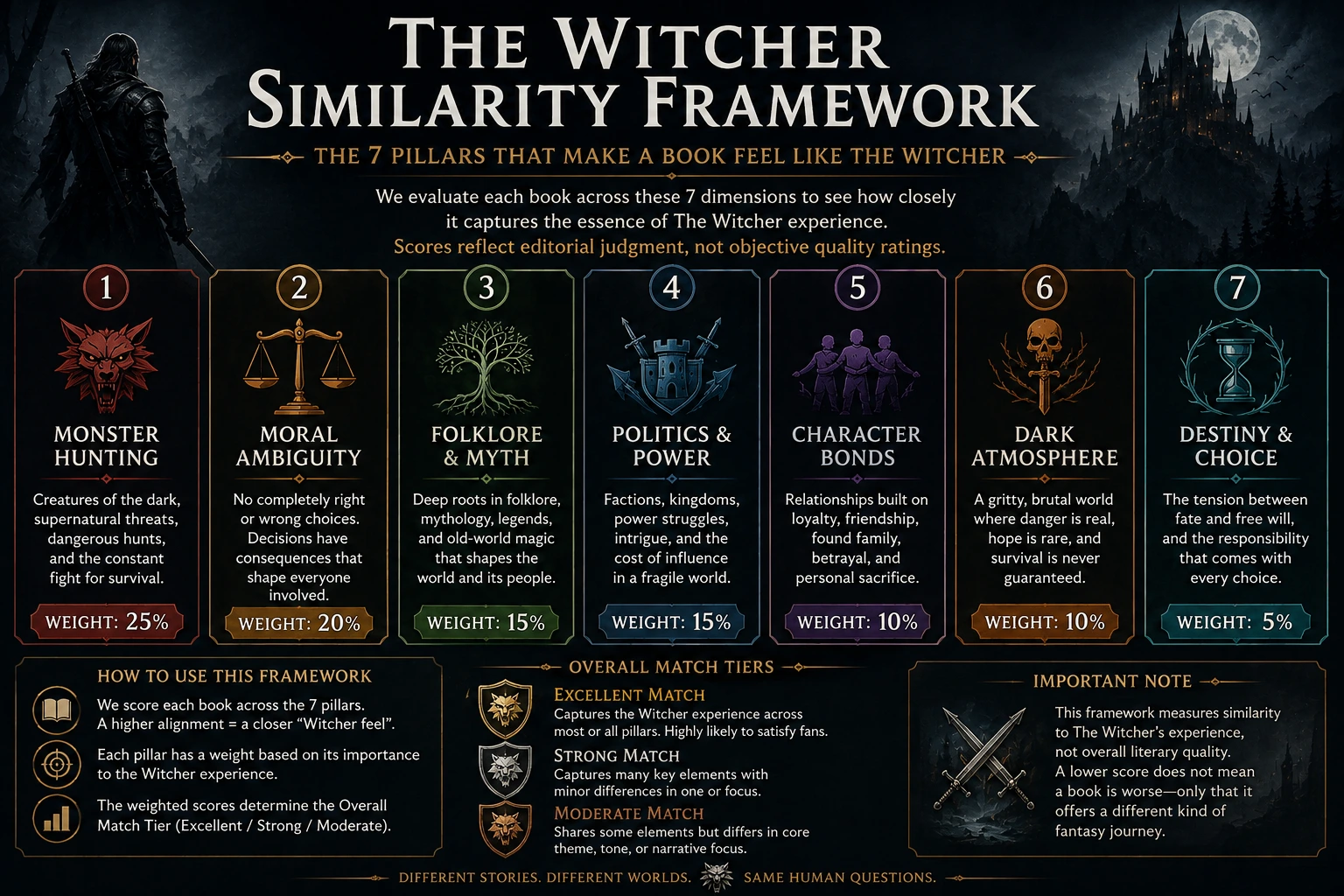
The final labels are deliberately qualitative:
- Excellent match: captures the Witcher experience across several major pillars and is highly likely to satisfy readers seeking that particular mix.
- Strong match: shares multiple important elements but differs more clearly in tone, focus, or narrative structure.
- Moderate match: overlaps meaningfully with selected Witcher elements but offers a distinctly different fantasy experience.
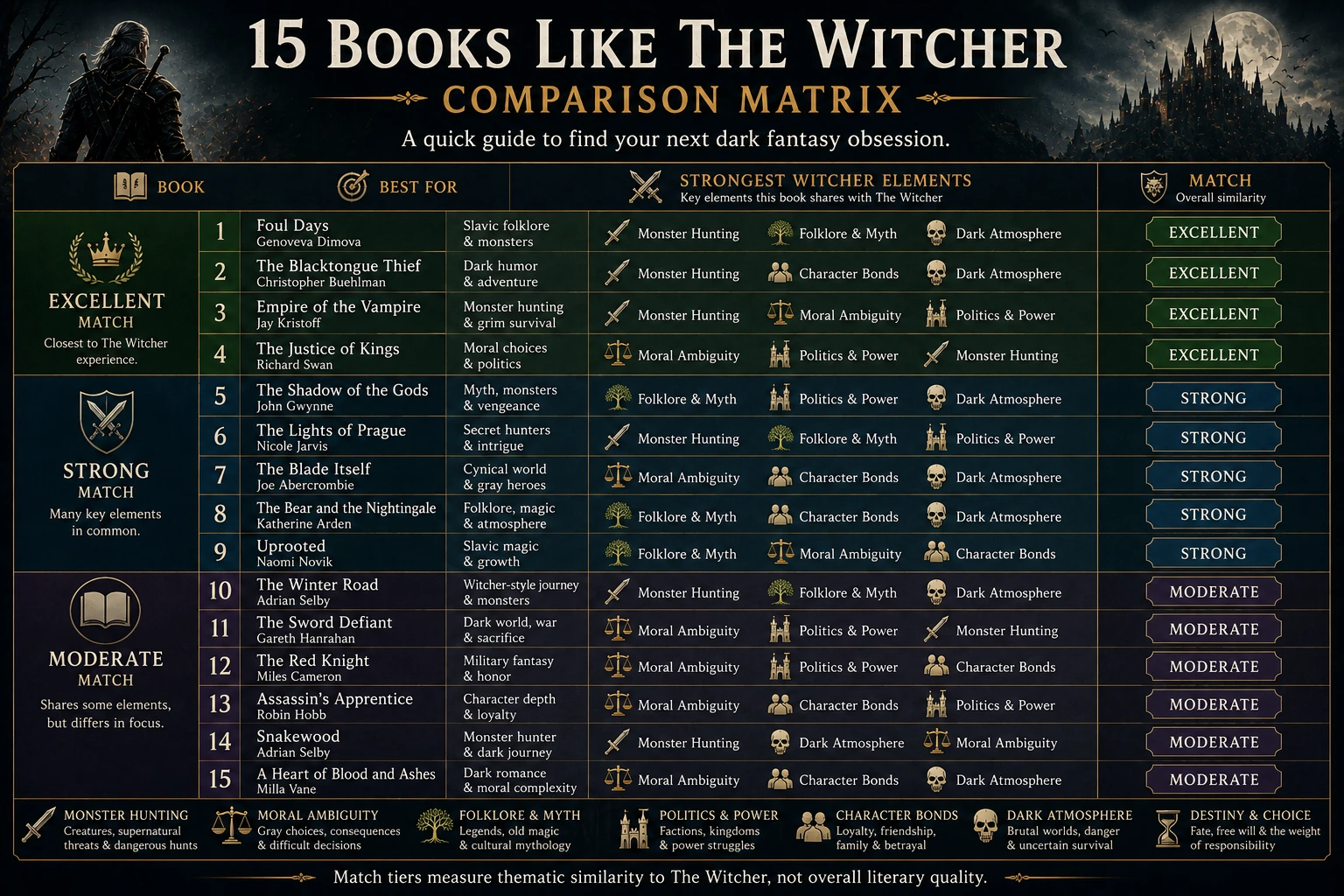
15 Books Like The Witcher Compared
| Rank | Book | Author | Best for | Strongest Witcher elements | Match |
|---|---|---|---|---|---|
| 1 | Foul Days | Genoveva Dimova | Slavic folklore & monsters | Monster hunting · Folklore · Dark atmosphere | Excellent |
| 2 | The Blacktongue Thief | Christopher Buehlman | Dark humor & adventure | Monsters · Character bonds · Dark atmosphere | Excellent |
| 3 | Empire of the Vampire | Jay Kristoff | Monster hunting & grim survival | Monster hunting · Moral ambiguity · Dark atmosphere | Excellent |
| 4 | The Justice of Kings | Richard Swan | Moral choices & politics | Moral ambiguity · Politics · Supernatural danger | Excellent |
| 5 | The Shadow of the Gods | John Gwynne | Myth, monsters & vengeance | Myth · Dark atmosphere · Power struggles | Strong |
| 6 | The Lights of Prague | Nicole Jarvis | Secret hunters & folklore | Monster hunting · Folklore · Hidden supernatural world | Strong |
| 7 | The Blade Itself | Joe Abercrombie | Cynicism & gray characters | Moral ambiguity · Politics · Brutal realism | Strong |
| 8 | The Bear and the Nightingale | Katherine Arden | Folklore, magic & atmosphere | Folklore · Character bonds · Dark atmosphere | Strong |
| 9 | Uprooted | Naomi Novik | Fairy-tale magic & corruption | Folklore · Magic · Difficult choices | Strong |
| 10 | The Winter Road | Adrian Selby | Gritty journey & danger | Harsh travel · Dark atmosphere · Adventure | Moderate |
| 11 | The Sword Defiant | Gareth Hanrahan | Old heroes, war & sacrifice | Politics · Moral ambiguity · Character history | Moderate |
| 12 | The Red Knight | Miles Cameron | Military fantasy & monsters | Combat · Supernatural danger · Duty | Moderate |
| 13 | Assassin’s Apprentice | Robin Hobb | Character depth & loyalty | Relationships · Court politics · Identity | Moderate |
| 14 | Snakewood | Adrian Selby | Mercenaries & grimdark danger | Moral ambiguity · Brutality · Old loyalties | Moderate |
| 15 | A Heart of Blood and Ashes | Milla Vane | Dark fantasy romance & vengeance | Moral complexity · Relationships · Brutal world | Moderate |
The 15 Best Books Like The Witcher
1. Foul Days by Genoveva Dimova
Best for: Slavic folklore, witches, monsters, old magic, and darkly comic survival · Editorial match: Excellent
Foul Days is the easiest recommendation to put first because the overlap is not merely an editorial invention: Macmillan explicitly presents the novel as “The Witcher meets Naomi Novik” and describes it as fantasy rooted in Slavic folklore. That positioning matches the core reason it belongs here.
The strongest similarity is the feeling that supernatural danger grows out of cultural memory. Monsters and magic do not feel like interchangeable game pieces. They belong to a lived world of legends, fears, inherited rules, and practical survival. The result is closer to the Witcher experience than a fantasy novel that simply adds a beast fight every few chapters.
It also has the right tonal flexibility. Darkness matters, but the story is not solemn every second. Humor, personality, danger, and folklore can exist together. That balance is one of the hardest Witcher qualities to reproduce.
Strongest overlap: Slavic folklore, monsters, dangerous magic, survival, and wit.
Important difference: the protagonist, magical system, and narrative priorities are distinctly Dimova’s rather than an imitation of Geralt’s world.
2. The Blacktongue Thief by Christopher Buehlman
Best for: dark humor, dangerous travel, monsters, companionship, and a world scarred by war · Editorial match: Excellent
Macmillan describes The Blacktongue Thief as a fantasy adventure set in a world shaped by goblin wars, enormous battle ravens, assassins, dangerous guilds, and stranger threats. That premise gives it immediate relevance to Witcher readers who want a world where danger feels common enough to influence culture.
The deeper match is voice. The novel can be funny without becoming safe. Its humor emerges inside a setting where people have histories, debts, wounds, prejudices, loyalties, and practical reasons not to trust one another. That creates the kind of tension where companionship has to be earned.
Readers who loved Geralt’s dry exchanges, traveling-party chemistry, unpredictable danger, and the sense that the road itself can produce a new moral problem should find a lot to enjoy here.
Strongest overlap: monsters, dark humor, traveling adventure, character bonds, and a violent lived-in world.
Important difference: it is more roguish and adventure-driven, with a different kind of protagonist and comic energy.
3. Empire of the Vampire by Jay Kristoff
Best for: professional monster hunting, grim survival, religious institutions, darkness, and compromised heroism · Editorial match: Excellent
Empire of the Vampire is one of the strongest choices if monster hunting is the part of The Witcher you want most. Macmillan presents it as the opening volume of a dark fantasy saga, and its world is structured around humanity’s struggle against supernatural predators.
The key similarity is that hunting monsters becomes a profession with training, history, tools, institutional meaning, and personal cost. That is much closer to the Witcher appeal than simply featuring creatures as obstacles. The hunter’s knowledge matters. So do the systems that decide what counts as a threat and what sacrifices are acceptable.
The atmosphere is significantly darker and more gothic. Readers should expect a heavier emphasis on horror, faith, violence, and survival. But if the idea of a damaged professional confronting creatures in a collapsing world is your main reason for seeking books like The Witcher, this is a natural next step.
Strongest overlap: monster hunter identity, brutal danger, morally compromised institutions, and dark atmosphere.
Important difference: vampire apocalypse and gothic horror replace the Witcher’s broader bestiary and Slavic-folkloric texture.
4. The Justice of Kings by Richard Swan
Best for: law, investigation, politics, swordsmanship, supernatural power, and morally expensive decisions · Editorial match: Excellent
Orbit’s description of The Justice of Kings makes the reason for its placement unusually clear: the story combines action, intrigue, magic, investigation, and an imperial legal order under strain. Its central question eventually becomes whether protecting the empire can justify abandoning the laws sworn to defend it.
That is deeply Witcher-like in structure. The physical problem is rarely the only problem. A capable person can know how to act and still face uncertainty about whether the action is legitimate. Institutions can preserve order while also producing injustice. Power can be necessary and dangerous at the same time.
Readers who value Geralt’s moral decisions more than the monster contracts may find this one of the best books on the list. It has less folklore than Foul Days, but far more of the pressure created when law, violence, loyalty, and political survival collide.
Strongest overlap: moral ambiguity, political intrigue, investigation, swordsmanship, and consequential choices.
Important difference: justice and imperial politics are more central than monster hunting.
5. The Shadow of the Gods by John Gwynne
Best for: myth, monsters, vengeance, brutal combat, fate, and a world shaped by dead gods · Editorial match: Strong
Orbit describes The Shadow of the Gods as a Norse-inspired epic packed with myth, magic, and bloody vengeance. It follows warriors moving through a world still shaped by the remains and consequences of divine conflict.
The Witcher connection is strongest in atmosphere and mythic residue. The supernatural past has not politely disappeared. It has left bones, powers, beliefs, dangers, and political consequences behind. Characters move through a world where old myth can become immediate physical reality.
The story is more overtly epic and battle-focused than much of The Witcher, but it shares the feeling that history is still alive enough to wound the present. It also gives its characters strong personal motives, which keeps the violence from becoming merely decorative.
Strongest overlap: mythic worldbuilding, monsters, vengeance, brutal action, and fate.
Important difference: the scale is more saga-like and martial, with less emphasis on professional monster contracts.
6. The Lights of Prague by Nicole Jarvis
Best for: hidden monsters, secret hunters, historical Europe, folklore, and atmospheric urban fantasy · Editorial match: Strong
Penguin Random House describes The Lights of Prague as a story set in historical Prague where darkness conceals supernatural danger and lamplighters secretly serve as vampire hunters. That premise alone gives it strong relevance to readers who want the “ordinary society living beside hidden monsters” aspect of The Witcher.
The atmosphere is especially effective. Prague is not a generic fantasy city; history and place shape the story’s supernatural texture. Hidden danger exists beside ordinary routines, which creates the sense that a person may walk past myth without recognizing it.
It is a strong recommendation for readers who prefer investigation, local legends, and secret supernatural work to battlefield-scale epic fantasy.
Strongest overlap: monster hunters, European atmosphere, folklore, secrecy, and moral complications around supernatural beings.
Important difference: historical urban fantasy replaces the Witcher’s secondary-world kingdoms and wandering structure.
7. The Blade Itself by Joe Abercrombie
Best for: cynical humor, deeply flawed characters, politics, violence, and moral grayness · Editorial match: Strong
The Blade Itself belongs here because Witcher fans often discover that what they actually miss is not the monsters at all. It is the refusal to divide the world into noble heroes and uncomplicated villains.
Joe Abercrombie’s characters are shaped by history, self-interest, fear, violence, ambition, habit, and flashes of better judgment. People can be perceptive about everyone except themselves. Power can reward the wrong behavior. Good intentions can become another tool of self-deception.
That produces a strong Geralt-adjacent feeling at the moral level even though the book is not built around monster hunting. The humor is sharp, the violence has consequences, and the political world is full of people whose stated principles rarely explain everything they do.
Strongest overlap: moral ambiguity, dark humor, compromised characters, politics, and brutality.
Important difference: far less folklore and creature hunting; much more emphasis on human institutions and human failure.
8. The Bear and the Nightingale by Katherine Arden
Best for: Russian folklore, spirits, old beliefs, winter atmosphere, and the conflict between lived tradition and imposed certainty · Editorial match: Strong
The Bear and the Nightingale is one of the strongest recommendations if folklore is the true reason you love The Witcher. Its appeal comes from a world where old supernatural beliefs remain close to everyday life and where the boundary between story, faith, fear, and reality is unstable.
Unlike the more combat-heavy books on this list, it does not need constant violence to make the supernatural feel dangerous. Atmosphere, family, community pressure, belief, and the changing meaning of old traditions carry much of the tension.
This is therefore a particularly good choice for readers who loved the Witcher’s quieter tales: villages with local fears, spirits with complicated motives, and the sense that dismissing an old story can be as dangerous as believing it too quickly.
Strongest overlap: folklore, spirits, cultural memory, winter atmosphere, and difficult social pressures.
Important difference: less monster hunting and far more emphasis on family, belief, and folkloric atmosphere.
9. Uprooted by Naomi Novik
Best for: fairy-tale darkness, corrupted nature, dangerous magic, complicated relationships, and old-world atmosphere · Editorial match: Strong
Penguin Random House describes Uprooted around a valley threatened by a malevolent Wood, with magic and danger embedded directly into the landscape. That connection between place, corruption, supernatural threat, and inherited social arrangements makes it especially relevant to Witcher readers.
The story feels rooted in fairy-tale logic without becoming simplistic. Magic has beauty and danger. The world contains patterns older than the characters. Threat does not arrive in only one form, and human relationships can become just as difficult to interpret as supernatural forces.
Readers who want folklore and magic more than sword fights should consider it one of the best transitions from The Witcher.
Strongest overlap: old-world magic, corrupted nature, folklore, emotional complexity, and danger.
Important difference: more fairy-tale and magical-development emphasis, less professional monster hunting.
10. The Winter Road by Adrian Selby
Best for: gritty travel, survival, old-soldier energy, violence, betrayal, and a harsh fantasy world · Editorial match: Moderate
This recommendation has unusually direct publisher support: Orbit describes The Winter Road as a gritty epic adventure intended to appeal to fans of Andrzej Sapkowski’s The Witcher, alongside readers of Mark Lawrence and Joe Abercrombie.
The strongest overlap is the road itself. Travel is not an empty transition between plot locations. Distance creates risk. Hard choices accumulate. Violence and betrayal shape how a character sees the world. Survival depends on experience rather than idealism.
It is less folkloric and less monster-centered than the top recommendations, but readers who enjoy Geralt as a tired professional moving through a brutal world may find the emotional texture familiar.
Strongest overlap: grim travel, survival, experience, violence, betrayal, and a weary professional perspective.
Important difference: less supernatural folklore and fewer monster-hunting structures.
11. The Sword Defiant by Gareth Hanrahan
Best for: aging heroes, old victories, new political consequences, sacrifice, and what happens after the legendary quest · Editorial match: Moderate
The Sword Defiant is valuable for readers who like fantasy that distrusts the idea of a clean heroic ending. The book looks at a world where famous past victories have become history, politics, resentment, and unfinished responsibility.
That creates an important Witcher-like question: what happens when the person who once knew what had to be done discovers that history has changed the meaning of the original choice? Heroism can create obligations that outlive the battle.
It is more explicitly interested in epic-fantasy aftermath than in folklore or monster contracts, but the tension between reputation, loyalty, power, and moral responsibility earns it a place here.
Strongest overlap: compromised heroism, political consequence, loyalty, history, and sacrifice.
Important difference: post-quest epic fantasy rather than monster-hunter episodic structure.
12. The Red Knight by Miles Cameron
Best for: military fantasy, supernatural threats, professional fighters, duty, siege-scale danger, and tactical combat · Editorial match: Moderate
The Red Knight is for the Witcher reader who wants more steel, monsters, and disciplined competence. Its strongest connection is the idea that supernatural danger is physical enough to demand skilled professionals rather than abstract chosen heroes.
The story leans much more heavily into military organization, tactical action, and large-scale conflict. That makes it less intimate than Geralt’s wandering contracts, but it preserves the satisfaction of watching experienced people confront threats that cannot be solved by courage alone.
Strongest overlap: combat expertise, supernatural danger, duty, violence, and a world where monsters materially affect human survival.
Important difference: far more military and siege-oriented, with less folkloric ambiguity.
13. Assassin’s Apprentice by Robin Hobb
Best for: character depth, loyalty, court politics, identity, mentorship, and painful long-term consequence · Editorial match: Moderate
Penguin Random House introduces Assassin’s Apprentice through Fitz, the rejected son of a prince who grows up near a royal court and is secretly trained in assassination while carrying unusual magical abilities. That setup is not especially close to monster hunting, but it is extremely relevant to Witcher readers who care most about character.
The novel understands that power can isolate. Loyalty can become obligation. Family can be political. A young person can be valued for usefulness while still being denied ordinary belonging. Those pressures create the kind of character-centered moral complexity that makes Ciri, Yennefer, Geralt, and their relationships memorable.
Strongest overlap: loyalty, identity, court politics, mentorship, belonging, and the cost of being useful to powerful people.
Important difference: introspective court-and-character fantasy rather than monster-hunting adventure.
14. Snakewood by Adrian Selby
Best for: mercenaries, grimdark violence, old loyalties, revenge, and morally compromised professionals · Editorial match: Moderate
Orbit directly describes Snakewood as a grimdark epic fantasy about a former mercenary company being hunted down and explicitly recommends it to fans of Andrzej Sapkowski’s The Witcher, Joe Abercrombie, and Mark Lawrence.
The strongest similarity is professional violence with history attached. These are not blank-slate heroes discovering danger for the first time. Past decisions have created enemies. Old loyalties matter. Skill can preserve a life without making that life innocent.
Readers who want the grim professionalism and moral weariness of the Witcher world more than the folklore should find this a worthwhile specialized match.
Strongest overlap: mercenaries, moral compromise, history, revenge, and brutal consequence.
Important difference: less mythic folklore and more mercenary grimdark.
15. A Heart of Blood and Ashes by Milla Vane
Best for: dark fantasy romance, vengeance, kings, war, difficult alliances, and emotionally charged moral conflict · Editorial match: Moderate
A Heart of Blood and Ashes is the most specialized recommendation in the ranked 15. Milla Vane’s own site presents it as part of the A Gathering of Dragons barbarian fantasy romance series, with a world of kings, war, gods, vengeance, and intense relationships.
Its Witcher overlap comes less from monster hunting and more from the way personal bonds exist inside violent political structures. Attraction does not erase distrust. Loyalty does not eliminate competing obligations. Characters have to decide what revenge, duty, and survival demand from them.
Choose it if the emotional conflict, dangerous relationships, political stakes, and brutal world of The Witcher matter more to you than Geralt’s profession.
Strongest overlap: dark world, vengeance, relationships, political conflict, and moral tension.
Important difference: romance is far more central, while monster hunting is not the main engine.
Choose Your Next Book by What You Loved About The Witcher
A single ranking can hide the most useful truth: two readers can love The Witcher for completely different reasons. One wants monster contracts. Another wants folklore. Another wants politics, moral dilemmas, found family, or simply a dark world populated by people with sharp edges.
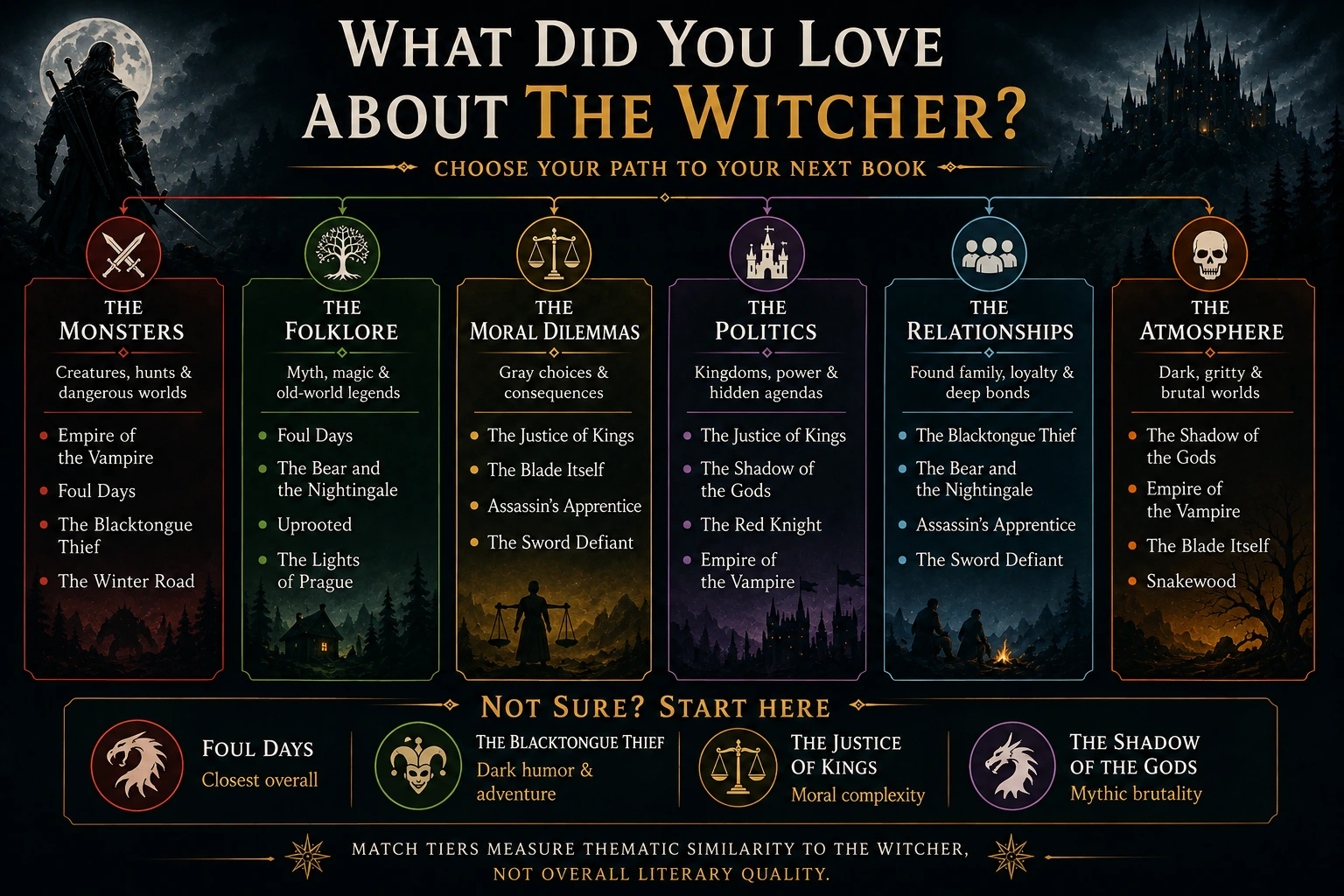
- The monsters: Empire of the Vampire, Foul Days, The Blacktongue Thief, The Winter Road.
- The folklore: Foul Days, The Bear and the Nightingale, Uprooted, The Lights of Prague.
- The moral dilemmas: The Justice of Kings, The Blade Itself, Assassin’s Apprentice, The Sword Defiant.
- The politics: The Justice of Kings, The Shadow of the Gods, The Red Knight, Empire of the Vampire.
- The relationships: The Blacktongue Thief, The Bear and the Nightingale, Assassin’s Apprentice, The Sword Defiant.
- The atmosphere: The Shadow of the Gods, Empire of the Vampire, The Blade Itself, Snakewood.
If You Loved the Monster Hunting Most
Monster hunting creates a particular kind of fantasy pleasure because it turns the supernatural into a problem of knowledge. The hunter needs more than courage. A creature may have habits, weaknesses, origins, social meanings, or rules. Preparation matters. Misidentification can be fatal.
For that specific experience, start with Empire of the Vampire if you want a professionalized struggle against supernatural predators. Choose Foul Days if you want monsters entangled with Slavic folklore. Pick The Lights of Prague for secret hunters operating inside an old European city. Try The Red Knight if you want professional fighters facing supernatural danger on a military scale.
The Blacktongue Thief is a looser fit for the “professional hunter” idea but a strong fit for the experience of traveling through a world where unnatural threats are common enough to reshape society.
From Monster Hunting to Political Intrigue
Not every Witcher fan wants the same balance between wild danger and human power. Some books stay close to physical threats and survival. Others shift the center of gravity toward courts, institutions, factions, and political manipulation.
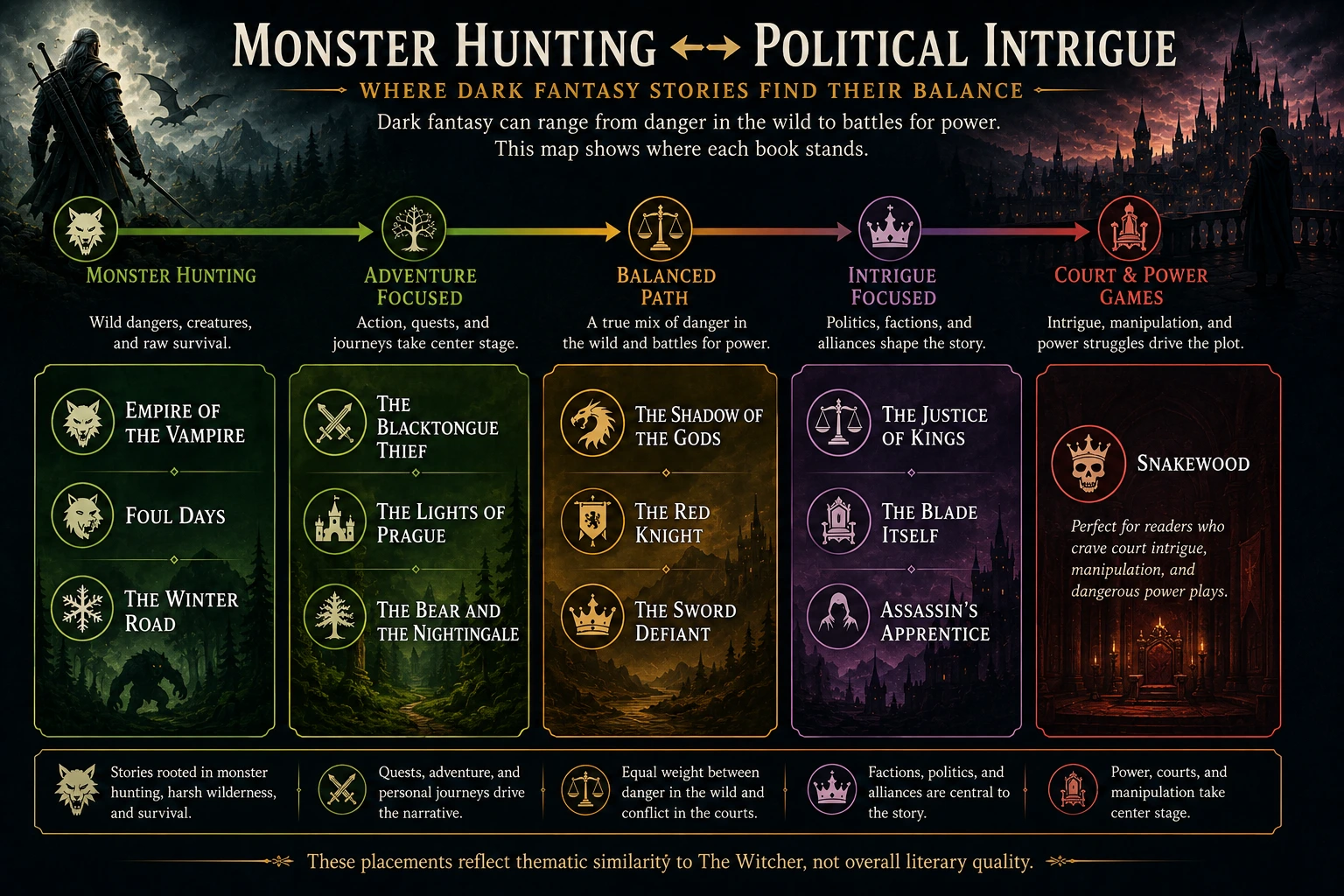
If you want the wilderness-and-threat side, prioritize Empire of the Vampire, Foul Days, and The Winter Road. If you want a more balanced mixture of danger and power, move toward The Shadow of the Gods, The Red Knight, and The Sword Defiant. If politics is the main attraction, The Justice of Kings, The Blade Itself, and Assassin’s Apprentice become stronger choices.
If You Loved the Folklore Most
Folklore is not the same as “having a magic system.” Folklore gives supernatural events cultural memory. A creature may be feared because of a story told for generations. A ritual may survive even after people forget why it mattered. The old world remains present inside the new one.
Foul Days is the clearest starting point because its publisher explicitly emphasizes Slavic folklore. The Bear and the Nightingale is ideal if you want spirits, winter, inherited belief, and the tension between old traditions and changing social reality. Uprooted is strongest for fairy-tale darkness, dangerous magic, and a landscape that seems to carry its own hostility. The Lights of Prague adds a historical-city setting where supernatural danger lives beside ordinary life.
Readers interested in why old stories remain socially powerful can also continue to Eternity Management’s verified article Why Do Civilizations Create Myths?. Fantasy often works because myth is not merely false explanation; it can also carry memory, identity, warning, and values through time.
If You Loved Geralt’s Moral Dilemmas More Than the Monsters
The most Witcher-like question is often not “Can the monster be killed?” but “What exactly is the monster?” A creature may be dangerous. A victim may also be dangerous. An institution may be lawful and cruel. A rebellion may be justified and destructive. Neutrality can prevent one injustice while enabling another.
For this dimension, The Justice of Kings is the strongest recommendation because its central conflict directly pits law, imperial survival, and personal judgment against one another. The Blade Itself goes further into cynicism, showing how self-interest, habit, violence, and institutional power distort moral narratives. Assassin’s Apprentice is slower and more intimate, focusing on loyalty, usefulness, belonging, and the cost of being shaped by a court. The Sword Defiant asks what remains after heroic victories become political history.
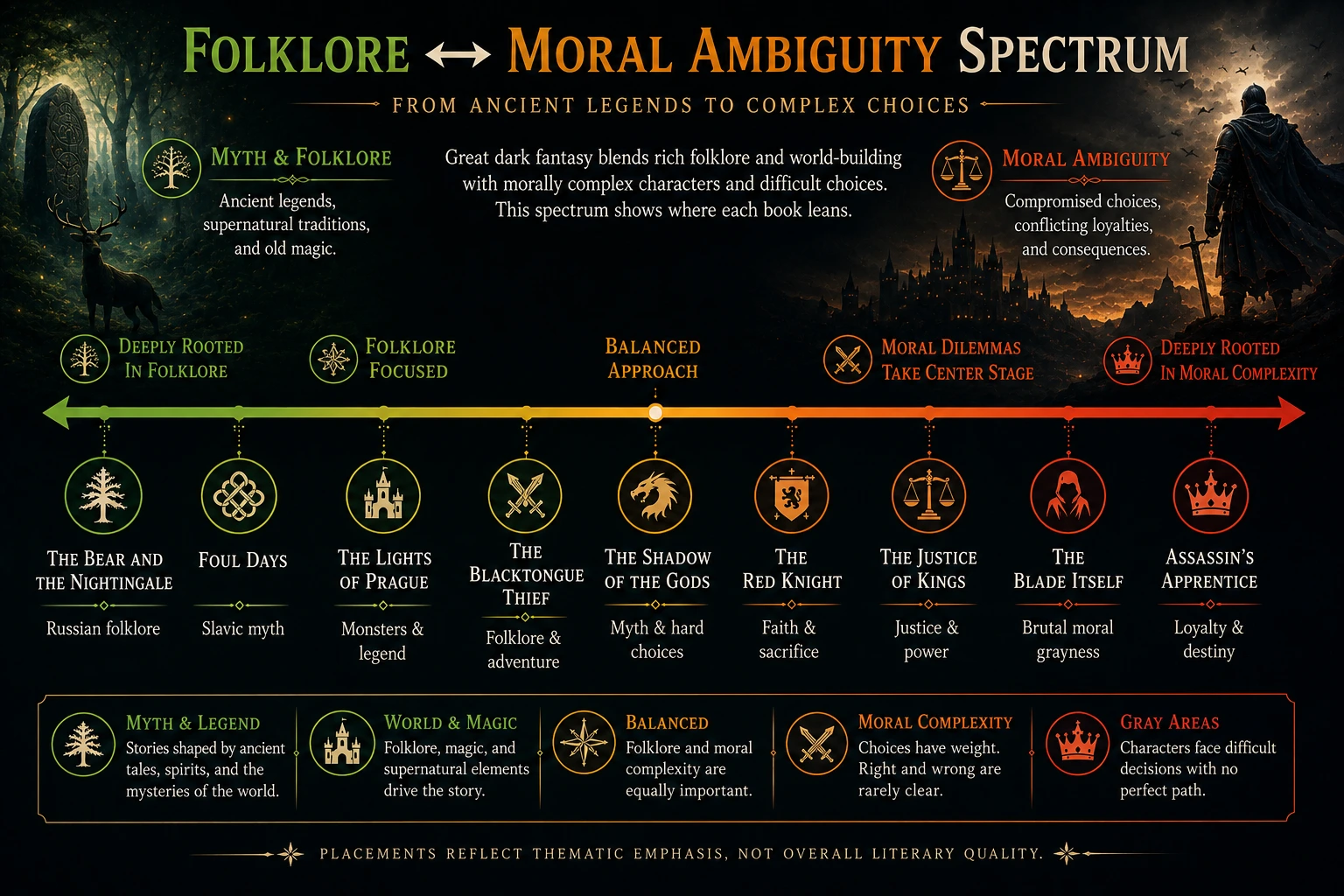
Readers interested in this side of fantasy may also explore Eternity Management’s collections of books about responsibility, books about choice, and books about human nature.
Books for Fans of The Witcher Games or TV Series
If your main entry point was the games, you may be especially sensitive to the mixture of exploration, local problems, contracts, monster knowledge, political consequences, and side characters who can make a seemingly small decision emotionally important. For that experience, Foul Days, The Blacktongue Thief, Empire of the Vampire, and The Lights of Prague are strong places to start.
If your favorite part of the screen adaptation is the tension among personal destiny, family, political power, and supernatural threat, The Justice of Kings, The Shadow of the Gods, Assassin’s Apprentice, and The Bear and the Nightingale may fit better.
No novel on this list reproduces every version of The Witcher. That is why the framework matters. A reader who wants Geralt-like dry competence may need a different recommendation from a reader who wants Ciri-like destiny, Yennefer-like political intelligence, or the folklore itself.
Why Monsters Are Rarely the Real Monsters
Dark fantasy becomes philosophically interesting when it stops treating “monster” as a biological category and starts treating it as a judgment.
A visible creature is convenient. It has claws, teeth, venom, magic, or hunger. The danger can be named. But human beings are also capable of organized cruelty, exclusion, betrayal, exploitation, and violence justified by law, tradition, faith, security, or fear. The more sophisticated fantasy becomes, the more often the creature is only the first layer of the problem.
This is one reason The Witcher remains memorable. The monster hunt repeatedly turns into a test of interpretation. What happened here? Who is lying? What created the threat? Who benefits from the obvious explanation? Is violence necessary? If it is necessary, what does necessity permit? If no option is clean, what responsibility remains?
The same structure appears across many of the recommendations. The Justice of Kings makes law itself morally consequential. The Blade Itself exposes the distance between heroic self-image and actual behavior. Assassin’s Apprentice asks what loyalty costs when the powerful define a person through usefulness. Foul Days makes supernatural danger inseparable from social survival and folklore.
This is also why the strongest dark fantasy does not eliminate morality by making everyone gray. Moral ambiguity should not mean that nothing matters. It means that values collide under conditions where information, time, power, and certainty are limited.
From Monster Hunting to Guardianship: Those Who Guard Eternity
The final connection is not stylistic but philosophical.
A monster hunter asks: What threatens people, and what must I do about it?
A guardian faces a harder version of the same question: What deserves protection, who has the authority to decide, and when does protection become control?
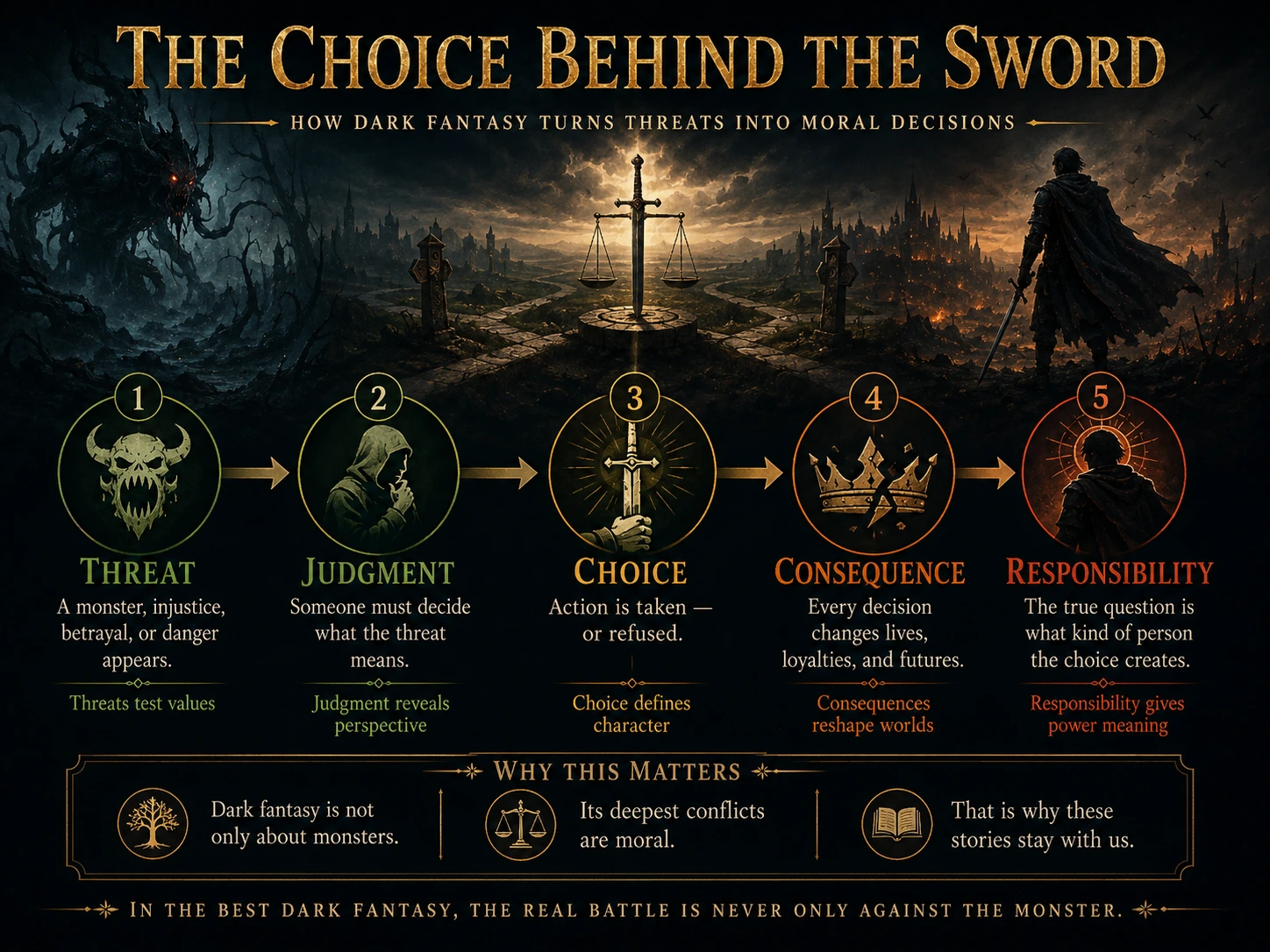
This sequence explains why morally complex fantasy can remain meaningful after the action scene ends. A threat tests values. Judgment reveals how a character interprets the world. Choice defines character. Consequences reshape relationships and institutions. Responsibility gives power its moral meaning.
Those Who Guard Eternity belongs to that philosophical territory. It is not included in the ranked 15 because it is written by Denys Kostin, the creator of Eternity Management and author/editor of this guide. The relationship should be explicit rather than disguised as an independent recommendation.
The novel is a philosophical fantasy about time, reality, consciousness, truth, safety, freedom, memory, civilization, and human choice. Its central concern is not whether a hero can defeat one monster. It is whether anything can be protected forever without being changed by the act of protection—and whether those entrusted with a larger view of reality can still respect the freedom of people who possess only limited knowledge and limited time.
Read the philosophical extension free
Begin Those Who Guard Eternity, Book 1 of the Eternity Saga, and explore a story about time, reality, consciousness, truth, choice, and the burden created by seeing more.
For the broader ethical question behind guardianship, continue with Who Should Guard the Future of Humanity?. It asks what separates legitimate protection from ownership of the future.
Related Reading on Eternity Management
- Philosophical Fantasy Books — fantasy that uses imagined worlds to explore reality, identity, choice, meaning, and responsibility.
- Books About Destiny — for prophecy, fate, and lives shaped by forces larger than individual intention.
- Books About Choice — for difficult decisions and the consequences that follow them.
- Books About Free Will — for the tension between constraint, causality, destiny, and agency.
- Books About Human Nature — for stories that ask what people become under pressure.
- Why Do Civilizations Create Myths? — for the social role of myth, memory, identity, and inherited meaning.
- Why Do Humans Create Heroes? — for the relationship between heroic stories, values, imitation, and responsibility.
- Books Like Dune — for power, destiny, religion, ecology, and political transformation on a larger scale.
Frequently Asked Questions About Books Like The Witcher
What book is most similar to The Witcher?
Foul Days by Genoveva Dimova is the strongest default recommendation in this guide because it combines Slavic folklore, monsters, dangerous magic, wit, and dark survival. Macmillan explicitly markets it as “The Witcher meets Naomi Novik.” Readers who care more about professional monster hunting may prefer Empire of the Vampire, while readers who care more about moral ambiguity may prefer The Justice of Kings or The Blade Itself.
What should I read after The Witcher?
Start with Foul Days for folklore and monsters, The Blacktongue Thief for dark humor and adventure, Empire of the Vampire for monster hunting, The Justice of Kings for moral and political conflict, or The Shadow of the Gods for mythic brutality and vengeance.
What fantasy books have monster hunters?
Among the recommendations here, Empire of the Vampire and The Lights of Prague most clearly center professional or secret hunters confronting supernatural threats. Foul Days, The Red Knight, and The Blacktongue Thief also place characters in worlds where monsters are practical dangers rather than distant mythology.
What books have Slavic folklore like The Witcher?
Foul Days is the clearest answer because its publisher explicitly describes it as fantasy rooted in Slavic folklore. The Bear and the Nightingale draws strongly on Russian folklore, while Uprooted offers fairy-tale and Eastern European atmospheric qualities that many Witcher readers appreciate.
Is The First Law similar to The Witcher?
Joe Abercrombie’s The First Law world, beginning with The Blade Itself, is similar mainly in moral grayness, cynical humor, political manipulation, violence, and deeply flawed characters. It is much less focused on folklore-driven monster hunting, so it is best for readers who loved the Witcher’s human conflicts more than its creatures.
What should I read if I like Geralt?
Choose Empire of the Vampire if you want a damaged professional monster hunter in a dark world, The Winter Road for weary competence and brutal travel, The Justice of Kings for a capable swordsman facing legal and moral conflict, or The Blade Itself if Geralt’s cynicism and gray moral landscape matter more than his profession.
Are these recommendations more like the Witcher books, games, or TV series?
The ranking is based on the broader Witcher experience rather than one adaptation. The framework emphasizes monster hunting, folklore, moral ambiguity, politics, relationships, dark atmosphere, and destiny. Readers coming from the games may prioritize exploration and contracts; readers coming from the books may prioritize voice, folklore, and moral complexity; viewers may prioritize character relationships, destiny, and political conflict.
Sources and Editorial Methodology
Methodology: The ranking is a spoiler-light editorial comparison based on the seven-pillar framework above. Publisher and author pages were used to verify authorship, series placement, and high-level premises. The “Excellent / Strong / Moderate” labels describe thematic similarity to The Witcher, not literary quality, popularity, awards, or objective value. No outside publisher paid for inclusion.
Primary and official sources used for verification:
- Macmillan — Foul Days by Genoveva Dimova
- Macmillan — The Blacktongue Thief by Christopher Buehlman
- Macmillan — Empire of the Vampire by Jay Kristoff
- Orbit — The Justice of Kings by Richard Swan
- Orbit — The Shadow of the Gods by John Gwynne
- Penguin Random House — The Lights of Prague by Nicole Jarvis
- Joe Abercrombie — The Blade Itself publication retrospective
- Penguin Random House — Uprooted by Naomi Novik
- Orbit — The Winter Road by Adrian Selby
- Orbit — The Sword Defiant by Gareth Hanrahan
- Penguin Random House — Assassin’s Apprentice by Robin Hobb
- Orbit — Snakewood by Adrian Selby
- Milla Vane — A Heart of Blood and Ashes
- Penguin Random House — The Bear and the Nightingale by Katherine Arden
- Gollancz — The Red Knight by Miles Cameron
Disclosure: Those Who Guard Eternity is written by Denys Kostin, creator of Eternity Management. It is separated from the independent ranking and presented only as a disclosed thematic extension.
Last editorial review: August 15, 2026.