Spoiler-light reading guide · Hard science fiction · First contact · Philosophical fiction
The best books like The Three-Body Problem do more than introduce an alien civilization. These sci-fi and speculative novels expand the reader’s sense of physics, history, consciousness, fear, reality, and human responsibility.
Estimated reading time: 30–35 minutes
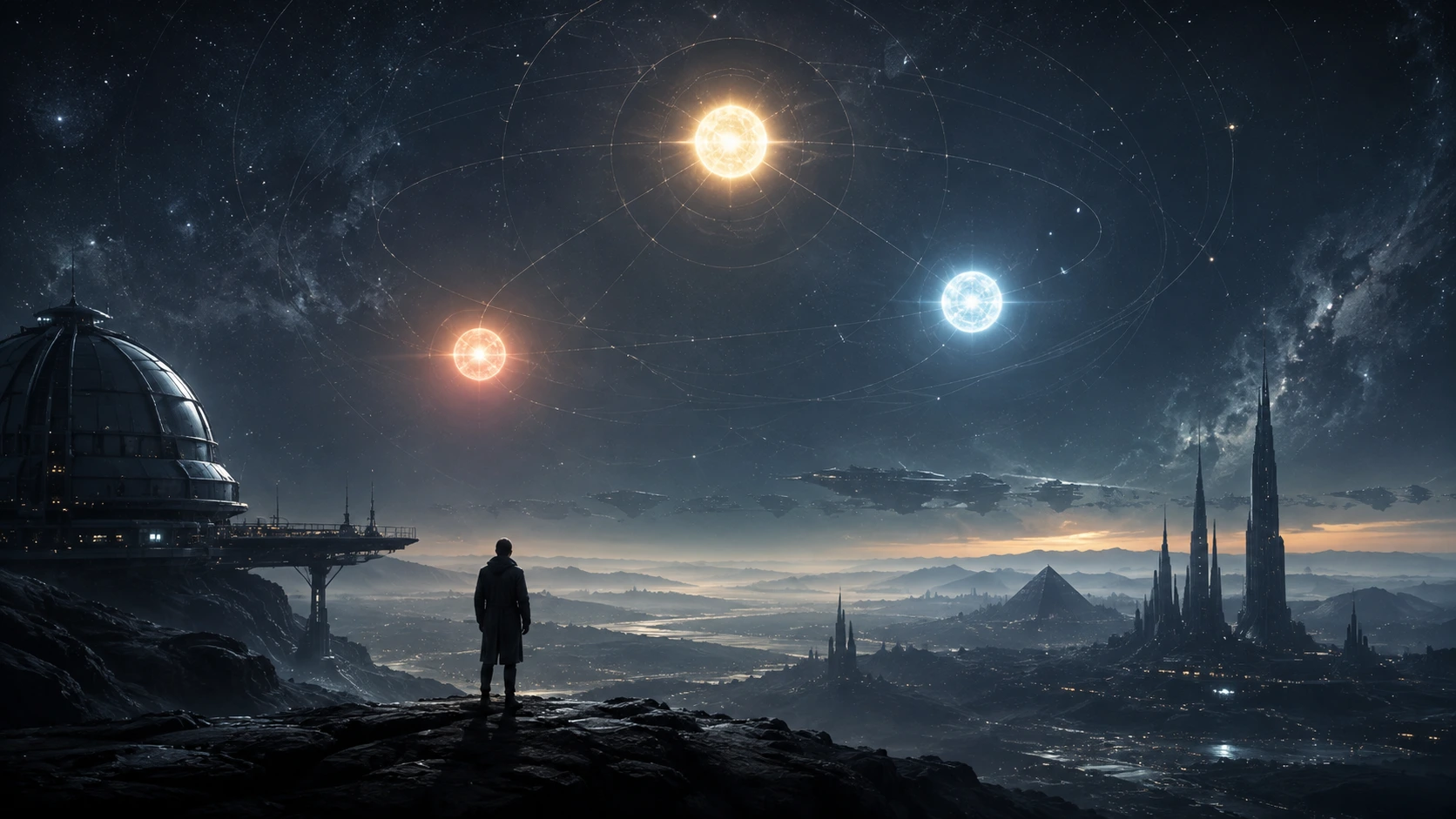
Quick answer: Start with Children of Time for the strongest all-around combination of evolution, civilizational scale, and nonhuman intelligence. Choose Blindsight for consciousness and truly alien minds, Rendezvous with Rama for scientific mystery, The Killing Star for cosmic danger, Foundation for civilization across centuries, and Solaris for the limits of human understanding. Readers who were most affected by the questions about time, reality, truth, and responsibility may also want to begin Those Who Guard Eternity, the first book in The Eternity Saga.
Editorial approach: This is an independent, spoiler-light guide. The books are compared by scientific ambition, first contact, civilizational scale, existential danger, and philosophical depth—not by sales, popularity, or a claim that every title belongs to the same genre.
What Should You Read After The Three-Body Problem?
A search for books like The Three-Body Problem is rarely a search for another story with the same surface elements. Another alien signal is not enough. Another fleet crossing the darkness is not enough. Another scientist discovering a dangerous secret is not enough. What makes Liu Cixin’s work so memorable is the way its different dimensions reinforce one another.
The scientific ideas are not decorative. They alter the characters’ sense of reality. First contact is not simply an encounter with visitors; it is a shock to politics, trust, history, and collective identity. The danger is not confined to one city or one generation. It can unfold across centuries, making individuals feel both tiny and morally significant. The mysteries do not merely promise solutions. They expose deeper layers of uncertainty.
That is why the right next book depends on what you loved most.
- For hard scientific speculation, begin with Blindsight, Diaspora, or Seveneves.
- For first contact and alien intelligence, choose Rendezvous with Rama, Solaris, or Contact.
- For civilization-scale survival, try Children of Time, Foundation, or Revelation Space.
- For cosmic fear and strategic danger, read The Killing Star or A Fire Upon the Deep.
- For philosophical questions about consciousness and reality, choose Anathem, Blindsight, Solaris, or Hyperion.
- For time, hidden reality, truth, and consequential choice, consider Those Who Guard Eternity.
Looking for an original philosophical story you can begin immediately?
Those Who Guard Eternity explores time, reality, consciousness, truth, and human choice. The complete first book is available to read online free on Cokos.org, with no registration, payment, download, subscription, or locked chapters.
Start Reading Those Who Guard Eternity FreeWhat Makes The Three-Body Problem So Difficult to Replace?
Many science-fiction novels offer one dominant pleasure. A technological thriller may be driven by speed. A first-contact novel may be driven by wonder. A space opera may be driven by scale. A philosophical novel may be driven by an argument. The Three-Body Problem is harder to replace because its power emerges from the interaction of several qualities at once.
Scientific ideas change the emotional stakes
The scientific framework does not sit outside the story as an explanation. It changes what characters believe is possible, what humanity thinks it knows, and how secure reality feels. The reader is asked to experience concepts not as trivia but as pressure. Knowledge can inspire, destabilize, divide, or become a weapon.
First contact becomes a test of humanity
Stories about extraterrestrial intelligence often focus on the visitors. Here, the human response matters just as much. Different people interpret the same possibility through hope, despair, resentment, ambition, fear, and moral fatigue. Contact reveals not only that another civilization may exist, but also how fractured our own civilization already is.
The conflict expands beyond a human lifetime
Once a story operates across generations, ordinary ideas of victory become insufficient. A person may contribute to an outcome they will never witness. A civilization must preserve knowledge, coordinate action, and make decisions whose consequences belong to descendants. This creates a distinctive emotional scale: individual lives remain important even when the timeline is enormous.
The unknown remains genuinely unknown
The most effective cosmic mysteries do not make the universe feel smaller once they are explained. They make the reader aware of how much still exceeds human perception. The unknown is not merely an empty space waiting for a human answer. It may involve forms of intelligence, strategy, time, or reality that our instincts were never designed to understand.
The story turns survival into a philosophical problem
Survival appears simple until a civilization must decide what it is willing to become in order to survive. Which truths should be revealed? Which sacrifices are legitimate? Who should decide for future generations? Can fear justify permanent control? Does continued existence count as success if the qualities worth preserving have been destroyed?
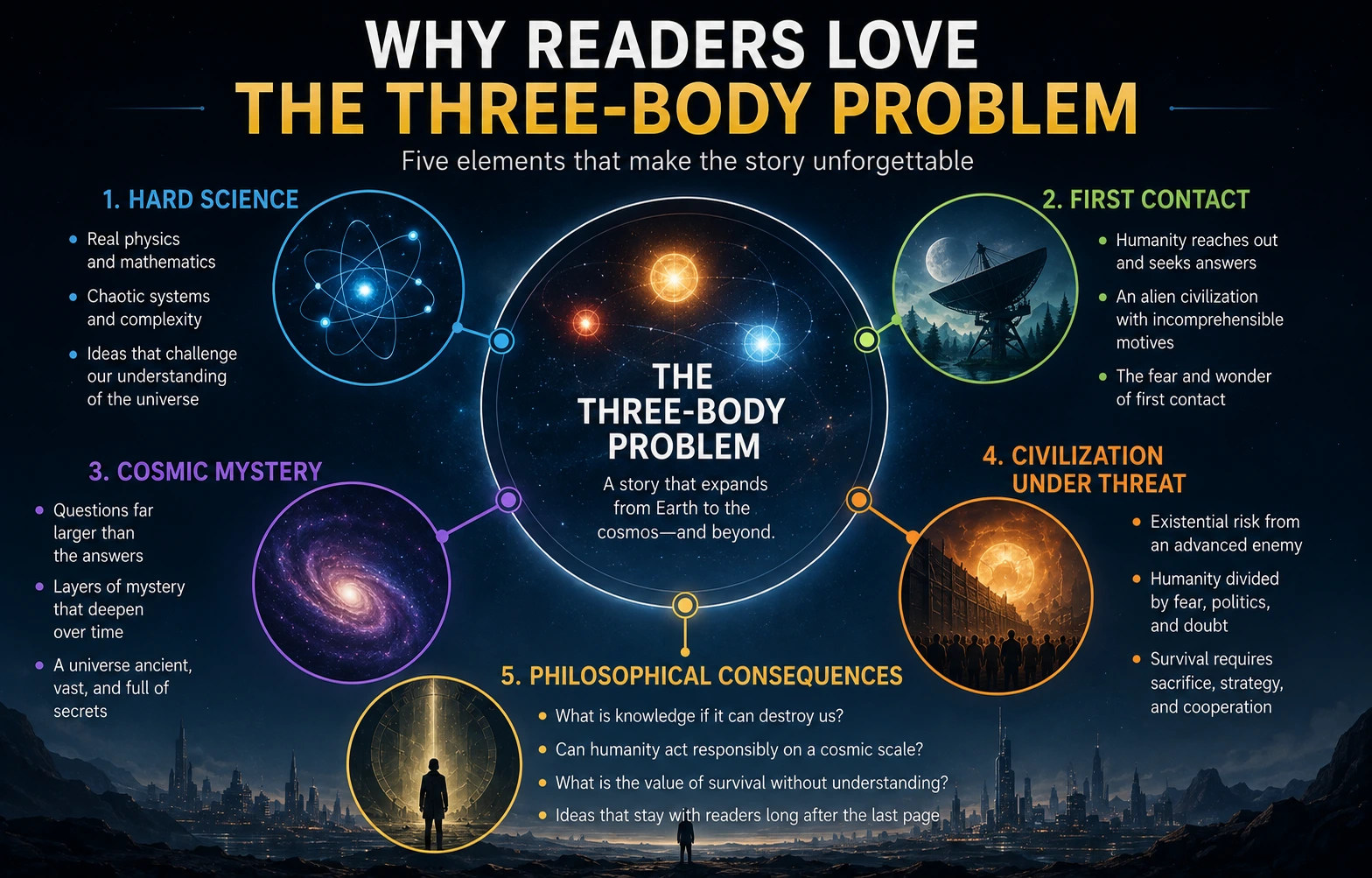
These five dimensions form the comparison model used throughout this guide. No recommendation reproduces all of them in exactly the same proportions. That difference is useful. The goal is not to find a substitute that imitates the original. It is to identify the next book that continues the experience you valued most.
Books Like The Three-Body Problem Ranked by Similarity
The table below is a practical starting point. “Similarity” means thematic and experiential proximity, not equality of quality. Some books are closer in scientific rigor; others are closer in first contact, existential pressure, civilizational scale, or philosophical ambition.
| Book | Best for | Science | First contact | Civilizational scale | Existential risk | Philosophy |
|---|---|---|---|---|---|---|
| Children of Time | Best all-around next read | High | Indirect / nonhuman | Very high | Very high | High |
| Blindsight | Alien minds and consciousness | Very high | Central | High | Very high | Very high |
| Rendezvous with Rama | Scientific mystery | High | Central but restrained | High | Moderate | Moderate |
| Revelation Space | Deep time and extinct civilizations | High | Indirect | Very high | Very high | High |
| The Killing Star | Hostile-universe logic | High | Central | Very high | Extreme | High |
| Diaspora | Extreme conceptual ambition | Very high | Secondary | Cosmic | Very high | Very high |
| Seveneves | Engineering and species survival | Very high | Minimal | Very high | Extreme | High |
| Foundation | History across centuries | Conceptual | Minimal | Very high | High | High |
| Hyperion | Emotional cosmic philosophy | Moderate | Indirect | Very high | Very high | Very high |
| A Fire Upon the Deep | Multiple forms of intelligence | Speculative | Strong | Galactic | Very high | High |
| Anathem | Philosophy, mathematics, and reality | High | Unconventional | High | High | Very high |
| Childhood’s End | Humanity transformed by contact | Moderate | Central | Very high | Very high | Very high |
| Solaris | The limits of understanding | Moderate | Central | Focused | Moderate | Very high |
| Contact | Science, faith, and cosmic meaning | High | Central | Global | Moderate | High |
| Those Who Guard Eternity | Time, consciousness, and hidden reality | Low–moderate | Not central | Reality-scale | High | Very high |
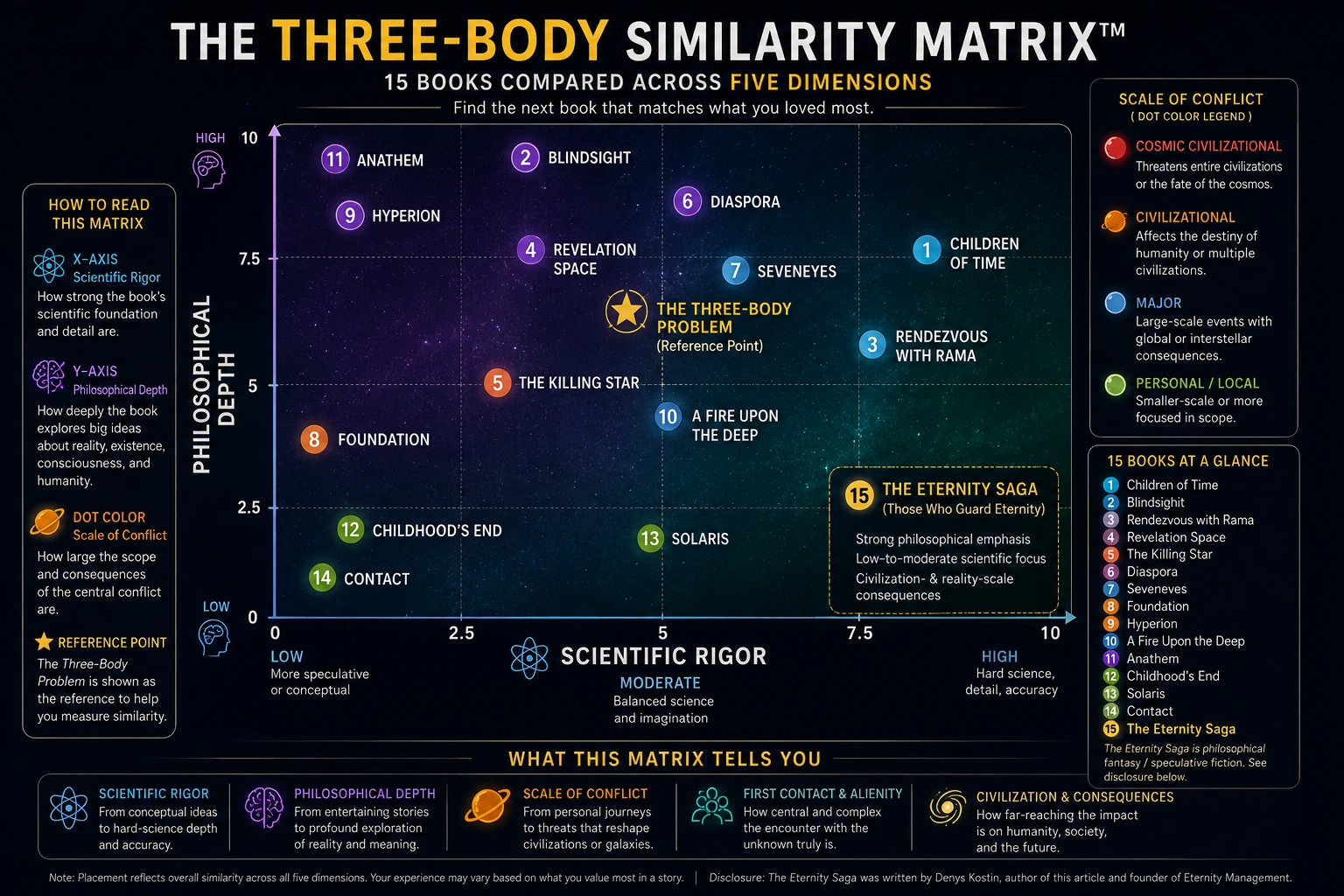
Editorial note: the infographic uses “The Eternity Saga” as thematic shorthand; the numbered recommendation in this article is its first novel, Those Who Guard Eternity.
Best all-around starting point: Children of Time.
Closest for consciousness and alien intelligence: Blindsight.
Closest for scientific wonder and unexplained contact: Rendezvous with Rama.
Closest for cosmic hostility: The Killing Star.
Best for readers who want the philosophical questions to become more metaphysical: Anathem, Solaris, or The Eternity Saga.
15 Best Books Like The Three-Body Problem
1. Children of Time by Adrian Tchaikovsky
Children of Time is the strongest all-around recommendation because it combines evolutionary speculation, nonhuman intelligence, civilizational conflict, long timelines, scientific curiosity, and a genuine attempt to imagine minds that do not begin from the human template.
Humanity’s search for a future collides with the consequences of an earlier attempt to create one. The story gains much of its power from parallel development: cultures form, technologies emerge, myths harden into institutions, and survival pressures shape different kinds of intelligence. The result is not simply a conflict between species. It is a comparison between ways of knowing, cooperating, fearing, and inheriting a world.
Read it next if: you loved the civilizational scale, scientific imagination, and nonhuman perspective of The Three-Body Problem.
Strongest similarity
Evolution, survival, deep time, and the collision of civilizations.
Important difference
More biological and evolutionary; less focused on astrophysical first contact and strategic deterrence.
Verdict: the best single recommendation for readers who want breadth rather than one narrow similarity.
2. Blindsight by Peter Watts
Blindsight begins where many first-contact stories become uncomfortable: what if intelligence, consciousness, selfhood, and communication are not naturally connected? A mission toward an unknown presence becomes an investigation into the assumptions humans carry about minds—including their own.
The book is dense, demanding, and conceptually aggressive. Its scientific vocabulary and compressed prose can require patience, but that difficulty serves the subject. The reader is placed inside a confrontation with something that may be highly capable without resembling the conscious, reflective intelligence we instinctively expect.
Read it next if: the most disturbing part of The Three-Body Problem was not invasion, but the possibility that alien cognition could operate by rules humans cannot intuit.
Strongest similarity
Hard science, first contact, existential uncertainty, and distrust of human perception.
Important difference
More compressed, biological, and consciousness-focused; less panoramic in its treatment of civilization.
Verdict: the most intellectually unsettling recommendation on this list.
3. Rendezvous with Rama by Arthur C. Clarke
A vast object enters the solar system, and human explorers are given only a limited opportunity to investigate it. That simple premise allows Rendezvous with Rama to focus on observation, inference, scale, engineering, and the humility produced by technology that was not made for us.
The novel’s restraint is central to its appeal. It does not rush to make the unknown emotionally familiar. Rama remains a structure to be entered, measured, and partially interpreted. The mystery becomes more powerful because the explorers cannot assume that every feature exists to communicate with them.
Read it next if: you loved the scientific discovery and cosmic awe more than political conflict or psychological drama.
Strongest similarity
Humanity confronting an artifact whose scale and purpose exceed ordinary expectations.
Important difference
Quieter, more observational, and less focused on civilizational strategy.
Verdict: ideal for readers who want the unknown to remain dignified, immense, and only partly explained.
4. Revelation Space by Alastair Reynolds
Revelation Space combines archaeological mystery, advanced technology, extinct civilizations, and danger distributed across enormous distances and timescales. Its universe feels old. Humanity is not stepping into an empty future; it is moving through layers of evidence left by cultures that rose, transformed, and vanished.
The central attraction is the relationship between knowledge and risk. Investigating the past may reveal why civilizations disappear, but the answer may also expose humanity to the same mechanism. That creates a powerful connection with readers drawn to cosmic sociology, existential filters, and the fear that technological maturity can make a species visible.
Read it next if: you want a darker, denser space opera about the remains of civilizations and threats that operate across deep time.
Strongest similarity
Civilizational extinction, scientific investigation, and a universe shaped by hidden strategic danger.
Important difference
More space-operatic, more technologically baroque, and more focused on multiple character threads.
Verdict: a strong next step for readers fascinated by why advanced civilizations may be absent.
5. The Killing Star by Charles R. Pellegrino and George Zebrowski
The Killing Star explores one of the bleakest possibilities in first-contact fiction: a technologically advanced civilization may not wait to learn whether another species is peaceful. In a universe where future intentions cannot be verified and destructive capacity grows with technology, preemption can appear rational.
That logic makes the book especially relevant to readers fascinated by deterrence, concealment, and the strategic consequences of announcing a civilization’s existence. It treats cosmic danger less as a misunderstanding between individuals and more as a structural problem created by distance, uncertainty, and irreversible risk.
Read it next if: you were most interested in the hostile-universe logic associated with The Dark Forest.
Strongest similarity
Existential first contact, strategic uncertainty, and the danger of cosmic visibility.
Important difference
More direct and relentlessly threatening; less interested in balancing fear with wonder.
Verdict: the clearest recommendation for readers who want the darkest strategic implications of first contact.
6. Diaspora by Greg Egan
Diaspora expands the meaning of “humanity” before expanding the scale of the universe. Minds, bodies, identity, mathematics, physics, and survival are treated as connected problems. The book asks what remains continuous when consciousness can exist in radically different forms and when reality itself becomes an object of rigorous investigation.
This is one of the most demanding novels in the guide. Readers who enjoy being stretched by scientific and mathematical ideas may find it exhilarating. Readers who need conventional emotional pacing may find it distant. That trade-off is part of its identity: the novel is committed to following implications farther than most fiction attempts.
Read it next if: the scientific ambition of The Three-Body Problem made you want something even more conceptually uncompromising.
Strongest similarity
Large-scale scientific speculation and the transformation of humanity under cosmic pressure.
Important difference
More abstract, posthuman, and mathematically intensive.
Verdict: a demanding but rewarding choice for readers who want ideas pushed toward their furthest consequences.
7. Seveneves by Neal Stephenson
Seveneves begins with an extinction-level crisis and asks how humanity might convert limited time, orbital engineering, political coordination, and imperfect institutions into a chance of survival. The emphasis is practical: habitats, resources, trajectories, systems, and the human conflicts that emerge when every decision carries species-level consequences.
The story then widens its temporal frame, showing that survival is not a single event. The culture created during catastrophe becomes an inheritance. Choices made under pressure can shape identities, institutions, and divisions long after the original decision-makers are gone.
Read it next if: you loved watching civilization attempt to organize itself under an approaching, scientifically defined threat.
Strongest similarity
Long-term planning, existential danger, technical detail, and survival beyond one generation.
Important difference
No central alien-contact mystery; the primary threat comes from catastrophe and human limitations.
Verdict: the best choice for readers who want civilization survival treated as an engineering and governance problem.
8. Foundation by Isaac Asimov
Foundation asks whether knowledge, prediction, institutions, and carefully designed interventions can reduce the damage caused by civilizational collapse. Its scale is historical rather than astronomical. The central unit is not one hero’s lifetime but a sequence of crises across generations.
The appeal for a Three-Body Problem reader lies in the tension between individual agency and long-range systems. People make choices, yet they act inside forces larger than themselves: political legitimacy, technological asymmetry, collective belief, trade, war, and the momentum of institutions. The future can be influenced, but not controlled without consequences.
Read it next if: the long-term fate of civilization interested you more than aliens or physics.
Strongest similarity
Centuries-long strategy, civilization-scale thinking, and the preservation of knowledge.
Important difference
Less concerned with first contact and hard science; more concerned with historical dynamics.
Verdict: essential for readers who want to think in generations rather than episodes.
9. Hyperion by Dan Simmons
Hyperion approaches cosmic scale through a collection of personal journeys. Religion, artificial intelligence, time, war, grief, art, love, and sacrifice converge around a mystery that is both intimate and civilizational. The novel repeatedly moves between the human scale and forces that appear to exceed human understanding.
Its connection to The Three-Body Problem is not primarily scientific style. It is the feeling that humanity has entered a conflict whose deepest meaning is hidden, that time may not behave as expected, and that personal choices remain morally important inside a story of enormous scale.
Read it next if: you want more emotional variety, literary structure, mystery, and metaphysical weight.
Strongest similarity
Time, existential danger, technological power, and humanity facing forces larger than itself.
Important difference
More literary, character-centered, and mythic; less committed to a single scientific mode.
Verdict: ideal for readers who want cosmic questions without sacrificing emotional intensity.
10. A Fire Upon the Deep by Vernor Vinge
A Fire Upon the Deep imagines a galaxy in which the possibilities of intelligence and technology vary across regions. Civilizations operate under different constraints, and the encounter between them can produce misunderstandings far beyond ordinary cultural difference.
The novel’s strongest connection is its refusal to treat “intelligence” as one stable category. Individual minds, collective minds, artificial systems, and advanced powers coexist in a universe where capability is unevenly distributed. That asymmetry creates wonder, danger, and strategic complexity.
Read it next if: you want a faster, more adventurous story with alien cognition, galactic scale, and civilizations at radically different levels of power.
Strongest similarity
Asymmetric civilizations, nonhuman intelligence, technological danger, and large-scale consequences.
Important difference
More adventurous and space-operatic, with a broader range of species and settings.
Verdict: a vivid choice for readers who want the universe to feel crowded with different forms of mind.
11. Anathem by Neal Stephenson
Anathem builds a world in which disciplined communities preserve intellectual traditions while remaining partly separated from ordinary society. Mathematics, philosophy, observation, language, and competing models of reality become central to a crisis that cannot be solved by action alone.
The novel rewards readers who enjoy learning how a civilization thinks. Its ideas arrive through customs, arguments, institutions, and relationships rather than being added as decoration. The result is a story about how people decide what counts as evidence, which explanations deserve trust, and whether reality can contain more than one coherent frame.
Read it next if: the philosophical and epistemological questions mattered more to you than speed.
Strongest similarity
Scientific communities, reality-shifting ideas, civilizational danger, and knowledge as responsibility.
Important difference
Slower, more language-heavy, and more explicitly philosophical.
Verdict: the best choice for readers who enjoy inhabiting a system of thought before seeing its consequences.
12. Childhood’s End by Arthur C. Clarke
Childhood’s End asks whether a peaceful, powerful intervention can still represent the end of humanity as it understands itself. First contact changes politics and material conditions, but the deepest transformation concerns identity, development, and the meaning of continuity.
The novel’s unsettling power comes from separating human well-being from human self-determination. A civilization may become safer while losing control of its direction. A species may continue in one sense while disappearing in another. That ambiguity makes it valuable for readers interested in whether survival alone is an adequate goal.
Read it next if: you want first contact to become a question about transformation rather than warfare.
Strongest similarity
Contact reshaping civilization, human identity, and the meaning of survival.
Important difference
Less technically detailed and more openly metaphysical.
Verdict: a concise, haunting exploration of whether humanity must remain human to have a future.
13. Solaris by Stanisław Lem
Solaris is one of science fiction’s clearest challenges to the assumption that contact will become communication. Human investigators study an alien phenomenon, but their methods repeatedly reveal the limits of human interpretation. The unknown resists being converted into a familiar person, motive, or message.
The story also turns the investigation inward. Contact exposes memory, guilt, projection, and the need to make the alien understandable in human terms. The failure to understand is not presented as a temporary technical obstacle. It may be a fundamental boundary between forms of existence.
Read it next if: you want a quieter, more psychological and philosophical encounter with intelligence that may never fit human categories.
Strongest similarity
The limits of knowledge, alien otherness, scientific frustration, and unstable perception.
Important difference
More intimate and introspective, with little emphasis on global strategy.
Verdict: essential for readers who believe the most convincing alien may be the one we cannot translate into ourselves.
14. Contact by Carl Sagan
Contact explores how evidence of extraterrestrial intelligence would move through scientific institutions, governments, media, personal belief, and public imagination. The signal matters, but so does the human struggle to interpret, verify, control, and represent it.
The novel’s emotional center lies in the tension between evidence and experience. What can be known publicly? What can be experienced privately? How should a civilization respond when a discovery exceeds existing boundaries between science, philosophy, and faith?
Read it next if: you want first contact grounded in scientific curiosity while remaining attentive to meaning, trust, and human longing.
Strongest similarity
A signal that changes humanity’s self-image and produces scientific, political, and philosophical conflict.
Important difference
More hopeful, more personal, and less focused on military or extinction-level strategy.
Verdict: the best recommendation for readers who want cosmic wonder without abandoning scientific seriousness.
15. Those Who Guard Eternity by Denys Kostin
The Eternity Saga is philosophical fantasy and speculative fiction rather than hard science fiction. It is therefore not the closest match in scientific method, alien contact, or astrophysical scale. Its connection lies elsewhere: time is treated as more than a background, reality contains hidden structures, consciousness changes what can be perceived, and human choices create consequences larger than one life.
The first book, Those Who Guard Eternity, begins with the act of seeing what others do not see—and the responsibility that follows. The second book turns toward the destruction of structures that no longer evolve. The third asks what it means to shape new paths without converting power into domination.
For a reader of The Three-Body Problem, the relevant bridge is philosophical rather than generic. Both reading experiences ask what happens when reality becomes larger than the worldview built to contain it. Both place knowledge under moral pressure. Both move from the question of what exists toward the question of what people should do once they know.
Read it next if: the questions about time, truth, responsibility, consciousness, and humanity’s future stayed with you longer than the astrophysics.
Strongest similarity
Hidden reality, consequential knowledge, time, choice, and responsibility at a scale larger than the individual.
Important difference
Philosophical fantasy rather than hard science fiction; more symbolic and metaphysical.
Verdict: not a direct substitute, but a natural continuation for readers who want the philosophical questions to deepen through a different genre.
Disclosure: The Eternity Saga was written by Denys Kostin, the author of this article and founder of Eternity Management. It is included because of its thematic connection to time, consciousness, reality, responsibility, and civilization-scale consequences. Its different genre and lower scientific emphasis are stated directly so readers can make an informed choice.
What If the Ideas Mattered More to You Than the Aliens?
Some readers finish The Three-Body Problem wanting another first-contact story. Others remain with the questions it made unavoidable: what knowledge does to power, identity, responsibility, and the human future.
Can human beings recognize reality when it contradicts the assumptions that organize their lives? Can knowledge remain neutral once it changes the balance of power? Can a civilization act responsibly when individuals, institutions, and generations do not share the same incentives? Who has the legitimacy to make decisions on behalf of people who do not yet exist?
That structure can continue through philosophical fantasy: reality expands, certainty collapses, and survival becomes inseparable from moral choice.
From discovering reality to becoming responsible for it
These stories begin with an epistemic question—what is true?—but knowledge changes the person or civilization that receives it. The decisive question becomes ethical: what should be done with the truth?
This shift is central to Those Who Guard Eternity. Time is not merely something that passes. It can be guarded, damaged, misunderstood, and reshaped. The characters are not rewarded simply for seeing more. Greater perception creates greater responsibility. Once a person can influence the structure of reality, neutrality becomes a choice with consequences.
From species survival to the value of survival
A civilization under threat asks how to continue, but its methods can transform what it is trying to protect. Fear can concentrate power, secrecy can become permanent, and coordination can become obedience.
The deeper test is whether survival preserves freedom, meaning, truth, memory, and choice. A future that destroys everything worth preserving may be a technical success and a civilizational failure.
From controlling the future to deserving influence over it
Long-term thinking begins with resilience and preserved options, but influence over the future creates a legitimacy problem: who may choose the path, and how can one generation help the next without imprisoning it inside one vision?
The Eternity Saga moves from guarding to destroying to shaping. Its final challenge is not power alone, but the maturity to use it without eliminating the freedom of others.
Continue the Questions Beyond The Three-Body Problem
Enter a world where time is not merely passing—it is being guarded, broken, and reshaped. Begin The Eternity Saga with Those Who Guard Eternity, a philosophical fantasy novel about time, reality, consciousness, truth, and human choice.
- Read the complete first book online
- No registration or subscription
- No payment or download
- No locked chapters
- Continue directly into Books 2 and 3
Which Book Should You Read Next?
The strongest recommendation is the one that matches the source of your curiosity. Use the paths below rather than choosing only by overall similarity.
You loved the science
Begin with Blindsight for biology, cognition, and alien intelligence; Diaspora for extreme conceptual and mathematical ambition; or Seveneves for engineering under extinction-level pressure.
You loved first contact
Choose Rendezvous with Rama for observational mystery, Contact for science and human meaning, or Solaris for the possibility that communication may never become mutual understanding.
You loved cosmic danger
Read The Killing Star for hostile-universe strategy, Revelation Space for ancient extinction mechanisms, or A Fire Upon the Deep for uneven intelligence and galactic-scale technological risk.
You loved civilizations over time
Start with Foundation for institutional strategy across centuries, Children of Time for evolutionary and cultural development, or Hyperion for history, faith, technology, and sacrifice across a vast future.
You loved consciousness and philosophy
Choose Blindsight for consciousness as an evolutionary problem, Solaris for projection and unknowability, or Anathem for competing models of knowledge and reality.
You loved time, reality, and hidden truths
Read Anathem for philosophical science fiction, Solaris for the limits of perception, or Those Who Guard Eternity for philosophical fantasy about time, consciousness, truth, and the responsibility created by seeing more.
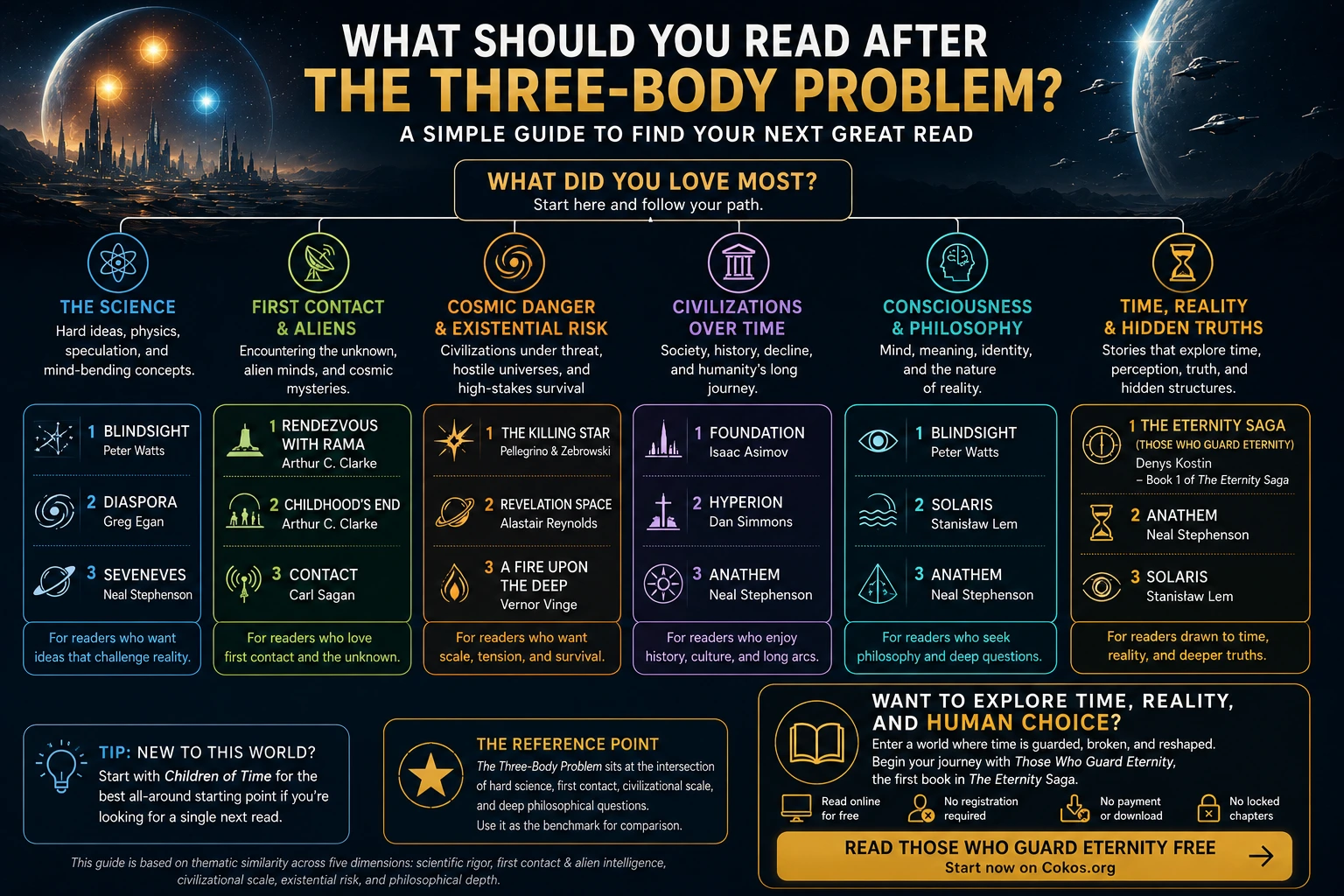
Readers who want one default recommendation should begin with Children of Time. It offers the broadest overlap without trying to reproduce the original. Readers who want the most difficult intellectual challenge should choose Blindsight or Diaspora. Readers who want a quieter encounter with the unknown should choose Rendezvous with Rama or Solaris.
From Cosmic Survival to Responsibility
The defining movement in civilization-scale science fiction is from discovery to responsibility.
A civilization asks whether it is alone, whether the unknown can be understood, and whether contact can be survived. Survival then exposes harder problems of trust, power, sacrifice, and what humanity is willing to become.
At the highest level, the problem becomes moral and political: who should guard the future, what makes that authority legitimate, and what prevents guardianship from becoming control?
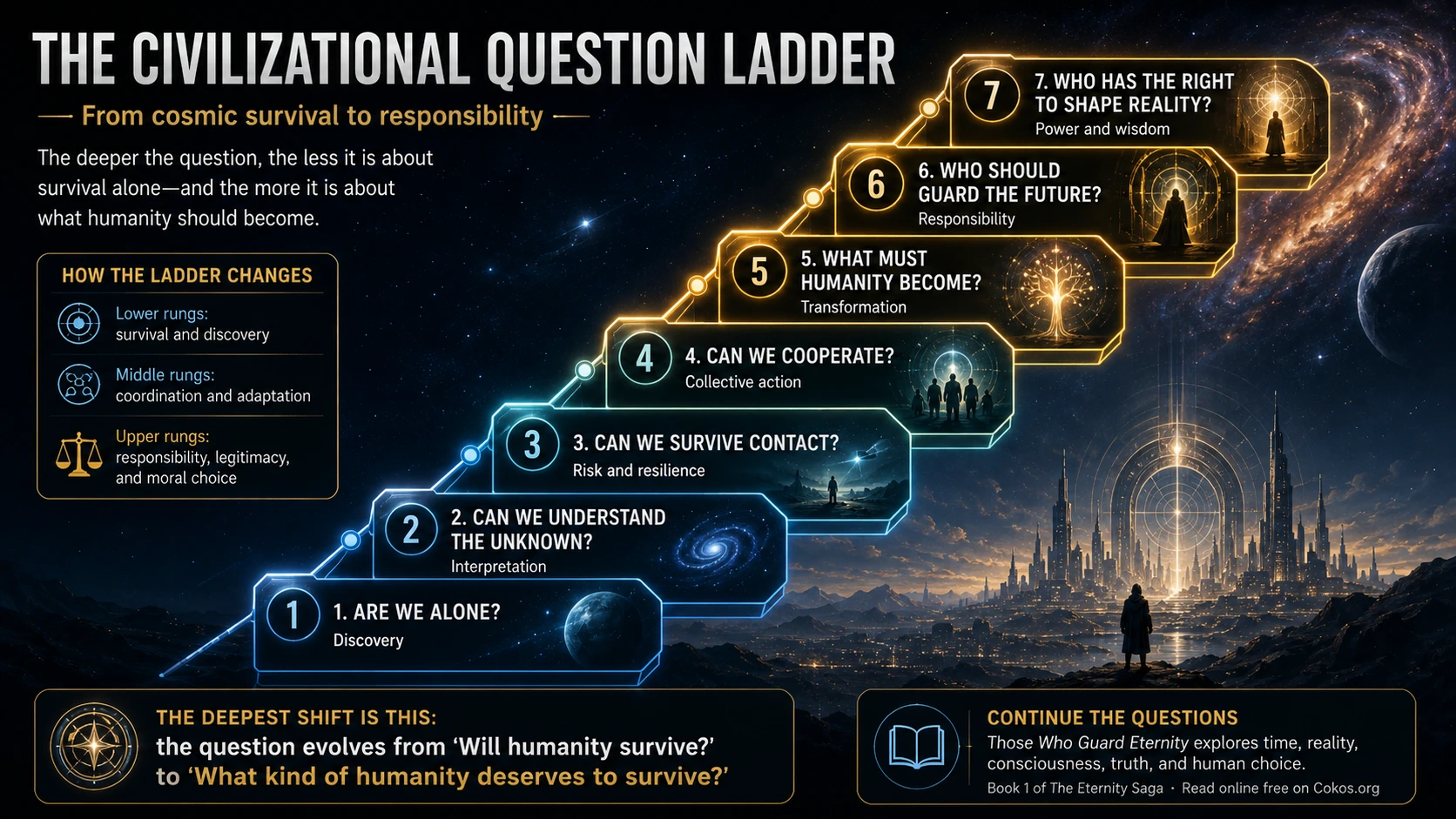
The ladder changes the standard of success: discovery and survival become coordination and adaptation, then wisdom, legitimacy, restraint, and meaningful choice.
The deepest question evolves from “Will humanity survive?” to “What kind of humanity deserves to survive?”
Here science fiction becomes civilizational philosophy. A society can gain power while losing trust, meaning, freedom, and the ability to see reality.
The best books like The Three-Body Problem make the future feel less like a spectacle and more like an inheritance shaped by present choices.
Begin The Eternity Saga
You have explored stories about humanity encountering the unknown. Now enter a story about people who discover that time itself is alive—and that seeing its hidden structure makes them responsible for what comes next.
Read Those Who Guard Eternity Online FreeFrequently Asked Questions
What should I read after The Three-Body Problem?
Start with Children of Time if you want the best all-around combination of scientific imagination, nonhuman intelligence, deep time, and civilizational conflict. Choose Blindsight for consciousness, Rendezvous with Rama for scientific mystery, The Killing Star for cosmic danger, or Foundation for civilization across centuries.
What books are most similar to The Three-Body Problem?
The closest thematic matches are Children of Time, Blindsight, Rendezvous with Rama, Revelation Space, The Killing Star, and Seveneves. Each shares a different part of the experience, so the best choice depends on whether you prioritize science, first contact, existential danger, or civilization-scale thinking.
What are the best hard science-fiction books like The Three-Body Problem?
Blindsight, Diaspora, Seveneves, Rendezvous with Rama, and Revelation Space are strong choices. Blindsight emphasizes biology and consciousness, Diaspora pushes mathematical and posthuman speculation, and Seveneves emphasizes engineering and survival.
Are there books like The Dark Forest?
Yes. Read The Killing Star for preemptive cosmic danger, Revelation Space for hidden extinction mechanisms, and A Fire Upon the Deep for civilizations with radically unequal forms of intelligence and power. These books explore a universe in which contact can create strategic risk rather than simple understanding.
Which books should I read if I loved the philosophical ideas?
Choose Solaris, Anathem, Childhood’s End, Hyperion, or Blindsight. Readers especially interested in time, hidden reality, consciousness, truth, and responsibility can also begin Those Who Guard Eternity.
Is The Eternity Saga hard science fiction?
No. The Eternity Saga is philosophical fantasy and speculative fiction. Its connection to The Three-Body Problem lies in questions about time, consciousness, reality, consequential knowledge, responsibility, and civilization-scale choices rather than scientific realism or alien contact.
Can I read The Eternity Saga online free?
Yes. All three books can be read online on Cokos.org. Begin with Those Who Guard Eternity, continue with the second book, and finish with the third. No registration, payment, subscription, download, or locked chapters are required on the Book 1 reading page.
Are these recommendations spoiler-free?
This guide is spoiler-light. It describes central premises, themes, tone, and the reason each book may appeal to a reader of The Three-Body Problem, while avoiding endings, late revelations, and major solutions.
Related Reading
Final Thoughts
The right book after The Three-Body Problem depends on the question you are not ready to leave behind. If that question concerns alien intelligence, choose Blindsight or Solaris. If it concerns survival across generations, choose Children of Time, Seveneves, or Foundation. If it concerns a hostile cosmos, choose The Killing Star or Revelation Space. If it concerns knowledge, reality, and the moral burden of seeing more, choose Anathem or begin The Eternity Saga.
The greatest science fiction expands the futures we can perceive—and asks which of them should be allowed to exist.
Read Those Who Guard Eternity Free
Begin Book 1 of The Eternity Saga and enter a world where time is guarded, broken, and reshaped by human choice.
Start Reading on Cokos.org View All Three Books