A civilization is not worth preserving merely because it is powerful, ancient, wealthy, or technologically advanced. It is worth preserving when it helps human beings flourish, protects truth and trust, and leaves future generations more capable of living wisely.
Imagine that nearly everything humanity has built disappears. Cities fall silent. Institutions dissolve. Archives are lost. Supply chains stop. The technologies on which billions of lives depend become unusable because the knowledge, trust, coordination, and infrastructure required to sustain them no longer exist.
A small number of survivors are left with an impossible task: civilization must begin again.
What should they rebuild first?
Power stations would matter. So would agriculture, medicine, shelter, sanitation, and communication. Yet these systems alone would not be enough. A technically capable society could still become cruel, unstable, dishonest, short-sighted, or empty of meaning. It might survive materially while becoming unworthy of survival in every deeper sense.
What makes a civilization worth saving?
This is not only a historical question. It is a question about purpose. It asks what must be protected when societies face crisis, what must be rebuilt after collapse, and what future generations should receive from us besides infrastructure, wealth, and tools.
Core answer: A civilization is worth saving when it helps human beings flourish across generations without destroying the moral, epistemic, social, and ecological foundations that make flourishing possible.
Survival Is Not the Same as Worth
Civilizations often measure themselves by visible strength: military capacity, territorial reach, economic production, scientific achievement, monumental architecture, or technological sophistication. These measures reveal what a society can do. They do not reveal whether its people know why they are doing it, whether its institutions deserve trust, or whether its achievements improve the lives of those who come after them.
A civilization can become more powerful while becoming less truthful. It can become richer while becoming less meaningful. It can accumulate knowledge while losing wisdom. It can increase individual freedom while weakening the responsibility that makes freedom sustainable. It can extend life while leaving people unsure what life is for.
This distinction matters because survival, by itself, is morally and philosophically incomplete. A system may preserve its structures while degrading the people within them. It may continue through coercion, fear, propaganda, exploitation, or permanent conflict. Longevity does not automatically justify preservation.
The standard must therefore be higher. A civilization becomes worth saving when it creates and protects the conditions through which human beings can develop their capacities, participate in a shared world, seek truth, accept responsibility, transmit knowledge, make wise decisions, and build for people they will never meet.
Civilization Is a System of Inheritance
Every human being is born into a world they did not create. We inherit languages, moral intuitions, institutions, technologies, stories, legal traditions, scientific discoveries, public spaces, damaged ecosystems, unresolved conflicts, accumulated debts, and possibilities opened by generations before us.
Even the most independent person depends on civilizational achievements that no individual could reproduce alone. Civilization is therefore more than a collection of buildings or a population living under one government. It is a long chain of transmission between the dead, the living, and the unborn.
When that chain works well, each generation receives more than it consumes. It inherits knowledge, refines it, corrects its errors, adds new understanding, and passes forward a world with greater capacity for human flourishing. When the chain breaks, societies may retain machines and institutions for a time, but lose the invisible foundations that make them function.
Those foundations include shared meaning, a commitment to truth, social trust, responsibility, preserved knowledge, wisdom, and long-term thinking. They cannot be replaced by technology because technology depends on them. They cannot be imposed permanently by force because force cannot create genuine trust or meaning. They must be renewed through culture, education, institutions, and everyday action.
Why Powerful Civilizations Still Collapse
History repeatedly demonstrates that power alone does not guarantee endurance. Some of the wealthiest, most technologically capable, and most influential civilizations eventually fragmented, declined, or disappeared. Their collapse rarely resulted from a single catastrophic event. Visible crises usually exposed weaknesses that had accumulated over generations.
Military defeat may end a civilization, but it rarely begins its decline. Economic crises can accelerate instability, yet prosperous societies can already be internally fragile. Environmental pressures matter, but their consequences depend on how wisely societies respond. Collapse is better understood as the final stage of a much longer process of civilizational erosion.
Strength without foundations
Societies can possess extraordinary resources while gradually weakening because their invisible foundations deteriorate. Institutions lose legitimacy. Citizens stop trusting one another. Public life becomes increasingly short-term. Shared purpose fragments. Material success may delay the consequences, but it cannot eliminate them.
When meaning erodes, responsibility declines. When responsibility declines, trust weakens. When trust weakens, institutions struggle to coordinate collective action. Eventually, even sophisticated economies and advanced technologies become difficult to sustain because the human system supporting them has become unstable.
Civilizations usually collapse long before their buildings do.
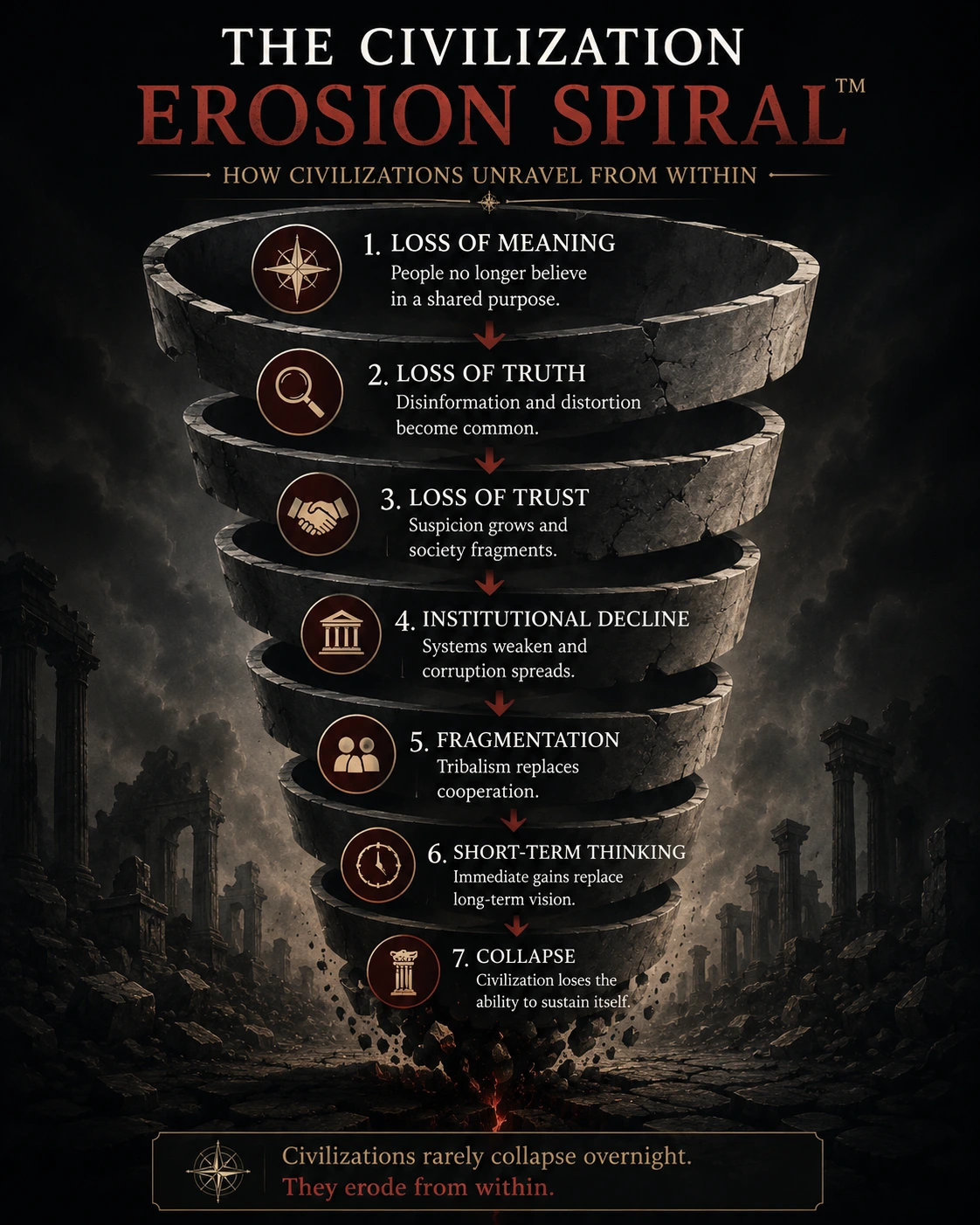
The Civilization Erosion Spiral™
The Civilization Erosion Spiral™ describes a sequence in which internal failures compound until visible collapse becomes increasingly difficult to avoid.
1. Loss of meaning
Decline often begins when people no longer believe that the civilization represents a shared project worth contributing to. Public life becomes transactional. Duties are seen as burdens. Sacrifice appears irrational because there is no future larger than private survival or consumption.
A society does not need one uniform worldview, but it does need enough shared purpose to justify cooperation. Without it, institutions become service providers rather than common achievements, and citizenship becomes a claim on benefits rather than participation in a collective inheritance.
2. Loss of truth
When shared purpose weakens, facts become easier to subordinate to group loyalty, convenience, or power. Competing communities stop disagreeing about interpretation and begin disagreeing about reality itself. Error correction becomes politically or emotionally costly.
A civilization that cannot distinguish evidence from preference eventually loses the ability to diagnose its own problems. It may have vast quantities of information yet lack a shared process for deciding what is true.
3. Loss of trust
Once people doubt the honesty of institutions, media, experts, neighbors, and leaders, cooperation becomes expensive. Every agreement requires additional enforcement. Every reform is interpreted as manipulation. Every mistake confirms a broader narrative of betrayal.
Low-trust societies can continue functioning, but they require more surveillance, bureaucracy, coercion, and defensive behavior. Energy that could have been used for creativity and progress is spent protecting against one another.
4. Institutional decline
Institutions weaken when they no longer fulfill their stated purposes, learn from failure, or attract people who feel responsible for their integrity. Formal structures may remain, but their capacity declines. Rules multiply while effectiveness falls.
Institutional decline is especially dangerous because people often respond by withdrawing further, which removes precisely the participation and talent required for renewal.
5. Fragmentation
As trust and institutional legitimacy decline, society fragments into groups that experience one another as threats. Identity becomes more important than shared problem-solving. Compromise is treated as weakness, and every public question becomes a struggle over status and control.
Diversity itself is not the problem. Civilizations often flourish through pluralism. The problem is the loss of a higher-order framework that enables differences to coexist within a shared civic reality.
6. Short-term thinking
Fragmented societies struggle to make long-term investments because every group fears that another group will capture the benefits. Leaders optimize for the next election, quarter, crisis, or headline. Maintenance is postponed. Education is politicized. Debt, environmental damage, and institutional fragility are transferred to future generations.
Short-term decisions can create temporary stability, but they deepen the conditions that made the decisions necessary. The civilization begins consuming its inheritance faster than it can renew it.
7. Collapse
Collapse is the moment when accumulated fragility becomes visible. It may take the form of political disintegration, economic breakdown, external conquest, demographic decline, ecological crisis, or a slow loss of capability. By then, the immediate trigger matters less than the weakened system it strikes.
The important lesson is that collapse prevention cannot begin only at the final stage. It requires restoring meaning, truth, trust, responsibility, knowledge, wisdom, and long-term thinking before the spiral becomes self-reinforcing.
Civilization Is More Than Infrastructure
Roads, hospitals, satellites, data centers, and power grids make civilization visible. Yet none of them explains why people cooperate across generations. Infrastructure is an expression of civilization, not civilization itself.
If every building remained standing but trust disappeared, contracts became meaningless, knowledge stopped being transmitted, and people no longer believed they shared a common future, the physical structures would gradually lose their purpose. Civilization would begin dissolving long before the last bridge collapsed.
The invisible architecture of civilization
Every enduring civilization rests on patterns of human cooperation that allow millions of people to coordinate without knowing one another personally. Shared meaning gives people a reason to contribute. Truth enables a common understanding of reality. Trust reduces the cost of cooperation. Responsibility turns freedom into sustainable action. Knowledge preserves learning. Wisdom improves judgment. Long-term thinking protects people who do not yet exist.
Civilization is a system for transmitting wisdom, trust, and possibility across generations.
This systems perspective changes how preservation should be understood. Protecting civilization is not simply preserving buildings, traditions, or institutions. It is preserving the conditions that allow future generations to correct, improve, and renew them.
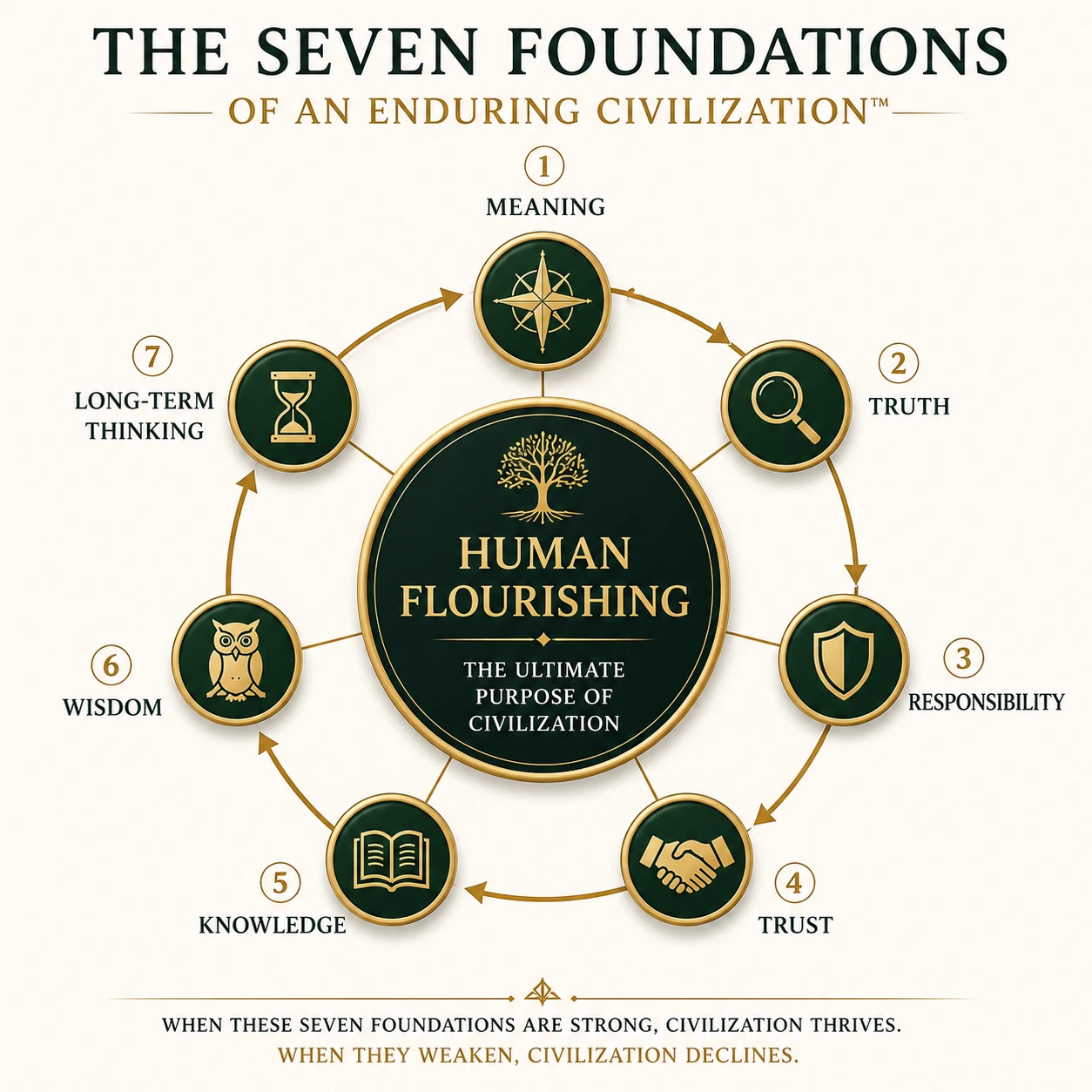
The Seven Foundations of an Enduring Civilization™
The Seven Foundations of an Enduring Civilization™ identify the conditions that allow a society to remain resilient, adaptive, and worthy of preservation. These foundations are not independent boxes. Each one strengthens or weakens the others.
1. Meaning: a reason to build beyond one lifetime
Meaning connects individual life with a larger story. It gives people a reason to educate children, maintain institutions, preserve culture, serve communities, and make sacrifices whose benefits they may never personally receive.
A meaningful civilization does not dictate one purpose to everyone. It creates space in which people can pursue different lives while still recognizing that they participate in a shared human project. It offers belonging without demanding conformity and aspiration without denying tragedy.
Human beings need more than comfort. They need to feel that their choices matter. This is why societies rich in entertainment and consumption can still experience emptiness. Material abundance can support meaning, but it cannot manufacture it.
2. Truth: a shared relationship with reality
Every civilization depends on mechanisms for discovering, preserving, and correcting knowledge. Science, journalism, education, courts, archives, and public debate serve different functions, but all contribute to the same civilizational requirement: reality must be allowed to correct belief.
Truth does not require universal agreement. In fact, a strong truth-seeking culture expects disagreement. What it requires is a shared commitment to evidence, intellectual honesty, and the possibility of admitting error.
Without that commitment, power decides what is real. Once truth becomes merely another instrument of competition, learning slows and institutional mistakes become harder to correct.
3. Trust: the invisible infrastructure of cooperation
Trust allows strangers to exchange value, accept expertise, obey fair rules, and coordinate during crisis. It reduces the need for constant monitoring and makes complex institutions possible.
Trust should not mean blind faith. Durable trust is earned through competence, honesty, transparency, accountability, and repeated reliability. Institutions become trustworthy when they can acknowledge failure without collapsing into denial or self-protection.
High-trust societies do not eliminate conflict. They make conflict governable because participants believe that disagreement can occur without destroying the shared system.
4. Responsibility: freedom directed toward stewardship
Freedom allows people to choose. Responsibility asks them to consider what their choices sustain or damage. A civilization cannot remain free if everyone treats the common world as someone else’s problem.
Responsibility begins with ordinary acts: keeping promises, caring for dependents, maintaining shared spaces, learning before judging, contributing to institutions, and accepting consequences. These actions rarely look heroic, yet they are the daily maintenance through which civilization survives.
A responsible society avoids two extremes. It does not reduce people to obedient instruments of the collective, and it does not celebrate individual choice while ignoring its cumulative effects. It treats freedom as participation in a world that must remain livable for others.
5. Knowledge: memory that compounds across generations
Knowledge allows each generation to begin where the previous generation ended. It is stored not only in books and databases but also in practices, institutions, crafts, languages, professional standards, and cultural memory.
A civilization that loses the ability to transmit knowledge may retain information while losing understanding. Facts become disconnected from the models, methods, and judgment required to use them.
Preserving knowledge therefore requires more than archiving. It requires teachers, apprenticeships, public institutions, curiosity, access, and a culture that values learning. It also requires protecting societies from the arrogance of believing that the latest knowledge makes historical experience irrelevant.
6. Wisdom: knowing what should be done
Knowledge expands capability. Wisdom directs capability toward worthy ends. It integrates facts with ethics, experience, uncertainty, and an understanding of consequences.
Wise civilizations recognize trade-offs. They know that every gain can create new risks, that not everything measurable is valuable, and that not everything technologically possible should be pursued without restraint.
Wisdom is especially important when decisions are irreversible or affect people who cannot participate in them. It requires humility: the recognition that models are incomplete, incentives distort perception, and future consequences may differ from present intentions.
7. Long-term thinking: loyalty to the unborn
The final foundation extends moral concern beyond the present. Long-term thinking asks whether today’s prosperity is being purchased by reducing tomorrow’s possibilities.
It appears in infrastructure maintenance, environmental stewardship, responsible debt, stable institutions, education, research, cultural preservation, and the design of technologies whose consequences may unfold over centuries.
Future generations cannot vote, protest, invest, or negotiate with us. Their interests depend on our willingness to represent them voluntarily. A civilization becomes enduring when it treats those absent voices as part of its moral community.
How the Seven Foundations Work Together
The seven foundations should not be interpreted as a checklist in which success in one area compensates indefinitely for failure in another. They form an interdependent system.
Meaning without truth can become fanaticism. Truth without trust cannot coordinate action. Trust without responsibility becomes complacency. Responsibility without knowledge becomes ineffective effort. Knowledge without wisdom increases capability without direction. Wisdom without long-term thinking remains trapped in the present. Long-term thinking without meaning lacks the motivation to endure sacrifice.
Human flourishing is not an eighth foundation. It is the purpose that gives all seven foundations direction. A society may possess meaning, trust, or knowledge, but if these are used to degrade human dignity or close the future, the system has become internally distorted.
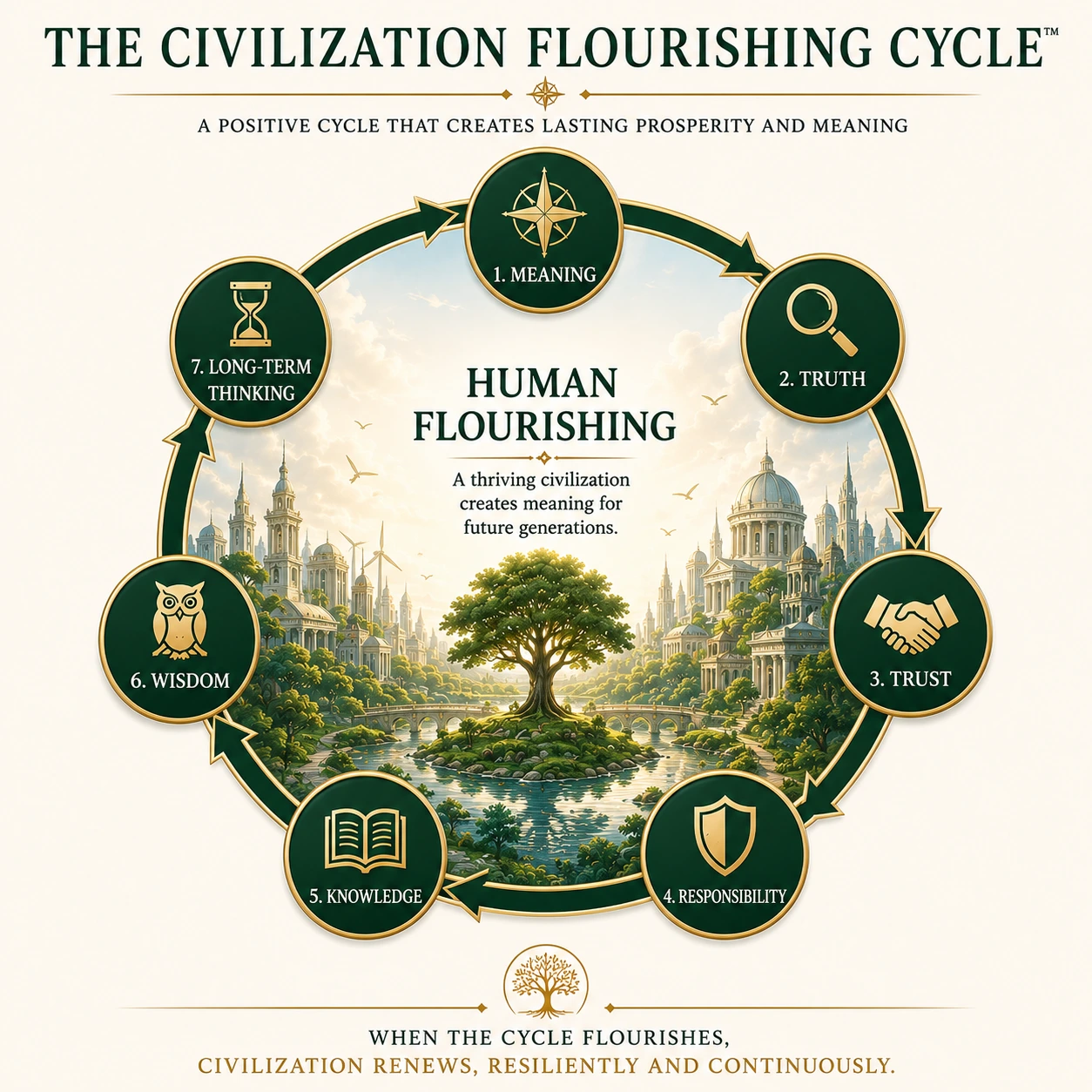
The Civilization Flourishing Cycle™
Healthy civilizations do more than avoid collapse. They regenerate the conditions that make future progress possible. Improvement in one foundational area strengthens others, creating a positive feedback loop.
Meaning motivates truth-seeking because reality matters when the future matters. Truth supports trust because honesty makes cooperation possible. Trust encourages responsibility because people are more willing to contribute when they believe others will also contribute. Responsibility preserves knowledge through education and stewardship. Knowledge becomes wisdom when integrated with judgment and ethics. Wisdom enables long-term thinking. Long-term thinking creates better conditions for human flourishing, which renews meaning.
Positive loops are not automatic
The cycle can be interrupted at any point. A society may educate widely but punish honest inquiry. It may celebrate responsibility while making institutions untrustworthy. It may plan for the future while excluding large parts of the population from flourishing.
For this reason, renewal requires continuous attention to the whole system. Civilizational health cannot be delegated to one ministry, profession, ideology, or generation. It is a distributed achievement.
Resilience is the capacity to learn without losing coherence
A resilient civilization is not one that never changes. It is one that can change without losing the foundations that make constructive change possible. It can question traditions without erasing memory, reform institutions without destroying legitimacy, and adopt new technologies without surrendering human purpose.
This balance matters because rigidity and fragmentation are opposite forms of failure. Rigid societies cannot adapt; fragmented societies cannot coordinate. Enduring civilizations preserve enough continuity to remain coherent and enough openness to learn.
The Civilization Worthiness Assessment™
Understanding the foundations is only the first step. Leaders, institutions, educators, and citizens also need a practical way to evaluate whether their civilization is strengthening or weakening those foundations over time.
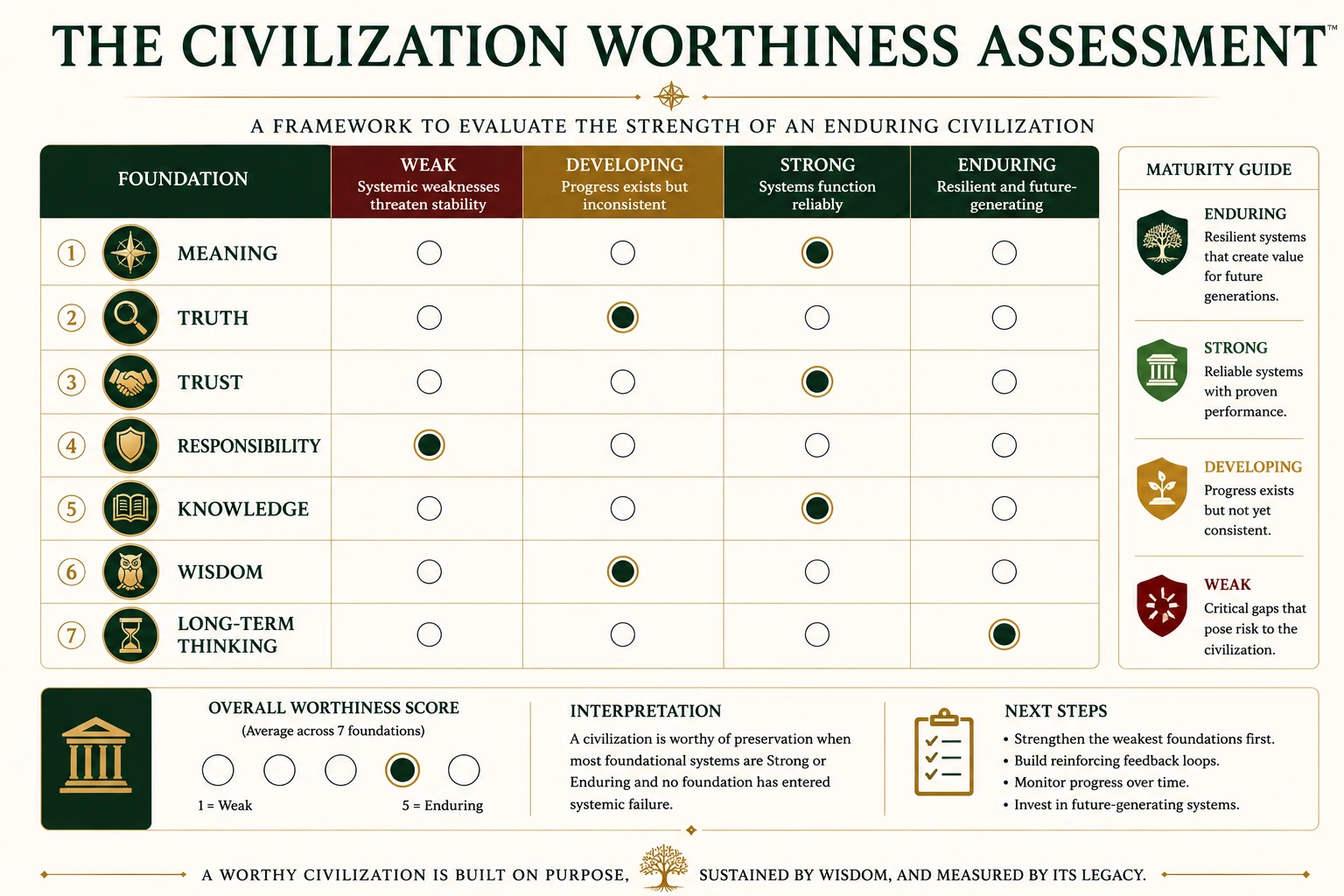
Evaluate foundations, not appearances
Many societies achieve impressive short-term outcomes while weakening their long-term foundations. Economic growth, political influence, or technological innovation may temporarily conceal declining trust, increasing fragmentation, or the erosion of responsibility.
The assessment therefore asks seven enduring questions:
- Does the civilization cultivate meaning without suppressing pluralism?
- Does it protect truth-seeking and reliable error correction?
- Do institutions earn trust through competence and accountability?
- Does freedom remain connected to responsibility?
- Is knowledge preserved, accessible, and expanded?
- Does wisdom guide consequential decisions?
- Are future generations represented in present choices?
Four levels of civilizational maturity
- Weak: the foundation is consistently undermined or exists only rhetorically.
- Emerging: meaningful progress exists, but it remains inconsistent or fragile.
- Strong: the foundation reliably supports social life and can survive ordinary shocks.
- Enduring: the foundation is deeply embedded, self-correcting, and transmitted across generations.
The purpose of the assessment is not to produce one final score that settles the value of a civilization. It is to reveal imbalances and dependencies. A society may be strong in knowledge and weak in wisdom, strong in meaning and weak in truth, or strong in long-term planning and weak in trust. These combinations produce different risks.
The weakest foundation can become the limiting condition
Civilizational systems often behave like interconnected structures: one severely degraded foundation can limit the value of the others. Vast knowledge cannot solve collective problems if no one trusts the institutions presenting it. Strong responsibility can be exploited if truth is suppressed. Long-term plans cannot endure if they have no meaningful public legitimacy.
The assessment should therefore guide strengthening actions rather than ranking civilizations. The important question is not, “Are we worthy?” as a permanent verdict. It is, “Which conditions must we strengthen now so that future generations inherit greater capacity to flourish?”
Can Technology Save Civilization?
Every generation is tempted to believe that its defining technology will solve humanity’s deepest problems. Fire transformed survival. Agriculture transformed settlement. Writing transformed memory. Printing transformed learning. Electricity transformed industry. The internet transformed communication. Artificial intelligence may transform nearly every domain of human activity.
Yet technology has consistently amplified the character of civilizations rather than replacing it. The same scientific discovery can improve health or enable oppression. The same communication platform can spread knowledge or misinformation. The same artificial intelligence can expand human agency or deepen dependence.
Technology is a multiplier of civilization, not a substitute for it.
Artificial intelligence makes purpose more important
As machines become increasingly capable of generating information, optimizing systems, and automating decisions, the uniquely human challenge shifts from producing capability to choosing its direction.
If wisdom does not grow alongside power, civilization may become extraordinarily efficient while losing sight of the values that justified progress. Efficiency without meaning can accelerate decline just as effectively as it accelerates growth.
AI can help analyze climate systems, design medicine, personalize education, preserve languages, and improve public services. It can also centralize power, weaken human judgment, automate manipulation, and make falsehood more scalable. The difference lies not in the technology alone but in the civilization deploying it.
Advanced capability can conceal civilizational immaturity
A society may possess advanced medicine, global connectivity, autonomous systems, and abundant information while experiencing declining trust, loneliness, institutional fragmentation, and short-term decision-making. Technological progress and civilizational progress are related, but they are not identical.
The deeper measure of progress is not whether humanity can build increasingly powerful tools. It is whether those tools increase the capacity of people to live meaningful, responsible, truthful, and flourishing lives.
What Would a Civilization Worth Saving Actually Protect?
The frameworks become practical when translated into priorities. A civilization worth saving would protect more than territory and production. It would protect the conditions that make a shared human future possible.
It would protect human dignity
Human beings would not be treated only as workers, consumers, voters, data points, or instruments of national power. Institutions would recognize that each person possesses intrinsic worth and developmental potential.
It would protect the search for truth
Science, scholarship, journalism, courts, and public debate would be protected not because they are always correct, but because civilization needs reliable processes for discovering error.
It would protect cultural memory
Stories, languages, art, historical records, and traditions would be preserved while remaining open to reinterpretation. A civilization without memory cannot learn from its achievements or crimes. This is one reason humans need stories: stories transmit identity, possibility, and warning across generations.
It would protect the conditions of responsibility
Citizens would have meaningful agency and clear accountability. Institutions would not ask people to take responsibility while denying them the information or power required to act.
It would protect future possibility
The civilization would avoid consuming ecological, financial, cultural, or institutional capital merely to preserve present comfort. It would see the future not as an empty space to exploit but as a community whose members have not yet arrived.
The Ultimate Test: Human Flourishing Across Generations
A civilization should not ultimately be judged by the height of its buildings, the size of its economy, the sophistication of its technologies, or even the length of its existence. Those achievements matter only insofar as they contribute to the development of human beings and preserve the conditions of future development.
The true purpose of civilization is human flourishing: enabling people to develop wisdom, pursue meaning, cultivate trust, preserve knowledge, accept responsibility, and participate in a future larger than themselves.
Flourishing is not identical to happiness. A life can be meaningful while containing sacrifice, grief, and difficulty. Nor is flourishing merely individual. People flourish through relationships, culture, institutions, and a living world that supports them.
This is why hope matters civilizationally. Hope is not passive optimism. It is the belief that responsible action can still influence the future. Without it, long-term cooperation becomes psychologically impossible.
A worthy civilization therefore increases capability without erasing meaning, expands freedom without abandoning responsibility, accumulates knowledge without losing wisdom, and pursues prosperity without consuming the future.
A civilization is worth saving not because it survives, but because it continually creates better conditions for human flourishing across generations.
Questions Every Generation Must Answer
- What forms of knowledge must never be lost?
- Which institutions deserve preservation, and which must be redesigned?
- What stories help people understand both their dignity and their responsibility?
- Where has convenience begun consuming long-term capacity?
- Which truths have become too costly to acknowledge?
- What do current systems ask future generations to pay for?
- What would we rebuild first if civilization had to begin again?
These questions cannot be answered once for all time. Civilizations remain worthy through repeated renewal. Every generation must reinterpret inherited principles under new conditions without severing the chain of learning that made its own life possible.
What History Actually Teaches About Civilizational Survival
Historical examples are often used too simply. One civilization is said to have collapsed because of invasion, another because of corruption, another because of environmental pressure, and another because of inequality. These explanations may identify important forces, but they can obscure the systemic character of decline.
External shocks rarely affect every society in the same way. A drought becomes catastrophic when institutions cannot coordinate adaptation. Military pressure becomes fatal when internal trust has already weakened. Economic disruption becomes politically explosive when people believe sacrifice is unfairly distributed. A technological transition becomes destabilizing when education, law, and culture cannot adjust quickly enough.
The deeper historical lesson is therefore not that civilizations can eliminate risk. No society can prevent every war, disease, disaster, or technological disruption. The lesson is that foundational quality shapes whether pressure produces learning, reform, fragmentation, or collapse.
Civilizations fail when adaptation becomes harder than denial
Every large system develops interests that benefit from existing arrangements. Over time, those interests can make honest diagnosis costly. Leaders may suppress evidence that threatens legitimacy. Institutions may defend procedures that no longer serve their purpose. Citizens may prefer narratives that preserve identity over facts that require sacrifice.
Once adaptation becomes more threatening than decline, a civilization can continue repeating failing responses even while evidence accumulates. The problem is no longer lack of intelligence. It is the inability to convert knowledge into coordinated action.
Civilizations survive by preserving learning capacity
The most resilient societies are not those that never make mistakes. They are those that detect mistakes early, distribute information reliably, protect dissent, revise institutions, and retain enough trust to act on new understanding.
This is why truth and trust must be protected together. Truth without trust may be ignored. Trust without truth becomes manipulation. A mature civilization needs institutions that are both epistemically reliable and publicly accountable.
Pluralism, Shared Meaning, and the Problem of Unity
The idea of shared meaning can sound dangerous because history contains many examples of rulers imposing one identity, faith, ideology, or destiny on diverse populations. A civilization worth saving must avoid confusing unity with uniformity.
Pluralism is not the absence of common ground. It is the ability to sustain deep differences within a shared framework of dignity, truth-seeking, law, responsibility, and peaceful participation.
The common meaning of an enduring civilization need not tell every person what to believe about ultimate reality. It can instead establish a thinner but still powerful commitment: human beings matter, truth matters, the future matters, and no group has the right to destroy the shared conditions that allow others to live and participate.
The difference between a common story and a compulsory story
A common story invites participation. A compulsory story demands submission. A common story can evolve through criticism and new experience. A compulsory story treats questioning as betrayal.
Enduring civilizations need narratives strong enough to inspire contribution and flexible enough to absorb correction. Their identity must be neither empty nor closed. It must explain why the civilization exists while leaving room for people to challenge how faithfully it serves that purpose.
Education as Civilizational Transmission
Education is often discussed as preparation for employment. That function matters, but it is only one part of education’s civilizational role. Education transmits the models of reality, moral habits, historical memory, practical skills, and standards of judgment through which a society reproduces itself.
A civilization can possess schools everywhere and still fail educationally if students learn to repeat information without evaluating it, compete without cooperating, demand rights without understanding responsibilities, or use technology without comprehending its consequences.
Education worthy of an enduring civilization would cultivate at least four capacities:
- Epistemic capacity: how to distinguish evidence, interpretation, uncertainty, and manipulation.
- Moral capacity: how to consider the dignity, interests, and rights of other people.
- Practical capacity: how to create, repair, cooperate, and contribute.
- Temporal capacity: how to understand inherited systems and anticipate long-term consequences.
Education also determines whether accumulated knowledge remains alive. An archive preserves information, but only education creates people capable of understanding it. Without teachers, mentors, communities of practice, and institutions that value inquiry, knowledge becomes inaccessible even when technically stored.
Institutions Worth Preserving Must Remain Correctable
Institutions are necessary because complex societies cannot rely on personal virtue alone. They stabilize expectations, preserve knowledge, coordinate large systems, and make cooperation possible beyond individual relationships.
Yet institutions can become detached from their purpose. Procedures begin serving the organization rather than the public. Metrics replace meaning. Authority becomes insulated from consequences. People learn that honesty is punished while conformity is rewarded.
An institution becomes worthy of preservation when it combines continuity with correction. It must retain enough stability to perform its function and enough openness to learn when that function is failing.
Five properties of trustworthy institutions
- Purpose clarity: people can explain what the institution exists to protect or produce.
- Competence: it can reliably perform the work entrusted to it.
- Accountability: authority remains connected to consequences.
- Transparency: important decisions can be examined and challenged.
- Learning capacity: failure changes future behavior rather than merely changing public language.
Institutions that lack these properties may still possess legal authority, but their legitimacy gradually decays. Rebuilding legitimacy requires more than communication. It requires visible alignment between stated purpose and actual behavior.
Ecological Limits and the Material Basis of Flourishing
A civilization cannot flourish independently of the living systems that support it. Food, water, climate stability, soil, energy, biodiversity, and public health are not external concerns added after economic priorities. They are preconditions of every economy and institution.
Short-term societies treat nature as an inventory. Enduring societies treat it as a regenerative system whose thresholds may be difficult or impossible to restore once crossed.
This does not require rejecting development or technology. It requires evaluating development by whether it expands human possibility without undermining the ecological basis of future possibility.
Stewardship is not anti-progress
Stewardship asks better questions of progress. Does innovation reduce irreversible harm? Does prosperity depend on transferring hidden costs to distant communities or future generations? Does a new system increase resilience or create dependence on fragile supply chains? Can resources regenerate at the rate they are consumed?
A civilization that knowingly destroys the conditions of its own continuity is not advanced in the deepest sense. It is consuming accumulated natural capital while calling the liquidation growth.
Justice, Power, and the Distribution of Sacrifice
Every civilization distributes benefits, burdens, risk, status, and voice. These distributions do not need to be perfectly equal to remain legitimate, but they must be explainable and open to correction.
Trust collapses when people repeatedly observe that powerful groups receive protection from consequences while vulnerable groups absorb the costs of collective decisions. A society can ask for sacrifice during crisis only when people believe sacrifice is distributed with some degree of fairness.
This is why the question of absolute justice must be approached carefully. Perfect justice may be impossible because values conflict, information is incomplete, and every rule creates edge cases. But the impossibility of perfection does not justify indifference. Enduring civilizations need credible processes for identifying harm, correcting abuse, and limiting concentrated power.
Power must remain answerable to purpose
Power is not inherently corrupting; civilization requires power to enforce law, defend people, build infrastructure, and coordinate emergencies. The danger begins when power becomes self-justifying.
A civilization worthy of preservation ensures that authority remains connected to a public purpose, constrained by law, exposed to scrutiny, and replaceable without destroying the entire system.
Why Comfort Alone Cannot Define Flourishing
It is tempting to define a successful civilization as one that maximizes comfort, safety, convenience, and pleasure. These goods matter. Preventable suffering should not be romanticized. Yet a civilization organized only around comfort risks weakening capacities that flourishing also requires.
Human beings need challenge, contribution, competence, belonging, and purpose. A life in which every difficulty is removed may become passive rather than fulfilled. A society that treats discomfort as failure may struggle to cultivate courage, patience, and responsibility.
The relevant distinction is not between suffering and comfort, but between meaningless suffering and meaningful effort. A civilization worth saving reduces avoidable suffering while preserving opportunities for growth, service, mastery, and voluntary sacrifice.
Civilizational Responsibility Begins Before Crisis
People often imagine responsibility in dramatic terms: defending society during war, responding to disaster, exposing corruption, or leading institutional reform. These acts matter, but the ordinary maintenance of civilization begins much earlier.
It begins when people tell the truth even when distortion would be easier. It begins when professionals preserve standards that no customer can directly observe. It begins when citizens learn before sharing, repair rather than discard, mentor rather than hoard knowledge, and participate rather than assume someone else will act.
No individual can carry civilization alone. But civilization is made from actions small enough for individuals to perform. Its invisible foundations are renewed or weakened through repeated choices that rarely appear in history books.
The question is not whether one person can save civilization
The better question is whether one person’s actions reinforce the flourishing cycle or the erosion spiral. Do they increase truth or confusion? Trust or suspicion? Responsibility or blame? Knowledge or forgetting? Wisdom or impulsiveness? Long-term capacity or short-term extraction?
This framing avoids both grandiosity and helplessness. Most people will never redesign a nation, but everyone participates in the social systems from which civilizational outcomes emerge.
Objections to the Idea of a “Worthy” Civilization
“Who decides what is worthy?”
No individual, institution, or culture should receive unlimited authority to define worth for everyone. That is precisely why the framework emphasizes pluralism, truth-seeking, accountability, and human dignity. Worthiness should be assessed through open reasoning and lived consequences rather than imposed as dogma.
“Every civilization contains injustice. Does that make none worth saving?”
A civilization need not be perfect to be worthy of preservation. The decisive question is whether it can recognize injustice, learn, and reform. A society that contains failure but preserves correction is different from one that makes failure unquestionable.
“Is this framework culturally universal?”
The seven foundations can be expressed differently across cultures. Meaning, responsibility, wisdom, and trust do not require identical institutions or beliefs. The framework proposes functional conditions for long-term cooperation, not one prescribed cultural form.
“Could a highly stable authoritarian system be enduring?”
It may endure politically for a long time, but duration alone does not establish worthiness. A system that suppresses truth, dignity, participation, or correction may preserve order while damaging the human capacities civilization exists to serve.
A Practical Agenda for Civilizational Renewal
The four frameworks suggest a practical sequence for renewal.
- Diagnose the weakest foundations. Avoid treating visible crises as isolated events.
- Restore shared reality. Improve evidence, transparency, and error correction.
- Rebuild earned trust. Align institutional claims with observable behavior.
- Reconnect freedom and responsibility. Give people both agency and accountability.
- Protect knowledge transmission. Strengthen education, memory, and professional standards.
- Create structures for wisdom. Include ethics, uncertainty, trade-offs, and long-term consequences in major decisions.
- Represent future generations. Evaluate whether present gains reduce future capability.
Renewal cannot be achieved through messaging alone. Civilizational narratives become credible when institutions embody them. Trust grows when people repeatedly observe competence, fairness, honesty, and repair.
The most important shift is from asking how to preserve existing systems exactly as they are to asking what those systems were supposed to make possible. Preservation without purpose becomes stagnation. Change without inheritance becomes amnesia. Renewal connects the two.
Frequently Asked Questions
What is the main purpose of civilization?
The deepest purpose of civilization is to create and preserve the conditions for human flourishing across generations. Infrastructure, law, science, culture, and economic systems are valuable because they can expand human capability, dignity, wisdom, and future possibility.
What makes a civilization endure?
An enduring civilization maintains shared meaning, truth-seeking, trust, responsibility, knowledge transmission, wisdom, and long-term thinking. It also preserves the ability to correct its own failures without losing social coherence.
Why do civilizations collapse?
Civilizations usually collapse through interacting pressures rather than one cause. The Civilization Erosion Spiral™ describes how loss of meaning, truth, and trust can weaken institutions, increase fragmentation, produce short-term behavior, and leave society unable to respond effectively to crisis.
Can technology prevent civilizational collapse?
Technology can improve resilience, knowledge, health, and coordination, but it cannot replace purpose, trust, responsibility, or wisdom. It amplifies the values and structures of the civilization using it.
How can individuals contribute to civilizational renewal?
Individuals contribute by protecting truth, keeping commitments, transmitting knowledge, strengthening trustworthy institutions, accepting responsibility, and considering the long-term effects of ordinary decisions. Civilizational foundations are maintained through distributed action.
Conclusion: Civilization as a Promise to the Future
Every generation inherits a civilization it did not build. It receives languages shaped by unknown ancestors, institutions built through forgotten sacrifice, scientific discoveries produced by lives it cannot repay, and landscapes altered by choices made long before its birth.
Inheritance creates responsibility. We are not owners of civilization in the final sense. We are temporary stewards of a system that connects the past with the future.
A civilization becomes worth saving when it understands this role. It does not preserve everything merely because it is old. It does not destroy everything merely because it is imperfect. It distinguishes what must be repaired, what must be remembered, what must be relinquished, and what must be built for the first time.
Its deepest achievement is not permanence. No civilization remains unchanged forever. Its achievement is continuity with learning: the ability to preserve what is essential while becoming wiser.
The question “What makes a civilization worth saving?” ultimately returns to each of us. Civilization is not an abstract object maintained somewhere else. It is recreated through the promises we keep, the truths we protect, the knowledge we transmit, the institutions we repair, and the future we choose to consider.
A civilization is worth saving when it helps future generations become wiser, freer, more responsible, and more fully human.