
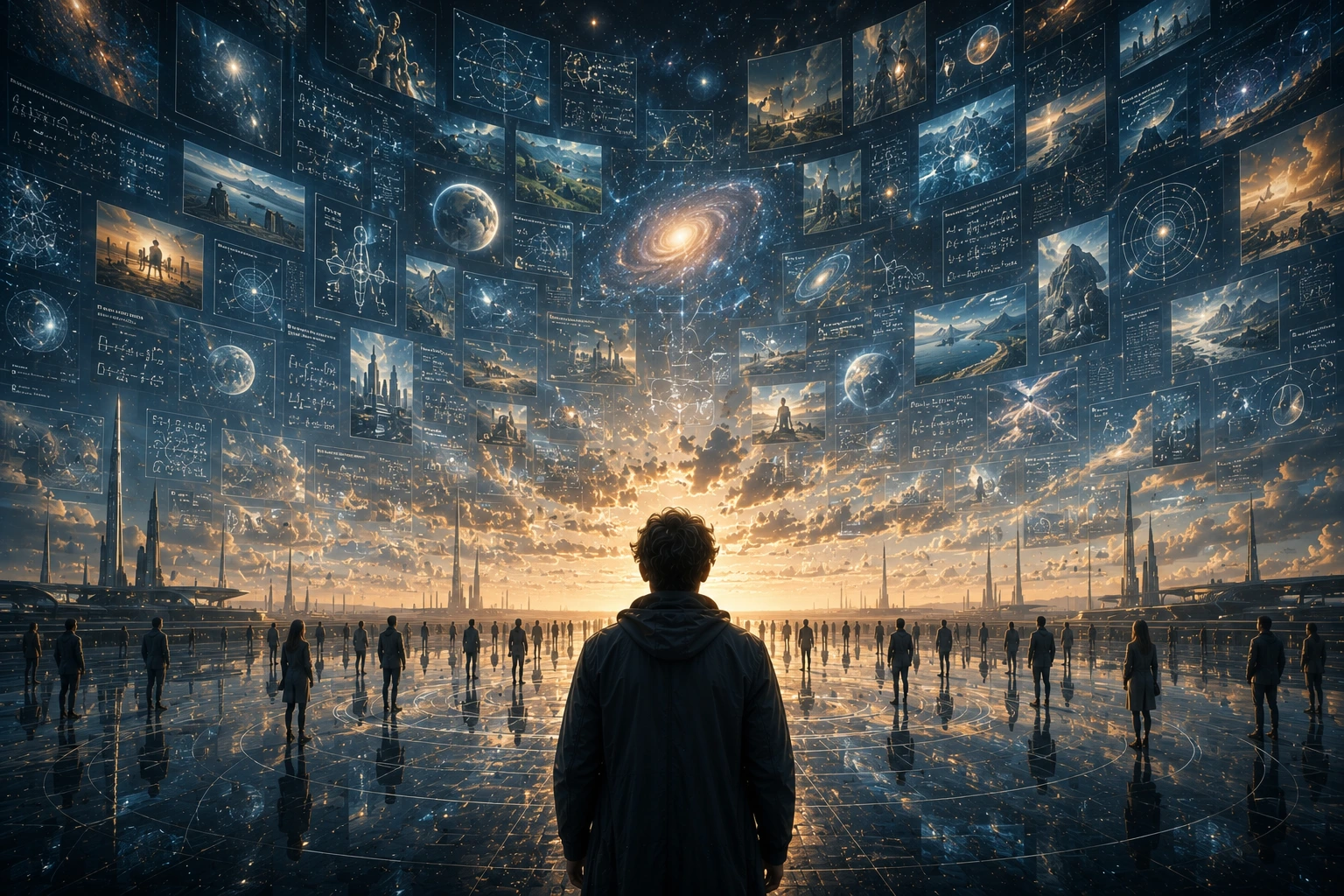
Can humanity survive the end of mystery? What happens when every question has an answer?
Not because humanity stopped asking.
Not because curiosity disappeared.
But because every mystery was solved.
Every equation completed. Every hidden law understood. Every secret of consciousness explained. Every unanswered question resolved.
Would humanity become complete?
Or would it lose something more important than knowledge itself?
Mystery Has Always Driven Civilization
Civilizations are built on questions.
What lies beyond the mountains? What causes the stars to move? What happens after death? Who are we? Why are we here?
The search for answers built astronomy, mathematics, medicine, philosophy and science.
Curiosity transformed survival into civilization. The unknown became one of humanity’s greatest engines.
The End of Mystery Is Not the Same as Knowledge
Most people imagine knowledge replacing mystery.
History suggests the opposite.
Every answer creates new questions. Every discovery reveals a larger unknown waiting beyond it.
Understanding gravity created questions about spacetime. Understanding genetics created questions about consciousness. Understanding the universe revealed how little we actually know.
The history of science is not the destruction of mystery. It is often the expansion of it.
What Happens When There Are No Questions Left?
Imagine a civilization that finally knows everything.
No unexplored galaxies. No unsolved equations. No unanswered philosophical questions. No uncertainty about life, consciousness, reality or existence.
At first this sounds like perfection.
No confusion. No ignorance. No doubt.
But uncertainty does more than create problems.
It creates movement.
A world without questions may become a world without direction.
Can Curiosity Survive Certainty?
Curiosity depends on possibility.
It depends on the feeling that something remains undiscovered.
Children explore because the world is new. Scientists explore because reality still hides secrets. Artists create because human experience remains unfinished.
If certainty replaces possibility, what happens to curiosity?
Would humanity continue searching if there was nothing left to find?
Or would civilization slowly become still?
Wonder, Awe and the Human Need for the Unknown
Wonder is different from knowledge.
Knowledge explains. Wonder expands.
Awe appears when reality feels larger than our current understanding. It is the feeling of standing before something vast, beautiful, strange or unfinished.
Looking at the night sky feels powerful partly because we do not fully understand what we are seeing. The ocean inspires awe because so much remains hidden beneath its surface.
Exploration, discovery and novelty seeking are not decorative parts of human nature. They are part of how human beings remain alive to the world.
Human beings live between understanding and mystery.
Remove one entirely and something fundamental may disappear.
The End of Mystery Could Create a Crisis of Meaning
Meaning rarely comes from completion.
Meaning comes from movement. From becoming. From seeking. From reaching toward something larger than ourselves.
A civilization that solves every mystery may discover a new problem:
What happens after the final answer?
Could Consciousness Survive Complete Understanding?
Consciousness may be humanity’s greatest mystery.
What creates subjective experience? Why does awareness exist at all? Why does reality feel like something from the inside?
Imagine a future where every one of these questions is answered.
Some mysteries do not simply challenge intelligence. They shape identity itself.
If consciousness becomes fully explained, humanity may not lose consciousness. But it may lose the sacred distance that once surrounded it.
Why This Question Belongs to Philosophical Science Fiction
The best philosophical science fiction does not ask only what humanity can build.
It asks what humanity can survive.
Could we survive unlimited knowledge? Could we survive perfect memory? Could we survive absolute truth?
Could we survive a universe that no longer surprises us?
The Eternity Management Question
In the world of Eternity Management, the greatest danger is often not destruction.
Sometimes the greatest danger is completion.
Unlimited knowledge may destroy humility. Perfect happiness may destroy longing. Infinite freedom may destroy responsibility. Unlimited power may destroy restraint. Perfect memory may destroy the ability to begin again. Absolute truth may destroy trust.
And the end of mystery may destroy wonder itself.
The real question is not whether humanity can solve every mystery.
The real question is whether humanity can survive becoming a civilization with nothing left to seek.
Frequently Asked Questions About the End of Mystery
What does the end of mystery mean?
The end of mystery describes a hypothetical future in which humanity has answered every major scientific, philosophical and existential question.
Would humanity stop progressing if every question were answered?
Possibly. Curiosity, exploration and discovery have historically been some of civilization’s strongest drivers.
Does knowledge destroy mystery?
No. Throughout history, new knowledge has often created entirely new mysteries to explore.
Is mystery necessary for meaning?
Many philosophers argue that meaning comes not only from answers, but from searching, learning and becoming.
Why do humans need wonder?
Wonder gives human beings a sense that reality is larger than what they already understand. It supports curiosity, exploration, humility and emotional connection to the unknown.
Could a civilization know everything?
It is impossible to know. Reality itself may contain infinite complexity and therefore infinite mystery.
Could humanity survive the end of mystery?
Perhaps. But humanity might become fundamentally different if curiosity, wonder and exploration disappeared from civilization.
Read More
- Books About Consciousness
- Books About Purpose
- Books About Meaning of Life
- Books About Time
- Books About Reality
- Books About Human Nature
- Books About Existence
- Why Do Humans Need Meaning?
- Can Humanity Survive Unlimited Knowledge?
- Can Humanity Survive Perfect Memory?
- Can Humanity Survive Absolute Truth?