
Why Do Humans Fear the Future More Than Death?
Death may be the end of life. But for many people, the future feels far more frightening.
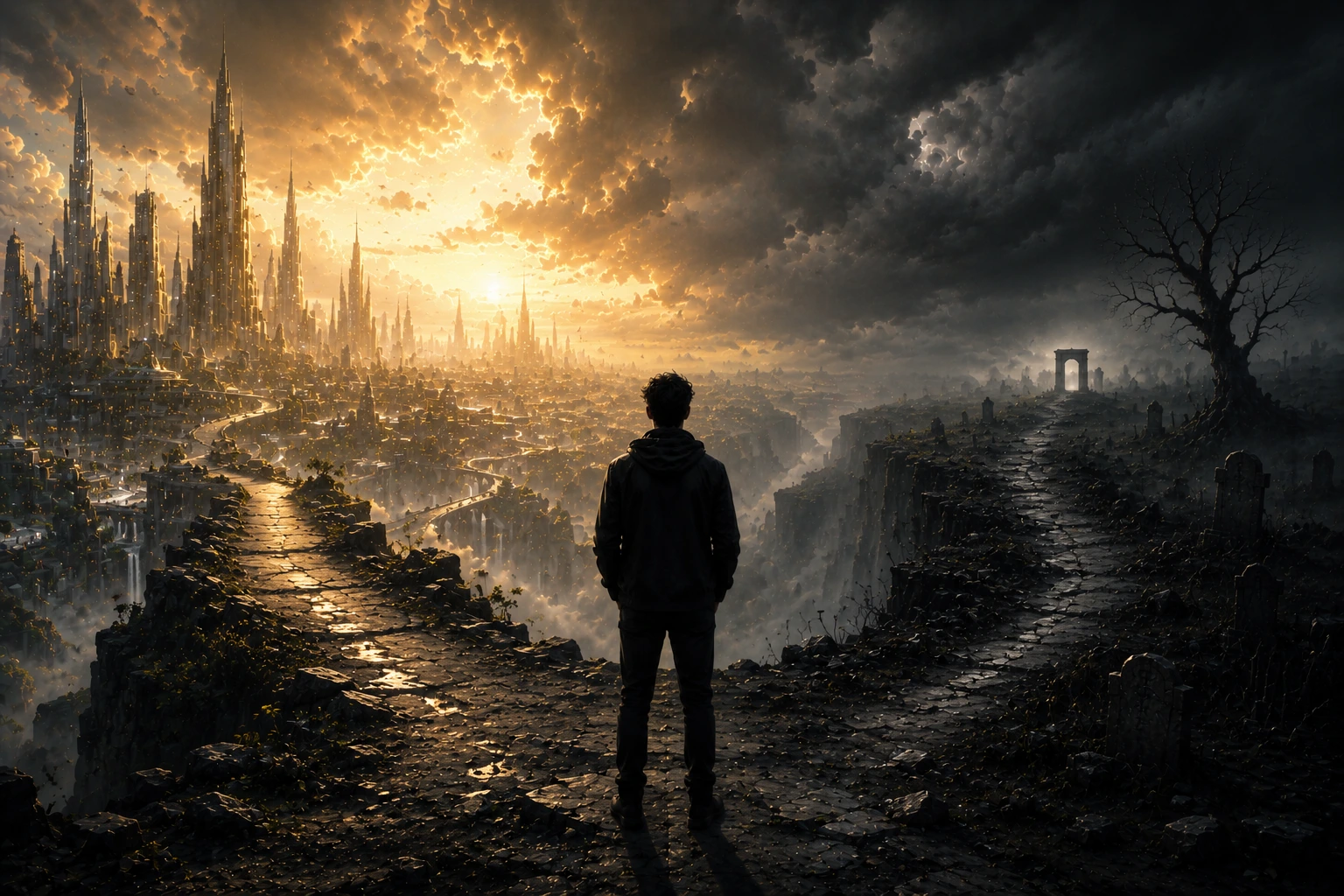
The future is not frightening because it is dark. It is frightening because it is unknown.
In this article:
- Why humans fear the future
- The psychology of uncertainty
- Why the unknown can feel worse than death
- Fear of change and fear of loss
- The relationship between mortality and meaning
- What philosophical science fiction can teach us about the future
What Is Fear of the Future?
Fear of the future is the anxiety created by uncertainty about what might happen next.
Unlike a visible threat, the future rarely has a clear shape. We cannot see it. We cannot fully predict it. We cannot control all the events that will eventually become our lives.
As a result, the human mind begins filling the gaps.
Sometimes with hope.
Often with fear.
People worry about losing their health, relationships, identity, financial security, purpose, freedom, or place in the world. The future becomes a canvas onto which the mind projects its deepest concerns.
Ironically, many people report feeling more anxious about the future than about death itself.
At first glance, that makes little sense.
Death appears to be the ultimate threat.
Yet psychologically, uncertainty often feels even more difficult to bear.
Why Humans Fear the Future
The fear of the future is not caused by a single factor.
It emerges from several powerful psychological forces working together.
1. Uncertainty Creates Endless Possibilities
Human beings evolved to predict their environment.
When prediction becomes impossible, the brain becomes alert.
Every unknown outcome remains open.
Every possibility competes for attention.
The mind starts asking questions:
- What if everything goes wrong?
- What if I make the wrong decision?
- What if I lose something important?
- What if the world changes faster than I can adapt?
The future becomes frightening because it contains thousands of potential realities at once.
Death contains only one.
Why Uncertainty Can Feel Worse Than Death
Psychologically, boundaries provide structure.
Even painful certainty can feel easier to process than limitless uncertainty.
Death represents an ending.
The future represents an infinite number of possible endings.
This is why people often spend years worrying about events that never happen.
The mind struggles less with reality than with possibility.
Reality eventually becomes known.
Possibility remains open.
And openness can feel exhausting.
The Fear of Change Is Often Stronger Than the Fear of Loss
Many people assume they fear losing what they have.
But often they fear becoming someone they do not yet understand.
The future threatens identity.
It asks uncomfortable questions:
- Who will I become?
- Will I still recognize myself?
- Will my values survive?
- Will my dreams still matter?
- Will I still belong?
Change forces us to leave behind versions of ourselves.
Every major transition contains a small death.
The end of childhood.
The end of certainty.
The end of a relationship.
The end of an old worldview.
This may be why the future feels threatening even when it promises improvement.
Because improvement still requires transformation.
The Future Is Not Really About Tomorrow
Most fears about the future are actually fears about meaning.
People rarely ask:
What will happen tomorrow?
They ask:
Will my life still matter tomorrow?
Beneath concerns about careers, money, relationships, or status lies a deeper question.
A question that has followed humanity for thousands of years.
This is where psychology begins to intersect with philosophy.
And where fear of the future becomes something much larger than ordinary anxiety.
It becomes a question about meaning itself.
The Future, Time, and Human Nature
The future cannot be separated from time.
Nor can it be separated from human nature.
Human beings are unique because they can imagine futures that do not yet exist.
This ability allows us to plan, create, innovate, and build civilizations.
But it also allows us to suffer from imagined futures that may never arrive.
Our greatest strength and one of our greatest vulnerabilities emerge from the same source.
The ability to see beyond the present moment.
That ability has shaped history.
It has also shaped every fear humanity has ever known.
For a deeper exploration of long-term human development, see:
Why Death Can Feel Simpler Than the Future
At first, the idea sounds absurd.
How could death — one of humanity’s oldest fears — ever feel simpler than the future?
Yet when we examine the psychology behind both concepts, the answer becomes surprisingly clear.
Death is terrifying.
But death is also finite.
The future is infinite.
Death eventually ends uncertainty.
The future continuously creates new uncertainty.
Every day introduces new decisions, new risks, new losses, new opportunities, and new responsibilities.
Death represents a boundary.
The future represents an endless horizon.
And human beings often struggle more with open questions than with final answers.
An unfinished story always contains the possibility of failure.
It also contains the possibility of success.
But psychologically, uncertainty tends to attract attention faster than certainty.
The brain constantly searches for threats hidden inside unknown outcomes.
As a result, the future becomes a source of endless mental simulation.
Death rarely changes.
The future changes every day.
Existential Anxiety and the Human Condition
Philosophers have explored this paradox for centuries.
Existential anxiety does not emerge simply because human beings die.
It emerges because human beings know they will die.
That awareness changes everything.
Unlike most living creatures, humans can imagine futures decades away.
They can anticipate loss before it happens.
They can grieve possibilities that never become reality.
They can fear events that exist only inside their imagination.
This ability allows extraordinary creativity.
It also creates extraordinary vulnerability.
The same mind that builds civilizations can also become trapped inside hypothetical futures.
Many existential thinkers recognized this tension.
The future is not simply a period of time.
It is the space where meaning, uncertainty, mortality, and freedom collide.
Freedom Is One of the Reasons the Future Feels Dangerous
People often say they want freedom.
And they do.
But freedom comes with a hidden cost.
Responsibility.
If your future is not predetermined, then your choices matter.
If your choices matter, mistakes matter.
If mistakes matter, uncertainty becomes unavoidable.
The future becomes frightening not because we are powerless.
The future becomes frightening because we have power.
Every decision closes some possibilities and opens others.
Every path creates consequences.
Every choice becomes part of a larger story.
What will you do with the time you still have?
Why We Fear Futures That Never Happen
One of the strangest aspects of human psychology is our ability to suffer from events that never occur.
A person may spend years worrying about failure.
Years worrying about rejection.
Years worrying about loss.
Years worrying about disaster.
And many of those imagined outcomes never become reality.
Yet the emotional cost is real.
The future becomes populated by invisible fears.
The mind rehearses pain in an attempt to avoid it.
Unfortunately, excessive rehearsal often produces anxiety rather than protection.
This creates a difficult paradox.
The ability to imagine the future helps humans survive.
The ability to imagine too much of the future can make survival emotionally exhausting.
The Fear of the Future Is Often the Fear of Losing Meaning
When people say they fear the future, they are often describing something deeper.
They fear becoming disconnected from what gives life meaning.
They fear losing purpose.
They fear becoming irrelevant.
They fear watching relationships disappear.
They fear living in a world that no longer feels familiar.
The fear is rarely about the future itself.
The fear is about what the future might take away.
This is why questions about meaning become so important.
If meaning survives change, the future becomes easier to face.
If meaning depends entirely on stability, every change becomes threatening.
For a deeper exploration of purpose and meaning, see:
The Future Becomes More Frightening When We Try to Control Everything
Many fears grow from the assumption that certainty is required before action.
But certainty rarely exists.
No generation in history has possessed complete knowledge of the future.
No civilization has eliminated uncertainty.
No human life has ever unfolded exactly according to plan.
The desire for certainty is understandable.
The problem is that certainty and the future are fundamentally incompatible.
The future remains open because reality remains open.
New people appear.
New technologies emerge.
New discoveries reshape society.
Unexpected events change entire civilizations.
Trying to eliminate uncertainty completely is like trying to stop time itself.
The effort often creates more anxiety than the uncertainty we were trying to remove.
What Philosophical Science Fiction Understands About the Future
Some of the most powerful stories ever written are not really about technology.
They are about uncertainty.
Great philosophical science fiction understands that the future is not frightening because of machines, artificial intelligence, or distant planets.
The future is frightening because it reveals human nature.
It exposes what people value.
It exposes what they fear.
It exposes what they are willing to sacrifice.
A futuristic civilization is often just a mirror.
A mirror showing humanity what it might become.
This is why stories about time, destiny, mortality, immortality, and the future continue to resonate across generations.
They are not really stories about tomorrow.
They are stories about us.
The Future Is a Question, Not an Answer
Perhaps this is why humans fear the future more than death.
Death closes the question.
The future keeps asking it.
Who will you become?
What will you choose?
What matters enough to protect?
What matters enough to sacrifice?
What kind of world are you helping create?
These questions have no final answer.
They evolve as life evolves.
The future remains frightening because it remains unfinished.
But the same openness that creates fear also creates possibility.
The future contains risk.
It also contains meaning.
It contains uncertainty.
It also contains hope.
And perhaps the greatest challenge of being human is learning to carry both at the same time.
The Future of Humanity Is Really a Question About Human Nature
Every generation asks what the future will look like.
Few generations ask what kind of humans will inhabit that future.
Technology changes.
Civilizations rise and fall.
Economies transform.
Empires disappear.
Yet many of the deepest human questions remain remarkably similar.
What gives life meaning?
What makes a person good?
How much freedom should individuals possess?
How much responsibility do we owe future generations?
Can progress solve human suffering?
Or does suffering simply evolve alongside progress?
The future of humanity is not only about innovation.
It is about values.
The future is shaped not only by what humans can do.
It is shaped by what humans choose to do.
For a deeper exploration of long-term human development, see:
The Strange Relationship Between Death and Immortality
Most people assume immortality would eliminate one of humanity’s greatest fears.
Death.
Yet many philosophers, writers, and scientists have questioned that assumption.
If death disappeared, would fear disappear with it?
Or would new fears emerge?
Would meaning become stronger?
Or weaker?
Would relationships become more valuable?
Or less urgent?
Would endless time create wisdom?
Or exhaustion?
Sometimes it is endless responsibility.
This is one reason immortality remains one of the most fascinating themes in philosophical fiction.
It forces us to ask whether limitations give life meaning.
And whether eternity would change what it means to be human.
Time Is What Makes Every Choice Matter
Imagine a world without time.
No deadlines.
No aging.
No endings.
No urgency.
Many people assume such a world would be ideal.
Yet time gives significance to almost everything humans value.
Love matters because it is limited.
Opportunities matter because they pass.
Decisions matter because they cannot always be reversed.
The future feels important because time moves forward.
Without time, there would be no future.
Without the future, there would be no meaningful choice.
Choice Creates the Future
The future is not simply something that happens.
It is something that emerges.
Every decision influences what becomes possible next.
Some choices affect only individuals.
Others affect families, communities, nations, or entire generations.
Fear of the future often appears when people recognize this responsibility.
The future becomes frightening because it is partially shaped by action.
And action always involves uncertainty.
No one receives complete information.
No one sees every consequence.
No one can perfectly predict outcomes.
Yet choices must still be made.
That is one of the central challenges of human existence.
Destiny and Freedom: The Tension Behind Every Future
Throughout history, people have wondered whether the future is already written.
Some believe destiny guides events.
Others believe human freedom shapes reality.
Most people live somewhere between those extremes.
Life often feels like a mixture of circumstances we did not choose and decisions we must still make.
This tension creates both hope and anxiety.
If the future is completely predetermined, freedom loses meaning.
If the future is completely open, responsibility becomes overwhelming.
The human experience exists between these possibilities.
Between fate and freedom.
Between certainty and uncertainty.
Between what is given and what is chosen.
How Eternity Management Explores the Fear of the Future
The Eternity Management universe was created around questions like these.
Questions about time.
Questions about mortality.
Questions about responsibility.
Questions about the future of humanity.
Questions about whether anyone has the right to shape eternity itself.
In the Eternity saga, the future is not merely a setting.
It is a force.
A responsibility.
A burden.
A possibility.
Some characters try to protect it.
Others try to control it.
Others try to destroy it.
Yet all of them confront the same question:
Final Thoughts: Why Humans Fear the Future More Than Death
Death is frightening.
But death is not the only thing humans fear.
The future asks questions that death never asks.
Who will you become?
What will you value?
What will you sacrifice?
What kind of world will you leave behind?
The future forces people to confront uncertainty, freedom, responsibility, and meaning simultaneously.
That is why it can feel heavier than mortality itself.
Not because the future is darker than death.
But because the future remains unwritten.
And every unwritten story contains both fear and possibility.
Perhaps the goal is not to eliminate fear.
Perhaps the goal is to move forward despite it.
To choose despite uncertainty.
To create meaning despite impermanence.
To participate in the future rather than hide from it.
Because the future will arrive whether we fear it or not.
The question is what we will do when it gets here.
Frequently Asked Questions
Why do humans fear the future?
Humans fear the future because it contains uncertainty. The brain naturally tries to predict outcomes, and when prediction becomes difficult, anxiety often increases.
Why can the future feel more frightening than death?
Death represents a boundary, while the future contains countless unknown possibilities. Many people find uncertainty more psychologically difficult than certainty.
Is fear of the future normal?
Yes. Fear of the future is a normal human response to uncertainty, change, responsibility, and the awareness that important outcomes are not fully under our control.
What is existential anxiety?
Existential anxiety is the discomfort that arises from questions about meaning, mortality, freedom, purpose, and the uncertainty of existence.
Can philosophical fiction help people understand the future?
Yes. Philosophical fiction explores questions about human nature, time, mortality, destiny, freedom, and the future in ways that encourage reflection rather than simple answers.