Philosophical Fantasy Books: Stories About Meaning, Choice, Time, and Eternity
Philosophical fantasy books combine the wonder of fantasy with deeper questions about consciousness, reality, memory, free will, destiny, human nature, and the meaning of life.
For readers who want more than magic, battles, and invented worlds, philosophical fantasy turns the entire story into a question: what does it mean to exist, to choose, to remember, and to shape the future?
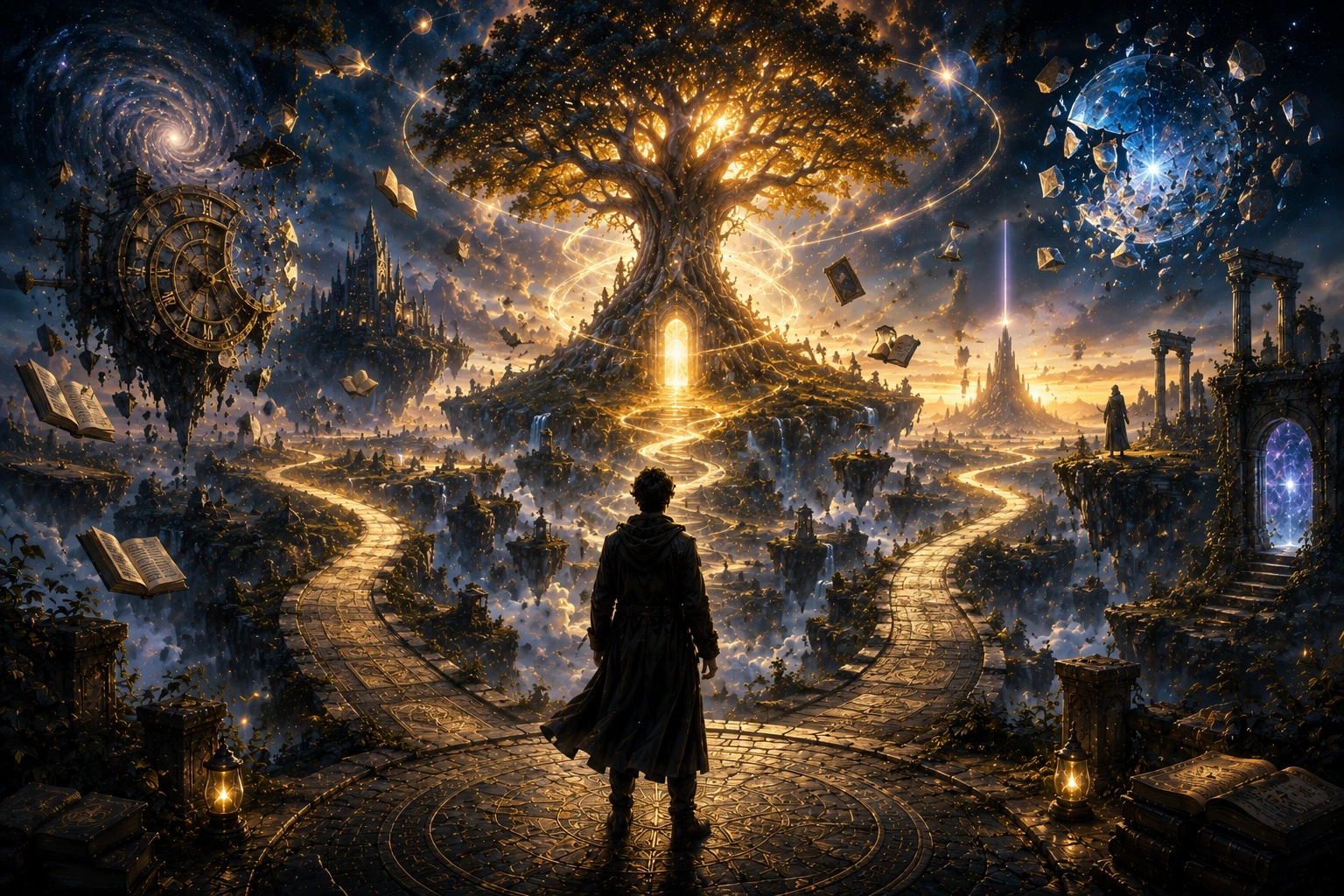
Philosophical fantasy books about meaning, consciousness, choice, time, destiny, reality, memory, and eternity.
What You Will Find on This Page
- what philosophical fantasy books are;
- what makes a book philosophical fantasy;
- why readers search for fantasy with deeper meaning;
- how philosophical fantasy explores consciousness, reality, time, memory, and eternity;
- how the Eternity Saga fits the genre;
- where to start reading philosophical fantasy online.
What Are Philosophical Fantasy Books?
Philosophical fantasy books are fantasy stories built around deep questions. They may include invented worlds, mythic structures, strange powers, ancient systems, immortal beings, symbolic landscapes, and cosmic conflict, but their real focus is not only what happens. Their real focus is what it means.
A philosophical fantasy novel asks questions such as: What is consciousness? Is reality fixed? Do choices matter? Can destiny be changed? What remains meaningful beyond death? What does time do to identity? What makes a person human?
In this kind of fantasy, magic is not only spectacle. It becomes a language for exploring existence, memory, responsibility, free will, and eternity.
What Makes a Book Philosophical Fantasy?
Not every fantasy novel is philosophical fantasy. While traditional fantasy often focuses on adventure, conflict, and worldbuilding, philosophical fantasy uses those elements to explore deeper questions about existence, consciousness, identity, free will, reality, meaning, and eternity.
| Fantasy | Philosophical Fantasy |
|---|---|
| Adventure-focused | Question-focused |
| External conflict | External and internal conflict |
| Magic systems | Meaning systems |
| Hero journey | Consciousness journey |
| Worldbuilding | Worldbuilding plus existential exploration |
| Victory and survival | Meaning and transformation |
The strongest philosophical fantasy books combine imagination with questions that remain relevant long after the story ends.
Why Readers Search for Philosophical Fantasy Books
Readers search for philosophical fantasy books when ordinary fantasy is not enough. They want wonder, but they also want meaning. They want worlds that feel vast, but also questions that feel intimate.
The best philosophical fantasy books create a double journey. On the surface, a character may travel through kingdoms, ruins, forests, cities, timelines, or cosmic structures. Beneath that surface, the reader follows a deeper journey through identity, purpose, memory, choice, fear, responsibility, and transformation.
Philosophical fantasy books appeal to readers who enjoy stories that explore consciousness, destiny, free will, identity, reality, meaning, and eternity through imaginative worlds, symbolic narratives, and transformative journeys.
This is why philosophical fantasy often stays with readers long after the plot ends. The story becomes a mirror for the reader’s own questions.
Philosophical Fantasy Books: Key Themes
| Theme | Question Explored |
|---|---|
| Meaning of Life | Why does existence matter? |
| Consciousness | What does it mean to be aware? |
| Choice | Do decisions reveal the self or create it? |
| Free Will | Can a person change what seems inevitable? |
| Destiny | Is the future discovered or shaped? |
| Reality | What makes a world real? |
| Eternity | What remains when time becomes larger than one life? |
Philosophical Fantasy Books About the Meaning of Life
Many philosophical fantasy books begin with the question of meaning. A character may face loss, power, immortality, prophecy, or an impossible choice and discover that survival alone is not enough.
Books about the meaning of life ask why existence matters and what gives life value when everything is temporary, unstable, or threatened by forces larger than one person.
Philosophical Fantasy Books About Human Nature
Philosophical fantasy often asks what people are beneath fear, ambition, memory, loyalty, love, power, and pain.
Human nature becomes visible when characters face temptation, responsibility, destiny, sacrifice, and the possibility of shaping the future. Fantasy gives those inner conflicts symbolic form.
Philosophical Fantasy Books About Consciousness
Consciousness is one of the strongest themes in philosophical fantasy because fantasy can make awareness visible. A character may awaken to hidden systems, perceive realities others cannot see, or discover that consciousness changes the world itself.
These stories ask whether awareness is only perception or a force that shapes meaning, memory, responsibility, and reality.
Philosophical Fantasy Books About Reality
Fantasy is built to question reality. A world may contain hidden layers, symbolic laws, unstable timelines, living systems, or realities shaped by memory and choice.
Philosophical fantasy books about reality ask whether the world is fixed, interpreted, created, remembered, or transformed by consciousness.
Philosophical Fantasy Books About Time
Time is more than chronology in philosophical fantasy. It can become a living system, a moral pressure, a prison, a wound, a path, or a force that reveals the cost of every choice.
Books about time ask what happens when the past is not gone, the future is not fixed, and the present becomes the place where meaning is decided.
Philosophical Fantasy Books About Memory
Memory is central to identity, meaning, and responsibility. Philosophical fantasy can turn memory into a sacred archive, a curse, a hidden key, a lost world, or a force that keeps eternity from collapsing.
Books about memory ask whether a person remains the same if memory changes, and whether the future can be repaired by remembering what was forgotten.
Philosophical Fantasy Books About Choice and Free Will
Choice is where philosophy becomes story. A character can believe many things, but a difficult choice reveals what those beliefs mean.
Philosophical fantasy books about choice and free will ask whether people can shape the future, resist destiny, or transform the meaning of the path they were given.
Philosophical Fantasy Books About Responsibility
Responsibility gives philosophical fantasy its moral weight. If a character can change a world, open a path, destroy a system, or shape eternity, then the question becomes: what must they answer for?
Books about responsibility explore what happens after choice, when consequences begin to unfold.
Philosophical Fantasy Books About Fate and Destiny
Fate and destiny are natural themes for philosophical fantasy because they create tension between what seems written and what can still be chosen.
These stories ask whether the future is a prison, a path, a possibility, or a responsibility waiting to be accepted.
Philosophical Fantasy Books About Purpose and Identity
Purpose gives direction to meaning. Identity gives meaning a personal form. Together, they create one of the strongest emotional structures in philosophical fantasy.
A character may begin as a wanderer, guardian, exile, ruler, witness, or destroyer, but the deeper question is who they become through memory, choice, responsibility, and time.
Philosophical Fantasy Books About Immortality and Eternity
Immortality and eternity make every philosophical question heavier. If time no longer ends quickly, meaning, memory, responsibility, love, and consequence become more difficult to escape.
Philosophical fantasy uses immortality not only as power, but as a test of whether identity and purpose can survive time.
Best Philosophical Fantasy Books for Readers Who Enjoy Deep Ideas
The best philosophical fantasy books do more than entertain. They challenge readers to think about existence, consciousness, responsibility, mortality, destiny, and the future.
Many readers search for philosophical fantasy because they want stories that explore:
- the meaning of life;
- the nature of consciousness;
- free will and destiny;
- identity and transformation;
- memory and reality;
- time and eternity;
- human nature and responsibility.
The Eternity Saga was created around those questions and explores them through a universe where time behaves like a living system and eternity itself can be guarded, destroyed, or shaped.
The Eternity Saga: Philosophical Fantasy About Time, Choice, and Eternity
Readers looking for philosophical fantasy books may enjoy the Eternity Saga by Denys Kostin.
The series explores a universe where time behaves like a living system and where consciousness, memory, choice, fate, destiny, responsibility, immortality, reality, and meaning constantly influence one another.
The Eternity Saga asks what happens when eternity itself can be guarded, destroyed, or shaped — and whether human beings can carry that responsibility without losing what makes them human.
Those Who Guard Eternity
The first book opens the world of Eternity through memory, duty, and the responsibility of protection.
Those Who Destroy Eternity
The second book explores what happens when power, fear, and choice threaten the structure of eternity.
Those Who Shape Eternity
The third book asks who has the right to shape the future and what meaning such power should serve.
Where to Start Reading Philosophical Fantasy
- Start with the main question: meaning, consciousness, fate, free will, or eternity.
- Choose a story that treats fantasy as more than escape.
- Begin with Book 1 of the Eternity Saga if you want philosophical fantasy centered on time, memory, choice, and eternity.
Explore More Philosophical Themes
This page is the main hub for the Eternity Management philosophical fantasy cluster. Explore the themes below if you want fantasy stories that go deeper into meaning, consciousness, time, choice, fate, identity, responsibility, and eternity.
Meaning of Life
Human Nature
Fate
Destiny
Choice
Free Will
Responsibility
Identity
Purpose
Consciousness
Reality
Memory
Time
Immortality
Frequently Asked Questions
What are philosophical fantasy books?
Philosophical fantasy books are fantasy stories that explore deep questions about meaning, consciousness, identity, reality, time, free will, destiny, responsibility, and human nature.
What makes philosophical fantasy different from regular fantasy?
Regular fantasy may focus mainly on adventure, magic, and worldbuilding. Philosophical fantasy uses those elements to explore deeper questions about existence, choice, morality, reality, and meaning.
What are the best philosophical fantasy books?
The best philosophical fantasy books combine imaginative worldbuilding with deeper questions about meaning, consciousness, identity, free will, destiny, reality, responsibility, and eternity. They use fantasy as a way to explore ideas that remain relevant beyond the story itself.
Are there philosophical fantasy books about the meaning of life?
Yes. Philosophical fantasy is especially suited to the meaning of life because it can turn inner questions into symbolic worlds, journeys, choices, and consequences.
Is the Eternity Saga philosophical fantasy?
Yes. The Eternity Saga is philosophical fantasy about time, memory, consciousness, choice, fate, destiny, immortality, responsibility, reality, meaning, and eternity.
Where should I start with the Eternity Saga?
Start with Those Who Guard Eternity, the first book in the series. It introduces the world, the central conflict, and the deeper themes of time, memory, responsibility, and eternity.
Begin a Philosophical Fantasy Saga About Time, Choice, and Eternity
Enter a fantasy universe where meaning is tested by memory, consciousness, fate, responsibility, and the future that can be guarded, destroyed, or shaped.