Books About Fate: Philosophical Fantasy About Destiny, Choice, and Free Will
Books about fate explore one of humanity’s oldest questions: is the future already written, or do our choices create it?
For readers of philosophical fantasy, fate is not only a plot device. It is where destiny, free will, choice, responsibility, consciousness, time, reality, and eternity collide.
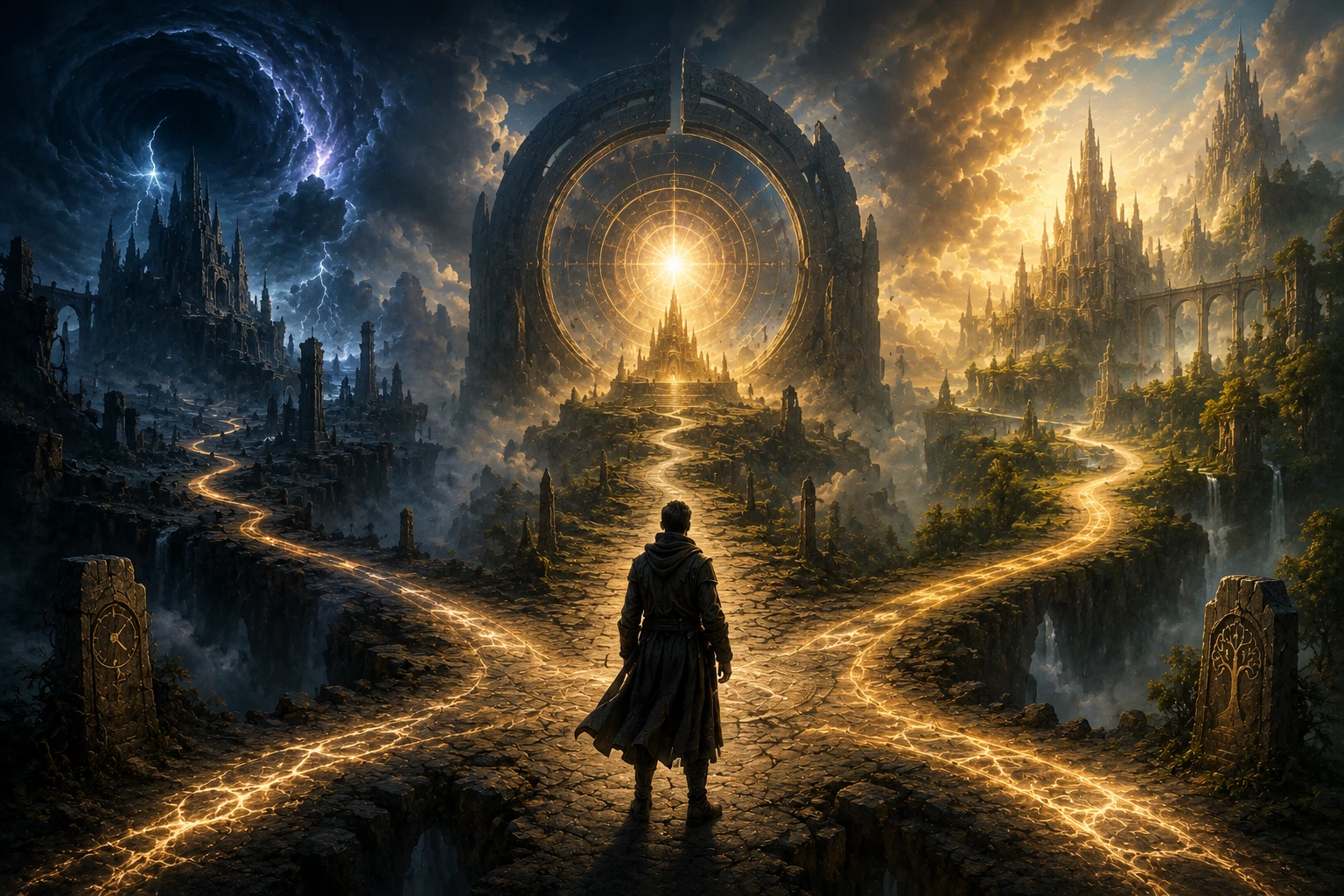
Books about fate: philosophical fantasy about destiny, free will, choice, time, responsibility, and eternity.
What You Will Find on This Page
- why readers search for books about fate;
- how fate differs from destiny;
- how fate connects to free will, choice, and responsibility;
- why consciousness, memory, time, and reality make fate more complex;
- how the Eternity Saga explores fate across time and eternity.
Why Readers Search for Books About Fate
Readers search for books about fate because the idea of fate touches every life. People wonder whether major events were always meant to happen, whether different choices could have created different futures, and whether the path ahead is discovered or created.
Stories about fate allow readers to explore those questions through characters who face prophecy, impossible decisions, hidden truths, inherited roles, and futures that seem both fixed and fragile.
The best books about fate do not give simple answers. They create emotional and philosophical tension between what appears inevitable and what still might be changed.
What Are Books About Fate?
Books about fate are stories that explore whether the future is predetermined, whether destiny can be resisted, and whether choice still matters when events seem guided by forces beyond the individual.
These books often appear as philosophical fantasy, speculative fiction, science fiction, mythological fiction, or literary fiction. The genre matters less than the central question: can a person change what seems inevitable?
In philosophical fantasy, fate can become visible through prophecy, time, memory, altered reality, ancient systems, and choices that echo far beyond one lifetime.
Books About Fate: Key Themes
| Theme | Question Explored |
|---|---|
| Fate | Is the future already written? |
| Destiny | Does every person have a path or purpose? |
| Free Will | Can choice change what seems inevitable? |
| Responsibility | Who answers for a future they helped create? |
| Consciousness | Does awareness make fate heavier? |
| Time | Can the future influence the present? |
| Eternity | What does fate mean when consequences outlive one lifetime? |
Books About Fate and Destiny
Fate and destiny are closely connected, but they are not identical. Destiny often points toward a future outcome or purpose. Fate refers to the forces, patterns, or circumstances that appear to guide events toward that outcome.
Books about fate and destiny explore whether a future can be changed once it has been glimpsed, predicted, inherited, or feared.
Many philosophical fantasy stories build tension around this question. A character may receive a prophecy, discover a hidden role, or learn that their life is connected to a larger pattern. The central conflict becomes whether knowledge of destiny changes destiny itself.
Books About Fate and Free Will
Few themes are more important to books about fate than free will. If people possess genuine freedom, then fate must be flexible. If fate is absolute, then free will may be an illusion.
Books about fate and free will often place characters in situations where every choice seems meaningful, but the future still appears to pull them toward a certain result.
The tension between fate and free will creates powerful fiction because it reflects a question readers continue to ask: are we shaping the future, or discovering a path already waiting for us?
Books About Fate and Choice
Choice gives stories about fate their emotional power. Without meaningful decisions, fate becomes passive. With meaningful decisions, fate becomes something a character must confront directly.
Books about fate and choice often focus on crossroads, turning points, sacrifices, and moments where one decision changes the trajectory of a life, a kingdom, a world, or a future.
These stories remind readers that even when some circumstances are beyond control, the response to those circumstances can still define the person who chooses.
Books About Fate and Responsibility
Fate becomes morally complex when responsibility enters the story. If a future seems predetermined, who is responsible for what happens? If a character knows what may occur, are they responsible for trying to change it?
Books about fate and responsibility explore the weight of knowing, choosing, refusing, delaying, or accepting a path. They ask whether responsibility begins only with freedom, or whether awareness itself creates obligation.
In philosophical fantasy, responsibility can extend beyond one person. A character may be responsible for a family, a kingdom, a civilization, a timeline, or the future of eternity itself.
Books About Fate and Identity
Fate challenges identity because it suggests that a person may already have a role before they choose it. A character may be told they are a guardian, destroyer, heir, exile, witness, or instrument of a larger design.
Books about fate and identity ask whether people become who they are because of destiny, memory, experience, or choice. If a future has been written, can the self still change?
The strongest stories show that identity is not simply the acceptance of fate. Identity is often formed in the struggle to understand, resist, transform, or carry fate responsibly.
Books About Fate and Consciousness
Consciousness changes the meaning of fate. A hidden future is one thing. A future that a character becomes aware of creates a different moral situation.
Books about fate and consciousness explore what happens when a character sees patterns others cannot see, remembers what others have forgotten, or becomes aware of consequences before they arrive.
Awareness makes fate heavier. Once a character understands that their choices may influence the future, they can no longer pretend that their actions are small.
Books About Fate and Memory
Memory is one of the hidden roots of fate. The future rarely appears from nothing. It grows from old choices, forgotten promises, repeated mistakes, inherited pain, and knowledge carried across time.
Books about fate and memory show that what has been remembered or forgotten can shape what becomes possible. A lost memory may hide the cause of a destiny. A recovered memory may open the chance to change it.
In philosophical fantasy, memory can become almost sacred. It can preserve identity, reveal patterns, carry responsibility, and connect one lifetime to consequences beyond itself.
Books About Fate and Reality
Some stories about fate do not only ask what will happen. They ask which reality will become real.
Books about fate and reality explore branching paths, hidden worlds, altered timelines, unstable futures, and the possibility that reality itself depends on the choices characters make.
This makes fate especially powerful in philosophical fantasy. Fate is no longer only personal. It can become structural, shaping the rules of the world and the future that emerges from them.
Books About Fate and Time
Fate cannot be separated from time. Fate is the idea that the future already has weight before it arrives.
Books about fate and time ask whether events move in a straight line, whether the future can influence the present, and whether one choice can change what seems inevitable.
When time behaves like a living system, fate becomes more than prediction. It becomes a field of possible futures shaped by memory, consciousness, responsibility, and choice.
Books About Fate and Purpose
Fate often raises the question of purpose. If a person is placed on a path, does that path have meaning? If a role is inherited, must it be accepted?
Books about fate and purpose explore whether purpose is discovered, chosen, inherited, or created through action. They ask whether fate gives life meaning or whether meaning comes from how a person responds to fate.
The deepest stories do not reduce purpose to destiny. They show that purpose becomes real when a character accepts responsibility for what their choices may create.
Books About Fate and Immortality
Immortality changes the experience of fate. A mortal person may fear one future. An immortal being may watch many futures unfold and still remain responsible for old choices.
Books about fate and immortality ask whether a person can escape destiny when time stretches far beyond ordinary life. They also ask whether long memory makes fate clearer or more painful.
In philosophical fantasy, immortality often makes fate heavier because consequences do not simply end. They return, transform, and demand an answer across centuries.
Books About Fate and Eternity
Eternity expands the question of fate beyond a single lifetime. If choices echo across worlds, generations, and ages, fate becomes more than a personal path.
Books about fate and eternity ask what can still be changed when consequences become vast. They explore whether eternity is fixed, fragile, protected, threatened, or shaped by those willing to carry responsibility.
In philosophical fantasy, eternity makes fate cosmic without removing its human center. One person’s choice can still matter when the scale becomes infinite.
Why Philosophical Fantasy Explores Fate So Well
Philosophical fantasy is one of the strongest genres for exploring fate because it can give visible form to invisible forces.
Fate can become a road, a prophecy, a storm, a labyrinth, a living system of time, or a future seen only in fragments. Choice can become a door. Memory can become a key. Responsibility can become the price of changing the path.
Fantasy gives fate scale. Philosophy gives it depth. Together, they create stories where the question of the future becomes emotional, symbolic, and deeply human.
The Eternity Saga: Philosophical Fantasy About Fate Across Time and Eternity
Readers interested in books about fate may enjoy the Eternity Saga by Denys Kostin.
The series explores a universe where time behaves like a living system and where fate, choice, memory, consciousness, responsibility, destiny, immortality, reality, and eternity constantly influence one another.
The Eternity Saga does not present fate as a simple answer. It asks whether the future is fixed, whether destiny can change, and whether one person’s decisions can alter consequences that extend far beyond a single lifetime.
Those Who Guard Eternity
The first book introduces a world where fate and responsibility collide. Characters must decide whether preserving eternity is worth the sacrifices it demands.
Those Who Destroy Eternity
The second book explores what happens when fate is challenged directly and the future itself becomes unstable.
Those Who Shape Eternity
The third book asks whether those who understand fate have the right to shape the future for everyone else.
Recommended Reading Order
- Those Who Guard Eternity — discover the first conflict between destiny, responsibility, and eternity.
- Those Who Destroy Eternity — explore the consequences of challenging the future itself.
- Those Who Shape Eternity — confront the ultimate question of who should shape destiny.
Who Should Read Books About Fate?
- readers of philosophical fantasy books;
- fans of books about fate and destiny;
- readers interested in free will and responsibility;
- people drawn to questions about consciousness and reality;
- readers who enjoy symbolic and thought-provoking fantasy;
- anyone interested in whether the future is discovered or created.
Books about fate appeal to readers who enjoy stories where choices matter, consequences accumulate, and the future remains uncertain even when prophecy seems clear.
The Eternity Saga connects fate to memory, consciousness, identity, choice, responsibility, reality, immortality, time, and eternity.
About the Author of the Eternity Saga
Denys Kostin is the creator of the Eternity Management universe and author of the Eternity Saga.
His work combines philosophical fantasy, symbolic storytelling, mythology, psychology, systems thinking, and questions about how fate, choice, responsibility, and consciousness shape reality over time.
Explore Related Themes
Books About Destiny
Destiny points toward the future; fate asks whether that future can be changed.
Books About Free Will
Free will is the force that challenges fate and gives choice moral weight.
Books About Choice
Choice turns fate from an abstract idea into a lived decision.
Readers Searching for Books About Fate Also Explore
- books about fate and destiny;
- books about fate and free will;
- books about choice and consequence;
- books about prophecy and future paths;
- books about consciousness, identity, and memory;
- books about time, reality, immortality, and eternity;
- philosophical fantasy books with deeper meaning.
Read Philosophical Fantasy About Fate Online or on Amazon
If you are searching for books about fate, destiny, free will, consciousness, responsibility, time, reality, and eternity, the Eternity Saga offers a philosophical fantasy exploration of those themes.
Begin with Those Who Guard Eternity and enter a universe where fate is not merely predicted — it is questioned, challenged, protected, and reshaped.
Frequently Asked Questions
What are books about fate usually about?
Books about fate explore whether the future is predetermined, whether destiny can change, and how choice influences outcomes that appear inevitable.
What is the difference between fate and destiny?
Destiny often refers to a future outcome or purpose, while fate refers to the forces, patterns, or circumstances that appear to guide events toward that outcome.
Are there fantasy books about fate?
Yes. Philosophical fantasy frequently explores fate through prophecy, time, alternate futures, consciousness, symbolic journeys, and characters who challenge what appears inevitable.
What books explore fate and free will?
Books that explore fate and free will examine whether people can genuinely influence the future or whether choices merely reveal a path that already exists.
Is the Eternity Saga a book series about fate?
Yes. The Eternity Saga explores fate through choice, destiny, consciousness, memory, responsibility, time, immortality, reality, and eternity.
Where can I read the Eternity Saga?
The Eternity Saga can be read online through the official Cokos.org library, beginning with Those Who Guard Eternity. Kindle editions are also available through Amazon.
Begin a Fantasy Saga About Fate, Choice, and Eternity
Enter a philosophical fantasy universe where fate is questioned, destiny is unstable, free will has weight, and eternity can be guarded, destroyed, or shaped.
Explore the full hub of philosophical fantasy books if you want stories about meaning, consciousness, choice, time, destiny, reality, and eternity.