Reading guide · Parallel worlds · Philosophical science fiction
The best books like Dark Matter do more than open doors into alternate universes. They make those universes personal—turning regret, love, memory, identity, and the lives created by choice into the real source of danger.
Editorial approach: This is a spoiler-light, independently ranked guide. Placement reflects thematic similarity, pace, emotional stakes, and philosophical depth—not a scientific score.

The closest overall book to Dark Matter is Recursion, especially for readers who want another fast Blake Crouch thriller built around unstable reality and intense personal stakes. Choose The Space Between Worlds for a true multiverse story, The Gone World for a darker investigation, Replay or The Midnight Library for alternate lives, and The Lathe of Heaven for a more philosophical exploration of reality. Readers ready to move beyond alternate worlds into living time, consciousness, and responsibility can begin Those Who Guard Eternity free online.
What Should You Read After Dark Matter?
Your best next book depends on what stayed with you after the final page. Dark Matter combines several reading experiences that are often separated in other novels: a high-speed thriller, a scientific thought experiment, a love story under pressure, and an identity crisis made physically real.
For the closest combination of urgency, emotion, and reality disruption, start with Recursion. For parallel universes and the social consequences of moving between them, choose The Space Between Worlds. For possible futures wrapped inside a grim investigation, choose The Gone World. For the emotional weight of unlived lives, try Replay or The Midnight Library. For a slower and more philosophical question—whether consciousness can change reality itself—read The Lathe of Heaven.
The important distinction is not simply whether a book contains another timeline. The strongest read-alikes reproduce the deeper pressure beneath the premise: what happens to identity when another version of your life becomes possible?
Books Like Dark Matter Ranked by Similarity
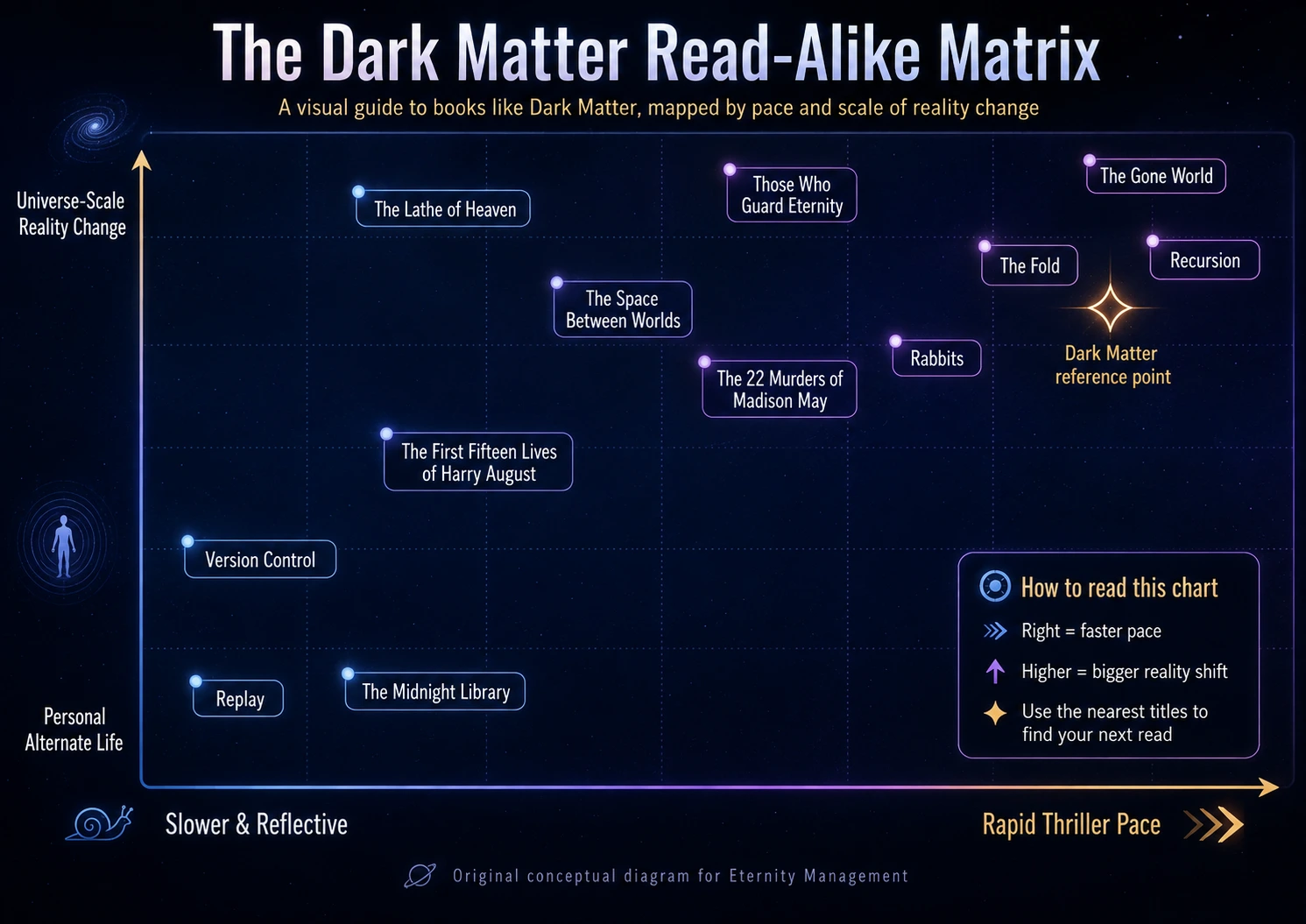
The table below compares each recommendation by the quality it shares most strongly with Dark Matter. The labels are intentionally descriptive rather than numerical; a quieter philosophical novel may be an excellent recommendation even when it is not a close match for Crouch’s pace.
| Book | Best match for | Pace | Reality mechanism | Main emotional or philosophical question |
|---|---|---|---|---|
| Recursion | Closest overall | Rapid | Memory and altered reality | What remains true when memory changes the world? |
| The Gone World | Darkest thriller | Fast | Possible futures | Can a future catastrophe be understood before it becomes inevitable? |
| The Fold | Scientific mystery | Fast | Experimental doorway | What if a breakthrough is not what its creators believe? |
| The Space Between Worlds | True multiverse | Medium-fast | Parallel worlds | Who are you when other versions of you lived differently? |
| The 22 Murders of Madison May | Parallel-world chase | Fast | World-to-world movement | Can identity survive repetition across realities? |
| Replay | Alternate lives | Reflective | Repeated lifetime | Would different choices finally produce the right life? |
| The First Fifteen Lives of Harry August | Memory across lives | Medium | Recurring life | What responsibility comes with remembering every life? |
| The Midnight Library | Emotional alternative | Reflective | Lives not lived | Is the ideal life hidden in a choice you did not make? |
| Version Control | Literary alternative | Slow-medium | Time and possibility | How do almost-invisible changes reshape a relationship? |
| The Lathe of Heaven | Philosophical classic | Reflective | Dream-shaped reality | Should anyone be allowed to improve reality for everyone? |
| Rabbits | Reality puzzle | Fast | Patterns and hidden rules | What happens when reality feels designed but cannot be trusted? |
| Those Who Guard Eternity | Deepest philosophy | Reflective | Living time and reality | Who has the responsibility to guard what reality can become? |
What Makes a Book Feel Like Dark Matter?
A book can contain time travel or parallel universes without producing the experience that makes Dark Matter memorable. Crouch’s central achievement is to make an enormous speculative idea feel intimate. The multiverse matters because one person must confront the lives he might have lived, the self he might have become, and the possibility that love is both a choice and a path through uncertainty.
1. Reality must become unstable
The reader needs to feel that the ordinary world can no longer be assumed. That instability may come from technology, memory, time, parallel universes, dreams, or hidden rules. The mechanism can change, but the effect is similar: the character can no longer trust the boundaries that once defined life.
2. Another reality must threaten identity
The most effective alternate-reality fiction does not use other worlds as decoration. It creates pressure on the question “Who am I?” A different version of one life may reveal ambition, regret, fear, tenderness, or moral compromise that remained hidden in the original world.
3. The speculative idea must carry emotional stakes
A scientific premise becomes compelling when it can cost someone a relationship, a home, a memory, or a coherent sense of self. Readers who loved Dark Matter are often searching for more than clever physics. They want a concept that changes what love, loyalty, and choice mean.
4. Choice must have consequences
Alternate worlds make choice visible. Every path not taken can become a world, and every world can become evidence that a different self was possible. The best stories resist the easy conclusion that one perfect decision would have solved everything.
5. The story must ask what makes a life real
Once several realities exist, physical survival is no longer the only question. Which memories belong to the self? Is a relationship still real if another version unfolded elsewhere? Does the existence of alternatives weaken commitment—or make commitment more meaningful?
12 Best Books Like Dark Matter by Blake Crouch
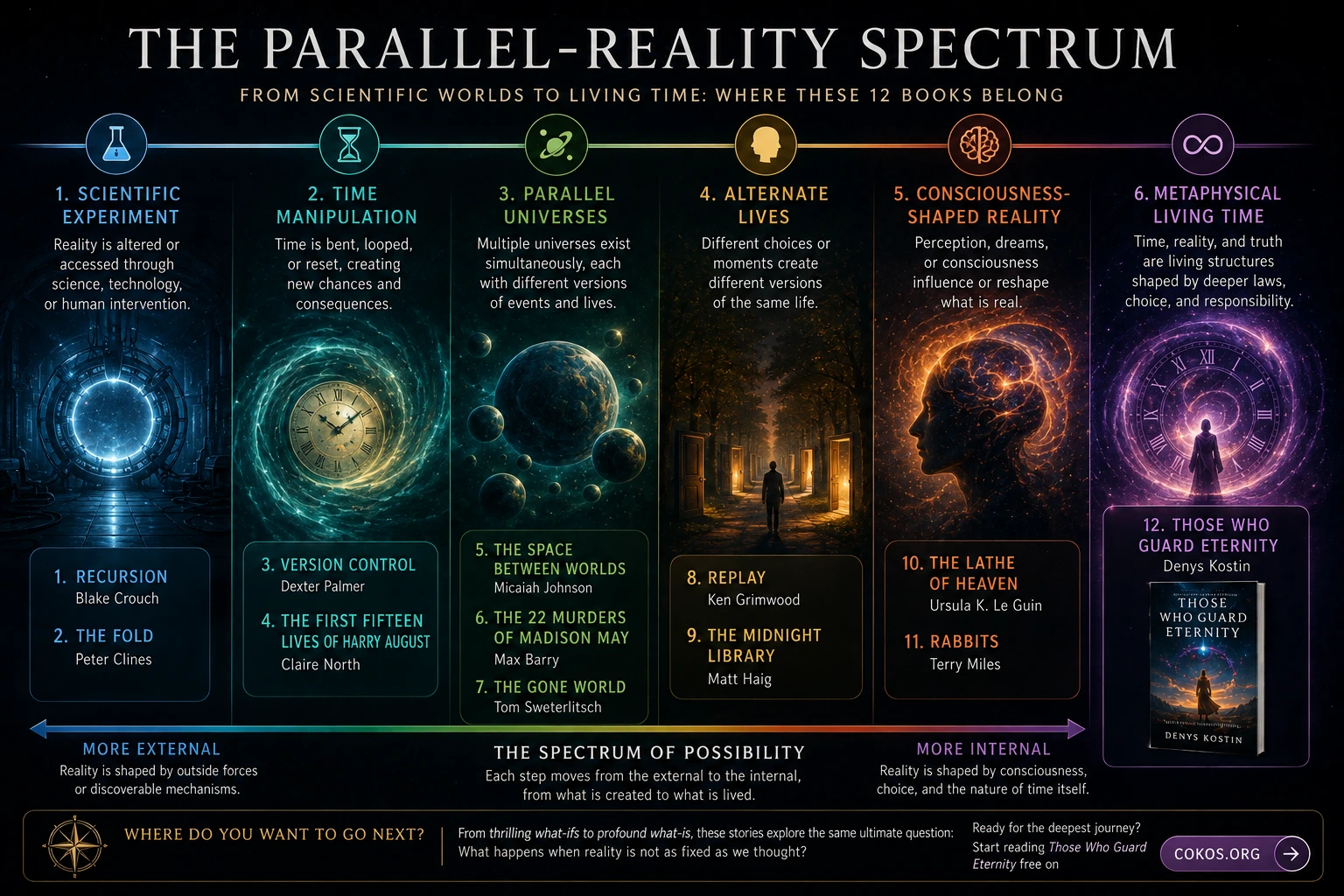
These recommendations move from the closest fast-paced matches toward slower, more philosophical alternatives. Each entry explains not only why the book belongs on the list, but also how it differs—so you can choose the experience you actually want next.
1. Recursion by Blake Crouch
Recursion is the most natural next choice because it preserves the qualities that make Dark Matter unusually accessible: a large speculative idea, immediate danger, emotional urgency, and a pace that keeps the concept moving through human lives rather than allowing it to become a lecture.
Its central territory is memory. As memories begin to undermine the stability of the present, the story asks whether reality can remain coherent when people remember lives that do not belong to the world around them. The premise expands quickly, but its force comes from the intimate damage caused when private history can no longer be trusted.
The difference is emphasis. Dark Matter makes branching possibility physical through alternate worlds; Recursion concentrates more heavily on memory as the architecture through which a life becomes real.
- Why it feels similar
- Blake Crouch’s rapid pacing, unstable reality, personal stakes, and escalating conceptual scale.
- How it differs
- Memory rather than parallel identity carries the central speculative pressure.
- Choose it if
- You want the safest recommendation and another thriller that turns an abstract idea into an emotional emergency.
2. The Gone World by Tom Sweterlitsch
The Gone World combines an investigation with possible futures and existential threat. Its speculative mechanism is not merely a device for visiting tomorrow; it creates uncertainty about which future matters, what information can be trusted, and whether catastrophe can be prevented when every glimpse of what comes next may be provisional.
Readers who loved the tension of being trapped inside a reality that keeps becoming more dangerous will find a strong match here. The book moves through mystery, science fiction, and horror-inflected territory, giving its alternate possibilities a colder and more ominous atmosphere than Dark Matter.
The emotional center is less romantic and more investigative. This is the recommendation for readers who want the reality puzzle to feel threatening on both a personal and world-ending scale.
- Why it feels similar
- Fast suspense, alternate possibilities, identity under pressure, and a concept that grows toward enormous consequences.
- How it differs
- Darker in tone, more procedural, and more willing to move toward cosmic dread.
- Choose it if
- You wanted Dark Matter to become even more unsettling.
3. The Fold by Peter Clines
The Fold begins with the appeal of a breakthrough: a technology that appears to make impossible movement possible. As the investigation deepens, the question changes from whether the invention works to whether everyone involved understands what it is actually doing.
That shift makes the novel a useful read-alike for Dark Matter. Both stories connect scientific ambition to doors that should perhaps never have been opened. Both also depend on the growing suspicion that the apparent explanation is too simple for the reality behind it.
The Fold is less focused on alternate versions of one life and more focused on discovery, anomaly, and the consequences of technological confidence. It is a strong choice for readers who loved the laboratory-thriller side of Crouch’s novel.
- Why it feels similar
- A scientific mystery, a portal-like premise, accelerating danger, and reality behaving differently than expected.
- How it differs
- More ensemble-driven and less centered on romantic or identity-based stakes.
- Choose it if
- You want another page-turner built around a dangerous breakthrough.
4. The Space Between Worlds by Micaiah Johnson
The Space Between Worlds moves directly into multiverse territory. Travel between parallel Earths creates access, power, danger, and a brutal way of measuring whose life matters. The existence of other versions of a person is not only a philosophical curiosity; it is built into the social and political structure of the story.
This makes the novel one of the strongest recommendations for readers who were most fascinated by the idea of meeting lives that unfolded under different conditions. It explores how privilege, survival, and identity change when worlds can be compared rather than merely imagined.
Compared with Dark Matter, the novel is more interested in systems and inequality. It broadens the multiverse from a private crisis into a structure that determines who can move, who is useful, and whose existence is treated as expendable.
- Why it feels similar
- Parallel worlds, alternate selves, danger created by world-crossing, and identity shaped by different possibilities.
- How it differs
- More political and socially expansive, with the multiverse embedded in questions of power.
- Choose it if
- You want the alternate-world premise to become a larger exploration of identity and inequality.
5. The 22 Murders of Madison May by Max Barry
This novel turns repetition across realities into a thriller. Different versions of Madison May exist in different worlds, yet danger follows the pattern from one reality to another. The result is a story about pursuit, recurrence, and the disturbing possibility that someone can become obsessed not with one person, but with the idea of that person across every world.
The connection to Dark Matter lies in movement through neighboring realities and in the instability created when one life is no longer unique. It also shares the momentum of a thriller, making it more immediately accessible than many literary multiverse novels.
Its emotional lens is different: rather than centering on the return to one chosen family, it examines violence, fixation, and the persistence of identity across worlds.
- Why it feels similar
- Parallel realities, recurring identities, chase energy, and the danger of crossing between worlds.
- How it differs
- More focused on pursuit and repeated victimhood than on regret or domestic love.
- Choose it if
- You want a multiverse premise that stays firmly inside thriller territory.
6. Replay by Ken Grimwood
Replay approaches alternate possibility without requiring simultaneous universes. Its power comes from repetition: a life can be lived again, and knowledge of what happened before can transform every decision that follows.
At first, repetition seems to offer control. Mistakes can be avoided. Opportunities can be anticipated. A person can pursue wealth, love, achievement, or freedom with an advantage no one else possesses. Yet the deeper question is whether optimization can create meaning—or whether a meaningful life requires uncertainty, commitment, and limits.
This makes Replay a strong recommendation for readers who cared most about the lives that might have existed behind each choice in Dark Matter. It is slower and more reflective, but emotionally close to the question at the heart of Crouch’s novel: would a different path truly make you a different person?
- Why it feels similar
- Alternate life paths, regret, relationships under changed conditions, and the search for the life worth choosing.
- How it differs
- Less thriller-driven and more interested in what repeated opportunity does to meaning.
- Choose it if
- You want the “what if?” question to unfold across an entire lifetime.
7. The First Fifteen Lives of Harry August by Claire North
Harry August returns to the beginning of his life while retaining the memory of what came before. That premise creates freedom, but it also creates responsibility. Knowledge can be accumulated across lives, relationships can be repeated or abandoned, and choices can affect not only one personal future but the shape of history.
Readers who enjoyed the meeting point between intimate identity and large-scale consequence in Dark Matter will find a powerful connection here. The novel asks what a self becomes when memory extends beyond one lifetime and when other people share a similar relationship with recurrence.
It is more structurally patient than Crouch’s thriller, but it still uses its idea to create conflict rather than treating immortality as a passive fantasy.
- Why it feels similar
- Multiple life possibilities, retained identity, escalating consequences, and the moral burden of exceptional knowledge.
- How it differs
- Built around recurring life rather than neighboring universes, with a broader historical canvas.
- Choose it if
- You want alternate-life fiction with stronger questions about responsibility and power.
8. The Midnight Library by Matt Haig
The Midnight Library explores the lives that might have followed from different decisions. Its alternate possibilities are less concerned with scientific explanation and more concerned with regret: the belief that somewhere beyond the present lies a version of life in which the right choices were made.
That makes it a thematic rather than tonal match for Dark Matter. Both novels ask whether the existence of alternatives makes the current life feel accidental or whether it reveals what the protagonist truly values. Both also test the fantasy that another path would have removed uncertainty and pain.
Readers seeking another tense science-fiction thriller may find it too gentle. Readers who were moved by the emotional question beneath the multiverse will find it much closer.
- Why it feels similar
- Alternate lives, regret, identity, and the search for the life that feels genuinely one’s own.
- How it differs
- Less scientific, less violent, and more openly focused on emotional healing.
- Choose it if
- You want the unlived-life theme without the intensity of a techno-thriller.
9. Version Control by Dexter Palmer
Version Control works through subtle dislocation rather than constant spectacle. Its world feels almost ordinary, yet details do not align cleanly. Time, technology, memory, and personal history create the sense that reality has shifted in ways that are difficult to name.
This quieter approach makes it especially useful for readers who loved the conceptual implications of Dark Matter but do not need another chase. The novel is attentive to the way speculative change enters a relationship: not only by creating another world, but by changing what two people remember, expect, and believe about the lives they share.
Its pace is slower and its structure more literary. The reward is a deeper examination of how personal reality depends on timing, interpretation, and the stories people tell about what happened.
- Why it feels similar
- Time, alternate possibility, intimate relationships, and a reality that feels subtly wrong.
- How it differs
- More gradual, less action-driven, and more interested in ambiguity.
- Choose it if
- You want the ideas of Dark Matter translated into literary and relational territory.
10. The Lathe of Heaven by Ursula K. Le Guin
In The Lathe of Heaven, dreams can alter the world. The premise moves beyond travel between existing realities and into the more unsettling question of whether consciousness can produce reality—and whether anyone should use that power deliberately.
The novel is a philosophical classic because each attempt to improve the world reveals the danger of turning an ideal into a universal design. A solution to one problem can erase something essential elsewhere. Reality cannot be managed without assumptions about what people need, what suffering means, and who has the authority to decide.
Compared with Dark Matter, the pace is slower and the inquiry more direct. Yet both books make the structure of reality inseparable from human desire.
- Why it feels similar
- Reality changes, identity becomes unstable, and personal desire acquires world-altering consequences.
- How it differs
- More philosophical, more compressed, and less dependent on thriller momentum.
- Choose it if
- You want to ask not only which reality is preferable, but who has the right to create it.
11. Rabbits by Terry Miles
Rabbits builds its reality-bending mystery around patterns, coincidences, rules, and a hidden competition whose boundaries are difficult to separate from ordinary life. The reader is pulled into the same uncertainty as the characters: is the world revealing a system, or is the search for a system changing how the world is perceived?
It resembles Dark Matter less through emotional structure and more through momentum and ontological unease. Both novels make reality feel navigable but dangerous, as though the correct sequence of actions might open a path that was invisible before.
This is the choice for readers who enjoy puzzles, conspiratorial atmosphere, and the feeling that reality contains an interface no one was supposed to find.
- Why it feels similar
- A fast mystery, unstable reality, hidden mechanisms, and escalating uncertainty.
- How it differs
- More puzzle-like and less centered on alternate family lives or romantic commitment.
- Choose it if
- You want to keep asking whether the pattern is real—or whether reality itself is the pattern.
12. Those Who Guard Eternity by Denys Kostin
Those Who Guard Eternity is not another rapid laboratory-based techno-thriller. Its connection to Dark Matter lies in the deeper territory beneath the suspense: unstable reality, identity, time, consciousness, truth, and the consequences of seeing possibilities that other people cannot see.
The novel begins the Eternity Saga, a philosophical fantasy in which time is not merely a neutral line and reality is not merely a passive container. The central concern is responsibility: what happens when the structure that makes human choice possible must itself be protected?
Readers who want the closest pacing match should begin with Recursion. Readers who want to continue moving from alternate worlds toward a larger inquiry into living time, hidden structures, and the moral weight of choice may find this the most distinctive next step.
Disclosure: Those Who Guard Eternity, Cokos.org, and Eternity Management were created by Denys Kostin, the author of this guide. The book is included because of its thematic connection, and that relationship is stated openly.
- Why it feels similar
- Reality is unstable, choice shapes consequence, and identity exists within structures larger than one visible world.
- How it differs
- Philosophical fantasy rather than a scientific thriller, with greater emphasis on time, truth, and responsibility.
- Choose it if
- You want the reality question to expand beyond “Which world?” into “What is reality, and who must guard what it can become?”
Which Book Should You Read Next?
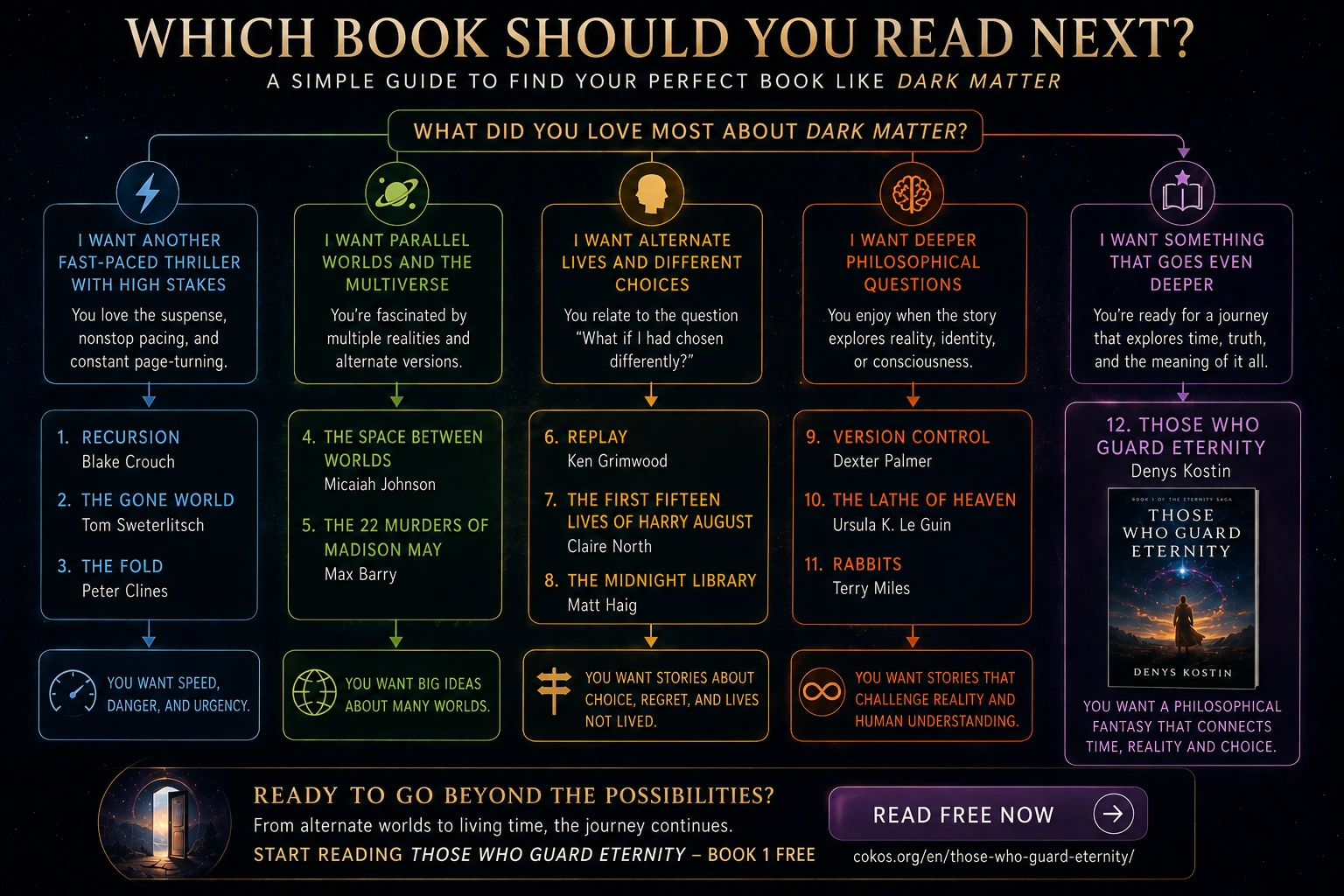
The list becomes easier to navigate when you identify the element you want to preserve from Dark Matter. A reader seeking another breathless thriller needs a different recommendation from a reader who wants to think longer about regret or consciousness.
For the closest fast-paced experience
Choose Recursion, The Gone World, or The Fold. These books keep the speculative concept under pressure through investigation, danger, and escalating consequences.
For parallel worlds and alternate identities
Choose The Space Between Worlds or The 22 Murders of Madison May. Both treat movement between realities as more than a theoretical possibility; it becomes a structure that changes identity and survival.
For alternate lives, regret, and different choices
Choose Replay, The First Fifteen Lives of Harry August, or The Midnight Library. These novels ask whether a life becomes better when it can be revised, repeated, or compared with lives not lived.
For deeper philosophical questions
Choose Version Control, The Lathe of Heaven, or Rabbits. Their approaches differ, but each destabilizes the assumption that reality is simply a fixed external world.
For a journey into living time and responsibility
Choose Those Who Guard Eternity. It moves from the existence of alternate possibilities toward the question of what makes reality possible—and what responsibilities emerge when time, truth, and choice are connected.
From Alternate Worlds to a Deeper Question About Reality
At first, the multiverse appears to be a question of quantity: how many worlds could exist? Yet the most memorable stories eventually become questions of quality. What makes one world matter? What makes one relationship real? What makes one choice belong to the self rather than to another possible version?
This is where books about parallel universes connect naturally to books about reality, books about consciousness, and books about identity. The alternate world is not only elsewhere. It becomes a method for seeing the current world more clearly.
The movement can be described as a progression:
- An alternate world reveals that reality could be different.
- An alternate self reveals that identity could be different.
- Different memories reveal that the past is part of what makes a world real.
- Commitment reveals that possibility alone cannot choose a life.
- Responsibility reveals that the power to change reality is not the same as the wisdom to shape it.
That final step is the bridge from a multiverse thriller into philosophical fantasy. It is also the territory explored by the Eternity Saga: reality as something connected to time, choice, consciousness, and responsibility.
Frequently Asked Questions About Books Like Dark Matter
What is the closest book to Dark Matter?
Recursion is the closest overall recommendation because it combines Blake Crouch’s fast pacing with unstable reality, emotional urgency, and a speculative idea that grows from a personal crisis into a much larger threat. The mechanism is different—memory rather than parallel identity—but the reading experience is the most similar.
What should I read after Dark Matter?
Read Recursion for the closest thriller, The Space Between Worlds for a multiverse story, The Gone World for a darker mystery, Replay for alternate lives, The Lathe of Heaven for philosophical science fiction, or Those Who Guard Eternity for a deeper exploration of living time and reality.
Is Recursion similar to Dark Matter?
Yes. Both are fast speculative thrillers by Blake Crouch, both make reality unstable, and both connect a large scientific idea to intimate emotional stakes. Recursion focuses more on memory, while Dark Matter focuses more on alternate worlds and alternate versions of the self.
What books are about parallel universes?
The Space Between Worlds, The 22 Murders of Madison May, Dark Matter, and parts of the reality-bending territory explored by The Fold are strong choices. Some alternate-life novels, including Replay and The Midnight Library, approach similar questions without using the same scientific multiverse structure.
Are there books like Dark Matter about alternate lives?
Yes. Replay, The First Fifteen Lives of Harry August, and The Midnight Library all explore different versions, repetitions, or possibilities of one life. They are generally more reflective and less focused on laboratory-based science than Dark Matter.
Which books like Dark Matter are more philosophical?
The Lathe of Heaven, Version Control, Replay, and Those Who Guard Eternity place greater emphasis on questions about reality, consciousness, identity, time, meaning, and responsibility. They may move more slowly, but they extend the ideas beyond the immediate thriller plot.
Is The Midnight Library similar to Dark Matter?
It is thematically similar but tonally different. Both explore alternate lives, regret, and the significance of choosing one path. The Midnight Library is gentler, less scientific, and more focused on emotional reflection than suspense.
Is Those Who Guard Eternity similar to Dark Matter?
It shares themes of unstable reality, identity, time, consciousness, and consequential choice, but it is not a close pacing or genre match. Those Who Guard Eternity is philosophical fantasy rather than a techno-thriller. It is best for readers who want the reality question to become deeper and more metaphysical.
What are the best mind-bending science-fiction thrillers?
For readers who prioritize speed and conceptual suspense, begin with Recursion, The Gone World, The Fold, The 22 Murders of Madison May, and Rabbits. Each uses a different mechanism, but all create tension by making the ordinary rules of reality unreliable.
Are these recommendations spoiler-free?
The guide is spoiler-light. It discusses each book’s central premise, tone, and thematic connection to Dark Matter, but avoids revealing major solutions, endings, and late-story reversals.
Related Reading
- Books Like Dune: Epic Science Fiction and Philosophical Novels
- Philosophical Fantasy Books
- Books About Reality
- Books About Consciousness
- Books About Identity
- Books About Time
- Books About Choice
- Books About Memory
Final Thoughts
Finding books like Dark Matter is not only a search for another multiverse. It is a search for stories in which an idea becomes personal—where reality changes, identity loses its certainty, and one choice must be made among possibilities that all feel real.
Choose Recursion for the closest combination of speed and conceptual scale. Choose The Space Between Worlds for parallel universes, Replay for unlived lives, The Gone World for darkness, and The Lathe of Heaven for philosophical depth.
Then, when the question changes from “Which world would I choose?” to “What makes any world real—and what responsibility follows from the power to shape it?” continue into Those Who Guard Eternity.