Why Immortality Might Be Worse Than Death
Humanity has spent thousands of years searching for eternal life. But what if living forever creates problems that mortality naturally prevents?
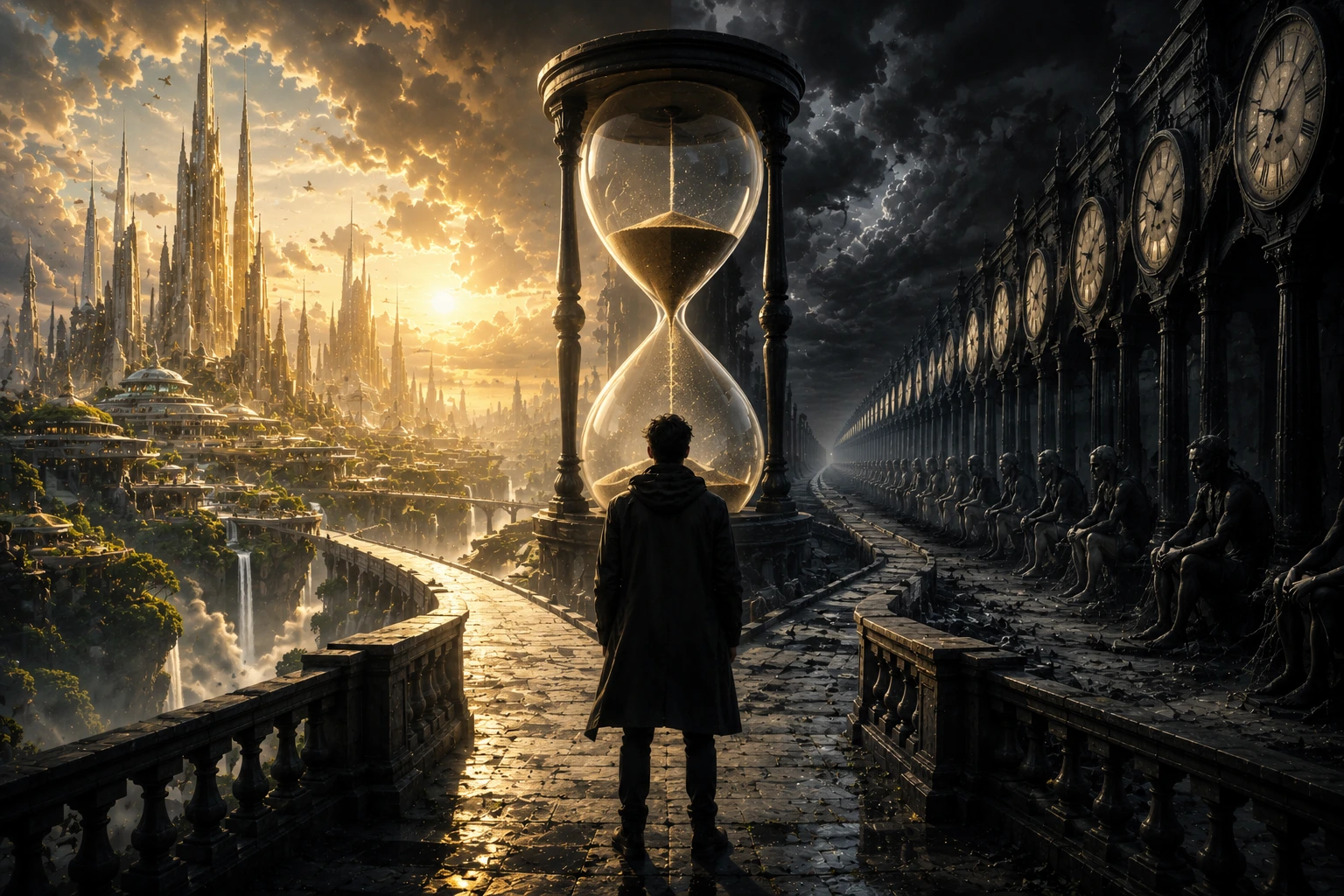
Immortality may eliminate death. But would it eliminate suffering, boredom, regret, and the search for meaning?
In this article:
- Why humans desire immortality
- Would immortality be a curse?
- The biggest problems with immortality
- Would living forever become boring?
- Why mortality may create meaning
- The psychological burden of endless existence
- Immortality and the future of humanity
Why Might Immortality Be Worse Than Death?
Immortality might be worse than death because endless life could create psychological, emotional, and philosophical problems that mortality naturally limits.
Many thinkers throughout history have suggested that living forever may eventually lead to boredom, emotional exhaustion, loss of urgency, weakened motivation, and the burden of carrying existence indefinitely.
At first glance, immortality seems like the perfect solution.
No aging.
No death.
No final goodbye.
No running out of time.
Yet the deeper we examine the idea, the more complicated it becomes.
Would living forever actually make people happier?
Would relationships still feel meaningful?
Would achievement still matter?
Would civilization continue evolving?
Would purpose survive eternity?
This question has fascinated philosophers, theologians, scientists, and science fiction writers for centuries.
And it remains one of the most important questions about the future of humanity.
What Are the Biggest Problems With Immortality?
Most discussions about immortality focus on what humanity gains.
Far fewer discuss what humanity may lose.
Many philosophical arguments against immortality focus on the following potential problems:
- Endless boredom
- Loss of urgency
- Psychological exhaustion
- Emotional detachment
- Infinite accumulation of regret
- Loss of meaning
- Civilizational stagnation
- The burden of endless responsibility
These concerns appear repeatedly because immortality is not simply a biological question.
It is a question about meaning.
It is a question about identity.
It is a question about human nature itself.
Would Immortality Be a Curse?
Stories about immortality often divide into two categories.
Some portray immortality as humanity’s ultimate achievement.
Others portray immortality as a curse.
The difference usually depends on one factor.
Meaning.
If endless life preserves meaning, immortality appears attractive.
If endless life gradually destroys meaning, immortality becomes frightening.
This is why so many philosophical stories eventually arrive at the same question.
To answer that question, we first need to understand why humans have desired eternal life throughout history.
Why Humans Desire Immortality
The dream of immortality is older than civilization itself.
Ancient kings searched for it.
Religions promised versions of it.
Alchemists pursued it.
Scientists continue exploring ways to extend human lifespan beyond anything previously imagined.
The attraction is obvious.
Death appears to take away everything people value.
- Relationships
- Knowledge
- Experiences
- Dreams
- Identity
- Possibility
Immortality appears to remove that limitation.
If life is valuable, why should it end?
If learning matters, why stop learning?
If love matters, why lose the people we care about?
The promise of immortality feels compelling because it seems to offer everything humans want while eliminating everything they fear.
The Ancient Dream of Eternal Life
Few ideas have appeared more consistently throughout human history than the dream of eternal life.
Cultures separated by oceans, languages, and centuries often imagined remarkably similar possibilities.
A way to escape death.
A way to continue existing.
A way to avoid the final boundary every human eventually encounters.
The ancient Mesopotamian Epic of Gilgamesh explored humanity’s search for immortality thousands of years ago.
Legends spoke of magical springs, sacred fruits, divine gifts, hidden realms, and secret knowledge capable of extending life indefinitely.
The details changed.
The desire remained the same.
Human beings wanted more time.
But perhaps the deeper desire was not time itself.
Perhaps it was permanence.
The hope that something meaningful could survive the constant movement of change.
The hope that loss could be defeated.
The hope that existence could become secure.
Yet permanence creates questions that mortality never has to answer.
What Would Happen If Death Disappeared?
Imagine waking up tomorrow and discovering that death no longer exists.
No aging.
No natural decline.
No final farewell.
No biological endpoint.
At first this sounds like humanity’s greatest achievement.
Millions of lives would be saved.
Families would stay together longer.
Knowledge would accumulate across centuries.
The fear of mortality would seem to disappear.
But removing death changes far more than lifespan.
It changes the structure of civilization itself.
Every major human system evolved under the assumption that life is limited.
- Education
- Careers
- Families
- Governments
- Inheritance
- Leadership
- Generational renewal
If nobody dies, entirely new questions emerge.
Who remains in power?
Who receives opportunities?
How does society renew itself?
What happens when the same individuals influence the world for centuries?
Death may be painful.
But it also creates space for renewal.
Without endings, beginnings become increasingly rare.
Would Living Forever Become Boring?
This is one of the most common objections to immortality.
And one of the most difficult to answer.
Supporters of immortality often argue that the universe contains endless possibilities.
There will always be new places to explore.
New knowledge to discover.
New experiences to pursue.
New civilizations to build.
That argument may be true.
But boredom is not caused by a lack of available experiences.
Boredom is often caused by familiarity.
An immortal individual may eventually witness thousands of years of history.
Read millions of books.
Master countless skills.
Travel across worlds.
Observe the rise and fall of entire civilizations.
And eventually a troubling question appears.
What happens when surprise becomes rare?
What happens when everything begins to resemble something already experienced?
This possibility appears repeatedly throughout immortality philosophy because novelty is deeply connected to motivation.
Curiosity drives engagement.
Engagement drives meaning.
Without genuine curiosity, existence may begin to feel repetitive regardless of its length.
Would Relationships Still Matter Forever?
Relationships are often used as an argument in favor of immortality.
People imagine keeping loved ones forever.
Never losing family.
Never losing friends.
Never saying goodbye.
Yet immortality introduces a difficult question.
What gives relationships value?
Part of their significance comes from their fragility.
People matter because they are not guaranteed.
Moments matter because they cannot be repeated exactly.
Time together matters because time itself is limited.
If time becomes infinite, the emotional structure of relationships may change.
Urgency disappears.
Scarcity disappears.
The assumption that every moment matters may weaken.
This does not necessarily mean relationships become meaningless.
But it does suggest they may become fundamentally different.
And different in ways humanity has never experienced before.
Would Achievement Still Have Meaning?
Many human accomplishments are powered by limitation.
People create because time is limited.
People pursue goals because opportunities are finite.
People focus because life is short.
Imagine removing that limitation.
If there is always another century available, urgency begins to disappear.
If there is always tomorrow, the value of today may begin to decline.
Many goals derive their emotional impact from difficulty and scarcity.
The possibility of failure creates tension.
The possibility of loss creates significance.
The possibility of running out of time creates focus.
Immortality changes all three.
The danger is not that achievement becomes impossible.
The danger is that achievement becomes ordinary.
And ordinary achievements rarely create lasting meaning.
The Psychological Burden of Endless Existence
Most people think about immortality biologically.
Few think about it psychologically.
Living forever is not simply a longer version of ordinary life.
It is an entirely different psychological reality.
An immortal individual would accumulate memories beyond anything human beings currently experience.
Relationships would multiply.
Losses would accumulate.
Regrets would remain.
Responsibilities would expand.
History itself would become personal memory.
What happens when a mind carries centuries of experience?
What happens after millennia?
What happens after ten thousand years?
The challenge is no longer survival.
The challenge becomes endurance.
And this is where the discussion becomes much darker.
Because the greatest threat to an immortal life may not be death.
It may be exhaustion.
Emotional Exhaustion Across Endless Time
Human beings are accustomed to thinking in years.
Perhaps decades.
Sometimes generations.
Immortality introduces a completely different scale.
Centuries.
Millennia.
Eras.
The emotional consequences of such timescales are difficult to imagine because no human mind has ever experienced them.
Every meaningful relationship eventually leaves a mark.
Every disappointment leaves a memory.
Every failure leaves a lesson.
Every loss leaves an absence.
Mortality naturally limits how much emotional weight a person carries.
Immortality removes that limit.
An immortal individual might eventually accumulate thousands of losses.
Thousands of regrets.
Thousands of unfinished stories.
The challenge would no longer be surviving hardship.
The challenge would be continuing to care after experiencing hardship repeatedly for centuries.
The Problem of Infinite Regret
One of the hidden assumptions behind immortality is that more time automatically solves mistakes.
But mistakes do not disappear simply because time continues.
In some cases, they become heavier.
A person who lives for eighty years may carry regrets for decades.
An immortal person may carry them for thousands of years.
Some wounds heal.
Others remain.
Some choices cannot be undone.
Some consequences cannot be reversed.
Immortality does not erase history.
It extends exposure to history.
The longer a life becomes, the larger the archive of memory grows.
And memory is not always a gift.
Sometimes memory becomes a burden.
Sometimes it becomes a prison.
Sometimes it becomes impossible to put down.
Why Limitations Create Meaning
Humans often view limitations as problems.
Yet many of the most meaningful aspects of life emerge directly from limitation.
A rare opportunity feels valuable because it may never return.
A conversation feels meaningful because it cannot be repeated exactly.
A human life feels precious because it is finite.
Scarcity creates value.
Boundaries create focus.
Endings create appreciation.
This principle appears throughout human experience.
Without limitation, prioritization becomes difficult.
Without prioritization, meaning becomes diffuse.
Without meaning, existence risks becoming directionless.
The uncomfortable possibility is that mortality contributes to significance.
Not because death is desirable.
But because limitation creates structure.
When Eternity Becomes a Prison
Most fantasies describe immortality as freedom.
Freedom from aging.
Freedom from death.
Freedom from biological limitation.
Yet endless existence introduces another possibility.
What if eternity becomes confinement?
An immortal being cannot escape time.
It experiences more of it.
Every century adds more memory.
Every millennium adds more responsibility.
Every era adds more history.
At some point, immortality may stop feeling like liberation.
It may begin feeling like obligation.
The obligation to continue.
The obligation to remember.
The obligation to endure.
The obligation to find meaning again and again and again.
This is why many philosophical stories portray immortality not as paradise but as burden.
The burden is not endless life.
The burden is endless continuation.
Would Human Identity Survive Forever?
Another rarely discussed question concerns identity itself.
If a person lives for ten thousand years, are they still the same person?
Human identity changes even across a few decades.
Values change.
Beliefs change.
Goals change.
Memories fade.
Perspectives evolve.
An immortal individual may experience transformations so extensive that continuity becomes difficult to define.
The person who began the journey might eventually become unrecognizable.
Immortality therefore raises a profound philosophical question.
If identity changes endlessly, who exactly becomes immortal?
The original person?
Or an endless sequence of different versions?
The answer is not obvious.
And that uncertainty sits at the heart of immortality philosophy.
Why Mortality May Be Necessary for Significance
Many people assume significance would increase if life lasted forever.
The opposite may be true.
Significance often emerges because choices are limited.
Time is limited.
Opportunities are limited.
Attention is limited.
These limitations force prioritization.
Prioritization creates meaning.
Meaning creates purpose.
An immortal existence may weaken this process.
If everything can be done eventually, deciding what matters becomes harder.
If every opportunity remains available indefinitely, urgency disappears.
If urgency disappears, purpose may begin to erode.
The result is one of the central paradoxes of immortality.
This does not prove immortality would be worse than death.
But it does explain why the question remains so difficult.
Immortality is not merely about survival.
It is about meaning.
And meaning may be far more fragile than life itself.
Immortality and the Future of Humanity
The question of immortality is ultimately a question about the future of humanity.
Technology continues advancing.
Medicine continues extending lifespan.
Artificial intelligence continues accelerating scientific discovery.
What appears impossible today may become achievable tomorrow.
This means immortality is no longer merely a philosophical thought experiment.
It is becoming a practical question.
If humanity eventually gains the ability to extend life indefinitely, society will face challenges unlike anything in history.
Political power could become concentrated for centuries.
Economic systems would need to change.
Generational renewal would slow dramatically.
The balance between stability and innovation would shift.
Some consequences may be positive.
Others may be dangerous.
The future of humanity depends not only on what technologies become possible.
It depends on whether humanity can use those technologies wisely.
Death vs Immortality
People often frame the discussion as a simple choice.
Death or immortality.
Ending or continuation.
Limitation or endless existence.
Yet reality is more complicated.
Death creates suffering.
Immortality may create burdens.
Mortality creates urgency.
Immortality may create indifference.
Death limits possibilities.
Immortality may dilute significance.
The question is not which option is perfect.
The question is which set of consequences creates a more meaningful life.
Time, Meaning, and Eternity
Every meaningful human experience exists within time.
Friendships require time.
Knowledge requires time.
Growth requires time.
Love requires time.
Meaning itself unfolds through time.
This creates one of the central paradoxes of immortality.
People often dream of escaping time.
Yet many of the things they value exist because time is limited.
A finite life creates urgency.
Urgency creates focus.
Focus creates purpose.
An immortal existence changes this entire structure.
Tomorrow becomes almost infinite.
The present may become less important.
And meaning may require entirely new foundations.
How Eternity Management Explores Immortality
The Eternity Management universe was built around questions that emerge when humanity encounters concepts larger than individual lives.
Time.
Memory.
Choice.
Destiny.
Responsibility.
Eternity.
The central question is not whether existence can continue forever.
The deeper question is whether meaning can survive across vast scales of time.
If civilizations endure for ages, what becomes worth protecting?
If memory accumulates endlessly, what remains important?
If individuals influence the future across centuries, what responsibilities follow?
Immortality is one expression of these questions.
But the deeper subject is humanity’s relationship with time itself.
Final Thoughts: Why Immortality Might Be Worse Than Death
For thousands of years, immortality has been humanity’s dream.
The dream of defeating death.
The dream of escaping limitation.
The dream of having more time.
Yet immortality may not simply remove problems.
It may create new ones.
Endless boredom.
Infinite regret.
Emotional exhaustion.
Loss of urgency.
Loss of meaning.
The challenge is not merely surviving forever.
The challenge is remaining fully alive forever.
This is why immortality remains one of the most fascinating questions in philosophy, science fiction, psychology, and discussions about the future of humanity.
Not because immortality is impossible.
But because immortality forces us to confront a deeper mystery.
What actually makes life worth living?
Until that question is answered, immortality will remain both a dream and a warning.
Frequently Asked Questions
Why might immortality be worse than death?
Immortality could create psychological challenges such as boredom, loss of motivation, emotional exhaustion, weakened purpose, and the burden of existing indefinitely.
Would living forever become boring?
Many philosophers argue that endless existence could eventually reduce novelty and surprise, making it difficult to maintain curiosity and engagement.
Would immortality be a curse?
Some philosophical traditions and science fiction stories portray immortality as a curse because eternal existence may create burdens that mortality naturally limits.
What are the biggest problems with immortality?
Potential problems include boredom, loss of urgency, emotional exhaustion, stagnation, infinite regret, and difficulty maintaining meaning over vast periods of time.
Would relationships still matter if people lived forever?
Relationships would likely continue to matter, but their emotional structure could change because scarcity and limited time contribute significantly to their perceived value.
Why does death give life meaning?
Many philosophers believe mortality creates urgency, focus, appreciation, and prioritization, all of which contribute to a meaningful life.
Could humans psychologically adapt to immortality?
No one knows. Human psychology evolved under conditions of mortality, so truly endless existence could create challenges humans have never experienced.
How would immortality affect civilization?
Immortality could transform leadership, economics, education, innovation, and generational renewal, potentially creating both opportunities and risks.
Is immortality a common theme in philosophical science fiction?
Yes. Immortality is one of the most important themes in philosophical science fiction because it raises questions about identity, meaning, time, memory, and human nature.
What is the difference between immortality and eternity?
Immortality refers to endless life, while eternity refers to limitless time. Philosophical fiction often explores the tension between the two concepts.